Here’s another recipe that can, be part of a home-made Christmas, either for nibbling at home or prettily wrapped in cellophane as a gift, or indeed any suitable gift-giving time.
It can also be customised in a number of ways, as I shall detail below, be it in the ingredients you choose or the finishing touches you employ.
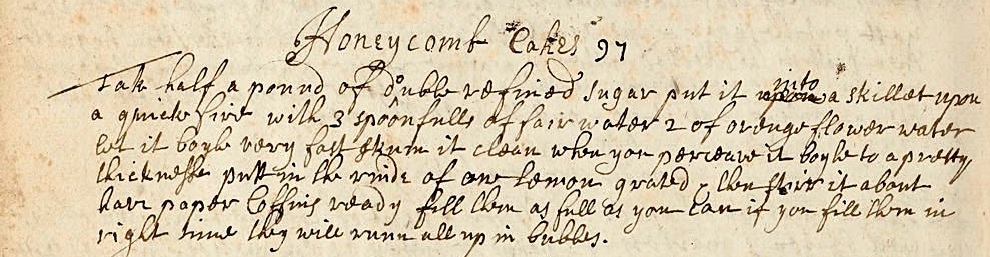
Cinder toffee is a traditional UK sweetie recipe which has been around for centuries, and early recipes can be found in household manuscript books from the reign of Charles II. Recently, it has seen a return to popularity under the name Honeycomb Toffee. Whilst a more appetising name, perhaps, unless you actually make it with honey, it is, to my mind, a bit misleading, whereas you have only to glance at the Wikipedia page for cinder to see that the appropriateness is evident in both looks and definition.
The toffee is made by bringing a mixture of sugars to the Hard Crack stage and then quickly stirring in a small amount of bicarbonate of soda to produce effervescence. The mixture is then poured into a suitably prepared tin and as it cools, the air bubbles are trapped in the sugar, thus giving it its distinctive structure.
Having read numerous recipes online, it is fairly safe to say that the most popular combination of sugars is caster sugar and golden syrup. This gives a bright, golden toffee reminiscent of the insides of a modern Crunchie bar. Whilst delicious, the flavour is, however, very one-note, and extremely sweet, and I got to pondering how it might be improved.
I found a recipe in F.Marian McNeil’s The Scots Kitchen (1929) for Black Man, a version of cinder toffee made with treacle, and kin to the Yellow Man of Northern Ireland. Made solely with treacle and bicarbonate of soda, it would definitely have the dark, bubbled appearance of genuine cinders, however in experimentation, the treacle proved exceedingly bitter as well as being much too easily burnt.
I liked the idea of using more complex flavourings to make the toffee and so I have come up with a base recipe for cinder toffee, with suggestions of how to adjust it for variety and interest. By varying the sugars and syrups, the range of flavours can be quite extensive and with more time at my disposal, I believe similar subtleties could also be achieved using honey as the liquid sugar. Feel free to experiment yourself!
Base Recipe Components
Choose your main flavouring from either the solid sugars or the liquid sugars. For example, malt extract and caster sugar, Demerera sugar and golden syrup. Both together, e.g. treacle and dark muscovado, is too dark and will burn to bitterness.
- Solid sugar: This can range from fine, white, caster sugar, granulated sugar, soft light brown, soft dark brown, Demerera, light muscovado, dark muscovado all the way through to molasses sugar. The varying degrees of colour have a bearing on the eventual flavour which becomes richer and more caramelised the darker you go.
- Liquid sugar: Any sweet syrup liquid at room temperature can be used including golden syrup, molasses, maple syrup, treacle, agave nectar, malt extract, honey.
- Butter – for richness
- water – to help dissolve the sugar
- cream of tartar/liquid glucose – to help prevent crystallisation
- bicarbonate of soda – for the bubbles! This recipe only uses a teaspoon, which, if properly stirred through, is more than enough to produce sufficient bubbles. Using more will produce more vigorous frothing, however, it will also become more noticeable in the flavour of the toffee, as well as being trickier to stir through without clumping.
Presentation Suggestions
- Plain: Cinder toffee is delicious in it’s simple, unadorned state, but will absorb moisture from the air if left exposed. Once cooled, it should be stored in an airtight box or ziplock bag to keep from becoming sticky.
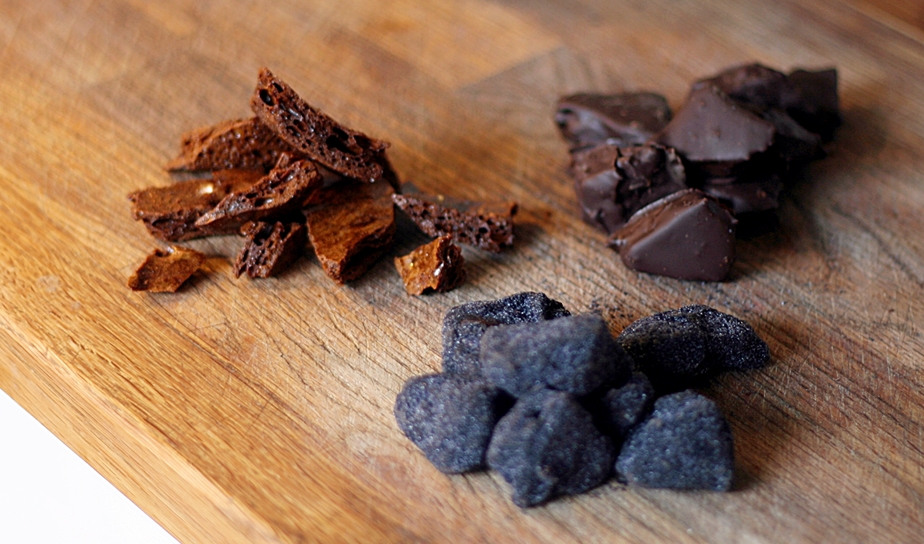
- Dipped in chocolate: To keep the toffee crisp without the need for airtight storage, you can dip pieces in melted chocolate and set aside to cool. Although this will serve admirably, it will have a tendency to melt in the hand. The solution is to temper the chocolate, instructions for which abound on the internet. Whilst milk chocolate is the most popular pairing, you can experiment with a whole range of flavours from white through to the extremely dark. The sweetness of the cinder toffee made with caster sugar and golden syrup can be offset to a certain extent by dipping in dark (at least 60% cocoa) chocolate, not to mention the very pleasing contrast of the golden toffee against the dark chocolate. Similarly, the bitterness of treacle cinder toffee can be lightened by the use of white chocolate flavoured with lemon zest.
- Made into cinder coal: This is the most fun. By tossing the chocolate-coated cinder toffee pieces into some black caster sugar, they immediately become, to all intents and purposes, little pieces of sweet coal, and thus the embodiment of their name.
How to make black sugar
The intense colour provided by modern gel food colouring is ideal for creating vibrant coloured sugar. Although we’ll only be using black the principal is the same for making any shade of coloured sugar.
1tsp black food gel colouring
200g caster sugar.
- Pour the sugar into a small zip-lock bag and add the food colouring gel.
- Seal the bag and gently massage the sugar against the gel. It will gradually take on an intense colour whilst still remaining separate grains.
- Continue massaging the sugar until it is evenly coloured throughout. If the shade is too light, add a little more gel and repeat the massaging motion.
- The coloured sugar will keep in the ziplock bag for weeks.
Cinder Toffee
110g caster sugar
110g treacle
30g unsalted butter
2tbs cold water
1 pinch cream of tartar or 1/2tsp glucose
1tsp bicarbonate of soda
- Line a roasting tin with parchment paper.
- Put all of the ingredients except the bicarbonate of soda into a non-stick saucepan and warm gently until the sugar has dissolved.
- Increase the heat until the sugars boil. Continue heating without stirring until the syrup registers 150°C on a thermometer.
- Tip in the bicarbonate of soda and mix briskly for 5 seconds, ensuring the powder is well incorporated.
- Pour the frothing mixture onto the baking parchment in the tin and leave to cool. You can speed this up (and thereby trap more bubbles in the toffee) by putting it into the freezer for 15 minutes.
- When completely cold, tap gently to break into bite-sized pieces.
To cover with chocolate
- Melt or temper 200g of your chocolate of choice.
- Drop pieces of cinder toffee into the melted chocolate and use a fork to lift them out.
- Tap the fork briskly on the side of the chocolate bowl in order to shake off excess chocolate.
- Lay the coated pieces on parchment paper to set.
- Store in an airtight container.
To make cinder toffee coal
- Whilst still wet, drop the chocolate coated pieces into the black sugar and toss to coat.
- Lift out the coated pieces and lay onto a wire rack until set.
- When completely cold, toss the pieces of coal gently in a wire sieve to remove excess sugar.
- Store in a ziplock bag or wrap in cellophane bags for presents.