Bacon and Egg Pies

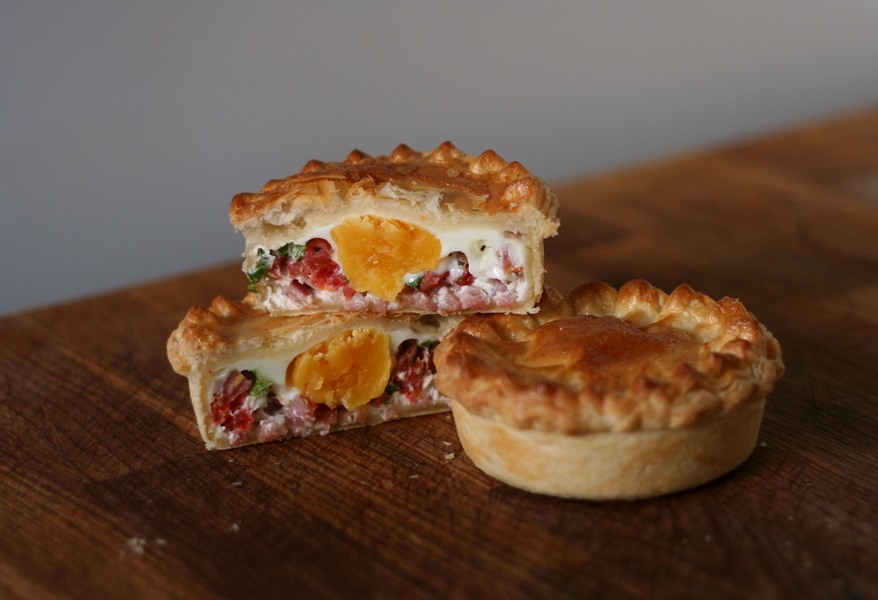
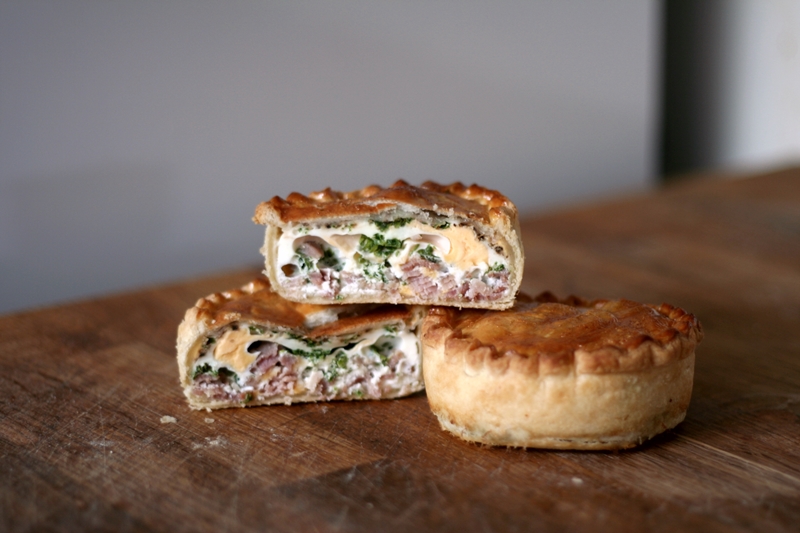
Sometimes the best-tasting food is also the simplest. This recipe was yet another from one of my many dusty W.I.pamphlets from the mid 20th century. It was so brief it barely qualified as a paragraph, let alone a recipe, so I’ve added some detail below to help things along. In essence, you can count the number of ingredients in this pie on one hand: pastry, egg, bacon, seasoning. The pie in the picture above also contains diced tomato, which I thought would add freshness; it did to a certain extent, but not to the degree I was hoping, and in fact, the ‘plain’ bacon and egg pie was tastier. Alas, my cross-section photo for this pie (see below) wasn’t as visually arresting as the one above, so I decided to lure you with the picture above, then set the record straight. You can choose whichever version appeals most.
Bacon and Egg Pie
Also, I’ve mentioned them before, but I just LOVE my small cake/tart tins I found at my local The Range (4 x 10cm diameter pans for £2.50). They have a small lip on the side, which makes them great for tarts or, in this case, for firmly attaching the pastry lids of pies. This is not a paid endorsement – I just think they are a bargain and am sharing.

You can be as pro-active or as lazy as you like with these pies – make everything from scratch or buy it in if you’re pressed for time. Personally, I like to hover, metaphorically, between the two: make the pastry for the base, but buy a sheet of ready rolled puff pastry for the top, on account of life too short etc. The cornflour shortcrust is dry and crisp, and the buttery, flaky, puff pastry is both delicious and a fantastic contrast. Once the pans are lined, sprinkle over a little cooked bacon, crack in a whole egg and add the lid and you’re done!

OK, yes, you should add a sprinkling of fresh parsley too.

And pepper. Of course pepper.

Well OBVIOUSLY crimping the edges is a good idea.

And it goes without saying that egg-yolk wash will give both colour and shine.

I’ll come in again.

AMONGST OUR WEAPONRY are such diverse elements as….

Oops! Wrong sketch.[1]

Once the pans are lined, sprinkle over a little cooked bacon and some fresh parsley, season with black pepper, crack in a whole egg, a little more parsley and pepper, add the lid, crimp the pastry edges, wash over with beaten egg and you’re DONE!

The quantities are up to you and however many you’re catering for. The suggestions below are for 4 individual pies. Any excess pastry, of either sort, can be frozen for later, as can the cooked pies, for up to a month.

Bacon and Egg Pies

1 batch cornflour shortcrust – scroll down on this page
1 sheet of puff pastry
100g lean bacon
4 large eggs
4-6 tablespoons of chopped, fresh parsley
coarse-ground black pepper
4 tomatoes – skinned, de-seeded and diced finely – optional

1 large yolk – for glazing

  • Pre-heat the oven to 200°C/180°C Fan.
  • Roll out the shortcrust pastry to a thickness of 5mm.
  • Grease and line your tart tins with the shortcrust pastry, making sure to ease the pastry into the bottom edge of the pan, not stretch it. Leave excess pastry hanging over the sides of the tin and chill in the fridge until required.
  • Chop the bacon into small dice and cook until just done. No browning. Drain on kitchen roll.
  • Remove pies from fridge.
  • Scatter the bacon in the bottom of the pies.
  • Add a sprinkling of chopped parsley and a little back pepper. No need for salt, as the bacon is salty enough. Add the tomatoes if using.
  • Crack an egg into each pie. If you want the yolk to be dead centre, you could clear a space amongst the bacon, but it’s not really necessary.
  • Add more parsley and black pepper.
  • Cut four squares of puff pastry, large enough to cover the pies.
  • Brush the rims of the pies with water then lay over the puff pastry squares.
  • Press firmly around the edges, then trim the excess pastry with a sharp knife.
  • Crimp the edges of the pies for a decorative effect.
  • Whisk the yolk with a tablespoon of water and brush the pie tops liberally.
  • Cut three or four small vent holes, NOT in the middle – you don’t want to break the yolk inside.
  • Bake for 15-20 minutes until the top is puffed and golden and the underside crisp.
  • Enjoy hot, warm or cold.

[1] NOBODY expects the Spanish Inquisition! Least of all my husband who read all of the above with a blank expression then said “I don’t get it.” *sigh*

Radnor Cranberry Tart

If you have an extended social life in the run-up to Christmas, and sample nothing but mince pies throughout December, by the time you get to the 25th, what with the Christmas Cake and Christmas Pudding, you can be all mince-pied out.

Also, sometimes you find yourself fancying something a little savoury at the end of a meal, and this is why this recipe is perfect. It’s simple and straightforward – just two main ingredients of fresh cranberries and juicy raisins. The raisins take the edge off the sometimes eye-popping sharpness of the cranberries and the little dash of vanilla also gives the aroma of sweetness, so only the merest sprinkle of sugar is required. It’s festively reminiscent enough of a mince pie to deserve a place on the table, its fresh-tasting, palate-cleansing, sweet but not too sweet, can be served hot or cold, but ALWAYS with a slice of cheese. I’m thinking some vintage cheddar, crumbly white Cheshire or even one of the fruited cheeses – white Stilton and apricot anyone?

It is a traditional (Welsh) border tart, ideal for Christmas – just look at that glorious colour! The original 1930s recipe in Mrs Arthur Webb’s Farmhouse Cookery didn’t specify any particular pastry, so I’m taking the opportunity to offer for your delectation and amusement, a new pastry recipe! Yes, I know I love the cornflour pastry – and I really do, both sweet and savoury versions – but I can’t resist something that has the potential to add a new arrow to my pastry quiver, as it were, and in this case, I’m really glad that I did.

It’s Eliza Acton’s 1845 recipe for cream pastry and it has my seal of approval for several reasons:

  • Simplicity – in its basic form, it can be whisked together with just two ingredients.
  • Taste – when baked, it is crisp and dry, without any hint of greasiness or stodginess.
  • It can be enriched with butter, but at a ratio of just 1/4 fat-to-flour, it is not as indulgent as it tastes. When enriched with butter, the texture is moving towards the flakiness of flaky pastry, yet with the ‘dryness’ and crispness of the cornflour pastry – Nom!
  • And on the practical side, it handles and rolls really nicely.

You can, of course, use your own favourite pastry instead.

Radnor Cranberry Tart

Eliza Acton’s Cream Pastry
This quantity makes enough for a 20cm pie.

225g plain flour
0.5tsp salt
300-450ml double cream
56g butter

  • Put the flour and salt into the bowl of a food processor.
  • With the motor running, gradually add in the cream, a little at a time, until the mixture comes together.
  • Tip the mixture out and knead until smooth.
  • Roll out the pastry into a long rectangle.
  • Using the same method as for Flaky Pastry, dot over half the butter.
  • Fold the ends over, turn the pastry 90 degrees and repeat.
  • Roll out one last time, and fold the ends inwards.
  • Wrap in plastic and chill in the fridge for 30 minutes.
  • Make the filling (see below).
  • Remove the pastry from the fridge and cut into 2 pieces (2/3 + 1/3 is about right).
  • Roll out the large piece and use it to line a greased, 20cm loose bottomed tart tin. Ease the pastry into the sides, rather than just stretching it by pressing down too hard. Leave the excess hanging over the edge of the tin.
  • Roll out the smaller piece of pastry to make the lid, and lay it onto a cutting board.
  • Chill both pieces of pastry in the fridge for 20 minutes. This will make sure it is relaxed and less prone to shrinkage in the oven.
  • By this time, the filling should be cool enough to use.
  • Preheat the oven to 200°C, 180°C Fan.
  • Remove the two lots of pastry from the fridge.
  • Fill the lined tin with the cooled filling and smooth over.
  • Using a pastry brush, wet the edges of the pastry, then lay the lid across the top and press the edges together.
  • Trim off the excess using the back of a knife.
  • Crimp the edges to your liking – I used the tines of a fork to make for a good seal.
  • Brush the surface of the tart with milk and sprinkle with caster sugar.
  • Cut a steam vent in the middle of the pastry lid using a sharp knife.
  • Bake for 25-30 minutes until the pastry is crisp and golden brown.
  • Allow to cool for 10 minutes in the tin, then remove to a wire rack to cool, if not serving warm.
  • Serve with a nice wedge of cheese.

Filling
450g fresh cranberries
225g raisins
30g sugar
60ml cold water
0.5tsp vanilla extract

  • Rinse the cranberries and put them in a pan with the raisins, sugar and water.
  • Cover and warm on a low heat until the mixture comes to the boil and you can hear the cranberries starting to pop.
  • Simmer for just five minutes, then turn off the heat.
  • Taste to make sure of the sweetness, but remember, this is not supposed to be a really sweet tart, however, it shouldn’t be too sour either. If you think it needs a little more sugar, add it by all means.
  • Stir in the vanilla and leave to cool.