I’ll be the first to admit that I love a good story behind a recipe. However, what winds me up no end are stories that have been made up to make a recipe appear more ‘authentic’ than it actually needs to be.
And so we have Chipstead Churdles. Chipstead is a small village in Surrey, southeast of Croyden. Churdle Pies are also claimed by Sussex, though I have yet to find any recipe predating this one.
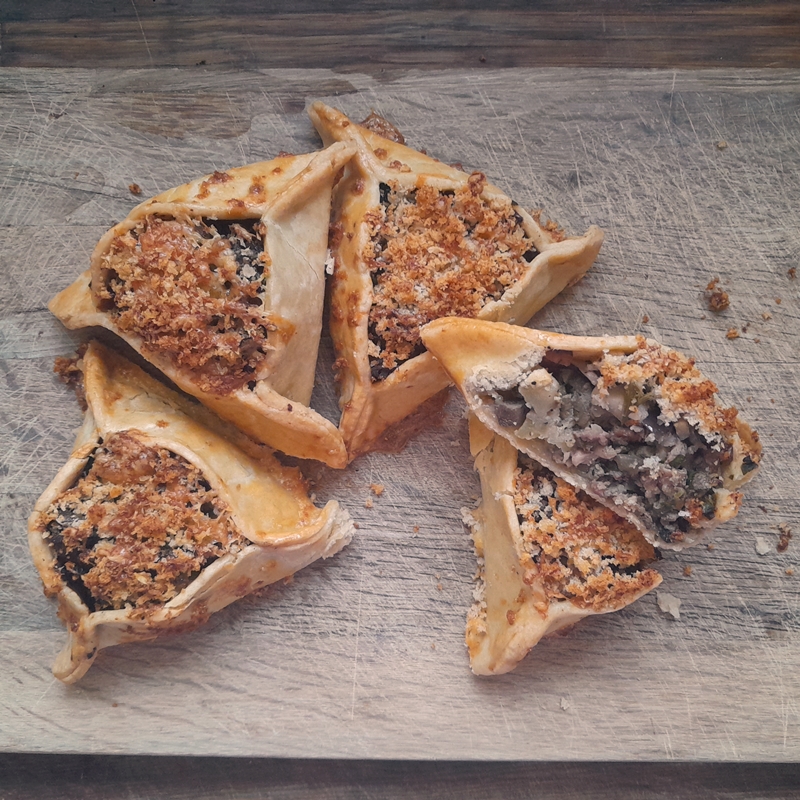
These little triangular pasties are a pleasant way to enjoy the classic and flavoursome combination of liver and bacon, aside from the traditional grilling. As you’ve probably already surmised, they have also managed to develop quite a colourful, and largely fictitious, provenance. Touted online as ‘an ancient recipe’, ideal for the farm worker to stuff into his pocket as he headed out to the fields, no-one seems to know specifically where and when they date from, although I’ve read many a vague “…Seventeenth century…” claim.
Even without any provenance, neither the shape nor the style of the pies would appear to support this. These are tricorn-shaped pies – although easy to form, hardly the most robust nor the most practical of shapes – with the top being left open to be filled with a cheese and breadcrumb mixture (this crunchy topping being much more of a 20thC style). Any farm worker worth his salt would end up with a pocketful of crumbs within an hour.
No, in actual fact, the recipe actually originates in Doreen Fulleylove’s “Simple Country Fare” (1970). Now to me, that’s not that long ago – good gravy, I remember 1970 – but then I have to stop and remind myself that that is now over fifty years ago.
The Churdles name, however, can be traced back much further, all the way to the 1920s. In his fabulously-titled “Away Dull Cookery!” (1932), Earle Welby recorded an entertaining nonsense menu devised by the dramatist Henry Arthur Jones for his grandchildren. It is, perhaps, the greatest menu I have ever read, and I reproduce it below:
Pickled Trunnions
Filets of Poucher Bonne Femme
Baked Banbury Mush
Squibbles on Toast
Truffled Guffins
Boogoose Bordelause
Varicose Beans
Danderchits in Aspic
Wombles
Stuffed Spanish Crippets
Churdle Pie
Mulligatawny Fritters
Nostrum Roes à la Diable
Piblets
Trundleberry Gin
It’s on my ever-lengthening list of Things To Do to devise and make dishes for this menu.
But back to the Chipstead Churdles. It seems to me that a far more likely scenario would be for the name Churdle to have been borrowed to grace a heretofore unnamed but very toothsome pie. And there’s nothing wrong with that at all.
Chipstead Churdles
The savoury flavours of liver and bacon are here paired with mushroom, onion and sharp apple to make for a lighter and fresher mouthful.
Melt the butter in a frying pan and add the onion. Fry gently for 8-10 minutes until softened and translucent.
Add the bacon and fry for a 1-2 minutes and then turn the slices over.
Add the liver and fry for 2 minutes, turning the slices over after 1 minute. This should cook the liver enough to remain pink in the centre. As it will be cooked again during the baking of the pies, you don’t want to overdo it at this stage.
Lift the meat from the pan and chop finely.
Scrape the cooked onion and butter into a bowl and add the chopped meat.
Stir in the mushrooms, apple, parsley and seasoning. Set aside.
Preheat the oven to 180°C/160°C Fan.
Roll out the pastry to a thickness of about 5mm.
Cut 8 circles of pastry 10-12cm in diameter. You can make 4 large pies, but the larger the pie, the more difficult the pastry is to handle.
Divide the filling into 8 and add one portion to the middle of each circle of pastry.
Damp the edges of the pastry with water.
Pinch the edges together to make a triangle base, folding the sides of the pastry inwards and pressing the edges together to make a three-cornered hat shape. Leave the middle of the pie open.
Mix the cheese and breadcrumbs and sprinkle one spoonful over the opening at the top of the pies, and transfer the pies to a baking sheet lined with baking parchment.
Whisk the egg with a tablespoon of water and use it to glaze the sides of the pies with a pastry brush.
Bake for 25-30 minutes until crisp and golden. Turn the baking sheet around after 15 minutes to help even the browning.
In times past, when secular life intertwined much more with the religious, and life was closely linked with the land, Plough Monday was the first Monday after (the) Twelfth Day (of Christmas), the Feast of Epiphany, January 6th. It was supposedly the day when work in the fields resumed for the men with spring ploughing and is a tradition that stretches back centuries. It is mentioned in the writings of Thomas Tusser in 1580:
“Plough Munday, next after that Twelf-tide is past, Bids out with the Plough; the worst husband is last: If Plowman get hatchet, or whip to the skrene, Maids loseth their cocke, if no water be seen:”
An explanation of these lines is provided by Daniel Hilman in 1710 (in his publication Tusser Redivivus) as follows:
“After Christmas (which formerly, during the twelve days, was a time of very little work) every gentleman feasted the farmers, and every farmer their servants and task men. Plough Monday puts them in mind of their business. In the morning the men and the maid servants strive who shall show their diligence in rising earliest. If the ploughman can get his whip, his plough-staff, hatchet, or anything that he wants in the field, by the fire-side, before the maid hath got her kettle on, then the maid loseth her Shrove-tide cock[¹], and it wholly belongs to the men. Thus did our forefathers strive to allure youth to their duty, and provided them innocent mirth as well as labour. On this Plough Monday they have a good supper and some strong drink.”
Despite the mention of ‘a good supper’, I’ve been unable to find any mention of precisely what this consisted of, and most recipes for Plough Monday Pudding, or just Plough Pudding date no further back than the mid 20th century.
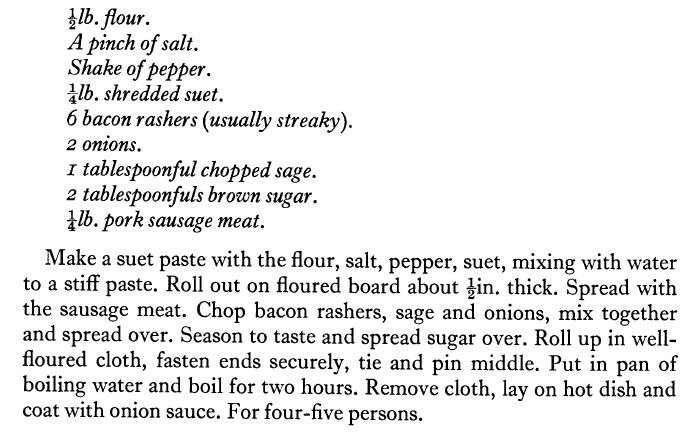
In December, 1960, Folklore magazine published[²] the following recipe that had appeared in The Times newspaper on the 8th August of that year. Although titled ‘Plough Pudding’ the introductionry paragraph indicated it was a recipe to be found in Sussex farmhouses.
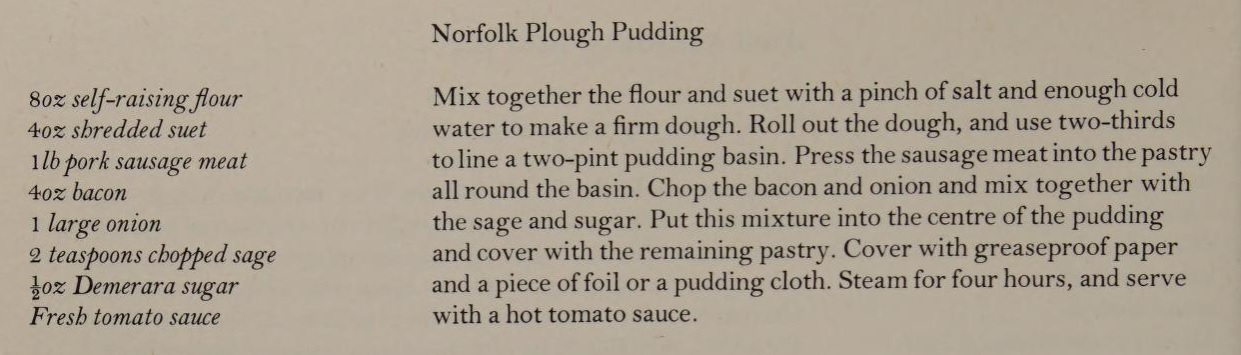
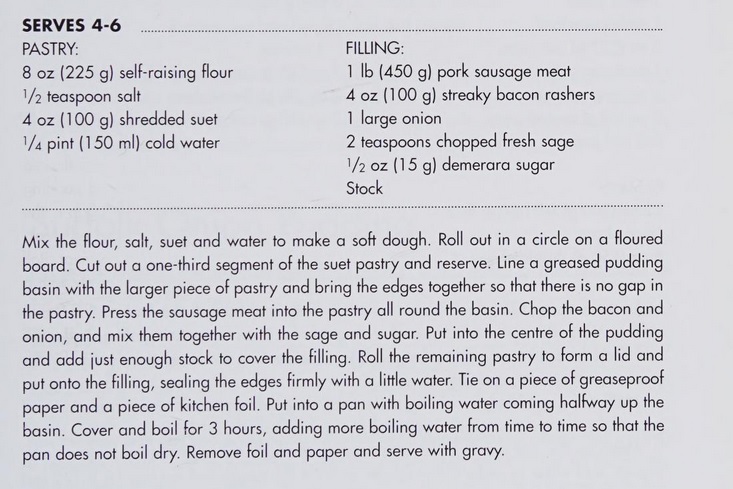
Subsequent versions all appear to be based on this recipe. Mary Norwak’s 1979 version[³] (below) made the very practical change of transferring the cooking vessel from a cloth to a bowl, and was ascribed to Norfolk. Mary Norwak lived in rural Norfolk, so perhaps this was a nod to her home county. She also quadruples the amount of sausage meat to make a very substantial pudding indeed.
By the time her English Puddings: Sweet and Savoury was published in 1981, she has adjusted her recipe to reduce the cooking time to three hours and included some stock in the filling, for added moisture. She also comments “Some Plough Puddings are suet rolls wrapped around bacon rashers with onions, sage, pepper and a little black treacle.”[4]
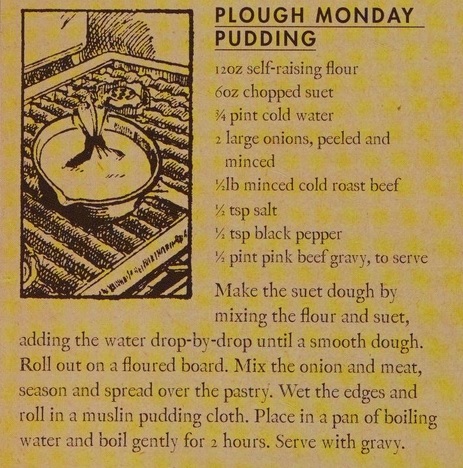
All other recipes appear to be variations of Mary Norwak’s, although few acknowledge it. The one exception I managed to find was in the Archers’ Country Kitchen by Angela Piper[5]. This version uses cold roast beef, presumably the remains of the Sunday roast and nothing like the original: sausagemeat and bacon being a much more believable stout yeoman’s supper than prime beef.
This recipe is also far from perfect in the method, in my opinion. The instructions for using a pudding cloth lack essential details (should be scalded and floured, to prevent the pudding from sticking), the illustration clearly shows a lidless saucepan, which no-one in their right mind would use to cook a STEAMED pudding, and the pan itself is on what appears to be a professional chef’s griddle rather than something more believable for a farmhouse dish. We’ll draw a discrete veil over the ‘pink beef gravy’ serving suggeston, as this page is the only one in the book which mentions it, so it will be forever a mystery.
ANYHOO…
Plough Monday Pudding 2021
My version of Plough Monday Pudding is yet another adaptation, this time for individual steamed puddings. My version also includes an alternative cooking method: the slow cooker. The great danger with the long steaming a suet pudding requires is the need to ensure the water doesn’t boil dry. Honestly, I find it rather stressful. Enter the slow cooker, where you can leave your pudding blissfully unattended, secure in the knowledge that the water will remain largely unevaporated from the moment you switch it on, to the time you haul out your golden delights.
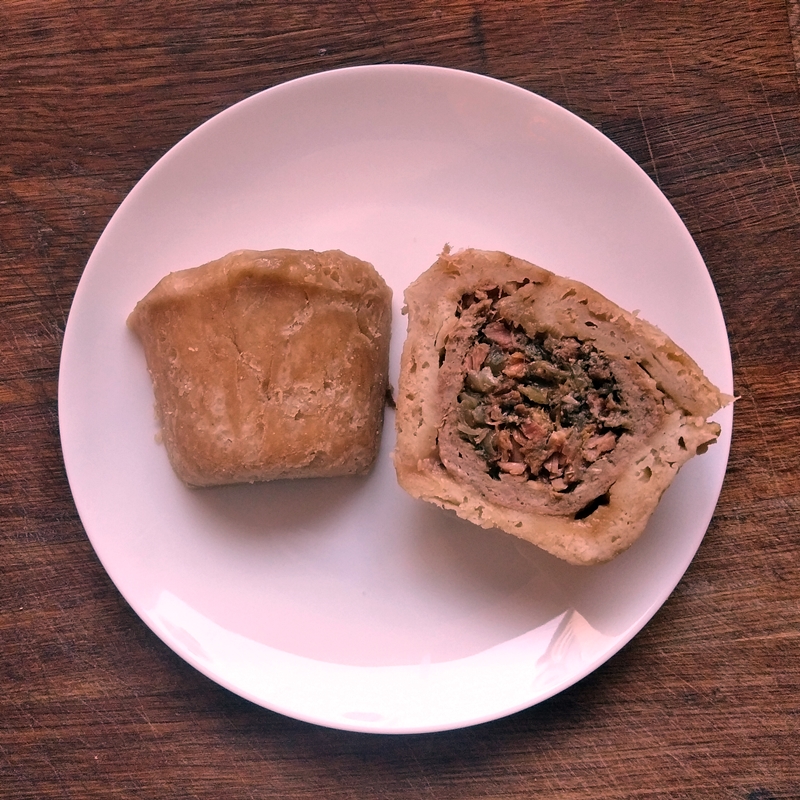
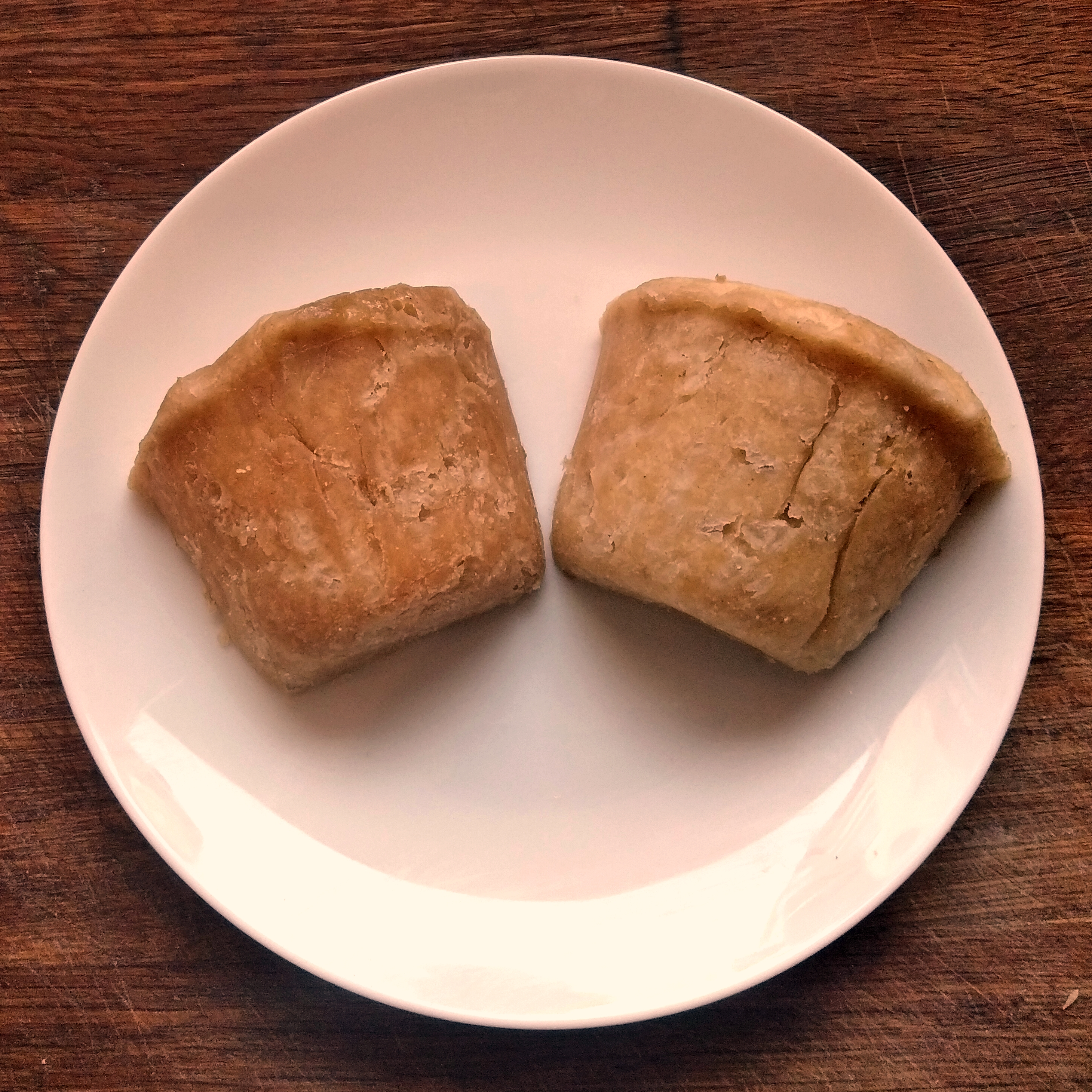
It’s actually better than the traditional method. In support of this statement, I’d like to offer the following photograph:
The pudding on the left was cooked for 4 hours in the slow cooker on High. The pudding on the right was steamed for 2 hours. Both are fully cooked, but the longer, slower approach of the slow cooker makes for a richer, more golden crust. Another option is to cook on Low for 8 hours – perfect to come home to on a cold, winter’s night.
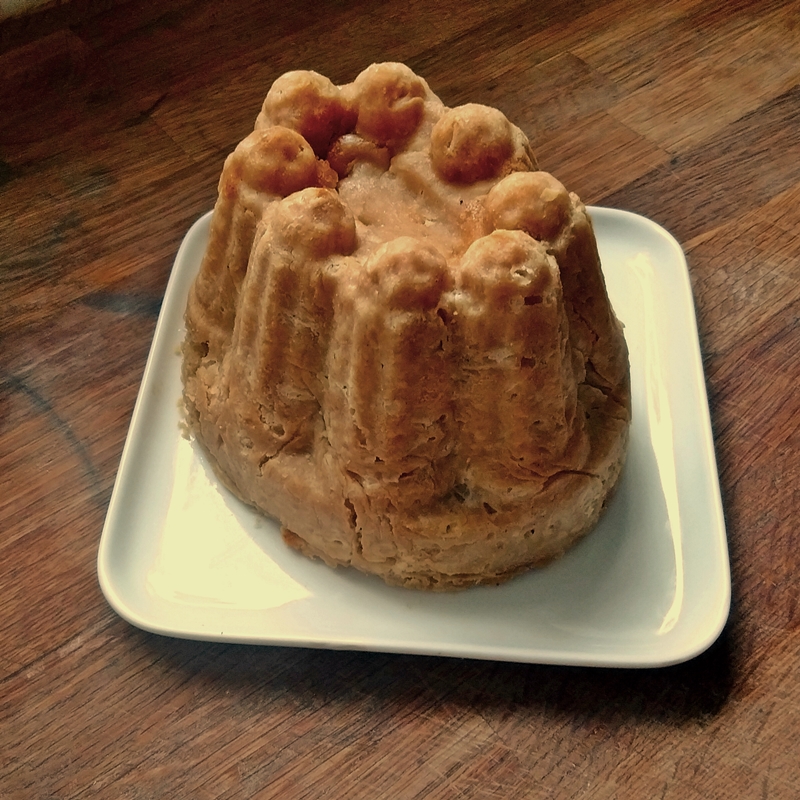
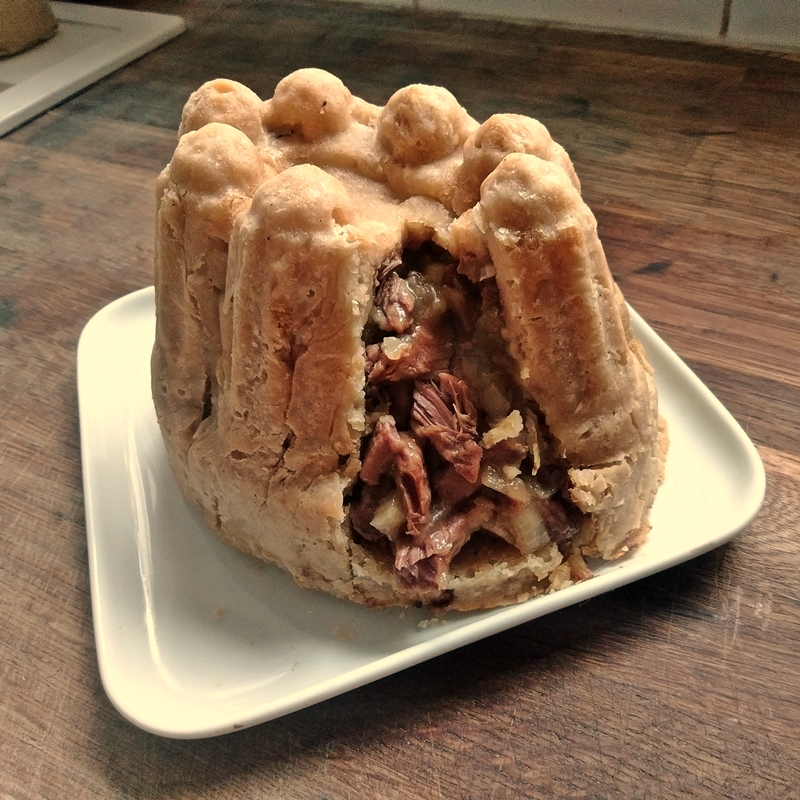
Don’t think you HAVE to cook your Plough Monday Pudding in individual dishes, or indeed in traditionally-shaped bowls. I have acquired a number of Victorian and later jelly moulds, which sadly sit unused for weeks at a time. Although the pastry needs care to ensure it nestles in all the nooks and crannies of the mould, the result is delightfully grand. Best of all, it can sit quite happily for up to 12 hours in the slow cooker on Low.
Jelly-mould Plough Monday Pudding
Plough Monday Pudding
You can choose any of the above recipes, or follow mine below. I have cherry-picked from all.
For 4 individual puddings or 1 large one.
250g self-raising flour 125g suet ½tsp salt melted butter for the moulds 1 pork sausage per individual pudding, or 6 for a large one. 2 large onions, chopped finely 125g lean bacon, chopped finely 2tbs chopped fresh sage or 1tbs dried 150ml chicken stock 1tbs treacle
Mix the flour, suet and salt together and add sufficient cold water to bring it together in a soft dough.
Grease your pudding moulds well with the melted butter.
For individual puddings, divide the pastry into 4 and roll out and line your dishes. Let the excess pastry hang over the edge until your puddings are filled. If you’re making a large pudding, cut off 1/4 of the dough for the lid and roll the rest and line your mould.
Remove the sausage skins. For each individual pudding, roll one sausage between clingfilm to about 5mm thickness. Line the pastry in the moulds with the sausage meat. For the large mould, you can press the sausagemeat in by hand, or roll them out and ‘patchwork’ it in.
Mix the chopped onion and bacon and add the sage and black pepper.
Spoon the onion mixture into the middle of your puddings.
Press down gently but firmly. You don’t want to be too rough, because you might tear the pastry, but the filling needs to be firmly packed to give structural integrity when they are turned out, and the raw onion will soften and shrink during cooking.
Add the treacle to the stock and heat gently until the treacle melts in.
Spoon the dark brown stock into your puddings, allowing time for it to seep down into the gaps, until you can see liquid level with the top of your filling. It should be 2-3 tablespoons for each individual pudding.
Cover the ‘top’ of your puddings. You needen’t be too precious about this, because when the puddings are turned out, this ‘top’ will be hidden underneath. For the small ones, fold over the excess pastry from the sides, and use water to moisten and seal the edges. For the large pudding, roll out the reserved pastry to size and again, use water to moisten and seal the edges.
Tear off some parchment for each pudding. Brush the underside with melted butter and make a large, single pleat in the parchment, then press on top of your puddings. Repeat with some foil. The pleat will allow the pastry to expand as it cooks, without running the risk of the foil tearing and allowing water to get in. Press the foil closely around the pudding basin to keep both parchment and foil in place.
For ease of lifting from the hot water at the end of cooking, you might want to tie string around the edge of the foil and create a loop over the top to grab onto.
Put your puddings into your slow cooker, ensuring there is space around them for the water to circulate.
Add sufficient water to the cooker to come ¾ of the way up the bowls/mould.
Turn the heat to High for 4 hours, or Low for 8 hours.
When ready to serve, lift the puddings from the cooker and set on a towel to drain and rest for 10 minutes.
Turn the puddings out and serve with either a hot tomato sauce (Norwak 1979) or gravy (Norwak, 1981).
Top Tip: If your puddings are looking a bit anaemic, you can brush them with melted butter and set into a 200°C, 180°C Fan oven for 5-15 minutes (depending on size), to give them a bit of colour.
Beef and onion Plough Monday Pudding
Top Tip: If you’re making the version of the pudding using cooked beef, toss your diced beef in cornflour before mixing with the onion. It will thicken the stock, stop your pudding becoming waterlogged and help hold it together when turned out.
[¹] It was a tradition that the local lord gave a gift of a cock hen to the woman of the house at Shrovetide. The Plough Monday friendly competition was a race to see who could get up earliest on that day, and either have their work implements ready (men) or have water on to boil (women). The winner received the prized chicken for that year.
[²] Folklore, Vol. 71, No. 4 (Dec., 1960), p262. All thanks to Dr Annie Gray for helping me get my hands on this article.
[³] The Farmhouse Kitchen, Mary Norwak, (1979), Warwick Press, p49.
[4] English Puddings: Sweet and Savoury, Mary Norwak, (1981), London : Batsford, p109
[5] Archers’ Country Kitchen, Angela Piper, (2011) Newton Abbot : David & Charles, p84

 Deja Food