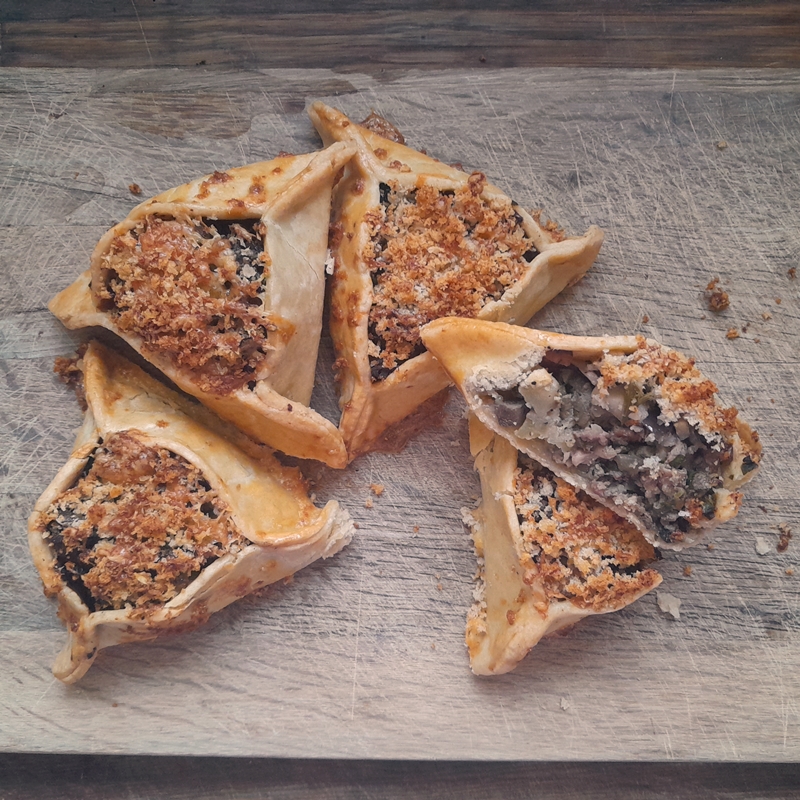
Chipstead Churdles

I’ll be the first to admit that I love a good story behind a recipe. However, what winds me up no end are stories that have been made up to make a recipe appear more ‘authentic’ than it actually needs to be.

And so we have Chipstead Churdles. Chipstead is a small village in Surrey, southeast of Croyden. Churdle Pies are also claimed by Sussex, though I have yet to find any recipe predating this one.

These little triangular pasties are a pleasant way to enjoy the classic and flavoursome combination of liver and bacon, aside from the traditional grilling. As you’ve probably already surmised, they have also managed to develop quite a colourful, and largely fictitious, provenance. Touted online as ‘an ancient recipe’, ideal for the farm worker to stuff into his pocket as he headed out to the fields, no-one seems to know specifically where and when they date from, although I’ve read many a vague “…Seventeenth century…” claim.

Even without any provenance, neither the shape nor the style of the pies would appear to support this. These are tricorn-shaped pies – although easy to form, hardly the most robust nor the most practical of shapes – with the top being left open to be filled with a cheese and breadcrumb mixture (this crunchy topping being much more of a 20thC style). Any farm worker worth his salt would end up with a pocketful of crumbs within an hour.

No, in actual fact, the recipe actually originates in Doreen Fulleylove’s “Simple Country Fare” (1970). Now to me, that’s not that long ago – good gravy, I remember 1970 – but then I have to stop and remind myself that that is now over fifty years ago.

The Churdles name, however, can be traced back much further, all the way to the 1920s. In his fabulously-titled “Away Dull Cookery!” (1932), Earle Welby recorded an entertaining nonsense menu devised by the dramatist Henry Arthur Jones for his grandchildren. It is, perhaps, the greatest menu I have ever read, and I reproduce it below:

  • Pickled Trunnions
  • Filets of Poucher Bonne Femme
  • Baked Banbury Mush
  • Squibbles on Toast
  • Truffled Guffins
  • Boogoose Bordelause
  • Varicose Beans
  • Danderchits in Aspic
  • Wombles
  • Stuffed Spanish Crippets
  • Churdle Pie
  • Mulligatawny Fritters
  • Nostrum Roes à la Diable
  • Piblets
  • Trundleberry Gin

It’s on my ever-lengthening list of Things To Do to devise and make dishes for this menu.

But back to the Chipstead Churdles. It seems to me that a far more likely scenario would be for the name Churdle to have been borrowed to grace a heretofore unnamed but very toothsome pie. And there’s nothing wrong with that at all.

Chipstead Churdles

The savoury flavours of liver and bacon are here paired with mushroom, onion and sharp apple to make for a lighter and fresher mouthful.

shortcrust pastry

1 onion
30g unsalted butter
200g smoked back bacon, rind removed
200g lamb’s liver
60g mushrooms, chopped
1 small Bramley apple, peeled and finely chopped
2-3tbs chopped parsley
½tsp ground black pepper
½tsp salt

4tbs fresh breadcrumbs
4tbs finely grated strong cheddar cheese

1 large egg for glazing

  • Peel and chop the onion finely.
  • Melt the butter in a frying pan and add the onion. Fry gently for 8-10 minutes until softened and translucent.
  • Add the bacon and fry for a 1-2 minutes and then turn the slices over.
  • Add the liver and fry for 2 minutes, turning the slices over after 1 minute. This should cook the liver enough to remain pink in the centre. As it will be cooked again during the baking of the pies, you don’t want to overdo it at this stage.
  • Lift the meat from the pan and chop finely.
  • Scrape the cooked onion and butter into a bowl and add the chopped meat.
  • Stir in the mushrooms, apple, parsley and seasoning. Set aside.
  • Preheat the oven to 180°C/160°C Fan.
  • Roll out the pastry to a thickness of about 5mm.
  • Cut 8 circles of pastry 10-12cm in diameter. You can make 4 large pies, but the larger the pie, the more difficult the pastry is to handle.
  • Divide the filling into 8 and add one portion to the middle of each circle of pastry.
  • Damp the edges of the pastry with water.
  • Pinch the edges together to make a triangle base, folding the sides of the pastry inwards and pressing the edges together to make a three-cornered hat shape. Leave the middle of the pie open.
  • Mix the cheese and breadcrumbs and sprinkle one spoonful over the opening at the top of the pies, and transfer the pies to a baking sheet lined with baking parchment.
  • Whisk the egg with a tablespoon of water and use it to glaze the sides of the pies with a pastry brush.
  • Bake for 25-30 minutes until crisp and golden. Turn the baking sheet around after 15 minutes to help even the browning.
  • Cool on a wire rack.
  • Serve warm.

Pickled Onions

I do love a pickled onion, and not having had any for a while, decided to put to the test some of the old recipes from the Wellcome Insitute Library archives. The methods are a little different from modern recipes and I was curious to see the differences made to the final product, if any.

Some of the pickled onion recipes were too involved for my purposes (and lack of patience), with the brining going on for almost a week before any actual pickling was done. I chose these two recipes because they were both immediate and do-able in a morning, and I liked that they had slightly different aromatics as well as methods.

A lot of pickling recipes take weeks to mature, and originally I hadn’t planned to post these recipes for quite a while. However, after a taste test this morning, the results were so delicious after just 24 hours, here we are.

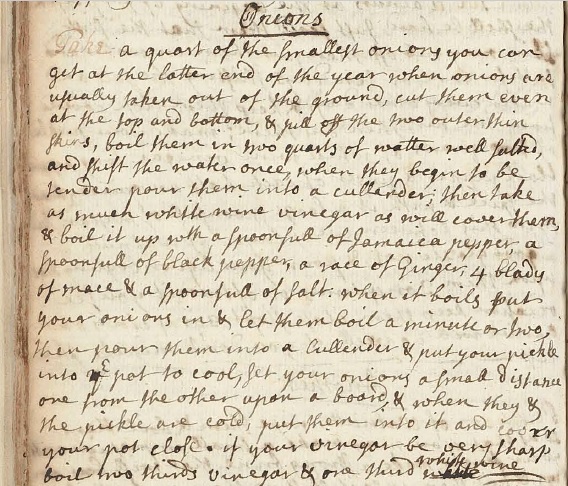
Pickled Onion manuscript recipe 1

This is the recipe from a manuscript (MS751) that belonged to one Elizabeth Sleigh, with later additions by a Mrs Felicia Whitfield. The manuscript has been dated to from the middle of the seventeenth century (1647) to the early 18th century (1722). The method involves blanching the peeled onions briefly in two changes of salted water, simmering the pickle with some aromatics and combining the two when both are cold.

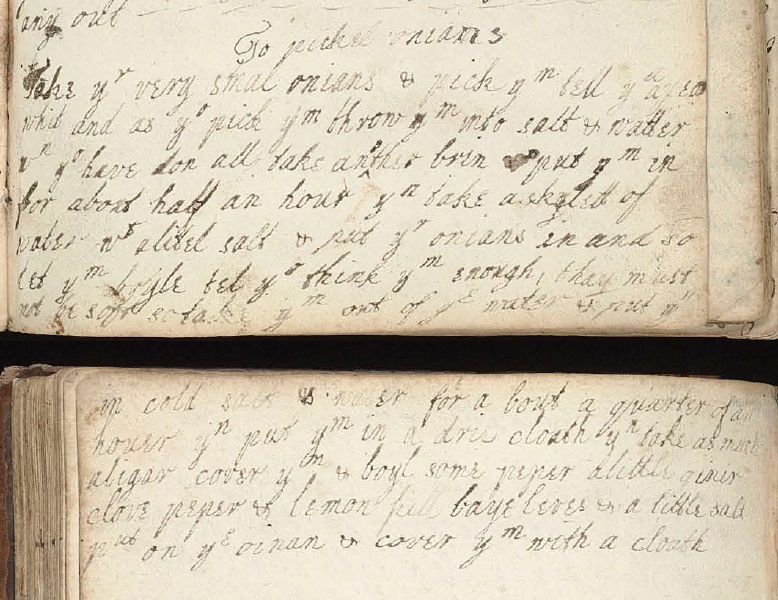
This recipe is from MS2323, originally owned by Amy Eyton and subsequenty by Mary Eyton and possibly even Mrs Sarah Justice. With a similar date (1691-1738), it is interesting how closely the recipes resemble one another in terms of method. This later recipe calls for initially soaking the peeled onions in two lots of brine, blanching in brine and then cooling in cold brine, and drying. The vinegar and aromatics are simmered for a while, then poured over the onions.

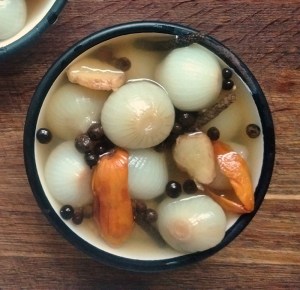
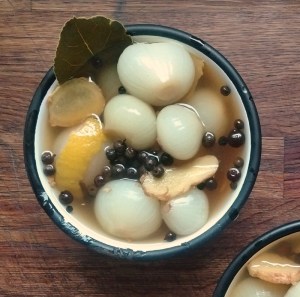
The results for both are deliciously similar: the onions have crunch and tang from the vinegar, but none of the harshness of raw onion nor eye-squinting ‘burn’ that accompanies the use of malt vinegar. The aromatics give subtle flavouring to the vinegar, which I suspect might intensify as time passes. As already mentioned, and by far the best part of this whole experiment, is they can be consumed almost immediately.

Elizabeth Sleigh’s Pickled Onions

1647-1722

I didn’t think I had any black peppercorns, so I used long peppercorns that were in the cupboard.

500-750g small/pickling/baby onions
9tbs table salt (divided)
800ml white wine vinegar
1tbs allspice berries
1tbs black peppercorns
1 thumb-sized piece of fresh ginger
4 blades of mace

clean jar(s)

  • Make a brine with 2 litres of cold water and 4tbs salt.
  • Cut the tops and bottoms off the onions and peel off the brown skin
  • Bring the brine to the boil and drop in the peeled onions and cook for two minutes. Drain.
  • Mix a fresh batch of brine (2 litres water, 4tbs salt).
  • Bring the fresh brine to the boil and drop in the onions and cook for another two minutes. Drain.
  • Cut the ginger into thin slices.
  • Add the aromatics and salt to the vinegar and bring to a boil. Turn the heat down to a simmer for 5 minutes.
  • Add the blanched onions and cook for 2 minutes
  • Turn off the heat and use a slotted spoon to remove the onions from the vinegar and set to cool on a baking tray or wire rack. Return any of the flavourings to the pickle.
  • Cover the vinegar pan and allow to cool.
  • When both onions and vinegar are cold, transfer them to your jar(s) and cover. If you’re using more than one jar, make sure the aromatics are divided equally amongst them.
  • Wait 24 hours, then enjoy.

Amy Eyton’s Pickled Onions

1691-1738

This recipe called for alegar – vinegar made from ale – of which I obviously have none, so I used half cider vinegar, half white wine vinegar. Use whatever light vinegar combination you like/have. Oh, and I found the black peppercorns.

500-750g small/pickling/baby onions
15tbs table salt (divided)
400ml white wine vinegar
400ml cider vinegar
1tbs allspice berries
1tsp whole cloves
1tbs black peppercorns
1 thumb-sized piece of fresh ginger
the zest of a lemon, cut in strips
4 bayleaves

clean jar(s)

  • Make a brine with 2 litres of cold water and 4tbs salt.
  • Cut the tops and bottoms off the onions and peel off the brown skin. Drop the peeled onions into the brine.
  • Mix a fresh batch of brine (2 litres water, 4tbs salt).
  • Drain the onions, then add them to the fresh brine for 30 minutes.
  • Make a third brine (2 litres water, 2tbs salt) and bring to the boil.
  • Drain the onions, then add them to the simmering brine for 3 minutes.
  • Mix 2 litres of cold water and 4tbs salt.
  • Drain the onions and drop them into the cold brine for 15  minutes
  • Add the aromatics and 1tbs salt to the vinegars and bring to a boil. Turn the heat down to a simmer for 5 minutes.
  • Drain the onions from the brine and dry with a clean cloth. Put the onions in your jar(s).
  • Turn off the heat under the pickle and allow to cool for five minutes,
  • Pour the pickle over your onions and seal. If you’re using more than one jar, make sure the aromatics are divided equally amongst them.
  • Wait 24 hours, then enjoy.