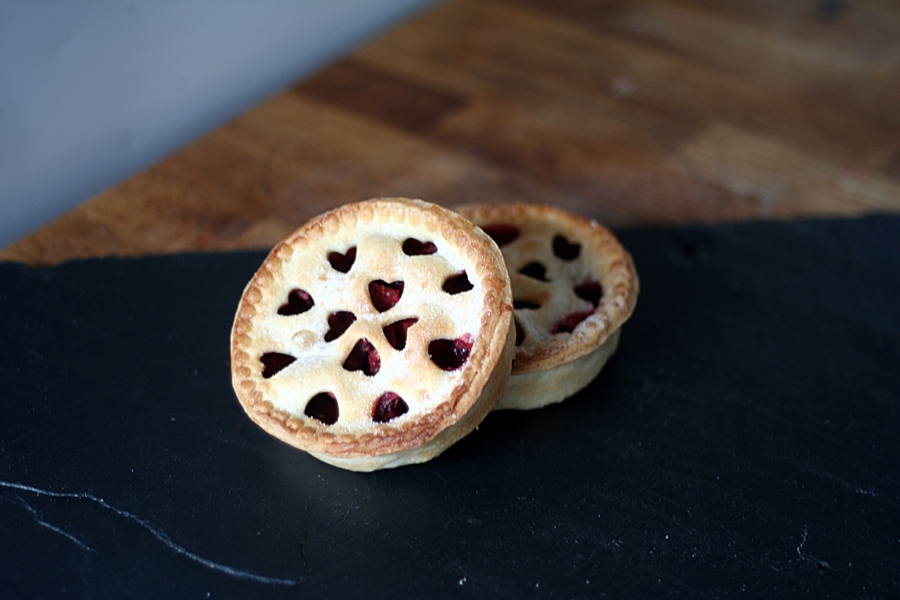
Spiced Strawberry Tart

Jane Parker, 1651 adapted from The Good Huswife’s Jewell, 1587

I was drawn to this recipe because it involved spicing strawberries and baking them in pastry, both details being so different from how we tend to use strawberries today. Originally, I was delighted to find the recipe in Jane Parker’s manuscript recipe book¹ but some months later, when I found an earlier version in a cookery book from the previous century, it became at once both more interesting and more delightful. Thomas Dawson’s recipe for strawberry tart², was published in the middle of the reign of Elizabeth I, and is, in all honesty, a little sparse on the level of detail to which our 21st century eyes are accustomed when it comes to recipes. Indeed, it is so brief I can quote it in full below:

To make a tart of strawberries

Wash your strawberries and put them into your Tarte and season them with sugar, cinnamon, and ginger and put in a little red wine into them.

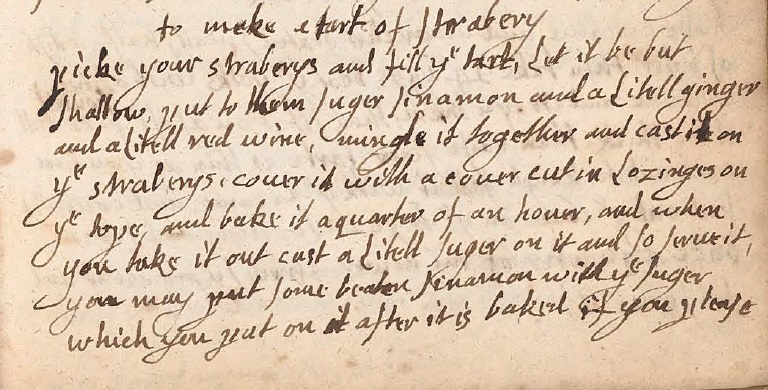
No quantities, cooking times, or even mention of a pastry recipe. It would appear Jane Parker also thought a little extra detail was required, and her recipe is as follows:

Jane Parker's Recipe
Source: MS3769, Wellcome Library Collection

Whilst there’s still no pastry recipe, we do have more detail in terms of presentation: the tart should be shallow, the pastry lid should have diamond cutouts, baking time of 15 minutes and a sprinkling of spiced sugar over the baked tart. These additional details, to my mind, highlight the fact that, even if she didn’t actually make the tart herself, Jane Parker definitely got the recipe from someone who had, as these details are precisely the kind of personal touches an experienced cook would note down for future reference.

After centuries of refinement, the strawberries we now use are impressively large but much milder in flavour than those that would have been used for this originally Elizabethan tart. If you can find sufficient wild strawberries either to mix with your ordinary strawberries or, decadently, to use on their own, their deep aromatic flavour, together with the wine and spices, will make for a much more robust flavour to this unusual Tudor tart.

Spiced Strawberry Tart

1 batch of Sweet Shortcrust Pastry

600g fresh strawberries
3 tbs caster sugar
1tbs cornflour
1tsp ground cinnamon
1 tsp ground ginger
½ tsp coarse ground black pepper
60ml red wine or port
Milk for glazing
1tbs caster sugar
1tsb ground cinnamon

  • Preheat the oven to 200°C/180°C fan/gas 6.
  • Roll out the shortcrust pastry thinly. The thinner the pastry, the less time it will need in the oven and the freshness of the strawberries will be all the better for it.
  • Cut out four lids for your tarts. Cut them generously so that there is sufficient pastry to form a seal with the pastry lining the tins. Use a small diamond cutter or any small shape, to cut a lattice into the lids. Be careful not to cut too close to the edge, otherwise they will be tricky to attach to the rest of the pastry.
  • Gather the trimmings and re-roll the pastry.
  • Grease and line four individual pie tins with the pastry. Let any excess pastry hang over the sides for now.
  • Prepare the strawberries: Remove the stalks and cut into small pieces, either 4 or 8, depending on the size of the strawberries.
  • Put the cut strawberries into a bowl and sprinkle over the red wine. Toss gently to coat.
  • Mix the sugar, cornflour and spices together. Sprinkle over the strawberries and toss gently to mix.
  • Divide the strawberry filling amongst the tins and smooth over.
  • Moisten the edges of the pastry and place the lids over each tart. Press firmly to seal, then trim and crimp the edges
  • Brush the tops with milk and bake for 12-15 minutes until the pastry is cooked and lightly golden.
  • Mix the remaining caster sugar and cinnamon together and sprinkle over the hot pies.
  • Cool on a wire rack.

¹ MS3769, Wellcome Library.
² The Good Huswife’s Jewell, 1587

Radnor Cranberry Tart

If you have an extended social life in the run-up to Christmas, and sample nothing but mince pies throughout December, by the time you get to the 25th, what with the Christmas Cake and Christmas Pudding, you can be all mince-pied out.

Also, sometimes you find yourself fancying something a little savoury at the end of a meal, and this is why this recipe is perfect. It’s simple and straightforward – just two main ingredients of fresh cranberries and juicy raisins. The raisins take the edge off the sometimes eye-popping sharpness of the cranberries and the little dash of vanilla also gives the aroma of sweetness, so only the merest sprinkle of sugar is required. It’s festively reminiscent enough of a mince pie to deserve a place on the table, its fresh-tasting, palate-cleansing, sweet but not too sweet, can be served hot or cold, but ALWAYS with a slice of cheese. I’m thinking some vintage cheddar, crumbly white Cheshire or even one of the fruited cheeses – white Stilton and apricot anyone?

It is a traditional (Welsh) border tart, ideal for Christmas – just look at that glorious colour! The original 1930s recipe in Mrs Arthur Webb’s Farmhouse Cookery didn’t specify any particular pastry, so I’m taking the opportunity to offer for your delectation and amusement, a new pastry recipe! Yes, I know I love the cornflour pastry – and I really do, both sweet and savoury versions – but I can’t resist something that has the potential to add a new arrow to my pastry quiver, as it were, and in this case, I’m really glad that I did.

It’s Eliza Acton’s 1845 recipe for cream pastry and it has my seal of approval for several reasons:

  • Simplicity – in its basic form, it can be whisked together with just two ingredients.
  • Taste – when baked, it is crisp and dry, without any hint of greasiness or stodginess.
  • It can be enriched with butter, but at a ratio of just 1/4 fat-to-flour, it is not as indulgent as it tastes. When enriched with butter, the texture is moving towards the flakiness of flaky pastry, yet with the ‘dryness’ and crispness of the cornflour pastry – Nom!
  • And on the practical side, it handles and rolls really nicely.

You can, of course, use your own favourite pastry instead.

Radnor Cranberry Tart

Eliza Acton’s Cream Pastry
This quantity makes enough for a 20cm pie.

225g plain flour
0.5tsp salt
300-450ml double cream
56g butter

  • Put the flour and salt into the bowl of a food processor.
  • With the motor running, gradually add in the cream, a little at a time, until the mixture comes together.
  • Tip the mixture out and knead until smooth.
  • Roll out the pastry into a long rectangle.
  • Using the same method as for Flaky Pastry, dot over half the butter.
  • Fold the ends over, turn the pastry 90 degrees and repeat.
  • Roll out one last time, and fold the ends inwards.
  • Wrap in plastic and chill in the fridge for 30 minutes.
  • Make the filling (see below).
  • Remove the pastry from the fridge and cut into 2 pieces (2/3 + 1/3 is about right).
  • Roll out the large piece and use it to line a greased, 20cm loose bottomed tart tin. Ease the pastry into the sides, rather than just stretching it by pressing down too hard. Leave the excess hanging over the edge of the tin.
  • Roll out the smaller piece of pastry to make the lid, and lay it onto a cutting board.
  • Chill both pieces of pastry in the fridge for 20 minutes. This will make sure it is relaxed and less prone to shrinkage in the oven.
  • By this time, the filling should be cool enough to use.
  • Preheat the oven to 200°C, 180°C Fan.
  • Remove the two lots of pastry from the fridge.
  • Fill the lined tin with the cooled filling and smooth over.
  • Using a pastry brush, wet the edges of the pastry, then lay the lid across the top and press the edges together.
  • Trim off the excess using the back of a knife.
  • Crimp the edges to your liking – I used the tines of a fork to make for a good seal.
  • Brush the surface of the tart with milk and sprinkle with caster sugar.
  • Cut a steam vent in the middle of the pastry lid using a sharp knife.
  • Bake for 25-30 minutes until the pastry is crisp and golden brown.
  • Allow to cool for 10 minutes in the tin, then remove to a wire rack to cool, if not serving warm.
  • Serve with a nice wedge of cheese.

Filling
450g fresh cranberries
225g raisins
30g sugar
60ml cold water
0.5tsp vanilla extract

  • Rinse the cranberries and put them in a pan with the raisins, sugar and water.
  • Cover and warm on a low heat until the mixture comes to the boil and you can hear the cranberries starting to pop.
  • Simmer for just five minutes, then turn off the heat.
  • Taste to make sure of the sweetness, but remember, this is not supposed to be a really sweet tart, however, it shouldn’t be too sour either. If you think it needs a little more sugar, add it by all means.
  • Stir in the vanilla and leave to cool.

Mince Pies Royale

Here is a great recipe for stretching a small amount of mincemeat into 30+ rich and delicious seasonable bites.

It is adapted from a recipe by Eliza Acton, and I’ve taken the opportunity to pair it with another of her recipes which she refers to as “Superlative Mincemeat”. Taking as an example my adaptation of Hannah Glasse’s Lenten mincemeat, I decided to try making this recipe suet-free. Now I still absolutely love Hannah’s recipe, but I also love discovering new things as well.

The mincemeat recipe is a delight for anyone who loves citrus fruit. It’s also a delight for anyone who loves a healthy slug of booze in their mincemeat. I’ve actually toned down the quantity of brandy because the alcoholic haze rising from the first test batch made my eyes water. Unusually, this mincemeat includes two boiled lemons, chopped finely, which add a real zing to the overall flavour. Once the lemons have been prepared, the method is very similar to the original fat-free mincemeat.

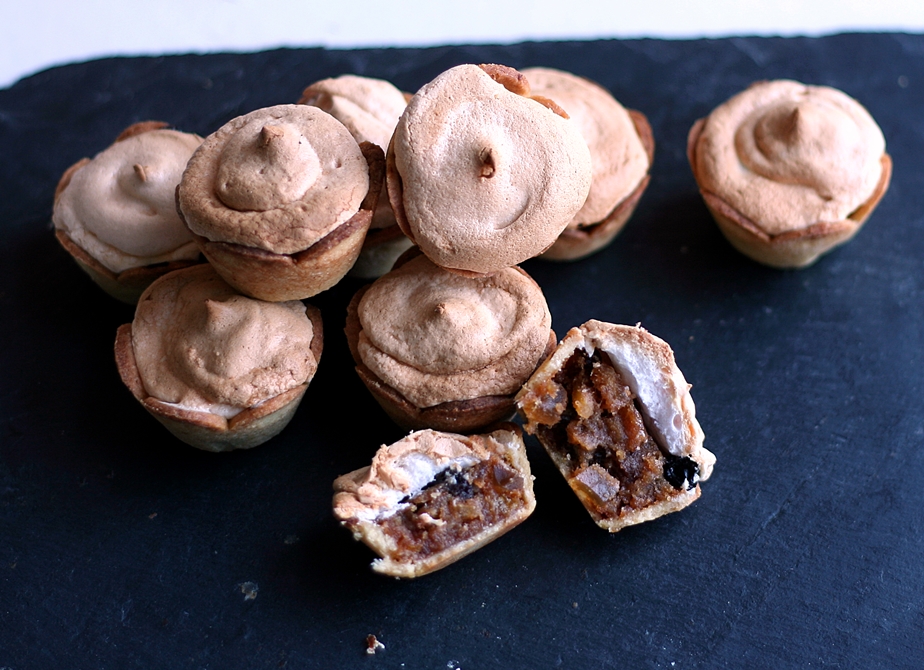
A portion of this mincemeat is then enriched and sweetened with sugar, fresh lemon, egg yolks and butter and used to fill pastry-lined mini tins. The pastry I’ve used is the sweet version of the cornflour shortcrust, flavoured with orange zest, and cut out using a flower cookie cutter. After an initial baking, the pies are topped with meringue and then baked for a further few minutes until nicely browned.

These little pies are extremely rich, which is why baking them in a mini muffin pan is ideal. The filling sets into a dense cross between Christmas pudding and Christmas cake and the crunchy meringue is a great contrast. This quantity makes about 30 mini pies, perfect as petites fours or to serve with coffee. You can keep them in a tin, but the meringues will go a little soft after 24 hours.

You can, of course, use any mincemeat and pastry you have to hand instead.

Citrus mincemeat

Makes about 1kg of mincemeat
2 small lemons (about 170g)
The weight of the lemons in raisins, currants and chopped dates
85g candied orange peel, chopped small
85g candied citron peel, chopped small
30-50g caster sugar
60ml  brandy
60ml apple juice
0.5tsp salt
1tsp grated nutmeg
0.5tsp ground mace
1tsp ground ginger

  • Put the lemons into a small saucepan and cover with cold water.
  • Bring to the boil and simmer for 15 minutes.
  • Drain the water and scrub the sides of the pan to remove the bitter lemon oil.
  • Rinse the lemons also.
  • Repeat 3 times, until the lemons are tender and a clove can be pushed through the skin.
  • Cut open the lemons and remove the pips.
  • Dice the pulp and rind finely.
  • Put the lemons and the rest of the ingredients into a small pan over a low heat.
  • Cover and allow the fruit to plump up. Stir occasionally.
  • If the fruit seems a little dry, add more liquid – your choice whether it’s alcoholic or not.
  • If the mixture seems too wet, uncover and allow the excess to evaporate.
  • Set aside to cool.

Orange Cornflour Pastry

225g plain flour
60g cornflour
140g unsalted butter
85g caster sugar
zest of 1 orange
1 large egg

  • Put everything except the egg into the bowl of a food processor and blitz until the mixture resembles breadcrumbs.
  • Whisk the egg and, with the motor running, gradually add to the mixture until it comes together in a ball. You might not require all the egg, or you might need additional liquid if the mix looks a little dry. If you have extra egg-white, tat would be ideal, otherwise use water.
  • Knead the pastry smooth and wrap in plastic.
  • Chill in the fridge for at least 30 minutes or until required.

Eliza Acton’s Mince Pies Royale

225g mincemeat
3 large eggs
30g clarified butter
juice and zest of 1 lemon
40g caster sugar
pinch of salt
caster sugar

  • Preheat the oven to 200°C, 180°C Fan.
  • Separate the eggs.
  • Mix together the mincemeat, egg yolks, lemon zest and juice and the sugar.
  • Warm the butter until just melted and stir in.
  • Grease a large (24 cup) mini muffin pan.
  • Roll out the pastry very thinly. It is easier to work with either 1/3 or 1/2 of the pastry at a time.
  • Cut out pastry and use it to line the mini muffin pan. For a lovely, neat edge to your pies, I recommend using a flower-shaped pastry cutter. The petals help to avoid the dreaded folds which can sometimes be an issue with the pastry for mini tarts.
  • Add a teaspoon of the enriched mincemeat mixture to each tartlet.
  • Bake for 7-8 minutes until the middle has set and the pastry is cooked.
  • If you’ve got filling and pastry left over (and you probably will), use them up first by making a second batch of tartlets before making the meringue. Arrange the cooked tartlets on a baking sheet, ready for the meringue.
  • While the tarts are baking, make the meringue.
    • You won’t need to use all of the egg white, so I suggest using just half.
    • Put a bowl onto your scales and set them to zero.
    • Pour in the amount of egg-white you will be using and make a note of the weight.
    • Measure out an equivalent amount of caster sugar.
    • Whisk the egg-whites with a pinch of salt until soft peaks.
    • Whisk in the sugar, a spoonful at a time until the meringue is firm and glossy.
    • Spoon the meringue into a piping bag. You choose what style of nozzle to fit.
  • When all the tarts are baked and arranged on a baking sheet, pipe the meringue on top. Make sure the meringue covers all of the filling and goes right to the edge of the pastry.
  • Return the tarts to the oven for 5-7 minutes until the meringue is nicely browned.
  • Cool the tartlets on a wire rack.

Orange Blossom Tart

Here’s a wonderfully aromatic and delicious dessert that I have adapted from a recipe that appears in Hannah Glasse’s “The art of cookery, made plain and easy”. It must have been popular, because Hannah gives no fewer than four recipes for Orange Pudding, each slightly different. Copyright infringement back then being rife, it is highly likely that Hannah is not the original author of this recipe, but I have yet to find an older version with these particular ingredients.

Hannah calls this a pudding – and indeed it is certainly something that you might eat after lunch or dinner, but it is in fact what we would term a tart, and I can honestly say it is unlike any tart I’ve ever tasted before, for the very best of reasons.

The most striking aspect is the flavour – a mixture of Seville orange, orange flower water, rosewater and white wine. Rather surprisingly, the word that popped into my head when breathing in its aroma was ice-cream – and that was before it was cooked! Once cooked and chilled, the flavours mingle together and taste extraordinary – the only way I can think to describe it is like plunging your face into a bunch of fresh flowers – but in a good way! This isn’t soapy/perfumed – it’s light and fresh and rounded. None of the flavours overpower, it’s just fantastically floral.

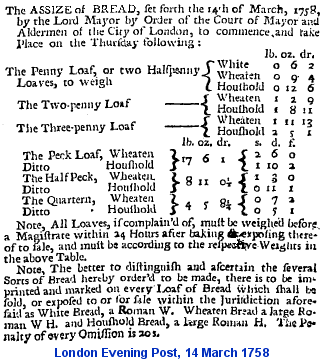
One of the challenges when adapting old recipes, is that specific quantities are sometimes a bit of a challenge. This recipe is a good example, because amongst other things it calls for “the crumb of a halfpenny loaf”. Although food prices were relatively stable before the industrial revolution, wheat, and by extension bread, was especially subject to price fluctuations due to harvest yield. So much so, specific laws were created concerning the manufacture and sale of the various types of bread (The Assize of Bread) and books of tables drawn up specifying the size of loaves depending on the cost of wheat.

Even with the Assize of Bread tables to hand, it’s still not clear which loaf the crumb should come from: white, wheaten or household. Household bread was the coarsest, and therefore unlikely, I reasoned, to have been used for such a delicate dessert. That left either white or wheaten and at just over 6oz and 9oz for a penny loaf, the difference in the quantity of crumb was going to be significant. The only solution was to make two tarts, and try each to see if one quantity was more suited than the other.

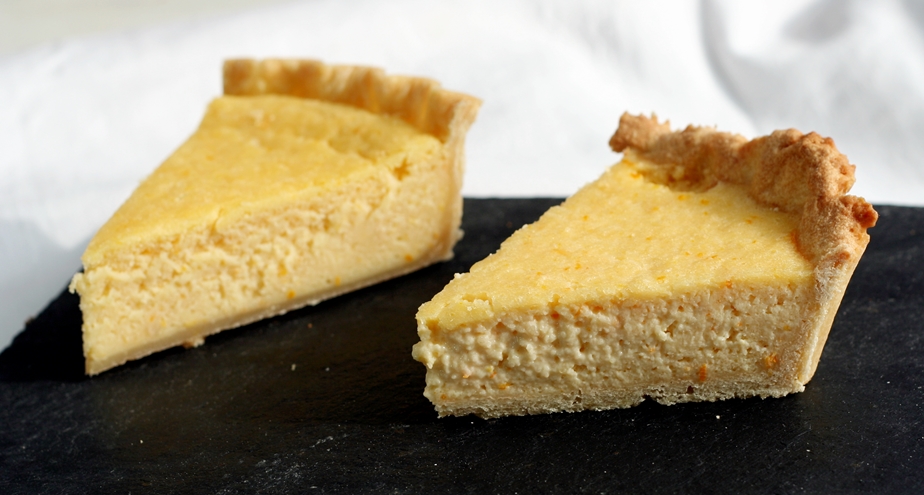
The photograph at the top shows the result. The slice on the left was cut from a tart made with 150g fresh white breadcrumbs. The slice on the right from a tart made with just 100g. Personally, I prefer the one on the left – the texture is like baked cheesecake, but not heavy and cloying. The slice on the right has a much softer consistency – if you’re a fan of baked custards, then this is the one for you. For an even more delicate texture, you could even try with just 50g of breadcrumbs – do let me know if you try this!

This is a wonderful springtime tart and I really hope you’ll give it a try.

Orange Blossom Tart

Sweet Shortcrust Pastry
225g plain flour
140g butter
60g cornflour
85g caster sugar
1 large egg
grated zest of 1 lemon
ice cold water
egg-white for glazing

  • Put all the ingredients except the water into the bowl of a food processor and blitz until the mixture comes together in a ball.
  • If the mixture is too dry, add some ice cold water 1 tablespoon at a time until the pastry forms a ball.
  • Tip the mixture onto a floured surface and knead smooth.
  • Wrap in plastic and chill for at least 30 minutes.
  • Grease a 22cm fluted, deep, loose-bottom tart tin – a lemon meringue tin if you have one, is ideal.
  • Remove the chilled pastry from the fridge and place on a floured surface.
  • Roll out thinly (7-8mm) and line the prepared tin, gently easing the pastry into the sides.
  • Let the excess pastry hang over the sides of the tin for now.
  • Prick the bottom of the pastry with a fork and put the lined tin back into the fridge to chill for another 30 minutes.
  • Preheat the oven to 200°C, 180°C Fan.
  • Remove the tart from the fridge and trim the excess pastry. Don’t remove too much – allow 3-4cm to overhand the side of the tin – this keeps the pastry from shrinking back into the tin and can be trimmed after cooking.
  • Line the pastry with baking parchment and fill with baking beads/beans/rice.
  • Bake for 12 minutes, then remove the parchment and beads and bake for another 5-6 minutes until the pastry is cooked through.
  • Brush the inside of the pastry with lightly beaten egg-white and return to the oven for 5 minutes. This seems like a faff, but it will ensure you pastry is both cooked AND resistant to the wetness of the filling until it is cooked. *lying* I deliberately undercooked the pastry on the left in the photo to demonstrate.

Filling
150g fresh white breadcrumbs
250ml double cream
75g caster sugar
5 large egg yolks
60ml white wine [1]
1 tablespoon orange flower water [2]
1 teaspoon rose water [2]
zest and juice of a Seville orange [3]
70g clarified butter – melted

  • Mix all of the ingredients together in a bowl and set aside to let the flavours mingle. It will have the consistency of porridge.
  • When the pastry base is finally cooked, turn the oven down to 160°C, 140°C Fan.
  • Cover the top edges of the pastry with tin foil, to prevent them from burning.
  • Pour the filling into the cooked pastry case and bake for 25-30 minutes until the filling is set. There should be a slight joggle to the middle of the tart, but nothing too fluid.
  • Set aside to cool for at least 1 hour.
  • When cold, trim off the excess pastry, remove from the tin and place on a serving plate.
  • Eat slightly warm or at room temperature. Alternatively (and my own personal preference) chill thoroughly in the fridge for at least 5 hours.

[1] The original recipe called for sack, a fortified wine similar to sweet sherry. You could use sherry, madeira even marsala if you like. Whilst I love the flavours of all three, I thought them a little rich for this recipe, so I chose a regular white wine. A sweet and aromatic dessert wine would also be delightful.

[2]Both of these fragrances are available in the baking aisle at the supermarket. They also tend to vary greatly in strength and aroma according to which brand you use. The original recipe called for equal quantities of both, but the rosewater I use is rather strong. In contrast, the orange flower water that I use is rather lightly perfumed, so I used slightly more. if you use different brands, my advice is to use just 1 teaspoon at a time and taste as you go until you’re happy with the flavourings.

[3] If, like me, you made Seville orange ice cubes with the zest and juice back in January, then all you need is one cube. If not, then use the zest only of a sweet orange, together with the zest of either a lemon or lime for added sharpness.

Banoffi Pie

I’d just like to take a moment to discuss a modern British classic pudding: Banoffi Pie.

Yes, Banoffi. Not Banoffee.

That’s just one of my little niggles regarding this dessert that have ultimately led to this post.

Done properly, to the original recipe, it is a classic, sophisticated and delicious dessert, worthy of a dinner party.

But it rarely IS done properly and, over the years, I’ve seen it churned out on television in worse and worse variations, until this past week when I saw an absolute shocker and so I was propelled into making this post just to set the record straight if nothing else.

I’m convinced that the fatty, over-sweetened mess that Banoffi Pie has evolved into, puts off a lot of people, which is a shame. Hopefully, if they can be persuaded to try it as it was originally conceived, they might just become fans.

I’ve mentioned in a previous post how Banoffi Pie came into being, and one of the co-creators has also published online the back-story as well as his original recipe.

Even though I am a fan of the original recipe, I’m going to change it a little.

I know, I know……I realise I’ve just spent three paragraphs banging on about people changing recipes, but in my head this is ALLOWED – because in the past I have actually eaten original recipe Banoffi Pie. Over the years I’ve developed a personal rule of first trying a recipe in it’s original form, out of respect to the original author. That done, you can tweak it how you like, but make it their way first. I’ve lost count of the times I’ve been pleasantly surprised with the results.

Once you’ve tried the original recipe too, you can pop back and we’ll carry on.

Back already? Excellent.

Before we begin, lets just have a quick whizz around the components, which gives me the opportunity to bang on about those too:

Pastry Base: Yes, contrary to popular belief, the original recipe called for a sweet, shortcrust pastry, which is actually ideal for this dessert. We’re going to draw a discrete veil over the crushed biscuit-and-butter and (my personal bête-noir) chocolate-biscuit-and-melted-chocolate bases, which push this dessert into being sickly. The filling is so rich and sweet, having the dry, crumbly pastry is a perfect foil. I actually have a copy of the original recipe published in the second book of recipes from the restaurant where it originated ( “The Deeper Secrets of The Hungry Monk” ) which just specified ‘shortcrust pastry’. This I interpreted as carte blanche to use whatever recipe I liked. What I have for you here is the original sweet cornflour pastry which I adapted to a savoury version for the Cheese and Potato Pies. It has that extra crispness that a regular all-butter pastry lacks.

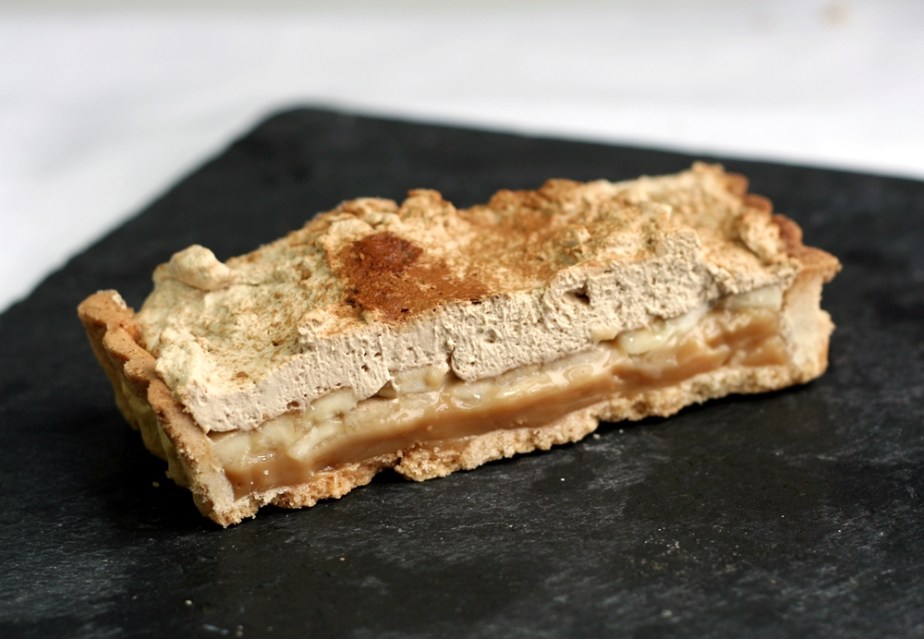
Filling: I’ve seen some people get very precious about the caramel “I make it all by hand!” they cry, ladling in the butter and cream. However, these caramels tend to be rather runny, and to be blunt, the filling can be doing without all that fat. The original is much simpler and is obtained by simmering unopened tins of sweetened, condensed milk for an extended length of time. This can be done in a variety of ways, but my method of choice is in the slow cooker because you can leave it unattended, and it won’t boil dry. Cover the tins with water, set it on Low and leave it for 8 hours. You can simmer them longer, up to 12 hours, and the caramel will gradually become darker the longer it is left in the water. The caramel in the picture was taken out of the slow cooker after 8 hours. In the UK, the most well-known producer of milk products (Carnation) have recently started selling tins of caramel. These are great if you need a dessert at short notice, but I find the caramel isn’t quite as firm as when you make it yourself, as well as being, to my taste at least, a great deal sweeter. If convenience is what you’re after, I suggest simmering more than one tin at a time and keeping the home-made spares in the cupboard.

Banana: This addition/improvement transformed Blum’s Coffee Toffee Pie into Banoffi Pie. The banana is laid on top of the caramel and underneath the cream, NOT on the pastry base. This would make spreading the caramel very difficult, as the sliced banana would stick to the caramel and slide about. And no, they don’t go on top of the cream either, because they’ll just turn brown and become very off-putting. And if you DO put them on top of the cream and then throw chocolate on top to disguise the browning, you’re fooling no-one. One variation that meets with Ian Dowding’s approval is to replace the banana with a thickened apple puree, making an Appleoffi Pie. Made with sharp, cooking apples such as Bramleys, I can just imagine the delicious contrast in both flavour and texture, although I’d probably leave out the coffee from the whipped cream for this version.

Coffee Cream:  Yes, coffee cream – whipped cream flavoured with coffee. So often this is replaced with plain whipped cream, or even vanilla flavoured cream, to the dessert’s great detriment. And, contrary to Mr Dowding’s original, in my opinion the coffee cream should be unsweetened and strong to the point of bitterness. Using espresso coffee powder turns it into a fantastic counterpoint to all the sweetness in the caramel and bananas, as well as lifting the dessert into dinner-party status. Coffee can do that. It’s almost as if it’s status as a grown-up flavour, confers adult status on everything it touches.

Chocolate for sprinkling/garnish: Whoa, whoa, whoa there, Nellie!? Whaddya doin’? You can’t go introducing a new flavour and shoving it on top of the pie just because you feel like it! Coffee, banana and caramel flavours are plenty busy enough, thankyousoverymuch! If you must sprinkle anything, a light dusting of espresso coffee powder is all the garnish it needs.

Baking Tin: You can make this dessert in any size and shape tin you like. A 20cm round tin, preferably with a loose bottom to help ease out the cooked pastry case, is traditional, but this time I used my loose-bottom rectangular flan tin (13cm x 35cm), which means the finished dessert can be neatly cut straight across in elegant, finger slices and the different layers are clean and clearly visible.

The Original(ish) Banoffi Pie

Pastry
60g cornflour
225g plain flour
140g butter
1 large egg
85g icing sugar
ice-cold water

  • Put all the ingredients into the bowl of a food processor and blitz until the mixture resembles breadcrumbs.
  • Gradually add the water, one tablespoon at a time, until the mixture comes together in a ball.
  • Knead smooth, then roll out thinly.
  • Line your chosen tart tin, easing the pastry into the corners/sides.
  • Leave the excess pastry overhanging the sides and chill in the fridge for 1 hour.
  • Preheat the oven to 200°C, 180°C Fan.
  • Remove the tin from the fridge and, now that the pastry has relaxed, trim the excess from the sides.
  • Prick the bottom of the tart tin with a fork.
  • Line the tin with baking parchment and weigh it down with baking beads/rice.
  • Bake for 12 minutes, then remove from the oven and take out the parchment and beans.
  • If the edges are already brown, cover them closely with foil and return the tart to the oven until fully baked (10-15 minutes).
  • Set aside to cool.

Filling
1 tin sweetened condensed milk turned to caramel, cooled

Unless you’re making a huge (30cm+) tart, then one tin is all you’ll need. Warmed carefully, it’ll spread a long way and a 1-2cm layer is rich enough for a treat without becoming sickly.

  • Open the cooled tin and tip into a small saucepan.
  • Warm the caramel gently until it becomes smooth and pourable.
  • Pour the warm caramel into the cooked pastry tart shell and spread it evenly over the base.
  • Lightly grease some clingfilm with butter and lay it closely over the caramel.
  • Chill until required.

To Assemble
300ml double cream
1tsp instant espresso powder + extra to sprinkle
2-3 bananas

  • Whisk the cream and coffee powder together until firm peaks.
  • Slice the bananas and lay a thin layer over the caramel.
  • Cover the bananas with the coffee cream. I like to just spoon it over, and keep it light and billowy, but if you prefer something more formal, you can pipe it. What you must do, is ensure that all the banana slices are completely covered. Just like the meringue on a lemon meringue pie, make sure the cream goes right to the edge of the tart, touching the edge of the pastry. Any banana left uncovered with start to discolour very quickly, but covered with the cream they remain delicately pale.
  • Dust the top lightly with espresso powder and chill until required.