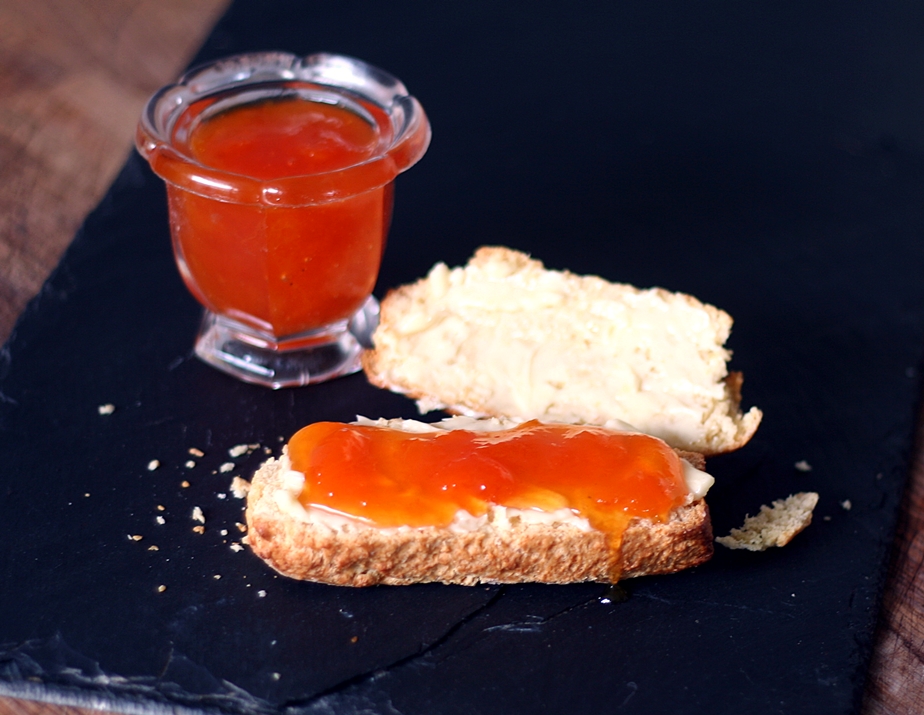
I’m a big fan of the sharp-sweet tang of apricots, and with a respectable amount of pectin, there’s no need to Faff About™ adding any extra. The small quantity lemon juice helps anyway, both in the set and in sharpening the flavour of the apricots.
This method, gleaned from several hand-written 17th century manuscripts, is slightly longer than your regular jam-making session might be, but it is seriously low on effort. Start-to-finish, it’s about 24 hours, but of that, there’s maybe only 1 hour of actually doing anything – bonus!
The result is so vibrant, so delicious, you’ll wish you’d made more – however many jars you make. I bought 6 x 350g punnets – and made six jars. One jar of finished jam for every 350g of raw fruit is also a handy way to work out how many jars your going to need. As a precaution, I always have one jar extra, all cleaned, heated and ready to go, in case of an overabundance. I’ve scaled the quantities down to use just 1 kg of fresh, pitted fruits (so 3 punnets from the shop), so it’s a little easier to scale up/down.
This method involves first macerating (or soaking) the fruit in sugar for several hours (or even overnight). The sugar draws out the juice from the fruit, and in turn a little of the sugar is absorbed. This absorption of sugar will help to firm up the fruit and keep it from disintegrating during the necessary boiling later on.
That being said, this is not a solid jam that has to be crowbar’d out of the jar (a particular dislike of mine). It’s definitely leaning more towards the conserve, although having sliced the fruit to manageable bite-sizes, I think that disqualifies it from the traditional definition of conserve (i.e. whole fruit in syrup).
ANYHOO….
Here’s how it goes:
Apricot Jam
3 x 350g punnets of Bergeron (for preference, but not compulsory) apricots, to give 1kg of prepared fruit
800g granulated sugar
Juice of 2-3 lemons
Day 1
- Rinse the apricots and cut into halves, top to bottom, and remove the stone.
- Layer the apricot halves, sugar and the juice of 2 of the lemons in a large bowl ensuring the cut surfaces of the apricots are covered with sugar.
- Cover the bowl with cling film and set aside for 8-10 hours, or overnight.
- Mop brow and declare loudly to any interested parties “This jam-making is EXHAUSTING! I must have a REST and watch a FILM”.
- Put feet up.
8 hours later, or next morning if you started at night
- Gently slide the apricot mixture (which will probably be quite runny by now) into a preserving pan and warm gently, until all the sugar is melted.
- Try and avoid stirring, as the fruit will still be very fragile and might begin to break apart with too much spoon action.
- When all the sugar is melted, bring the mixture to a boil.
- As soon as it boils, remove the pan from the heat and gently pour the fruit mixture back into the bowl.
- Re-cover with cling film and set aside overnight.
- Mop brow and put feet up as above.
12-14 hours later
Here’s where things might get a little too Faffy™ for your liking, feel free to skip the next part if you prefer a slightly more rustic jam.
- Removing the skins
- Strain the fruit from the syrup. I prefer to lift the aricot gently with a skimmer, to avoid squishingthem too much, but you can pour it through a sieve if you like.
- By this time, after their overnight soaking, the skins should be wrinkled and easy to separate from the flesh of the apricots. I usually start by picking up an apricot half by the skin in my left hand and then using a small, sharp knife to ease the flesh away. Sometimes the cut edge of the apricot next to the skin has hardened and needs a little encouragement to come free. If your apricots have a slightly thicker skin, this may not be as easy as described. In this case, give up.. Persevering will only mash the apricots to mush.
- Discard skins.
- Using some sharp scissors, cut the now skin-free apricots into strips about 0.5-1cm wide. Again, feel free to skip this if so inclined. It just makes the jam easier to spread. Set fruit aside for now.
- Once the fruit is prepared, it’s time to boil the syrup to setting point.
- But before you start heating it, taste. I like a particularly sharp jam, so I tend to add the juice of another lemon at this stage if necessary. Taste the syrup and make your own decision.
- Also, put 2 saucers in the freezer. These will be used later to test whether your jam has reached setting point.
- Pour all the syrup into the preserving pan and bring to a simmering boil. Keep an eye on it, as too high a heat may cause it to boil over.
- Skim the froth from the top of the simmering syrup – removing this will help give your finished jam that jewel-like clarity. Don’t throw the foam away, it’s still delicious, just bubbly. Enjoy on toast with some salty feta or goats cheese – NOM!
- Setting point is reached at 105°C, when the excess water has evaporated – there will be a distinct lack of steam coming from the pan, but use a thermometer to double-check.
- Add the apricots, sliding them gently into the syrup. It will immediately go off the boil, and as there will be quite a lot of syrup clinging to the apricots themselves, it will take several minutes to come back to setting point.
- Use this time to wash your jam jars, rinse and arrange onto a baking sheet, together with their lids.
- Put the jars into a cold oven, and turn the heat to 100°C, 80°C Fan.
- When the jam has reached setting point for the second time, draw the pan to one side away from the heat and test the jam by putting a teaspoon onto one of the cold saucers from the freezer. Return the plate to the freezer for a minute or two then remove and slowly push a finger through the cooled jam. If the surface wrinkles, then the jam is done. If not, return to the heat for a few more minutes and test again.
- Once the jam is set to your satisfaction, turn off the heat and leave it to cool a little. You want it to be cool enough to begin to form a thin skin on the surface. This means that it is starting to set, and you should put it in jars. Depending on how big a batch you’re making, this could be as long as 20 minutes. Have a cuppa while waiting!
- Stir the jam gently, to distribute the fruit throughout the syrup. Now that the jam has cooled a little, the fruit will stay suspended evenly. Stirring when the jam is too hot will do nothing, and pouring too-hot jam into jars will just make all the fruit float to the top.
- Remove the hot and now dry jars from the oven and, using a jam funnel, pour your jam into the jars. You might want to use oven gloves to hold the jar steady. Fill the jars as close as possible to the top – to within 5mm at least (bacteria love air gaps, so you want to keep them as small as possible).
- Screw the lids on tightly and then wipe off any spillage from the outside of the jars. Leave to cool completely before labelling.