
The Wellcome Collection has digitised thousands of resources related to the medical field, including hundreds of manuscripts, and made them freely available online. Many of these manuscripts also contain cookery recipes, because the food and medicines were considered the domain of the female head of the household, and so everything was kept in the one volume. The usual practice was to have medicinal receipts written in the front of the book, and then the book was turned over and the food recipes were written starting in the back of the book, and thus appeared upside down when reading the book left to right.
Over the centuries, household manuscripts became more food oriented and the medicinal recipes reduced to instructions for health salves and powders, but home cures can still be found in these hand-written treasures well into the 19th century.
As already mentioned, these resources are freely available, and over the years I have downloaded and indexed almost 300 of the manuscripts containing food recipes. My spreadsheet of recipes from just the Wellcome Collection stands at just over 35.5 thousand entries, and I have also branched out into indexing collections from the National Library of Scotland, McGill University collection The Folger Shakespeare Library and the Leeds University collection. They all make for a huge resource when looking for recipes for specific ingredients or recipes from particular eras.
This week, I was looking for apple recipes. I had over-estimated the number of Bramley (cooking) apples I needed for a recipe I was trialling (It did not go well. I was not inspired to tweak it. Let us speak of it not), and so had two large specimens in the fruit bowl needing to be used while still green, shiny and crisp and before they collapsed into a floury heap.
After a quick flip through the Wellcome Collection spreadsheet, I’ve got nearly 800 recipes to choose from. And the recipe I landed on was Rare Fritters (rare in this context meaning exceptional, especially delicious). Or should I say, recipes. Because the same recipe appears twice in the spreadsheet, from two different contemporary sources.
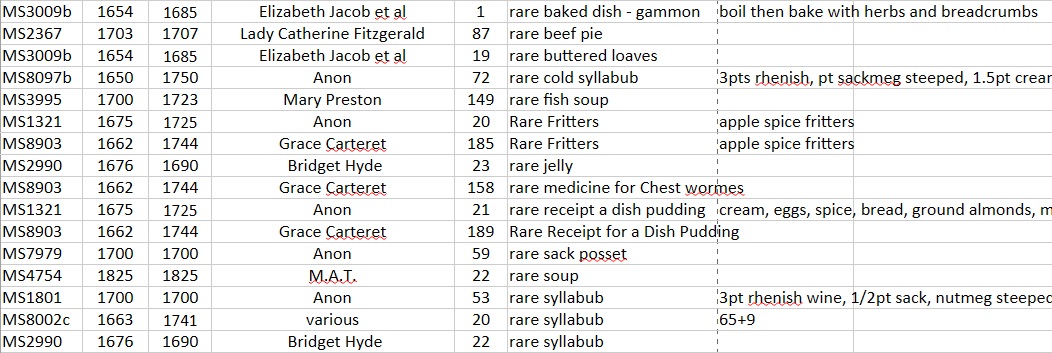
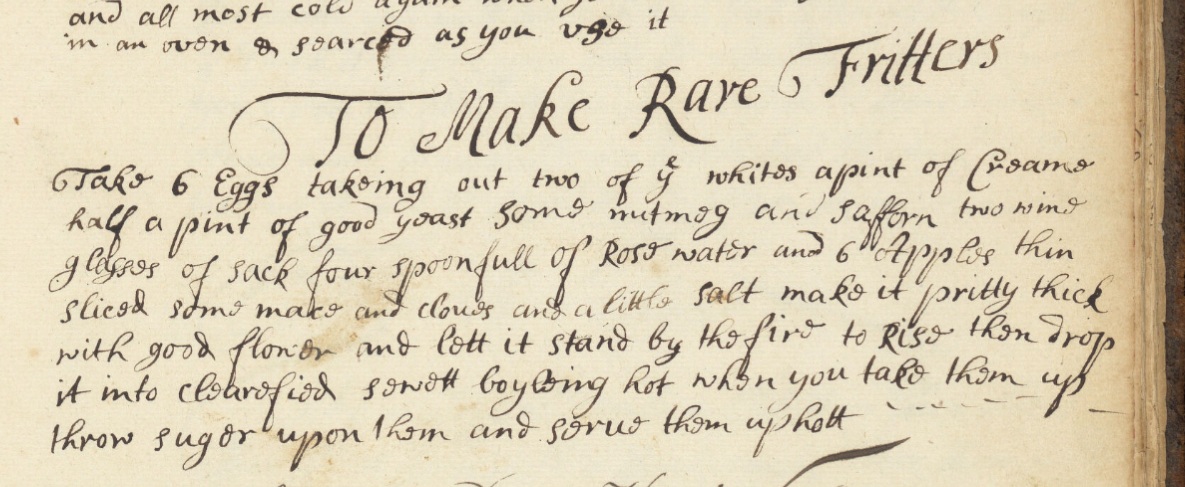
One is from the household manuscript book of Grace Carteret, 1st Countess Granville (1654-1744), dated 1662-mid 18thC.
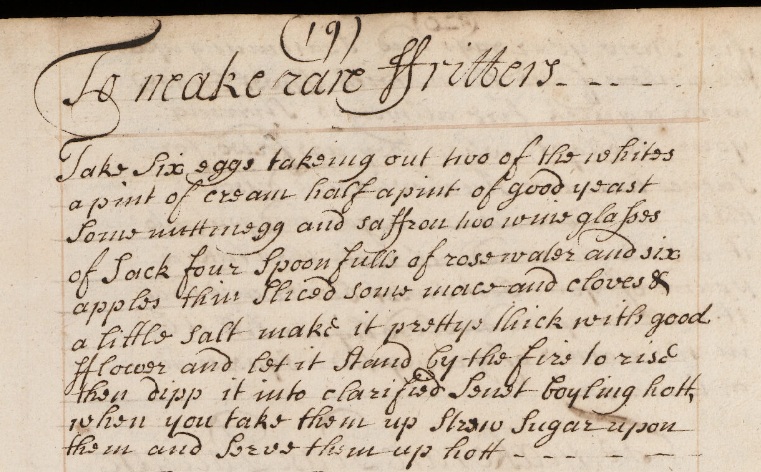
The second is from an anonymous manuscript dated 1675-c.1725
Written in thankfully legible hands, it is obvious that they are two versions of the same recipe, with the only slight differences being in spelling. This makes the recipe all the more interesting, because it comes from an age where there were very few printed cookery books from which this recipe could have been copied. We’re talking England at the time of The Restoration, peak Merry Monarch era (Charles II). There’s no like recipe in Gervase Markham’s The English Hus-wife” (1613), Robert May’s “The Accomplisht Cook” (1660), nor Hannah Wolley’s “The Queen-like Closet or Rich Cabinet” (1670). Similar, yes – but nothing with these ingredients/instructions/quantities. And that’s kinda it for 17thC cookbooks[1].
Which begs the question; how did this recipe end up in two different household books? Perhaps these ladies knew each other – they’re certainly of the same era. Did they exchange recipes directly, or is there an as-yet unknown publication from which they both copied? The answer is obviously rhetorical, but I do like to ponder such things.
ANYHOO…
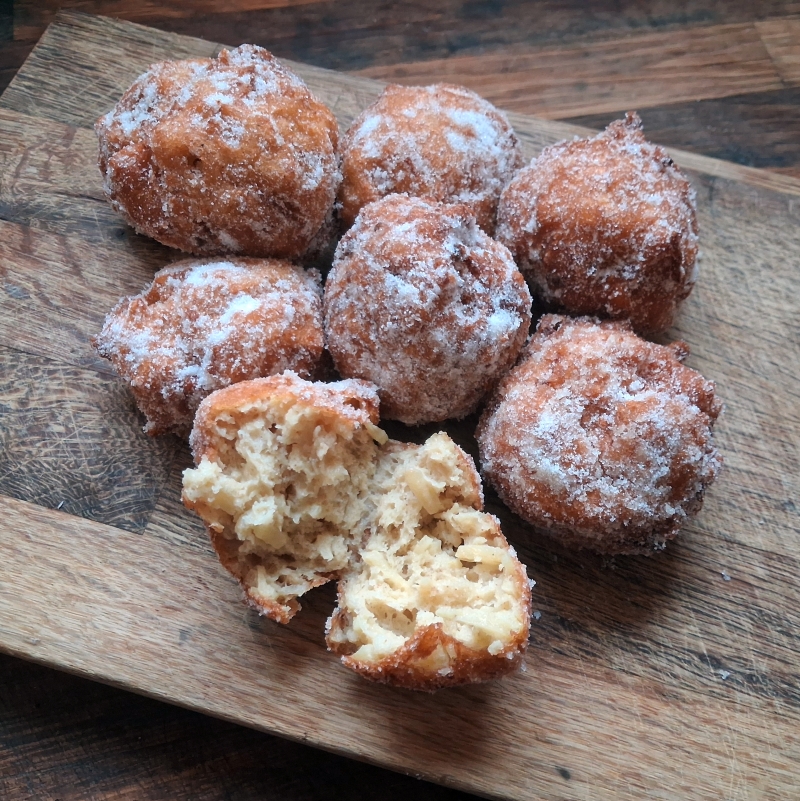
The recipe is, as they say, an absolute banger. In modern terms, they are apple fritters. The mix of flavourings and spices means you can really taste the 17th century – in a good way! The flavours are more complex and the texture more refined than modern recipes, which tend to use large, cubed, dessert apples and rely on baking powder to provide aeration. Cooking apples, in general, break down during cooking more easily than dessert/eating apples. Bramley apples in particular break down into an incredibly light fluff. It’s almost magical. In this recipe, with the short cooking time, the pieces of apple are still visible, but they are just barely holding it together, so you when you bite into the fritters, you get an amazing apple taste with seemingly no tangible textural evidence of apple.
Apple Fritters
I made a half-batch of the original recipe, which still made a very generous quantity. You could halve it again, for an even smaller batch, but then you run the risk of disappointment when they’re all gone in five minutes.
Makes 20-30, depending on size
200ml milk
large pinch of saffron
2 large eggs
1 large yolk
300ml double cream
80ml fortified wine (cream sherry/mead/ginger wine/madeira/marsala)
2 tsp rosewater
1 tsp ground nutmeg
½ tsp ground mace
½ tsp ground cloves
½ tsp salt
1 sachet fast-action yeast
450g (2 large) cooking apples (Bramleys recommended)
250-300g plain flour (or Gluten-Free flour + 1 tsp xanthan gum)
oil for frying
caster sugar for dusting
- Put the milk and the saffron into a small pan and heat it until scalded (little bubbles around the edge of the pan.
- Remove from the heat and allow the saffron to steep for 30 minutes.
- Use an immersion blender to combine the soaked saffron threads into the warm milk (optional).
- Add the saffron milk, eggs, yolk, cream, fortified wine, rosewater, spices, salt and yeast to a medium bowl and stir to combine.
- Peel and core the apples and grate on a mandolin fitted with a thin grating blade. Chop the resulting pile of apple ‘sticks’ across with a knife to make the shreds smaller.
- Stir the apple shreds into the wet ingredients.
- Add flour to thicken. How much flour will depend on the moisture content of the wet ingredients. I suggest starting with 250g and adding the rest if necessary. The final texture should be similar to a fruit cake mixture just before you put it in the tin. Not very helpful if you’re unfamiliar with fruit cake recipes, so I’ve been sitting here trying to think of another scenario, so how’s this: a little bit firmer than a bolognese sauce. Firm enough to hold it’s shape if you mound it up in the bowl, but still be moist.
- Cover the bowl with plastic and set aside to rise for 1 hour.
- Once the dough is risen, heat some oil in a pan, or a deep-fat fryer if you have one, to 170°C.
- Drop pieces of dough into the hot oil and fry until cooked and golden brown. Don’t ‘knock back’ the dough – you want to keep as much of the aeration as possible.
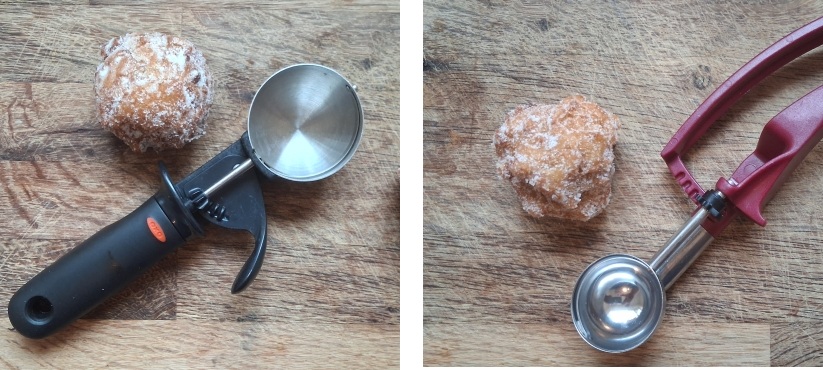
You can use two spoons, but an ice-cream scoop is by far the easiest option, if you have one. I have two – a regular-sized one and a mini scoop. Dropping a level scoop of dough into the oil will result in an almost spherical apple fritter. The size of the piece of dough will dictate how long it is cooked. The dough will double in size during cooking.- If you use a large scoop, the cooking time will be 8 minutes.
- If you use a small scoop, the cooking time will be 6 minutes.
- Don’t cook too many at one time, as it will cool the oil too much and may cause the finished fritter to be greasy. I suggest 6 small fritters or 4 large, maximum. Left to their own devices, the fritters should flip themselves over naturally when the bottom is cooked, but due to the dough not always being perfect spheres, you may need to flip them over yourself halfway through cooking.
- When cooked, lift the fritters from the pan and shake to get rid of most of the oil.
- Lay the cooked fritters onto 2 or 3 sheets of kitchen paper to drain any remaining oil, and allow to cool. Don’t stack them on top of one another in a bowl, otherwise they’ll just get squished. You want the outsides to harden a little before adding the sugar, so that they hold their shape.
- When they have cooled to just warm, sprinkle over caster sugar. You can also put the caster sugar into a ziplock bag or large bowl and roll/toss the fritters until coated. Even though there is no sugar in the actual recipe, rolling in sugar made them a little too sweet for my tastes. I suggest sprinkling first and adding more later if liked.
- Any left when cold (good luck with that!) can be stored in an airtight container.
[1] The main ones, at least. Elinor Fettiplace’s Receipt Book (1604) is a private family manuscript not printed until 1986. John Evelyn’s “Acetaria: A Discourse of Sallets” (1699) and Thomas Tryon’s “Wisdom’s Dictates” (1691) both being very late published and containing no fritters.

