
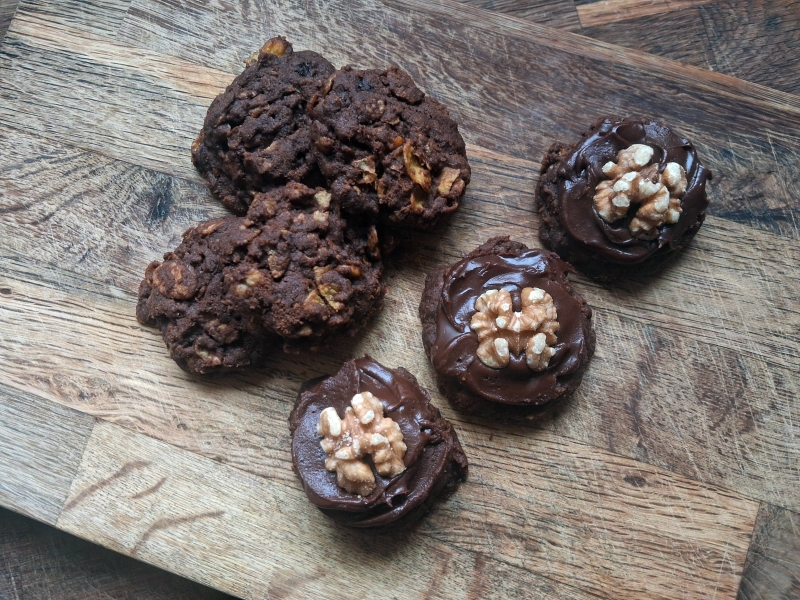
These biscuits are surprising. Surprisingly long-lived, surprisingly few ingredients readily available in your cupboards, and a surprisingly rich and addictive taste and texture. They’ve been around almost a century, and with that fact you immediately know they must have something special about them, because terrible recipes just don’t hang around. To illustrate this fact, allow me to introduce Ann Peckham’s Crimson Biscuits.
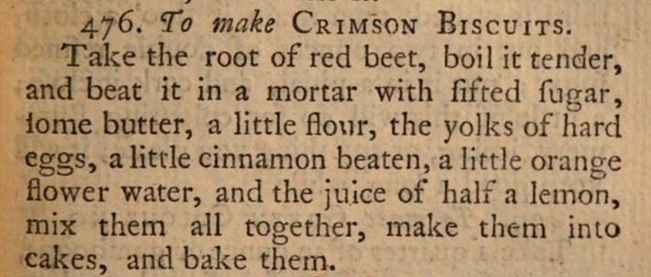
Yes, these delightful beetroot confections were first printed in Ann Peckam’s The Complete English Cook, back in 1767, and, even the 18th century fervour for cookbook plagiarism couldn’t tempt anyone else to put it in with all the other stolen recipes. I know it’s a bad recipe because many years ago I made it. And even accounting for the differences in gastronomic tastes back then, I find it difficult to believe anyone ever found this appealing.
But back to Afghans.
I noted this recipe whilst flicking through one of my many Women’s Institute cookbooks, specifically Tea Time Treats (1980), published by the Yorkshire County Federation of Women’s Institutes. And it’s not the only book to have included this recipe, or at least a version of it. It can be found dotted through many recipe books, although, truth be told, not so much in recent years and I’m wondering if it has something to do with the name. I’ve pondered long and hard on whether there is something derogatory about the name and have come to the conclusion that, if there is, it is because you think there is. The Afghan biscuit originated in New Zealand in the 1930s and whilst there are a variety of theories on the origins of it’s name, I’m choosing to believe that the name comes from the appearance of the topping and biscuit together, which resembles to the traditional pakol hat worn by Afghani men and/or the biscuit alone symbolising the rugged Afghan landscape.
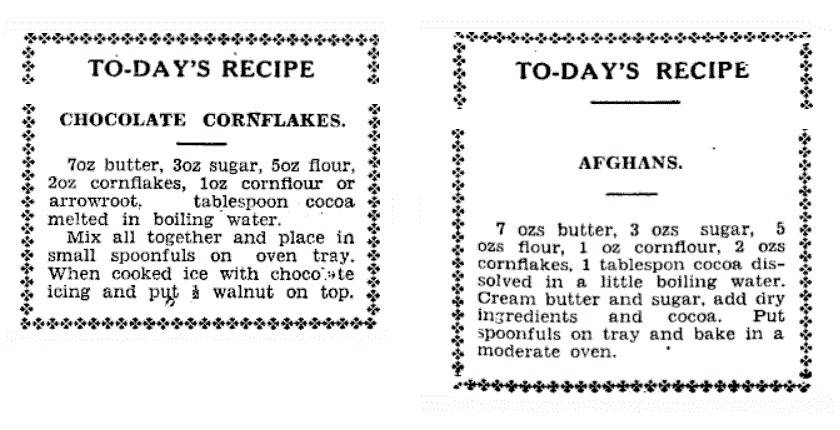
The two earliest recipes cited by Wikipedia, come from The Timaru Herald, in late 1933 and early 1934 (below).
The earliest recipe I was able to find myself, and one which I am using in this post, appears in a 1941 edition of the New Zealand Journal of Agriculture (below).
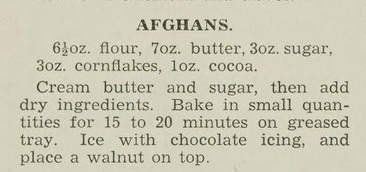
A notable ingredient – and there are only five – is cornflakes, which not only give each biscuit the aforementioned rugged appearance but also an amazing crunchy texture – which persists even when storing the biscuits in an airtight container. The biscuit mixture is also unusual in that it contains a greater quantity of butter than flour. However, it also contains a generous quantity of cocoa powder, which is very dry, despite being composed of 20% fat (and in many baking instances can be used as a substitute for flour on a 1:1 basis).
The recipes in The Timaru Herals also include a small propprtion of cornflour, thereby technically bumping the number of ingredients to six. I tried this variation, as I love the texture it brings in, say, Melting Moments, but it didn’t seem to add anything to the texture in this instance. The flavour of the biscuits came across as powdery and the texture seemed a little off – perhaps it was fighting with/against the already dry cocoa. Anyways, it was not for me – I feel the texture is best with just the cornflakes. Try it yourself (by removing 30g plain flour and adding 30g cornflour) if you’re intrigued.
Toppings
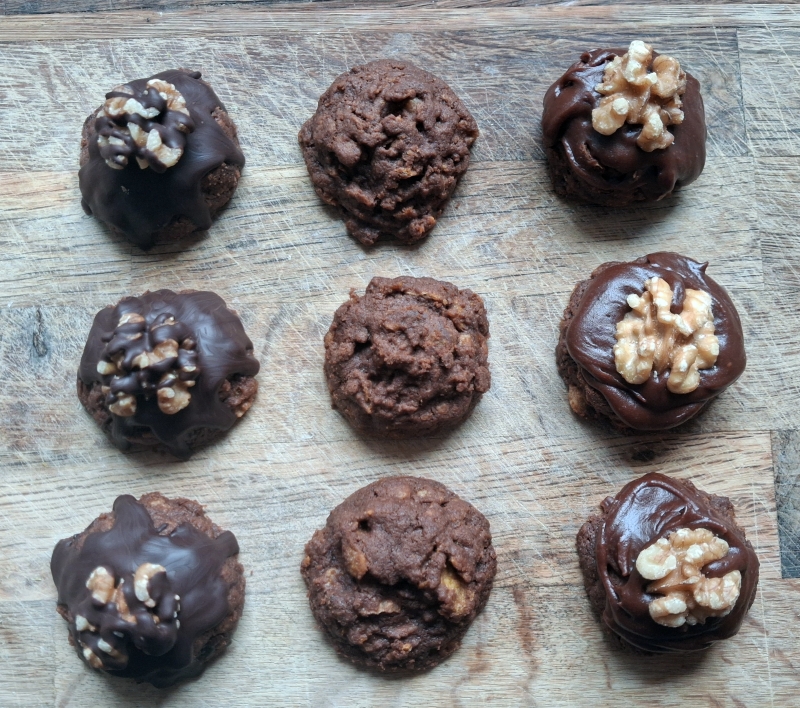
As can be seen from the early recipes, the traditional adornment for Afghans is chocolate icing and half a walnut. Rather unhelpfully, the early recipes fail to provide a suitable icing recipe, so I have gone in search of answers.
The Edmonds Cookbook, the iconic New Zealand publication (akin in stature to the BeRo booklet in the UK and early publisher of an Afghan biscuit recipe), suggests a buttercream made by mixing a large quantity of icing sugar, cocoa, a generous amount of butter and vanilla flavouring, with a couple of tablespoons of hot water. I tried this version and it was very pale and gritty from the cocoa powder. Cocoa really needs both liquid and heat in order to mix in properly.
Several modern Afghan recipes recommend plain, melted chocolate. Afghans are not an overly sweet biscuit, so I thought this version might be more of a success – the richness and smoothness as contrast to the biscuit itself, but it was not to be. There was actually too much texture contrast between the biscuit and the chocolate and they fought, rather than complimented each other. In addition, it needed a significant amount of chocolate in order for the half walnut to adhere.
After some experimentation, the best icing version came from an adaptation of the original buttercream. By using less butter and also melting it as well as using boiling water, the cocoa combined into a much smoother mixture. Easily spreadable and glossy, it sets once cooled, but with no loss of shine. The walnut attaches easily into the soft icing and is held firmly in place when it cools.
All this being said, I’m not entirely convinced that the biscuit actually needs any gilding at all. The richness of the butter content, the depth of the chocolate flavour and the texture of the cornflakes make for a much more substantial and interesting biscuit than normal. My recommendation would be to enjoy these biscuits unadorned, but if making for a special occasion/gifting, then add some glamour with the icing/walnut.
Afghan Biscuits
As already mentioned, these biscuits require only five cupboard staples. They are easily adapted to gluten-free by switching out the plain flour for a gluten-free one, but be sure to remember to add xanthan gum (guess what prompted me to mention this), otherwise they will just spread and pool together into one huge sheet (ask me how I know this will happen?). If this happens, just crumble it up and enjoy with a spoon, or over cereal/yogurt. Still delicious. Ask me how I know this 😀
Easiest method is to use a stand mixer, but hand-held/by hand is also fine.
200g butter – softened
85g soft dark brown sugar
180g plain flour (or GF flour with ½ tsp xanthan gum)
30g cocoa powder
85g cornflakes
- Heat the oven to 180°C, 160°C Fan.
- Sift the flour and cocoa together into a bowl.
- Cream together the butter and the sugar until light and fluffy.
- Add the cocoa/flour and mix until combined and resembling large crumbs.
- Add in the cornflakes and mix briefly. The flakes will be crushed a little by the mixer attachment, so only mix until they are combined with the rest of the ingredients, and no longer. You want to still be able to see them, so don’t mix/crush them into powder.
- Prepare two baking sheets by covering them with baking parchment.
- Spoon or scoop dollops of the mixture onto the baking sheets. I use my small 4cm-ish diameter ice-cream scoop, which gives 26-28 portions, but you could use 2 spoons/forks and really lean in to the whole rugged appearance vibe.
- Bake for 20 minutes, turning the baking sheets around after 10 minutes to ensure even baking.
- Cool the biscuits on the tins and store in an airtight container once cold.
Fudgy Chocolate Icing
If you prefer to use melted chocolate for your biscuits, you will need approximately 200g. Otherwise, use the icing below.
200g icing sugar
25g cocoa
50g unsalted butter
30ml boiling water
walnut halves
- Sift together the icing sugar and cocoa
- Melt the butter, add the boiling water, and pour both into the cocoa/sugar mixture.
- Stir vigorously with a spoon until the mixture comes together into a glossy paste.
- Top each biscuit with a spoonful of icing and press a walnut half into the top.
- Store in an airtight container once cooled and set.

