
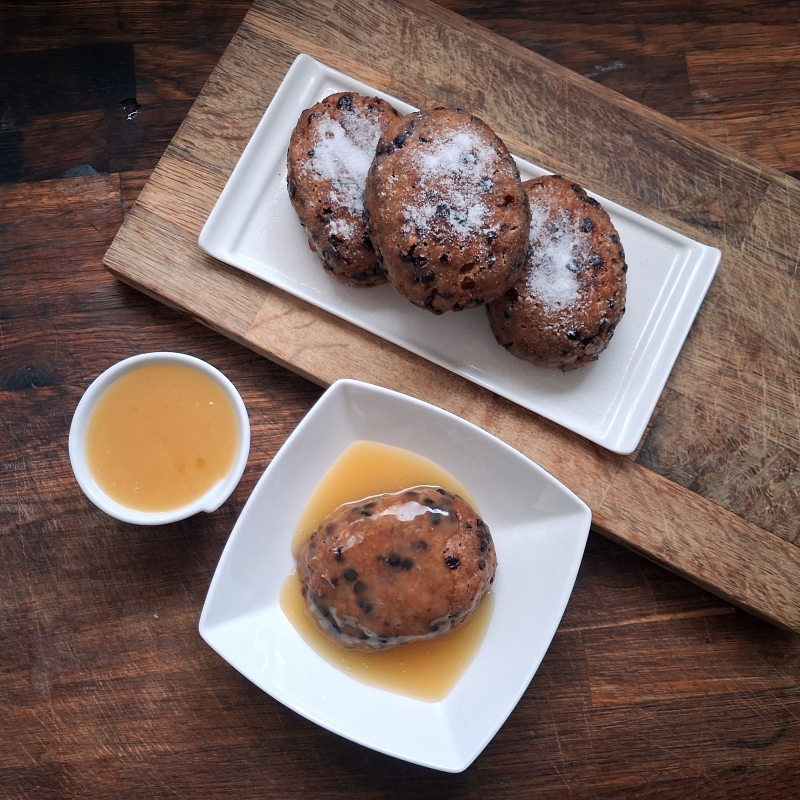
New College Puddings is a recipe that has been around for centuries. It’s been on my radar for years, and when indexing recipes in manuscripts, it made frequent appearances. I was aware of the recipe basics – breadcrumbs, dried fruit, suet, fried – I acknowledged them, but never really paid much attention beyond wondering whether ‘new college puddings’ was just an updated version of a mysterious older recipe for ‘college puddings’. And the answer?

After some sleuthing, I discovered that they are named for New College, Oxford, founded in 1379 by William of Wykeham, Bishop of Winchester, as The College of St Mary of Winchester in Oxford. It became known as ‘New College’ in order to distinguish it from the other college dedicated to St Mary (Oriel College), which had been founded in 1326. So the recipe was actually ‘NEW COLLEGE puddings’ rather than ‘NEW college puddings’. It’s funny to think that an almost-650 year-old institution was, at one time, considered the Johnny-come-lately, modern upstart. Disappointingly, searching the modern New College website brings up precisely zero references to puddings.
Moving on…
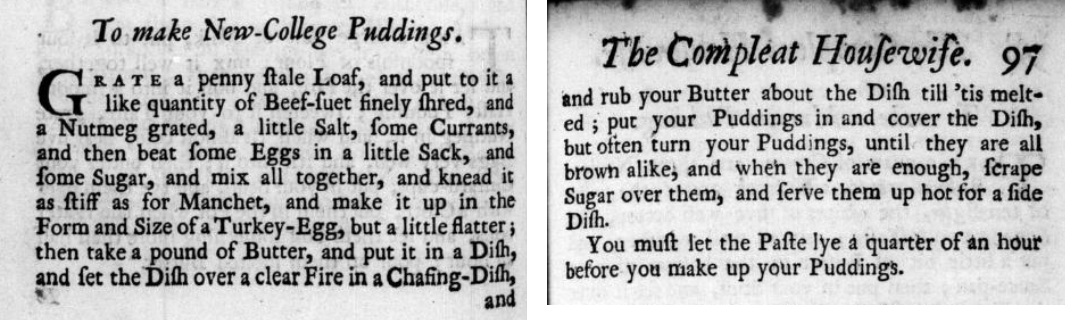
For a long time, the earliest recipe for New College Puddings was in the “The Compleat Housewife” by E___ S___ (thought to be by Eliza Smith, but the book originally only ever had the author’s initials, until she passed away that is, whereupon the publishers had free reign to make up any old tosh, which they did). Below is the recipe from the 1728 Second Edition.
Later in the century, Hannah Glasse included a recipe for Oxford Puddings (see below) in her 1747 “The Art of Cookery”, which is essentially the same recipe, except these puddings are served with a butter/wine sauce, whereas E.S.’s included sack in the mixture itself.
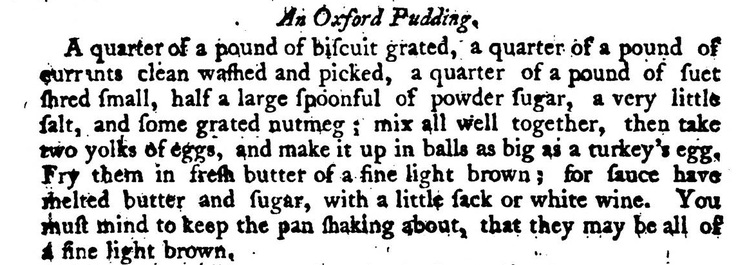
Both recipes consist of dry crumbs, suet, currants, sugar, nutmeg, with eggs to bind the mixture together, which is then shaped and fried in butter. Interestingly, the Glasse recipe is entitled “An Oxford Pudding” (singular) when it is very clearly made up of a number of small puddings, suggesting that this should more accurately be called “A pudding from Oxford”, thus tying in with the original E.S. recipe.
In the 21st century, an earlier recipe of impeccable provenance has emerged as a number of handwritten manuscripts have come to light. Radolphus (Ralph) Ayres was head cook at New College, Oxford in the early eighteenth century (approx. 1714-1725) and kept a manuscript of the many recipes he used. There are at least four known copies of this manuscript collection, which includes New College Puddings. His serving suggestion is to present them surrounding a wobbly, creamy Quaking Pudding.
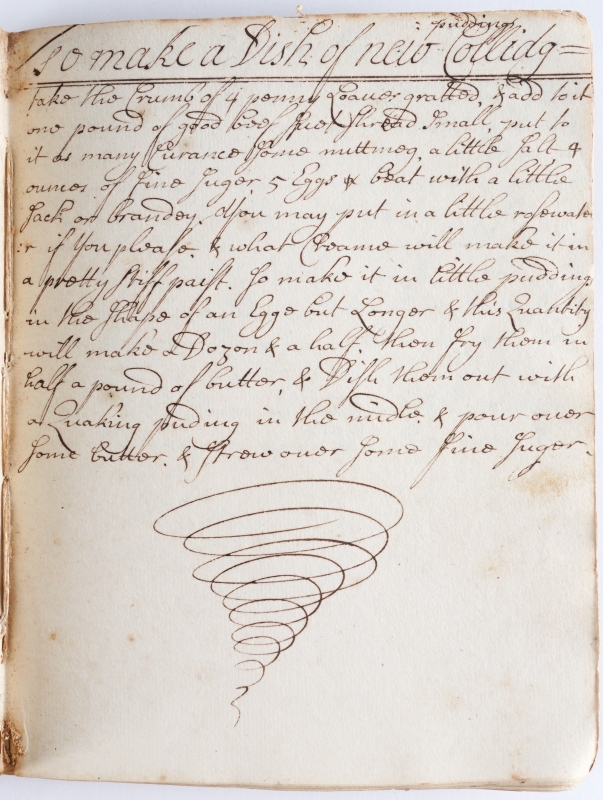
In addition, the manuscripts at the Wellcome Collection contain over 50 New College Pudding recipes, and when you add in recipes printed in books as well, there’s close to 100 recipes to choose from. For over three centuries this recipe was included in all the popular cookery books of the age, but their popularity waned in the 20th century, as more exotic sweet options became available.
This is a shame, since they are a wonderful example of making something delicious and satisfying from almost nothing. Stale breadcrumbs, suet and dried fruit, a bit of sugar, an egg or two and suddenly it’s a hearty, warm and comforting winter treat. Minor details have changed over time – little additions to improve the taste or changes in cooking methods. With the cold winter days fast approaching, and high food prices forcing our hand with affordable food choices – whatever your situation, there is a New College Pudding recipe for you!
New College Puddings have all the warmth, comfort and flavour of a steamed pudding, but without the hours and hours of boiling/steaming. Using breadcrumbs instead of flour means that the cooking time can be drastically reduced and the only ingredient that actually needs any cooking is the egg. The mixture can be fried, baked and/or steamed and no cooking method requires more than 30 minutes. The texture and flavour is a cross between a steamed pudding and Christmas cake, and if that sounds like something you’d enjoy, you’re not going to be disappointed.
I’ve selected four subtly-different recipes for you to try, ranging from the earliest recipe I could find, to the most elaborate. Whichever one you choose – and I do hope you’ll choose at least one – you’re in for a tasty and comforting treat.
A College Pudding – 17thC
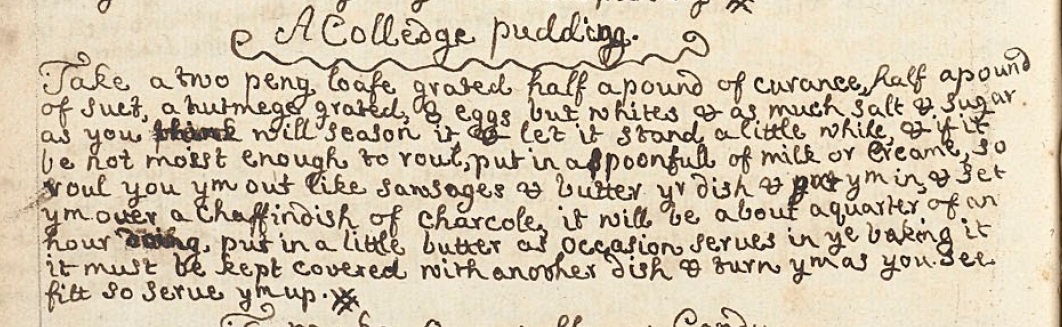
This is the earliest recipe I could find, definitely pre-1700, and its also one of the simplest. This quantity makes just 6 puddings – ideal for trying out to see if you like the style. There is no seasoning spice in this recipe, and, for me, it is noticeable by its absence. You might want to add 1tsp mixed spice just to get into the the steamed pudding mood.
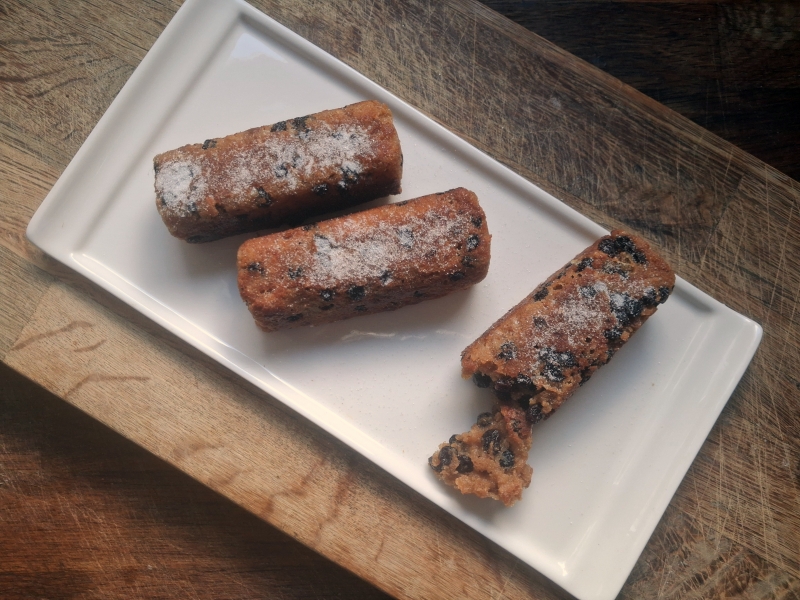
85g stale breadcrumbs
60g currants
50g dried suet (Atora brand in the UK, vegetarian or beef)
¼ tsp salt
1 tsp mixed spice (optional)
2-3 tbs packed dark brown sugar
1 large egg
1 large yolk
2tbs milk
milk to mix
butter for frying
caster sugar for sprinkling
- Put all of the dry ingredients in a bowl and stir together.
- Whisk the egg and yolk together, and add 2tbs milk.
- Stir the wet ingredients into the dry. Add more milk if required. The mixture needs to be moist enough to hold together if pressed, but still hold its shape.
- Rest for 15 minutes, to allow the liquid to be absorbed. If it’s still a little dry, add milk 1tbs at a time, until suitably moistened.
- Shape your puddings. I used my silicone mould of cylinders, but I appreciate that not everyone has as much kitchen stuff as I do, so an alternative method would be to
- divide the mixture into six.
- Form each roughly into a sausage shape.
- Wrap/roll each portion in plastic wrap.
- Twist the ends tightly, shaping the mix into a smooth cylinder.
- Chill the shaped mixture for at least 30 minutes in the fridge.
- When ready to cook, remove the chilled puddings from their moulds.
- Melt a generous lump of butter (about 50g) in a non-stick pan. Several of the recipes I’ve read advocate for huge quantities of fat – up to and including a pound of butter (but also suet, dripping and lard) – and for the pan to be constantly shaken to ensure the puddings don’t stick. Non-stick pans are our modern convenience for this.
- Fry the puddings over medium-low heat (5 on an induction hob) until browned on all sides.
- Remove the browned puddings from the pan and drain on paper towels.
- Sprinkle a little caster sugar over the puddings and serve hot.
New College Puddings – c1798
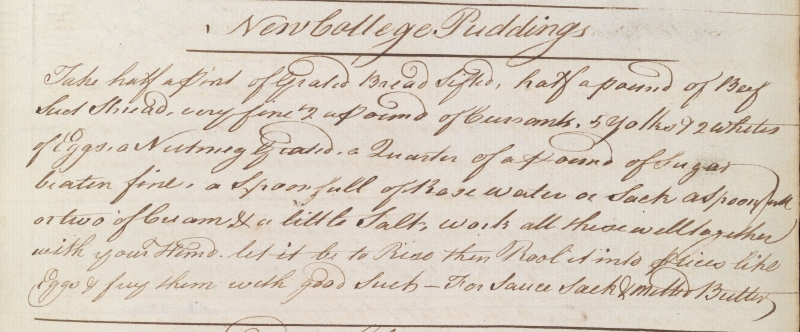
These puddings might be considered the next level in that there is a move to the overwhelmingly most popular/traditional shape, that of an egg. Other recipes I have read specify a turkey egg in size, which is roughly as broad as the palm of your hand, so a little more substantial in size. We also have the addition of spice in the form of nutmeg, and either some rosewater or sack to moisten the mix.
Finally, the dish is complemented with a wine and butter sauce. I chose to thicken the sauce with arrowroot, to give it a bit of body. You could substitute cornflour, but arrowroot is great for sauces as it thickens and clears, and also retains liquidity when cold, so the sauce pours well both hot and cold (in contrast to cornflour, which thickens a sauce when hot, but tends to set solid when cold). Arrowroot also thickens at a much lower temperature, well below boiling, and will actually lose its thickening qualities if it does boil, so you need to keep an eye on it.
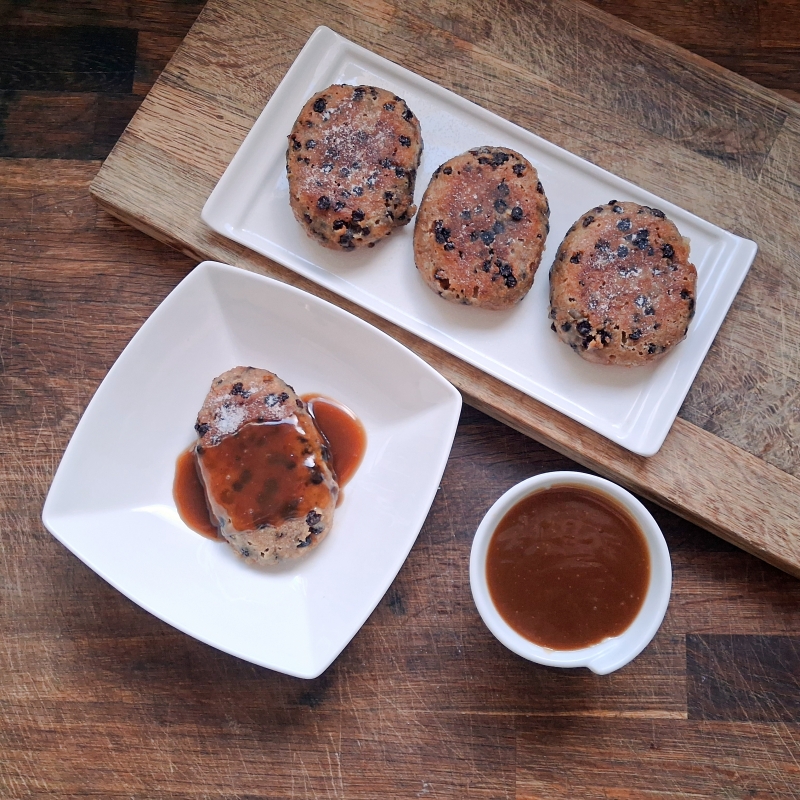
For the puddings
75g dry breadcrumbs
60g dried suet
75g currants
½ tsp salt
30g soft dark brown sugar
1tsp ground nutmeg
1 large egg
1tbs rosewater or sherry/mead/ginger wine/Madeira/any favourite fortified wine
2-3tbs single cream,
Sauce:
60g unsalted butter
2-3 tbs packed soft dark brown sugar
120ml sherry/mead/ginger wine/Madeira/any favourite fortified wine
2tsp arrowroot
1tbs water
water to dilute (optional)
- Put all of the dry ingredients in a bowl and stir together.
- Whisk the egg, alcohol and milk together.
- Stir the wet ingredients into the dry. Add more milk if required. The mixture needs to be moist enough to hold together if pressed, but still hold its shape.
- Rest for 15 minutes, to allow the liquid to be absorbed. If it’s still a little dry, add milk 1tbs at a time, until suitably moistened.
- Shape your puddings.
- Divide the mixture into 4 and place each portion onto some plastic wrap.
- Wrap the plastic around the mixture and press together into an oval shape.
- Set aside in the fridge until required
- Make your sauce:
- Melt the butter in a pan.
- Add the sugar and stir until the sugar is dissolved.
- Mix the arrowroot with the water until smooth, then add the wine.
- Pour the liquids into the sugar/butter mix.
- Stir together over medium heat until the sauce loses it’s milkiness and thickens.
- Taste your sauce and add water if liked. Since the sauce thickens below boiling point, a lot of the alcohol from the booze will still be present, so water it down if it’s all a bit much.
- Set aside until required.
- Fry your puddings:
- Melt 50g butter in a non-stick pan.
- Remove the plastic wrap from your puddings and place them in the pan.
- Fry gently on medium-low heat (5 on an induction hob) until browned on both sides and hot in the middle.
- Place puddings on/in a serving dish and sprinkle with caster sugar.
- Reheat your sauce and pour over the puddings, or pour into a dish/jug and serve alongside.
Baked New College Puddings – 1840s
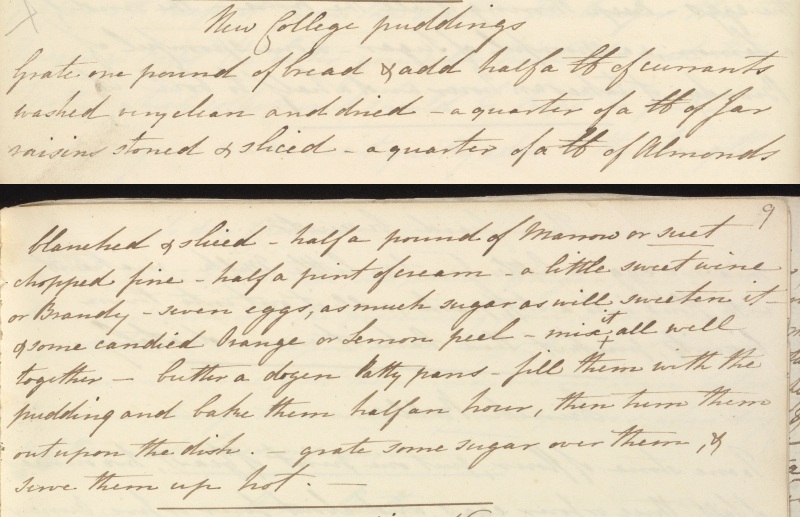
These puddings are pretty similar to the above recipe, but have been adapted to being baked in the oven in buttered teacups. Nowadays we have a plethora of baking tins and moulds to choose from, so these are easily the most ‘hands-off’ puddings of the four.
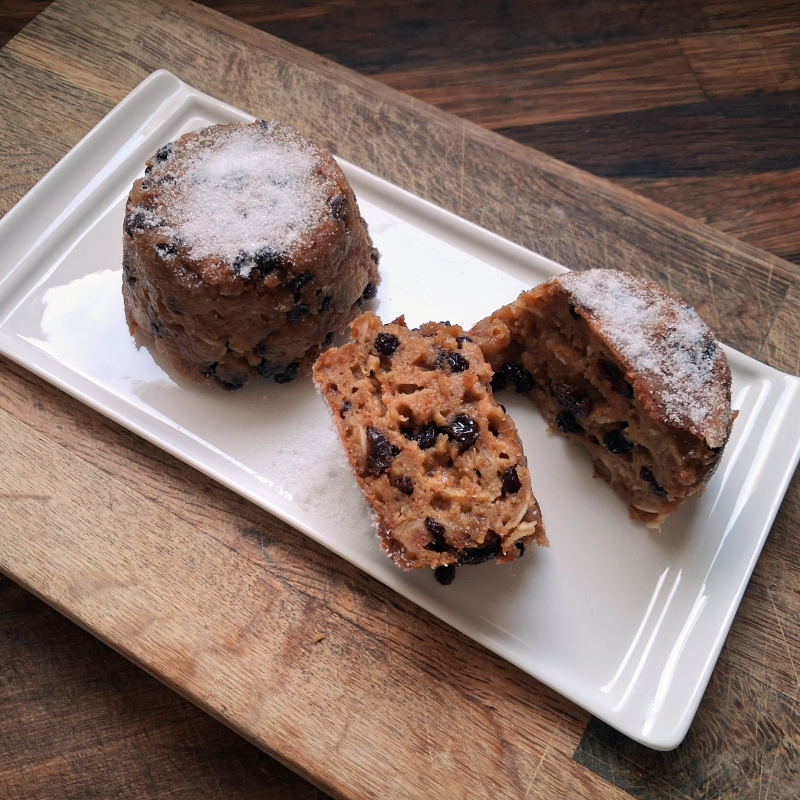
New College Puddings
120g breadcrumbs
60g currants,
30g raisins,
30g flaked almonds,
60g dried suet
30g candied orange or lemon peel, chopped fine
3-4tbs packed soft dark brown sugar
100ml double cream
2 tbs brandy
2 large eggs
4 individual pudding tins/large ramekins
butter for buttering the moulds
caster sugar for sprinkling
- Butter your moulds generously and set aside.
- Mix all the dry ingredients together in a bowl.
- Whisk the eggs, cream and brandy together and stir through the rest of the ingredients. Don’t worry about having the mixture wet enough to stick together – the shape of the moulds will do all the work. It is enough just to have the crumb moist.
- Divide the mixture into four and spoon into your pudding moulds/ramekins. Avoid pressing the mixture down, as it will make the resulting pudding dense and heavy. Cover each mould with foil, to retain moisture while baking.
- Heat the oven to 180°C/160°C Fan.
- Arrange the moulds on a baking tin and bake for 30 minutes, turning the tin around halfway through, to ensure even baking.
- Remove the puddings and allow to cool for 5 minutes, then turn out onto plates/serving dish.
- Sprinkle with caster sugar and serve.
Boiled and Fried Georgian New College Puddings – 1820s
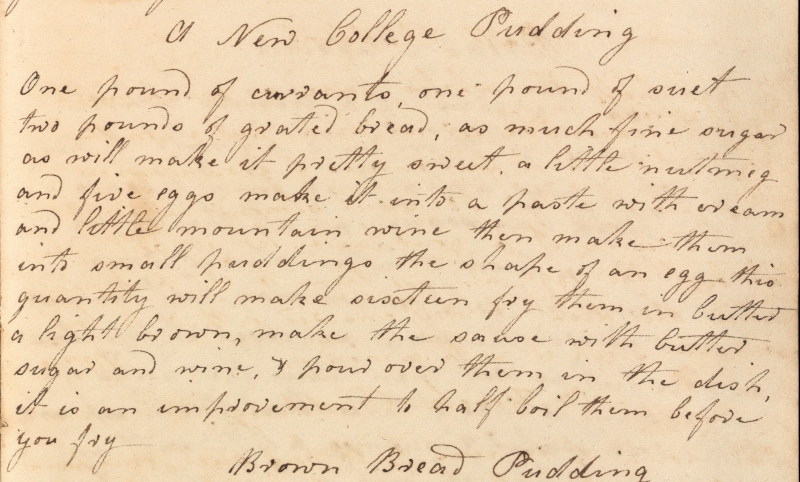
There’s nothing very surprising with these puddings as regards ingredients, other than perhaps all the extra flavourings, but I was taken with both the quantities – the original recipe was for 16 small puddings – and the suggested improved cooking method of half boiling (steaming) followed by frying. These puddings are served with a butter-wine sauce, exactly the same as the sauce above, but this time made with white sugar.
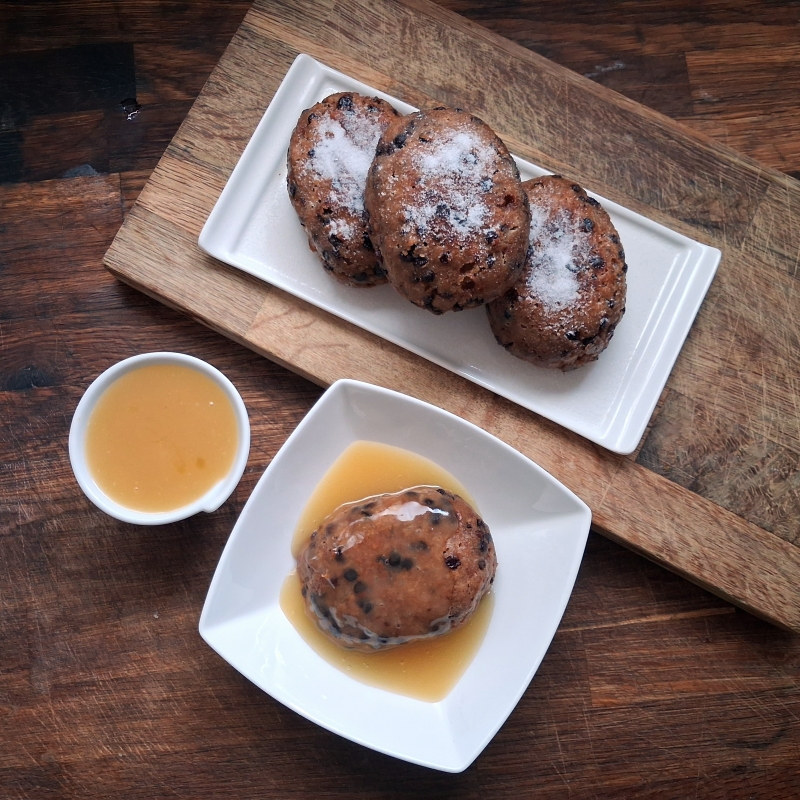
It was very straightforward to scale down this recipe and make just four puddings, but they turned out to be, relative to the other New College Puddings – enormous. The same egg shape mentioned in other recipes, just much larger. I’ve deliberately used the same flatware in each of the photos to give some idea of scale, so you can see that I was unable to get even three on the serving plate without stacking them. Having made these, I think the reason for suggesting boiling (steaming) first, before frying, is two-fold: to heat the puddings through and also to help the puddings hold together better. Steaming cooks the egg, which holds the fruit and breadcrumbs together, and frying gives the outside a delicious crisp and buttery finish. I steamed the puddings in plastic wrap before removing it and frying.
Georgian New College Puddings
You don’t HAVE to make four puddings – use the mixture to make smaller ones (either 6 or 8), depending on what you are serving beforehand, as well as your guests’ appetites.
For the puddings
115g currants
115g currants
225g breadcrumbs
100g soft dark brown sugar
1½ tsp ground nutmeg
1 large egg
2tbs sherry/Madeira/Marsala or other fortified wine
60ml single cream, plus more to moisten
100g butter to fry
caster sugar for sprinkling
Sauce
60g unsalted butter
2-3 tbs white caster/granulated sugar
120ml sherry/mead/ginger wine/Madeira/any favourite fortified wine
2tsp arrowroot
1tbs water
water to dilute (optional)
- Mix all the dry ingredients together in a bowl.
- Whisk the egg, wine and cream together and stir through the rest of the ingredients.
- Divide the mixture into four and spoon onto squares of plastic wrap.
- Twist the plastic wrap around the filling and shape into an oval.
- Place the shaped puddings into a steamer pan, with the plastic wrap ‘seal’ underneath. Cover the pan with a lid.
- Bring a saucepan of water to a boil and place the covered steamer pan on top. Steam for 20 minutes.
- While your puddings are steaming, make the sauce.
- Melt the butter in a pan.
- Add the sugar and stir until the sugar is dissolved.
- Mix the arrowroot with the water until smooth, then add the wine.
- Pour the liquids into the sugar/butter mix.
- Stir together over medium heat until the sauce loses it’s milky appearance and thickens.
- Taste your sauce and add water if liked. Since the sauce thickens below boiling point, a lot of the alcohol will be retained, so water it down if it’s all a bit much. Set aside until required
- Remove the steamer pan from over the hot water and set aside for 5 minutes to cool a little.
- In a large frying pan, melt the butter.
- Unwrap each pudding and place into the pan. Fry a golden brown on each side.
- Remove the puddings from the pan and drain on kitchen paper.
- Reheat the sauce and pour into a mall serving jug.
- Transfer the puddings to your serving dish and sprinkle with caster sugar.
- Serve the puddings with the sauce alongside.

