
Personal recipe books can be quite eclectic in the mix of recipes the owner chooses to include. Quite apart from the recipes they (or if you’re a wealthy noblewoman, your scribe) include, there can also be hurried notes scribbled down on scraps of paper or the backs of envelopes, letters and cards answering requests for recipes, as well as clippings from newspapers and magazines.
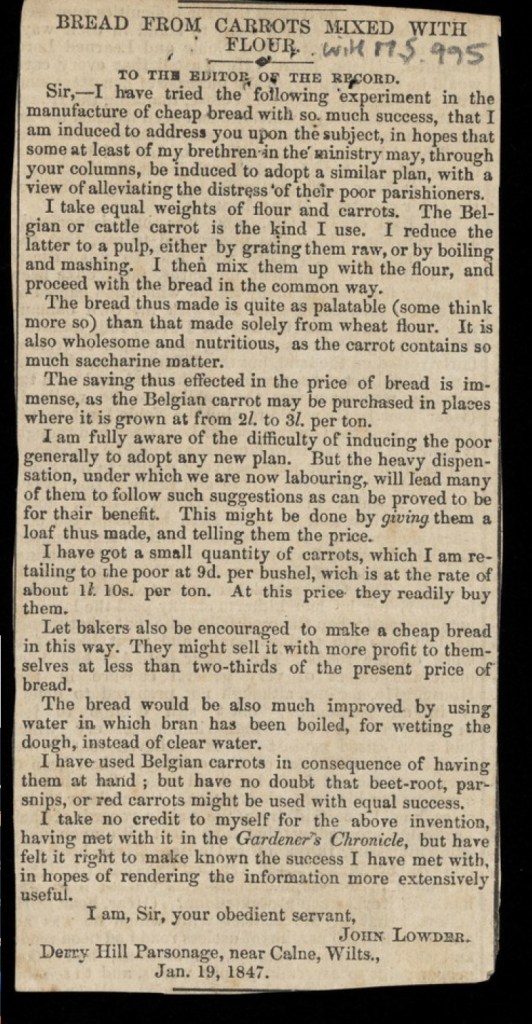
This recipe was found between the pages of Catherine Ashley’s household book, dated circa 1830 (MS.995, held by The Wellcome Collection). It had been clipped from The Record, a twice-weekly religious newspaper, in January, 1847. The author, The Rev. John Lowder, had experimented with using carrots to make bread after reading an article in The Gardeners’ Chronicle in December 1846. He wrote to the editor of The Record in the hope that by sharing his findings, his clergy brethren might find the results useful for their own poor and needy.
The article in The Gardeners’ Chronicle had detailed an open correspondence between The Right Hon. T.F.Kennedy, Paymaster General for the Irish Civil Service and Henry Labouchere, the then Secretary of State for Ireland in the government of Lord John Russell (1846-1852). In it, Kennedy suggested that experiments done in Austria on the supplementing of flour with beetroot to make bread might help with the (then early stages) of the potato disaster in Ireland. Growing beetroot on just one acre, he maintained, would produce a crop of £30 value, with a clear profit of £15 to the grower, and provide valuable supplementary nutrition to the Irish poor, being of a much higher value than potatoes. Although noble, this idea falls at the first hurdle because the poor in Ireland were eating potatoes precisely because they did not have access to the flour needed for this scheme to work.
Parsnips were also used in experiments and were deemed excellent, but carrots were not, with the reason being given as carrots were “much less palatable.”
Enter the Rev. Lowder with his own efforts, whereby he succeeded in producing delicious carrot bread by cooking and pureeing the carrots first, whereas the original experiments had been done by grating the raw vegetables.
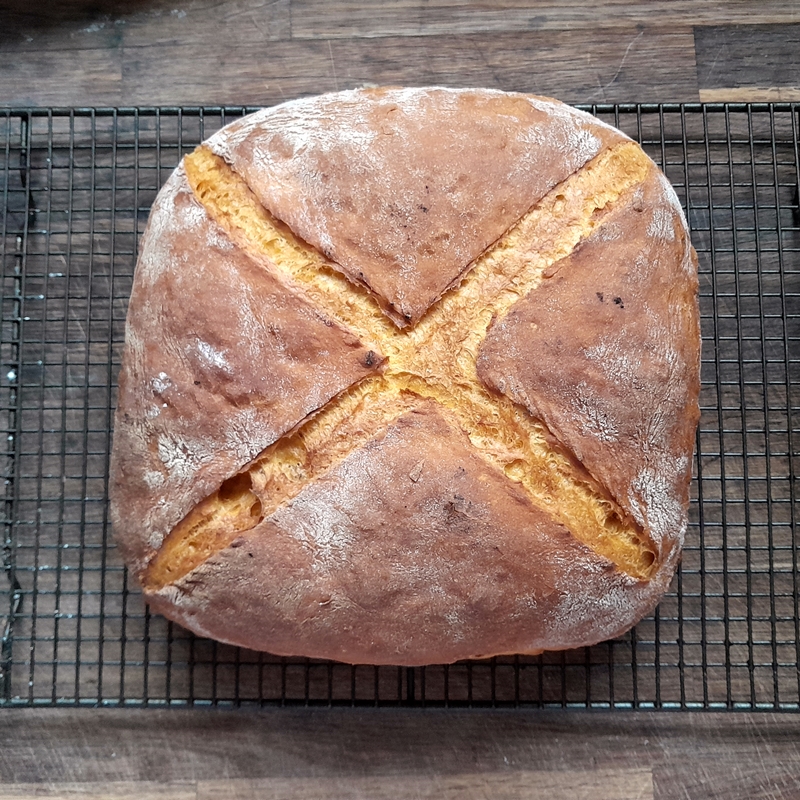
The recipe is simple: equal weights of (pureed, cooked) carrot and flour mixed together, and then continued with the usual bread-making method. I thought this almost too good to be true and put it to the test by adding only salt and yeast. The result is the loaf picture above. I added no water, bar the 2-3 tablespoons of carrot water needed to get the carrots pureed. In all honesty, it looked too moist in the initial mixing, but I had faith and decided to wait and see what the first rise made of it. The resulting dough after an hour was gloriously light and very lithe and needed only the briefest of shaping before putting it into a 20cm/8″ square tin. Another rise of 30 minutes was followed with a 40 minute bake. The loaf was cooled on a rack overnight before being sliced.
I appreciate that the use of white bread flour is probably of a finer quality than that employed by the good Reverend Lowder in his experimentation, but I made that call in order to give the recipe its best chance of success.
Shortly after this recipe was published (1848) Reverend Lowder moved half a world away, with his wife and five children, to China, after being appointed Chaplain of Shanghai. Heartrendingly, he would perish in a swimming tragedy shortly thereafter (September, 1849) at the age of just thirty-nine.
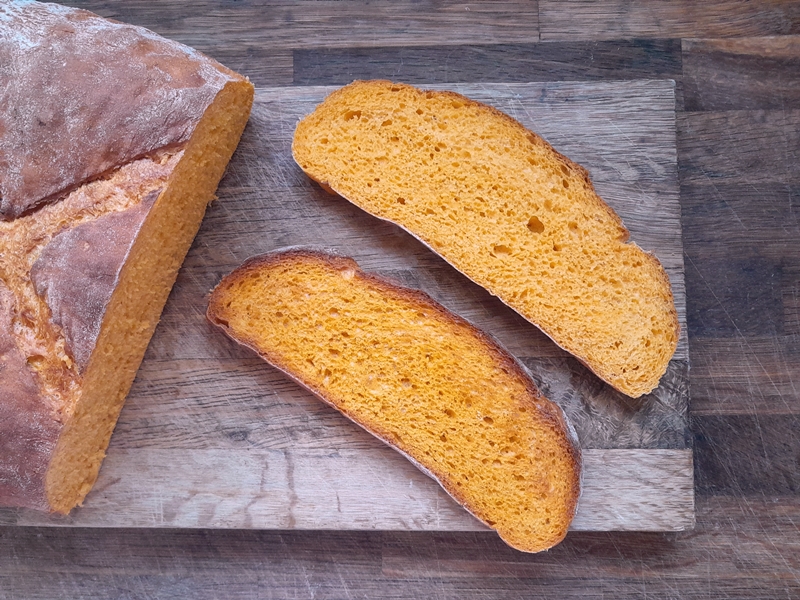
As can be seen in the photo above, the colour of the crumb is glorious. Given the vibrancy, it’s surprising that there isn’t more carrot flavour. The texture is soft, with a slight chew, similar to potato bread. When toasted, the colour changes very little – the darkening of the crust around the edges being the main indicator. There is a suspicion of roasted carrot in the flavour, and if you’re eating it with anything other than butter, you might miss it altogether. Overall, I’m really liking this new (to me) recipe – it will definitely be making a regular appearance in this household.
Carrot Bread
Since proportions of flour and carrot are the only specifications, although I’ve not tried it yet, I see no reason why carrots left over from a previous meal might not be successfully used in this recipe, adding plain water if necessary for a smooth puree. If the total of puree + flour is less than 700g, then only one sachet of yeast would be needed, and half the salt. Some accent spices could also be added, such as caraway or cumin seeds.
500g carrots, peeled and sliced
500g strong white flour
10g salt
2 sachets fast action yeast
- Put the carrots into a saucepan, cover with water and bring to a simmer.
- Cook until tender all the way through – between 20-30 minutes, depending on the size of the carrot pieces.
- When cooked, strain (reserving the liquid) and puree in a liquidiser or using a stick blender. Add a little of the cooking water if the carrots aren’t blending easily.
- When pureed and smooth, set aside for 10 minutes to cool slightly, in order to not adversely affect the yeast.
- When just warm, put the carrots and the rest of the ingredients into a bowl and bring together as a dough. Knead either by hand or using a dough hook for 10 minutes.
- Cover and allow to rise for 1 hour.
- Tip out the risen dough onto a lightly floured surface and gently deflate.
- Shape and add to your tin of choice. I used a 20cm/8 inch square tin lined with baking parchment. If you use a different shaped tin, you might have to adjust the cooking time accordingly.
- Allow to rise for a further 30 minutes.
- Heat the oven to 220°C/200°C Fan.
- Just before putting your loaf in the oven, cut some slashes in the top crust to prevent it rising unevenly during the initial ‘oven spring’. Bake for 35-40 minutes until well risen and with the crust firm. You might want to remove your loaf from the tin and return it to the oven to bake for another 5-10 minutes in order to really crisp up the crust.
- Cool on a wire rack.
- Slice when cold.
 Deja Food