Summer Ice-creams

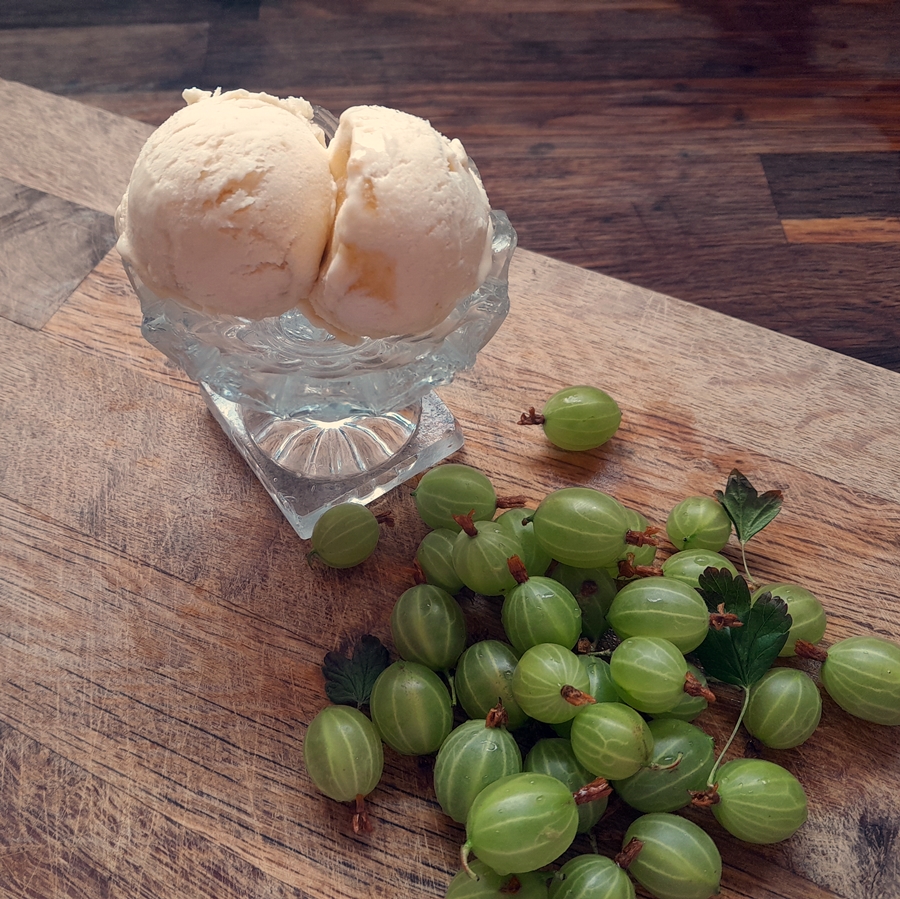
The brief green gooseberry season is upon us and their delicate but sharp taste is a wonderfully aromatic taste of summer. Reddish dessert gooseberries ripen later in the season, but the sharpness of the green is my preference. They’re a thorny bush, so be prepared for having multiple jabs in your hands. I picked some at a local Pick Your Own fruit farm. Top Tip: most berries conceal themselves on the undersides of branches, so always lift them up for maximum harvesting efficiency. If your local fruit farm doesn’t have PYO gooseberries (and many don’t, sadly) they can also sometimes be found in the freezer of your local Farm Shop.

After laying down a batch of my bi-annual batch of gooseberry vinegar (a doddle to make, but a year in the fermenting/clearing), I decided to make a batch of gooseberry ice-cream. As the owner of a tiny kitchen (2m x 3m), I have neither the counter/cupboard space for an ice-cream maker, nor the patience to keep stirring a semi-frozen mixture in order to break up the ice-crystals, so the ‘set it and forget it’ no-churn recipe employing sweetened condensed milk is pretty much a no-brainer in this household.

The method is practically the same as that given for Damson Ice-Cream from a couple of years ago: Mix most of a fruit puree into the cream/milk mixture, then ripple through a ribbon of the remaining puree and set in the freezer.

The means of obtaining your gooseberry puree is a little different than usual, mainly due to their water content, which will wreak icy-crystal havoc with your ice-cream if it is too high. Rather than simmer with water until they break down, the gooseberries are coddled in a closed vessel over simmering water. The result will be a clear-ish liquid (which can be poured off) and the fruit pulp, which is then used for the ice-cream. This approach preserves not only the colour, but also the flavour, as prolonged cooking and/or high heat impairs both.

The second recipe is my re-creation of an ice-cream I had several years ago in Yorkshire. It’s actually not really a summer ice-cream, because citrus isn’t really in season in July, but oranges are in the shops and marmalade is on the shelves, and I am in love with it, so here we are.

The bitterness of Seville oranges, just as the tartness of gooseberries, is the perfect pairing with this ice-cream method, because the condensed milk is SO sweet, it needs something sharp to cut through all that sugar. Interestingly, in developing this version, I did learn that there is such a thing as too much bitterness. An early version contained both the zest and juice of Seville oranges (which I keep in my freezer as frozen cubes for year-round zestiness), and while I liked the end result, it really leaned heavily into bitterness, so I had to dial it back somewhat. This version uses the zest of regular oranges and no juice, with the slivers of peel from the marmalade providing delicious pops of intense Seville bitterness, tempered with sugar.

Both of these ice-creams will need to be removed from the freezer for 20-30 minutes before serving, in order to soften.

Gooseberry Ice-Cream

I have left the gooseberries without sugar, as there is more than enough sweetness with the condensed milk. Feel free to add some sugar if you feel they need it.

500g green gooseberries

1 x 397g tin of sweetened condensed milk
600ml double cream

  • Put the gooseberries in a lidded pan without any additional water and set it inside a larger pan. Add water until the larger pan is half filled. Heat over medium high heat until the water is simmering and coddle the gooseberries until soft. if you don’t have suitable pans to do this, you can put them into a casserole with a close-fitting lid and bake in the oven at 170°C, 150°C Fan. for 20-30 minutes.
  • Tip the coddled gooseberries into a sieve over a bowl and allow the clear liquid to drain through. Set the liquid aside.
  • Rub the gooseberry pulp through the sieve until all that remains are the seeds. Discard the seeds and set the pulp aside to cool.
  • Put the condensed milk and double cream into a bowl and whisk together until light and billowly.
  • Fold through 3/4 of the gooseberry pulp until well combined.
  • Spoon the ice-cream mixture into containers and then stir through the remaining puree in a ripple.
  • Cover and freeze at least overnight before serving.
  • Waste not, want not: You can add sugar to the clear gooseberry liquid and simmer it down to a syrup to pour over your ice-cream.
  • Bonus: Add a splash of elderflower cordial to taste to the puree, but beware of adding too much liquid.

Marmalade Cheesecake Ice-Cream

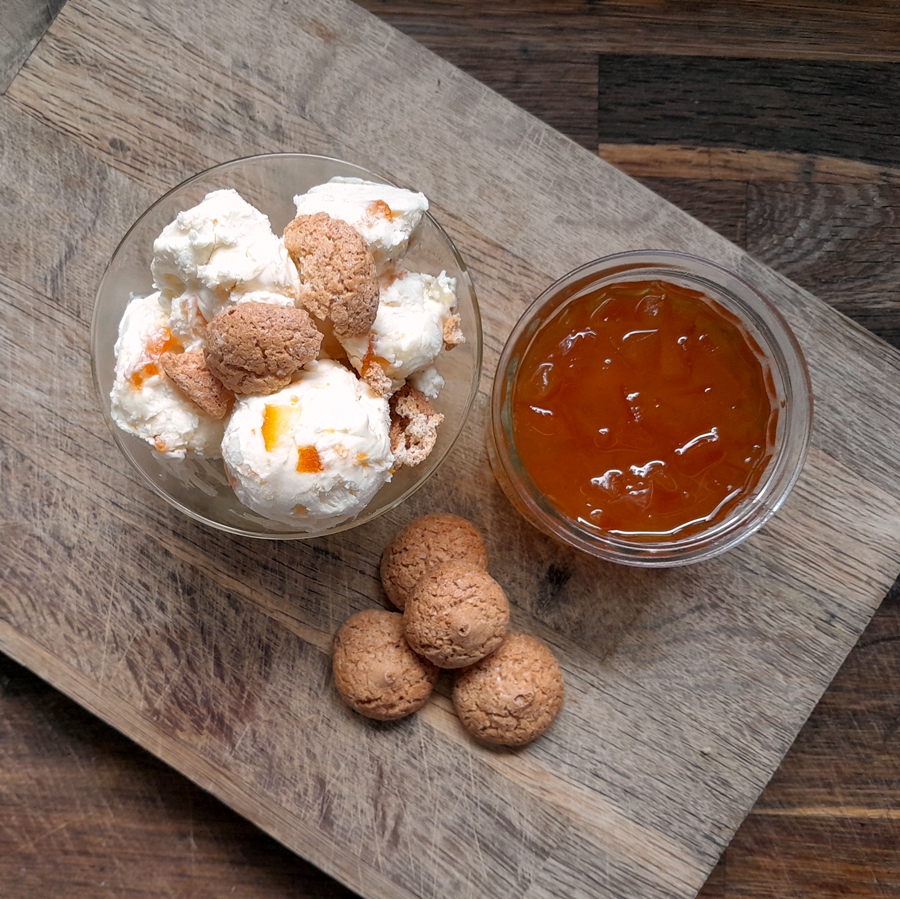
There is a slight difference in the method of this ice-cream, in order to get the cream cheese fully incorporated with the other ingredients. There’s no added sugar, as the condensed milk add more than enough. The amount of marmalade you’ll need will depend very much on the whatever marmalade you are using. I used a jar of my Dundee Marmalade, which is quite peel-heavy, so I only needed one jar.  Top Tip: An efficient way to get your marmalade shreds separated from your marmalade jelly, tip your jar(s) of marmalade into a pan and warm it gently until the jelly liquefies, then pour it through a sieve over a bowl. The jelly can then be poured back into the jar(s) for use later. Cut your shreds into smaller pieces if liked.
100g of orange shreds from your favourite marmalade – about half a cup.

zest of 3 oranges
330g cream cheese, Philadelphia for preference – at room temperature
1 x 397g tin of sweetened condensed milk
600ml double cream

  • Put the orange zest and cream cheese into a bowl and whisk until smooth.
  • Pour in the condensed milk and whisk again until smooth.
  • Add the double cream and whisk until light and billowy.
  • Stir through the marmalade shreds.
  • Spoon the ice-cream mixture into containers.
  • Cover and freeze at least overnight before serving.

Serving suggestion

To emulate a regular cheesecake, serve with some crisp/crunchy biscuits – Digestive biscuits/Graham crackers are a favourite. I used amaretti in the picture because that’s what I had, and regular readers will know we don’t make special trips to the supermarket for just one ingredient.
Old Fashioned Cheesecakes

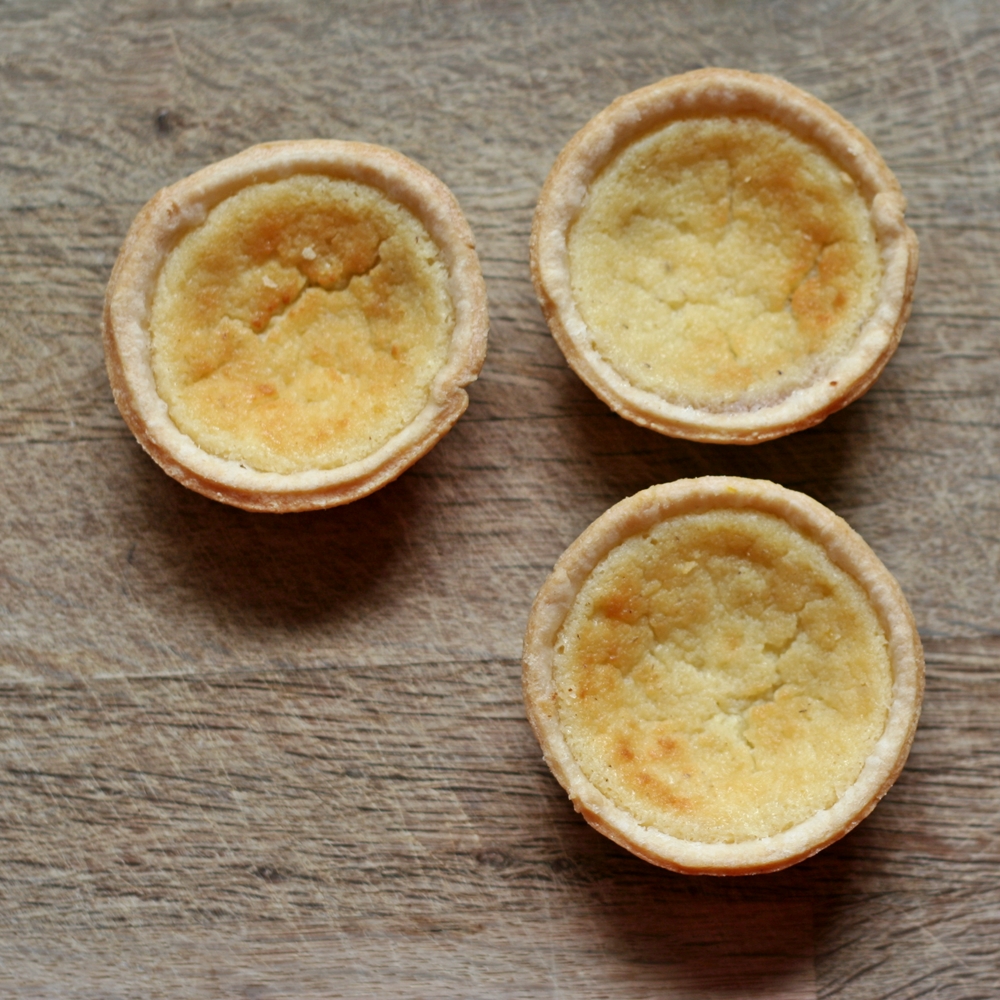
These cheesecake recipes come from a favourite book – All About Pastries, from the All About… Confectionery Series by H.G.Harris & S.P Borella (circa 1900). The recipes are all for commercial quantities, but I’ve become quite adept at scaling them down to more manageable batches.

They were simpler times back then, and ‘cheesecakes’ weren’t always made of the cream cheese that is so widespread today. Much as the term ‘pudding’ originally described a texture, thus accounting for its use to describe both savoury black/white puddings, and sweet Kentish pudding pies, ‘cheesecake’ was used to describe a soft and light texture in a pastry case.

Before refrigeration, cheese curds weren’t available year round, especially as cows were sometime slaughtered in the winter when food sources were scarce. So with typical ingenuity, recipes were developed to achieve the same delicious morsel using other ingredients. Ground almonds were popular, and in commercial bakeries, cake, biscuit and bread crumbs have all been employed to produce a tender tartlet filling.

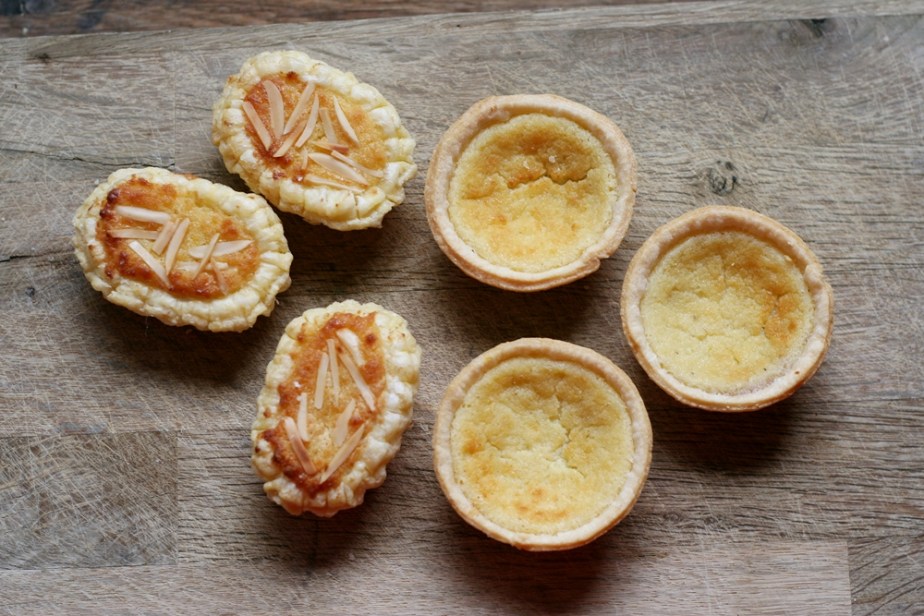
These two cheesecakes provide a nice comparison, because they also illustrate how one’s choice of pastry can affect the overall success of a recipe.

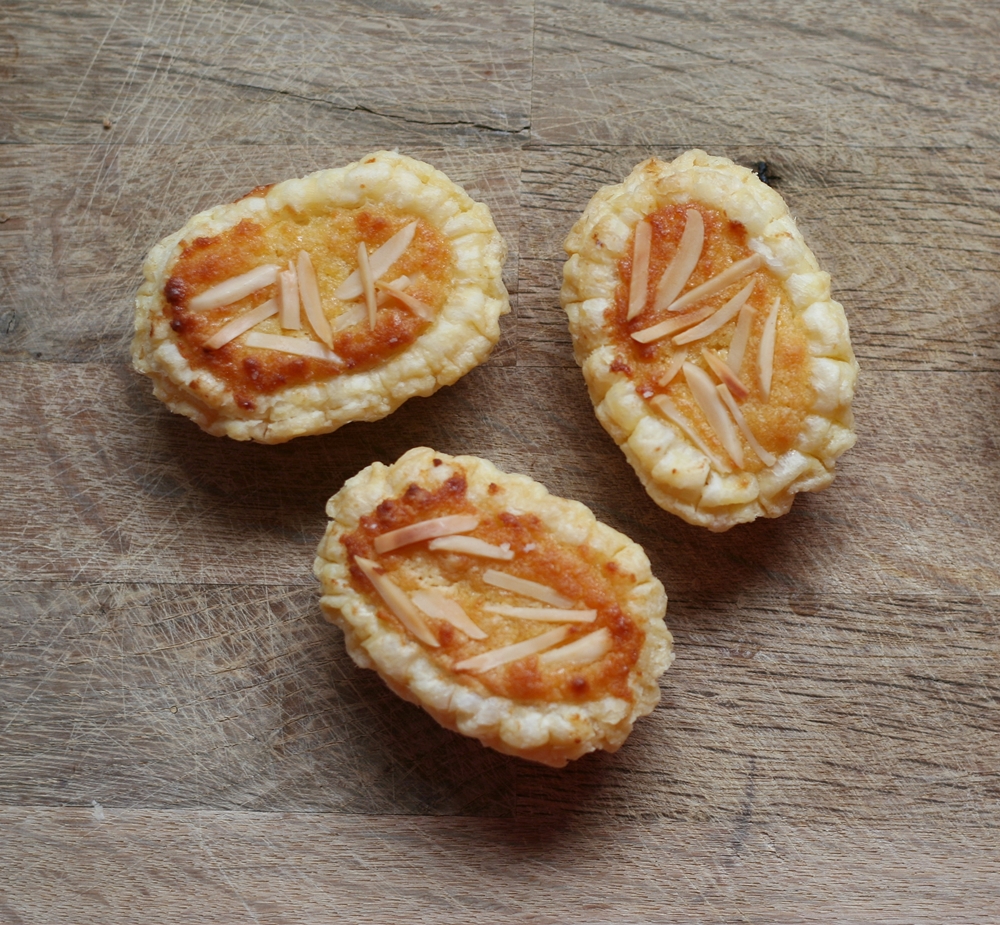
In the photograph above, the cheesecakes on the left are made with sieved cooked potato. The tartlets on the right are made with curd cheese. The cheesecakes on the left are made with buttery puff pastry, while the ones on the right are made with a very dry and crisp cornflour shortcrust. This is the combination of filling and pastry recommended in the book, but for science I decided also to swap them round, and bake the potato filling in shortcrust and the curd filling in puff pastry. It was not a success. Or rather, it was successful in confirming my belief that contrast is everything.

  • When the filling is rich, use a plain, unsweetened pastry.
  • When the filling is humble, use a rich, butter pastry.

This rule is of mutual benefit, because of the contrast between the two. The pastry adds a texture as well as a flavour contrast to the filling. Baking the rich filling with the butter pastry just made for a finished tartlet that was both heavy and overly greasy. Baking the potato filling with the crisp shortcrust made for a disappointing dry and desiccated bite. Bear this need for contrast in mind as you create your own pastry/filling combinations.

Potato Cheesecakes

Potato Cheesecakes

If you don’t have any maraschino, you could use a little lemon or orange zest, or almond/vanilla instead.

Potato Filling
75g cooked, sieved floury potato
75g unsalted butter – softened
1tsp maraschino liqueur
60g ground almonds
60g caster sugar
1 large egg
1 large yolk

  • Press the potato through a sieve. This is easiest when the potato is still warm.
  • Add the butter and maraschino and beat together until light and fluffy.
  • Whisk the egg and the yolk together, then whisk into the potato mixture.
  • Whisk in the ground almonds.
  • Add the sugar and just stir it enough to combine.
  • Transfer to a container, cover and chill for at least 30 minutes.

To assemble
2 sheets ready rolled puff pastry, all-butter if available
raspberry jam
a few slivered almonds to decorate
small fluted tartlet tins approx. 5cm in diameter

  • Grease the tartlet tins.
  • Unroll the pastry and cut into rectangles the approximate size of your tins.
  • Line the tins with the pastry, making sure to press it firmly into the fluted sides.
  • Using the ball of your thumb, press the base of the tart thin, thereby easing the edges of the pastry up the sides of the tin. If it rises above the top edge, that’s fine.
  • Chill the lined tins in the fridge for at least 30 minutes, to relax the pastry.
  • When the filling and pastry are thoroughly chilled, remove from the fridge.
  • Trim the pastry flush with the top edge of the tartlet tins using a sharp knife.
  • Put half a teaspoon of jam into the bottom of each tart case
  • Fill the tartlets 2/3 full with the potato filling , making sure it is spread to the sides of the pastry (to prevent the jam from bubbling up/through).
  • Scatter a few slivers of almond over the top.
  • Heat the oven to 210°C/190°C Fan.
  • Bake until the pastry is cooked and the filling puffed and browned. This will take 15-20 minutes. You need to judge how cooked you want your pastry to be. In the picture above, the pastry is baked, but not browned and the filling a delicate colour. Longer baking will brown the pastry, but the filling will also darken considerably, unless you cover them. Given the delicate nature of the filling, I think the lighter colour on the pastry is more suitable, but it’s only a personal preference.
  • Allow to cool in the tins for 10 minutes before removing to a wire rack.
  • Serve at room temperature.

Curd Cheesecakes

Curd Cheesecakes

Pastry
225g plain flour
60g cornflour
140g unsalted butter
ice cold water

  • Put the flours and butter into the bowl of a food processor and blitz until the mixture resembles breadcrumbs.
  • With the machine running, gradually add the cold water a tablespoon at a time until the mixture comes together in a ball.
  • Tip the mixture onto a floured surface, knead smooth then wrap in clingfilm and chill for 30 minutes.
  • Grease some tartlet or cupcake tins.
  • Remove the pastry from the fridge and roll out to a thickness of 4-5mm.
  • Cut out circles using a pastry cutter the same diameter as your tin indentations. Turn them over (so the side rolled by the rolling-pin is against the metal of the tin) and smooth into the sides of the tins.
  • Using your thumb, press the pastry on the base of the tins thin. This motion will ease the edge of the pastry to the top of the tins.
  • Chill the tin in the fridge while the filling is mixed.

Curd Filling
150g curd cheese, well drained
75g unsalted butter, softened
50g caster sugar
1 large egg
zest of 1/2-1 lemon, according to taste
1/4 nutmeg, grated

  • Sieve the curd. Don’t skip this step, thinking that it is soft enough. Forcing the curd through a sieve gives it an incredible lightness which allows it to combine smoothly and easily with the other ingredients. Since there will be some loss in the process,  the actual amount required for the recipe is 115g.
  • Whisk the butter and sugar together until light and creamy.
  • Add the egg and whisk in thoroughly.
  • Add the flavourings, then lightly stir in the curd.
  • Chill until required.

To Assemble
raspberry jam
small fluted tartlet tins approx. 5cm in diameter

  • Put half a teaspoon of jam into the bottom of each tart case
  • Half fill the tartlets with the curd filling , making sure it is spread to the sides of the pastry with no gap (to prevent the jam from bubbling up/through).
  • Heat the oven to 200°C/180°C Fan.
  • Bake until the pastry is cooked and crisp and the filling puffed – 15-20 minutes. The filling will lose its puff as it cools. This is normal.
  • Allow to cool in the tins for a few minutes before transferring to a wire rack to cool completely.
  • Serve at room temperature.