Candied Cranberries

Here’s a recipe you might want to try when fresh cranberries are back in the shops.

After discovering the joys of home-candied peel a few years ago, I have since tried my hand at several different fruits. With it being the season for mincemeat and fruit cake decorating, when I spotted some punnets of fresh cranberries on sale, I thought I’d give them a try.

Hunting around on the internet, it seems many people’s idea of candied cranberries is to dip them in egg-white and roll them in caster sugar. Beautiful and festive and twinkly-frosty, but not really candied in the traditional sense.

I also found no recipes on the traditional method of candying for these particular berries, so I thought I’d make up my own, based on the many examples of preserving recipes I’ve found in various manuscript books.

My method is a combination of the old-fashioned method of making conserves with delicate fruit, and how to make sloe gin *hic!*

This recipe takes about a week, but your active involvement is little more than an hour. Over the week, the delicate berries will gradually exchange their juice for sugar, making the cranberries more robust the more sugar they absorb, and as a bonus you’ll get a beautifully-coloured cranberry syrup.

For ease, select a pan you can get by without using for a week.

Candied Cranberries

1kg fresh cranberries
1kg caster sugar

  • Poke holes in each cranberry with a cocktail stick in order to let the juice out (and the sugar in). You don’t have to be too fastidious – I made about 5 or 6 holes around the middle.
  • Layer the cranberries and the caster sugar in a pan – a wide pan is better than tall saucepan, for ease of gently moving the berries around later.  Leave for 24 hours. The sugar will draw out some of the juice.
  • Next day, heat the pan very gently to melt the sugar. You’ll probably have to add a little water to get it started – about 1/2 a cup. Shake, don’t stir – or if you absolutely have to, stir very gently. Vigorous stirring and/or heating will cause the berries to burst. Some will burst anyway, but try and keep that at a minimum by being gentle.
  • Once the sugar is melted, turn off the heat, cover, and leave 24 hours. As the sugar is absorbed by the cranberries, they will gradually become more robust, but for the first day or two, you’ll need to be careful.
  • Repeat the heating gently for 5 minutes then leaving overnight for 5 days. Gradually the syrup will become redder and the cranberries more jewel-like.
  • After 5 days, warm the syrup (to make it easier to drain) and pour through a sieve to separate the cranberries from the syrup.
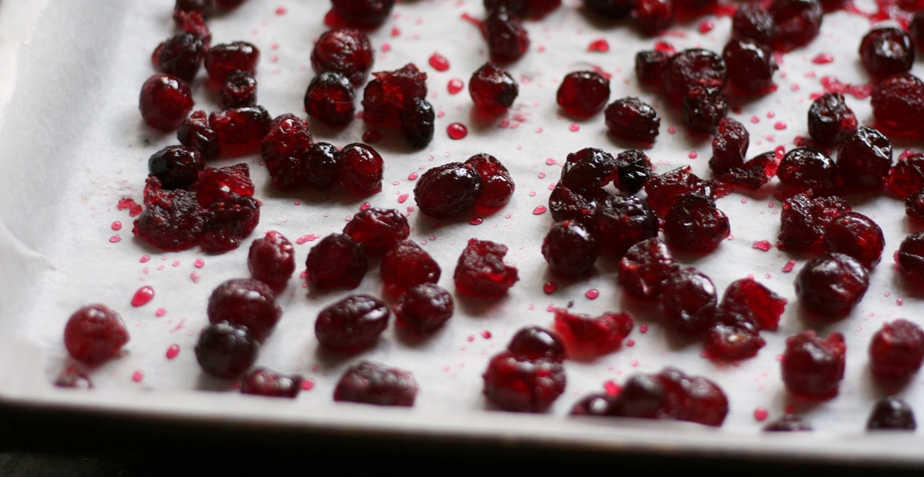
  • To finish, the cranberries need to dry a little, so line 2 large baking sheets with parchment and scatter the candied cranberries over. Try and get them separated, to facilitate drying, but there will be some squished ones you can’t do much about at this stage.
  • Last thing at night, put the trays in the oven and turn the heat to 170°C/150°C Fan for 5 minutes, then turn off and leave to dry overnight.
  • Repeat the drying next day – 170°C/150°C Fan for 5 minutes then turn off and leave to dry. If extremely sticky, they might need another overnight drying (I did Friday night/Saturday day/Saturday night).
  • Once only slightly tacky to the touch, they’re ready to use. I sorted mine into 3 groups: Perfect ones went back into the syrup (to keep moist) to use as decorations. I dipped a few of the not-so-perfect ones in dark chocolate, and rolled the rest in caster sugar and stored in a ziplock bag. The exploded ones I chopped and put in a jar for mincemeat.

Honey Curd

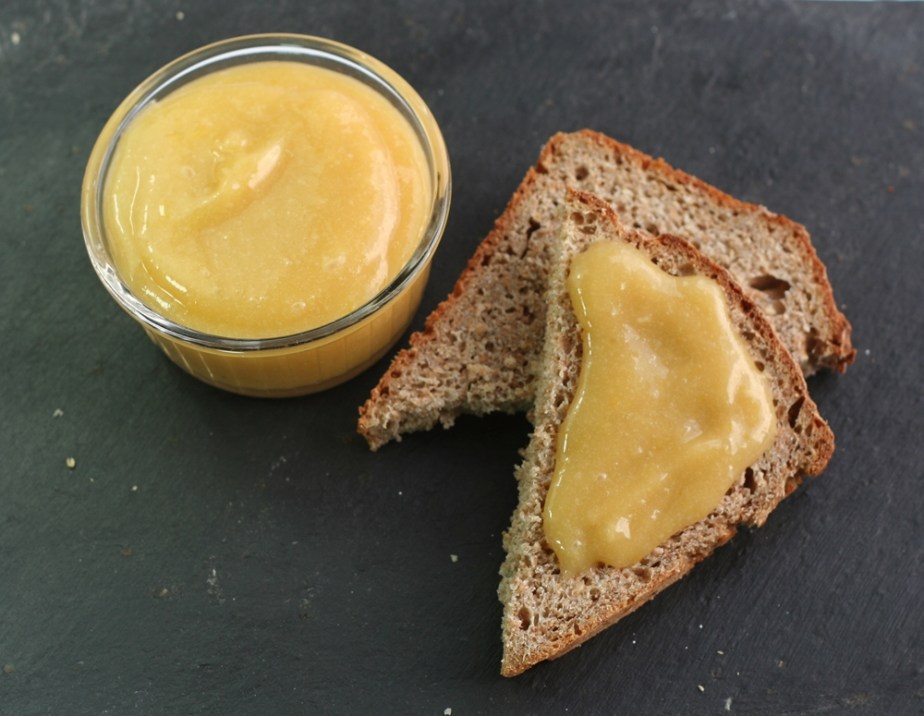
This recipe was an absolute delight to discover in an old Women’s Institute recipe book. For a start, the use of honey instead of refined sugar is so much better for you, and it increases the keeping properties immensely. The original recipe claimed that it would keep a year.

I used the cheapest, runny honey to see how much the flavour of the honey impacted on the final result, and it’s not overly intrusive – just a gentle hint at the end.

The real beauty of this recipe is how you can tweak both the honey and the accompanying fruit to give an almost limitless variety – Lime Tree Honey and limes, Orange Blossom Honey and oranges are just a couple of suggestions that sprung into my mind. Update: I have now tried both these flavour combinations, and can honestly say, hand on heart, that they are two of the most sublime-tasting citrus curds I have EVER tasted.

This recipe will make double the quantity of honey, so you’ll need just one extra jar in addition to your jar of honey. Wash both jars and lids and put them into a cold oven. Turn the oven on to 100°C, 80°C Fan until dry and hot.

As for the instructions, they couldn’t be easier. The original recipe contained just one line of instruction, but I’ve managed to pad that out to four!

Honey Curd

340g jar of runny honey[1]
2 large eggs
1 large yolk
zest and juice of 1 lemon
juice of 1 extra lemon
45g clarified butter

  • Put all of the ingredients into a small pan and whisk together over a low heat until thickened.
  • Pour into the clean, warm jars and seal.
  • Set aside to cool.
  • Use as any other curd – the original recipe recommends it as a filling for little tarts.

[1] Don’t be too precious about being exact –  I only specify 340ml because that’s how much honey was in the jar that I used. 300ml-ish is fine.

Apricot Jam

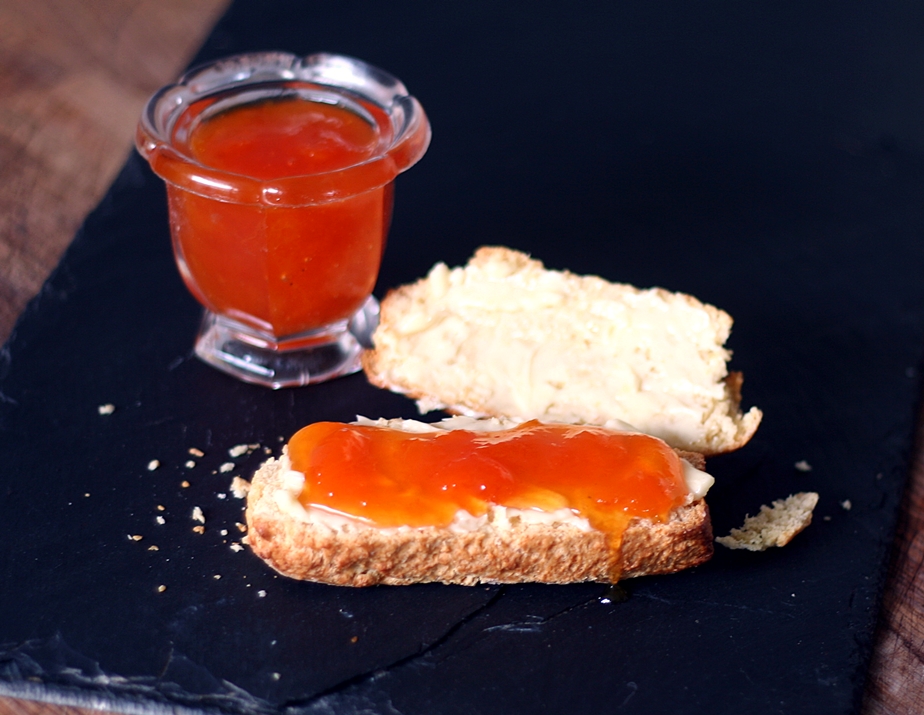
I’m a big fan of the sharp-sweet tang of apricots, and with a respectable amount of pectin, there’s no need to Faff About™ adding any extra. The small quantity lemon juice helps anyway, both in the set and in sharpening the flavour of the apricots.

This method, gleaned from several hand-written 17th century manuscripts, is slightly longer than your regular jam-making session might be, but it is seriously low on effort. Start-to-finish, it’s about 24 hours, but of that, there’s maybe only 1 hour of actually doing anything – bonus!

The result is so vibrant, so delicious, you’ll wish you’d made more – however many jars you make. I bought 6 x 350g punnets – and made six jars. One jar of finished jam for every 350g of raw fruit is also a handy way to work out how many jars your going to need. As a precaution, I always have one jar extra, all cleaned, heated and ready to go, in case of an overabundance. I’ve scaled the quantities down to use just 1 kg of fresh, pitted fruits (so 3 punnets from the shop), so it’s a little easier to scale up/down.

This method involves first macerating (or soaking) the fruit in sugar for several hours (or even overnight). The sugar draws out the juice from the fruit, and in turn a little of the sugar is absorbed. This absorption of sugar will help to firm up the fruit and keep it from disintegrating during the necessary boiling later on.

That being said, this is not a solid jam that has to be crowbar’d out of the jar (a particular dislike of mine). It’s definitely leaning more towards the conserve, although having sliced the fruit to manageable bite-sizes, I think that disqualifies it from the traditional definition of conserve (i.e. whole fruit in syrup).

ANYHOO….

Here’s how it goes:

Apricot Jam

3 x 350g punnets of Bergeron (for preference, but not compulsory) apricots, to give 1kg of prepared fruit
800g granulated sugar
Juice of 2-3 lemons
Day 1

  • Rinse the apricots and cut into halves, top to bottom, and remove the stone.
  • Layer the apricot halves, sugar and the juice of 2 of the lemons in a large bowl ensuring the cut surfaces of the apricots are covered with sugar.
  • Cover the bowl with cling film and set aside for 8-10 hours, or overnight.
  • Mop brow and declare loudly to any interested parties “This jam-making is EXHAUSTING! I must have a REST and watch a FILM”.
  • Put feet up.

8 hours later, or next morning if you started at night

  • Gently slide the apricot mixture (which will probably be quite runny by now) into a preserving pan and warm gently, until all the sugar is melted.
  • Try and avoid stirring, as the fruit will still be very fragile and might begin to break apart with too much spoon action.
  • When all the sugar is melted, bring the mixture to a boil.
  • As soon as it boils, remove the pan from the heat and gently pour the fruit mixture back into the bowl.
  • Re-cover with cling film and set aside overnight.
  • Mop brow and put feet up as above.

12-14 hours later

Here’s where things might get a little too Faffy™ for your liking, feel free to skip the next part if you prefer a slightly more rustic jam.

  • Removing the skins
    • Strain the fruit from the syrup. I prefer to lift the aricot gently with a skimmer, to avoid squishingthem too much, but you can pour it through a sieve if you like.
    • By this time, after their overnight soaking, the skins should be wrinkled and easy to separate from the flesh of the apricots. I usually start by picking up an apricot half by the skin in my left hand and then using a small, sharp knife to ease the flesh away. Sometimes the cut edge of the apricot next to the skin has hardened and needs a little encouragement to come free. If your apricots have a slightly thicker skin, this may not be as easy as described. In this case, give up.. Persevering will only mash the apricots to mush.
    • Discard skins.
  • Using some sharp scissors, cut the now skin-free apricots into strips about 0.5-1cm wide. Again, feel free to skip this if so inclined. It just makes the jam easier to spread. Set fruit aside for now.
  • Once the fruit is prepared, it’s time to boil the syrup to setting point.
  • But before you start heating it, taste. I like a particularly sharp jam, so I tend to add the juice of another lemon at this stage if necessary. Taste the syrup and make your own decision.
  • Also, put 2 saucers in the freezer. These will be used later to test whether your jam has reached setting point.
  • Pour all the syrup into the preserving pan and bring to a simmering boil. Keep an eye on it, as too high a heat may cause it to boil over.
  • Skim the froth from the top of the simmering syrup – removing this will help give your finished jam that jewel-like clarity. Don’t throw the foam away, it’s still delicious, just bubbly. Enjoy on toast with some salty feta or goats cheese – NOM!
  • Setting point is reached at 105°C, when the excess water has evaporated – there will be a distinct lack of steam coming from the pan, but use a thermometer to double-check.
  • Add the apricots, sliding them gently into the syrup. It will immediately go off the boil, and as there will be quite a lot of syrup clinging to the apricots themselves, it will take several minutes to come back to setting point.
  • Use this time to wash your jam jars, rinse and arrange onto a baking sheet, together with their lids.
  • Put the jars into a cold oven, and turn the heat to 100°C, 80°C Fan.
  • When the jam has reached setting point for the second time, draw the pan to one side away from the heat and test the jam by putting a teaspoon onto one of the cold saucers from the freezer. Return the plate to the freezer for a minute or two then remove and slowly push a finger through the cooled jam. If the surface wrinkles, then the jam is done. If not, return to the heat for a few more minutes and test again.
  • Once the jam is set to your satisfaction, turn off the heat and leave it to cool a little. You want it to be cool enough to begin to form a thin skin on the surface. This means that it is starting to set, and you should put it in jars. Depending on how big a batch you’re making, this could be as long as 20 minutes. Have a cuppa while waiting!
  • Stir the jam gently, to distribute the fruit throughout the syrup. Now that the jam has cooled a little, the fruit will stay suspended evenly. Stirring when the jam is too hot will do nothing, and pouring too-hot jam into jars will just make all the fruit float to the top.
  • Remove the hot and now dry jars from the oven and, using a jam funnel, pour your jam into the jars. You might want to use oven gloves to hold the jar steady. Fill the jars as close as possible to the top – to within 5mm at least (bacteria love air gaps, so you want to keep them as small as possible).
  • Screw the lids on tightly and then wipe off any spillage from the outside of the jars. Leave to cool completely before labelling.

Fat-free Mincemeat

This recipe is adapted from Hannah Glasse’s 1747 recipe for Mince Pies for Lent.

Nowadays, we traditionally make mincemeat far in advance of the festive season, so that it can mature in flavour. Both the sugar and the suet act as preservative and so when Christmas rolls around, you’ve got a jar of deliciously spicy sweetmeat and not a fizzing, fermenting jar of goo.

The downside of course is having to be organised enough to remember to make it far enough in advance, making enough for those unexpected baking moments (such as surprise visitors, or a last minute school bake sale contribution), and not making too much so you have storage problems. Quite apart from it not being suitable for either vegetarians or vegans.

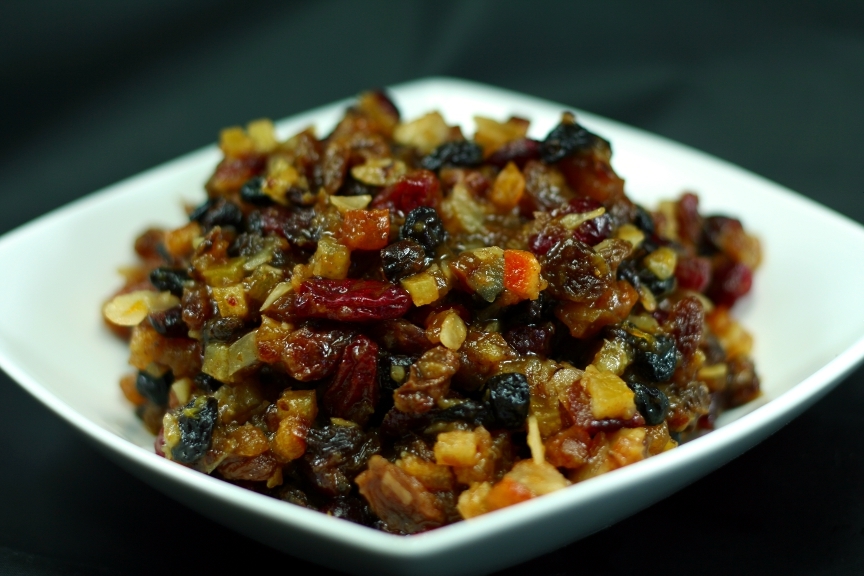
Here, hopefully, is a solution. No suet means it’s vegetarian and vegan. No added sugar means its more suited to people needing to control their sugar intake, for whatever reason – although there IS sugar in the candied peel, so this isn’t quite a sugar-free recipe. Best of all it doesn’t need maturing, it’s literally mix and go.

The mixture is gently warmed and the fruits absorb the sherry, brandy and fruit juices. The finely-chopped dates break down and bind everything together. The result is packed full of flavour and with a much cleaner and fresher taste. This mix makes just under 500g of ready-to-use mincemeat.

NB This will keep for up to a week in the fridge, but no longer. Cooked as mince pies and frozen – up to 3 months.

Fat-free Mincemeat

50g currants
50g raisins – crimson raisins look pretty
50g sultanas
50g dates – finely chopped
25g candied orange peel [1]
25g candied lemon peel [1]
25g candied grapefruit peel [1]
35g dried cranberries
25g flaked almonds – chopped
2tbs sherry
1tbs brandy
juice & grated rind of an orange
pinch of ground ginger
a grating of nutmeg,
pinch of ground cinnamon
pinch of mixed spice
pinch of ground cloves

60-100ml apple juice

  • Put the dried fruits into a small saucepan.
  • Cut the candied peel into small pieces with scissors and add to the pan with the spices. NB If you’re using your home-made candied peel that has been stored in syrup, then there’s no need to soften it in the saucepan – just stir it in with the nuts once the fruit has plumped.
  • Add the orange juice and zest, brandy, sherry and 60ml of apple juice.
  • Stir gently to combine and set pan over the lowest possible heat.
  • Cover and let the mixture stew gently until all the liquid has been absorbed.
  • If the fruit isn’t as plumped and juicy as you would like, add a little more apple juice.
  • The mixture should be moist, but with no liquid visible in the bottom
  • When you’re happy with the consistency, stir through the chopped, flaked almonds.

[1] If you’ve made some candied peel yourself, then these are pretty straightforward. If not, then use 75g of what you have/can get. Buy whole peel pieces if possible – they retain their flavour much better than chopped – and cut them just before use.


Candied Peel

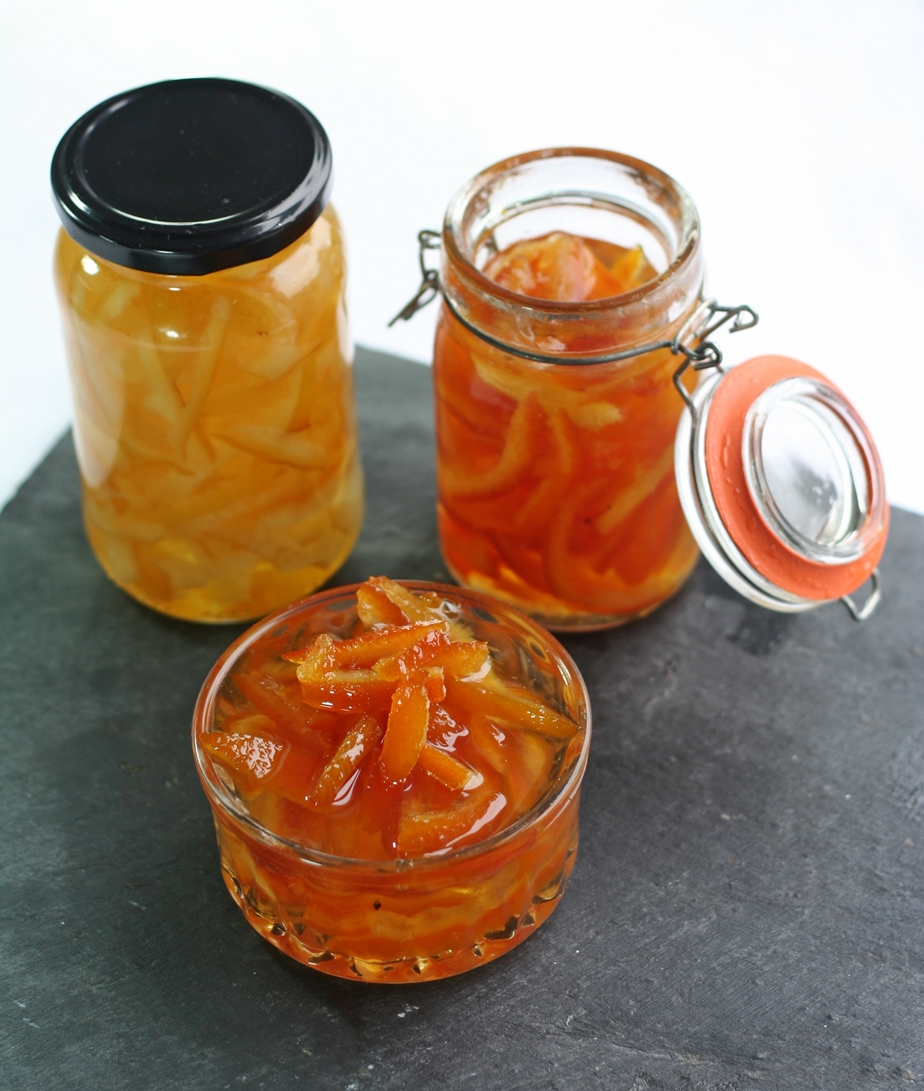
A forgotten art in British preserving is home-made candied peel. ‘But I can buy that!’ you shriek. Yes, I know. But if you’ve ever tasted fresh candied peel made with nothing more than sugar, peel and water – you’d understand. I used to hate store-bought candied peel, and avoided anything that included it, but home-made just blows it out of the water. The explosion of citrus flavour is amazing. The beauty of making it yourself is that you can candy any citrus peel you like, and not be limited to just orange and lemon. So here, for anyone who fancies having a go, is how to do it, gleaned from 17th century manuscript recipe books. It’s not difficult or complicated, but it is a bit repetitive. But make a decent amount at one time, and you won’t have to repeat it for a good few months. Oh – and it’ll make your house smell amazing.

How To Candy Peel

Citrus fruit of choice
Sugar
Water

  • Remove the skin from the fruit. Slice off the top and bottom (to make a flat surface to stand the fruit on) and then cut the peel from the sides of the fruit by slicing downwards. Keep as much of the pith as possible.
  • Scrape any flesh and membranes from the fruit rind. Don’t worry if you can’t get it all, it’ll become easier after the peel has been boiled. Leave the pith intact – it’s the pith absorbing the sugar that keeps the rind juicy and helps prevent it becoming hard.
  • Place the rind into a pan large enough to hold it plus an inch of water. Cover with clean water.
  • Bring water to a boil and boil for a minute or two then drain.
  • Rinse the peel thoroughly, and also scrub the sides of the saucepan thoroughly as well. Why? The bitterness of the peel comes from the citrus oil in the skin of the fruit. Bringing the water to the boil helps release this oil, but it then floats on the top of the water, coats the rind when the water is poured off, and also congeals onto the sides of the pan. If you don’t rinse the peel and scrub the pan well, you just end up basically boiling the peel in the bitter citrus oil, which kinda defeats the whole purpose of repeated boilings.
  • Repeat until the peels are semi translucent and very tender. This will greatly depend on the type and condition of the fruit itself, but as a rough guide, lemons = 4 times, oranges = 5 times, grapefruit = 6 times.
  • Leave in a colander to drain well.
  • While the peel is draining, make some sugar syrup: mix 1 part water to 2 parts sugar. 500ml water to 1kg sugar is straightforward, but might leave you with a lot of leftovers, if you’re not making much peel. Not very helpful I’m afraid, but to my mind, it is better to have a little extra syrup, than have to make more once you’ve added the peels because there isn’t enough. I usually guesstimate by eye – and use non-standard measures (i.e. large mug or jug) and just measure by volume.
  • Heat the sugar and water slowly until the sugar is dissolved, then bring to a boil and continue to heat until the mixture is clear.
  • Squeeze excess water from the peels by pressing them between several layers of kitchen roll – or I find that using a clean hand towel works best – they’re surprisingly soggy peels!
  • Scrape off any remaining flesh and membranes using the side of a teaspoon and cut the peels into 5mm strips.
  • Once the syrup is clear, drop in the drained peel. Make sure that there is enough syrup to allow all of the rinds to be submerged.
  • Bring syrup and rind to a boil then cover and put onto the lowest heat. Let it stew gently until the rinds become translucent and jewel-like (almost like coloured glass). Stir occasionally. This takes about an hour. Don’t be tempted to turn up the heat to speed things along, it’ll just harden the peel.
  • Store the candied peel in screw-top jars, making sure it’s completely covered by the syrup. This will keep it moist until required, and the high sugar content of the syrup will act as a preservative. When you need to use it in a recipe, rinse off the excess syrup and pat dry with a paper towel.
  • Any excess syrup can be bottled and saved to drizzle over cakes or desserts. It will have a wonderful flavour.

Seedless Raspberry Jam

If you make no other preserves this year, make this one.

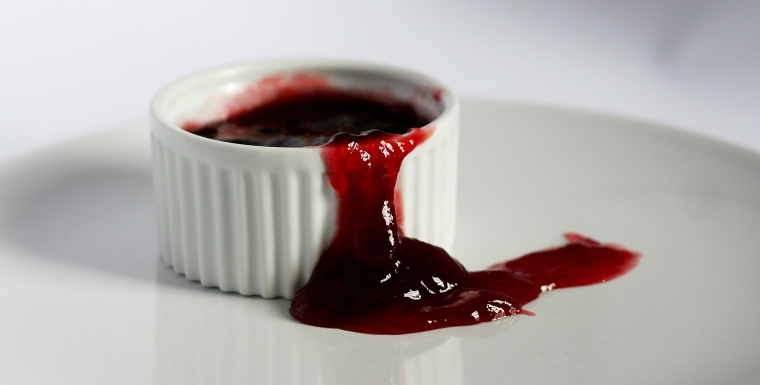
I’m serious. If you were here, I’d grab your lapels and lean disconcertingly close to your face whilst muttering this assertion. Look at that colour! Now imagine that colour as a taste explosion on your tongue! It’s incredible! I’m using far too many exclamation marks!!! Help meee!!!!!!!!

*takes deep breath*

Anyhoo….

For years I thought I disliked raspberry jam. No, I did actually dislike it – because all I could focus on was the seeds. A few years ago I was given a huge bag of raspberries and decided to make some jam because we’d all eaten as much of the fresh fruit as we could. Since I was running a bit low on jars, I thought I’d reduce the volume a little by sieving out the seeds and wow – what a difference it made. Without the distraction of the seeds, it was just pure, unadulterated flavour. Astonishing! This is now my number one favourite preserve.

“But I can’t make jam!” I hear you cry.  “Its all huge vats of boiling fruit…. mountains of sugar…pectin…setting point…hundreds of specialised sterilised jars…takes hours and hours….kitchens full of steam… and…and…and…”

To which I say, “Actually, not so much”.

Lets address possible objections one by one.

Huge vats of boiling fruit.
Its always puzzled me why, for the most part,  jam recipes consist of vast quantities of fruit. Yes, I know it’s all about preserving nature’s bounty for the cold winter months, but if you’re new to jam-making, and possibly you’re not sure whether you’re actually going to like a recipe, investing in huge quantities of ingredients might seem a little daunting. And even if it turns out that you DO like the recipe, you then have huge quantities of jam to get into jars and make sure it doesn’t get mouldy. Then there’s the giant preserving pans required. Actually, that’s not true. Preserving pans are really just large versions of ordinary pans and they’re big because of all the huge quantities of fruit that most recipes call for. They’re also large because they need to provide a large surface area to help with the evaporation of excess liquid, which will eventually lead to a jam setting. If you’re working with a small amount of fruit, there’s no reason why a broad, regular pan won’t do just as good a job – a deep, 28cm frying pan, for example.

Mountains of sugar
Not all jam requires vast quantities of sugar – it all depends partly on the fruit and partly on personal taste. Sugar is what preserves the fruit, so there is a minimum level below which you should not stray if you want the results of all your hard work to last. Apart from that, its pretty much down to personal taste. I don’t have a sweet tooth, yet I love seedless raspberry jam.

Pectin
Pectin occurs in fruit in varying concentrations, and, together with some kind of acid, is what helps jam to set. If a fruit is low in pectin, you can either combine it with another fruit high in pectin or add a home or commercially produced pectin. The amount of pectin in a fruit decreases as it ripens, so the riper the fruit you’re using, the more likely you’ll need some additional pectin. Raspberries have a moderate amount of pectin, so if you use slightly under-ripe berries with a dash of lemon juice, you can probably get away without using any additional pectin at all. If in doubt, use preserving sugar which has pectin already added to it.

Setting point
This is the point where the concentration of sugar and pectin are such that, when cooled, a jam will set. This is the reason for (sometimes) prolonged boiling. The boiling causes excess water to evaporate, and this in turn means that the concentration of sugar in the mix increases. When enough water has evaporated, the jam sets. Traditionally this has been tested in several ways, but thanks to modern science, these days we can just use a thermometer. You can pick up a sugar thermometer for about £7.00, and it will have the setting point for jam marked at 105°C. Since water boils at 100°C, you can relax in the knowledge that all excess moisture will be evaporated by the time your jam reaches this temperature and your jam is going to set.

Hundreds of specialised sterilised jars
Hundreds? Really? I thought I was the one doing the histrionics here?? OK, so if you’re dealing with vast quantities of fruit and sugar, you’re going to need a lot of jars, but we’re not here, so we won’t. Calm down. When I was a child, jam was always bottled in Kilner jars, and these type of jars are still available today, with either a screw-down or clip-down lid and rubber ring to make the firm seal that is going to help keep your jam sweet and fresh. When I was at school, we learned how to make jam in ordinary jam jars and to seal the jars with waxed-paper discs, cellophane and rubber bands. There’s nothing wrong with using either of these methods, but each of them have drawbacks: Kilner jars are rather expensive and the waxed-disc method is tricky to get right, and getting it wrong means fuzzy jam. The solution is to re-use jars that would otherwise go into the recycle bin. Using a variety of jars means you can just use small jars to keep the jam fresh or offer as gifts. I find pesto jars particularly suitable: they hold a small amount and they have a freshness ‘button’ on the lid which can be re-set when you make jam. To remove labels, simply soak in hot, soapy water until they slip off. If the labels are a bit more stubborn, use a knife to scrape off the softened label and a scourer covered in washing up liquid to remove the glue. Use a range of sizes and shapes, large and small. If you have a dishwasher, then sterilising couldn’t be easier – pop the clean jars and lids in on a hot cycle. Leave the door closed until you’re ready to use them. In the oven, put jars and lids on a baking tray and slide into a cold oven. Turn the heat to 100°C for 30 minutes.

Hours and hours with kitchen full of steam
No. The beauty of this recipe is that it takes very little cooking time at all – 3-5 minutes at most. No water is added to the fruit, so there’s not much excess water to be got rid of, and the less a jam is cooked, the brighter the colour and the better the flavour.

So if that’s all settled, on with the recipe!

Seedless Raspberry Jam
1.2kg raspberries – slightly under-ripe if possible.
Approximately 1kg granulated or preserving sugar (see above)
Juice of 1 lemon (optional)

Equipment
1 oven-proof bowl
1 wide, deep pan
a fine-meshed sieve
Plastic bowl
wooden spoon
knife
sugar thermometer
A selection of jars and lids

  • Wash the jars and lids in hot, soapy water and arrange on a baking tray.
  • Put the raspberries into the oven-proof bowl.
  • Put the jars and raspberries into the oven and heat to 100°C for 30 minutes. This will both sterilise the jars and encourage the juice in the fruit to run and make the next stage easier.
  • Remove the raspberries from the oven. Leave the jars in the oven to keep warm and reduce the temperature to 80°C.
  • Weigh your bowl, write it down somewhere and put the sieve over the top of the bowl.
  • Pour the softened fruit and juice into a sieve and stir vigorously with a wooden spoon to extract as much juice and pulp as possible. NB It’s probably best to do this a small quantity at a time. You need to keep stirring/pressing until there is nothing left in the sieve but a solid mass of seeds. I won’t lie to you, this takes a while, but its well worth it. Keep scraping the sieved pulp off the bottom of the sieve with the back of the knife. Don’t use the spoon, as you might accidentally get some seeds fall into the pulp. Discard seeds.
  • When done, weigh the bowl again and subtract the bowl’s original weight to find the weight of the juice and pulp.
  • Add this and an equal weight of whatever sugar you are using to your large pan. NB Warming the sugar will make it dissolve more easily.
  • Over a very low heat, stir gently until all the sugar has dissolved.
  • Taste and add lemon juice if liked.
  • Turn heat to high and, using a sugar thermometer, heat rapidly to 105°C. NB This shouldn’t take long at all. Even if it’s not quite reached 105°C, remove from the heat after 5 minutes – prolonged boiling will ruin both flavour and colour.
  • Remove from heat and pour into warmed jars to within 1cm of the top. Seal immediately. As the jam and the air trapped in the jar cools, it will contract and eventually pull the ‘safety button’ on the lid back to it’s original position. After making a batch of jam I love sitting listening to the ‘bink!’ of the lids safely sealing in all that wonderful flavour.

Variation: Not much, except to say that you can easily scale this recipe up if you want to make a larger batch. Just be sure to use an equal weight of sugar to pulp and you can make this with any amount of fruit you like.

Cost: In season, as little as £1 per pound of finished jam.