Slapan

I’ve been reading a lot of bakestone recipes lately, and, spoiler alert, if you like Welsh Cakes, then this recipe is about to become your new favourite.

This recipe comes from a small but delightful mid-20th century recipe book. “Croeso Cymreig: A Welsh Welcome”, originally published by the Wales Gas Board in the 1950s (mine is from 1957). I’ve seen a couple of editions on the second hand market (AbeBooks) for about £20, but more modern editions seem available for as little as £3. These newer editions are published by Gwasg Dinefwr Press or John Jones Press under the title “Recipes from Wales – 113 Traditional Welsh Recipes”. Alternatively, you can view a copy online for free at Archive.com

One of the reasons why I like this book is that it includes several variations of the same recipe. Some of them have different cooking methods too, for example, there are three Teisen Lap (‘moist cake’) recipes that can be cooked in an oven, in a Dutch oven in front of the fire, or on a griddle.

Slapan originates in North Wales. The book contains two Slapan recipes – ordinary Slapan, and Slapan Sir Fon (Anglesey Slapan). The difference between the two seems to be that Slapan is made with mixed fruit, and Slapan Sir Fon is made with currants only. Doing some more reading, I found a third version – Slapan Dafydd (Saint David’s Slapan) – which is made with sultanas only.

There are subtle variations in both the liquid used (milk/buttermilk) and leavening agents (baking powder, bicarbonate of soda, and also a little of both), but essentially it is the same method for all: rub the butter into the flour, add the rest of the ingredients and bring together into a soft dough with the eggs and liquid. Spoonfuls of the dough are then cooked on a bakestone, turning halfway through. An important aspect of the appeal of these teatime dainties is the speed with which they can be brought to the table – not much more than 30 minutes from start to finish. Perfect for when company drops by unexpectedly.

Taste

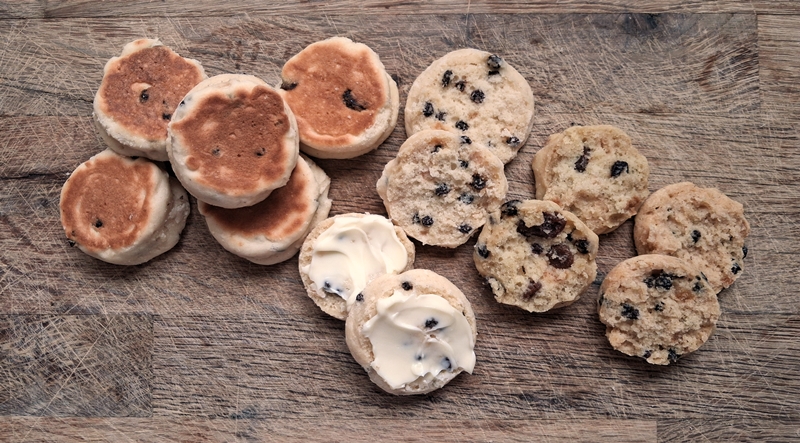
So what are they like to eat? Really delicious, actually. I mentioned above that Slapan are similar to Welsh Cakes, and they are, but without any of the spicing of the latter. Also in contrast, they are very light. With all the love in the world, even Welsh Cake devotees must admit they’re decidedly firm in texture. The texture of Slapan is much closer to a scone, or a muffin, but decadently rich with butter. They are not overly sweet, the dried fruit contributing a lot, so there is relatively little sugar added. Slapan are best served warm from the pan, split and generously buttered. Crisp outsides give way to a soft, cake-like centre, and with lashings of delicious butter melting inside, it’s a surprisingly rich treat.

Equipment

You don’t need a bakestone to cook your Slapan, a non-stick pan and a heat source with serve just fine. Slapan are baked, not fried, so there is no need to grease the pan. The traditional method is to spoon the mixture onto the bakestone using two spoons, but I found my small ice-cream scoop² much easier to use, in addition to making small, delightful 2-bite Slapan.

Slapan

Each batch makes approximately 12 Slapan. If you’re using gluten-free flour, then you may need to add extra flour (see note below).

120g plain flour/gluten-free flour³
60g chilled butter – cubed
20g sugar (caster or soft brown)
¼ tsp salt
scant ½ tsp baking powder
30-50g mixed dried fruit/currants/sultanas
1 large egg
2-ish tbs milk

  • Put a non-stick pan onto a medium (number 5 on my 1-9 electric hob) heat and let it come to temperature while you mix up the dough. if you’re using gluten-free  flour, you should delay this until the mixture half-rested.
  • Put the flour, butter, sugar, salt and baking powder into the bowl of a food processor and blitz until the mixture resembles breadcrumbs.
  • Crack the egg into a mixing bowl and add milk for a total of 90ml of liquid. Whisk together well (I use a stick blender), then add the flour mixture and dried fruit.
  • Fold together until the mixture forms a smooth-ish dough. The consistency should be like that of a fruit cake, or mashed potatoes. Definitely too soft to roll out.
  • Using a small ice-cream scoop, or two spoons, drop the dough into the now hot pan. Drop them around the edge, rather than the middle, so that they don’t scorch. Cooking them all at once will make it tricky to turn over, so do two batches of six or seven.
  • Bake for 5 minutes. A light crust will form on the bottom of each heap.
  • Using two cocktail sticks, carefully turn each Slapan over.
  • Bake for a further 3-4 minutes until the underside is as browned as the top.
  • Cool on a wire rack.
  • Split, butter and serve warm.

Bonus Recipe: Christmas Slapan

Here’s my own take on a Slapan variation, seen top right in the photo – with the addition of candied peel, mixed spice and a splash of booze. Much quicker to rustle up than mince pies.

120g plain flour/gluten-free flour³
60g chilled butter – cubed
20g soft brown sugar
¼ tsp salt
scant ½ tsp baking powder
½ tsp mixed spice
15g candied lemon and orange peel, finely chopped
15g dried cranberries or barberries
20g dried currants
1 large egg
1 tbs brandy
1 tbs cream sherry/madeira

  • Method as above.

¹ You need to sign up to be able to borrow books, but it is free, no strings attached.

² A small ice-cream scoop of 4cm diameter, roughly 30ml volume.

³ I’ve made this recipe with two different gluten-free flours. Schar’s Baking/Patisserie flour (red bag) contains a thickener (guar gum), and so the recipe took the same quantity of flour as regular flour. Dove’s Farm Freee gluten-free flour contains no thickener, and they recommend adding xantham gum when using. I didn’t have any, so I ended up adding more flour (60g in 2 batches of 30g) and allowed it to sit a while (20 minutes) to allow the excess liquid to be absorbed.
Querkles

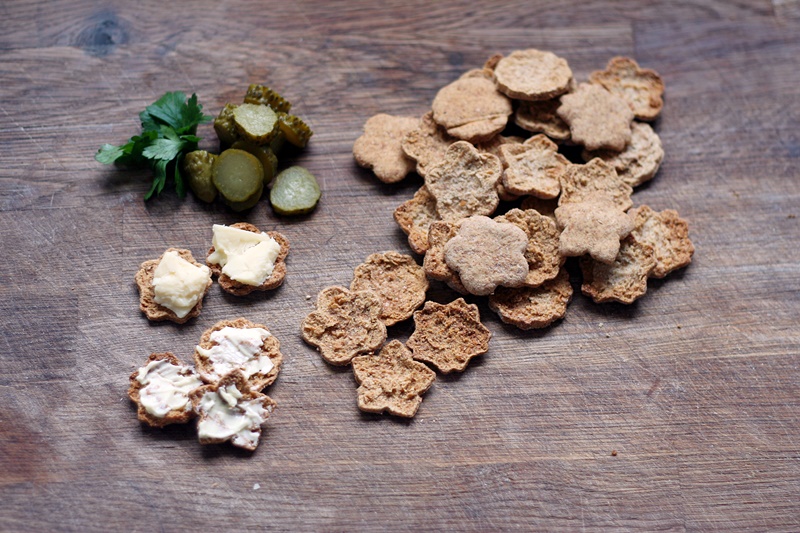
These biscuits are great to have to hand in the cupboard for enjoying with cheese or jam, with butter, or serve them completely unadorned with drinks for toothsome and low-fat snacking – they may look plain, but they’re very moreish.

When I was writing last week’s post about Almacks, I thought to myself: I can add a link to those nice cracker biscuits – and then I couldn’t find them on the blog at all. The pictures eventually turned up in a folder on my laptop almost two years old, because it appears that I’d taken the photos but forgotten to actually write the post ! And so here we are.

These unusually-named biscuits come from the classic Victorian “Biscuits for Bakers” (1896) by Frederick T. Vine. Mr Vine has no idea where the name came from but assures us that “As the above seems rather catchy and the biscuits are something of a novelty, we will let it stand.”

Making your own savoury biscuits might seem a bit of a chore, especially when opening a packet is so much easier, but it’s always good to have a recipe to hand for short notice situations.

OK, now I think on it, I must confess I’m at a bit of a loss as to what kind of situation might warrant being deemed a biscuit emergency, so ANYHOO….

Another reason for making your own, of course, is because you have complete control over size, shape, texture and flavour of your biscuits. For crackers this is extremely simple, for it takes no more than the addition of a spoonful of dried herbs or a sprinkling of sea salt flakes to make a batch individual. The size is only limited by what biscuit cutters you possess. I’ve used a set of mini cutters to make the crackers in the picture above, each roughly the same size, but with differing shapes, which, in my opinion adds to the appeal. I’ll admit the biscuits shown in the picture are very small, about 3cm in diameter, but this means they can be popped into your mouth whole, thereby avoiding the danger lurking in larger biscuits, of shattering into pieces and dropping crumbs all down your front; I’m looking at you, Carr’s Water Biscuits and Bath Olivers.

The method for these biscuits is unusual in that, once baked, they are split open and returned to the oven so that the insides may dry and bcome toasted. Again, it is up to you how long you leave them and at what temperature, so the texture and colour can be suited to your needs.

SHOPS CLOSED ON EASTER SUNDAY! Finally thought of a biscuit memergency.

Querkles

225g wholemeal brown flour
7g butter
15g sugar
1tsp cream of tartar*
½tsp bicarbonate of soda*
½tsp salt

milk to mix

  • Heat the oven to 170°C, 150°C Fan.
  • Put all of the dry ingredients into a food processor and blitz until well mixed.
  • Slowly add milk to mix until the mixture comes together in a paste.
  • Tip out onto a floured surface and knead smooth.
  • Roll out as for pastry, to a thickness of 5mm.
  • Cut your biscuits with whatever cutters you prefer. The top of a small glass can also serve.
  • Lay the biscuits on a baking sheet lined with baking parchment and bake for 10-12 minutes if small, 15-18 minutes if larger, until the surface is cooked, but not brown. NB If making small biscuits, work in small batches to help reduce breakage when splitting – see below.
  • Remove from the oven and with the point of a sharp knife, cut around the edges of the biscuits and split them in two. NB You should work quickly, because if the biscuits cool, then they will break rather than split apart.
  • Lay the biscuit halves insides-upwards and return to the oven for 15-20 minutes until crisp and browned to your taste.
  • Allow to cool completely, then store in an airtight container.

TOP TIP If, when cooled, your biscuits aren’t crisp, just put them back into the oven until they are. I suggest a much lower heat (100°C, 80°C Fan) for longer (20-30 minutes) in order to really dry them out. Fun Fact: Victorian bakers used drying ovens or provers to get that crispness to their biscuits without having to brown them further in the heat of the main ovens.

* Or instead of these two, 2 tsp baking powder.

Apple Snow

This recipe is more usually served in the late summer and autumn months, but I’ve chosen it now because the weather outside today has carpeted the garden with a thick layer of snow.

This is a classic dessert whose provenance stretches back centuries. Although the name ‘Apple Snow’ is the one more usually found in modern recipe books, it can also be found under the name Apple Fluff, Apple Souffle, Apple Puff and this version, Apple Cream Without Cream.

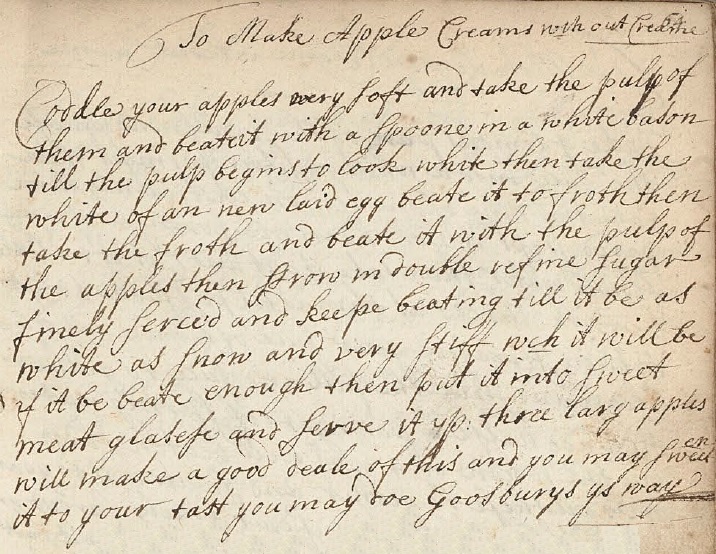
This last was found in a manuscript from the 17th century, held by The Wellcome Library. The manuscript has been attributed to the splendidly named Mrs Deborah Haddock, who sounds as if she should be the twinkly-eyed star of stories set in a small, quaint fishing village.

It is elegant in its simplicity, requiring only apple pulp, an egg-white and a little sugar. It is also, thanks to modern kitchen gadgetry, prepared incredibly swiftly, requiring less than ten minutes to come together before serving, once the initial preparation has been completed.

Apple Cream Without Cream, aka apple Snow, c1675, MS7892, Wellcome Library Collection

Choice of Fruit

This recipe can be made with any apple you have to hand, either keeping a purity of flavour with a single variety, or mixing and matching in a clearing-out-the-fruit-bowl, waste-not-want-not kind of way.

One of the manuscript recipes I read recommended green apples as being the best, but failed to elaborate any identifying characteristics beyond colour. I prefer to use Bramley apples, for the pale insides and sharpness of taste. Other varieties you might like to try include Worcester Pearmains, which have dazzlingly white flesh that tastes faintly of lemon and rough-skinned Russets that have an almost nutty flavour.

Alternatively, you could follow the recommendation in the recipe above and try this with gooseberries.

Apple Snow

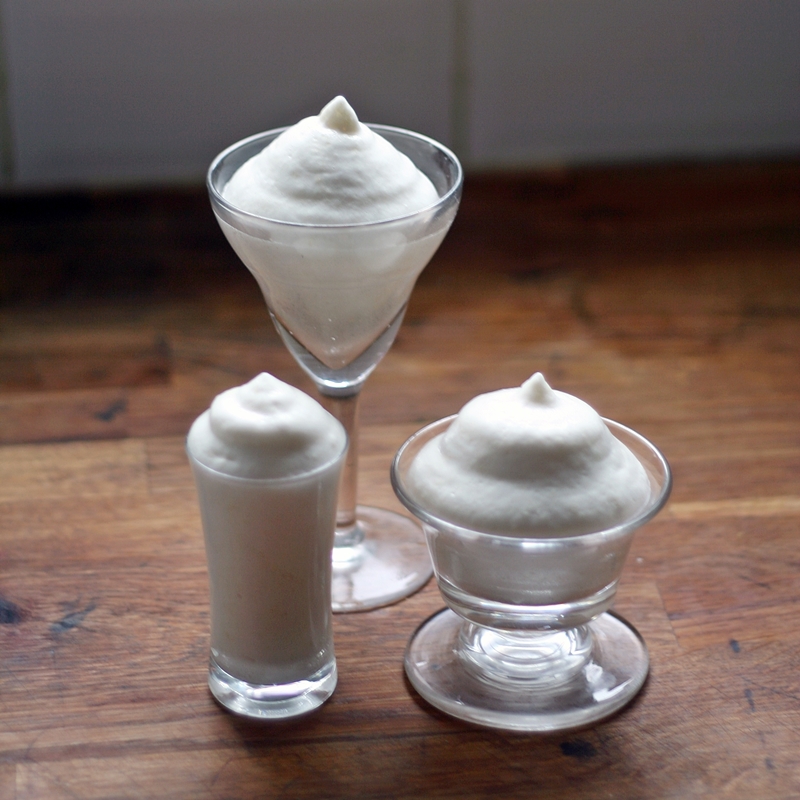
This recipe tweaks the original slightly with additions found in other versions. In terms of quantity, it will make a visually impressive amount, but is so light and delicate, a full glass is still only a relatively small amount. It will hold its shape for two hours or so, but can be mounded in more impressive heights if served immediately after preparation.

Serves 4 – 8

5 Bramley apples, or apple of your choice.
juice of 1 lemon
2tbs cream sherry (optional)
4tbs caster sugar
1 large egg-white

  • Peel, core and chop the apples finely. Toss them in the lemon juice as you go, to prevent them from discolouring.
  • Add the apple and lemon juice to a saucepan with the sherry, if using.
  • Cover and cook over medium-low heat until the apples soften and turn to froth.
  • Mash the apples to a pulp, then sieve to remove all lumps. Chill until required.
  • Whisk the egg-white until it will stand in soft peaks. Set aside.
  • Put 250ml chilled apple pulp into a bowl and whisk on High for 2-3 minutes until pale and fluffy.
  • Add the whisked egg-white and continue whisking, adding in the sugar one spoonful at a time.
  • After 2-3 minutes the mixture will have both increased in volume and become dazzlingly white.
  • Taste and whisk in more sugar if needed.
  • Spoon or pipe into glasses and serve with some crisp biscuits on the side.
  • If you have apple pulp spare, you could spoon a little of it into the glasses before adding the apple snow.