Old-Fashioned Lemonades

I don’t think I’ve done drinks on the blog before, but I’ve got a trio of delicious variations on lemonade, originating in the 17th century manuscript books at the Wellcome Library. They are each wonderfully thirst-quenching and will make for a delicious treat to have in the fridge.

Mrs Yorke’s Lemonade – the best that can be made

From the recipe book of Mary Rooke, 1770s (back right in photo).

Mary Rook's Original Recipe
Source: DDU 818/1, Essex Record Office

225g granulated sugar
225ml fresh lemon juice (from 4 juicy lemons – have 5, just in case)
Thin strips of peel from 4 lemons
900ml boiling water
450ml boiling milk

  • Put the sugar, lemon juice, thinly peeled lemon peel into a bowl.
  • Pour over the boiling water and stir to dissolve the sugar.
  • Cover with plastic and allow to cool.
  • When cold, pour in the boiling milk. NB The lemon juice will cause the milk to curdle. DON’T PANIC – THIS IS FINE.
  • Cover with plastic and allow to cool, then chill overnight in the fridge.
  • Strain the solids out by passing the lemonade through a fine-mesh sieve.
  • Strain the lemonade finely by passing it through a jelly bag, or a double layer of muslin. Be sure to scald the muslin first by pouring boiling water over it, then squeeze out the excess moisture.
  • To have your lemonade especially clear, rinse the muslin thoroughly and double the layers to 4 and pass the lemonade through it again. This will take longer than the first time, due to the greater number of layers of material.
  • Taste and add more sugar if liked. For adults only, you can add 225ml of white wine. Choose one with light, citrus flavours.
  • Chill thoroughly.
  • Serve over ice.

Cool Summer Drink

Anon., 17th century (back left in photo).

Original Recipe
Source: MS8097, Wellcome Library Collection

This is a very refreshing drink similar to an Indian lassi. The milk will tend to separate slightly, so blending the drink just before serving helps combat this.

450ml milk
400ml water
½ tsp rosewater – I use Nielsen Massey
Juice of 2 lemons
1/4 nutmeg, grated
1 sprig rosemary
1 tbs granulated sugar

Slices of lemon and sprigs of rosemary to serve

  • Bruise the rosemary to release its flavour by gently tapping the leaves with a rolling-pin.
  • Put all of the ingredients into a jug.
  • Cover with plastic and allow to infuse for 2 hours in the fridge.
  • Remove the rosemary and strain the drink by passing it through a fine-mesh sieve, which will catch any rosemary leaves that might have fallen from the stem.
  • Using a stick blender or liquidiser, thoroughly mix the drink to an even consistency.
  • Serve at once.

Lemonada

Anon., 17th century, (front left in photo).

Lemonada Original Recipe
Source: MS8097, Wellcome Library Collection

600ml light and fresh German white wine – Liebfraumilch or Reisling
450ml water
225g granulated sugar
Juice of 2 lemons
juice of 1 orange
5cm stick of cinnamon
1/4 nutmeg in 1 piece
thumb-sized piece of fresh ginger, sliced thinly

  • Put all of the ingredients into a pan over a low heat and stir until the sugar is dissolved.
  • Bring to the boil, cover and remove from the heat.
  • Allow to steep until cold.
  • Strain to remove solids and chill in the fridge until required.
  • Serve over ice.

18thC English French Bread

Bread is a curious topic to go a-hunting in the recipe archives because there are relatively so few recipes. Considering how central it was for such a large part of the population, the proportion of recorded recipes is surprisingly low.

The reason for this might be similar to that often cited as being behind Marco Polo’s failure to mention paper money in his account of travels in China: familiarity. It is a theory that Polo was so familiar with its usage after his many years in the country, and since his memoirs were written so long after his return, he completely forgot the surprise and wonder that the concept paper money would have for his readers. Perhaps the ability to make bread was so fundamental, so ingrained, few thought to write down the recipes since it was a skill everyone possessed.

It was also, however, a specialised craft, requiring both skill and equipment to produce on a large-scale, not to mention the unsociable hours and back-breaking work mixing huge quantities of dough without machinery. As such, as hard, manual labour, it was firmly in the province of the labouring classes, however skilled.

The more well-to-do, whose recipes have survived in household manuscript books, seem to have been partial to French bread, and it has been interesting to note the numbers of recipes for French bread consistently exceeding those for anything English. A large proportion of them are variations on this recipe, using egg whites as part of the liquid component.

French Bread recipe dating from 1703, MS7788 in the Wellcome Collection

I chose this 1703 recipe because of its simplicity – other recipes use whole eggs/butter/milk/cream, and I wanted to see whether the egg-whites had a noticeable effect on the flavour and texture of the loaf without any other distractions. The answer is yes – it is certainly different to a bread made without egg-whites. There’s no way to tell whether this is a genuine approximation of the French bread of the time, but I suspect that it wouldn’t have been too far removed from the sourdough bread enjoying a resurgence today.

Traditional sourdough, baked in a wood-fired oven, is a wonderful thing – insanely crusty with a great ‘chew’. It’s not to everyone’s tastes, though – which is where this loaf might gain favour. After baking, the crisp crust softens as it cools, making it easy to slice without the dangers of crust fragments ricocheting off at alarming speeds that comes with cutting a traditional sourdough. The crumb is open and springy with enough of a chew to make it very satisfying. From the photo above, it would appear that the centre of the loaf actually has a more open texture than the edges. It can be relished spread with just a little butter – and how long is it since you can say you honestly enjoyed a slice of white bread and butter?

I’ve obviously scaled this recipe down from the original and have made just one change: salt. True to my own code of conduct when working with old recipes, I did bake it ‘as written’ in the first instance, and while it had the great crust and texture described above, the flavour was lacking. Finally, I find it amusing to note that 300 years after it was jotted down, this recipe still takes just 30 minutes to bake.

18th Century English French Bread

450g strong white bread flour
1 sachet fast-action yeast
1tsp salt
50ml egg-white whisked with 300ml warm water
Additional warm water (maybe)

  • Mix the flour, yeast and salt in a bowl.
  • Whisk together the eggwhites and the warm water and add to the dry ingredients.
  • Mix thoroughly, adding more water if required (unlikely), to form a rather soft dough.
  • Knead for 10 minutes.
  • Cover lightly with plastic and set in a warm place to rise for 1 hour. If your kitchen is on the cool side, you can turn the oven to 160°C, 140°C Fan for 2 minutes, then switch it off and put in your dough to prove.
  • Tip out the risen dough and pat gently to deflate.
  • Shape the dough into a smooth ball and transfer to a greased 1kg loaf tin. The dough should half-fill the tin. If you’d prefer a taller loaf, use a smaller or longer shape.
  • Set aside to rise for 30 minutes. On cold days I put the loaf into the small top oven while the main oven below warms up.
  • Preheat the oven to 200°C, 180°C Fan.
  • Bake for 30 minutes, turning the loaf around after 20 minutes to help colour it evenly.
  • Cool on a wire rack.
  • Slice when cold.

Hard Sauce

100g unsalted butter – softened
150g caster sugar
120ml cream sherry, or any favourite alcohol

  • Whisk the softened butter until extremely light and fluffy. This is easiest with a stand mixer and paddle attachment, but electric mixer is fine.
  • Add the caster sugar and continue whisking until even paler and fluffier.
  • Gradually add the sherry a tablespoon at a time until fully incorporated. The mixture should look like thick whipped cream.
  • You can either use as is, or do the following for a pourable sauce.
    • Spoon the mixture into a small pan and put over the lowest heat possible.
    • Allow the mixture to melt, and DO NOT stir. It will slowly form a creamy sauce the consistency of double cream.
    • Pour into a jug and serve at once.

Sugarless Biscuits

I don’t mean to boast (which means I’m going to), but I’m very pleased with this recipe, which I found in a book from 1767 entitled “Primitive cookery; or the kitchen garden display’d”. In the curious attribution style of the day, the frontispiece declares the book “Printed for J.Williams at No. 38, Fleet Street”, which leaves the authorship somewhat undetermined – possibly J.Williams or he might have been the publisher, or even the printer himself.

That mystery aside, the frontispiece also contains some wonderful claims, viz “RECEIPTS for preparing a great Variety of cheap, healthful and palatable Dishes without Fish, Flesh or Fowl; WITH A BILL of FARE of Seventy Dishes that will not cost above Two-Pence each”. The low cost and the vegetarian nature of the dishes was doubly interesting, since vegetarianism didn’t really take off in Britain until the nineteenth century. Alas, it wasn’t quite the groundbreaking publication I thought, as I found meat and meat products scattered liberally throughout, and although the seventy tupenny dishes are meatless, they consist mostly of dishes along the lines of “[insert the name of a vegetable] boiled and bread and butter”. Still, it’s not all plain fare, as the following meal suggestion illustrates: “Bread and half a pint of canary, makes an excellent meal.” With half a pint of sherry (canary) inside you, you wouldn’t really care that you only had bread to eat. And for tuppence? Bargain!

ANYHOO…..

These biscuits are listed in the book as Parsnip Cakes – the word ‘cake’ having a much more versatile usage in the eighteenth century, and more inclined to refer to shape, rather than some delightful teatime confection. Parsnips provide both bulk and a very gentle sweetness. Sliced, dried in the oven and then ground in a spice grinder, the parsnip ‘flour’ is then mixed with an equal quantity of flour, a little spice, and formed into a dough by mixing with double cream. Rolled out to a thinness of 5mm and baked in a cool oven, the resultant biscuits are crisp, crunchy and similar to a close-textured digestive biscuit. The flavour of parsnip is detectable, especially if, in the drying they have also browned a little and the sugars caramelised, but it’s not overpowering.  More nutty than vegetable. In terms of sweetness, they sit bang on the fence between sweet and savoury – sweet enough to satisfy a sugar craving, savoury enough to eat with cheese.

It’s this versatility which got me thinking of ways in which it could be adapted, and after experimentation, came up with the following:

  • Spices. You can vary the spices and tip the biscuits more towards sweet or savoury as you prefer.
    • Sweet spices: cinnamon, nutmeg, ginger, cloves.
    • Savoury spices: garam masala, cumin, coriander, smoked paprika, curry powder.
    • Neutral spices that could go either way: aniseed, fennel, fenugreek, caraway, cardamom, Chinese five spice.
    • Herbs: thyme, rosemary, sage, garlic powder, onion powder, chives, etc.
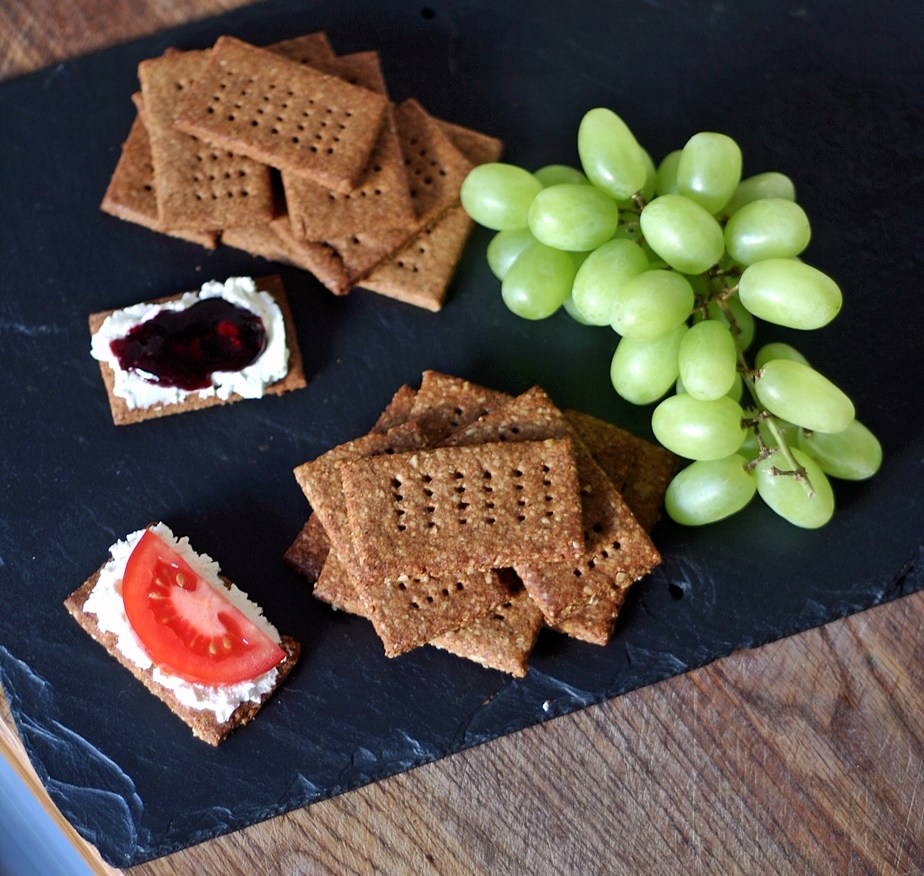
  • Flours. This is where these biscuits are most versatile.The flour you match with the parsnip powder doesn’t have to be limited to plain white. The biscuits in the picture above have been made with stoneground wholemeal with aniseed (top) and medium oatmeal, with a little salt (bottom). Here are just a few further suggestions:
    • brown
    • wholemeal
    • medium oatmeal
    • barley
    • rice
    • plain white
    • white + cornflour
    • brown + rye
    • malted
  • Usage. The dough can also be used as a pastry, with different results coming from the different flours used. Mixing the parsnip flour with brown flour or oatmeal would make a fantastic crust for something like a cauliflower cheese tart. I haven’t tried it for turnovers/handpies, but I suspect you’d need to use bread flour and to work it quite well in order to prevent it cracking when trying to fold it.

Sugarless Biscuits

The recipe for mixing the actual biscuits requires only a fraction of your parsnip flour, thereby allowing you to make several batches from this one quantity. That said, this made only about 200g of parsnip flour in total.

4 large parsnips
50g flour of choice
½-1tsp spice/herb/flavouring of choice
50-70ml double cream

¼ tsp salt (for savoury biscuits and/or when using oatmeal)

  • Peel the parsnips and slice thinly – a mandolin is ideal.
  • Arrange the slices on parchment-lined baking sheets and put into the oven.
  • Turn the oven on low, 120°C/100°C Fan.
  • Since the slices are so thin, they won’t take very long to dry at all. Check after 15 minutes. If they have curled into flower shapes, remove from the oven and allow to cool. If they aren’t completely crisp when cold, you can easily dry them a little longer. It’s better to dry them in two stages, than to let them go a little too long and allow them to take on colour – unless that’s what you’re after, of course.
  • When the parsnips slices are crisp and cold, grind them to powder in a spice grinder, or pound them in a pestle and mortar. If you’re using them for savoury biscuits, you can get away with having it a little coarser – like semolina or polenta. For sweet biscuits, you’ll probably need to sieve out the larger pieces and re-grind.
  • Preheat the oven to 140°C/120°C Fan
  • To make the biscuits:
    • Put 50g parsnip flour in the bowl of a food processor.
    • Add 50g of your chosen flour.
    • Add your chosen spices and salt, if required.
    • Blitz for a few seconds to mix.
    • With the motor running, gradually pour in the double cream. Depending on the flour you are using, the quantity of cream required to bring the dough together will vary. Add just enough until the dough comes together in a ball, or at least resembles damp breadcrumbs.
    • Tip out and press together into a ball.
    • Roll out between sheets of cling film plastic (to avoid sticking) to about 5mm and cut into biscuits. I made rectangles of 2.5cm x 5cm, but any shape will do.
    • Lay the biscuits onto a parchment-lined baking sheet and prick the middles neatly with a fork.
    • Bake for 10 minutes, then turn the baking sheet around and bake for a further 10 minutes.
    • Transfer to a wire rack and return to the oven for a final 5 minutes in order to ensure the undersides are dried and crisp.
    • Allow to cool on the wire rack before storing in an airtight container.


Orange Blossom Tart

Here’s a wonderfully aromatic and delicious dessert that I have adapted from a recipe that appears in Hannah Glasse’s “The art of cookery, made plain and easy”. It must have been popular, because Hannah gives no fewer than four recipes for Orange Pudding, each slightly different. Copyright infringement back then being rife, it is highly likely that Hannah is not the original author of this recipe, but I have yet to find an older version with these particular ingredients.

Hannah calls this a pudding – and indeed it is certainly something that you might eat after lunch or dinner, but it is in fact what we would term a tart, and I can honestly say it is unlike any tart I’ve ever tasted before, for the very best of reasons.

The most striking aspect is the flavour – a mixture of Seville orange, orange flower water, rosewater and white wine. Rather surprisingly, the word that popped into my head when breathing in its aroma was ice-cream – and that was before it was cooked! Once cooked and chilled, the flavours mingle together and taste extraordinary – the only way I can think to describe it is like plunging your face into a bunch of fresh flowers – but in a good way! This isn’t soapy/perfumed – it’s light and fresh and rounded. None of the flavours overpower, it’s just fantastically floral.

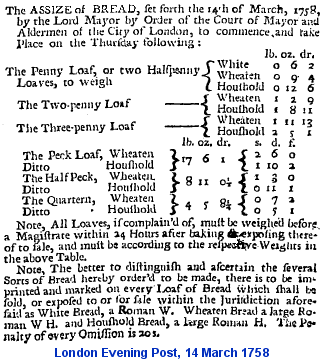
One of the challenges when adapting old recipes, is that specific quantities are sometimes a bit of a challenge. This recipe is a good example, because amongst other things it calls for “the crumb of a halfpenny loaf”. Although food prices were relatively stable before the industrial revolution, wheat, and by extension bread, was especially subject to price fluctuations due to harvest yield. So much so, specific laws were created concerning the manufacture and sale of the various types of bread (The Assize of Bread) and books of tables drawn up specifying the size of loaves depending on the cost of wheat.

Even with the Assize of Bread tables to hand, it’s still not clear which loaf the crumb should come from: white, wheaten or household. Household bread was the coarsest, and therefore unlikely, I reasoned, to have been used for such a delicate dessert. That left either white or wheaten and at just over 6oz and 9oz for a penny loaf, the difference in the quantity of crumb was going to be significant. The only solution was to make two tarts, and try each to see if one quantity was more suited than the other.

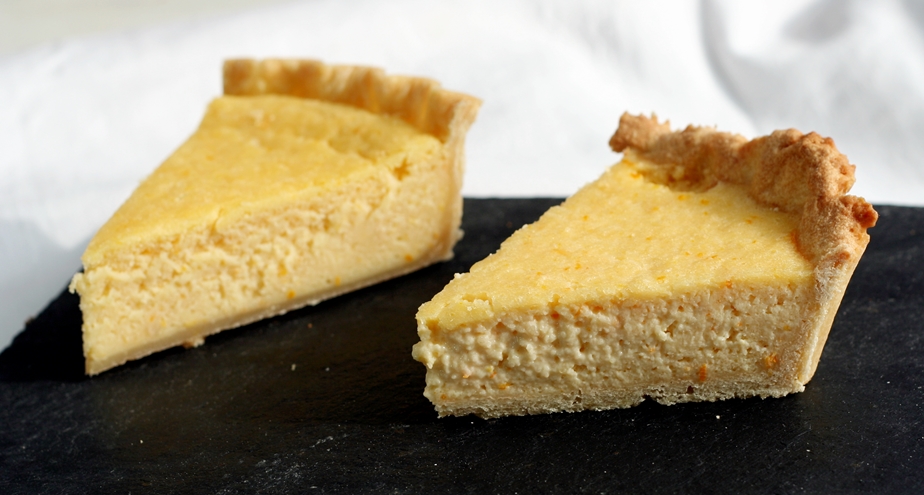
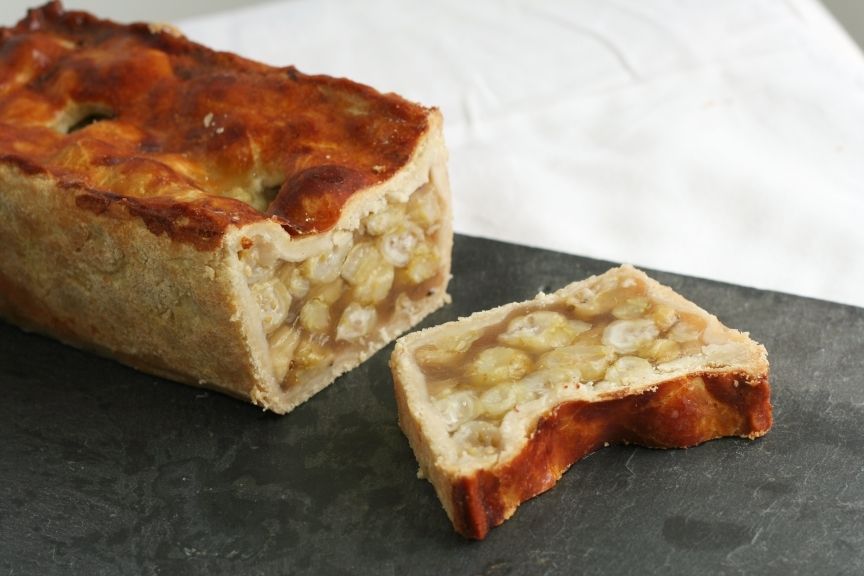
The photograph at the top shows the result. The slice on the left was cut from a tart made with 150g fresh white breadcrumbs. The slice on the right from a tart made with just 100g. Personally, I prefer the one on the left – the texture is like baked cheesecake, but not heavy and cloying. The slice on the right has a much softer consistency – if you’re a fan of baked custards, then this is the one for you. For an even more delicate texture, you could even try with just 50g of breadcrumbs – do let me know if you try this!

This is a wonderful springtime tart and I really hope you’ll give it a try.

Orange Blossom Tart

Sweet Shortcrust Pastry
225g plain flour
140g butter
60g cornflour
85g caster sugar
1 large egg
grated zest of 1 lemon
ice cold water
egg-white for glazing

  • Put all the ingredients except the water into the bowl of a food processor and blitz until the mixture comes together in a ball.
  • If the mixture is too dry, add some ice cold water 1 tablespoon at a time until the pastry forms a ball.
  • Tip the mixture onto a floured surface and knead smooth.
  • Wrap in plastic and chill for at least 30 minutes.
  • Grease a 22cm fluted, deep, loose-bottom tart tin – a lemon meringue tin if you have one, is ideal.
  • Remove the chilled pastry from the fridge and place on a floured surface.
  • Roll out thinly (7-8mm) and line the prepared tin, gently easing the pastry into the sides.
  • Let the excess pastry hang over the sides of the tin for now.
  • Prick the bottom of the pastry with a fork and put the lined tin back into the fridge to chill for another 30 minutes.
  • Preheat the oven to 200°C, 180°C Fan.
  • Remove the tart from the fridge and trim the excess pastry. Don’t remove too much – allow 3-4cm to overhand the side of the tin – this keeps the pastry from shrinking back into the tin and can be trimmed after cooking.
  • Line the pastry with baking parchment and fill with baking beads/beans/rice.
  • Bake for 12 minutes, then remove the parchment and beads and bake for another 5-6 minutes until the pastry is cooked through.
  • Brush the inside of the pastry with lightly beaten egg-white and return to the oven for 5 minutes. This seems like a faff, but it will ensure you pastry is both cooked AND resistant to the wetness of the filling until it is cooked. *lying* I deliberately undercooked the pastry on the left in the photo to demonstrate.

Filling
150g fresh white breadcrumbs
250ml double cream
75g caster sugar
5 large egg yolks
60ml white wine [1]
1 tablespoon orange flower water [2]
1 teaspoon rose water [2]
zest and juice of a Seville orange [3]
70g clarified butter – melted

  • Mix all of the ingredients together in a bowl and set aside to let the flavours mingle. It will have the consistency of porridge.
  • When the pastry base is finally cooked, turn the oven down to 160°C, 140°C Fan.
  • Cover the top edges of the pastry with tin foil, to prevent them from burning.
  • Pour the filling into the cooked pastry case and bake for 25-30 minutes until the filling is set. There should be a slight joggle to the middle of the tart, but nothing too fluid.
  • Set aside to cool for at least 1 hour.
  • When cold, trim off the excess pastry, remove from the tin and place on a serving plate.
  • Eat slightly warm or at room temperature. Alternatively (and my own personal preference) chill thoroughly in the fridge for at least 5 hours.

[1] The original recipe called for sack, a fortified wine similar to sweet sherry. You could use sherry, madeira even marsala if you like. Whilst I love the flavours of all three, I thought them a little rich for this recipe, so I chose a regular white wine. A sweet and aromatic dessert wine would also be delightful.

[2]Both of these fragrances are available in the baking aisle at the supermarket. They also tend to vary greatly in strength and aroma according to which brand you use. The original recipe called for equal quantities of both, but the rosewater I use is rather strong. In contrast, the orange flower water that I use is rather lightly perfumed, so I used slightly more. if you use different brands, my advice is to use just 1 teaspoon at a time and taste as you go until you’re happy with the flavourings.

[3] If, like me, you made Seville orange ice cubes with the zest and juice back in January, then all you need is one cube. If not, then use the zest only of a sweet orange, together with the zest of either a lemon or lime for added sharpness.

Fat-free Mincemeat

This recipe is adapted from Hannah Glasse’s 1747 recipe for Mince Pies for Lent.

Nowadays, we traditionally make mincemeat far in advance of the festive season, so that it can mature in flavour. Both the sugar and the suet act as preservative and so when Christmas rolls around, you’ve got a jar of deliciously spicy sweetmeat and not a fizzing, fermenting jar of goo.

The downside of course is having to be organised enough to remember to make it far enough in advance, making enough for those unexpected baking moments (such as surprise visitors, or a last minute school bake sale contribution), and not making too much so you have storage problems. Quite apart from it not being suitable for either vegetarians or vegans.

Here, hopefully, is a solution. No suet means it’s vegetarian and vegan. No added sugar means its more suited to people needing to control their sugar intake, for whatever reason – although there IS sugar in the candied peel, so this isn’t quite a sugar-free recipe. Best of all it doesn’t need maturing, it’s literally mix and go.

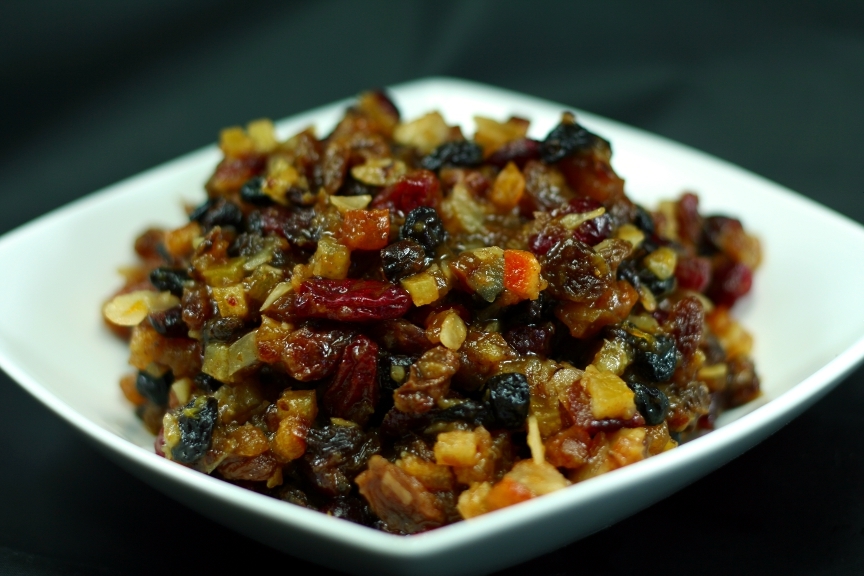
The mixture is gently warmed and the fruits absorb the sherry, brandy and fruit juices. The finely-chopped dates break down and bind everything together. The result is packed full of flavour and with a much cleaner and fresher taste. This mix makes just under 500g of ready-to-use mincemeat.

NB This will keep for up to a week in the fridge, but no longer. Cooked as mince pies and frozen – up to 3 months.

Fat-free Mincemeat

50g currants
50g raisins – crimson raisins look pretty
50g sultanas
50g dates – finely chopped
25g candied orange peel [1]
25g candied lemon peel [1]
25g candied grapefruit peel [1]
35g dried cranberries
25g flaked almonds – chopped
2tbs sherry
1tbs brandy
juice & grated rind of an orange
pinch of ground ginger
a grating of nutmeg,
pinch of ground cinnamon
pinch of mixed spice
pinch of ground cloves

60-100ml apple juice

  • Put the dried fruits into a small saucepan.
  • Cut the candied peel into small pieces with scissors and add to the pan with the spices. NB If you’re using your home-made candied peel that has been stored in syrup, then there’s no need to soften it in the saucepan – just stir it in with the nuts once the fruit has plumped.
  • Add the orange juice and zest, brandy, sherry and 60ml of apple juice.
  • Stir gently to combine and set pan over the lowest possible heat.
  • Cover and let the mixture stew gently until all the liquid has been absorbed.
  • If the fruit isn’t as plumped and juicy as you would like, add a little more apple juice.
  • The mixture should be moist, but with no liquid visible in the bottom
  • When you’re happy with the consistency, stir through the chopped, flaked almonds.

[1] If you’ve made some candied peel yourself, then these are pretty straightforward. If not, then use 75g of what you have/can get. Buy whole peel pieces if possible – they retain their flavour much better than chopped – and cut them just before use.


Muffins

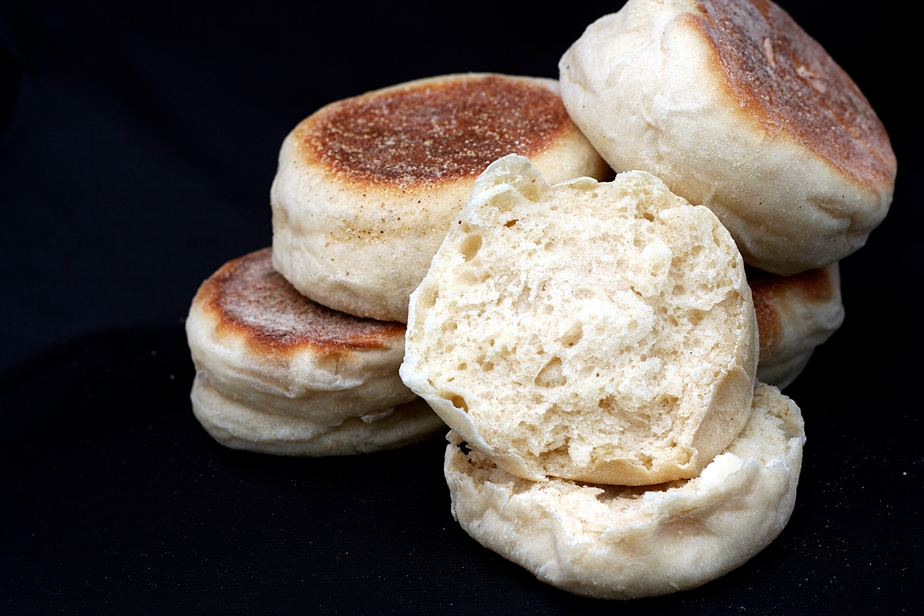
Bread muffins are quintessentially and traditionally British and have a very particular appearance – golden brown on their flat tops and bottoms, with a broad band of pale softness around the middle.  Recipes can be found at least as far as the mid 18th century, but there seems to be a lack of anything older. I suspect the reason for this is that muffins were traditionally made by bakers as opposed to the home cook, and therefore had no place in domestic cookery books. So – a professional baker might well have been the original source of Hannah Glasse’s muffin recipe.

Heroines of Cookery: Hannah Glasse (1708 – 1770)

Hannah Glasse is best known for her cookbook, The Art of Cookery Made Plain and Easy, first published in 1747 and constantly in print for almost 100 years – although her authorship was allegedly only definitively established in the 1930s. She wrote in a very no-nonsense manner, advocated the use of fresh, seasonal, inexpensive ingredients and made her opinions regarding pretentious and wasteful foreign cooks known in no uncertain terms:

“So much is the blind folly of this age, that they would rather be imposed on by a French booby than give encouragement to a good English cook.”

The Art of Cookery covers all aspects of food preparation in a straightforward and concise manner. Impressively, Hannah also includes chapters on preserving meats, bottling and pickling, tips on how to buy fresh produce at market and also includes a seasonal calendar of fruits and vegetables. Free digital copies of her famous book are available here and here.

I think Hannah must have been quite a character. Her recipe is entitled “To make muffins and oat cakes” – but in enthusing about the proper way to make muffins, she wanders off at a tangent and gets so distracted, that the oat cakes are never mentioned again. She even goes so far as to include instructions for building the cooking surface upon which you are supposed to do your muffin cooking. On one point, however, she is most clear: knives should not be used on muffins. Toast them whole and then tear them apart by hand, and be rewarded with pillowy-soft, honeycombed centre, but…

“…don’t touch them with a knife, either to spread or cut them open, if you do they will be as heavy as lead…”


Muffins

Makes 12-15 small muffins

420ml whole milk
50g butter
1 tsp salt
2 tbs granulated sugar
1 large egg
3 tbs potato flour [1]
400g strong white bread flour
1 sachet instant yeast
rice flour, for shaping (optional)[2]
semolina, for cooking (optional)

  • Cut the butter into small dice and add to the milk. Heat gently (microwave/saucepan) until the milk is warmed and the butter melted.
  • Put all ingredients except the semolina and the rice flour in the bowl of your stand mixer and knead slowly to combine. Continue kneading for 5 minutes.
  • If the dough is looking stretchy and shiny, then cover and leave to rise for 1 hour. If not, add more(3-4 tbs) flour and knead for another 5 minutes. Cover and leave to rise.
  • Tip out the dough and knock it back (i.e. pat it down to deflate).
  • Divide dough into 80-100g pieces and shape the dough into balls.
  • Heat your pan over a low heat. Do not add any grease or oil.
  •  When the whole pan is of an even heat, scatter semolina into the bottom of the pan if liked.
  • Use a fish slice/spatula to move the muffins into the pan turning them over as you do so.
  • Cook gently until the undersides are nicely browned – between 5-8 minutes – then use your spatula to turn over the muffins.
  • Cook the second side for a slightly shorter time. If you’ve made a test muffin, you can pull it apart to check the insides are fully cooked.
  • The semolina helps keep the muffins from sticking to the pan, but it does get very browned, so wipe the pan clean after every batch and add fresh semolina before the next batch.

[1] Available at health food stores, Holland & Barrett, Oriental food shops.
[2] I got this tip from Elizabeth David’s book English Bread and Yeast Cookery. The rice flour dries the surface of the muffins without making them sticky or leaving clumps, so the excess is easy to brush off. If unavailable, substitute with cornflour or just use regular flour.