Bara Brith

This week it’s the classic Welsh speckled bread Bara Brith. Nowadays, this is usually made using baking powder as the leavener, but personally I prefer the more traditional yeast.

And bonus! There’s two recipes for you to choose from!

When looking at an old recipe, I usually study the range of recipes available and select the one that, to my imagination, sounds the nicest. If there is a tie, then I will make both and decide which makes the cut by taste. This time, however, it was too difficult to decide, so I chose not to choose and leave that decision to you.

Both recipes have their strongpoints, not least from their provenance and pedigree.

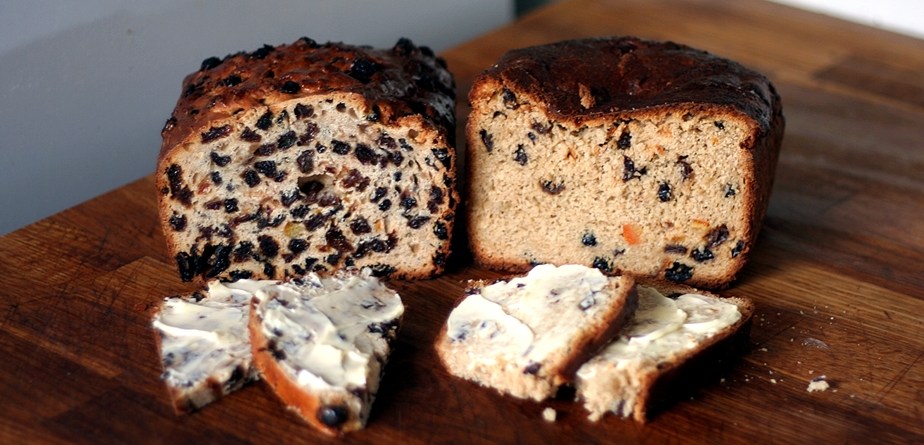
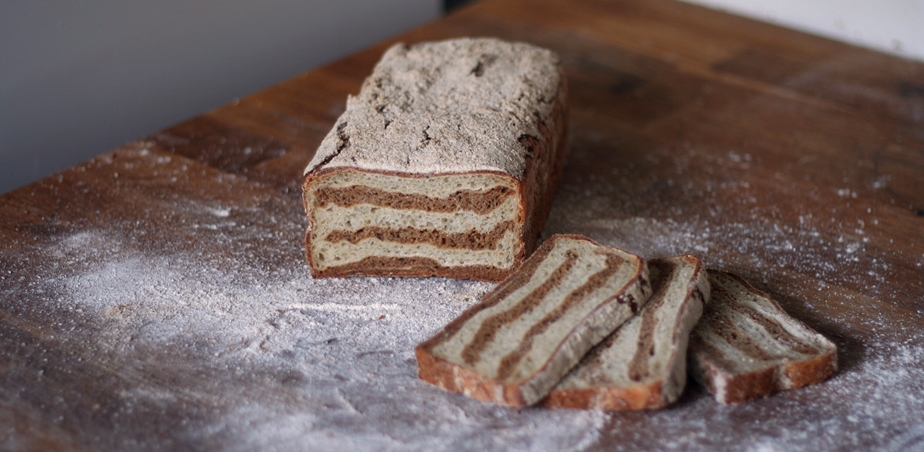
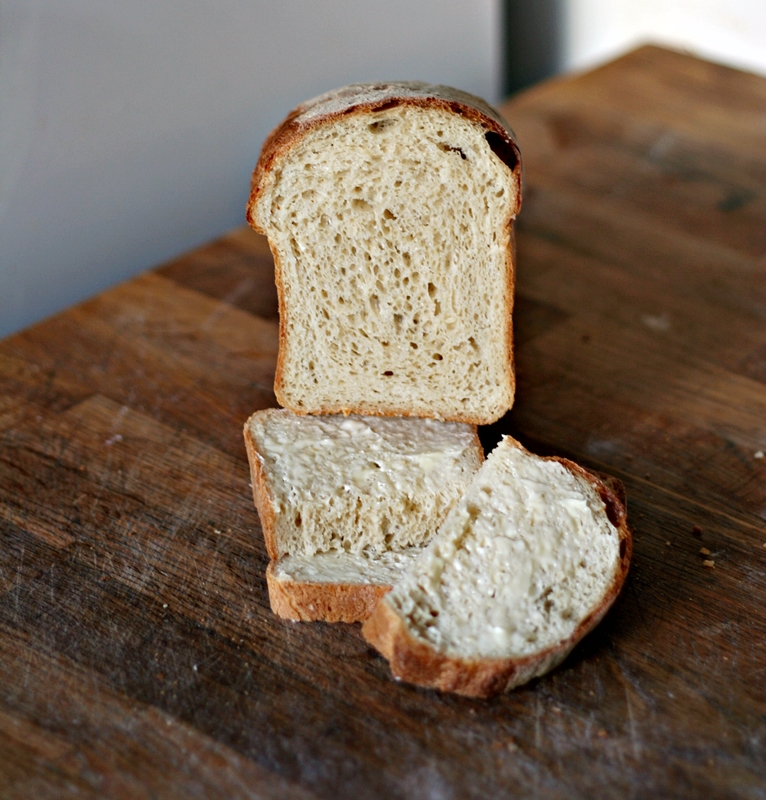
On the left of the photo above, we have the recipe from Walter Banfield’s classic book “Manna”: A Comprehensive Treatise on Bread Manufacture (1937), a book admired by Elizabeth David and breathtaking in its breadth and scope. It is based on additions made to ordinary white bread dough after its first proving. The large quantity of fruit and peel contrast brightly against the white of the dough and make for a very sturdy slice that will keep moist for a long time.

On the right of the photo, a possibly more authentic Bara Breith from Mrs E.B.Jones, who, for many years, ran the Powys Temperance Hotel on Market Square, Llanrhaeadr-Ym-Mochnant in the first half of the 20th century. The recipe was collected by Dorothy Hartley and included in her iconic book Food in England, first published in 1954. As can be seen from the picture, this recipe isn’t as heavily fruited as the first one, but it has the added interest of being made from half wheat flour and half oat flour (finely ground oatmeal). Against expectation, the crumb is very light, making it a much more delicate slice.

I love the richness of the fruit in the bread dough version, but also really enjoy the delicate flavours of Mrs Jones’ version. I suggest you make both and decide for yourself.

Both loaves will keep well wrapped in parchment and foil, in a cake tin. Both are best enjoyed sliced and buttered, with a hot cup of something in front of a roaring fire.

Mrs Jones’ Bara Brieth

Don’t feel the need to order oat flour especially for this recipe, you can make your own by blitzing rolled oats in a spice grinder, or just use medium oatmeal for a more robust texture.

60g candied orange peel – diced
100g currants
70g sultanas
225g strong white flour
225g oat flour or medium oatmeal
115g lard
115g Demerara sugar
¼ tsp salt
1 large egg
1 tsp mixed spice
1tsp soft brown sugar
30g fresh yeast

  • Put the peel and the fruit into a bowl and pour over boiling water. Set aside to plump for about 30 minutes.
  • After 15 minutes, cream the yeast and the soft brown sugar together.
  • Put the flours and the lard into the bowl of a food processor and blitz until the mixture resembles breadcrumbs.
  • Tip into the bowl you will be using for mixing and add the Demerara sugar, spice and salt
  • Drain the fruit, retaining the water, and use it to mix the dough. Keep the fruit warm in a low oven while the dough is kneaded.
  • Add the yeast to the flour mixture with the egg, lightly whisked. Use the (by now just) warm fruit-soaking water to mix everything to a soft dough.
  • Knead for 10 minutes.
  • Mix in the warm fruit, cover with plastic and allow to rise until doubled in size. Due to the richness of the ingredients, this may take anything between 1 and 2 hours.
  • Grease a large loaf tin.
  • When the dough has risen, tip it out and pat down to deflate. Form into a loaf shape and lay into the prepared tin.
  • Cover lightly and allow to rise for about 45 minutes.
  • Preheat the oven to 170°C, 150°C Fan.
  • Bake for 30 minutes.
  • Turn the tin around 180 degrees and lay a sheet of foil lightly over the top, to prevent the loaf browning too much.
  • Bake for a further 25-30 minutes.
  • Remove from the tin and if the bottom doesn’t sound hollow, return to the oven for 5-10 minutes to crisp up. You can place the loaf directly onto the oven bars.
  • Cool on a wire rack.

Walter Banfield’s Bara Brith

450g strong white flour
½ tsp salt
1tsp soft brown sugar
30g fresh yeast
warm water to mix

115g lard in small cubes
5g mixed spice
65g Demerara sugar
1 large egg
300g currants
90g sultanas
90g raisins
60g candied orange peel – diced
50g plain flour

  • Cream the sugar and yeast together with a tablespoon of the flour and a little warm water and set aside to work
  • Mix with the rest of the ingredients into a soft dough.
  • Cover with plastic and set aside to rise for 1 hour.
  • After 30 minutes, spread the fruit (not the peel) out on a baking sheet lined with parchment and put into the oven on its lowest setting, just to warm through.
  • Grease a large loaf tin.
  • When the dough has risen to twice its original size, add in the finely cubed lard, spice, egg and sugar and knead smooth.
  • Add the warmed fruit and peel and mix thoroughly.
  • Sprinkle over the flour and mix thoroughly.
  • Shape into a large loaf and place into the prepared tin.
  • Allow a long second rise, of 1-2 hours.
  • Preheat the oven to 170°C, 150°C Fan.
  • Bake for 30 minutes.
  • Turn the tin around 180 degrees and lay a sheet of foil lightly over the top, to prevent the loaf browning too much.
  • Bake for a further 25-30 minutes.
  • Remove from the tin and if the bottom doesn’t sound hollow, return to the oven for 5-10 minutes to crisp up. You can place the loaf directly onto the oven bars.
  • Cool on a wire rack.

Fresh Yeast Muffins

Some of you might know that there’s already a muffin recipe on the blog. Nevertheless, I decided to revisit muffins in part because it is now ridiculously easy to get hold of fresh yeast, but also because a lot of muffin recipes and videos Out There™ are just plain wrong when it comes to the method of shaping them. There, I said it. Oh yes, there’s no holding me back when my dander is up.

Because there’s no need to go faffing about with rolling out the dough and using *in her best Lady Bracknell voice of disapproval* a pastry cutter. Apart from anything else, it ruins the iconic shape of the muffin (a flattened top and bottom with a smooth, soft and pale crust around the middle) with an ugly seam where the dough has been compressed as it was cut.

This recipe is adapted from one listed in Florence White’s Good Things in England and dates from 1826, and without being overly dramatic, eating them is like biting into a cloud. To keep them as soft as possible, I’ve used ordinary plain flour and used the whey from some curd cheese I made earlier this week as part of the mixing liquid, as it gives a beautifully soft crumb. Don’t worry about having to use whey, you can just make the mixture equal parts whole milk and water.

Fresh Yeast Muffins

Makes 14

560g plain flour
20g fresh yeast
1 tsp granulated sugar
1tsp salt
300ml whey + 150ml whole milk OR 225ml water + 225ml milk

cornflour for dusting

semolina for cooking (optional)

  • Put the flour and salt into a bowl. I use my stand mixer fitted with a dough hook.
  • Crumble the yeast into a small bowl  and add the sugar. Work the sugar into the yeast then set aside for five minutes until it becomes liquid.
  • Mix the whey and milk (or milk and water) in a small pan and warm gently to blood temperature.
  • Pour the yeast into the milk mixture and then pour the whole into the flour.
  • Mix thoroughly and knead for 10 minutes – five if using a dough hook.
  • Cover and leave to rise for 1.5-2 hours.
  • Deflate the dough, knead briefly, cover, and allow to rise for another 30 minutes.
  • Sprinkle the work surface with cornflour. The dough is rather loose and prone to stickiness. The cornflour doesn’t stick to itself, and will therefore act as a non-stick layer between the dough and the work surface.
  • Tip the dough out and divide it into 75g portions. This quantity of dough will, when risen and cooked, make the perfectly-sized muffin – 8-9cm across and 4cm thick. You can make them larger, but remember to adjust the cooking time accordingly.
  • For each piece of dough, fold the edges in towards the middle, then turn over so that the folds are underneath and the top is smooth. Cup your hand over the dough and roll it in small circles, shaping the dough into a smooth ball. Set the ball on a cornflour-dusted surface to rise. Don’t put the balls of dough too close together, or they might rise into each other.
  • Allow the dough to rise for 30 minutes from the moment the first ball of dough is shaped. They will take time to cook in batches, so with the staggered batch cooking, the last few will have risen just in time to be cooked.
  • Put a heavy-based pan onto a large ring on a low heat.
  • Cook the muffins in batches. Depending on the size of your pan, you can cook 4 or 5 at a time. Sprinkle the pan with semolina if you like, although if your pan is non-stick, this can be omitted.
  • Gently slide a thin spatula under one of the risen balls of dough and transfer it to the pan turning it upside down as you do so, so that the top of the muffin cooks first. This will help create the perfect muffin shape, because the base of the dough is already flat and the top is rounded. If you cook the base first, the top continues to rise and curve, and the drying effect of the radiated heat from the pan will dry the surface of the dough and will make it ‘reluctant’ to flatten into the traditional muffin shape. Cooking the top first, the weight of the dough allows it to settle like a gently deflating cushion, into the flattened shape, and a partial hardening of the already flat bottom (which is currently the top) is fine.
  • Cook for five minutes, then gently turn the muffins over and cook for another 5 minutes. When done, they should sound hollow when tapped.
  • Transfer to a wire rack to cool.
  • Wipe the pan free of semolina, then repeat until all the muffins are cooked.

To serve – very important

These instructions are adapted from Hannah Glasse, who insisted that no knife should touch muffins, as they would become heavy. Here is a guide to enjoying your fresh muffins.

You will need:
chilled butter cut into thin slices.
toppings such as jam, honey or sausage, egg and bacon, depending on degree of hunger.

  • Whilst perfectly delicious soft pillows when freshly cooked, unless you are able to eat them hot from the pan, muffins should be toasted on the outside before being served. The insides are best left un-toasted, so you can bite down through the softness to the crunchy outside. The contrast is sensational.
  • Grill  for 2-3 minutes each side until the outsides have crisped, but not darkened.
  • While the muffin is still warm, take a serrated knife – yes, I know Hannah said no to knives, but a little help is needed in order to divide the muffin.  Take your knife and gently draw it around the side of the muffin like an equator, if you will – just breaking the soft crust to a depth of 1-2mm.
  • Once the ‘skin’ (it really is too soft to be called a crust) has been scored all the way around, hold the muffin sideways and with the tips of your fingers, gently pull the muffin apart. The cutting will help it divide evenly into two halves.
  • Quickly lay a slice of cold butter between the two halves and put them together again.
  • Cover with a cloth to keep warm.
  • After about a minute, turn each buttered muffin upside down, so that the now melted butter can seep into the other half of the muffin.
  • Your muffin is now ready to be enjoyed as is, or to drizzle over the toppings of choice. Remember, do not spread your toppings, or the pressure will deflate your soft, billowy muffin.