Ormskirk Gingerbread

If you’d asked me only a few years ago, of my opinion of gingerbread, I would have given an indifferent shrug in response: I didn’t dislike it, but I wasn’t a fervent fan either. Ginger biscuits and the gingerbread used for gingerbread men I thought dull. Ginger cake was fine, but it would never be a first choice. Since then, I have discovered so many old recipes that have range and depth and nuance that it’s turned my head completely. And here we have another to add to the collection.

Ormskirk Gingerbread has a lot going for it, and I’d even go so far as to say it is probably one of the best-tasting gingerbreads you’ve never heard of.

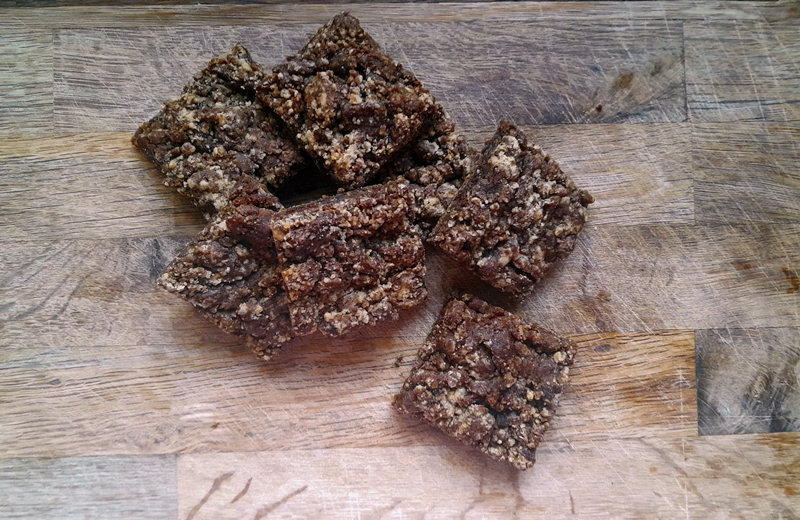
It has a speckled appearance, from mixing the dry ingredients with melted butter and treacle, which is enough to bind, but not drown. There is candied peel, traditionally lemon but sometimes others, and spices, usually ginger, but frequently, additional spices as well. A major attraction, for me at least, is the texture, falling between the softness of parkin and the crispness of a biscuit. As you, quite literally, sink your teeth into a piece, you experience a dense chewiness which, with the variety of flavourings, is immensely satisfying.

Ormskirk Gingerbread (1830s) is  one of the earliest geographically-linked gingerbreads I’ve found – predated only by Wrexham Gingerbread (1828). In the 1850s, a group of five local women paid £20 per year to the East Lancashire Railway company for the privilege to sell their gingerbread to travellers passing through Ormskirk station, which must have contributed to the spread of its popularity.

I have a selection of recipes for you to try, because in all honesty, I like them all. The method is the same for all of them, so I shall be listing the scaled-down ingredients alongside each recipe, then you can scroll down to the method and cooking instructions. All quantities are for a 20cm square tin.
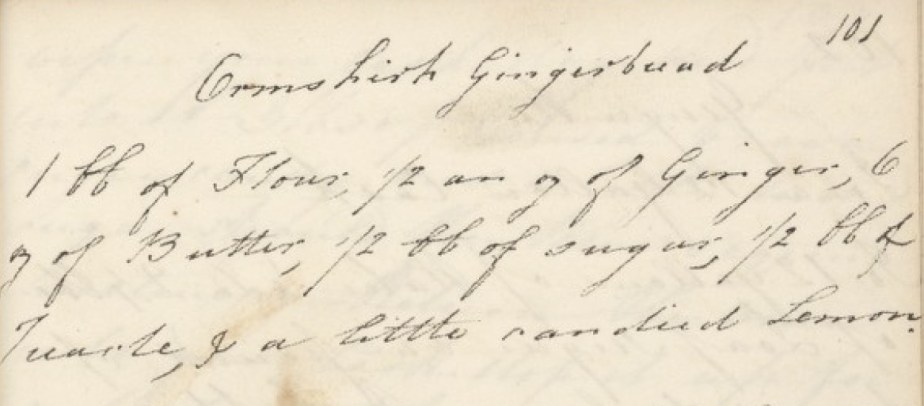
Ormskirk Gingerbread recipe, (1822-1841), MS4998, Wellcome Collection

This recipe is from a handwritten manuscript held at the Wellcome Collection. It might actually be older than the recipe below, but there’s no way of telling for sure. Rather unhelpfully, there are no instructions for either making or baking, but it clearly contains all the classic ingredients and is a great introduction to this type of gingerbread:

225g plain flour
115g soft, light brown sugar
7g/1tbsp ground ginger
85g butter
115g treacle
20g candied lemon peel
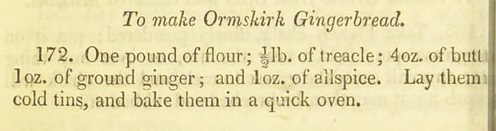
From: The domestic receipt-book by Joseph Worrrall, 1832, p38.

This is the earliest printed recipe I found. Unfortunately, it contains an error – the sugar is missing. Aside from this, what I found interesting was the complete omission of what appears to be a major component of other recipes, the candied lemon peel.  In  addition, there is, proportionally, a lot of spice in relation to the quantity of flour, but it is an interesting variation. In the past, I have bought dried, chipped ginger, and ground it as needed, and the flavour is bright and vibrant and, curiously, with a touch of lemon. Similarly with allspice, whose flavour really evokes a blend of spices.

225g plain flour
60g butter
115g treacle
115g soft, light brown sugar
14g ground ginger
14g allspice
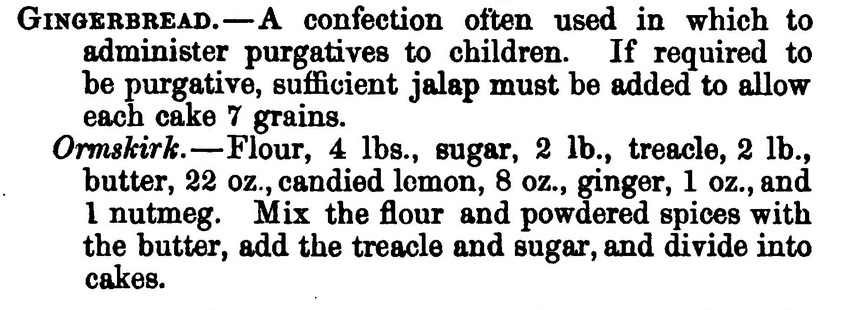
From The druggist’s hand-book of practical receipts, Thomas F. Branston, 1853, p80

This recipe echoes the medicinal uses many believed gingerbread possessed in the middle ages. I find it odd that it is Ormskirk Gingerbread that is specified in particular, instead of a generic gingerbread recipe. Jalap is the ground root of a Mexican plant of the Morning Glory family, and it was used in times past for its laxative effect.

225g plain flour
115g soft, light brown sugar
115g treacle
80g butter
30g candied lemon peel
2 tsp ground ginger
1½ tsp ground nutmeg
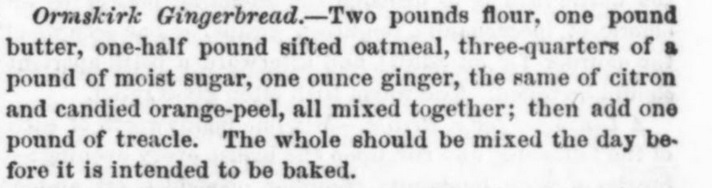
Peterson Magazine 1861-01: Vol 39 Iss 1, p93

This last recipe is a full-on, all the bells and whistles version. There’s no candied lemon peel – instead there’s candied orange and candied citron and, aside from the ginger, no other spices. There’s a higher than usual farinaceous component, with the addition of some oatmeal flour (which you can make yourself by putting rolled oats into a blender/spice mill). Finally, there’s the instruction to mix it a full day before you want to bake it. Many old gingerbread recipes have this added time requirement, because they’d also use alum and potash as raising agents, and these worked slowly, so a mix for gingerbread could be sitting in a tub for days if not weeks. There’s no raising agent included in this recipe, so I was curious whether there would be any difference to the other batches. Verdict: There was, and the resulting gingerbread was definitely veering towards cakey, although this might have been due to the added oatmeal – if that’s your preferred texture, have at it. The next time I make this I probably wouldn’t wait the 24 hours, but that’s just me being impatient.

225g plain flour
115g butter
60g sifted oatmeal flour
80g soft, light brown sugar
115g treacle
15g candied orange peel
15g candied citron peel
7g ground ginger

As I said at the top, all these recipes are delicious.

Ormskirk Gingerbread

Another reason to choose to make this gingerbread is that it can be made gluten-free, using gluten-free flour (I used Doves Farm) and gluten-free oats (Morrisons have the nicest looking GF oats – they’re like steel-rolled ones!).

It can also be made vegan, if you swap out the butter for either coconut oil or some other fat that is solid at room temperature.

Finally, there’s two slight variations in method, and it relates to how you handle the butter. The traditional method for gingerbread is to melt it in the treacle and then pour the mixture into the dry ingredients to mix. The other method is to blitz it with the dry ingredients in a food processor (or rub it in by hand). It doesn’t matter which method you choose, as the result is the same.

  • Choose your ingredients from one of the four recipes above.
  • Line a 20cm square tin with baking parchment.
  • Heat the oven to 160°C, 140°C Fan.
  • Mix your spices, sugar and flour(s).
  • If you’re blitzing the butter with the dried ingredients, add it now.
  • Blitz the mixture to resemble breadcrumbs.
  • Slice the candied peel thinly and then cut into 1cm pieces. Mix the peel into the dry ingredients, making sure the pieces don’t stick together.
  • Pour your treacle into a pan to warm. I use a large frying pan, as I prefer to add everything to the treacle, as opposed to pouring the treacle into the dry ingredients. Add the butter if you’ve not added it to the flour. You’re not trying to boil it, just warm it up enough that it moves freely and the butter (if using) is melted.
  • When the butter has melted and the treacle warmed, pour  the warm liquid into the dry ingredients and mix in. It doesn’t have to be evenly coloured.
  • Tip the mixture into your prepared pan and level out. I like to leave it rather roughly textured. Don’t press the mixture down hard, just even it out.
  • Bake for 40 minutes, turning the tin around after 20 minutes to ensure even baking.
  • Remove from the oven and , leaving the gingerbread in the tin, divide it into pieces. You can cut it into any shape you please – easiest with a square tin is 16 pieces (4 x 4 grid).
  • Set the pan aside to cool completely.
  • When the gingerbread is cold, store in an airtight container.
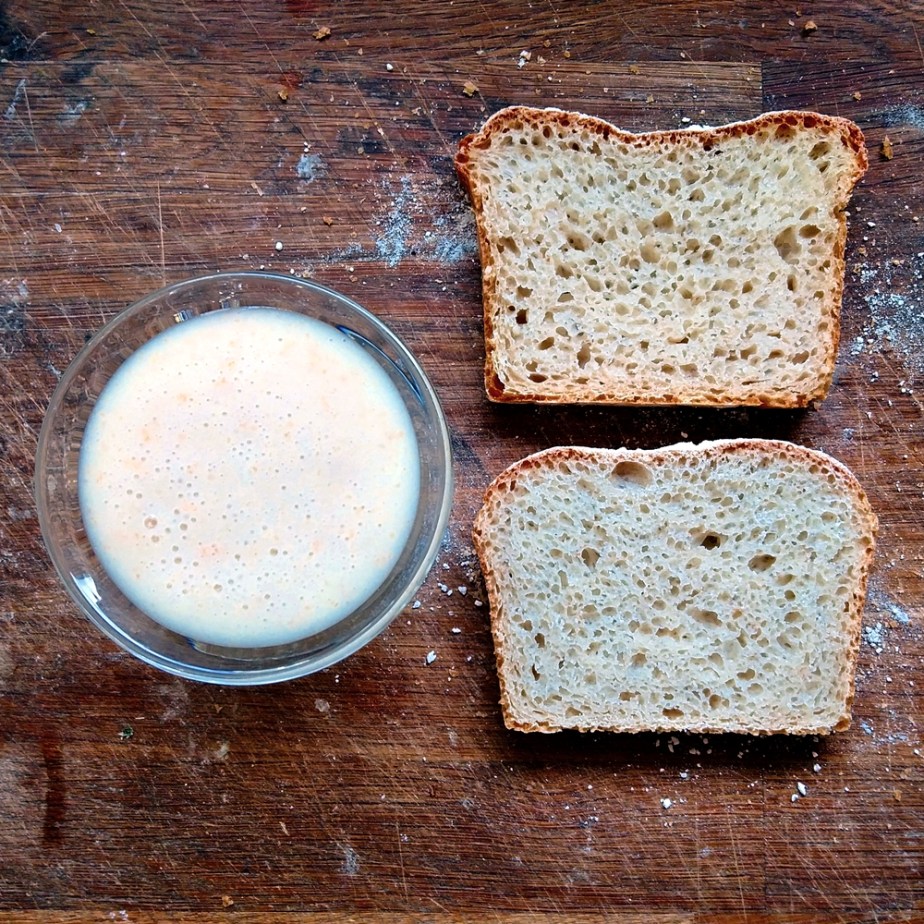
Barm

Barm is what we used to use to make bread before the advent of solid, compressed yeast. It was skimmed off the top of fermenting beer and occasionally wine, and, back in the day when everyone was drinking small beer and ale because water couldn’t be relied on, was in ready supply.

Nowadays, it is a little tricky to obtain, unless you live near a brewery, but easy to rustle up your own due to the numerous recipes available in old books.

In general, a small quantity of hops is simmered in water for flavour, then flour and sugar and boiled, mashed potatoes are added to create the right consistency (a little like double cream). Frustratingly, when I was first looking into this, most of the recipes I found included an instruction something along the lines of: “then add a pint of good barm.” So yes, you end up with a large quantity of barm for all your baking needs, but only if you have barm to begin with. What about if you have no barm or, as I recently found, no yeast in the shops due to the random panic buying intially happening at the start of the COVID-19 lockdown?

To the rescue came a recipe in a Welsh-language cookery book “Llyfr Coginio a Chadw Ty”, (Wrexham, circa 1880), in which you can indeed start with no barm and end up with about a gallon.

I’ve made this a few times. The batch I made last year was in October, and after something of a baking frenzy spread over a couple of weeks, I left the remainder outside the back door in a closed, tupperare box. With the recent demise of yeast in the shops, I thought I’d try and resurrect it, and by jove it worked! The bread had a pronounced beery/yeasty flavour, which was due to the age, I think. Still, good to know it can keep for over 5 months in a cool environment.

Unlike a sourdough starter, it doesn’t need cosseting and feeding. Once mixed, and it has ‘risen and fallen’, it can be transferred to your container of choice and left alone. Before you use it, you stir it up (because it will settle over time), take what you need, then put the rest back.

Baking with barm is a little different from regular yeast. For starters, it takes a long time to rise, but on the plus side, it only needs to rise once. For wholemeal flour, it’s usually about 10 hours at room temperature for a loaf, and for white flour, around eight. This can be to your advantage, in that you can set a batch to rise at night, and it’ll be ready to bake by the morning. Also morning/afternoon rise, bake at night. If these times don’t suit, you could always go for an extra long, slow rise by putting the dough in a cool place, or even in the fridge (not tried this myself yet).

I have three hop bines planted in my garden, and if, like me, your garden is tiny, I can thoroughly recommend them as they are excellent producers of foliage for a tiny footprint of earth. I freeze some of the cones for barm making, others can be used in pillows to aid sleep. They also look fabulous hanging up and absorbing smells from the kitchen (although once dry, the droppage from the cones when you brush past is a housekeeping nightmare).

I realise not everyone will be in a similar position, so I have spent some time exploring other options, and

  • you can buy hops on the internet from brewing supply stores. You only need 60g for one batch of barm – which makes a LOT – so don’t go mad with the quantities.
  • I have also been investigating whether hops are actually needed at all, and the good news is, they aren’t! I have successfully made a batch of barm using only sugar, flour, potatoes, salt and water. If I’m honest, the hop-less bread does initially seem to lack a little something flavourwise, so my workaround for this is a suggestion to use beer as some (up to 50%) of the initial liquid, in order to get the hint of brewery aromas. You can choose dark, strong beers if you like it really pronounced, or something from the ales aisle for a lighter flavour. Or, you could just wait a while – the lower bread in the picture was baked with 2 week old hopless barm, and it had already started to have its own yeasty flavour.

Home-made Barm

Day One
4.5 litres water or beer & water mixed
60g dried hops (optional)
225g brown sugar
4tbs salt
450g flour – a mixture of different flours if liked.

Day Three
1.5kg floury potatoes (Maris Piper, Wilja, etc)

Day Four
Put into container(s)

  • Day One. The aim on Day One is to get a mixture that will attract the natural airborne yeast that surrounds us. One method uses hops, another uses no hops, but beer and water, a third uses neither beer or hops.
    • With Hops: Add your hops to litres of water, bring the water to a gentle simmer and simmer for 30 minutes. If you want just a mild hoppiness, strain now, otherwise allow to cool to blood temperature and strain.
    • With Beer: Make up 4.5 litres of liquid using beer/ale and water. Bring the mixture to blood temperature.
    • No hops or beer: Bring 4.5 litres of water to blood temperature.
  • Weigh out 450g flour. It can be one type of flour or a mixture of flours. Generally speaking, bleached white bread flour isn’t the best, better to have a mixture of brown/wholewheat with a little rye or buckwheat for flavour.
  • Weigh out 225g brown sugar. Again, the type doesn’t matter, it’s more for colour and flavour. I prefer dark muscovado.
  • Mix the flour, salt and sugar to a smooth paste with a little of your warm liquid, then add the whole to the rest of the liquid and whisk together thoroughly.
  • Set aside and leave uncovered (so it can catch all the lovely natural yeast) for 48 hours. I use my preserving pan and leave it on one of the back rings of the hob.
  • The flour will eventually sink, so keep a whisk handy and give it a good stir every now and then.
  • Day Three
  • Peel and boil 1.5kg mealy potatoes.
  • Put the cooked potatoes through a ricer, or mash thoroughly.
  • Add the mashed potatoes to the flour mixture and mix thoroughly. If you’re concerned about there being lumps of potato, I’ve found a stick blender is very efficient at smoothing out the mix.
  • Leave for at least 24 hours. NB essentially what you are doing here is feeding the yeast your delicious flour/sugar mixture caught in the previous two days with a carb-fest of potatoes. The yeast will enjoy this so much, it will start working overtime, but will eventually fall into a carb coma. This is my very unscientific explanation of the ‘rise and fall’ that needs to happen before you confine your barm in a container. Failure to let this initial activity work through completely will result in exploded containers (see Exhibit A: my bathroom walls/ceiling/shower screen a few weeks ago….).
  • You can pre-empt any overflows by continuing to whisk vigorously during this 24 hour period, to knock out the air in the mixture. If you’re concerned that your pan might overflow overnight, put it in the (empty) kitchen sink before you go to bed. I’ve done this every time, and it’s never overflowed, but I’ll bet the one time I don’t do it, I’ll regret it.
  • Day Four: You will see a distinct ‘tide mark’ around your pan indicating both the high point your mixture got to, and confirmation that it has indeed ‘dropped’.
  • Stir your mixture one last time, and put into your container(s). I use a large, 5 litre tupperwear box for a whole batch, but large (1.5 litre) plastic fruit juice bottles make for a handy size, with the added ease of a screwtop. VERY IMPORTANT do not screw the lids tight initially, just rest them on the top and only tighten them gradually, otherwise explosions, mess, wailing and gnashing of teeth, yaddah, yaddah…

Here endeth the lesson on the making of barm. Next up, what to do with your gallon of barm !


Malt Scones

My current lack of oven (for those interested the ETA is currently mid-February) has prompted me to delve into my small but eminently interesting collection of Victorian and Edwardian commercial bakery books in search of something to ‘bake’.

Back in the day, there were numerous recipes that could be baked on a griddle, a far more varied selection than the standard trio of Welshcakes, muffins and crumpets generally known today.

Admittedly, these do tend to be variations of a theme of ‘scones’, but the range available with just slight alterations of the ratio of ingredients is delightful.

The recipe I’ve chosen today is for an unusual griddle scone, as it is flavoured with malt, and every other version I have read has been for oven-baked scones only. I’m a great fan of malt loaves,  and have been since childhood, and they’re pretty straightforward to make at home. The 2-5 day wait for them to mature once baked, however, is frustratingly long.

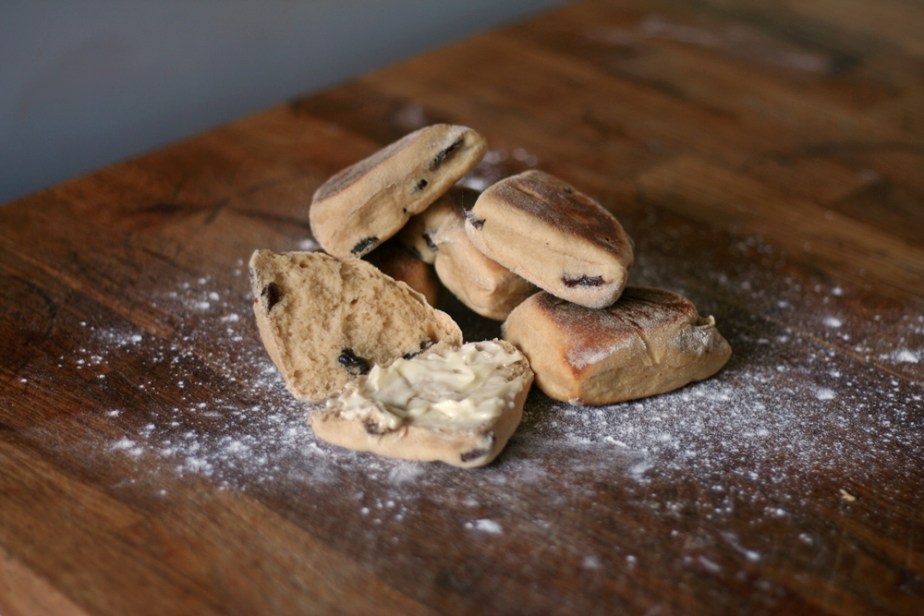
Not so with this recipe. Cooked in just 10 minutes on the stovetop, they can be enjoyed on day of making either fresh from the griddle or cooled, split and buttered. The delicate malt flavour is probably most pronounced when the scones are freshly baked and cooled. Interestingly, these use both yeast and raising agents to achieve their light and fluffy texture, as well as just a single proving.

These are not SWEET sweet scones, although the malt and the sultanas do place them on the sweet side. I was delighted to discover that, with the original quantity of sultanas (30g), they are delicious with cheese. For a sweeter bite, double this quantity and enjoy them split and buttered.

This batch makes twelve, so if this is rather too much for your needs for one day, you can either freeze some, warm them in the oven (just flaunt your oven-ness at me why don’t you!?) or enjoy them toasted and buttered.

Malt Scones

Makes 12

Ferment
150ml warm water
10g    fresh yeast
2 tsp sugar – brown or white
1tbs plain flour

225g plain flour
35g unsalted butter
30g sultanas
60g  malt extract
½tsp cream of tartar
¼tsp bicarbonate of soda

  • Whisk together the ferment ingredients and set aside in a warm place for 30 minutes until frothy.
  • Put the remaining ingredients except the sultanas, into a food processor and blitz until the malt and butter are fully incorporated,
  • Tip the flour mixture into a bowl.
  • Gradually stir in the frothy ferment until the mixture comes together as a soft dough. NB Depending on the moisture levels of the rest of the ingredients you might not need all of the ferment.
  • Knead for 10 minutes.
  • Add the sultanas and mix thoroughly.
  • Divide the dough into three (about 150g each, or 170g if using the larger amount of sultanas).
  • Roll into a smooth ball, then pat out by hand to a 12cm circle.
  • Cut into quarters and set the farls onto a floured board to rise for 45 minutes.
  • Heat a heavy-bottomed pan on the stove top. I use a cast iron, non-stick pan on the largest ring set to the lowest heat. Allow the pan 5-10 minutes to come to an even heat before you start cooking the scones. If your pan doesn’t have a thick base, then choose a smaller heat and watch carefully that the scones don’t become too dark.
  • Cook the scones in batches, for 5 minutes per side until risen and lightly browned.
  • Cool on a wire rack.
  • Store in an airtight container once cold.