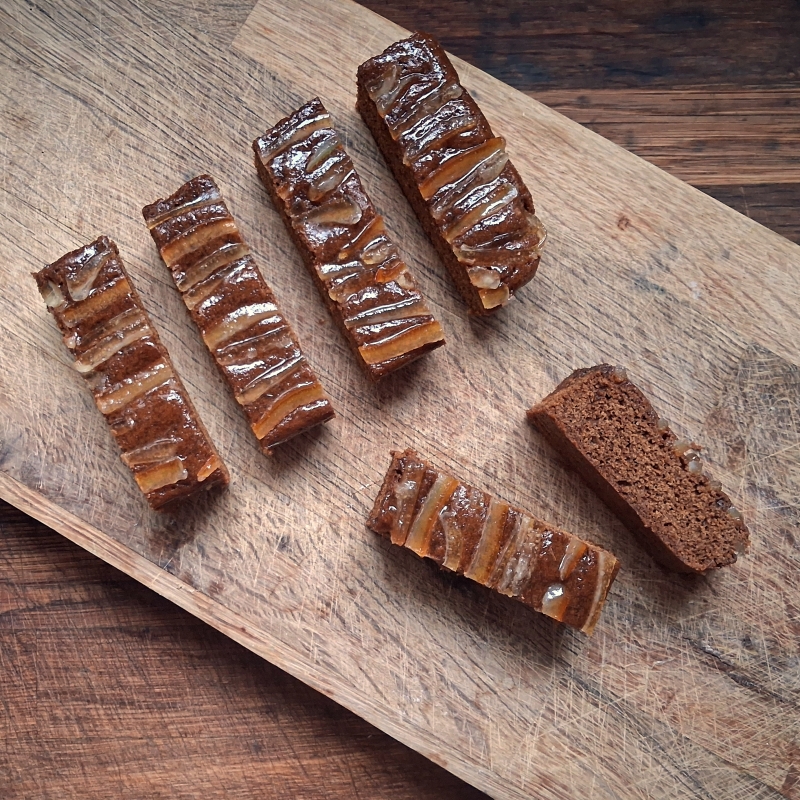
Pepper Gingerbread

What’s this? Two posts in one week? Yes, I’m spoiling you. But it was something I came across when looking for recipes to celebrate Mothering Sunday, and just couldn’t resist.
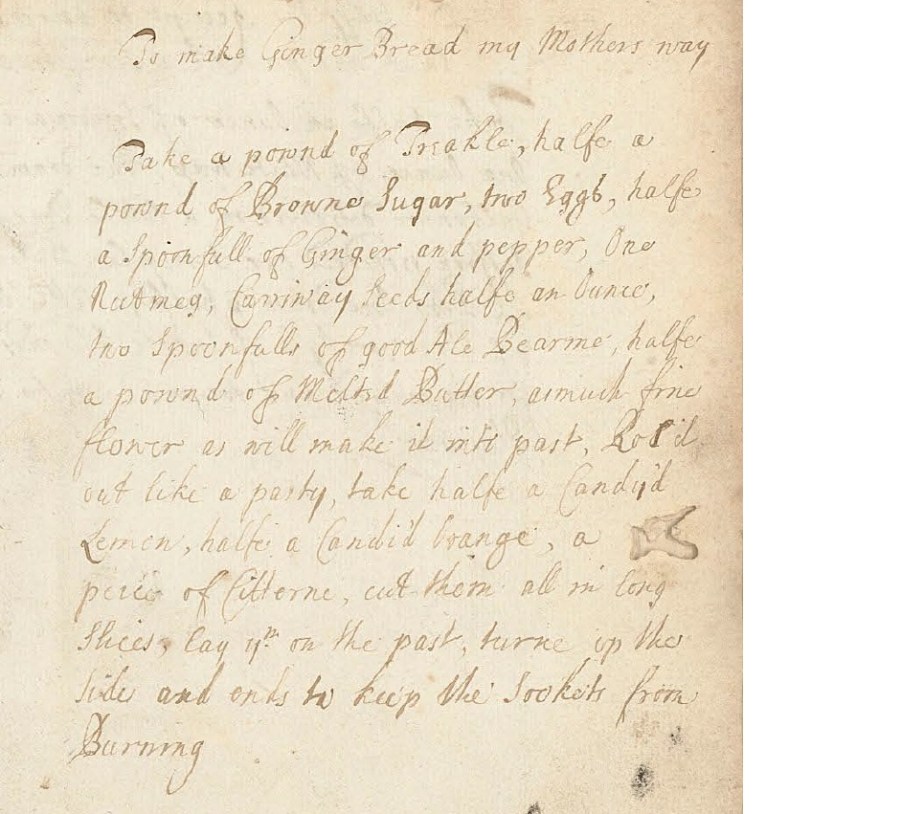
To Make Gingerbread My Mother’s Way, c1675, MS7849, Wellcome Collection

Apart from the whole ‘Mother’ connection, I like that this recipe page is rather splattered and smudged, indicating that it was well loved, and it now proudly displays its battle-worn scars from many a baking day. The manuscript has been dated as circa 1675. Whilst this particular manuscript might well have been started around then, I’m no handwriting expert (I’ve just read thousands of recipes), but I’m thinking that this recipe is written is a more modern hand, so I’ve suggested both 17th and 18th centuries as suitable source dates.

This recipe require only the slightest tweak in order to bring it to a 21st century palate, namely switching the raising agent from barm to bicarbonate of soda. As mentioned numerous times in my writings, initially I like to bake recipes as they are written, as far as is possible. I also invariably reduce the quantities of ingredients, as recipes from times past tend to be on the large side, baking as they were for entire households: you don’t want to expend great expense on large quantities of ingredients only to find you have a complete dud of a recipe on your hands.

I’ve had to guesstimate ‘spoonful’ quantities for the spices and I must have been doing something right, because the first batch I made tasted delightful. The texture was what let it down: even using an entire sachet of fast-action yeast (which I suspect is much more sprightly than traditional barm) failed to make any noticeable impression on the soft gingerbread paste, and it clunked heavily onto the counter top when I turned it out of the tin. I suspect the weightiness of the treacle was just too much for the yeast to handle. However, adding just half a teaspoon of bicarbonate of soda produced a close-textured but pleasantly spongy result.

The spices are a fantastic, if rather unusual, mixture: ginger, caraway seeds, pepper and nutmeg. The overall flavour is definitely ginger, but it is also rounded out with hints of the other spices. Don’t skimp on the caraway seeds – for one batch I made I put less than the recipe indicated because I ran out, and the difference was noticeable and not as full-bodied as the original.

My final tweak was to add a shiny glaze, to really bring out the jewel-like colours of the candied peels. You can use a variety of sweet syrups and/or honey to achieve a great shine, but I like the gelatine glaze as it gives shine without stickiness, and you can store any excess glaze in the fridge for use with other things.

Pepper Gingerbread

This is, conveniently, a one-pot bake, as everything is gradually mixed together in a single saucepan before being turned into the tin for baking. I have used a small, low-sided pan, but a long, narrow tart tin would also do. If you’re not in the mood to make your own candied peel, you can buy large piece peel online.¹

150ml treacle
75g unsalted butter
75g soft, dark-brown sugar
1 large egg – beaten
1 tbs caraway seeds
1.5 tsp ground ginger
1.5 tsp grated nutmeg
0.5 tsp ground white pepper
0.5 tsp bicarbonate of soda
250g plain flour

Topping
2 quarters of candied lemon peel – sliced thinly
2 quarters candied orange peel – sliced thinly
1 medium piece candied citron – sliced thinly

Glaze (optional)
150ml water
50g caster sugar
1 sheet leaf gelatine

  • Line a shallow 18cm x 28cm baking tray with parchment paper.
  • Put the treacle, butter and sugar into a small pan and set over low heat (2) until the butter is melted.
  • Remove from the heat, stir, and set aside to cool to body temperature (you don’t want to cook the egg by having it too hot).
  • Whisk in the beaten egg.
  • Sift the spices, seeds, bicarb and flour together.
  • Add to the saucepan and stir until well combined, with no flour visible at all.
  • Pour the mixture into the parchment-lined pan and smooth over. The paste will be quite soft and will ‘settle’ into the pan on its own accord.
  • Heat the oven to 170°C, 150°C Fan.
  • Lay the thin strips of candied peel onto the top of the gingerbread. To reproduce the pattern in the top photograph, lay a ‘stripe’ of orange peel the length of the pan, then repeat with lemon and then again with citron. Repeat these stripes until the whole of the gingerbread is covered.

  • Bake the gingerbread for 25 minutes, turning the tin around halfway through.
  • Remove the gingerbread from the oven and brush with the gelatine glaze.
  • Allow to cool in the tin.

Glaze
While the gingerbread is baking,

  • Bloom the sheet of gelatine in water.
  • Put the sugar and water into a small pan and stir over medium heat until the sugar is dissolved.
  • Remove from the heat and add the bloomed gelatine. Stir until melted.

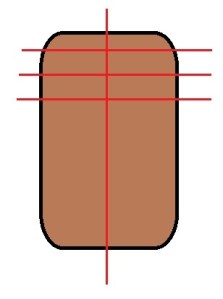
Cutting the gingerbread into bars:
¹ Websites I have used for orange and lemon caps include Wholefoods Online and Wilton Wholefoods. Citron is rather tricky. I made some a while ago, buying the fresh fruit from My Exotic Fruits, and still have some left, but it seems that sourcing it in Europe might be the only way to buy it ready-made nowadays. You could just use orange and lemon, or make some using grapefruit/pomelo peel.
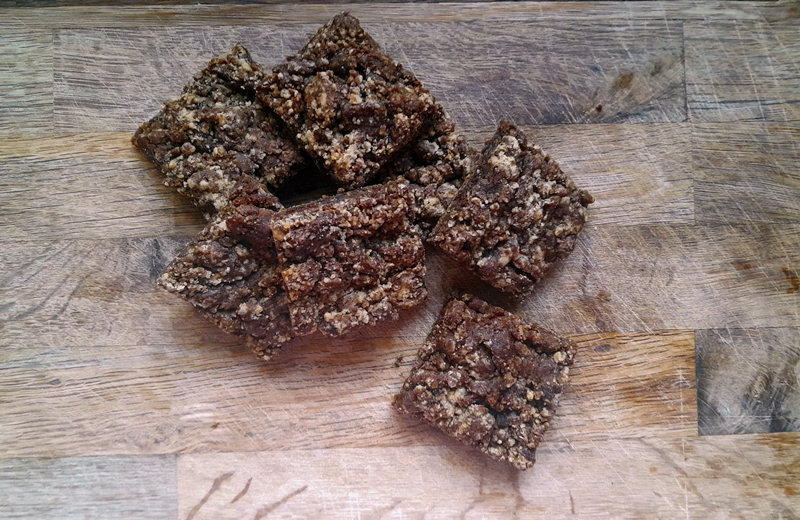
Ormskirk Gingerbread

If you’d asked me only a few years ago, of my opinion of gingerbread, I would have given an indifferent shrug in response: I didn’t dislike it, but I wasn’t a fervent fan either. Ginger biscuits and the gingerbread used for gingerbread men I thought dull. Ginger cake was fine, but it would never be a first choice. Since then, I have discovered so many old recipes that have range and depth and nuance that it’s turned my head completely. And here we have another to add to the collection.

Ormskirk Gingerbread has a lot going for it, and I’d even go so far as to say it is probably one of the best-tasting gingerbreads you’ve never heard of.

It has a speckled appearance, from mixing the dry ingredients with melted butter and treacle, which is enough to bind, but not drown. There is candied peel, traditionally lemon but sometimes others, and spices, usually ginger, but frequently, additional spices as well. A major attraction, for me at least, is the texture, falling between the softness of parkin and the crispness of a biscuit. As you, quite literally, sink your teeth into a piece, you experience a dense chewiness which, with the variety of flavourings, is immensely satisfying.

Ormskirk Gingerbread (1830s) is  one of the earliest geographically-linked gingerbreads I’ve found – predated only by Wrexham Gingerbread (1828). In the 1850s, a group of five local women paid £20 per year to the East Lancashire Railway company for the privilege to sell their gingerbread to travellers passing through Ormskirk station, which must have contributed to the spread of its popularity.

I have a selection of recipes for you to try, because in all honesty, I like them all. The method is the same for all of them, so I shall be listing the scaled-down ingredients alongside each recipe, then you can scroll down to the method and cooking instructions. All quantities are for a 20cm square tin.

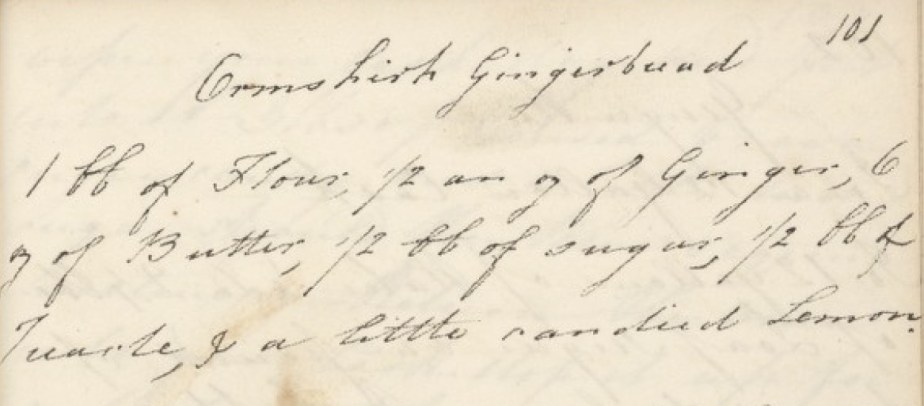
Ormskirk Gingerbread recipe, (1822-1841), MS4998, Wellcome Collection

This recipe is from a handwritten manuscript held at the Wellcome Collection. It might actually be older than the recipe below, but there’s no way of telling for sure. Rather unhelpfully, there are no instructions for either making or baking, but it clearly contains all the classic ingredients and is a great introduction to this type of gingerbread:

225g plain flour
115g soft, light brown sugar
7g/1tbsp ground ginger
85g butter
115g treacle
20g candied lemon peel

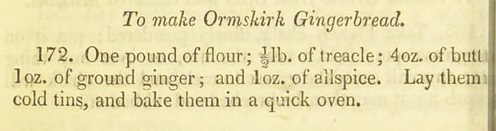
From: The domestic receipt-book by Joseph Worrrall, 1832, p38.

This is the earliest printed recipe I found. Unfortunately, it contains an error – the sugar is missing. Aside from this, what I found interesting was the complete omission of what appears to be a major component of other recipes, the candied lemon peel.  In  addition, there is, proportionally, a lot of spice in relation to the quantity of flour, but it is an interesting variation. In the past, I have bought dried, chipped ginger, and ground it as needed, and the flavour is bright and vibrant and, curiously, with a touch of lemon. Similarly with allspice, whose flavour really evokes a blend of spices.

225g plain flour
60g butter
115g treacle
115g soft, light brown sugar
14g ground ginger
14g allspice

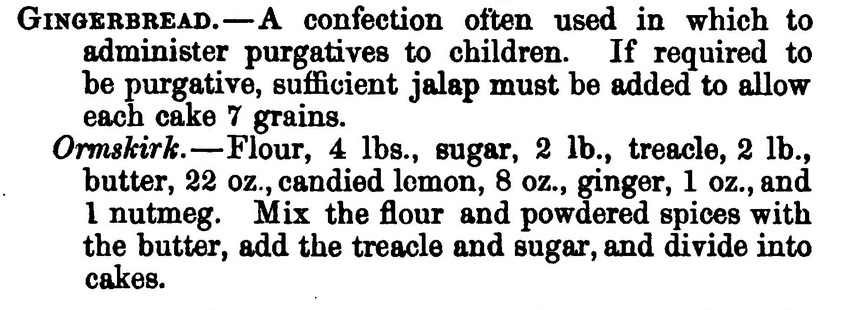
From The druggist’s hand-book of practical receipts, Thomas F. Branston, 1853, p80

This recipe echoes the medicinal uses many believed gingerbread possessed in the middle ages. I find it odd that it is Ormskirk Gingerbread that is specified in particular, instead of a generic gingerbread recipe. Jalap is the ground root of a Mexican plant of the Morning Glory family, and it was used in times past for its laxative effect.

225g plain flour
115g soft, light brown sugar
115g treacle
80g butter
30g candied lemon peel
2 tsp ground ginger
1½ tsp ground nutmeg

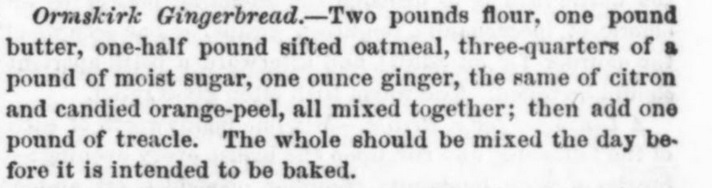
Peterson Magazine 1861-01: Vol 39 Iss 1, p93

This last recipe is a full-on, all the bells and whistles version. There’s no candied lemon peel – instead there’s candied orange and candied citron and, aside from the ginger, no other spices. There’s a higher than usual farinaceous component, with the addition of some oatmeal flour (which you can make yourself by putting rolled oats into a blender/spice mill). Finally, there’s the instruction to mix it a full day before you want to bake it. Many old gingerbread recipes have this added time requirement, because they’d also use alum and potash as raising agents, and these worked slowly, so a mix for gingerbread could be sitting in a tub for days if not weeks. There’s no raising agent included in this recipe, so I was curious whether there would be any difference to the other batches. Verdict: There was, and the resulting gingerbread was definitely veering towards cakey, although this might have been due to the added oatmeal – if that’s your preferred texture, have at it. The next time I make this I probably wouldn’t wait the 24 hours, but that’s just me being impatient.

225g plain flour
115g butter
60g sifted oatmeal flour
80g soft, light brown sugar
115g treacle
15g candied orange peel
15g candied citron peel
7g ground ginger

As I said at the top, all these recipes are delicious.

Ormskirk Gingerbread

Another reason to choose to make this gingerbread is that it can be made gluten-free, using gluten-free flour (I used Doves Farm) and gluten-free oats (Morrisons have the nicest looking GF oats – they’re like steel-rolled ones!).

It can also be made vegan, if you swap out the butter for either coconut oil or some other fat that is solid at room temperature.

Finally, there’s two slight variations in method, and it relates to how you handle the butter. The traditional method for gingerbread is to melt it in the treacle and then pour the mixture into the dry ingredients to mix. The other method is to blitz it with the dry ingredients in a food processor (or rub it in by hand). It doesn’t matter which method you choose, as the result is the same.

  • Choose your ingredients from one of the four recipes above.
  • Line a 20cm square tin with baking parchment.
  • Heat the oven to 160°C, 140°C Fan.
  • Mix your spices, sugar and flour(s).
  • If you’re blitzing the butter with the dried ingredients, add it now.
  • Blitz the mixture to resemble breadcrumbs.
  • Slice the candied peel thinly and then cut into 1cm pieces. Mix the peel into the dry ingredients, making sure the pieces don’t stick together.
  • Pour your treacle into a pan to warm. I use a large frying pan, as I prefer to add everything to the treacle, as opposed to pouring the treacle into the dry ingredients. Add the butter if you’ve not added it to the flour. You’re not trying to boil it, just warm it up enough that it moves freely and the butter (if using) is melted.
  • When the butter has melted and the treacle warmed, pour  the warm liquid into the dry ingredients and mix in. It doesn’t have to be evenly coloured.
  • Tip the mixture into your prepared pan and level out. I like to leave it rather roughly textured. Don’t press the mixture down hard, just even it out.
  • Bake for 40 minutes, turning the tin around after 20 minutes to ensure even baking.
  • Remove from the oven and , leaving the gingerbread in the tin, divide it into pieces. You can cut it into any shape you please – easiest with a square tin is 16 pieces (4 x 4 grid).
  • Set the pan aside to cool completely.
  • When the gingerbread is cold, store in an airtight container.

Rhubarb Gingerbread

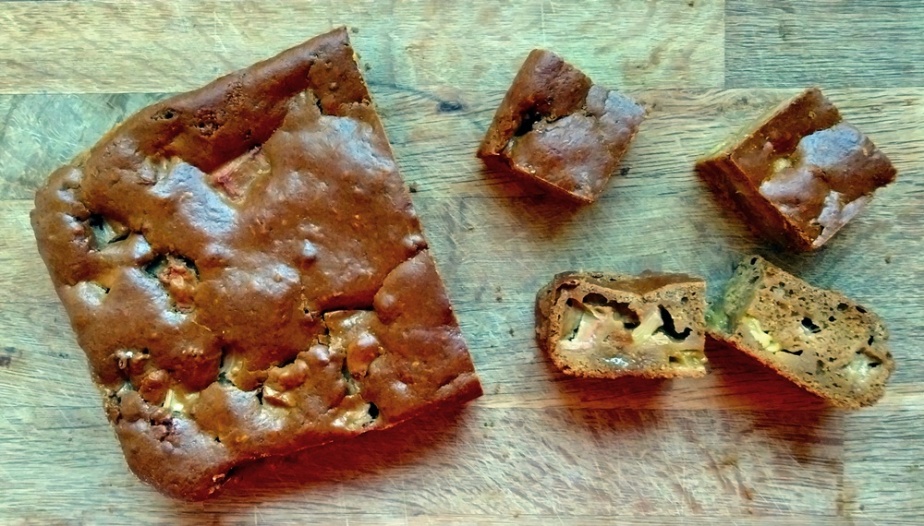
This is a recipe from that classic of home cooking, Farmhouse Fare. I have copies ranging in date from the 1930s to the 1960s, and I always find it interesting to see which recipes come and go through the decades as they are replaced with more fashionable dishes, or as tastes change, as well as recipes which persist over time. This recipe comes from the second impression of the third edition, published in 1947.

It recipe is in the style of the delightfully named pudding cakes, which are so deliciously comforting hot from the oven with custard or cream, that can also be enjoyed cold as a cake. I must confess, though, this really does taste better warm, so have been briefly zapping leftover slices in the microwave to bring it back to a cosy and comforting temperature.

Pairing sharp, zingy  rhubarb with the warmth of treacle and ginger is just the tonic for this time of year, when there has possibly been a little over-indulgence, and a jaded palate needs reviving with something bright and fresh.

The rhubarb in the shops is currently of the beautiful, coral-pink forced variety and sandwiching it within gently-spiced sponge provides richness and freshness with every bite.

Rhubarb Gingerbread

150-250ml milk
60g butter
85g treacle
1 heaped teaspoon ground ginger
1 level teaspoon ground cinnamon
1 large egg – whisked
225g self-raising flour, or plain flour + 2tsp baking powder
200g rhubarb, chopped into 2cm slices
50g soft brown sugar

  • Grease and line a dish with parchment paper. Grease the parchment paper. I used a rectangular tin of dimensions 15cm by 25cm. You could also use a 20cm square tin, or indeed a round cake tin.
  • Heat the oven to 180°C, 160°C Fan.
  • Put 150ml milk, butter, treacle and spices into a pan and warm through until the butter has melted.
  • Remove from the heat and sift in the flour, then whisk in the beaten egg.
  • Add more milk, if required, until the mixture reaches a dropping consistency – that is, it will drop freely from a spoon (as opposed to thud in a lump).
  • Spread half of the mixture into your prepared tin and then lay over the rhubarb. I like to gently poke the slices into the mixture standing on end, but you could also just scatter them freestyle.
  • Sprinkle over the sugar, then top with the remaining mixture.
  • Smooth over and bake for 45-50 minutes, until the middle is springy to the touch. If you like to test for doneness with a toothpick, be sure you don’t mistake cooked rhubarb for uncooked cake mixture and overbake.
  • Allow to cool in the tin for 10 minutes, then serve for pudding either as is, which is delicious, or with custard, cream or ice-cream.