Cookeels

I have a ‘lost’ recipe for you today – a spiced bun that has been known about, recorded and discussed for over 200 years, but for which there has been no recipe. Until now.
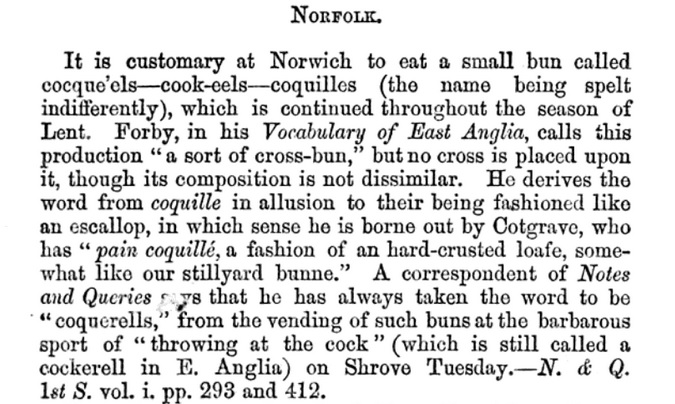
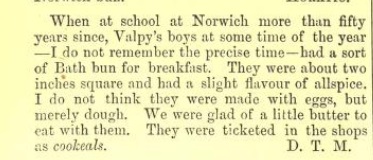
British Popular Customs, Present and Past; Illustrating the Social and Domestic Manners of the People: Arranged According to the Calendar of the Year
By Thomas Firminger Thiselton Dyer · 1876 p81

As luck would have it, I found not one but two recipes buried in the handwritten manuscripts held by The Wellcome Collection.

The earliest mention of Cookeels is found in Robert Forby’s The Vocabulary of East Anglia.

Cookeel: A sort of cross-bun, made and eaten in Norfolk during Lent. They are sold cheap and may be from Fr. Coquille.
The Vocabulary of East Anglia, Robert Forby, 1830, p76.

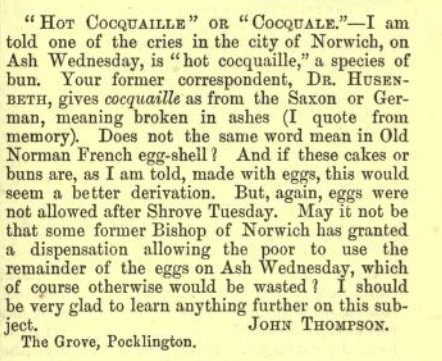
This definition is expanded upon throughout the nineteenth century as more and more academics weigh in with their opinion.
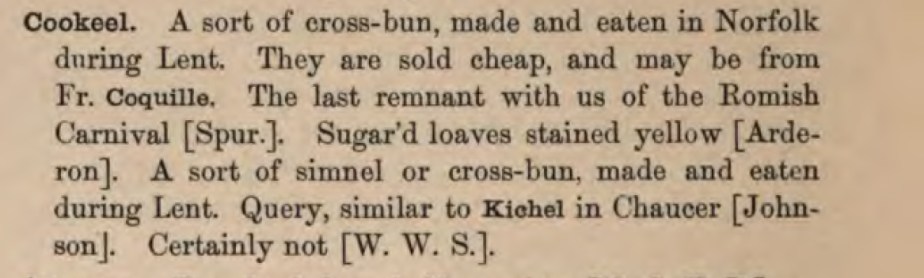
From “A glossary of words used in East Anglia, founded on that of Forby”, p46, Walter Rye, 1895, London
Notes and queries, Fifth Series, Volume Ninth, 1878, Jan-June, London. p87
Notes and queries, Fifth Series, Volume Ninth, 1878 Jan-June, London. p152

Something that became more and more apparent, is the somewhat lackadaisical approach to the spelling of these baked items. This is also true of the names of the two manuscript recipes, to whit Cookeals and Cock Ells:
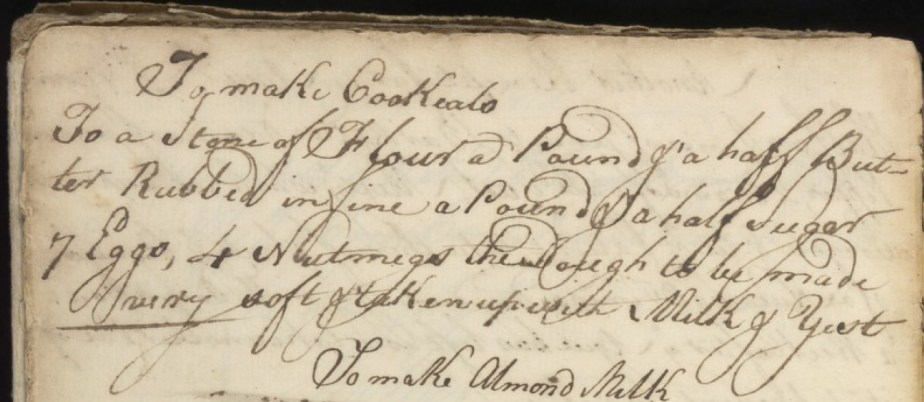
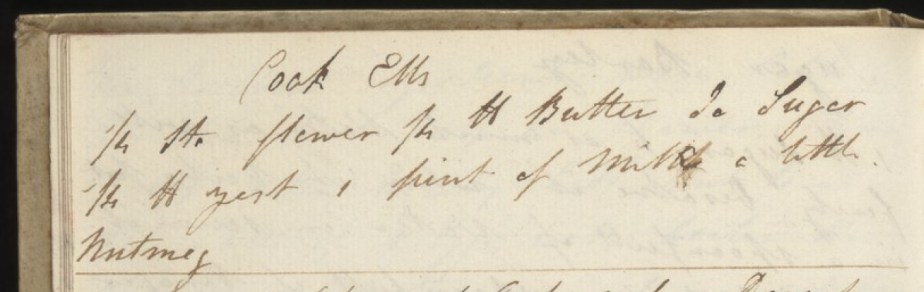
MS7850, Anonymous manuscript circa 1745, Wellcome Collection

MS7834, Anonymous 19thC manuscript, Wellcome Collection

Confession time, I do like to get the the truth of the matter when it comes to recipe names and history. Love a great backstory, cannot be doing with made-up rubbish. So with all these different names, I decided to drill down and see if I couldn’t get to the bottom of it all (this phrase will come back to haunt me shortly).

I don’t think there’s much merit in the name deriving from the French ‘coquille’ (shell): there’s no hard crust, due to the butter, milk and eggs, and no mention of them being shell-shaped. Similarly, I think naming them after the cockfighting pits is also a bit of a stretch. The various accounts seeme to waver between Cockeel and Cookeel, and neither of the handwritten recipes offer any definitive help.

Playing around with the spelling, it turns out that Cockle bread is a thing:

“So far back as the time of Henry III., we find mention made of wassel bread, cockle bread and bread of treet corresponding with the three sorts of bread now in use, viz. white, wheaten and household bread.”

The Englishwoman’s Domestic Magazine, Vol. 1, No. 1, p157, 1852.

Cocklety bread has also been recorded in playground chants:

“The term ” Cockelty ” is still heard among our children at play. One of them squats on its haunches with the hands joined beneath the thighs, and being lifted by a couple of others who have hold by the bowed arms, it is swung backwards and forwards and bumped on the ground or against the wall, while continuing the words, “This is the way we make cockelty bread.”- -Robinson’s Whitby Glossary, p. 40.”

“The traditional games of England, Scotland, and Ireland” 1894-1898, Alice Bertha Gomme, p75

Delighted with this quaint image, I pursued Cockle Bread further – and immediately regretted that decision.
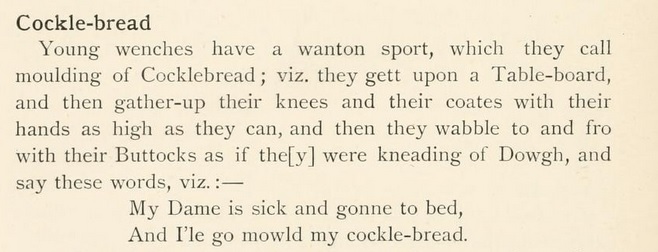
“The traditional games of England, Scotland, and Ireland” 1894-1898, Alice Bertha Gomme, p74

And before I knew it, I was learning that as an extension of this ribaldry, sometimes dough was actually kneaded this way, and then baked and fed to the person whom the girl wished to enamour.


ANYHOO……..Spice buns!

Cookeels

Makes 16

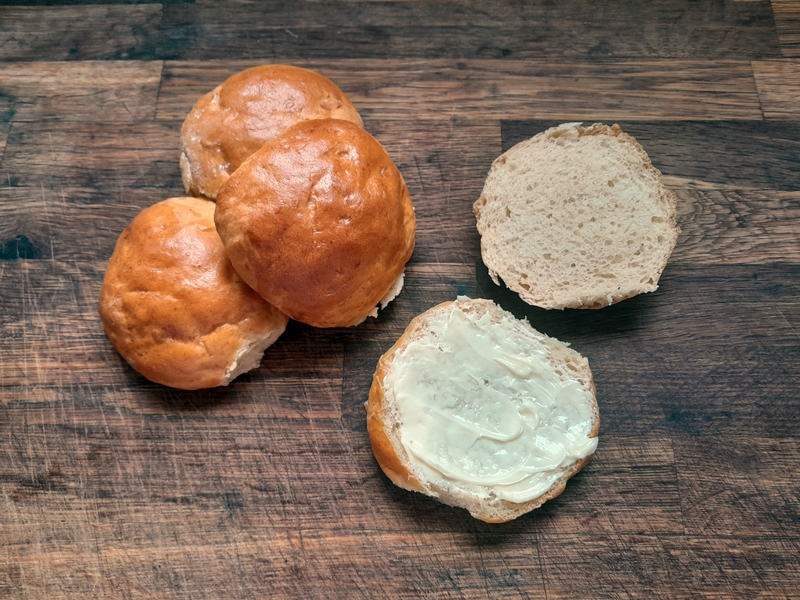
These soft, pillowy buns were enjoyed throughout the season of Lent. Unlike the more famous Good Friday buns, they contained no fruit and neither were they marked with a cross. One of the above anecdotes mentioned allspice as a seasoning, but neither of the recipes do, so we’re going to stick to nutmeg. Usually mixed with several other spices, the fact that these buns have just a single spice adds to their appeal. The enrichment of the egg, milk and butter makes the dough exceedingly soft and the baked bun incredibly tender of crumb. Delicious warm from the oven and freshly buttered, you can also enjoy them toasted with butter and cheese.

150ml water
150ml milk
1 large egg
100g butter
100g caster sugar
pinch of salt
450g strong white flour
2tsp ground nutmeg
1 sachet fast-action yeast

1 large egg yolk
2-3tbs milk

  • Put the dry ingredients into a food processor and blitz until the mixture resembles breadcrumbs.
  • Tip the mixture into a mixing bowl.
  • Zap the water in the microwave for 1 minute. This should heat it but without boiling.
  • Pour the milk into the hot water and stir. It should now be warm. Add the egg to the warm milk mixture and whisk thoroughly.
  • Pour the milk mixture into the other ingredients and mix until the dough comes together. It will be very soft – too soft to knead – but it will become manageable once risen.
  • Cover the mixing bowl with plastic wrap and set aside in a warm place to rise for 1 hour.
  • Cover a large baking tray, or shallow oven shelf for preference, in baking parchment.
  • Once the dough has risen, dust your work surface well with flour.
  • Tip the dough out onto the flour and pat gently to deflate. Dust the surface with flour, then, with the help of a dough scraper, lift and fold the sides inwards and pat down. Continue the dusting and folding until the dough is firm enough to handle. The first time I made this, I put too much liquid in, but it only took three lots of folding to make it manageable.
  • Pat the dough into a square. it will be roughly 20cm, but if it’s larger, that’s fine.
  • Cut the dough into 16 pieces. The easiest way is to cut your square of dough into quarters, then cut each quarter into four.
  • For each piece, fold in the edges of the dough, flip it over and roll into a ball under your hand.
  • Set the shaped dough onto your prepared baking sheet. The dough will spread during rising/baking to the size of a teacake, so space them well apart (7-8cm).
  • When all the dough has been shaped, cover lightly and set aside to rise for 30 minutes.
  • Heat the oven to 180°C/160°C Fan.
  • Whisk together the egg yolk and the milk and brush this glaze over your risen buns. You can use just milk if you prefer.
  • Bake your buns for 20 minutes, turning the baking tray/shelf around after 10 minutes to help with even colouring.
  • Remove from the oven and immediately cover with a clean cloth. This will trap the steam and ensure your buns are soft and pillowy when cooled.
  • Store in an airtight container when cold.
Ouse Bridge Cakes

I love coming across a geographically-named recipe. It gives a place and time in which to ground the dish: Grasmere Gingerbread, Cornish Pasties, Chelsea Buns.

Almost better yet, is discovering a recipe that is also unknown today, having gone out of fashion or due to some other circumstance. Such is Ouse Bridge Cakes.

There’s practically no information available about these bakes. In “The Gentlewoman’s Kitchen” (1984), Peter Brears suggests Ouse Bridge Cakes are a yeast dough flavoured with mace, cloves and nutmeg and mixed with sugar and milk. In his book “Secret York” (2014), author Paul Chrystal writes:

“Ouse Bridge Cakes, known in the eighteenth century, a type of Yorkshire tea cake.”

And that’s pretty much it. Not much to go on at all.

Luckily, in my scouring of old manuscripts, I have turned up five, different, eighteenth-century Ouse Bridge Cake recipes. I reasoned that, within their pages lay an understanding of what constituted the original Ouse Bridge Cakes.

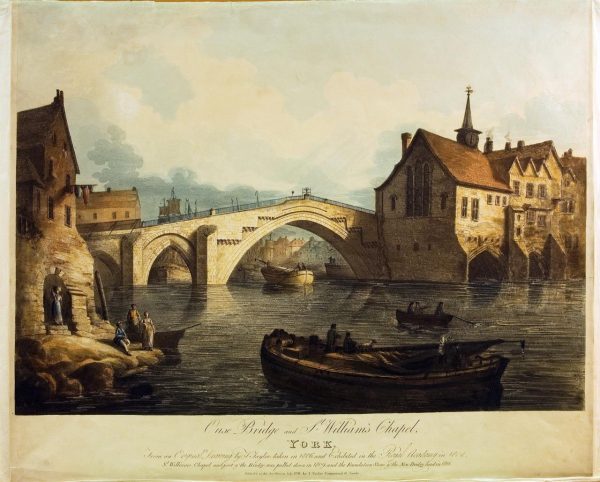
But first, a little history. The bridge over the River Ouse that this recipe refers refers to is in the city of York. Although there have been many bridges over the centuries, it is the fourth Ouse Bridge (1565–1810) which has been commemorated in these buns.

Old Ouse Bridge from the South. T.Taylor, 1806.

Just as with many city bridges of the time, the Ouse bridge was heavily built-up, its five arches supporting substantial buildings on both sides of it’s towering centre arch.

Old Ouse Bridge from the North. Attrib. Henry Cave (British 1779-1836)

With all this busyness on the bridge, it is likely that there were businesses too, and if not a baker’s shop, then almost certainly a stall or street hawkers. Just as Wood Street Cake (see Great British Bakes) took its name from the London street where it was made, Ouse Bridge Cakes take theirs from the place where they could be bought, if not actually baked.

As already mentioned, Ouse Bridge cakes were a spiced bun. But seeing as Yorkshire has quite a reputation for similar items – the most well-known being the Yorkshire Teacake (as with all tea cakes, best eaten toasted and buttered) – it occurred to me that there must be something to distinguish the Ouse Bridge cake from a host of other buns, and that something was probably its shape. A bun of a particular shape is instantly recognisabe – just look at modern Chelsea Buns and their square, spiralled form (which isn’t the original shape – but don’t get me started, see Great British Bakes (again)).

Luckily, there were two of the five recipes (yes, remember them? Back before the detour?) that held clues. The first was in a manuscrpt dating from the mid-eighteenth century, which suggested the dough be weighed out into 8oz (225g) pieces before being shaped.

Ouse Bridge Cakes recipe, MS3498, (1750-1900) Wellcome Collection.

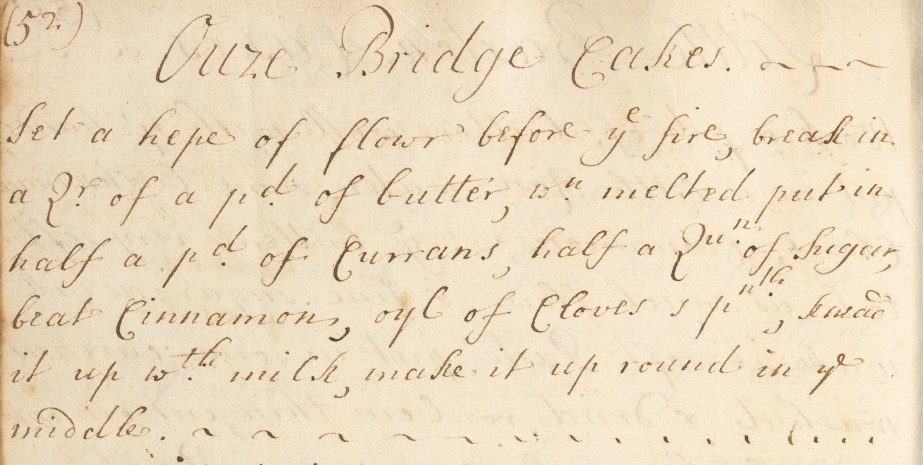
The second piece of information was from a manuscript dated 1750, the last line of which reads “make it up round in ye middle”.

Ouse Bridge Cakes recipe from MS4645, (1750-1853), Wellcome Collection.

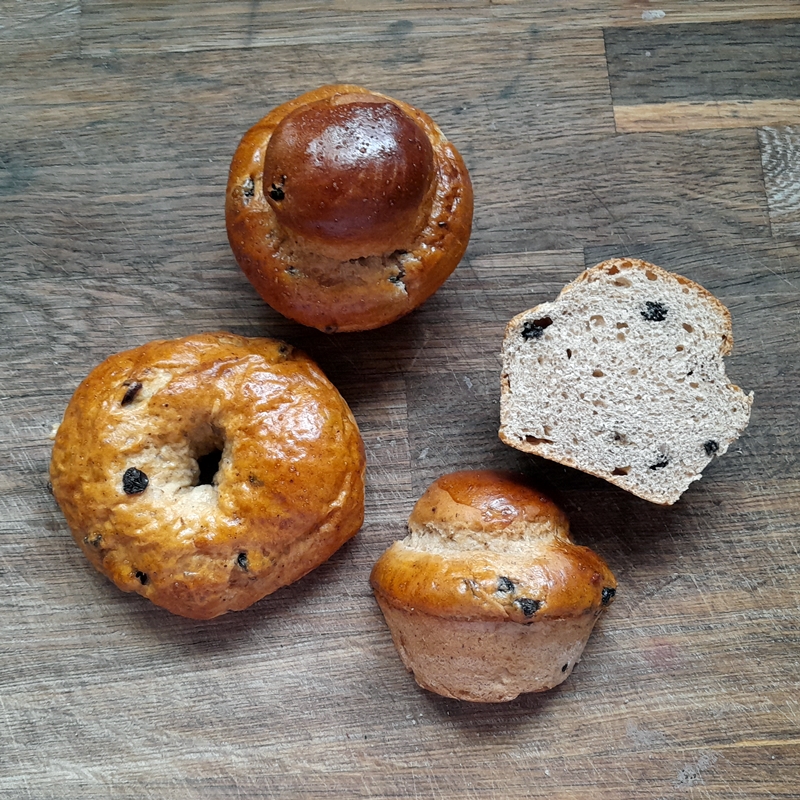
I spent a lot of time thinking about this, and decided it meant to shape it like a bagel/ring donut. I also asked online, and the feedback was that it might mean something cottage-loaf-esque, so I experimented with both shapes. I still think the ‘hole in the middle’ is a better fit for the description, but until more recipes are rediscovered, the jury will have to remain resolutely out.

Of course, it might well be that none of these five recipes are the definitive, perfect Ouse Bridge Cakes. Back in the day, even the moderately wealthy (such as the authors of these manuscripts) didn’t necessarily bake for themselves: practically everyone bought their bread from a baker. The recipes that we find in manuscripts are attempts to copy, on a smaller scale, something enjoyed elsewhere, so that they can be enjoyed in their own homes. The five recipes in the manuscripts were all different, yet there were some uniting features, as each author tried to recreate something they had only tasted. Firstly, all of them had currants, ranging from a spartan few ounces to almost half the total weight of the ingredients. All of them were flavoured with spices (nutmeg, cinnamon, cloves, ginger, mace),  but nutmeg was a common denominator amongst all five. All of them were enriched with milk and either butter or cream, and most had added sugar.

The recipe below is very much a Goldilocks version of them all. Neither too much nor too little of everything, because recipe testing revealed certain flaws in the versions that veered towards the extreme. The overly-fruited buns were heavy and close textured, and those buns with generous/excessive additions of butter and cream were reluctant to rise, with a rather greasy taste.

This version is moderately fruited, moderatly enriched and moderately spiced. Delicious warm from the oven, and even more so toasted, with slabs of cold, mature Cheddar cheese (it’s a taste sensation!).

Ouse Bridge Cakes

Each bun is formed from a generous 75g of dough, and I have scaled the quantities down to make a very modest seven buns per batch. Feel free to double the recipe as you see fit. The spicing is just a suggestion: change things up if you have a favourite mix.

225g flour
1 sachet fast-action yeast.
180ml milk
15g sugar
30g unsalted butter
60g currants
1 tsp ground ginger
1 tsp ground nutmeg
½ tsp ground cloves
½ tsp ground mace
1 large egg for glazing

  • Put the milk, sugar and butter in a pan and scald. IMPORTANT Scalding is when the milk almost boils, but not quite. Heat it until it bubbles around the edges (or in the middle if you have an induction hob), then remove from the heat and allow to cool down. Scalding milk breaks down the proteins, which will allow your buns to remain soft and yielding, even when cold. Using 100% unscalded milk in a dough recipe can lead to heaviness.
  • When the milk mixture has cooled to blood temperature, pour it into your mixing bowl.
  • Sift the flour, yeast and spices together and add to the milk mixture.
  • Knead the mixture by hand or on the lowest possible speed on your stand mixer for 10 minutes. increase speed to high for up to 2 minutes, or until the mixture comes together in a clean ball.
  • Add the currants and fold them in.
  • Cover the bowl with cling film. The milk, butter and sugar will make the dough slower to rise that a regular dough, so allow at least 90 minutes or until the dough has doubled in size.
  • Tip out the dough and divide into seven pieces, each of roughly 75 grams. There’s no need to get all aggressive and start punching it: it will naturally deflate with the turning out.
  • Shape the dough as you see fit. In addition to the two shapes mentioned above, you can also shape them into a regular teacake shape. NB: If you’re going for the cottage loaf shape, I recommend baking the shaped dough in cupcake tins, which really lets the dough ‘sit up’ and hold it’s shape. I used silicone baking trays rather than metal, to keep the dough from forming too crusty an outside.
  • Set aside to rise for 40 minutes.
  • When the dough has risen, whisk the egg and brush over the buns with a pastry brush.
  • Heat the oven to 180°C, 160°C Fan.
  • Bake the buns for 20 minutes, turning the baking trays/sheets after 10 minutes to ensure even baking.
  • When cooked and golden brown, transfer to a wire rack to cool.
  • Store in an airtight container at room temperature.