Steamed Sponge

This recipe is for a traditional steamed sponge, the type many of us remember from our childhoods. So comforting in the winter months, with a blanket of hot custard draped over. They are a breeze to mix, but in these days when most people have a gas or electric stove-top, rather than an always-on range, the three-hour steaming time makes the cooking something of a marathon.

To make things easier for everyone, I’ve scaled this recipe down to make four individual puddings which can be cooked in a steamer pan over simmering water. Not only are mini puddings delightfully small and perfectly formed, they take a mere 30 minutes to steam. This means that they can be put on to cook as everyone sits down to the meal, and be ready by the time the main course is done and cleared away.

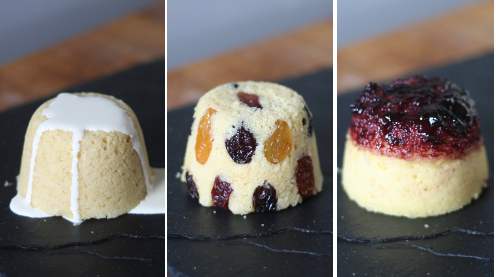
As if this weren’t cause enough to rejoice, this recipe can also be easily and infinitely adapted with different ingredients and flavours, even to the point of producing four differently-flavoured puddings from the one mixture. A few suggestions are included below, but do please experiment with your own creations too!

Steamed Sponge

Serves 4

The base instructions are for a plain sponge.

170g plain flour
1 tsp baking powder
70g butter
pinch of salt
85g caster sugar
1 large egg
½ tsp vanilla extract
120-150ml milk
softened butter for greasing the pudding bowls

  • Bring a pan of water to a simmer.
  • Put the butter, flour, salt, sugar and baking powder into the bowl of a food processor and blitz until the mixture resembles breadcrumbs.
  • Tip out into a bowl.
  • Whisk the egg and vanilla with the milk and stir into the dry ingredients until smooth.
  • Generously butter four individual pudding bowls and divide the mixture evenly amongst the prepared bowls.
  • Cut four squares of foil for the lids and make a single pleat in the middle. This will allow the sponge mixture to expand during cooking without forcing the foil cover off. Butter the inside surface of the foil, then fold over and around the pudding bowls.
  • Arrange the four bowls in the steamer pan, cover with a lid and place over the simmering water.
  • Steam for 30 minutes.
  • Peel off the foil and run a knife around the side of the puddings to loosen them.
  • Turn out the puddings and serve with cream, custard or pudding sauce of your choice.

Variations

These tweaks can be made to the basic vanilla sponge.

  • Jam Sponge – put a tablespoon of your favourite jam into the bottom of the pudding bowls before adding the sponge mixture. Have some of the jam warmed for serving.
  • Fruit Sponge – put 2 tablespoons of cooked fruit into the bottom of the pudding bowls before adding the sponge mixture. Again, have extra fruit to hand when serving.
  • Raisin decoration – dot large colourful raisins onto the sides of the buttered moulds before adding the plain sponge mixture.
  • Raisin sponge – Add 60g raisins to the plain mixture. You can also ornament the sides of the bowls as above.
  • Coconut sponge – add 60g dessicated coconut to the sponge mixture. Stick more coconut to the butter in the moulds before adding the sponge mixture.
  • Citrus sponge – omit the vanilla flavouring, add the grated zest of a lemon/orange/lime to the sponge mixture, together with the juice. Use a little less milk to mix. Add 60g of diced, candied peel of the same flavour if liked.
  • Candied fruit sponge – use 60g of candied fruit such as cherries, cranberries, pineapple, either on their own or mixed.

The following tweaks should be done by altering the method slightly and using the creaming method for the sponge (creaming butter and sugar, then eggs then dry ingredients), as the darker colour of the sponge sometimes highlights butter pieces that have not fully combined with the other ingredients.

  • Dried fruit pudding with toffee top. Use brown sugar to mix the sponge and add 60g of chopped figs, dates or prunes to the sponge mixture. Mix 30g of softened butter and 30g of soft, dark brown sugar and divide amongst the bowls before adding the sponge mixture.
  • Double jam sponge – Omit the vanilla, before adding the milk and egg, stir 3 tablespoons of jam into the sponge mixture. Add 1 tablespoon of jam to the bottom of each of the pudding bowls.
  • Chocolate sponge – Add 2 tablespoons of cocoa to the mixture and use a little more milk to mix. Add 60g chocolate chips to the mixture, or put them in the bottom of each pudding mould to form a chocolate ‘cap’. Alternately, half fill the moulds then add the chocolate chips in a well, and cover with more sponge mixture. This will make for a molten centre once cooked.
  • Coffee and Walnut sponge – Omit the vanilla, add a tablespoon of espresso powder or coffee essence to the sponge mixture and stir through 60g chopped walnuts. Put a half-walnut upside down in the bottom of each basin before adding the sponge mixture.

Fruit Charlotte

This is a deliciously simple, autumnal dessert that, although it can be assembled from very few, ordinary ingredients, ends up tasting so much better than the sum of its parts – the crisp, golden outside, hot and sharp insides and cool cream or hot, rich custard make this a dish of delicious contrasts. It is one of the many British desserts that evolved to use up stale bread and cooked fruit. Whilst the filling can be almost any fruit purée you have to hand, the construction needs to observe a few rules if it is going to look as impressive when served as it tastes.

Firstly, the fruit purée needs to be relatively firm and ‘dry’, with little or no visible liquid. If your cooked fruit is especially moist, then just set it in a sieve to drain – the resultant liquid can be sweetened and served as a pouring syrup or saved for use in/on other desserts. Alternatively, set it over a low heat in a wide pan, to help evaporate the excess liquid. If you think your fruit is still too soft, you could consider whisking in an egg yolk or two to help thicken it during cooking, making it more of a fruit custard.

The bread should not be plastic-wrapped and pre-sliced. The best charlottes are made when the bread can absorb some moisture from the filling in much the same way as it does in Summer Pudding, and sliced bread just doesn’t have a suitable surface for this. Not that having your bread sliced by a machine is bad – it can make it wonderfully thin and regular – just buy a whole loaf and get the bakery to cut it for you on their machine. If it’s not stale, just leave the slices you intend to use out on the counter for an hour, they’ll dry just enough. During baking, the dry outside will, thanks to the coating of butter, crisp up and turn wonderfully golden, and the inside will draw moisture from the filling and pull everything together, so that you have a firm pudding to turn out.

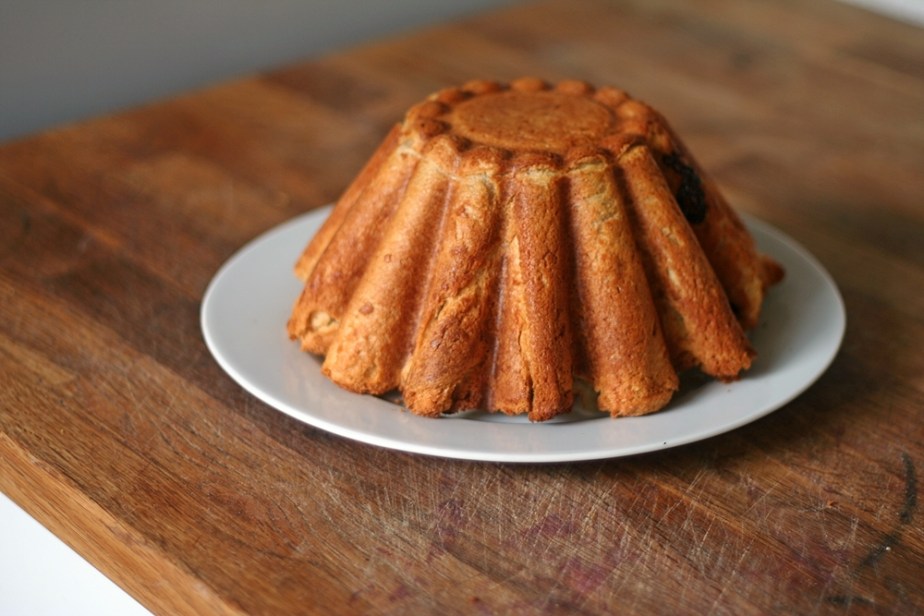
The final important consideration is the shape of the bowl in which you construct your charlotte. It needs to be both oven-proof and domed/tapering. Straight-sided charlottes are usually cold desserts such as the Charlotte Russe, which uses sponge fingers and a firmly set cream and is also thoroughly chilled before being served, which helps greatly with presentation. A traditional, domed pudding bowl, or individual pudding bowls, are ideal. Their tapering form is most conducive to maintaining an impressive shape of your hot charlotte. The fluted tins commonly marketed as brioche tins are also the ideal shape, with the added detail of fluting giving the turned-out dish a very elegant appearance.

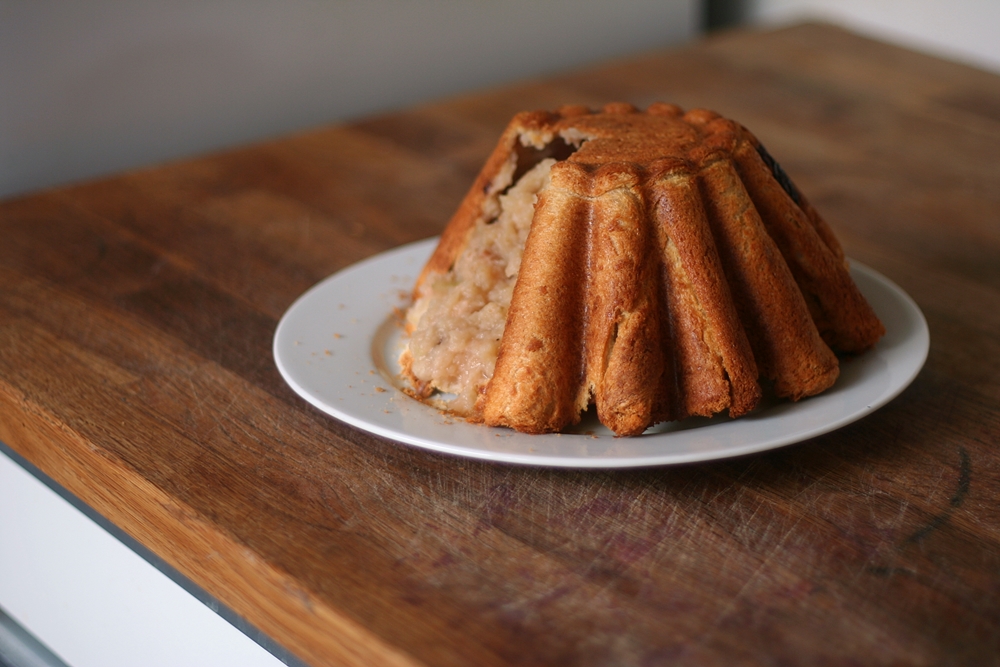
This is an adaptation of Mrs Rundell’s recipe from 1808. Her version calls for raw apples, sugar and butter and is baked slowly for 3 hours with a weight on top to help compress the apples as they shrink during cooking. This recipe is much shorter, just over one hour, but this length of time is necessary for the bread to crisp, turn golden and be sturdy enough to support the fruit filling until serving time. Higher heat and baking for a shorter time means that, when turned out, the pudding slowly sags and collapses, like a Victorian matron with her corset removed. The use of an already-cooked puree makes preparation that much quicker and the cooked pudding less prone to loss of volume.

Fruit Charlotte cut

Fruit Charlotte

I used some apples from a friend’s garden for this recipe, and added no sugar – the sharpness was a great contrast against the rich, buttery crust. I highly recommend this approach. If your fruit is especially sharp, consider using a sweet custard as an accompaniment.

750g fruit pulp
stale white bread slices
softened butter

pouring cream or custard to serve

  • Preheat the oven to 200°C/180°C fan.
  • Butter the inside of your bowl(s) generously with softened butter.
  • Cut the crusts from the bread. Cut a circle or flower shape for the bottom of your bowl and put it in first. It will make for a neat top once you turn out the pudding, and also hide the ends of all the side pieces of bread.
  • Line your bowl(s) with the crustless bread. How you choose to do this is up to you. Personally, I keep the pieced of bread whole and patch where necessary. If your bread is fresh and springy, you can make things easier for yourself by using a rolling pin to flatten them slightly. If you are using individual pudding bowls, you might want to reduce this to a width of 1.5cm, as the smaller form will need thinner slices if it is still to look dainty when turned out.  Place the slices inside the pudding at a slight angle and press into the butter. Leave the excess sticking out of the top of the bowl for now. Make sure  there are no spaces or holes for fruit to leak through. You can see on the above photo that a little apple juice has squeezed out and been caramelised by the heat of the oven. Delicious, but a flaw if you’re after an unblemished exterior to your charlotte.
  • Fill the lined mould with the fruit puree.
  • Butter slices of crustless bread for the top of the mould. Fold the ends of the bread at the sides inward and place the final pieces of bread butter-side upward over the top.
  • Spread a little butter onto a sheet of parchment and place this butter-side down over your filled bowl.
  • Add a cake tin on top together with an oven-safe weight, such as a foil-wrapped metal weight or quarry tile.
  • Bake for about an hour until the outside of the buttered bread is crisp and golden brown and the filling piping hot. For individual puddings, bake for 30-40minutes.
  • Remove the weight/tin/parchment and bake for a further 10 minutes, to allow the lid to crisp up.
  • Remove from the oven and turn out onto your serving dish.

Fruit Pudding Pies

Mary Rooke, 1770

Pudding pies used to be immensely popular in the 18th century, and describe a particular style of dish where a pastry case is filled with a thick, flavoured and sweetened porridge and the two baked together. Obviously, you’re now saying to yourself, ‘Hang on a second, that’s a tart, not a pie’, and you’d be quite right, of course, but only by 21st century semantics. In addition, the ‘pudding’ of the title is to our modern eyes, rather vague, but to those of an 18th century cook, it was curiously specific, and not for the reason you might think.

Look up the word ‘pudding’ in the Oxford English dictionary, and the very first definition is: A stuffed entrail or sausage, and related senses. Yes, no mention of warm, comforting delicacies served at the conclusion of a meal, but innards and stuff in ’em! In the 17th and 18th centuries, pudding could be sweet or savoury. Echoes of these savoury puddings are still visible today in the black and white puddings sold in butchers shops. Sweet puddings included dense mixtures of dried fruits, peel, suet and spices, either stuffed into entrails or wrapped in floured cloths and simmered in water, as the traditional Clootie Dumplings of Scotland are today.

A more accurate description of pudding from these times would be that of a foodstuff of a certain texture, and so it is with pudding pies. The texture is more akin to a baked cheesecake, smooth and dense, but with just a fraction of the richness, they’re practically health food! In this instance, the filling is flavoured with the sharpness of gooseberries. I like the way it cuts through the denseness and really lifts and brightens the filling, but any smooth fruit puree will work well, the best results coming from sharply acidic fruit.

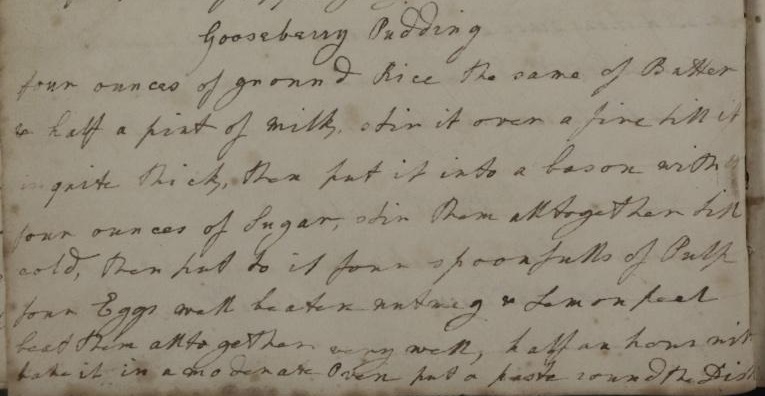
Original Recipe
Source: D/DU 818/1, Essex Record Office

Fruit Pudding Pies

112g ground rice
112g butter
225ml milk
112g sugar
100ml gooseberry pulp
4 large eggs
zest of a lemon
½ tsp freshly grated nutmeg
4 individual pudding, or deep tart, dishes lined with shortcrust pastry

  • Preheat the oven to 180°C/160°C fan/gas 4.
  • Stir the ground rice, butter and milk over heat until quite thick, then pour into a basin.
  • Add the sugar and stir together until cold.
  • Add the gooseberry pulp, well-beaten eggs, lemon and nutmeg.
  • Mix thoroughly.
  • Spoon the mixture into the pastry-lined dishes and smooth over.
  • Put the tarts onto a baking sheet and cover lightly with a sheet of foil, to prevent the filling darkening too much.
  • Bake for 20-30 minutes, depending on the size and shape of your pie dishes. Remove the foil after 15 minutes and turn the pie dishes around if they seem to be colouring unevenly.
  • Cool on a wire rack.
  • Serve warm or cold with cream or custard.

Oyster Tarts

A great little recipe from that classic baking institution: Be-Ro.

Thomas Bell founded his grocery company in Newcastle-upon-Tyne in 1875. Amongst other items, he manufactured and sold baking powder and the world’s first self-raising flour under the brand name Bell’s Royal.

After the death of King Edward VII the use of the word ‘Royal’ in business was prohibited, so Thomas shortened each word to just two letters, and the Be-Ro brand was born.

To encourage the use of self-raising flour, the company staged exhibitions where visitors could taste freshly-baked scones, pastries and cakes. This proved so popular, and requests for the recipes so numerous, the Be-Ro Home Recipes book was created. Now in it’s 40th edition, the company claims that, at over 38 million copies, its recipe booklet “is arguably one of the best-selling cookery books ever.”

I’m not sure which edition my Be-Ro booklet is, as it’s undated, but from the appearance of the smiling lady on the front it definitely has a 1930s feeling; it’s pictured on the Be-Ro website, with a deep red cover.

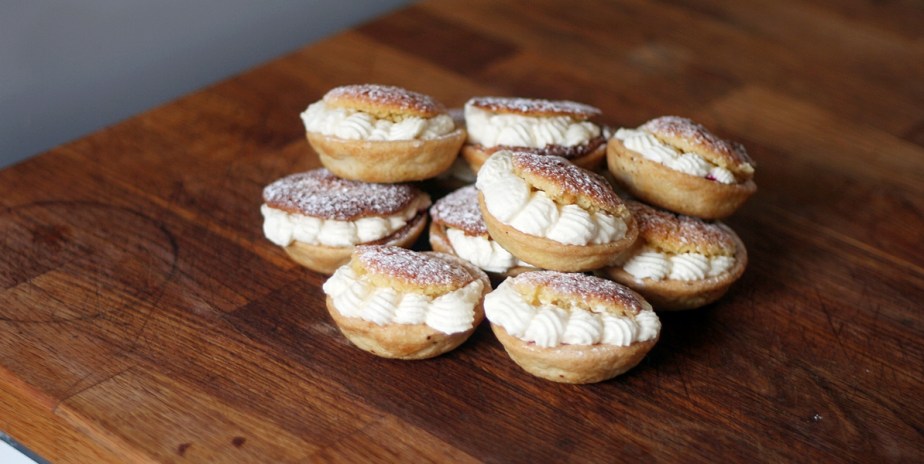
These little tarts are a beautiful example of how the simplest ingredients can be given a subtle twist and appeal by both their appearance and the ease with which they are whipped up. In essence, these are a Bakewell Tart with cream, but a little tweak turns them into sweet ‘oysters’.

I’m not a fan of almond flavouring, so I’ve used lemon zest to brighten the almond sponge and used a seedless blackcurrant jam inside. Adding the jam after baking (unlike the method for Bakewell Tarts) circumvents cooking the jam for a second time, and so it retains its brightness of flavour as well as colour. The pastry is crisp and dry and a perfect contrast against the moist filling. I’ve opted for an unsweetened pastry, but feel free to use a sweetened one if you prefer.

You could customise these tarts by swapping the ground almonds for almost any other nut, and matching the jam accordingly. Here are a few that occurred to me.

  • Almond with orange zest, and orange curd as the filling.
  • Coconut and lime curd, with a little lime zest in the filling.
  • Hazelnuts or pecans, with a praline paste or Nutella in the filling.
  • Walnut and a little coffee icing.

Have fun with them!

Oyster Tarts

Pastry
60g cornflour
225g plain flour
140g butter
ice-cold water

Filling
70g unsalted butter, softened
70g caster sugar
1 large egg
zest of 1 small lemon
85g ground almonds

To serve
200g cream cheese
200ml whipping cream
1tsp vanilla extract
1-2tbs icing sugar, plus more to sprinkle
120g sharp jam

  • Put all the pastry ingredients except for the water into the bowl of a food processor and blitz until the mixture resembles breadcrumbs.
  • Gradually add the water, one tablespoon at a time, until the mixture comes together in a ball.
  • Knead smooth, then roll out thinly. Cover with cling film and chill in the fridge to relax.
  • Preheat the oven to 170°C, 150°C Fan.
  • Beat the butter and sugar for the filling until light and fluffy. This will take about 5 minutes to get as much air into the mix as possible.
  • Add the egg and whisk in thoroughly.
  • Fold in the lemon zest and ground almonds.
  • Grease a 12-hole shallow tart tin.
  • Remove the pastry from the fridge and cut out 12 circles. Line the prepared tin with the pastry.Add about a tablespoon of filling to each tart. I use a small ice-cream scoop but 2 spoons will also work.
  • Bake for 18-20 minutes, turning the tin around after 10 minutes to ensure even cooking.
  • Transfer the cooked tarts onto a wire rack and allow to cool.
  • Whisk the cream cheese, vanilla and cream together until firm. Gently stir through a little icing sugar to slightly sweeten.
  • When the tarts have cooled, slice off the top of the filling with a sharp knife and set aside.
  • Add a teaspoon of jam and either spoon or pipe a little of the cream mixture into each tart.
  • Set the ‘lids’ back on the tarts at a jaunty angle, so as to appear like a half-opened oyster.
  • Dust with icing sugar and serve.

Posset Pie

Joseph Cooper, 1654

The surfeted Groomes doe mock their charge With Snores.
I have drugg’d their Possets.

Macbeth, Act II, scene II

The broadest description of a posset that I can think of is that of a hot syllabub: a thickened drink of either milk or cream, sweetened and flavoured with any of a number of alcoholic drinks and/or fruit, served warm.

In the Middle Ages it was seen as a winter warmer and it’s ability to make one feel good meant that over the years it segued into becoming borderline medicinal. It was recommended for insomnia, indigestion, as a purgative and of benefit when fasting.

Recipes abound, and the styles are as numerous as their intended uses: custard posset, cold posset, apple posset, whipped posset, froth posset, sack posset, soap sud posset, posset without milk, posset without wine, posset without milk wine or beer.

Thus far, Joseph Cooper is the only person I have found that turns posset into a dessert. Twenty years later Hannah Woolley would include this same recipe in her own book, adding a few of her own details to the method.

Apples are the recommended fruit, but this would work well with almost any fleshy fruit pulp; apricots in summer, for example, and dark, sharp damsons in autumn.

Posset Pie

Sweet shortcrust pastry
Eggwhite for glazing

500g fruit puree
2 large yolks
200ml double cream
50ml cream sherry
1tsp ginger
1/2tsp cinnamon
1-2tbs icing sugar
4 heaped tablespoons dried white breadcrumbs

To decorate
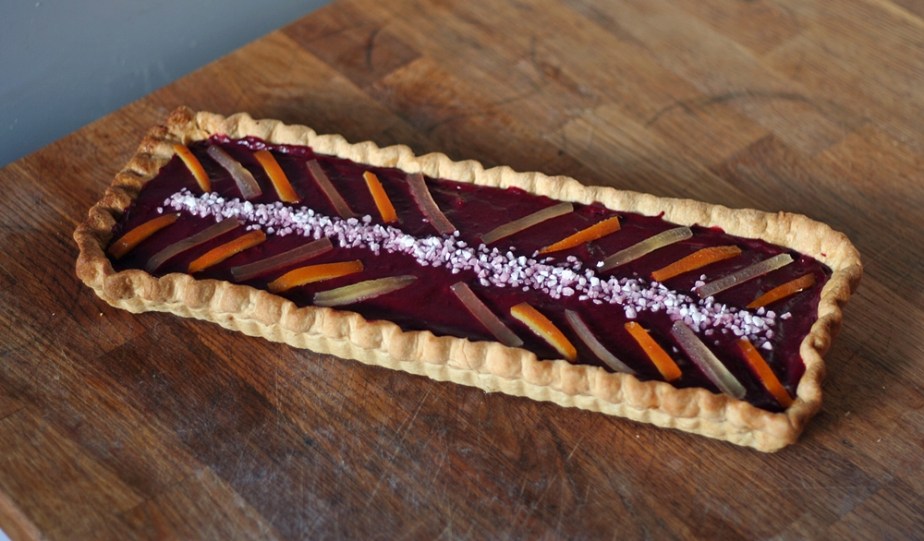
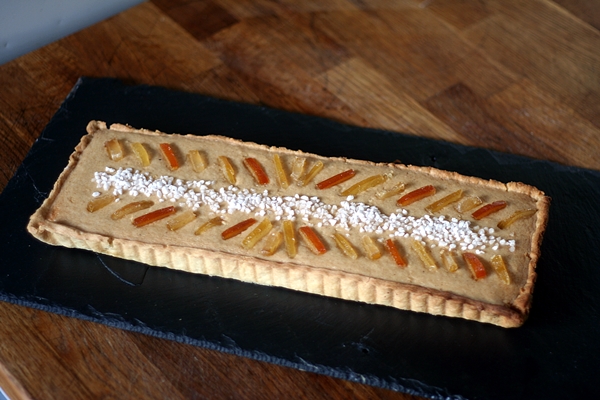
2cm matchsticks of candied orange, lemon and citron peel
sugar nibs

  • Preheat the oven to 200°C/180°C fan/gas 6.
  • Roll out the pastry and line a greased shallow tart tin. My favourite shape is long and rectangular (36 x 12 x 3cm).
  • Prick the bottom with the tines of a fork to prevent blistering and line with parchment paper and baking beads.
  • Bake for 10 minutes, then remove the parchment and baking beads and bake for a further five minutes.
  • Brush the insides of the tart with beaten egg white and bake for a further 3 minutes.
  • Turn the oven heat to 160°C/140°C fan/gas 3.
  • Mix the filling ingredients until smooth. Taste and add more sugar if liked.
  • Pour into the pastry case and smooth over.
  • Bake for 20-25 minutes until the filling is almost set. It will firm up while it cools.
  • Arrange your candied peel and sugar nibs on the pie as decoratively as you like.
  • Serve cold.
Apple Posset Pie
Apple Posset Pie Joseph Cooper, 1654

Shrewsbury Pudding Tart

Georgiana Hill, 1862

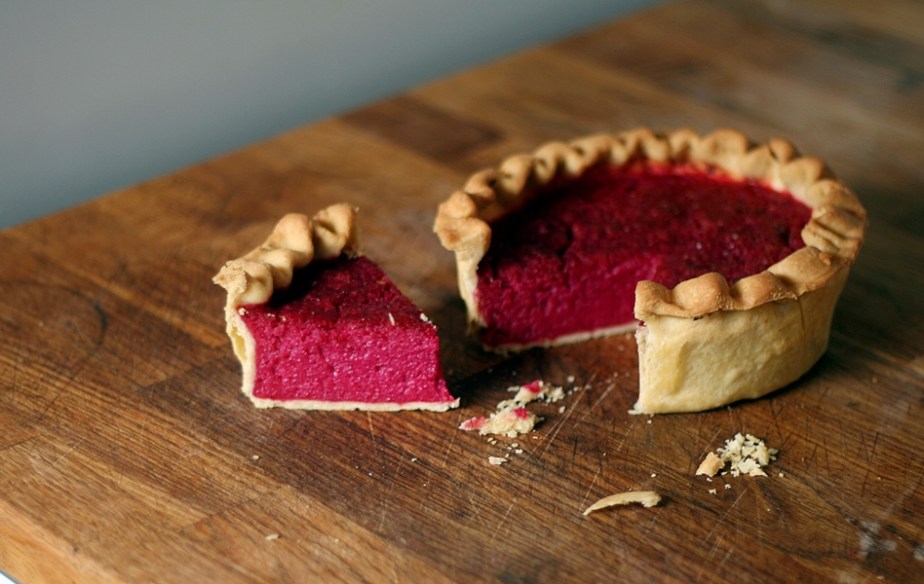
Here is something a little different for the adventurous, an unusual dessert in the form of a gloriously vibrant beetroot tart: given an official Thumb’s Up™ by my daughter. I’ve tweaked this recipe slightly and baked it in a pastry case, for ease of serving. The original method was for a buttered-and-breadcrumbed bowl. The cooking times are roughly the same. The flavour is very light and delicate, the lemon counteracting a lot of the beetroot’s sweetness.

1 x 24cm blind-baked pastry shell

225g cooked beetroot
115g unsalted butter – melted
150g icing sugar
zest of 1 lemon
juice of 2 lemons
3 large eggs
60ml brandy
150-200g fresh white breadcrumbs

  • Preheat the oven to 150°C, 130°C Fan.
  • Puree the beetroot until smooth.
  • Add the butter, sugar, lemon, eggs and brandy and whisk thoroughly.
  • Add in the breadcrumbs BUT not all at once. You want them to absorb a lot of the moisture in the filling, which will vary depending on the freshness of the eggs and the moisture in the beetroot. You might not need all of them. The texture should be similar to a sponge cake mix, but still pourable.
  • Add the filling to the pie shell and place the tin on a baking sheet.
  • Bake for 25-30 minutes until the filling has set. Turn the baking sheet around after 15 minutes to ensure even baking.
  • Cool on a wire rack.

Sweet Shortcrust Pastry

This pastry has been scaled down from a recipe I found in a Victorian/Edwardian commercial bakers’ book. It’s an all-butter (and therefore vegetarian) pastry  and includes a small proportion of cornflour. This makes the pastry extra crispy, which isn’t always easy with an all-butter pastry. It also gives it a really smooth, almost silken, dry feel which makes it very easy to handle.

60g cornflour
225g plain flour
140g butter
1 large egg
85g icing sugar
ice-cold water

  • Put all the ingredients into the bowl of a food processor and blitz until the mixture resembles breadcrumbs.
  • Gradually add the water, one tablespoon at a time, until the mixture comes together in a ball.
  • Knead smooth, then roll out.
  • Cover with plastic and chill for 30 minutes.


Spiced Strawberry Tart

Jane Parker, 1651 adapted from The Good Huswife’s Jewell, 1587

I was drawn to this recipe because it involved spicing strawberries and baking them in pastry, both details being so different from how we tend to use strawberries today. Originally, I was delighted to find the recipe in Jane Parker’s manuscript recipe book¹ but some months later, when I found an earlier version in a cookery book from the previous century, it became at once both more interesting and more delightful. Thomas Dawson’s recipe for strawberry tart², was published in the middle of the reign of Elizabeth I, and is, in all honesty, a little sparse on the level of detail to which our 21st century eyes are accustomed when it comes to recipes. Indeed, it is so brief I can quote it in full below:

To make a tart of strawberries

Wash your strawberries and put them into your Tarte and season them with sugar, cinnamon, and ginger and put in a little red wine into them.

No quantities, cooking times, or even mention of a pastry recipe. It would appear Jane Parker also thought a little extra detail was required, and her recipe is as follows:

Jane Parker's Recipe
Source: MS3769, Wellcome Library Collection

Whilst there’s still no pastry recipe, we do have more detail in terms of presentation: the tart should be shallow, the pastry lid should have diamond cutouts, baking time of 15 minutes and a sprinkling of spiced sugar over the baked tart. These additional details, to my mind, highlight the fact that, even if she didn’t actually make the tart herself, Jane Parker definitely got the recipe from someone who had, as these details are precisely the kind of personal touches an experienced cook would note down for future reference.

After centuries of refinement, the strawberries we now use are impressively large but much milder in flavour than those that would have been used for this originally Elizabethan tart. If you can find sufficient wild strawberries either to mix with your ordinary strawberries or, decadently, to use on their own, their deep aromatic flavour, together with the wine and spices, will make for a much more robust flavour to this unusual Tudor tart.

Spiced Strawberry Tart

1 batch of Sweet Shortcrust Pastry

600g fresh strawberries
3 tbs caster sugar
1tbs cornflour
1tsp ground cinnamon
1 tsp ground ginger
½ tsp coarse ground black pepper
60ml red wine or port
Milk for glazing
1tbs caster sugar
1tsb ground cinnamon

  • Preheat the oven to 200°C/180°C fan/gas 6.
  • Roll out the shortcrust pastry thinly. The thinner the pastry, the less time it will need in the oven and the freshness of the strawberries will be all the better for it.
  • Cut out four lids for your tarts. Cut them generously so that there is sufficient pastry to form a seal with the pastry lining the tins. Use a small diamond cutter or any small shape, to cut a lattice into the lids. Be careful not to cut too close to the edge, otherwise they will be tricky to attach to the rest of the pastry.
  • Gather the trimmings and re-roll the pastry.
  • Grease and line four individual pie tins with the pastry. Let any excess pastry hang over the sides for now.
  • Prepare the strawberries: Remove the stalks and cut into small pieces, either 4 or 8, depending on the size of the strawberries.
  • Put the cut strawberries into a bowl and sprinkle over the red wine. Toss gently to coat.
  • Mix the sugar, cornflour and spices together. Sprinkle over the strawberries and toss gently to mix.
  • Divide the strawberry filling amongst the tins and smooth over.
  • Moisten the edges of the pastry and place the lids over each tart. Press firmly to seal, then trim and crimp the edges
  • Brush the tops with milk and bake for 12-15 minutes until the pastry is cooked and lightly golden.
  • Mix the remaining caster sugar and cinnamon together and sprinkle over the hot pies.
  • Cool on a wire rack.

¹ MS3769, Wellcome Library.
² The Good Huswife’s Jewell, 1587

Old English Bread Pudding

Mary Bent, circa 1670

I adore everything about this recipe. For a start, it epitomises the very British traits of not only being a hot pudding, but also having been created from almost nothing. The ingredients are modest, the flavouring minimal, yet these simple, little puddings are a real delight. Even more so when you realise that these were already being looked upon with nostalgic fondness when Mary Bent recorded this recipe in the middle of the seventeenth century. Where modern bread puddings tend towards the solid and the fruited, this 350 year old recipe is light and delicate as a souffle.

Original Recipe
Source: MS1127, Wellcome Library Collection

Old English Bread Pudding

125g fresh breadcrumbs
300ml milk
2 large yolks
1 large egg
2tbs caster sugar
1/4tsp salt
freshly grated nutmeg

  • Warm the milk until just below boiling then pour over the breadcrumbs and allow to soak for 15 minutes.
  • Preheat the oven to 160°C/140°C fan/gas 3.
  • Whisk the egg and yolks and pour into the breadcrumb mixture. Add the sugar, salt and grate the nutmeg.
  • Stir everything together until a smooth mixture.
  • Generously butter four pudding basins and pour the breadcrumb mixture evenly amongst them.
  • Arrange the basins on a lipped baking sheet.
  • Bake for 45 minutes, turning the baking sheet around after 20 minutes to ensure even browning.
  • When cooked, allow the puddings to rest for a couple of minutes, then run a knife around the sides of the pudding bowls and turn out.
  • Serve with a few fresh berries and whipped cream or Hard Sauce .


Fudge

Confession: This is not my recipe.

It is the original fudge recipe that used to be posted on the Carnation website and for some reason was taken down a few years ago.

Luckily for me – and you – I have it ingrained on my brain as it is the best, no-fail recipe I have ever used, and I am posting it here so I can be lazy and just point everyone who asks for the recipe here, instead of writing it out again and again.

It makes the kind of fudge that has texture: when cooled, it is hard to bite into – yet it melts in the mouth. Very similar to the confection known in Scotland as Tablet.

The secret is two-fold: boiling the mixture to the correct temperature, and beating it as it cools to ‘grain’ the sugar.

You CAN make this the Old School way, testing for the Firm Ball stage by doing the drop test in water, and by beating the cooling mixture hard with a wooden spoon. However, I’m all for using gadgets wherever possible, so a thermapen or similar thermometer and an electric whisk or stand mixer are my recommendations.

Each batch makes a 1.2kg slab large enough to last over the festive season. Alternatively, you can make a batch and divide it up into small batches in clear plastic bags and use it for presents, or make two batches of contrasting flavours and make it go even further.

You can use the basic recipe to make a number of equally delicious variations, and I’ve thrown in an extra one by Nell Heaton – a favourite author of mine from the 1940s/1950s, who deserves greater recognition for her delicious, trustworthy recipes – which is a real explosion of flavour when made with home-made candied peel, fruit and nuts.

Fudge

1 x 397ml tin of sweetened, condensed milk
150ml milk
125g butter
450g Demerera sugar

  • Line a baking pan with parchment. The size of the pan doesn’t really matter, but I recommend a rectangular pan, for ease of cutting the fudge into cubes once cooled. The original recipe suggested a pan 18cm square, which will make for a small, very thick slab. Personally, I use a pan 30cm by 24cm
  • Put all of the ingredients into a pan and stir over a low heat until the sugar has dissolved.
  • Bring to the boil and stir continuously until it registers between 116°C and 120°C on a thermometer dipped into the centre of the pan. Make sure the tip of the thermometer doesn’t touch the bottom of the pan, as this will be much hotter and the thermometer will thus give a false reading.
  • When your fudge reaches temperature, remove from the heat and allow the bubbles to settle. Pour into your stand mixer and use the beating paddle (not the whisk) to beat slowly until the mixture thickens. Alternatively, use your electric hand mixer directly into the pan, also whisking until the mixture has thickened.
  • When it is thick and still just pour-able, tip it into your parchment-lined tin and smooth over. I tested the most recent batch I made and when sufficiently thickened and cooled, it registered 80°C.
  • Leave to cool completely.
  • When cold, cut into cubes with a sharp knife and store in an airtight box.

Variations

  • Rum and Raisin Fudge: Warm 115g raisins in 3-4tbs dark rum and leave to plump. Add just before beating.
  • Chocolate Fudge: Melt 170g dark, 60% chocolate and add just before beating.
  • Fruit and nut fudge: Stir in 85g mixed dried fruit and chopped nuts.
  • Nell Heaton’s Tutti Frutti Fudge (my favourite) Add 350g – yes, a whopping 12 ounces in old money – of mixed chopped nuts, dried fruit and candied peel sliced or diced small. I suggest about 90g mixed candied peel, 130g flaked or slivered almonds and chopped walnuts, and 130g mixed raisins, sultanas, cranberries and chopped apricots.