Slapan

I’ve been reading a lot of bakestone recipes lately, and, spoiler alert, if you like Welsh Cakes, then this recipe is about to become your new favourite.

This recipe comes from a small but delightful mid-20th century recipe book. “Croeso Cymreig: A Welsh Welcome”, originally published by the Wales Gas Board in the 1950s (mine is from 1957). I’ve seen a couple of editions on the second hand market (AbeBooks) for about £20, but more modern editions seem available for as little as £3. These newer editions are published by Gwasg Dinefwr Press or John Jones Press under the title “Recipes from Wales – 113 Traditional Welsh Recipes”. Alternatively, you can view a copy online for free at Archive.com

One of the reasons why I like this book is that it includes several variations of the same recipe. Some of them have different cooking methods too, for example, there are three Teisen Lap (‘moist cake’) recipes that can be cooked in an oven, in a Dutch oven in front of the fire, or on a griddle.

Slapan originates in North Wales. The book contains two Slapan recipes – ordinary Slapan, and Slapan Sir Fon (Anglesey Slapan). The difference between the two seems to be that Slapan is made with mixed fruit, and Slapan Sir Fon is made with currants only. Doing some more reading, I found a third version – Slapan Dafydd (Saint David’s Slapan) – which is made with sultanas only.

There are subtle variations in both the liquid used (milk/buttermilk) and leavening agents (baking powder, bicarbonate of soda, and also a little of both), but essentially it is the same method for all: rub the butter into the flour, add the rest of the ingredients and bring together into a soft dough with the eggs and liquid. Spoonfuls of the dough are then cooked on a bakestone, turning halfway through. An important aspect of the appeal of these teatime dainties is the speed with which they can be brought to the table – not much more than 30 minutes from start to finish. Perfect for when company drops by unexpectedly.

Taste

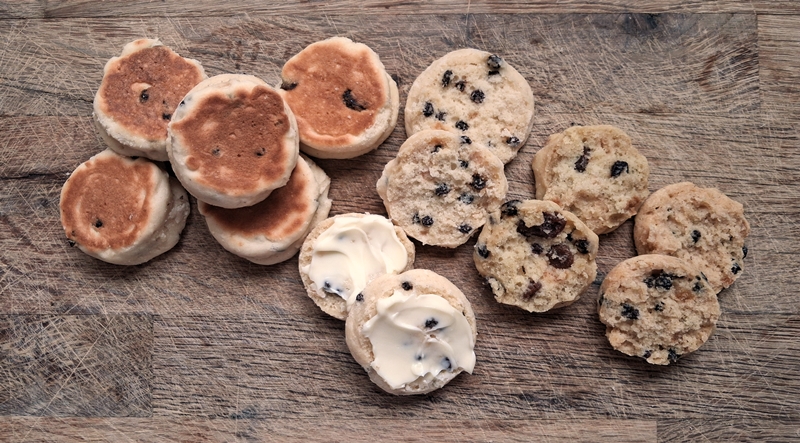
So what are they like to eat? Really delicious, actually. I mentioned above that Slapan are similar to Welsh Cakes, and they are, but without any of the spicing of the latter. Also in contrast, they are very light. With all the love in the world, even Welsh Cake devotees must admit they’re decidedly firm in texture. The texture of Slapan is much closer to a scone, or a muffin, but decadently rich with butter. They are not overly sweet, the dried fruit contributing a lot, so there is relatively little sugar added. Slapan are best served warm from the pan, split and generously buttered. Crisp outsides give way to a soft, cake-like centre, and with lashings of delicious butter melting inside, it’s a surprisingly rich treat.

Equipment

You don’t need a bakestone to cook your Slapan, a non-stick pan and a heat source with serve just fine. Slapan are baked, not fried, so there is no need to grease the pan. The traditional method is to spoon the mixture onto the bakestone using two spoons, but I found my small ice-cream scoop² much easier to use, in addition to making small, delightful 2-bite Slapan.

Slapan

Each batch makes approximately 12 Slapan. If you’re using gluten-free flour, then you may need to add extra flour (see note below).

120g plain flour/gluten-free flour³
60g chilled butter – cubed
20g sugar (caster or soft brown)
¼ tsp salt
scant ½ tsp baking powder
30-50g mixed dried fruit/currants/sultanas
1 large egg
2-ish tbs milk

  • Put a non-stick pan onto a medium (number 5 on my 1-9 electric hob) heat and let it come to temperature while you mix up the dough. if you’re using gluten-free  flour, you should delay this until the mixture half-rested.
  • Put the flour, butter, sugar, salt and baking powder into the bowl of a food processor and blitz until the mixture resembles breadcrumbs.
  • Crack the egg into a mixing bowl and add milk for a total of 90ml of liquid. Whisk together well (I use a stick blender), then add the flour mixture and dried fruit.
  • Fold together until the mixture forms a smooth-ish dough. The consistency should be like that of a fruit cake, or mashed potatoes. Definitely too soft to roll out.
  • Using a small ice-cream scoop, or two spoons, drop the dough into the now hot pan. Drop them around the edge, rather than the middle, so that they don’t scorch. Cooking them all at once will make it tricky to turn over, so do two batches of six or seven.
  • Bake for 5 minutes. A light crust will form on the bottom of each heap.
  • Using two cocktail sticks, carefully turn each Slapan over.
  • Bake for a further 3-4 minutes until the underside is as browned as the top.
  • Cool on a wire rack.
  • Split, butter and serve warm.

Bonus Recipe: Christmas Slapan

Here’s my own take on a Slapan variation, seen top right in the photo – with the addition of candied peel, mixed spice and a splash of booze. Much quicker to rustle up than mince pies.

120g plain flour/gluten-free flour³
60g chilled butter – cubed
20g soft brown sugar
¼ tsp salt
scant ½ tsp baking powder
½ tsp mixed spice
15g candied lemon and orange peel, finely chopped
15g dried cranberries or barberries
20g dried currants
1 large egg
1 tbs brandy
1 tbs cream sherry/madeira

  • Method as above.

¹ You need to sign up to be able to borrow books, but it is free, no strings attached.

² A small ice-cream scoop of 4cm diameter, roughly 30ml volume.

³ I’ve made this recipe with two different gluten-free flours. Schar’s Baking/Patisserie flour (red bag) contains a thickener (guar gum), and so the recipe took the same quantity of flour as regular flour. Dove’s Farm Freee gluten-free flour contains no thickener, and they recommend adding xantham gum when using. I didn’t have any, so I ended up adding more flour (60g in 2 batches of 30g) and allowed it to sit a while (20 minutes) to allow the excess liquid to be absorbed.
Welsh Cakes

I’ve always had a fondness for Wales. The first family holidays were amongst its lush and rolling hills and I became an avid fan of rugby through watching Wales during the glorious days of the mid-1970s.

In terms of its food, I’m constantly frustrated by the existence of so few old books from which to draw recipes. I have on my bookshelves just three in the Welsh language, all dating from the 19th century, and, disappointingly, not one of them contains recipes for either Bara Brith or Welsh Cakes. I have a feeling that there must be a very rich hoard of manuscript recipes lurking somewhere in storage, perhaps in a record office or some archive, just waiting to be discovered.

I have already brought you a couple of Bara Brith recipes, being unable to choose between the rich fruitiness of one and the delicate texture of the other. For years I have been in search of an authentic and worthy Welsh Cake recipe, with no joy. With the best will in the world, the modern Welsh Cake can be a little on the heavy side. The more tactful descriptions suggest ‘close-textured’, other spade-a-spade critiques might go with ‘stodgy’. And the stodginess would seem to be almost necessary, as too long on the griddle and the pastry-like dough of the modern Welsh cake recipe is prone to drying out and becoming tough.

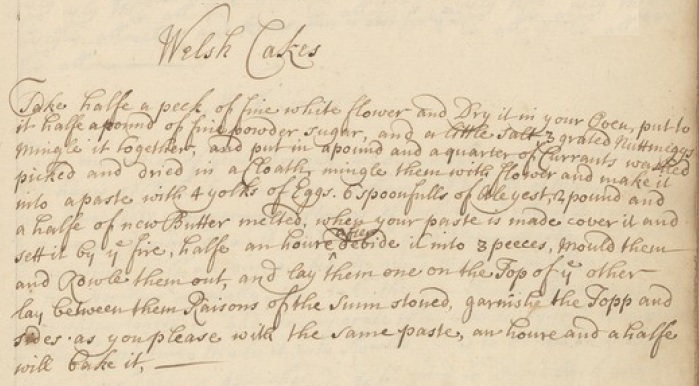
I have therefore been more than a little mollified by this week’s recipe, which I found in the digitised manuscript collection of the Welcome Library. It comes from the recipe book of Dorothea Repps (nee Fountaine) and dated 1703, when she was just 21 and already married to John Repps. I am extremely fond of this manuscript book, for Dorothea’s handwriting is bold, confident and easy to read, and adorned with swooping flourishes. This recipe for Welsh Cakes appears very early on in the book and consequently I feel confident that she must have recorded it  no later than 1710.

What I find curious, quite apart from it pre-dating most other Welsh Cake recipes by at least 150 years, is the fact that Dorothea spent her life in Norfolk, just about as far east and distant from Wales as you can get without falling in the sea. There’s nothing else in her book that is particularly Welsh, so its presence is something of an enigma. Also curious is the form that Dorothea’s Welsh Cakes take: a single, large, layered yeast cake sprinkled with currants and sandwiched with raisins.

Welsh Cakes Recipe
From MS 7788, Wellcome Library Collection

As with many recipes of this age, the quantities of ingredients are huge, and reflect the catering-size amounts required in a large house. I scaled them down to something more manageable and baked it as described and I have to be honest, it was a bit heavy. Nice, but decidedly door-stop. So I had another go, making even smaller, single-serving versions, with just two layers of the currant dough sandwiching the plump raisins. They were very neat, and baked to a lovely golden brown, but…..ordinary. Despite the richness of the mix, the oven heat, even without fan convection,  made the outsides of a crustiness that all the post-baking basting with milk failed to soften.

Having concentrated so much on the presentation, after carefully cutting and shaping these little filled cakes, I found myself left with quite a lot of trimmings. I can’t abide waste, so I decided to gather them together, re-roll and cut them like modern Welsh Cakes. Since the oven was in use baking the sandwich version, I thought I might cook these in a dry pan on the stove top. And this spur of the moment decision provided the secret to revealing the deliciousness of this recipe. For cooked in the traditional bakestone manner, they are extraordinary.

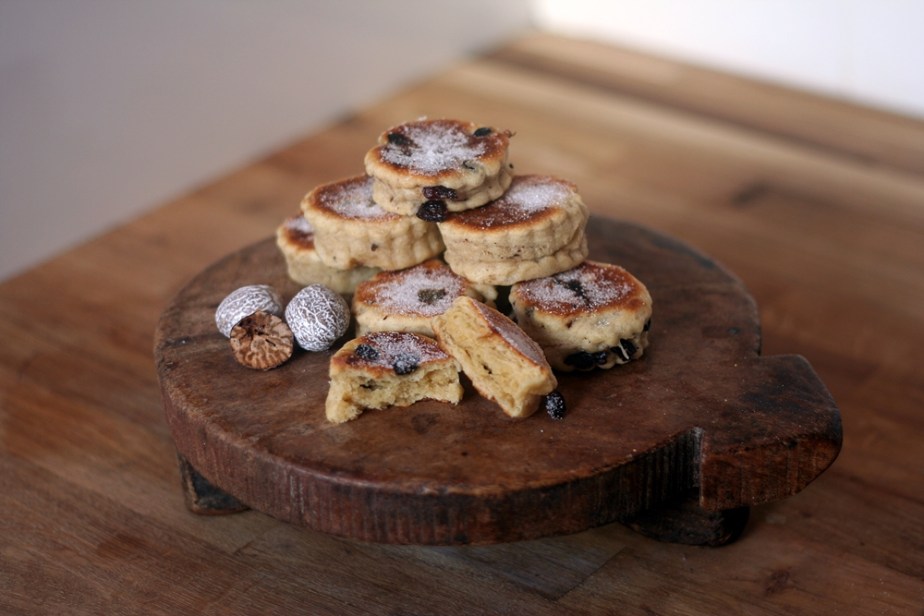
The thin crust that forms from contact with the warm pan (for a gentle heat is all they require) surrounds a yeast-raised interior so delicate and feather-light they almost disappear. They are at their best hot from the pan, sprinkled with a little caster sugar.

This combination of a centuries-old recipe, with a relatively modern form and method of cooking produces a real tea-time delicacy.  Wherever she gathered this delightful recipe from, I’m grateful to Dorothea Repps for recording it in her book so that we can enjoy them today. If you’re in Norfolk, you can stop by and thank her yourself: she is buried in the place where she lived until the ripe old age of 78 and lies surrounded by her family, in a vault in the magnificent church  of St Peter and St Paul, in Salle.

Dorothea Repps’ Welsh Cakes

You can, of course, use your own favourite spicing/flavourings for these Welsh cakes, instead of Dorothea’s suggestion of nutmeg. I suggest no more than a total of 1 teaspoon of whatever spices you choose.

Makes 16-20

225g plain flour
pinch of salt
½-1tsp freshly grated nutmeg
15g icing sugar
80g unsalted butter
1 large egg yolk
50-100ml milk
10g fresh yeast
40-60g currants

caster sugar for sprinkling

  • Mix the flour, icing sugar, salt and spices in a bowl.
  • Whisk 50ml of milk and the yeast together, then add the yolk and stir thoroughly.
  • Melt the butter and allow to cool a little before whisking in the milk/yeast mixture.
  • Add these wet ingredients to the dry and knead until the mixture comes together in a soft dough. Add more milk if necessary.
  • Knead for 10 minutes until smooth.
  • Knead in 40g of the currants. If it looks a little sparse to your tastes, add more until the desired level of fruitiness is achieved. Oooh, Matron!
  • Cover and set aside to rise until the dough has doubled in size. Due to the richness of the mixture, this may take between 1.5-2 hours.
  • When risen, tip the dough out and pat gently to deflate. Use a rolling-pin to roll the dough out to a thickness of 1.5cm.
  • Use a fluted, 5cm cutter to cut out little cakes, making sure each one contains a sprinkling of fruit. Re-roll trimmings until all dough has been used.
  • Cover lightly with plastic wrap and set aside to rise for 30-45 minutes.
  • When ready to cook, gently heat a thick-bottomed, heavy pan on your stove. My induction hob goes from 0-9, and I cook these on 5. I also place the cakes around the edge of the pan, avoiding the concentrated heat of the middle. The dough is rich with butter, so no further oil is required.
  • Bake the cakes until lightly browned on each side and the centre is cooked through: around 7 minutes for the first side, and 6 minutes on the second. Turn them gently, as the uncooked tops will have risen due to the heat and will be extremely light and easily deflated.
  • Remove the cooked cakes from the pan and sprinkle the tops lightly with caster sugar.
  • Serve warm, or allow to cool on a wire rack and store in an airtight box. Warm gently before serving