Spiced Strawberry Tart

Jane Parker, 1651 adapted from The Good Huswife’s Jewell, 1587

I was drawn to this recipe because it involved spicing strawberries and baking them in pastry, both details being so different from how we tend to use strawberries today. Originally, I was delighted to find the recipe in Jane Parker’s manuscript recipe book¹ but some months later, when I found an earlier version in a cookery book from the previous century, it became at once both more interesting and more delightful. Thomas Dawson’s recipe for strawberry tart², was published in the middle of the reign of Elizabeth I, and is, in all honesty, a little sparse on the level of detail to which our 21st century eyes are accustomed when it comes to recipes. Indeed, it is so brief I can quote it in full below:

To make a tart of strawberries

Wash your strawberries and put them into your Tarte and season them with sugar, cinnamon, and ginger and put in a little red wine into them.

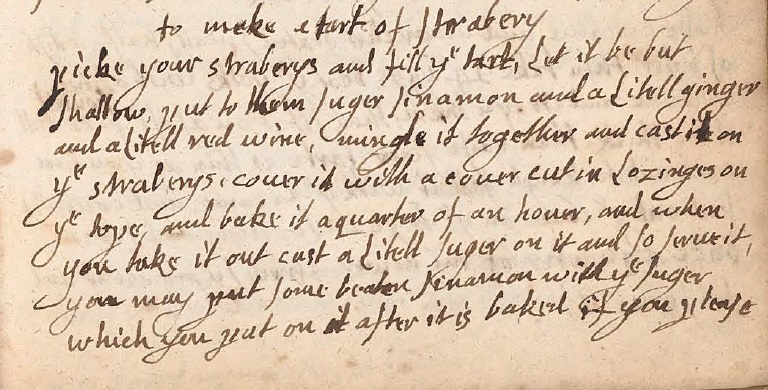
No quantities, cooking times, or even mention of a pastry recipe. It would appear Jane Parker also thought a little extra detail was required, and her recipe is as follows:

Jane Parker's Recipe
Source: MS3769, Wellcome Library Collection

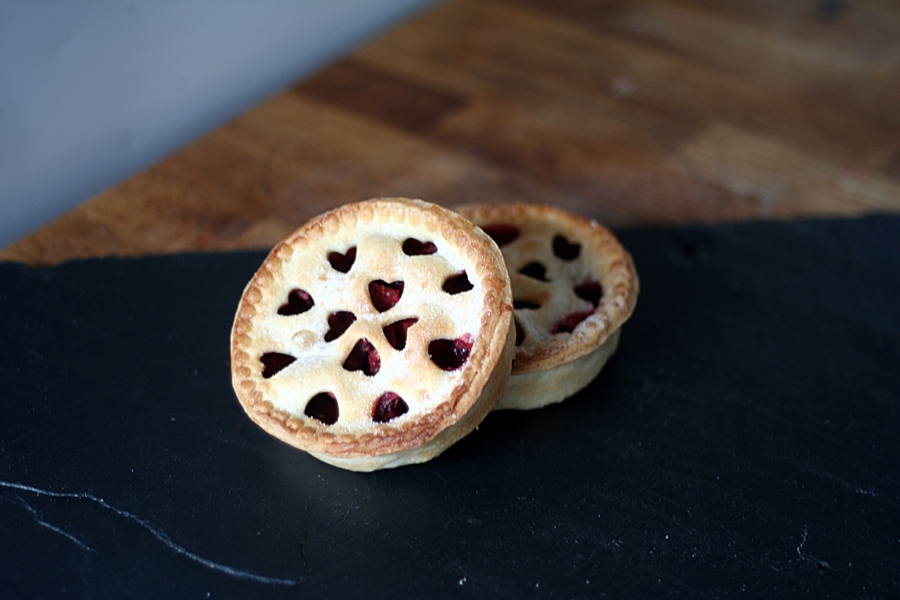
Whilst there’s still no pastry recipe, we do have more detail in terms of presentation: the tart should be shallow, the pastry lid should have diamond cutouts, baking time of 15 minutes and a sprinkling of spiced sugar over the baked tart. These additional details, to my mind, highlight the fact that, even if she didn’t actually make the tart herself, Jane Parker definitely got the recipe from someone who had, as these details are precisely the kind of personal touches an experienced cook would note down for future reference.

After centuries of refinement, the strawberries we now use are impressively large but much milder in flavour than those that would have been used for this originally Elizabethan tart. If you can find sufficient wild strawberries either to mix with your ordinary strawberries or, decadently, to use on their own, their deep aromatic flavour, together with the wine and spices, will make for a much more robust flavour to this unusual Tudor tart.

Spiced Strawberry Tart

1 batch of Sweet Shortcrust Pastry

600g fresh strawberries
3 tbs caster sugar
1tbs cornflour
1tsp ground cinnamon
1 tsp ground ginger
½ tsp coarse ground black pepper
60ml red wine or port
Milk for glazing
1tbs caster sugar
1tsb ground cinnamon

  • Preheat the oven to 200°C/180°C fan/gas 6.
  • Roll out the shortcrust pastry thinly. The thinner the pastry, the less time it will need in the oven and the freshness of the strawberries will be all the better for it.
  • Cut out four lids for your tarts. Cut them generously so that there is sufficient pastry to form a seal with the pastry lining the tins. Use a small diamond cutter or any small shape, to cut a lattice into the lids. Be careful not to cut too close to the edge, otherwise they will be tricky to attach to the rest of the pastry.
  • Gather the trimmings and re-roll the pastry.
  • Grease and line four individual pie tins with the pastry. Let any excess pastry hang over the sides for now.
  • Prepare the strawberries: Remove the stalks and cut into small pieces, either 4 or 8, depending on the size of the strawberries.
  • Put the cut strawberries into a bowl and sprinkle over the red wine. Toss gently to coat.
  • Mix the sugar, cornflour and spices together. Sprinkle over the strawberries and toss gently to mix.
  • Divide the strawberry filling amongst the tins and smooth over.
  • Moisten the edges of the pastry and place the lids over each tart. Press firmly to seal, then trim and crimp the edges
  • Brush the tops with milk and bake for 12-15 minutes until the pastry is cooked and lightly golden.
  • Mix the remaining caster sugar and cinnamon together and sprinkle over the hot pies.
  • Cool on a wire rack.

¹ MS3769, Wellcome Library.
² The Good Huswife’s Jewell, 1587

Nectar Rice Pudding

I received an email from a friend this week, being very complimentary about this rice pudding recipe I’d given her. She wrote “This is so yummy on a chilly winter day in Melbourne!” I made a mental note to put it on the blog in the autumn, but then I got up this morning and looked out the window at the clouds and the cold and the rain and decided that you all needed this recipe today.

Adapted from May Byron’s wartime Pudding Book (1917) it is an absolute delight in a number of ways. It’s a variation of the traditional, some would say nursery, pudding, but these variations elevate it much higher than its list of ingredients might at first imply. For a start, the method is markedly different from the traditional, first boiling the rice in water  followed by a slow simmer on the stove top, then just a brief 20 minutes in the oven. Cooking time is practically halved, compared to the traditional method requiring 2 hours baking and the result is astonishingly soft and creamy. The best part of this recipe, however, is the flavourings. Against just a suspicion of vanilla, the mandarin peel imparts a light and fragrant note, which is in turn enhanced by the aromatic honey and flakes of coconut. The whole dish is lifted out of the nursery and into something altogether more elegant and refined, whilst still retaining it’s simplicity.

Very definitely a grown-up treat for a gloomy, rainy Sunday in June.

Nectar Rice Pudding

120g pudding rice
580ml whole milk
75g granulated sugar
1 large or 2 medium mandarin oranges
½ tsp vanilla extract
280ml double cream
4 large yolks
70ml aromatic honey – acacia, orange blossom, heather, etc
2tbs unsweetened dessicated coconut

  • Bring some water to the boil and add the rice.
  • Cook for five minutes, then drain well in a sieve.
  • Put the rice, milk, and sugar in a thick-bottomed, lidded pan.
  • Peel the mandarins.
  • Eat the mandarins.
  • Put the peel into the pan with the rice.
  • Add the vanilla.
  • Cover the pan and put over the lowest heat available.
  • Simmer softly for 40 minutes, stirring every 10 minutes.
  • Mix the cream, yolks and honey together.
  • Preheat the oven to 140°C/120°C Fan.
  • After the 40 minutes is up, remove the mandarin peel and discard.
  • Pour in the cream and honey mixture. Stir briskly whilst pouring to ensure the eggs don’t cook immediately and curdle.
  • Stir the mixture over the heat until the mixture almost simmers, then pour into a deep oven-proof bowl. To achieve the perfect consistency after baking, the mixture should be about 5cm deep in the dish.
  • Sprinkle the coconut over the surface.
  • Bake for 20 minutes until just wobbling in the middle, and golden brown and bubbling on top.
  • Allow to cool for at least 10 minutes.
  • Serve warm.

Old English Bread Pudding

Mary Bent, circa 1670

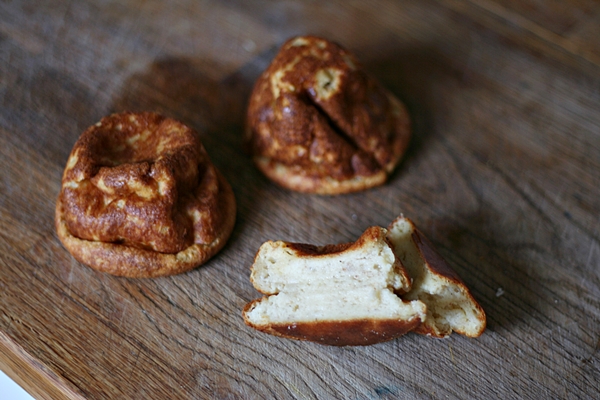
I adore everything about this recipe. For a start, it epitomises the very British traits of not only being a hot pudding, but also having been created from almost nothing. The ingredients are modest, the flavouring minimal, yet these simple, little puddings are a real delight. Even more so when you realise that these were already being looked upon with nostalgic fondness when Mary Bent recorded this recipe in the middle of the seventeenth century. Where modern bread puddings tend towards the solid and the fruited, this 350 year old recipe is light and delicate as a souffle.

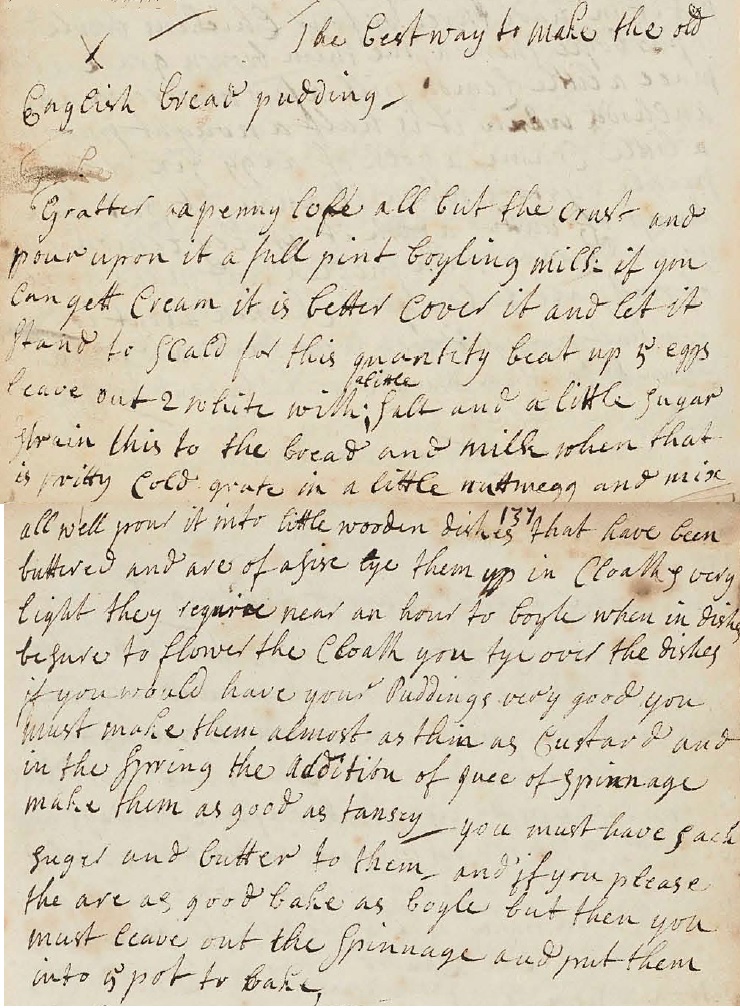
Original Recipe
Source: MS1127, Wellcome Library Collection

Old English Bread Pudding

125g fresh breadcrumbs
300ml milk
2 large yolks
1 large egg
2tbs caster sugar
1/4tsp salt
freshly grated nutmeg

  • Warm the milk until just below boiling then pour over the breadcrumbs and allow to soak for 15 minutes.
  • Preheat the oven to 160°C/140°C fan/gas 3.
  • Whisk the egg and yolks and pour into the breadcrumb mixture. Add the sugar, salt and grate the nutmeg.
  • Stir everything together until a smooth mixture.
  • Generously butter four pudding basins and pour the breadcrumb mixture evenly amongst them.
  • Arrange the basins on a lipped baking sheet.
  • Bake for 45 minutes, turning the baking sheet around after 20 minutes to ensure even browning.
  • When cooked, allow the puddings to rest for a couple of minutes, then run a knife around the sides of the pudding bowls and turn out.
  • Serve with a few fresh berries and whipped cream or Hard Sauce .


Sugarless Biscuits

I don’t mean to boast (which means I’m going to), but I’m very pleased with this recipe, which I found in a book from 1767 entitled “Primitive cookery; or the kitchen garden display’d”. In the curious attribution style of the day, the frontispiece declares the book “Printed for J.Williams at No. 38, Fleet Street”, which leaves the authorship somewhat undetermined – possibly J.Williams or he might have been the publisher, or even the printer himself.

That mystery aside, the frontispiece also contains some wonderful claims, viz “RECEIPTS for preparing a great Variety of cheap, healthful and palatable Dishes without Fish, Flesh or Fowl; WITH A BILL of FARE of Seventy Dishes that will not cost above Two-Pence each”. The low cost and the vegetarian nature of the dishes was doubly interesting, since vegetarianism didn’t really take off in Britain until the nineteenth century. Alas, it wasn’t quite the groundbreaking publication I thought, as I found meat and meat products scattered liberally throughout, and although the seventy tupenny dishes are meatless, they consist mostly of dishes along the lines of “[insert the name of a vegetable] boiled and bread and butter”. Still, it’s not all plain fare, as the following meal suggestion illustrates: “Bread and half a pint of canary, makes an excellent meal.” With half a pint of sherry (canary) inside you, you wouldn’t really care that you only had bread to eat. And for tuppence? Bargain!

ANYHOO…..

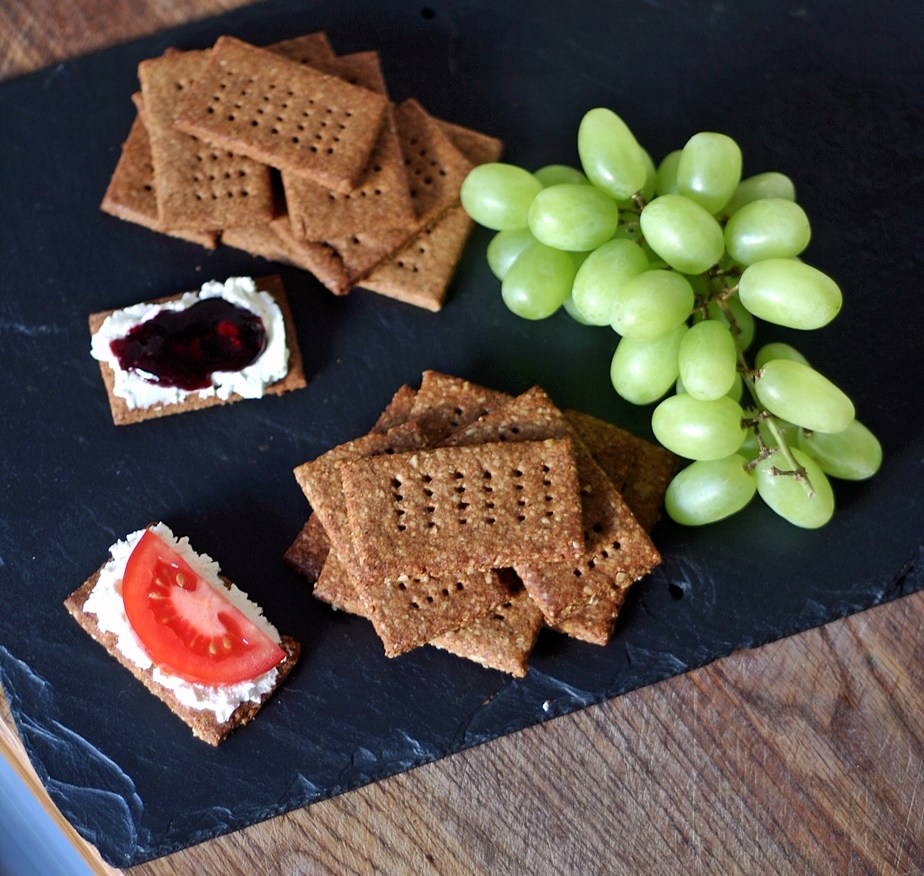
These biscuits are listed in the book as Parsnip Cakes – the word ‘cake’ having a much more versatile usage in the eighteenth century, and more inclined to refer to shape, rather than some delightful teatime confection. Parsnips provide both bulk and a very gentle sweetness. Sliced, dried in the oven and then ground in a spice grinder, the parsnip ‘flour’ is then mixed with an equal quantity of flour, a little spice, and formed into a dough by mixing with double cream. Rolled out to a thinness of 5mm and baked in a cool oven, the resultant biscuits are crisp, crunchy and similar to a close-textured digestive biscuit. The flavour of parsnip is detectable, especially if, in the drying they have also browned a little and the sugars caramelised, but it’s not overpowering.  More nutty than vegetable. In terms of sweetness, they sit bang on the fence between sweet and savoury – sweet enough to satisfy a sugar craving, savoury enough to eat with cheese.

It’s this versatility which got me thinking of ways in which it could be adapted, and after experimentation, came up with the following:

  • Spices. You can vary the spices and tip the biscuits more towards sweet or savoury as you prefer.
    • Sweet spices: cinnamon, nutmeg, ginger, cloves.
    • Savoury spices: garam masala, cumin, coriander, smoked paprika, curry powder.
    • Neutral spices that could go either way: aniseed, fennel, fenugreek, caraway, cardamom, Chinese five spice.
    • Herbs: thyme, rosemary, sage, garlic powder, onion powder, chives, etc.
  • Flours. This is where these biscuits are most versatile.The flour you match with the parsnip powder doesn’t have to be limited to plain white. The biscuits in the picture above have been made with stoneground wholemeal with aniseed (top) and medium oatmeal, with a little salt (bottom). Here are just a few further suggestions:
    • brown
    • wholemeal
    • medium oatmeal
    • barley
    • rice
    • plain white
    • white + cornflour
    • brown + rye
    • malted
  • Usage. The dough can also be used as a pastry, with different results coming from the different flours used. Mixing the parsnip flour with brown flour or oatmeal would make a fantastic crust for something like a cauliflower cheese tart. I haven’t tried it for turnovers/handpies, but I suspect you’d need to use bread flour and to work it quite well in order to prevent it cracking when trying to fold it.

Sugarless Biscuits

The recipe for mixing the actual biscuits requires only a fraction of your parsnip flour, thereby allowing you to make several batches from this one quantity. That said, this made only about 200g of parsnip flour in total.

4 large parsnips
50g flour of choice
½-1tsp spice/herb/flavouring of choice
50-70ml double cream

¼ tsp salt (for savoury biscuits and/or when using oatmeal)

  • Peel the parsnips and slice thinly – a mandolin is ideal.
  • Arrange the slices on parchment-lined baking sheets and put into the oven.
  • Turn the oven on low, 120°C/100°C Fan.
  • Since the slices are so thin, they won’t take very long to dry at all. Check after 15 minutes. If they have curled into flower shapes, remove from the oven and allow to cool. If they aren’t completely crisp when cold, you can easily dry them a little longer. It’s better to dry them in two stages, than to let them go a little too long and allow them to take on colour – unless that’s what you’re after, of course.
  • When the parsnips slices are crisp and cold, grind them to powder in a spice grinder, or pound them in a pestle and mortar. If you’re using them for savoury biscuits, you can get away with having it a little coarser – like semolina or polenta. For sweet biscuits, you’ll probably need to sieve out the larger pieces and re-grind.
  • Preheat the oven to 140°C/120°C Fan
  • To make the biscuits:
    • Put 50g parsnip flour in the bowl of a food processor.
    • Add 50g of your chosen flour.
    • Add your chosen spices and salt, if required.
    • Blitz for a few seconds to mix.
    • With the motor running, gradually pour in the double cream. Depending on the flour you are using, the quantity of cream required to bring the dough together will vary. Add just enough until the dough comes together in a ball, or at least resembles damp breadcrumbs.
    • Tip out and press together into a ball.
    • Roll out between sheets of cling film plastic (to avoid sticking) to about 5mm and cut into biscuits. I made rectangles of 2.5cm x 5cm, but any shape will do.
    • Lay the biscuits onto a parchment-lined baking sheet and prick the middles neatly with a fork.
    • Bake for 10 minutes, then turn the baking sheet around and bake for a further 10 minutes.
    • Transfer to a wire rack and return to the oven for a final 5 minutes in order to ensure the undersides are dried and crisp.
    • Allow to cool on the wire rack before storing in an airtight container.


Bara Brith

This week it’s the classic Welsh speckled bread Bara Brith. Nowadays, this is usually made using baking powder as the leavener, but personally I prefer the more traditional yeast.

And bonus! There’s two recipes for you to choose from!

When looking at an old recipe, I usually study the range of recipes available and select the one that, to my imagination, sounds the nicest. If there is a tie, then I will make both and decide which makes the cut by taste. This time, however, it was too difficult to decide, so I chose not to choose and leave that decision to you.

Both recipes have their strongpoints, not least from their provenance and pedigree.

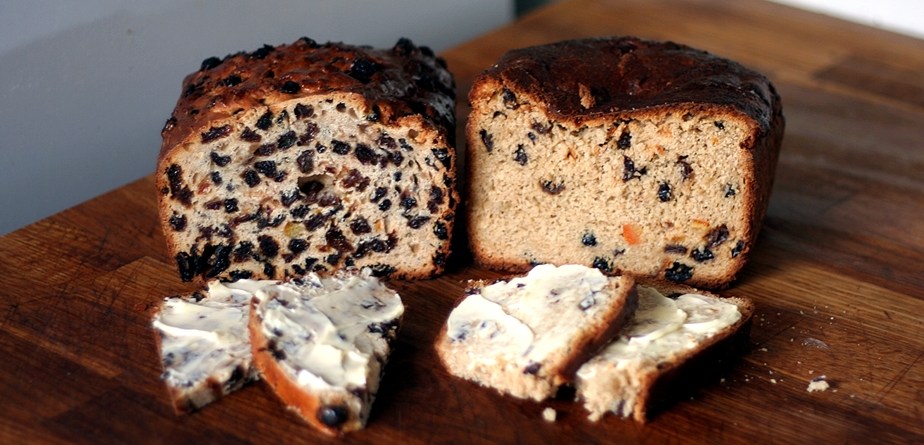
On the left of the photo above, we have the recipe from Walter Banfield’s classic book “Manna”: A Comprehensive Treatise on Bread Manufacture (1937), a book admired by Elizabeth David and breathtaking in its breadth and scope. It is based on additions made to ordinary white bread dough after its first proving. The large quantity of fruit and peel contrast brightly against the white of the dough and make for a very sturdy slice that will keep moist for a long time.

On the right of the photo, a possibly more authentic Bara Breith from Mrs E.B.Jones, who, for many years, ran the Powys Temperance Hotel on Market Square, Llanrhaeadr-Ym-Mochnant in the first half of the 20th century. The recipe was collected by Dorothy Hartley and included in her iconic book Food in England, first published in 1954. As can be seen from the picture, this recipe isn’t as heavily fruited as the first one, but it has the added interest of being made from half wheat flour and half oat flour (finely ground oatmeal). Against expectation, the crumb is very light, making it a much more delicate slice.

I love the richness of the fruit in the bread dough version, but also really enjoy the delicate flavours of Mrs Jones’ version. I suggest you make both and decide for yourself.

Both loaves will keep well wrapped in parchment and foil, in a cake tin. Both are best enjoyed sliced and buttered, with a hot cup of something in front of a roaring fire.

Mrs Jones’ Bara Brieth

Don’t feel the need to order oat flour especially for this recipe, you can make your own by blitzing rolled oats in a spice grinder, or just use medium oatmeal for a more robust texture.

60g candied orange peel – diced
100g currants
70g sultanas
225g strong white flour
225g oat flour or medium oatmeal
115g lard
115g Demerara sugar
¼ tsp salt
1 large egg
1 tsp mixed spice
1tsp soft brown sugar
30g fresh yeast

  • Put the peel and the fruit into a bowl and pour over boiling water. Set aside to plump for about 30 minutes.
  • After 15 minutes, cream the yeast and the soft brown sugar together.
  • Put the flours and the lard into the bowl of a food processor and blitz until the mixture resembles breadcrumbs.
  • Tip into the bowl you will be using for mixing and add the Demerara sugar, spice and salt
  • Drain the fruit, retaining the water, and use it to mix the dough. Keep the fruit warm in a low oven while the dough is kneaded.
  • Add the yeast to the flour mixture with the egg, lightly whisked. Use the (by now just) warm fruit-soaking water to mix everything to a soft dough.
  • Knead for 10 minutes.
  • Mix in the warm fruit, cover with plastic and allow to rise until doubled in size. Due to the richness of the ingredients, this may take anything between 1 and 2 hours.
  • Grease a large loaf tin.
  • When the dough has risen, tip it out and pat down to deflate. Form into a loaf shape and lay into the prepared tin.
  • Cover lightly and allow to rise for about 45 minutes.
  • Preheat the oven to 170°C, 150°C Fan.
  • Bake for 30 minutes.
  • Turn the tin around 180 degrees and lay a sheet of foil lightly over the top, to prevent the loaf browning too much.
  • Bake for a further 25-30 minutes.
  • Remove from the tin and if the bottom doesn’t sound hollow, return to the oven for 5-10 minutes to crisp up. You can place the loaf directly onto the oven bars.
  • Cool on a wire rack.

Walter Banfield’s Bara Brith

450g strong white flour
½ tsp salt
1tsp soft brown sugar
30g fresh yeast
warm water to mix

115g lard in small cubes
5g mixed spice
65g Demerara sugar
1 large egg
300g currants
90g sultanas
90g raisins
60g candied orange peel – diced
50g plain flour

  • Cream the sugar and yeast together with a tablespoon of the flour and a little warm water and set aside to work
  • Mix with the rest of the ingredients into a soft dough.
  • Cover with plastic and set aside to rise for 1 hour.
  • After 30 minutes, spread the fruit (not the peel) out on a baking sheet lined with parchment and put into the oven on its lowest setting, just to warm through.
  • Grease a large loaf tin.
  • When the dough has risen to twice its original size, add in the finely cubed lard, spice, egg and sugar and knead smooth.
  • Add the warmed fruit and peel and mix thoroughly.
  • Sprinkle over the flour and mix thoroughly.
  • Shape into a large loaf and place into the prepared tin.
  • Allow a long second rise, of 1-2 hours.
  • Preheat the oven to 170°C, 150°C Fan.
  • Bake for 30 minutes.
  • Turn the tin around 180 degrees and lay a sheet of foil lightly over the top, to prevent the loaf browning too much.
  • Bake for a further 25-30 minutes.
  • Remove from the tin and if the bottom doesn’t sound hollow, return to the oven for 5-10 minutes to crisp up. You can place the loaf directly onto the oven bars.
  • Cool on a wire rack.

Luxury Bath Buns

Here’s a variation of a recipe in MY BOOK which I have adapted from one of my favourite vintage recipe books, snappily entitled “Morning and Hot-Plate Goods including Scones, Buns, Teabread, etc” by John Boyd.

It is a book for professional bakers, in that the recipes inside involve ingredients measured in pounds rather than ounces, but it is compact nevertheless, with a jaunty yellow cover and both line and photographic illustrations throughout. It is undated, but after a quick search of t’internet, the mid 1940s seems a good guesstimate of age.

The book claims that this is the original recipe of those buns in the 18th century that caused everyone ‘taking the waters’ in Bath to put on so much weight, allegedly forcing Dr Oliver to invent the altogether much less fun Bath Oliver biscuit for people to nibble on instead. The dough is a deep, golden colour from all the butter and eggs, and dotted with crunchy sugar and orange peel. Don’t be alarmed at the quantity of nutmeg, it looks a lot, but it’s not overpowering at all – skimp on it at your peril.

These buns are definitely an indulgence  –  a delicious, DELICIOUS indulgence, but the freezer is your friend and thus these treats can be spread over a few weeks, rather than having to consume them all in one sitting, however tempting that may be.

Since my book came out, I’ve picked up a couple of snippets of additional information about Bath Buns. Despite their rich ingredients, their appearance wasn’t supposed to be a smooth, spherical ball of dough, rather they were deliberately of a rough and craggy exterior, which, I must admit, is a great contrast to their soft, luxurious interiors. The iconic sugar nib topping remains.

Some recipes suggest using a pair of spoons to portion out the soft dough, but thanks to a quick flick through MANNA by Walter Banfield, I discovered an altogether easier method (see below).

The recipe calls for fresh yeast – my latest fad – but feel free to substitute rapid-rise yeast if preferred.

Luxury Bath Buns

Makes 16-ish

450g strong white flour
4 large eggs
225g unsalted butter
30g granulated sugar
30g fresh yeast
60ml milk
2 whole nutmegs – grated
225g sugar nibs
2oz candied orange peel – finely chopped
3 drops lemon essence (original) or the zest of a lemon (my suggestion)

1 large egg for glazing

  • Heat some water in a small pan.
  • Crack the eggs into a bowl and add the milk.
  • Whisk together, then put the bowl over the simmering water and whisk until the mixture is warmed, but no hotter than blood-temperature (dip a clean finger in to test).
  • Whisk in the yeast and 50g from the flour and set aside  to rise for 30 minutes.
  • While this is working, in another bowl, gently warm the butter over the simmering water until soft. Add the granulated sugar, nutmeg and lemon essence/zest and whisk to combine.
  • Combine the two mixtures after the yeast has been working for 30 minutes and stir into the remaining flour.
  • Knead well for 10 minutes. It is an extremely soft dough, but please resist the temptation to add any more flour as this would compromise the texture of the finished buns (I use a stand mixer & a dough hook).
  • Adding the nibs and peel: Here you have a choice. You can add in 150g of the nibs at the end of the kneading, then set it to rise, OR you can add in 150g of the sugar after the first rise. Adding the sugar straight after the kneading will mean it leeches moisture from the dough and starts to dissolve as the dough rises, leading to less of a crunch in the bite of the finished bun. Add 150g of sugar nibs after the first rise, and they are still relatively large and crunchy, even after baking. The rest of the nibs will be scattered over the top of the buns, so their crunchiness needs to be factored into your decision as well. The peel can be added at either time, but I generally add it after the kneading to allow its aroma to permeate the dough.
  • Cover the bowl with cling film and leave to rise for 1 hour.
  • Tip out the dough and pat down.
  • Add the sugar/peel if not already done so.
  • Portion the dough into pieces weighing 150g. Form these pieces into neat balls, then gradually stretch the ball of dough between your hands until it pulls in half – pretty much like those diagrams of cells dividing. Place the buns with the torn side upwards onto baking sheets lined with parchment paper. In the recipe in my book, the buns were placed atop a sugar cube soaked in lemon juice. As the buns cooked, the sugar and lemon juice melted together to give a deliciously crunchy coating to the base of each bun. These buns are so rich from the butter and the sugar nibs, this isn’t necessary, however the parchment is a must to ensure they don’t stick.
  • Whisk the egg with a little water and glaze the buns, then allow to rise for 45 minutes.
  • Preheat the oven to 200°C/180°C Fan.
  • Glaze the buns again, then top with the remaining sugar nibs
  • Bake for 15-20 minutes, turning the tins around after 10 minutes to ensure even browning.
  • Remove from the oven and leave on the tins. Cover the hot buns with clean tea towels to keep the crust soft as they cool.
  • Enjoy warm.

Sea Foam Fudge

This is another fantastic textured fudge recipe, but in a whole different way to the Condensed Milk Fudge.

It is made with whisked egg-whites and a hot sugar syrup, beaten to grain the sugar. The result is a dazzlingly white, almost marshmallow appearance. The magic, however, happens when you take a bite. Just like it’s namesake, Sea Foam Fudge melts away like a whisper.

It is positively ethereal. Which is why it needs a jolly great handful of cranberries, apricots and a few chopped nuts for zing and colour and a bit of texture. Some Yuletide flotsam, to be carried into your mouth on a cushion of sea foam, if you will. Or not. I tend to get a bit carried away with my extended metaphors.

ANYHOO….

In the US I believe this is called Divinity and lacks the fruit,  but also veers dangerously (for my not-very-sweet-tooth) towards the soft and nougat-y.

As with meringues, this will absorb moisture if left uncovered, so pack into a ziplock bag for personal indulgence, or shiny, crackly cellophane if gifting as presents.

This comes from a delightful book in my collection – Sweet-Making For All by Helen Jerome, originally published in 1924. Just as with Ms Nell Heaton, I have great confidence in Ms Jerome’s recipes, which are always clear and straightforward. If you come across any of their books, I can highly recommend them.

Sea Foam

450g white granulated sugar
60g golden syrup or glucose[1]
180ml water
2 large egg whites
50g chopped nuts – pistachios are colourful, almonds keep things pale
50g chopped dried apricots
50g chopped cranberries – dried or candied

1tsp vanilla extract or 1tbs rum

  • Line a 20cm square tin with baking parchment.
  • Put the sugar, syrup and water into a pan and heat gently until the sugar is dissolved.
  • Bring to a boil and continue to heat until the syrup reaches 130°C. Do not stir.
  • When the temperature of the syrup reaches 120°C, start whisking the egg-whites until stiff. The temperature of the sugar syrup will rise relatively quickly, so keep an eye on each. Or get a glamorous assistant to help.
  • Still whisking, pour the hot syrup slowly into the whisked egg-whites, as if making Italian meringue, and continue beating until the mixture begins to thicken and lose its gloss. Add the flavouring whilst whisking.
  • When the mixture has lost its high sheen and thickened slightly add the fruit and nuts and continue beating until the mixture has thickened further and becomes cloud-like. NB This might happen suddenly, so be prepared.
  • Smooth your Sea Foam into the tin. Alternatively, roll lightly into logs about 2cm in diameter Try not to squash out the air you’ve just whisked in as you do so. Wearing latex gloves or dusting your hands with cornflour, or both – will help.
  • Cover lightly and allow to cool completely. If you can enclose your tin in a large ziplock bag to protect from humidity, so much the better.
  • When cold, cut into squares and/or dip into tempered chocolate. Store in an airtight container.

[1] The glucose will keep the fudge startlingly white, the golden syrup will add a very pale golden hue.

Candied Cranberries

Here’s a recipe you might want to try when fresh cranberries are back in the shops.

After discovering the joys of home-candied peel a few years ago, I have since tried my hand at several different fruits. With it being the season for mincemeat and fruit cake decorating, when I spotted some punnets of fresh cranberries on sale, I thought I’d give them a try.

Hunting around on the internet, it seems many people’s idea of candied cranberries is to dip them in egg-white and roll them in caster sugar. Beautiful and festive and twinkly-frosty, but not really candied in the traditional sense.

I also found no recipes on the traditional method of candying for these particular berries, so I thought I’d make up my own, based on the many examples of preserving recipes I’ve found in various manuscript books.

My method is a combination of the old-fashioned method of making conserves with delicate fruit, and how to make sloe gin *hic!*

This recipe takes about a week, but your active involvement is little more than an hour. Over the week, the delicate berries will gradually exchange their juice for sugar, making the cranberries more robust the more sugar they absorb, and as a bonus you’ll get a beautifully-coloured cranberry syrup.

For ease, select a pan you can get by without using for a week.

Candied Cranberries

1kg fresh cranberries
1kg caster sugar

  • Poke holes in each cranberry with a cocktail stick in order to let the juice out (and the sugar in). You don’t have to be too fastidious – I made about 5 or 6 holes around the middle.
  • Layer the cranberries and the caster sugar in a pan – a wide pan is better than tall saucepan, for ease of gently moving the berries around later.  Leave for 24 hours. The sugar will draw out some of the juice.
  • Next day, heat the pan very gently to melt the sugar. You’ll probably have to add a little water to get it started – about 1/2 a cup. Shake, don’t stir – or if you absolutely have to, stir very gently. Vigorous stirring and/or heating will cause the berries to burst. Some will burst anyway, but try and keep that at a minimum by being gentle.
  • Once the sugar is melted, turn off the heat, cover, and leave 24 hours. As the sugar is absorbed by the cranberries, they will gradually become more robust, but for the first day or two, you’ll need to be careful.
  • Repeat the heating gently for 5 minutes then leaving overnight for 5 days. Gradually the syrup will become redder and the cranberries more jewel-like.
  • After 5 days, warm the syrup (to make it easier to drain) and pour through a sieve to separate the cranberries from the syrup.
  • To finish, the cranberries need to dry a little, so line 2 large baking sheets with parchment and scatter the candied cranberries over. Try and get them separated, to facilitate drying, but there will be some squished ones you can’t do much about at this stage.
  • Last thing at night, put the trays in the oven and turn the heat to 170°C/150°C Fan for 5 minutes, then turn off and leave to dry overnight.
  • Repeat the drying next day – 170°C/150°C Fan for 5 minutes then turn off and leave to dry. If extremely sticky, they might need another overnight drying (I did Friday night/Saturday day/Saturday night).
  • Once only slightly tacky to the touch, they’re ready to use. I sorted mine into 3 groups: Perfect ones went back into the syrup (to keep moist) to use as decorations. I dipped a few of the not-so-perfect ones in dark chocolate, and rolled the rest in caster sugar and stored in a ziplock bag. The exploded ones I chopped and put in a jar for mincemeat.

Fudge

Confession: This is not my recipe.

It is the original fudge recipe that used to be posted on the Carnation website and for some reason was taken down a few years ago.

Luckily for me – and you – I have it ingrained on my brain as it is the best, no-fail recipe I have ever used, and I am posting it here so I can be lazy and just point everyone who asks for the recipe here, instead of writing it out again and again.

It makes the kind of fudge that has texture: when cooled, it is hard to bite into – yet it melts in the mouth. Very similar to the confection known in Scotland as Tablet.

The secret is two-fold: boiling the mixture to the correct temperature, and beating it as it cools to ‘grain’ the sugar.

You CAN make this the Old School way, testing for the Firm Ball stage by doing the drop test in water, and by beating the cooling mixture hard with a wooden spoon. However, I’m all for using gadgets wherever possible, so a thermapen or similar thermometer and an electric whisk or stand mixer are my recommendations.

Each batch makes a 1.2kg slab large enough to last over the festive season. Alternatively, you can make a batch and divide it up into small batches in clear plastic bags and use it for presents, or make two batches of contrasting flavours and make it go even further.

You can use the basic recipe to make a number of equally delicious variations, and I’ve thrown in an extra one by Nell Heaton – a favourite author of mine from the 1940s/1950s, who deserves greater recognition for her delicious, trustworthy recipes – which is a real explosion of flavour when made with home-made candied peel, fruit and nuts.

Fudge

1 x 397ml tin of sweetened, condensed milk
150ml milk
125g butter
450g Demerera sugar

  • Line a baking pan with parchment. The size of the pan doesn’t really matter, but I recommend a rectangular pan, for ease of cutting the fudge into cubes once cooled. The original recipe suggested a pan 18cm square, which will make for a small, very thick slab. Personally, I use a pan 30cm by 24cm
  • Put all of the ingredients into a pan and stir over a low heat until the sugar has dissolved.
  • Bring to the boil and stir continuously until it registers between 116°C and 120°C on a thermometer dipped into the centre of the pan. Make sure the tip of the thermometer doesn’t touch the bottom of the pan, as this will be much hotter and the thermometer will thus give a false reading.
  • When your fudge reaches temperature, remove from the heat and allow the bubbles to settle. Pour into your stand mixer and use the beating paddle (not the whisk) to beat slowly until the mixture thickens. Alternatively, use your electric hand mixer directly into the pan, also whisking until the mixture has thickened.
  • When it is thick and still just pour-able, tip it into your parchment-lined tin and smooth over. I tested the most recent batch I made and when sufficiently thickened and cooled, it registered 80°C.
  • Leave to cool completely.
  • When cold, cut into cubes with a sharp knife and store in an airtight box.

Variations

  • Rum and Raisin Fudge: Warm 115g raisins in 3-4tbs dark rum and leave to plump. Add just before beating.
  • Chocolate Fudge: Melt 170g dark, 60% chocolate and add just before beating.
  • Fruit and nut fudge: Stir in 85g mixed dried fruit and chopped nuts.
  • Nell Heaton’s Tutti Frutti Fudge (my favourite) Add 350g – yes, a whopping 12 ounces in old money – of mixed chopped nuts, dried fruit and candied peel sliced or diced small. I suggest about 90g mixed candied peel, 130g flaked or slivered almonds and chopped walnuts, and 130g mixed raisins, sultanas, cranberries and chopped apricots.

Fresh Yeast Muffins

Some of you might know that there’s already a muffin recipe on the blog. Nevertheless, I decided to revisit muffins in part because it is now ridiculously easy to get hold of fresh yeast, but also because a lot of muffin recipes and videos Out There™ are just plain wrong when it comes to the method of shaping them. There, I said it. Oh yes, there’s no holding me back when my dander is up.

Because there’s no need to go faffing about with rolling out the dough and using *in her best Lady Bracknell voice of disapproval* a pastry cutter. Apart from anything else, it ruins the iconic shape of the muffin (a flattened top and bottom with a smooth, soft and pale crust around the middle) with an ugly seam where the dough has been compressed as it was cut.

This recipe is adapted from one listed in Florence White’s Good Things in England and dates from 1826, and without being overly dramatic, eating them is like biting into a cloud. To keep them as soft as possible, I’ve used ordinary plain flour and used the whey from some curd cheese I made earlier this week as part of the mixing liquid, as it gives a beautifully soft crumb. Don’t worry about having to use whey, you can just make the mixture equal parts whole milk and water.

Fresh Yeast Muffins

Makes 14

560g plain flour
20g fresh yeast
1 tsp granulated sugar
1tsp salt
300ml whey + 150ml whole milk OR 225ml water + 225ml milk

cornflour for dusting

semolina for cooking (optional)

  • Put the flour and salt into a bowl. I use my stand mixer fitted with a dough hook.
  • Crumble the yeast into a small bowl  and add the sugar. Work the sugar into the yeast then set aside for five minutes until it becomes liquid.
  • Mix the whey and milk (or milk and water) in a small pan and warm gently to blood temperature.
  • Pour the yeast into the milk mixture and then pour the whole into the flour.
  • Mix thoroughly and knead for 10 minutes – five if using a dough hook.
  • Cover and leave to rise for 1.5-2 hours.
  • Deflate the dough, knead briefly, cover, and allow to rise for another 30 minutes.
  • Sprinkle the work surface with cornflour. The dough is rather loose and prone to stickiness. The cornflour doesn’t stick to itself, and will therefore act as a non-stick layer between the dough and the work surface.
  • Tip the dough out and divide it into 75g portions. This quantity of dough will, when risen and cooked, make the perfectly-sized muffin – 8-9cm across and 4cm thick. You can make them larger, but remember to adjust the cooking time accordingly.
  • For each piece of dough, fold the edges in towards the middle, then turn over so that the folds are underneath and the top is smooth. Cup your hand over the dough and roll it in small circles, shaping the dough into a smooth ball. Set the ball on a cornflour-dusted surface to rise. Don’t put the balls of dough too close together, or they might rise into each other.
  • Allow the dough to rise for 30 minutes from the moment the first ball of dough is shaped. They will take time to cook in batches, so with the staggered batch cooking, the last few will have risen just in time to be cooked.
  • Put a heavy-based pan onto a large ring on a low heat.
  • Cook the muffins in batches. Depending on the size of your pan, you can cook 4 or 5 at a time. Sprinkle the pan with semolina if you like, although if your pan is non-stick, this can be omitted.
  • Gently slide a thin spatula under one of the risen balls of dough and transfer it to the pan turning it upside down as you do so, so that the top of the muffin cooks first. This will help create the perfect muffin shape, because the base of the dough is already flat and the top is rounded. If you cook the base first, the top continues to rise and curve, and the drying effect of the radiated heat from the pan will dry the surface of the dough and will make it ‘reluctant’ to flatten into the traditional muffin shape. Cooking the top first, the weight of the dough allows it to settle like a gently deflating cushion, into the flattened shape, and a partial hardening of the already flat bottom (which is currently the top) is fine.
  • Cook for five minutes, then gently turn the muffins over and cook for another 5 minutes. When done, they should sound hollow when tapped.
  • Transfer to a wire rack to cool.
  • Wipe the pan free of semolina, then repeat until all the muffins are cooked.

To serve – very important

These instructions are adapted from Hannah Glasse, who insisted that no knife should touch muffins, as they would become heavy. Here is a guide to enjoying your fresh muffins.

You will need:
chilled butter cut into thin slices.
toppings such as jam, honey or sausage, egg and bacon, depending on degree of hunger.

  • Whilst perfectly delicious soft pillows when freshly cooked, unless you are able to eat them hot from the pan, muffins should be toasted on the outside before being served. The insides are best left un-toasted, so you can bite down through the softness to the crunchy outside. The contrast is sensational.
  • Grill  for 2-3 minutes each side until the outsides have crisped, but not darkened.
  • While the muffin is still warm, take a serrated knife – yes, I know Hannah said no to knives, but a little help is needed in order to divide the muffin.  Take your knife and gently draw it around the side of the muffin like an equator, if you will – just breaking the soft crust to a depth of 1-2mm.
  • Once the ‘skin’ (it really is too soft to be called a crust) has been scored all the way around, hold the muffin sideways and with the tips of your fingers, gently pull the muffin apart. The cutting will help it divide evenly into two halves.
  • Quickly lay a slice of cold butter between the two halves and put them together again.
  • Cover with a cloth to keep warm.
  • After about a minute, turn each buttered muffin upside down, so that the now melted butter can seep into the other half of the muffin.
  • Your muffin is now ready to be enjoyed as is, or to drizzle over the toppings of choice. Remember, do not spread your toppings, or the pressure will deflate your soft, billowy muffin.