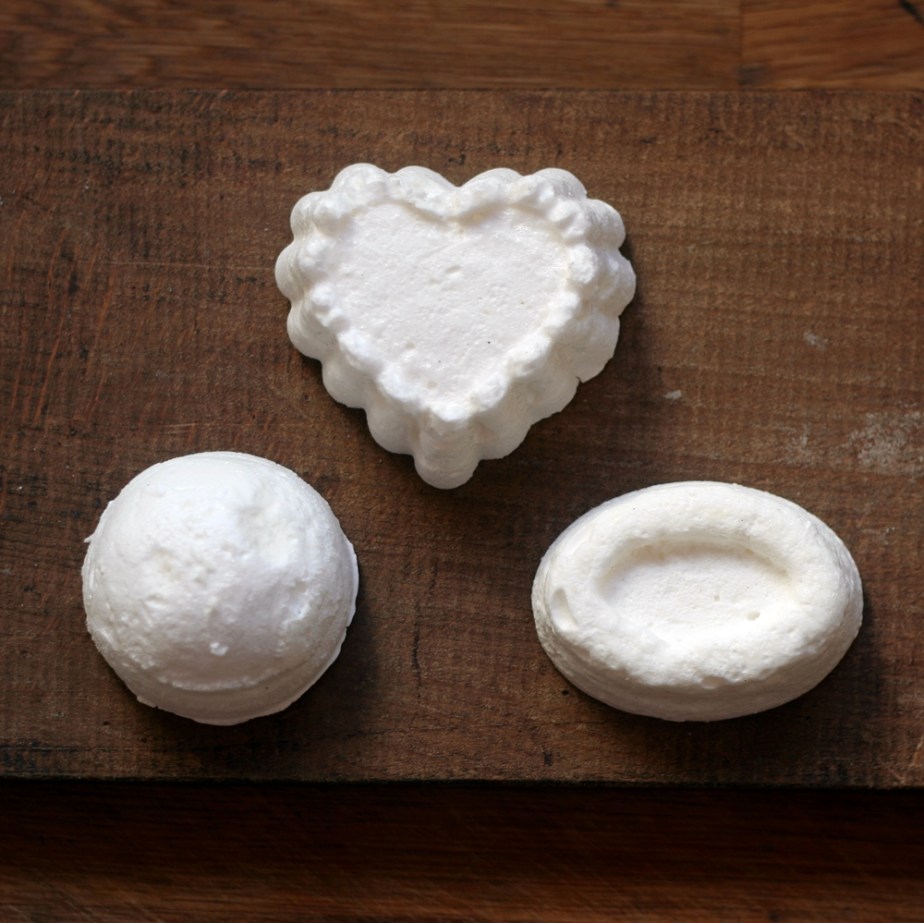
Shaping Meringues

I have a bit of a love/hate relationship with meringues. On the one hand they are extremely simple to make, with just two ingredients, but on the other, for the most part, they are almost universally blobby. Not such a defect, you might think, but it doesn’t help the elegance of a dish when one’s natural inclination is to the rustic.

So armed with one of my favourite baking books, I decided to experiment with trying to impose some order on these feather-light and versatile confections.

There are three basic types of meringue, which have come to be identified as French, Italian and Swiss, based mostly on how the sugar is treated in the mixing.

French meringue is the classic, with the egg-whites being whipped to soft peaks, before caster sugar is gradually added, then whisked to stiff peaks. This is a versatile meringue in that you can bake it by itself in blobs and nests an kisses or use it to top sweet-filled pies and tarts. However, it is not stable and will, over time, deflate back into a liquid. It needs to be baked after whisking.

Italian meringue has become very popular in recent times, due to its longer ‘shelf-life’ for want of a better word. The egg-whites are whisked together with a hot sugar syrup which cooks them enough to prevent them deflating once cold. Italian meringue can be folded into mousses and ice-creams to provide lightness and creaminess, can be piped directly onto cakes and pies and toasted either in the oven or with a blow-torch. It can also have butter whipped into it to make an indulgent filling/icing for cakes large and small.

Swiss Meringue is a method that falls roughly between that of French and Italian. The sugar and unwhipped egg-whites are stirred over simmering water until the sugar has dissolved, then they are removed from the heat and whisked vigorously until cool. This method makes for a firm, dazzlingly-white meringue that holds its shape exceptionally well, especially when piped with a patterned nozzle, which makes it the perfect meringue to use for adding a little more form and structure to your desserts.

This recipe comes from the Victorian baking book, “All about Biscuits” by H.G.Harris & S.P.Borella (c1900) and is listed only as a meringue mixture (one of many throughtout the book). It calls for caster sugar and the whites of eggs  to be whisked to a temperature of 66°C. Comparing this method with recipes available online, it is interesting to note that the ratio of sugar to egg-whites in modern mixtures varies, as does the temperature to which the mixture should be heated, from equal quantities by weight of sugar and egg-whites up to double the sugar to egg-whites, and in temperature from ‘until the sugar is dissolved’ as high as 80°C.

This recipe is a diplomatic middle-ground, but you should experiment to find the mixture that works best for you. What you do with the meringue after it is made, is really the main focus of this post, and my initial experiments are included below.  Most modern recipes stop after the mixing stage and either suggest the meringue be used as-is on top of pies and cakes, or that butter is whipped into the meringue to create a buttercream. Detailed below is a third option: that of baking the meringue dry to enjoy as they are or for use in other recipes. I hope to be able to add to the photographs as I discover additional suitable designs.

Use of silicone moulds
Meringue Shapes
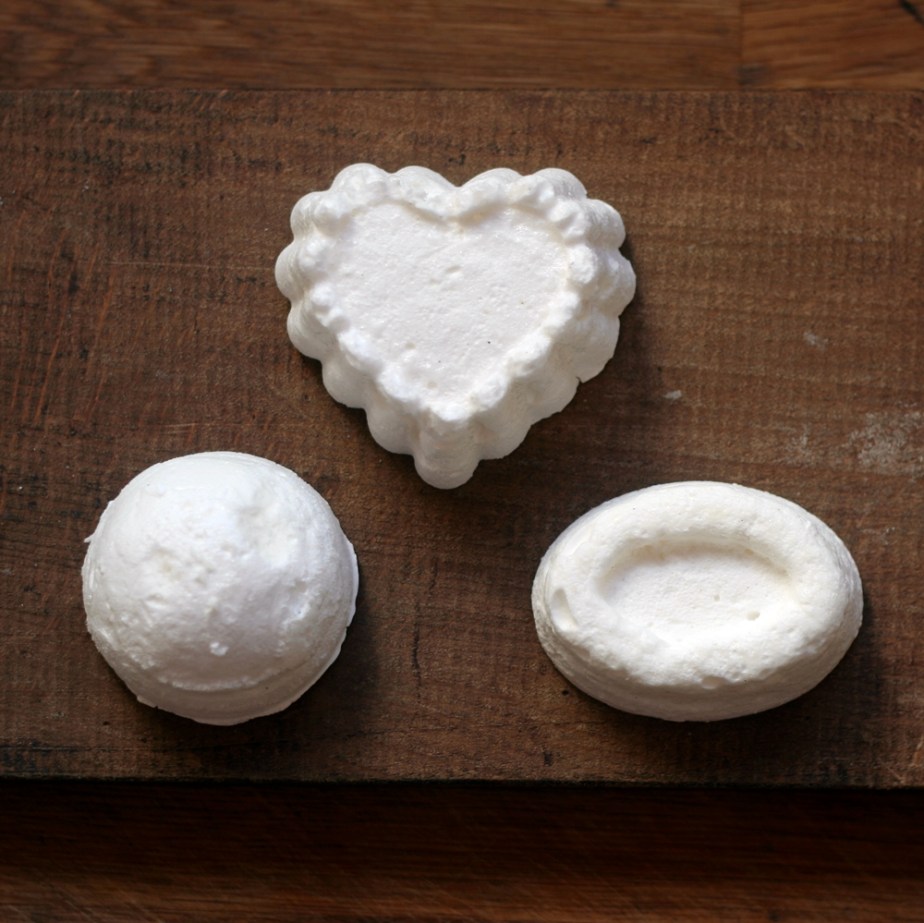
Meringues shaped in silicone moulds

Use of flexible silicone moulds are the simplest way to give your meringues a professional look. Smooth the meringue into clean moulds, trying to ensure there are no air-pockets trapped between the mixture and the surface of the mould. The drawback of this approach is the length of time the meringues take to dry. The best method I have found, is to cook them at a slightly higher temperature initially (80°C), until the visible surface is cooked and firm, then gently ease them from the mould and allow them to dry overnight in an extremely low oven (mine will actually go as low as 30°C). They will be perfectly dry, dazzlingly white and will keep for days in an airtight container.
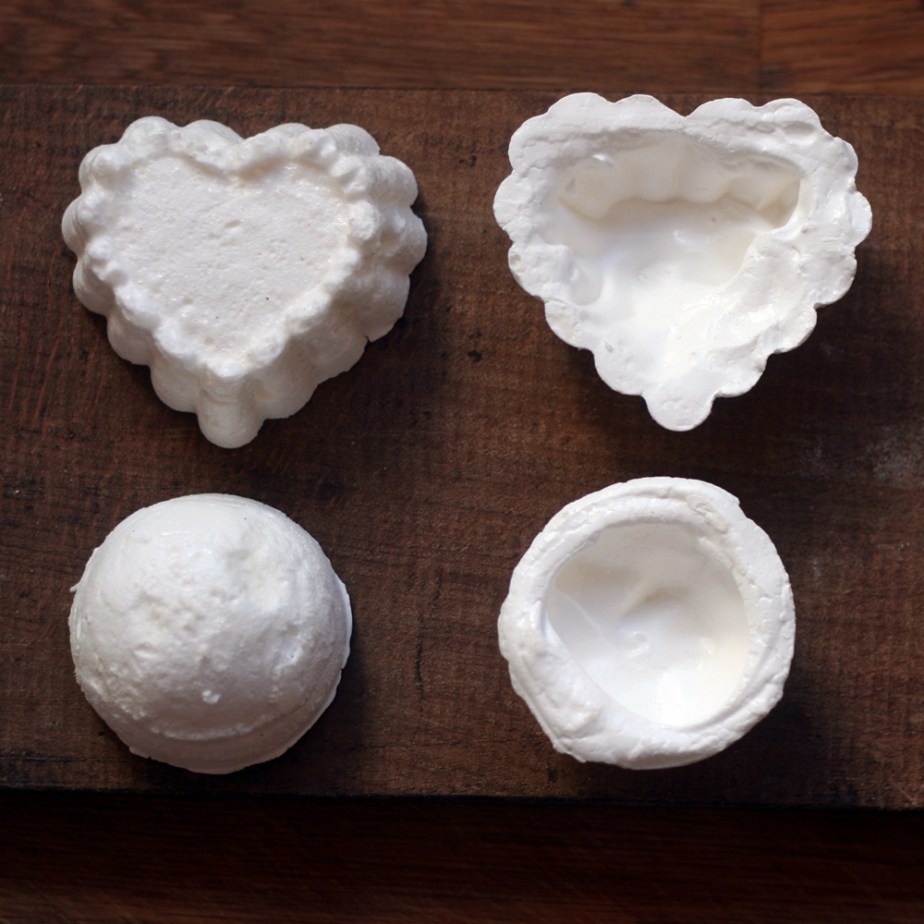
Meringues shaped in silicone moulds can be hollowed out to shorten baking time and provide room for a surprise filling

If you hollow out the meringue shapes, as seen above, not only does this reduce the drying time, but you can then use this for a hidden filling underneath, or turn the meringue the other way up and use it as a bowl for a moist and creamy filling: Eton Mess becomes Eton Tidy in an instant!

Use of piping tips

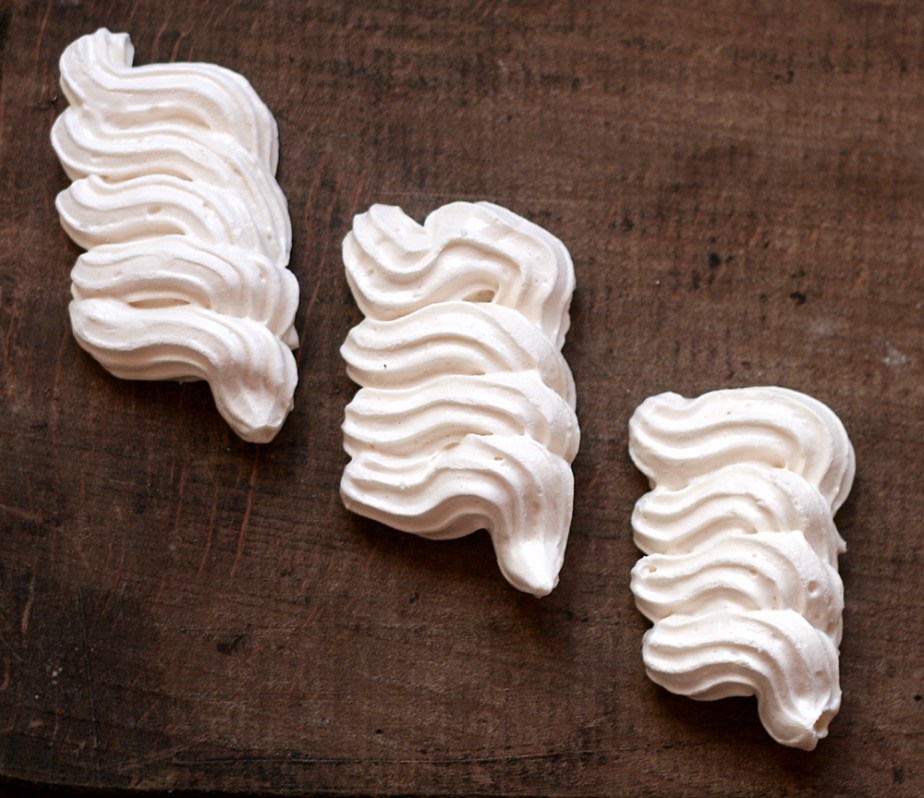
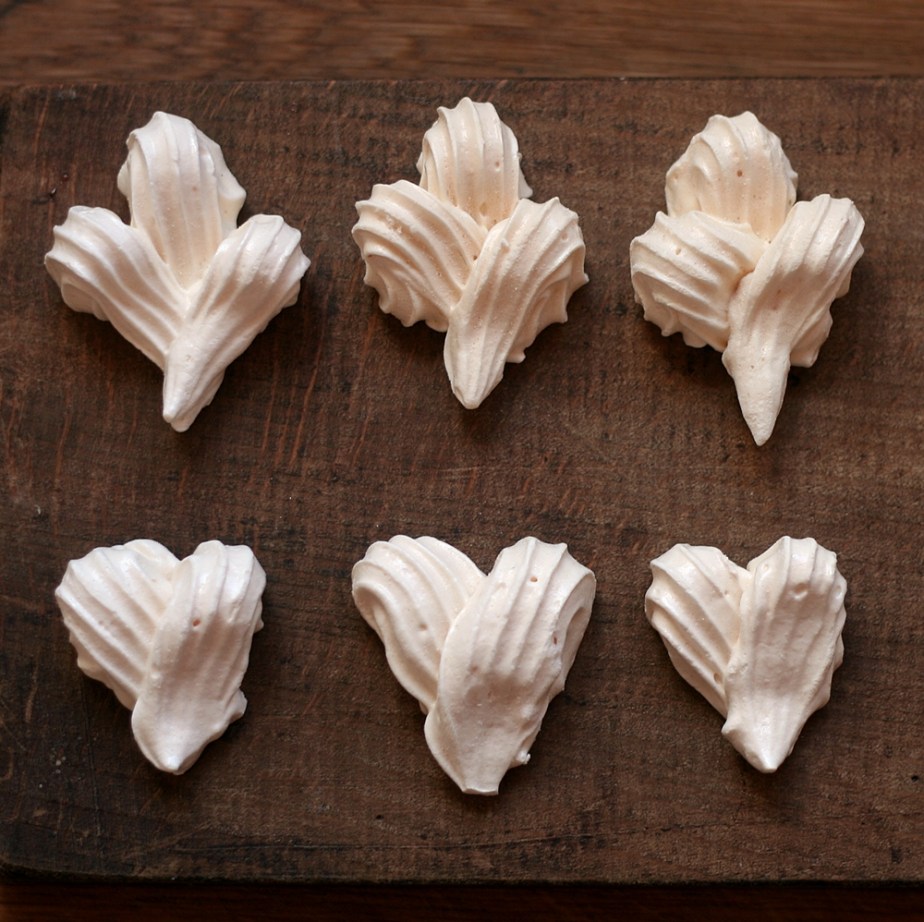
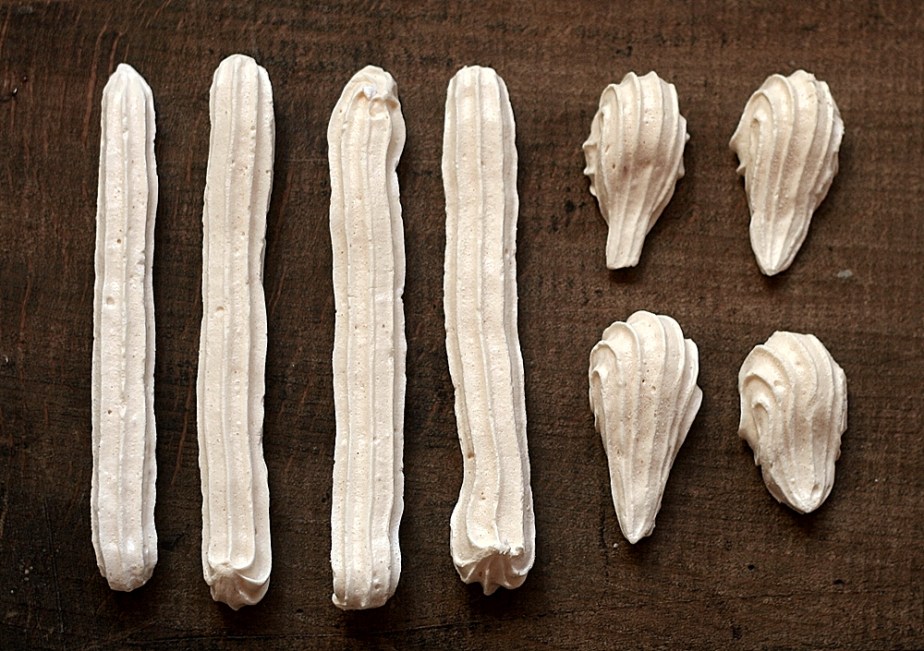
Spooned into a piping bag fitted with a shaped piping tip, Swiss Meringue is fantastic for creating shapes and designs with crisp details that hold their shape whilst baking. A few simple examples are listed below.
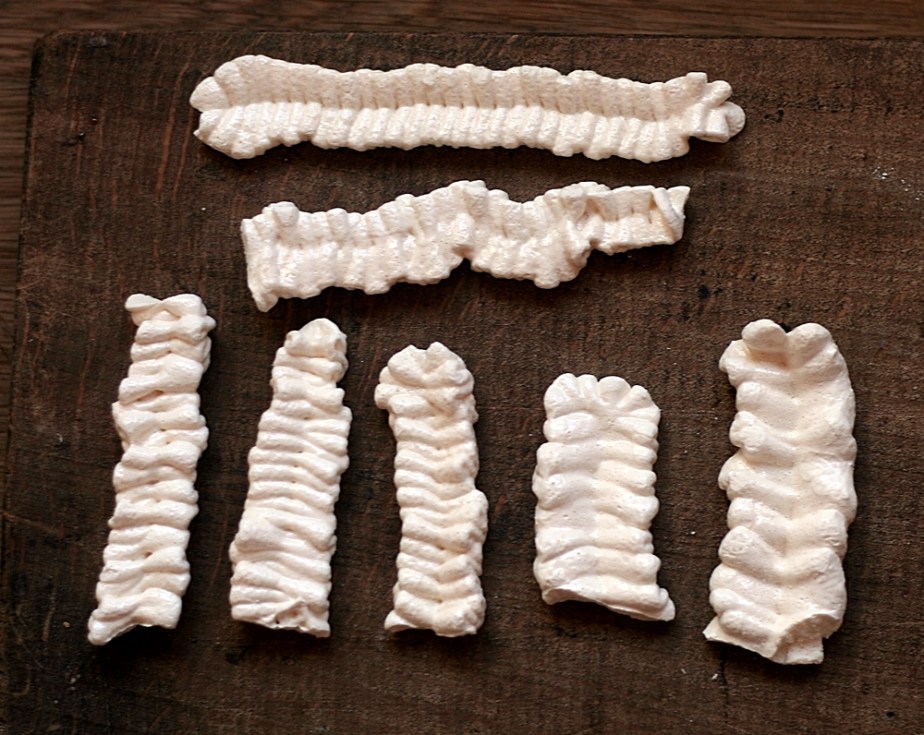
Meringue Ruffles made using the ‘leaf’ piping tip
Meringue Batons and Shells piped using an open star tip.
Meringue Feathers piped using an open star tip.
Meringue Swirls piped using an open star tip.
Meringue Fleur de Lys and Hearts piped using an open star tip.

Swiss Meringue

450g caster sugar
300g egg-whites

  • Put the egg-whites and sugar into a clean, dry bowl and set it on top of a pan of simmering water.
  • Be sure that the bowl doesn’t touch the surface of the water.
  • Gently stir the ingredients together until the sugar is dissolved and the temperature has reached 66°C.
  • Remove the bowl from the pan and whisk the contents briskly until the mixture is cold, firm, billowy and dazzlingly white.
  • Pipe onto parchment-lined baking sheets or into silicone moulds as you see fit.

To bake

The whiter you wish your meringues, the lower the temperature they need to bake, or rather, dry out. The shape will also dictate how long they require in the oven.

  • Preheat the oven to 100°C, 80°C Fan.
  • Bake for 1-2 hours, depending on shape, until set and firm. If you’re using silicone moulds, now would be the time to ease the meringues from the moulds.
  • Reduce oven temperature to 50°C, 40°C Fan and allow meringues to dry out.
  • Once cooled, store in an airtight container until required.
Lemon Biscuits

One of my favourite sets of books is a series for the Edwardian baking trade written by H.G.Harris and S.P.Borella. Published as part of The British Baker Library in the first years of the twentieth century, the “All About…” books are a fascinating record of the sheer range and variety of baked goods both fashionable and available at the time. The full set of books in the series comprises volumes devoted to:

  • All About Biscuits
  • All about Pastries
  • All About Gateaux & Dessert Cakes
  • All About Ices, Jellies, Creams & Conserves
  • All About Genoese, Petits Fours, Glacés and Bon Bons

I’ve collected my copies of these books via eBay and AbeBooks, so I recommend checking out both of these sites if you’re interested in acquiring some for yourself.

With recipe quantities suited to commercial batches, a certain amount of scaling is required in order to use any of the recipes for the home, but the effort is invariably worth it. These recipes date from an era when biscuits were sold either individually priced or by weight and you could thus make a selection specifically tailored to your entertaining or just personal needs.

These biscuits come from the All About Biscuits volume, from the chapter Dessert and Wine Biscuits. The chapter is filled with biscuits both elaborate and plain that would have been served in a range of contexts. In general terms, the dessert course was a selection of fruits, nuts, sweetmeats and sweet biscuits arranged along the centre of the table throughout the meal, acting also as table decoration. In addition, biscuits were served alongside the popular cream, syllabubs, jellies and trifles to add some textural crunch and contrast against the softness and richness.

I chose these biscuits partly for their simplicity and partly because they were labelled ‘old-fashioned’ over a century ago and I was struck that even in an era of great change and innovation, there was still enjoyment of confections which harked back to earlier times. There’s no excessive icing, decoration or filling; they are just a simple, elegant and pure-tasting delight.

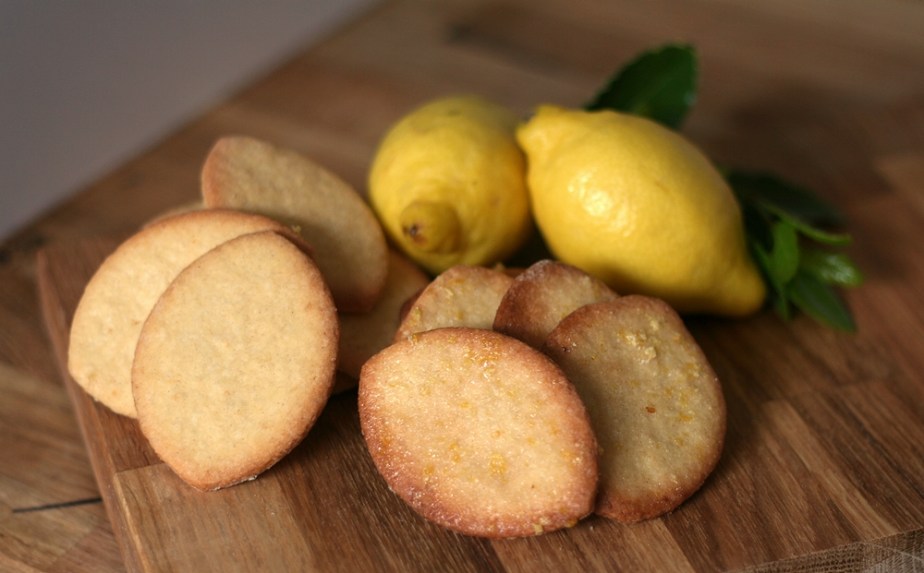
The original biscuits are crisp, with a delicate lemon flavour, ideal for serving with fruit fools, possets and fresh fruit, or even for enjoying with a mid-morning or afternoon cup of tea. I also thought they could stand a little embellishment, for an extra special treat, should the occasions arise. After a bit of experimentation I came up with the following: once baked and whilst still hot, brush the biscuits with what is essentially a lemon drizzle mixture of lemon zest, lemon juice and sugar. As the biscuits cool, this topping hardens into a glittery, lemon-flavoured crust, sweet but still eye-poppingly sharp with lemon juice. It is delicious.

This recipe makes 20-30 biscuits, so there is more than enough to have a mix of both glazed and unglazed biscuits.

Old Fashioned Lemon Biscuits

The original unglazed biscuits are on the left of the photo, the lemon-glazed biscuits are on the right.

225g plain flour
115g unsalted butter
110g caster sugar
zest and juice of 1 lemon
1 large egg – beaten

Lemon Drizzle Glaze – optional
zest & juice of 2 lemons
4-6 tbs caster sugar

  • Put the flour, sugar, zest and butter into a food processor and blitz until the mixture resembles breadcrumbs.
  • Add the lemon juice and blitz again.
  • Whisk the egg and, with the food processor running, gradually add a tablespoon at a time until the mixture comes together in a ball. Depending on the moisture in your flour and butter and the quantity of juice you get from your lemon, you might not need to use all of the egg.
  • Tip out the mixture and knead smooth.
  • Wrap in plastic and chill for at a least an hour until firm enough to roll.
  • Preheat the oven to 200°C 180°C Fan.
  • Line two baking sheets with baking parchment.
  • Roll the chilled dough out thinly (3-4mm) and cut out lemon-shaped  biscuits. You can use a 7cm plain circular cutter and then use it to cut off a crescent of dough to make the lemon shape. Press the trimmings together and re-roll.
  • Lay the biscuits onto the baking sheets, 1-2cm apart – there is little spreading during baking.
  • Bake for 11-12 minutes, turning the baking sheet around after 6 minutes to help even colouring.
  • While the biscuits are baking, make the glaze (if using). Use a fine grater to remove the zest of the lemons. If using a microplane grater, you will need to then chop the curls of zest into smaller pieces to achieve an even coverage when brushing on the glaze. Add the lemon juice and sugar to the zest and stir all together. There’s no need to ensure all the sugar is dissolved, as this will contribute to the crunchiness of the layer.
  • When the biscuits are baked and starting to colour at the edges, remove and brush the glaze onto as many biscuits as you like. Leave to cool on the baking sheets for 10 minute, then transfer to a cooling rack to cool completely.
  • The heat of the biscuits themselves, as well as that from the baking sheets, will help the glaze to set. After 30 minutes, if your biscuits aren’t as crisp as you would like, or the glaze isn’t fully dry, set the cooling racks into the oven, which should still be warm from the baking and allow the warmth there to work its magic.
  • Store in an airtight container.


Malt Scones

My current lack of oven (for those interested the ETA is currently mid-February) has prompted me to delve into my small but eminently interesting collection of Victorian and Edwardian commercial bakery books in search of something to ‘bake’.

Back in the day, there were numerous recipes that could be baked on a griddle, a far more varied selection than the standard trio of Welshcakes, muffins and crumpets generally known today.

Admittedly, these do tend to be variations of a theme of ‘scones’, but the range available with just slight alterations of the ratio of ingredients is delightful.

The recipe I’ve chosen today is for an unusual griddle scone, as it is flavoured with malt, and every other version I have read has been for oven-baked scones only. I’m a great fan of malt loaves,  and have been since childhood, and they’re pretty straightforward to make at home. The 2-5 day wait for them to mature once baked, however, is frustratingly long.

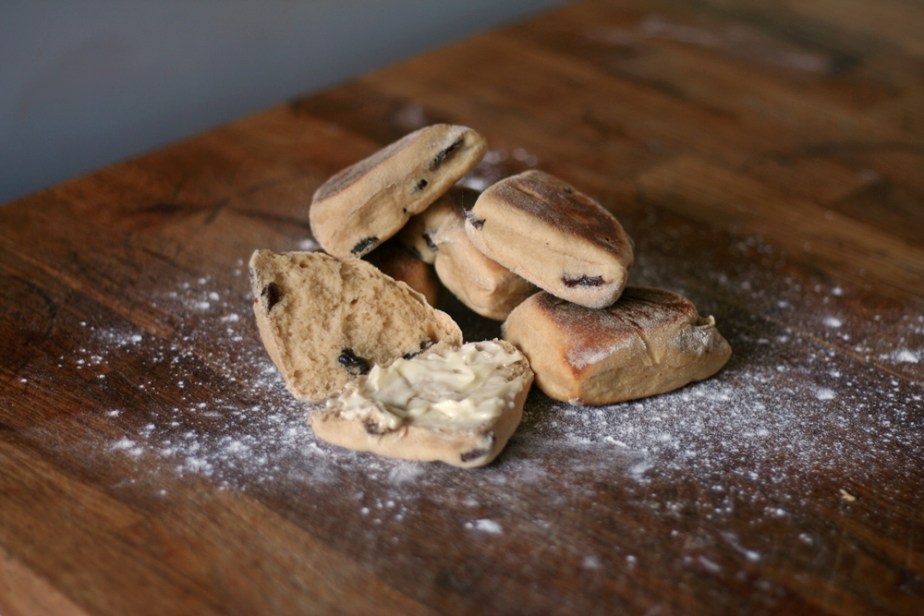
Not so with this recipe. Cooked in just 10 minutes on the stovetop, they can be enjoyed on day of making either fresh from the griddle or cooled, split and buttered. The delicate malt flavour is probably most pronounced when the scones are freshly baked and cooled. Interestingly, these use both yeast and raising agents to achieve their light and fluffy texture, as well as just a single proving.

These are not SWEET sweet scones, although the malt and the sultanas do place them on the sweet side. I was delighted to discover that, with the original quantity of sultanas (30g), they are delicious with cheese. For a sweeter bite, double this quantity and enjoy them split and buttered.

This batch makes twelve, so if this is rather too much for your needs for one day, you can either freeze some, warm them in the oven (just flaunt your oven-ness at me why don’t you!?) or enjoy them toasted and buttered.

Malt Scones

Makes 12

Ferment
150ml warm water
10g    fresh yeast
2 tsp sugar – brown or white
1tbs plain flour

225g plain flour
35g unsalted butter
30g sultanas
60g  malt extract
½tsp cream of tartar
¼tsp bicarbonate of soda

  • Whisk together the ferment ingredients and set aside in a warm place for 30 minutes until frothy.
  • Put the remaining ingredients except the sultanas, into a food processor and blitz until the malt and butter are fully incorporated,
  • Tip the flour mixture into a bowl.
  • Gradually stir in the frothy ferment until the mixture comes together as a soft dough. NB Depending on the moisture levels of the rest of the ingredients you might not need all of the ferment.
  • Knead for 10 minutes.
  • Add the sultanas and mix thoroughly.
  • Divide the dough into three (about 150g each, or 170g if using the larger amount of sultanas).
  • Roll into a smooth ball, then pat out by hand to a 12cm circle.
  • Cut into quarters and set the farls onto a floured board to rise for 45 minutes.
  • Heat a heavy-bottomed pan on the stove top. I use a cast iron, non-stick pan on the largest ring set to the lowest heat. Allow the pan 5-10 minutes to come to an even heat before you start cooking the scones. If your pan doesn’t have a thick base, then choose a smaller heat and watch carefully that the scones don’t become too dark.
  • Cook the scones in batches, for 5 minutes per side until risen and lightly browned.
  • Cool on a wire rack.
  • Store in an airtight container once cold.

Staffordshire Oatcakes

Staffordshire Oatcakes are, quite possibly, the best regional speciality you’ve never heard of.

In fact, that is much more of a generalisation than you may realise, because they’re specifically regional to North Staffordshire, centering on the area around Stoke-on-Trent.

It’s historic origins are mixed, with some anecdotes suggesting they originated from soldiers returning from India and trying to reproduce the chapatis they had eaten, with local produce. A more likely scenario, is as one of the various traditional ‘bakestone’ items found in workers cottages all over the country. With wheat being a valuable commodity, most people used flour from cheaper oats and barley, and with a cooking time of mere minutes, they are surprisingly sustaining.

They can be eaten hot from the pan, but as with other griddle bakes such as muffins, crumpets and pikelets, they can be made in batches, and then toasted as required, making, if anything, an even speedier snack.

Oatcake shops used to be small and plentiful, with sales being made through open windows. Alas, the last of this kind of  shop, the Hole In The Wall in Stoke-on-Trent, closed down due to re-development of the area in 2012. Commercial producers are still churning out batches in 6s and 12s, and they are even stocked by some of the large supermarket chains, but they taste best when home-made. Obvs.

Before we get to the recipe, a word or two about ingredients…

  • These oatcakes are made mostly of oats, in the form of oat flour. If you want to hunt out some oat flour, then have at it, but I’ve found, through trial and error, that whizzing some steel-rolled oats in a spice grinder is both easier and cheaper. You could probably use a blender as well, as they too have the off-set blades necessary to chop the oats into a suitable fineness. Whatever is easiest being the main order of the day.
  • You can use instant yeast, but I must admit, the batter made with fresh yeast always tastes better to me.
  • I’ve read a lot of recipes and watched many a documentary clip on Staffordshire Oatcakes and I’m going to confess up front that this recipe might be viewed poorly by oatcake devotees. It makes a batter that is rather thicker than the traditional, which results in a thicker oatcake. In my defence, it makes for a more durable oatcake which I can then turn easily in the pan without it breaking, and it ‘laces’ beautifully, with the surface becoming dappled with the characteristic pockmarks and holes seen also on pikelets and crumpets. The thickness also allows for a wonderful contrast when toasted between the crisp outsides and the fluffy insides. If all this is a heresy to you, feel free to dilute the batter down to your liking after the 1-hour rise.
  • If you have a decent non-stick pan, you can cook these fat-free.

Staffordshire Oatcakes

280g oat flour – ground from steel-rolled oats
110g stoneground wholemeal bread flour
110g strong white bread flour
1tsp granulated sugar
1tsp table salt
20g fresh yeast, crumbled or 1 sachet fast-action yeast
450ml whole milk – warmed
450ml warm water

  • Put everything into a large bowl and whisk together with a balloon whisk. Alternatively, use a stick blender.
  • Cover with cling film and leave in a warm place to rise.
  • Heat a non-stick pan over medium heat. If your pan is in need of a little help, use a sparing layer of fat (bacon fat or lard) to help prevent your oatcakes from sticking.
  • Gently stir your oatcake batter. The yeast and rising time will have turned it into a liquid with the consistency of frothy double cream.
  • Put 1 ladle/cup of batter into the middle of your pan and tilt the pan around until the batter has spread fully. Don’t be tempted to use the back of your ladle/cup to spread the batter out, as it’s very easy to spread it too thin and either make holes in the middle, or edges so thin they begin to burn before the middle is cooked.
  • The moisture in the batter will soon evaporate, leaving a lacy surface of holes and craters where bubbles from the batter burst.
  • Allow the oatcake to cook until there is no moisture visible on the surface – about 2 minutes.
  • Using a spatula or slice, loosen the edges and then the undersides of the oatcake until it is freely sliding around in the pan.
  • Flip the oatcake over and cook for another 2 minutes or until the surface is starting to brown (see photo).
  • When done, slide out of the pan onto a wire rack to cool.
  • Continue until all the batter is used up. This will make a batch of about 10 sturdy oatcakes.

As the oatcakes cool, they will soften and take on the appearance of a floppy pancake. Wrap in plastic and store in the fridge until required.

Oatcakes for Breakfast/Brunch/Snack/Whenever

You can put whatever you like in your oatcakes, but a filling of bacon and cheese is not only traditional but forms one of those rare, simple ingredient combinations that border the sublime.

You will need:

oatcakes
back bacon rashers – 2-3 per oatcake
grated vintage cheddar cheese

Sauce – brown or red (optional)

  • Grill your bacon or cook in a pan until beginning to caramelise. Set aside and keep warm.
  • Take your oatcake and put into a hot, dry pan – ideally the one you originally cooked it in. An oatcake has two very different sides, the pockmarked ‘front’ and the smooth, brown ‘back’. Put the ‘back’ of the oatcake into the pan first.
  • Allow the oatcake to heat through for 1.5-2 minutes.
  • Flip the oatcake.
  • Sprinkle the cheese over the hot ‘back’ (which is now uppermost) of the oatcake. It will melt as the other side toasts.
  • When the underside of the oatcake is warmed through and crisp, lay 2-3 rashers of bacon on top of the melted cheese on one half of the oatcake and fold the other half of the oatcake over (as in the photo).
  • Slide onto a plate and enjoy with sauce, if liked.
  • Repeat as often as necessary.


Steamed Sponge

This recipe is for a traditional steamed sponge, the type many of us remember from our childhoods. So comforting in the winter months, with a blanket of hot custard draped over. They are a breeze to mix, but in these days when most people have a gas or electric stove-top, rather than an always-on range, the three-hour steaming time makes the cooking something of a marathon.

To make things easier for everyone, I’ve scaled this recipe down to make four individual puddings which can be cooked in a steamer pan over simmering water. Not only are mini puddings delightfully small and perfectly formed, they take a mere 30 minutes to steam. This means that they can be put on to cook as everyone sits down to the meal, and be ready by the time the main course is done and cleared away.

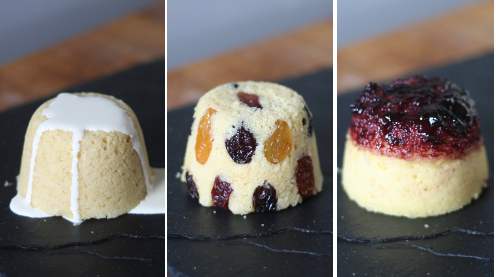
As if this weren’t cause enough to rejoice, this recipe can also be easily and infinitely adapted with different ingredients and flavours, even to the point of producing four differently-flavoured puddings from the one mixture. A few suggestions are included below, but do please experiment with your own creations too!

Steamed Sponge

Serves 4

The base instructions are for a plain sponge.

170g plain flour
1 tsp baking powder
70g butter
pinch of salt
85g caster sugar
1 large egg
½ tsp vanilla extract
120-150ml milk
softened butter for greasing the pudding bowls

  • Bring a pan of water to a simmer.
  • Put the butter, flour, salt, sugar and baking powder into the bowl of a food processor and blitz until the mixture resembles breadcrumbs.
  • Tip out into a bowl.
  • Whisk the egg and vanilla with the milk and stir into the dry ingredients until smooth.
  • Generously butter four individual pudding bowls and divide the mixture evenly amongst the prepared bowls.
  • Cut four squares of foil for the lids and make a single pleat in the middle. This will allow the sponge mixture to expand during cooking without forcing the foil cover off. Butter the inside surface of the foil, then fold over and around the pudding bowls.
  • Arrange the four bowls in the steamer pan, cover with a lid and place over the simmering water.
  • Steam for 30 minutes.
  • Peel off the foil and run a knife around the side of the puddings to loosen them.
  • Turn out the puddings and serve with cream, custard or pudding sauce of your choice.

Variations

These tweaks can be made to the basic vanilla sponge.

  • Jam Sponge – put a tablespoon of your favourite jam into the bottom of the pudding bowls before adding the sponge mixture. Have some of the jam warmed for serving.
  • Fruit Sponge – put 2 tablespoons of cooked fruit into the bottom of the pudding bowls before adding the sponge mixture. Again, have extra fruit to hand when serving.
  • Raisin decoration – dot large colourful raisins onto the sides of the buttered moulds before adding the plain sponge mixture.
  • Raisin sponge – Add 60g raisins to the plain mixture. You can also ornament the sides of the bowls as above.
  • Coconut sponge – add 60g dessicated coconut to the sponge mixture. Stick more coconut to the butter in the moulds before adding the sponge mixture.
  • Citrus sponge – omit the vanilla flavouring, add the grated zest of a lemon/orange/lime to the sponge mixture, together with the juice. Use a little less milk to mix. Add 60g of diced, candied peel of the same flavour if liked.
  • Candied fruit sponge – use 60g of candied fruit such as cherries, cranberries, pineapple, either on their own or mixed.

The following tweaks should be done by altering the method slightly and using the creaming method for the sponge (creaming butter and sugar, then eggs then dry ingredients), as the darker colour of the sponge sometimes highlights butter pieces that have not fully combined with the other ingredients.

  • Dried fruit pudding with toffee top. Use brown sugar to mix the sponge and add 60g of chopped figs, dates or prunes to the sponge mixture. Mix 30g of softened butter and 30g of soft, dark brown sugar and divide amongst the bowls before adding the sponge mixture.
  • Double jam sponge – Omit the vanilla, before adding the milk and egg, stir 3 tablespoons of jam into the sponge mixture. Add 1 tablespoon of jam to the bottom of each of the pudding bowls.
  • Chocolate sponge – Add 2 tablespoons of cocoa to the mixture and use a little more milk to mix. Add 60g chocolate chips to the mixture, or put them in the bottom of each pudding mould to form a chocolate ‘cap’. Alternately, half fill the moulds then add the chocolate chips in a well, and cover with more sponge mixture. This will make for a molten centre once cooked.
  • Coffee and Walnut sponge – Omit the vanilla, add a tablespoon of espresso powder or coffee essence to the sponge mixture and stir through 60g chopped walnuts. Put a half-walnut upside down in the bottom of each basin before adding the sponge mixture.

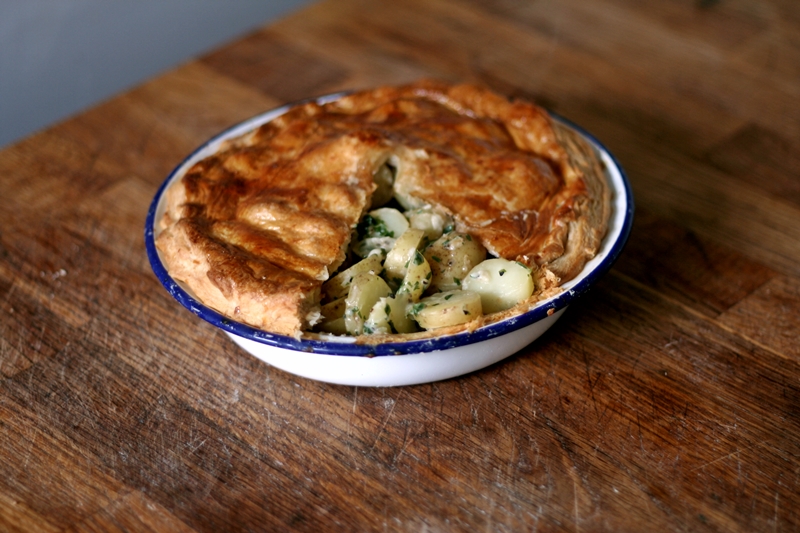
New Potato Pie

Pies are frequently seen as the star of a meal, but this new potato pie is a delightful accompaniment to numerous meals. Tender new potatoes are baked beneath a rich buttery crust with a creamy sauce flavoured with parsley.

Not only does the crisp and golden pastry lid keep in all the flavours, it allows the potatoes to finish cooking without fear of them falling to pieces.

Simple and delicious with a gratin of leeks, sprinkled with cheese, or fresh, farmhouse ham and salad.

New Potato Pie

500g new potatoes, scrubbed
2tbs plain flour
1/2tsp salt
1/4tsp ground white pepper
3-4tbs chopped, fresh parsley
80ml double cream or creme fraiche
1 sheet puff pastry
beaten egg to glaze

  • Preheat the oven to 200°C/180°C fan/gas 5.
  • Bring a pan of water to the boil.
  • Boil the potatoes for 5 minutes, then drain.
  • When cool enough to handle, cut the potatoes into slices, 2cm thick.
  • Mix the flour, salt and pepper, sprinkle over the potatoes.
  • Add the parsley and toss to coat.
  • Put potatoes into an oven-proof dish and pour over the cream.
  • Cut some strips of pastry and line the edge of the dish.
  • Dampen the pastry rim and cover with the sheet of pastry, pressing the edges down firmly.
  • Brush wih beaten egg and cut a vent in the middle to let out steam.
  • Bake for 20-30 minutes, depending on the size and shape of your dish until the pastry is crisp and brown and the potatoes cooked through.

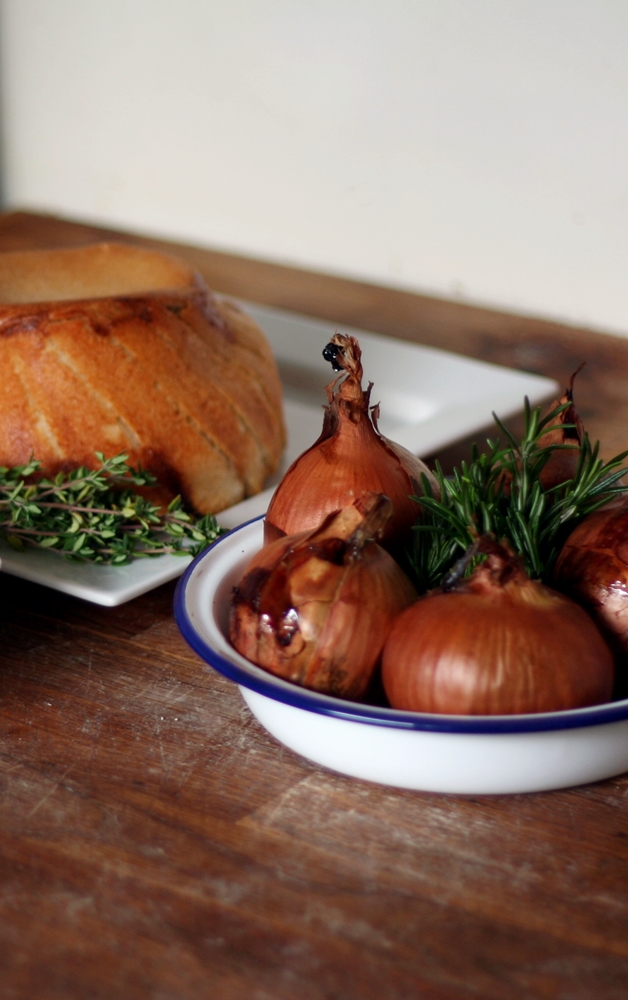
Onion Charlotte

In the great pantheon of cookery ingredients, onions tend to get a bit of a raw deal, in my opinion.

Although they are fundamental to the development of flavour in a multitude of savoury casseroles, stews, soups, pies and salads, they are rarely celebrated with starring roles and are usually relegated to the sidelines: always the bridesmaid, never the bride.

This recipe puts onions front and centre – or rather quite the opposite – as a creamy, onion filling is wrapped in a golden, bread casing.

Normally viewed as a pudding dish, there’s no reason why the distinctive features of a fruit charlotte, namely the hot flavourful filling and crisp, buttery bread shell can’t be applied to a savoury dish.

It is a fine accompaniment, or with the addition of some cubes of cheese, mushrooms or bacon, can even become the main attraction.

Random Onion Tip: Include the papery, brown skins in your stock pot. They make for a wonderful colour.

Onion Charlotte

Farmhouse Cookery, 1930s

400g onions
400ml milk
200ml water
¼ tsp cinnamon
½ tsp ground nutmeg or ½ whole nutmeg, grated
2tbs cornflour mixed with a little cold water.
15g butter
30g softened butter
6-8 slices of stale white bread. If you have none, then cut some bread into slices and arrange on a wire rack to dry a little.
1 x 1.2 litre pudding basin

  • Peel the onions and put into a saucepan
  • Add cold water to cover and bring to the boil.
  • Turn the heat down and allow to simmer for 20 minutes.
  • Strain the liquid off and set aside to use for soup.
  • Chop the cooked onions neatly and return to the pan.
  • Add the milk and water and simmer until the onions are cooked through.
  • Season with salt and pepper and the spices.
  • Add the cornflour mix and heat gently, stirring, until thickened.
  • Add the butter and stir gently until melted.
  • Remove from the heat and set aside to cool.
  • Generously grease the pudding basin with the butter. A pastry brush will make this very easy.
  • Cut a circle of bread to fit into the bottom of the basin and place it there.
    Set one slice of bread aside to make the cover.
  • With the remaining bread, cut it lengthwise into strips about 5cm wide.
  • Line the sides of the bowl with the bread strips, overlapping each one slightly so that there are no gaps for the filling to leak through. Err on the side of caution and use extra bread if necessary to be sure the bowl is fully lined. The pieces of bread will stick out above the bowl rim, and this is fine.
  • Fill the bread-lined bowl with the onion mixture.
  • Butter the remaining bread and lay it, butter side upwards, on top of the onion filling.
  • Wrap the bowl in cling film, gently folding over the pieces of bread sticking up around the edges.
  • Place a saucer with a weight on top and chill in the fridge for at least an hour, or until required.
  • Preheat the oven to 180°C/160°C fan/gas 4.
  • Remove the cling film from the pudding bowl, replace the saucer and weight with oven-proof equivalents.
  • Put the bowl on a baking sheet and bake for 1 hour, until the bread is golden brown and crisp.
  • Remove from the oven and allow to rest in the bowl for five minutes, then run a knife around the bowl to loosen it and turn out onto your serving dish.

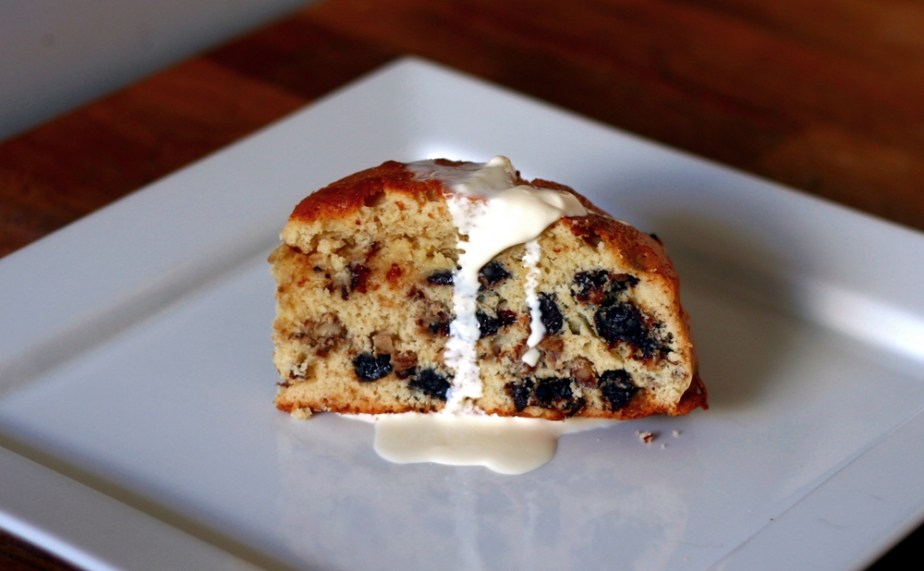
Pudding Cake

May Byron, 1915

The pudding cake is, to my perception, a genre of puddings that has all but disappeared from our tables, despite being popular since the 18th century. It describes something that, when cold, would be recognisable as a cake, but here it is served, warm and comforting, straight from the oven. As with the Fruit Sponge, it’s the hugely enjoyable lure of warm sponge with cream or custard that is the main draw.

The flavourings for this recipe are only limited by your imagination – you can use any combination of fruit/nuts/candied peel that takes your fancy. For this base recipe I have opted for the unjustly unglamorous prune for the wonderfully rich dark, almost toffee flavour the fruit develops during cooking.

Pudding Cake

250g prunes, stones removed
250ml apple juice
100g chopped nuts or flaked almonds
3 large eggs
200ml milk, plus extra if needed
100g butter, melted
200g sugar
2tsp baking powder
350g plain flour

Double cream or custard to serve.

  • Quarter the prunes and put them in a small pan. Pour over the fruit juice and put over medium heat.
  • When the mixture boils, cover and turn off the heat and leave to stew for 30 minutes.
  • Preheat the oven to 180°C/160°C fan/gas 4.
  • Grease and line a 24cm, springform tin with parchment paper.
  • Drain the prunes.
  • Put the eggs, milk, butter, sugar baking powder and flour into a bowl and mix thoroughly until it comes together into a smooth cake batter. If it seems a little heavy, mix in some additional milk until it achieves a dropping consistency and falls easily from the spoon.
  • Spoon a quarter of the batter into the prepared tin and scatter half of the soaked prunes over.
  • Add another layer of cake batter and sprinkle over the nuts.
  • Spoon in half the remaining batter and sprinkle the rest of the prunes.
  • Pour the rest of the batter into the tin and smooth over.
  • Bake for 40-50 minutes, until the cake is risen and golden.
  • Allow to cool in the tin for ten minutes before removing and transferring to a warmed serving dish or plate.
  • Serve in wedges with double cream or custard poured over.

Gooseberry and Elderflower Raised Pie

Traditional

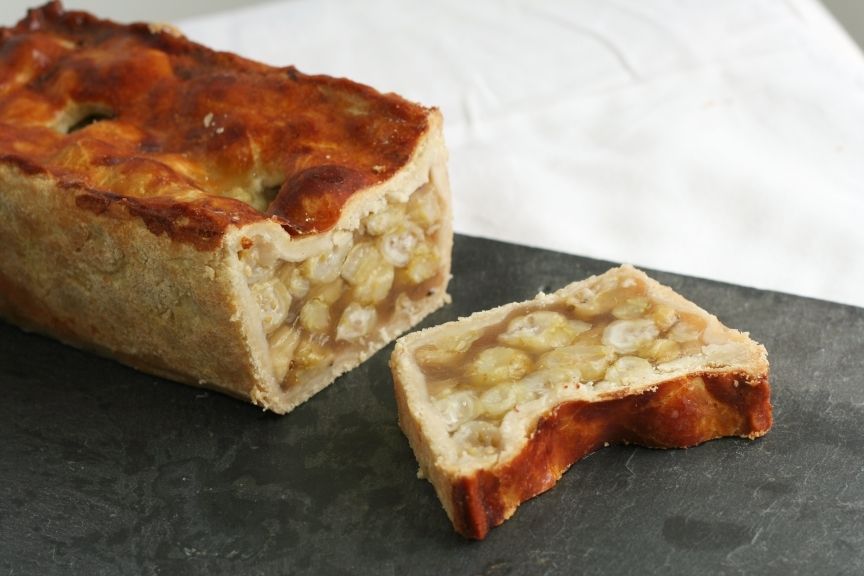
There’s a 200-year-old tradition in Oldbury-on-Severn of making gooseberry pies with a sweetened hot water crust pastry as part of the Whitsun celebrations. Jane Grigson mentions them in several of her writings on English food. Due to the age of the recipe, it was some time before I managed to find a picture of these iconic tarts, and for a long time had to rely solely on my imagination. Consequently, what I pictured in my mind was the pie you see above, and was just a little disappointed to eventually learn that the pies were small, hand-sized, shallow, round pies with a single layer of gooseberries and a lot of sweet/sharp juice.

The use of a hot water crust for a fruit pie is unusual, and can be tricky to work with. Some recipes even recommend that once the tart shell has been formed, the pastry is chilled overnight in order to make a firm casing for the gooseberries, but this then makes it difficult to attach the lid firmly once the paste is cold.

In my searching, I also found accounts that seemed to agree on two things: everyone seemed to like these tarts, even if they didn’t like gooseberries, and that they were extremely juicy when bitten into. I decided to make a large, consumer-friendly variation of this classic dessert pie by setting the juice with gelatine, so that it could be sliced and each slice would hold its shape.

Elderflower is a classic flavour pairing with gooseberries, and this pie combines a jelly made from the gooseberry juice syrup and elderflower cordial with fresh gooseberries and a sweetened hot water crust. The jelly is sweet and delicately flavoured and the gooseberries are so sharp, the contrast between the two is both delicious and refreshing. To make everything much easier, it is baked in a loaf tin.

Sweet Hot Water Crust
600g plain white flour
400ml water
100g butter
100g lard
60g caster sugar

  • Put the fats, sugar and water into a pan and warm over a low heat just until the fat has melted.
  • Put the flour into a bowl and pour on the warmed liquid. Stir well.
  • The paste will be very soft when it comes together, and you can roll it out if you like, but it can also just be flattened and pressed into the tin by hand.

1kg fresh gooseberries
1kg caster sugar
2-3 tablespoons of elderflower cordial

beaten egg to glaze.

3-4 sheets of leaf gelatine

  • Use a sharp knife to top-and-tail the gooseberries, removing the stalk and the calyx.
  • Generously grease a large loaf tin. You can, of course, make this in any shaped tin, but a rectangular loaf tin does produce pretty and regular slices. In order to decide what size of tin to use just tip in your prepared gooseberries. The best fit will be from the tin the gooseberries only just fill.
  • If liked, line the tin with baking parchment in order to help with the removal of the pie once it has cooled.
  • Make the pastry and divide into two. Roll out one piece and cut a lid for your pie. Use the empty tin to mark out its size, then cut the pastry 3cm larger all the way round. Set aside.
  • Gather the trimmings and the rest of the pastry together and roll out to about 1cm. Line your greased loaf tin and allow the excess pastry to drape over the sides for now. Make sure any cracks are well patched, so that the juice stays inside the pie.
  • Layer the gooseberries in the lined tin with the sugar.
  • Moisten the edges of the pastry with water and place the pastry lid on top of the pie. Press the edges together and trim the excess. Crimp the edges in a decorative manner.
  • Cut three circular vent holes in the lid at least 2cm in diameter.
  • Use the pastry trimmings to make additional decorations if liked.
  • Cover lightly with cling film and chill in the fridge for 1 hour to firm up.
  • Preheat the oven to 200°C/180°C fan/gas 6.
  • Brush the lid of the pie with beaten egg and bake for 45 minutes to 1 hour, until the top is crisp and golden and the sides are well-baked. It is better to cook the pie a little longer than for the pie to be under-baked, so if the top is becoming too dark, cover with some foil.
  • When you’re happy with the done-ness of the pastry, remove the pie from the oven and set aside to cool for 10 minutes.
  • Tricky Part: You need to drain the juice from the pie in order to mix in the elderflower cordial and the gelatine that will make it set. After much experimentation, I recommend the following method:
    • Put your pie onto a wire cooling rack.
    • Put a second rack upside-down on top of your pie.
    • Place a large bowl on your work surface. If you think it necessary, place a damp teatowel underneath to prevent slippage.
    • With your thumbs uppermost, pick up your pie tin, sandwiched between the wire racks.
    • Holding the pie tin over the bowl, flip it towards you and let all of the juice drain out of the pie through the vent holes. Once the juice has topped dripping, turn your pie the right way up and set aside.
  • Taste the syrup and add sufficient elderflower cordial to flavour. Since the pie will be eaten cold, you can make the flavouring slightly stronger than usual, since the flavours will be somewhat muted when served.
  • When you’re happy with the taste, measure the volume of syrup. For every 150ml, you need to bloom (soak in water) 1 leaf (sheet) of gelatine. Once bloomed, drain and add the gelatine to the syrup and warm gently until melted.
  • Pour the syrup/gelatine mixture back into the pie. You want enough syrup in the pie to make the cooked gooseberries float.
  • Leave your pie to cool. Cover with plastic wrap and chill overnight in the fridge.
  • Allow to come to room temperature before removing from the tin and cutting in slices to serve.

Oyster Tarts

A great little recipe from that classic baking institution: Be-Ro.

Thomas Bell founded his grocery company in Newcastle-upon-Tyne in 1875. Amongst other items, he manufactured and sold baking powder and the world’s first self-raising flour under the brand name Bell’s Royal.

After the death of King Edward VII the use of the word ‘Royal’ in business was prohibited, so Thomas shortened each word to just two letters, and the Be-Ro brand was born.

To encourage the use of self-raising flour, the company staged exhibitions where visitors could taste freshly-baked scones, pastries and cakes. This proved so popular, and requests for the recipes so numerous, the Be-Ro Home Recipes book was created. Now in it’s 40th edition, the company claims that, at over 38 million copies, its recipe booklet “is arguably one of the best-selling cookery books ever.”

I’m not sure which edition my Be-Ro booklet is, as it’s undated, but from the appearance of the smiling lady on the front it definitely has a 1930s feeling; it’s pictured on the Be-Ro website, with a deep red cover.

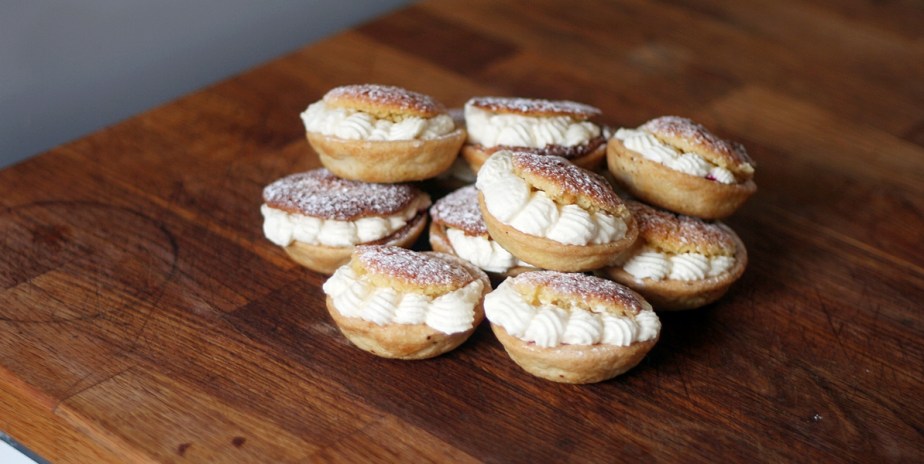
These little tarts are a beautiful example of how the simplest ingredients can be given a subtle twist and appeal by both their appearance and the ease with which they are whipped up. In essence, these are a Bakewell Tart with cream, but a little tweak turns them into sweet ‘oysters’.

I’m not a fan of almond flavouring, so I’ve used lemon zest to brighten the almond sponge and used a seedless blackcurrant jam inside. Adding the jam after baking (unlike the method for Bakewell Tarts) circumvents cooking the jam for a second time, and so it retains its brightness of flavour as well as colour. The pastry is crisp and dry and a perfect contrast against the moist filling. I’ve opted for an unsweetened pastry, but feel free to use a sweetened one if you prefer.

You could customise these tarts by swapping the ground almonds for almost any other nut, and matching the jam accordingly. Here are a few that occurred to me.

  • Almond with orange zest, and orange curd as the filling.
  • Coconut and lime curd, with a little lime zest in the filling.
  • Hazelnuts or pecans, with a praline paste or Nutella in the filling.
  • Walnut and a little coffee icing.

Have fun with them!

Oyster Tarts

Pastry
60g cornflour
225g plain flour
140g butter
ice-cold water

Filling
70g unsalted butter, softened
70g caster sugar
1 large egg
zest of 1 small lemon
85g ground almonds

To serve
200g cream cheese
200ml whipping cream
1tsp vanilla extract
1-2tbs icing sugar, plus more to sprinkle
120g sharp jam

  • Put all the pastry ingredients except for the water into the bowl of a food processor and blitz until the mixture resembles breadcrumbs.
  • Gradually add the water, one tablespoon at a time, until the mixture comes together in a ball.
  • Knead smooth, then roll out thinly. Cover with cling film and chill in the fridge to relax.
  • Preheat the oven to 170°C, 150°C Fan.
  • Beat the butter and sugar for the filling until light and fluffy. This will take about 5 minutes to get as much air into the mix as possible.
  • Add the egg and whisk in thoroughly.
  • Fold in the lemon zest and ground almonds.
  • Grease a 12-hole shallow tart tin.
  • Remove the pastry from the fridge and cut out 12 circles. Line the prepared tin with the pastry.Add about a tablespoon of filling to each tart. I use a small ice-cream scoop but 2 spoons will also work.
  • Bake for 18-20 minutes, turning the tin around after 10 minutes to ensure even cooking.
  • Transfer the cooked tarts onto a wire rack and allow to cool.
  • Whisk the cream cheese, vanilla and cream together until firm. Gently stir through a little icing sugar to slightly sweeten.
  • When the tarts have cooled, slice off the top of the filling with a sharp knife and set aside.
  • Add a teaspoon of jam and either spoon or pipe a little of the cream mixture into each tart.
  • Set the ‘lids’ back on the tarts at a jaunty angle, so as to appear like a half-opened oyster.
  • Dust with icing sugar and serve.