Cookeels

I have a ‘lost’ recipe for you today – a spiced bun that has been known about, recorded and discussed for over 200 years, but for which there has been no recipe. Until now.
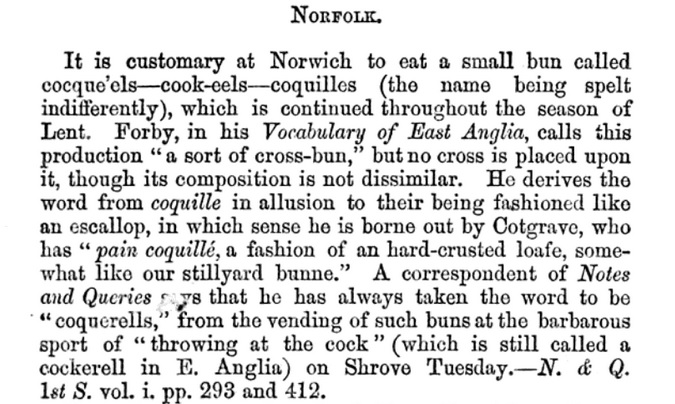
British Popular Customs, Present and Past; Illustrating the Social and Domestic Manners of the People: Arranged According to the Calendar of the Year
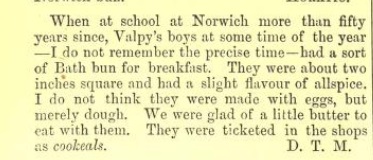
By Thomas Firminger Thiselton Dyer · 1876 p81

As luck would have it, I found not one but two recipes buried in the handwritten manuscripts held by The Wellcome Collection.

The earliest mention of Cookeels is found in Robert Forby’s The Vocabulary of East Anglia.

Cookeel: A sort of cross-bun, made and eaten in Norfolk during Lent. They are sold cheap and may be from Fr. Coquille.
The Vocabulary of East Anglia, Robert Forby, 1830, p76.

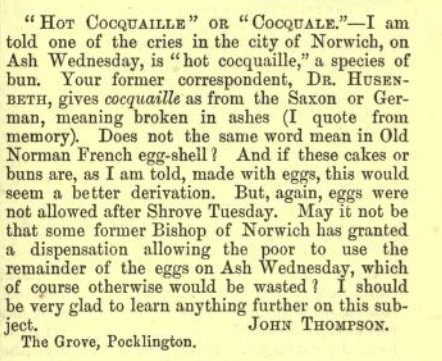
This definition is expanded upon throughout the nineteenth century as more and more academics weigh in with their opinion.
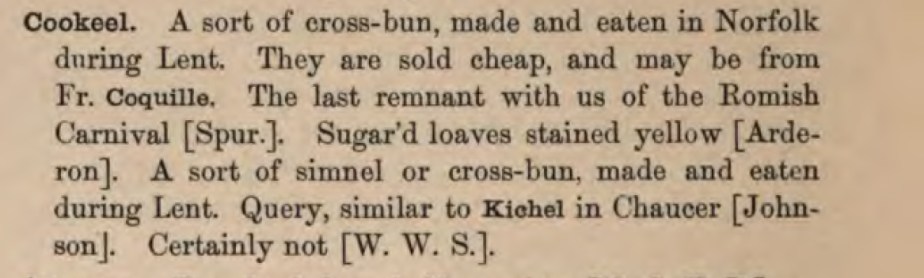
From “A glossary of words used in East Anglia, founded on that of Forby”, p46, Walter Rye, 1895, London
Notes and queries, Fifth Series, Volume Ninth, 1878, Jan-June, London. p87
Notes and queries, Fifth Series, Volume Ninth, 1878 Jan-June, London. p152

Something that became more and more apparent, is the somewhat lackadaisical approach to the spelling of these baked items. This is also true of the names of the two manuscript recipes, to whit Cookeals and Cock Ells:
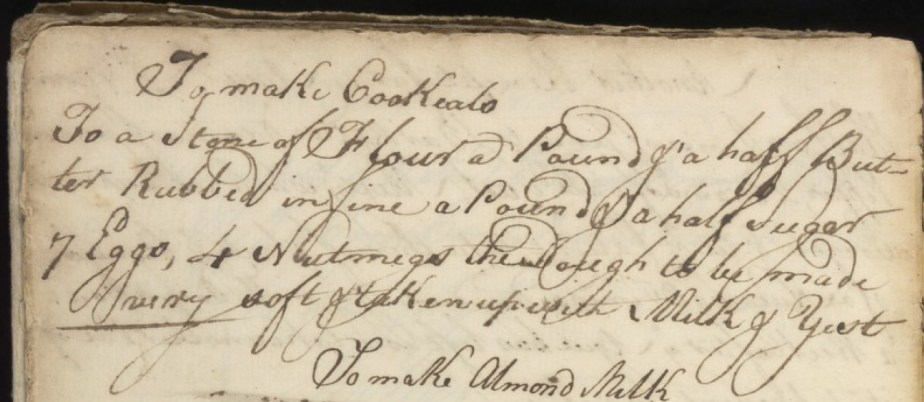
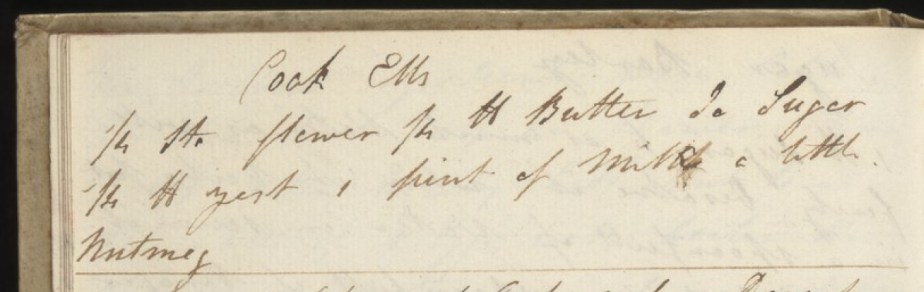
MS7850, Anonymous manuscript circa 1745, Wellcome Collection

MS7834, Anonymous 19thC manuscript, Wellcome Collection

Confession time, I do like to get the the truth of the matter when it comes to recipe names and history. Love a great backstory, cannot be doing with made-up rubbish. So with all these different names, I decided to drill down and see if I couldn’t get to the bottom of it all (this phrase will come back to haunt me shortly).

I don’t think there’s much merit in the name deriving from the French ‘coquille’ (shell): there’s no hard crust, due to the butter, milk and eggs, and no mention of them being shell-shaped. Similarly, I think naming them after the cockfighting pits is also a bit of a stretch. The various accounts seeme to waver between Cockeel and Cookeel, and neither of the handwritten recipes offer any definitive help.

Playing around with the spelling, it turns out that Cockle bread is a thing:

“So far back as the time of Henry III., we find mention made of wassel bread, cockle bread and bread of treet corresponding with the three sorts of bread now in use, viz. white, wheaten and household bread.”

The Englishwoman’s Domestic Magazine, Vol. 1, No. 1, p157, 1852.

Cocklety bread has also been recorded in playground chants:

“The term ” Cockelty ” is still heard among our children at play. One of them squats on its haunches with the hands joined beneath the thighs, and being lifted by a couple of others who have hold by the bowed arms, it is swung backwards and forwards and bumped on the ground or against the wall, while continuing the words, “This is the way we make cockelty bread.”- -Robinson’s Whitby Glossary, p. 40.”

“The traditional games of England, Scotland, and Ireland” 1894-1898, Alice Bertha Gomme, p75

Delighted with this quaint image, I pursued Cockle Bread further – and immediately regretted that decision.
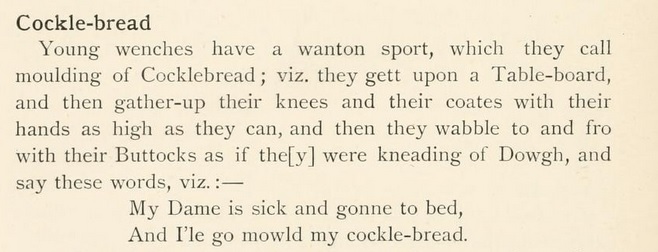
“The traditional games of England, Scotland, and Ireland” 1894-1898, Alice Bertha Gomme, p74

And before I knew it, I was learning that as an extension of this ribaldry, sometimes dough was actually kneaded this way, and then baked and fed to the person whom the girl wished to enamour.


ANYHOO……..Spice buns!

Cookeels

Makes 16

These soft, pillowy buns were enjoyed throughout the season of Lent. Unlike the more famous Good Friday buns, they contained no fruit and neither were they marked with a cross. One of the above anecdotes mentioned allspice as a seasoning, but neither of the recipes do, so we’re going to stick to nutmeg. Usually mixed with several other spices, the fact that these buns have just a single spice adds to their appeal. The enrichment of the egg, milk and butter makes the dough exceedingly soft and the baked bun incredibly tender of crumb. Delicious warm from the oven and freshly buttered, you can also enjoy them toasted with butter and cheese.

150ml water
150ml milk
1 large egg
100g butter
100g caster sugar
pinch of salt
450g strong white flour
2tsp ground nutmeg
1 sachet fast-action yeast

1 large egg yolk
2-3tbs milk

  • Put the dry ingredients into a food processor and blitz until the mixture resembles breadcrumbs.
  • Tip the mixture into a mixing bowl.
  • Zap the water in the microwave for 1 minute. This should heat it but without boiling.
  • Pour the milk into the hot water and stir. It should now be warm. Add the egg to the warm milk mixture and whisk thoroughly.
  • Pour the milk mixture into the other ingredients and mix until the dough comes together. It will be very soft – too soft to knead – but it will become manageable once risen.
  • Cover the mixing bowl with plastic wrap and set aside in a warm place to rise for 1 hour.
  • Cover a large baking tray, or shallow oven shelf for preference, in baking parchment.
  • Once the dough has risen, dust your work surface well with flour.
  • Tip the dough out onto the flour and pat gently to deflate. Dust the surface with flour, then, with the help of a dough scraper, lift and fold the sides inwards and pat down. Continue the dusting and folding until the dough is firm enough to handle. The first time I made this, I put too much liquid in, but it only took three lots of folding to make it manageable.
  • Pat the dough into a square. it will be roughly 20cm, but if it’s larger, that’s fine.
  • Cut the dough into 16 pieces. The easiest way is to cut your square of dough into quarters, then cut each quarter into four.
  • For each piece, fold in the edges of the dough, flip it over and roll into a ball under your hand.
  • Set the shaped dough onto your prepared baking sheet. The dough will spread during rising/baking to the size of a teacake, so space them well apart (7-8cm).
  • When all the dough has been shaped, cover lightly and set aside to rise for 30 minutes.
  • Heat the oven to 180°C/160°C Fan.
  • Whisk together the egg yolk and the milk and brush this glaze over your risen buns. You can use just milk if you prefer.
  • Bake your buns for 20 minutes, turning the baking tray/shelf around after 10 minutes to help with even colouring.
  • Remove from the oven and immediately cover with a clean cloth. This will trap the steam and ensure your buns are soft and pillowy when cooled.
  • Store in an airtight container when cold.
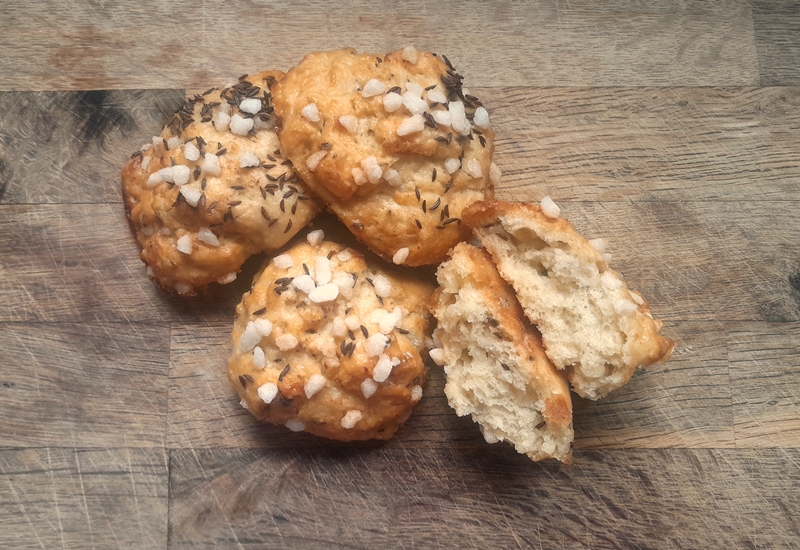
18th Century Bath Buns

We don’t eat buns as frequently as we used to, and I think it is a great shame, because buns are synonymous with fun!

I spend a lot of time pondering different recipes, and one thing that causes much musing is the way recipes evolve in the UK, compared to, say, France.

French recipes tend to be rather rigid and proscribed. Definitions of what constitutes those two most recognisable of French baked goods – the croissant and the baguette – have been firmly established, almost set in stone. A croissant is a croissant, a baguette de tradition is a baguette de tradition, – there are rules, there is order, and there is never, ever, deviation. You want to tweak a recipe a little? Then you have to give it a new name. The French have no truck with ‘croissant-ish’ or ‘baguette de tradition adjacent.’ No messing about with rules that have been decided decades, even centuries, ago. Absolument pas!

In contrast, British recipes are a lot more open to interpretation. On the Books and Writing page of this website you will find, amongst other things, a paper I wrote on Pikelets, and how, over the centuries, the word has been used to describe different recipes for arguably quite different items. Also a paper on Summer Pudding, which has undergone its own transformation during its long and illustrious history.

Having given the matter a great deal of thought, I’m pretty comfortable with viewing recipes, especially British ones, as having a timeline. Some are long, some short, but throughout which adapts and changes with tastes and fashions. To illustrate this, in Great British Bakes, I included multiple recipes for Shrewsbury Cakes, an all but forgotten English shortbread that has a history spanning centuries. Others, such as the less-successful Crimson Biscuits (be honest – have YOU ever heard of them?) in Ann Peckham’s 1767 book, have timelines of alarming brevity. An added feature (frustration) with British recipes is that they might go by a number of different names, according to region, or indeed the one name may refer to numerous different dishes.

And so, after WAY too much preamble, we come to Bath Buns, whose history stretches back into the 1600s, and might be a genuine contender for Britain’s Oldest Bun, much to the probable dismay of fans of Sally Luns and Chelsea Buns, very much the Johnny-Come-Latelies of the eighteenth century pastry scene. The glitterati of Bath were happily taking the waters and chomping on this style of bun for the best part of a century before Dr Oliver invented his biscuit in an effort to improve the health of The Ton.

The Bath Bun of the late 17th century is rather different to the buns we might find in bakeries and tea shops today. The early Bath Buns were sweetened and flavoured with caraway comfits: seeds enclosed in numerous layers of sugar and enjoyed as sweetmeats and digestives. Today, a classic Bath Bun should retain the image of these candied seeds by being topped with pearled or candied sugar, which retains its colour and shape during baking, giving them a very distinct appearance. The time and effort required to create seeded comfits is considerable, and it is unsurprising to learn that they are no longer made. In imitation, I have found that using pearled/candied sugar and a sprinkling of unadorned seeds provides the sweetness, flavour and crunch of these forgotten sweetmeats.

The original Bath Buns were also incredibly rich with butter. Looking at recipes throughout the century, the most popular ratios ranged from an almost paltry one third of the weight of flour in butter, up to croissant-exceeding levels of 1.5 times the weight of flour in butter. Add in, as in the recipe below, a couple of pounds of caraway comfits, and these buns are probably a major cause of the gentry having to ‘take the waters’.

The first recipe below, the earliest I could find, is from an old manuscript dated to ‘late 17th century’ and has an equal weight of flour and butter. I scaled the recipe down, but there was still an alarming quantity of butter in not much dough. I broke my own rule too, in the baking, and did not bake it as written. Partly because I suspect that there is an error in the transcribing the original ingredients, and partly because I just couldn’t bring myself to put the full complement of sugar into the dough. I settled for half, and even that was a challenge – the buns were practically crystallized!

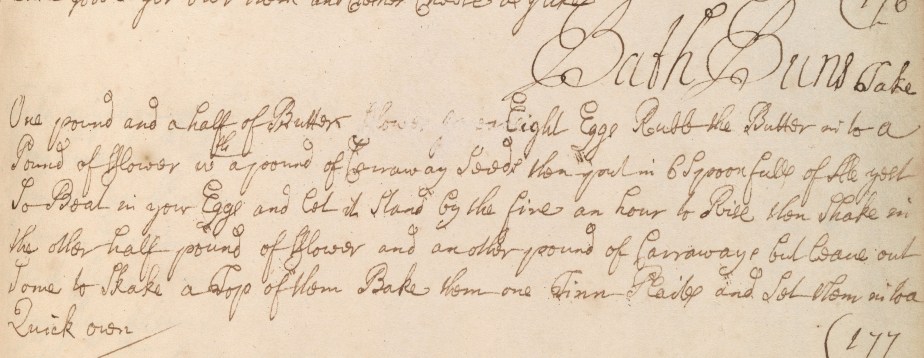
Earliest Bath Bun recipe I’ve found, from manuscript dated 1675-1725, MS1792, Wellcome Collection

With all the eggs and butter and sugar the dough is incredibly soft – too soft to knead – and is practically spooned onto baking trays – something which later recipes mention frequently. The modern Bath Bun traditionally should have a rather rough appearance, and shuns the round perfection of Sally Luns or the even sugared, square edges of the Chelsea Buns. Due to all this richness, the dough can take a long time to rise and the finished texture is cake-like rather than bready, crunchy with the sugar crystals and with the unusual (to our modern palates) and distinct flavour and aroma of caraway.

Bath Buns recipe from manuscript dated 1675-1725, MS1792, Wellcome Collection

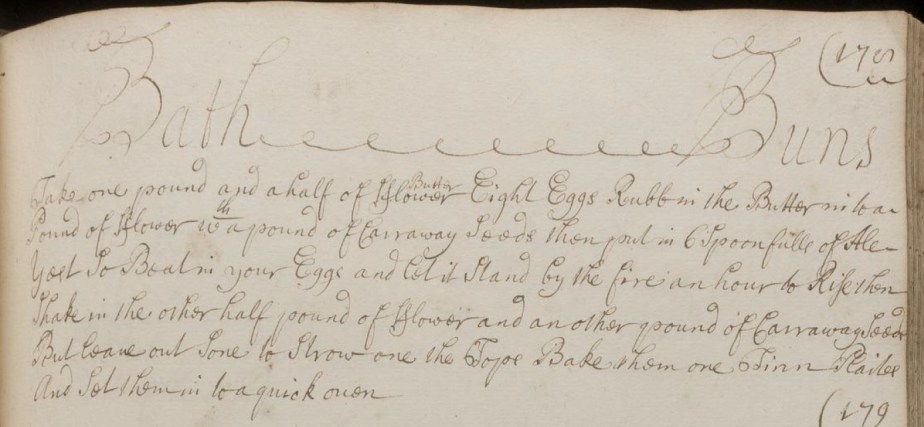
This recipe is particularly interesting because it has a twin, in another manuscript, on the other side of the Atlantic Ocean. This manuscript is one of the holdings at Yale University Library, and are both written in the same handwriting, possibly that of a scribe. They are mostly similar, but not exact copies. My guess is that one was copied from the other, with edits being made to exclude recipes not liked and including new recipes in the copy. With this in mind, I’m of the opinion that the Wellcome Collection manuscript is the copy. Below is the potential ‘original’.

Bath Bun recipe from MS Osborn fc181, Yale University Library.

All of which is an interesting detour, but doesn’t really get us an enjoyable Bath Bun that respects the traditions of the original, but is also acceptable to our 21st century tastes. Fear not, for galloping to our rescue comes a heroine for the ages: Mrs Bridget Ilbert (1712-1790), daughter of the 6th Earl of Devon and the wife of William Ilbert of Bowringsleigh, Devon.

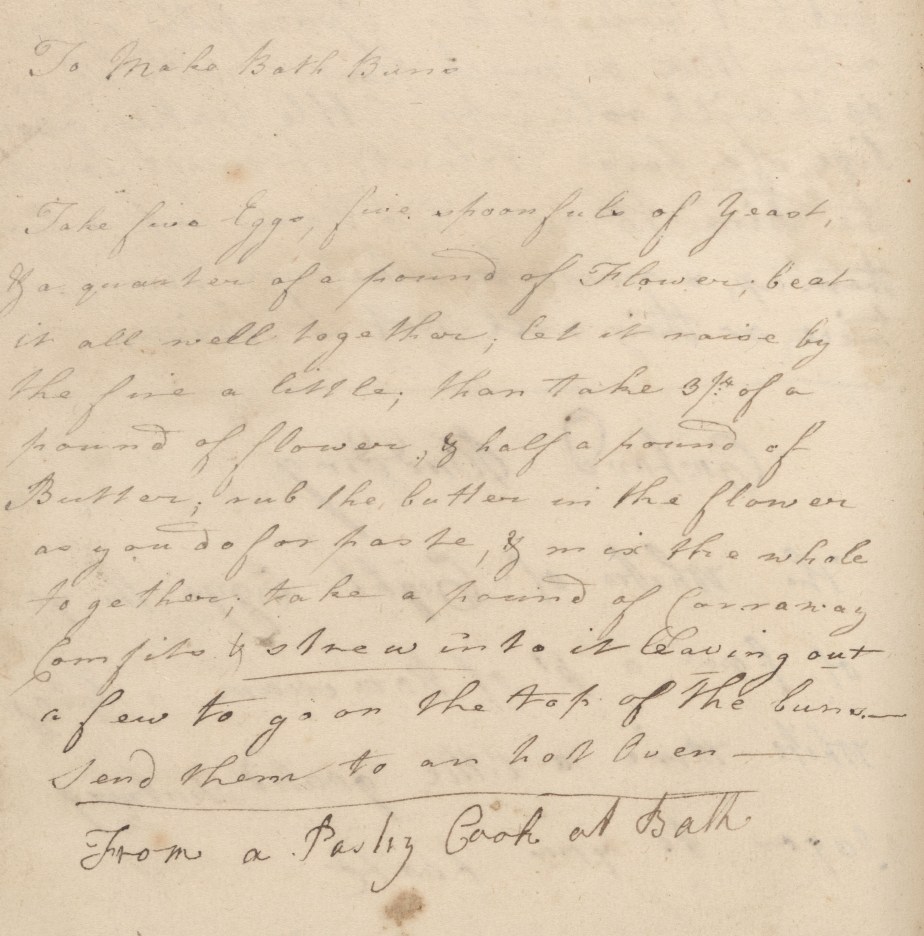
Recipe for Bath Buns in Bridget Ilbert’s manuscript MS1821, Wellcome Collection

Bridget’s manuscript is held at The Wellcome Collection, and one of the recipes within is for Bath Buns. I particularly like this recipe because it comes with the added credentials of being “From a Pastry Cook at Bath” – and you can’t get much better than that. The recipe is undated, unfortunately, but it is not too big a stretch to allocate a date in the general area of early-to-mid 18th century.

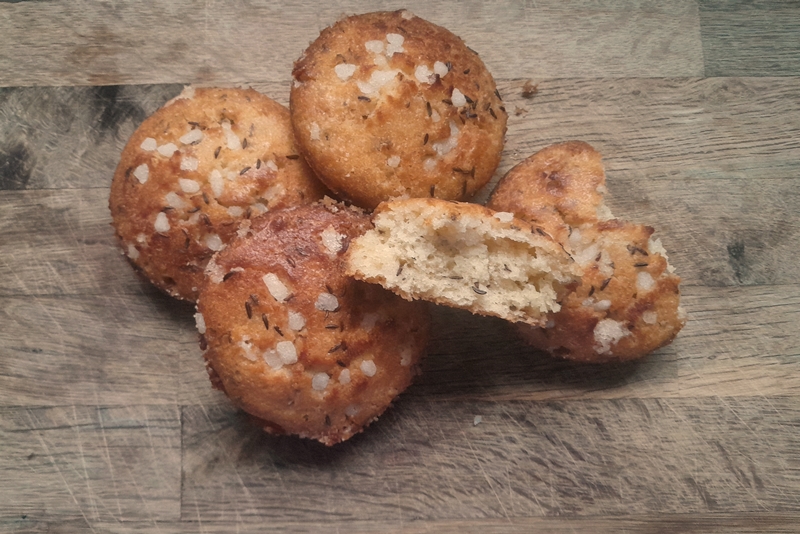
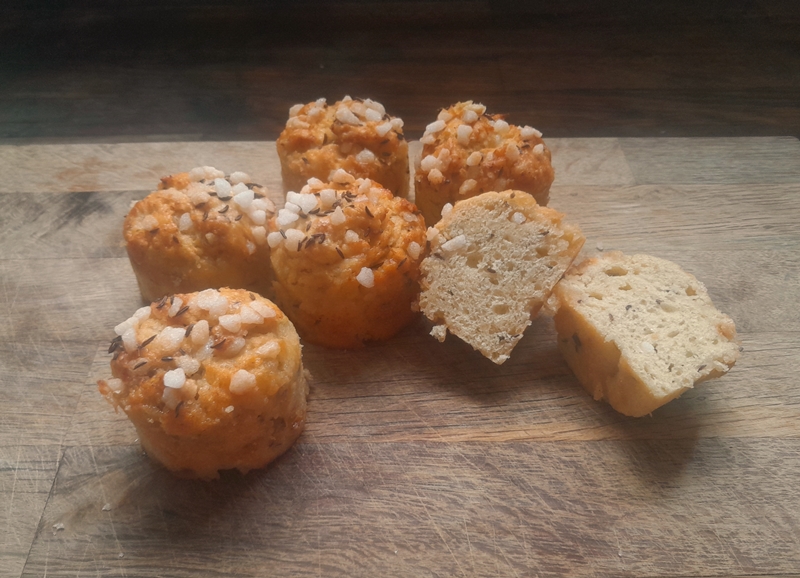
Miniature bath buns adapted from a recipe MS1821, Wellcome Collection

Original 18thC Bath Buns

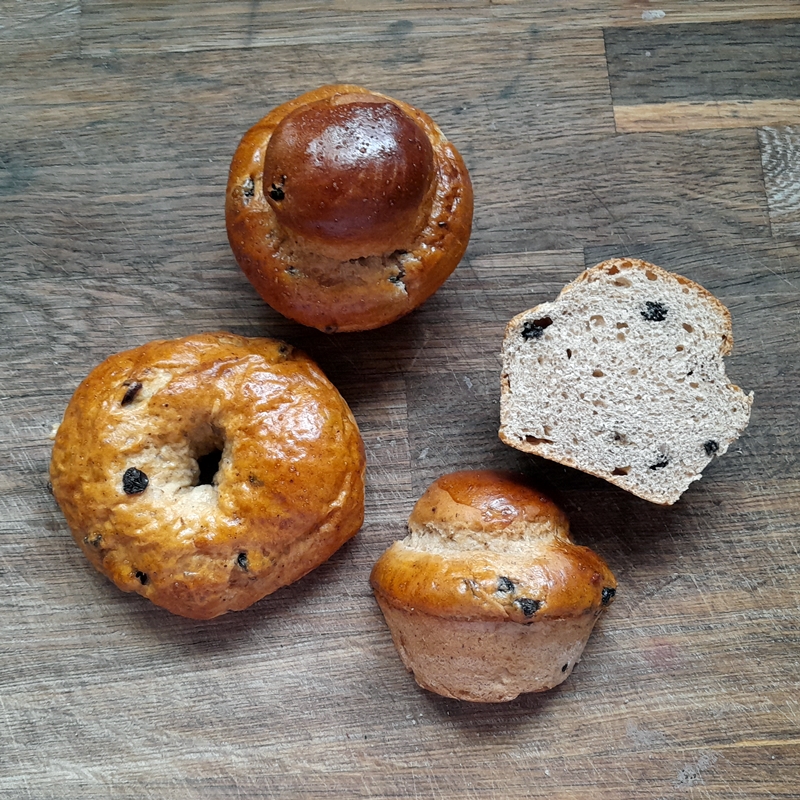
You can bake these on baking sheets or in silicone moulds. I used a mould like this, and had dough enough left over to make 4 free-form buns in the photo at the top of the page.

Makes 10-12 buns.

225g plain flour – divided
115g unsalted butter
1 sachet fast action yeast
2 large eggs
2tbs warm water
1tbs caraway seeds
100g crystallised sugar

1 large egg for glazing
milk
more crystallised sugar for  finishing
a few caraway seeds to sprinkle

  • Crack the eggs into the bowl of a stand mixer and add the yeast, water and 50g of flour.
  • Whisk together thoroughly, then set aside to rise for 20 minutes.
  • Prepare your baking items – parchment paper on baking sheets if baking ‘free-form’, butter your silicone moulds if using.
  • Put the remaining flour and the butter into a food processor and blitz until the mixture resembles breadcrumbs.
  • Add the butter mixture to the yeast mixture, together with the caraway seeds and mix thoroughly to a smooth paste.
  • Mix in 100g crystallised sugar.
  • Spoon onto/into your prepared baking items. 50g of dough makes an elegant size. Try and make your dough sit up high in as round a shape as you can make. N/A if baking in moulds.
  • Whisk the egg with half an egg-shell of milk.
  • Brush the egg glaze over the buns.
  • Add a scattering of crystallised sugar onto the top of each bun, followed by a pinch of caraway seeds.
  • Allow to rise for 30-45 minutes, depending on how warm your kitchen is. There won’t be a huge rise, because of all the sugar and butter.
  • Heat the oven to 180°C, 160°C Fan.
  • Bake for 15-20 minutes until golden brown. The bottoms of the buns will be slightly brown when baked.
  • Allow to cool for 10 minutes to firm up before transferring to a wire rack to cool completely.
  • Best served fresh.
  • Store in an airtight container.
  • To reheat before serving, microwave briefly, 10 seconds per bun, i.e. for 4 buns, zap them for 40 seconds.

Georgian Cross Buns

Reading a handwritten manuscript is very exciting: you never know what is just over the next page.

Lately I have been reading through the manuscripts held by the National Library of Scotland and alighted upon something rather unusual. It is a manuscript from a bakery, with appropriately large batch quantities. It is a fascinating peek into the variety of bakes and extras that formed the day to day offerings of a Georgian bakery.

The manuscript has been dated to 1827, which puts it slap-bang in the middle of the reign of George IV, but other than that, there appears to be no other identifying information. Now this might be looked upon as more than a little frustrating, however, being much more of a glass-half-full person, I usually see it as an opportunity for sleuthing, and seeing whether or not I can glean any more information from the pages within.

Firstly, I think the date is very well chosen, and I’m sure the Library of Scotland is nothing short of THRILLED at my approbation. This I deduced from the raising agents used in the recipes, which call either for yeast or volatile salts. Volatile salts are the precursor to baking powder, which was only a mere fifteen years away from being invented.

Another piece of information I noted gave me reason to believe that there may well be a Scottish link, aside from where the manuscript is currently held, is the use of the word ‘carvey’ for caraway seeds. In the 18th century, the word was in much greater use throughout the British Isles, but in the 19th century, it was retained mostly in Scotland. The one thing holding me back from declaring this a definite is the Englishness of the other recipes: Abernathy biscuits, Bath cakes and buns, Weymouth biscuits, Stratford cakes, Norwich biscuits, Isle of Wight cracknels…

The recipes themselves cover a wide range of items: biscuits, cakes, buns, jams and jellies, sweeties, custards, bread, muffins and cakes. I love this manuscript for its sheer uniqueness. I have a small but favourite collection of commercial baking books dating from around the turn of the 20th century, but I’ve not come across any other handwritten recipes of catering size quantities of this early age. Browsing for something for Easter, I came across this recipe for Buns for Shops or Cross Buns. Perfect!

But it came at a price. And the price was the spelling.

Oh my dears, the spelling.

I fully appreciate that spelling from 200 years ago is going to be a little quirky, but this… This is on a whole new level.

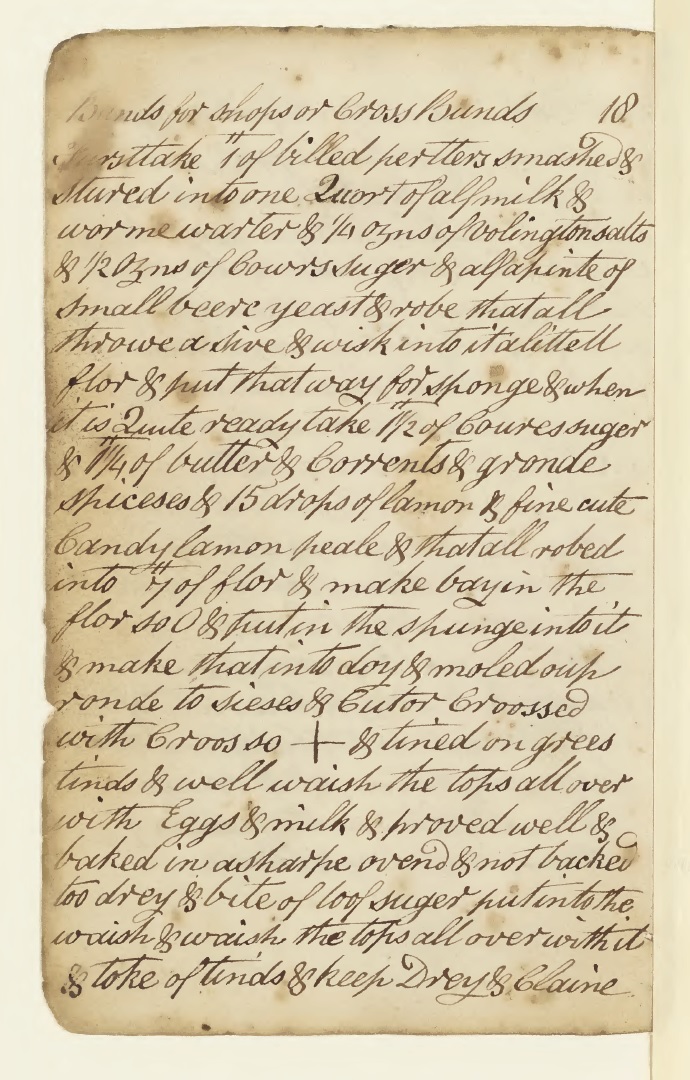
Cross Buns Manuscript Recipe, National Library Scotland

In case your cursive reading skills are a little rusty, allow me to transcribe the recipe for you, with the original spelling, in all it’s glory.

Bunds for shops or Cross Bunds
Fursttake 1″ of billed pertters smashed & stured into one Quort of alfmilk & worme warter & 1/4 ozns of volington salts & 1/2 ozns of Cours suger & alfa pinte of small beere yeast & robe that all throwe a sive & wisk into it a littell flor & put that way for sponge & when it is Quite ready take 1 1/2″ of coures suger & 1 1/4″ of butter & Corrents & gronde spiceses & 15 drops of lamon & fine cute Candy lamon pale & that all robed into 7″ of flor & make bayin the flor so O & pit in the spunge into it & make that into doy & moled oup ronde to sieses & Cut or Croossed with Croos so + & tined on grees tinds & well waish the tops all over with Eggs & milk & proved well & baked in a sharpe ovend & not backed too drey & bite of loaf suger put into the waish & waish the tops all over with it & toke of tinds & keep Drey & Claine.

The modern translation is as follows:

Buns for shops or Cross Buns
First take 1lb of boiled potatoes mashed & stirred into one Quart of half milk & warm water & ¼ oz of volatile salts & ½ oz of Coarse sugar & half a pint of small beer yeast & rub that all through a sieve & whisk into it a little flour & put that away for sponge & when it is Quite ready take 1½lb of coarse sugar & 1¼lb of butter & Currants & ground spices & 15 drops of lemon & fine cut Candied lemon peel & that all rubbed into 7lb of flour & make a bay in the flour so – O – & put the sponge into it & make that into dough & mould it up round to size & Cut or Cross with a Cross so + & put them on greased tins & well wash the tops all over with Eggs & milk & prove well & bake in a sharp oven & don’t bake too dry & add a bit of loaf sugar into the wash & wash the tops all over with it & take them off the tins & keep them Dry & Clean.

Yes, that first ingredient is boiled potatoes, and I will freely admit it took me a good half hour of pondering and saying the phrase out loud to myself in a frankly embarrassing number of accents in order to try and work out what it might be. Adding mashed, boiled potatoes to a bread recipe helps keep the resulting buns from drying out too quickly and keeps them pleasantly chewy. ‘Volington Salts’ makes me chuckle, because it sounds like the name of a Georgian Dandy.

The travails of translating the handwriting aside, there are two aspects of this recipe that I love. Firstly, it is the unusual (to modern palates) combination of spicings and flavourings. The recipe calls for both lemon essence and candied lemon peel as well as ‘mixed spices’. I’ve also made some biscuits from this book which called for cinnamon and lemon, and maybe its because this combination seemed so unusual to my 21st century palate, but to me they tasted Georgian. The ‘mixed spices’ gives you carte blanch to use whatever combination you like, but I’m going to recommend cinnamon and nutmeg, which were a popular combination for decades in the 17th and 18th centuries. The lemon flavouring, for some reason, I found problematic: liquid flavouring seemed to fade when baked, so I tried using finely grated fresh lemon zest, which also didn’t have quite the punch I was looking for. Perhaps a combination of the two will give the lemon burst I think these might need – but if we hang around for me to trial that, we’d miss Easter, so onwards!

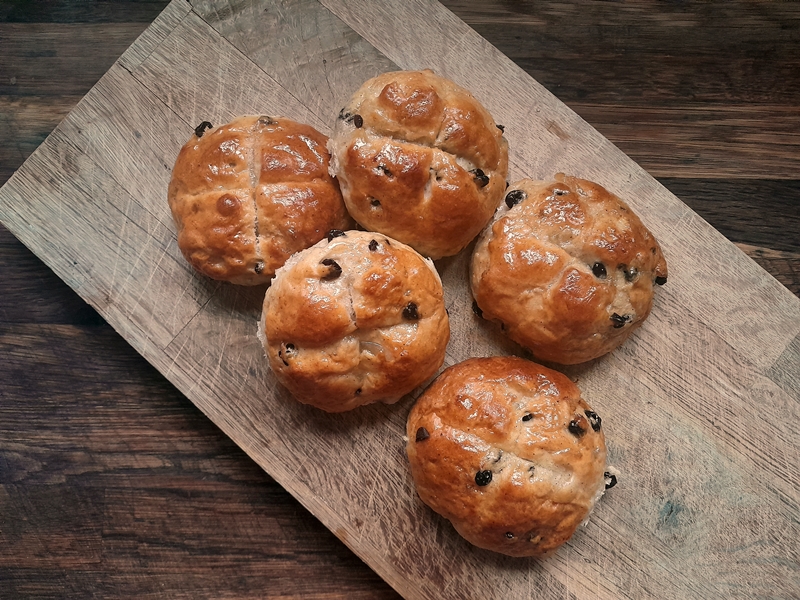
Georgian Cross Buns

This is a 1/7th scale of the original recipe, and will make 18 x 60g buns. If this is a bit much, halve the recipe and divide the dough into 8 buns. Make a sponge if you feel inclined, but I went for mixing all together at once.

70g cooked mashed potatoes
100ml milk
100ml water
450g strong white flour, or plain
7g sachet of fast action yeast
100g caster sugar
80g butter
1tsp ground cinnamon
1tsp ground nutmeg
1 tsp lemon flavouring and/or zest of 1 lemon
60g fine sliced candied lemon peel
125g currants

For the glaze


1 large egg
1/2 an eggshell of milk
2tbs caster sugar

  • Heat the milk and water to blood temperature.
  • Add the cooked potato and whisk together – a stick whisk works well to make the mixture smooth.
  • Put the flour, yeast, sugar, butter, spices and lemon flavouring(s) into a food processor and blitz until the mixture resembles breadcrumbs.
  • Put the liquid mixture into a mixing bowl and add the dry mixture on top.
  • Knead for 10 minutes. Don’t be tempted to add more liquid – there’s moisture in the butter and the working of the dough will bring that out and make a dough that ‘cleans the bowl’.
  • When the dough has come together and is smooth and elastic, mix in the currants and lemon peel.
  • Cover the bowl with plastic and set aside in a warm place to double in size.  If your kitchen is on the cool side, use your oven: Turn the heat to 170°C/150°C Fan for TWO MINUTES ONLY, switch off, and place your bowl inside. Due to the enrichments of butter and sugar, this may take longer than normal, probably closer to 90 minutes.
  • Tip out the risen dough and gently deflate by pressing with the hands.
  • Divide your dough by weight: 60g makes a decent-sized bun, but go larger if you prefer a more substantial bun.
  • Roll the dough into a smooth ball, press flat with the palm of your hand, then arrange on a parchment-lined baking sheet at least 3cm apart.
  • Cover lightly with plastic and allow to rise a second time (30-45 minutes).
  • Heat the oven to 180°C, 160°C Fan.
  • When the buns are sufficiently risen, cut a cross into them. I find pressing (not rolling) a pizza wheel down into the buns is an ideal tool for this: it marks a deep cross, but doesn’t cut through the edges of the bun and cause them to split during baking. Alternatively, use the flat end of a spatula.
  • Whisk the egg and milk together, and glaze the buns by brushing the mixture over them using a pastry brush.
  • Bake for 15-20 minutes, depending on size. For the smaller 60g buns 15 minutes is fine. If your buns are larger, then leave them for 20 minutes. Turn the baking sheet around halfway though.
  • While the buns are baking, add 2tbs caster sugar to the remaining bun wash and stir to dissolve.
  • When the buns are baked and golden brown, remove from the oven and place the baking sheet on a rack. Brush the hot buns over with the sweetened bun wash. The heat of the buns will set the sweetened glaze, and your cross buns will cool with a lovely shine.
  • Remove the buns from the baking sheet when cool and store in an airtight container.
  • Serving suggestion: Delicious when freshly baked. When cooled, cut in half and toast both sides. Serve warm with butter and a sharp cheddar cheese.

Ouse Bridge Cakes

I love coming across a geographically-named recipe. It gives a place and time in which to ground the dish: Grasmere Gingerbread, Cornish Pasties, Chelsea Buns.

Almost better yet, is discovering a recipe that is also unknown today, having gone out of fashion or due to some other circumstance. Such is Ouse Bridge Cakes.

There’s practically no information available about these bakes. In “The Gentlewoman’s Kitchen” (1984), Peter Brears suggests Ouse Bridge Cakes are a yeast dough flavoured with mace, cloves and nutmeg and mixed with sugar and milk. In his book “Secret York” (2014), author Paul Chrystal writes:

“Ouse Bridge Cakes, known in the eighteenth century, a type of Yorkshire tea cake.”

And that’s pretty much it. Not much to go on at all.

Luckily, in my scouring of old manuscripts, I have turned up five, different, eighteenth-century Ouse Bridge Cake recipes. I reasoned that, within their pages lay an understanding of what constituted the original Ouse Bridge Cakes.

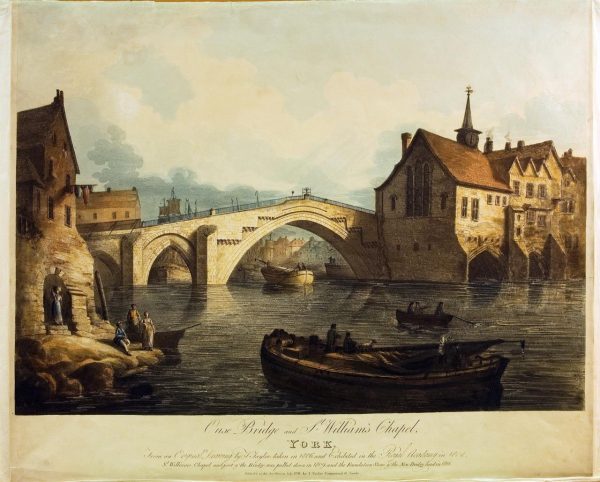
But first, a little history. The bridge over the River Ouse that this recipe refers refers to is in the city of York. Although there have been many bridges over the centuries, it is the fourth Ouse Bridge (1565–1810) which has been commemorated in these buns.

Old Ouse Bridge from the South. T.Taylor, 1806.

Just as with many city bridges of the time, the Ouse bridge was heavily built-up, its five arches supporting substantial buildings on both sides of it’s towering centre arch.

Old Ouse Bridge from the North. Attrib. Henry Cave (British 1779-1836)

With all this busyness on the bridge, it is likely that there were businesses too, and if not a baker’s shop, then almost certainly a stall or street hawkers. Just as Wood Street Cake (see Great British Bakes) took its name from the London street where it was made, Ouse Bridge Cakes take theirs from the place where they could be bought, if not actually baked.

As already mentioned, Ouse Bridge cakes were a spiced bun. But seeing as Yorkshire has quite a reputation for similar items – the most well-known being the Yorkshire Teacake (as with all tea cakes, best eaten toasted and buttered) – it occurred to me that there must be something to distinguish the Ouse Bridge cake from a host of other buns, and that something was probably its shape. A bun of a particular shape is instantly recognisabe – just look at modern Chelsea Buns and their square, spiralled form (which isn’t the original shape – but don’t get me started, see Great British Bakes (again)).

Luckily, there were two of the five recipes (yes, remember them? Back before the detour?) that held clues. The first was in a manuscrpt dating from the mid-eighteenth century, which suggested the dough be weighed out into 8oz (225g) pieces before being shaped.

Ouse Bridge Cakes recipe, MS3498, (1750-1900) Wellcome Collection.

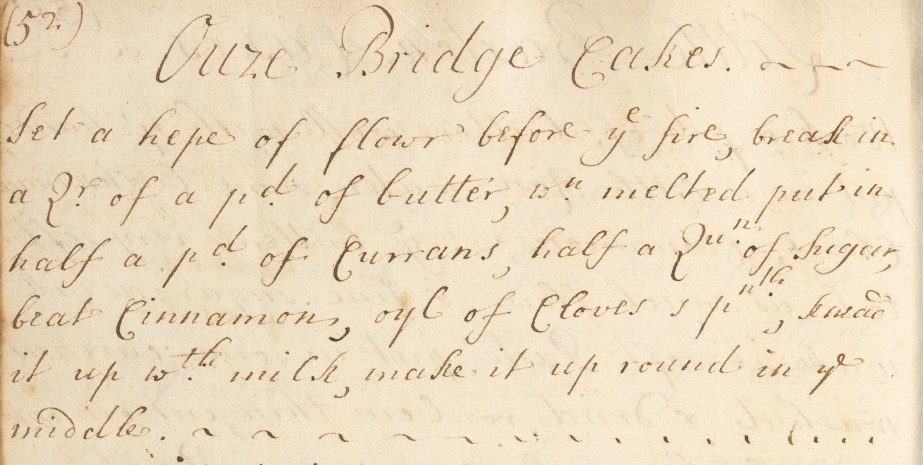
The second piece of information was from a manuscript dated 1750, the last line of which reads “make it up round in ye middle”.

Ouse Bridge Cakes recipe from MS4645, (1750-1853), Wellcome Collection.

I spent a lot of time thinking about this, and decided it meant to shape it like a bagel/ring donut. I also asked online, and the feedback was that it might mean something cottage-loaf-esque, so I experimented with both shapes. I still think the ‘hole in the middle’ is a better fit for the description, but until more recipes are rediscovered, the jury will have to remain resolutely out.

Of course, it might well be that none of these five recipes are the definitive, perfect Ouse Bridge Cakes. Back in the day, even the moderately wealthy (such as the authors of these manuscripts) didn’t necessarily bake for themselves: practically everyone bought their bread from a baker. The recipes that we find in manuscripts are attempts to copy, on a smaller scale, something enjoyed elsewhere, so that they can be enjoyed in their own homes. The five recipes in the manuscripts were all different, yet there were some uniting features, as each author tried to recreate something they had only tasted. Firstly, all of them had currants, ranging from a spartan few ounces to almost half the total weight of the ingredients. All of them were flavoured with spices (nutmeg, cinnamon, cloves, ginger, mace),  but nutmeg was a common denominator amongst all five. All of them were enriched with milk and either butter or cream, and most had added sugar.

The recipe below is very much a Goldilocks version of them all. Neither too much nor too little of everything, because recipe testing revealed certain flaws in the versions that veered towards the extreme. The overly-fruited buns were heavy and close textured, and those buns with generous/excessive additions of butter and cream were reluctant to rise, with a rather greasy taste.

This version is moderately fruited, moderatly enriched and moderately spiced. Delicious warm from the oven, and even more so toasted, with slabs of cold, mature Cheddar cheese (it’s a taste sensation!).

Ouse Bridge Cakes

Each bun is formed from a generous 75g of dough, and I have scaled the quantities down to make a very modest seven buns per batch. Feel free to double the recipe as you see fit. The spicing is just a suggestion: change things up if you have a favourite mix.

225g flour
1 sachet fast-action yeast.
180ml milk
15g sugar
30g unsalted butter
60g currants
1 tsp ground ginger
1 tsp ground nutmeg
½ tsp ground cloves
½ tsp ground mace
1 large egg for glazing

  • Put the milk, sugar and butter in a pan and scald. IMPORTANT Scalding is when the milk almost boils, but not quite. Heat it until it bubbles around the edges (or in the middle if you have an induction hob), then remove from the heat and allow to cool down. Scalding milk breaks down the proteins, which will allow your buns to remain soft and yielding, even when cold. Using 100% unscalded milk in a dough recipe can lead to heaviness.
  • When the milk mixture has cooled to blood temperature, pour it into your mixing bowl.
  • Sift the flour, yeast and spices together and add to the milk mixture.
  • Knead the mixture by hand or on the lowest possible speed on your stand mixer for 10 minutes. increase speed to high for up to 2 minutes, or until the mixture comes together in a clean ball.
  • Add the currants and fold them in.
  • Cover the bowl with cling film. The milk, butter and sugar will make the dough slower to rise that a regular dough, so allow at least 90 minutes or until the dough has doubled in size.
  • Tip out the dough and divide into seven pieces, each of roughly 75 grams. There’s no need to get all aggressive and start punching it: it will naturally deflate with the turning out.
  • Shape the dough as you see fit. In addition to the two shapes mentioned above, you can also shape them into a regular teacake shape. NB: If you’re going for the cottage loaf shape, I recommend baking the shaped dough in cupcake tins, which really lets the dough ‘sit up’ and hold it’s shape. I used silicone baking trays rather than metal, to keep the dough from forming too crusty an outside.
  • Set aside to rise for 40 minutes.
  • When the dough has risen, whisk the egg and brush over the buns with a pastry brush.
  • Heat the oven to 180°C, 160°C Fan.
  • Bake the buns for 20 minutes, turning the baking trays/sheets after 10 minutes to ensure even baking.
  • When cooked and golden brown, transfer to a wire rack to cool.
  • Store in an airtight container at room temperature.

Chelsea Buns

Back in  2013 I wrote an article on the history of Chelsea Buns, ultimately included in my book Great British Bakes which culminated in a recipe suggestion for the original Chelsea Buns.

I based the recipe on anecdotes that appeared in various publications on the borough of Chelsea and its surroundings, mostly written in the mid-to-late nineteenth century.

Before me appeared the shops so famed for Chelsea buns, which, for above thirty years, I have never passed without filling my pockets…. …….These buns have afforded a competency, and even wealth; to four generations of the same family; and it is singular, that their delicate flavour, lightness and richness, have never been successfully imitated.”i

To be good, it should be made with a good deal of butter, be very light and eat hotii

“The old Chelsea Buns were greatly in demand and were a superior kind to our common buns, more like Bath Buns. Old people say they were very rich and seemed full of butter. They were square in form and were made with eggs, with the kind of sugar, lemon and spice but without fruit.”iii

“Note that the true Chelsea Bun of the Hands family was by no means the darksome and dismal lump which is now sold us as a hot cross bun. On the contrary, it was specially famous for its flaky lightness and delicate flavour.”iv

“It was not round, but square in shape, and it came into the world in batches, the several individuals crammed as close together as the cells of a honeycomb…..Excellent they were—light, sweet, glistening as to their crowns in a sort of sugary varnish, and easy of digestion.”v

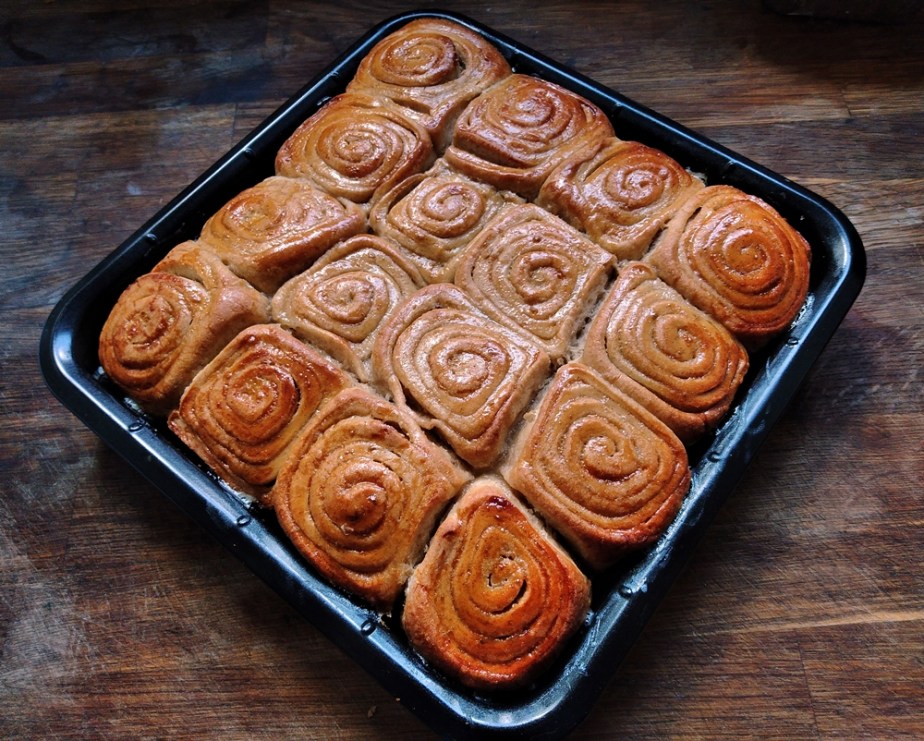
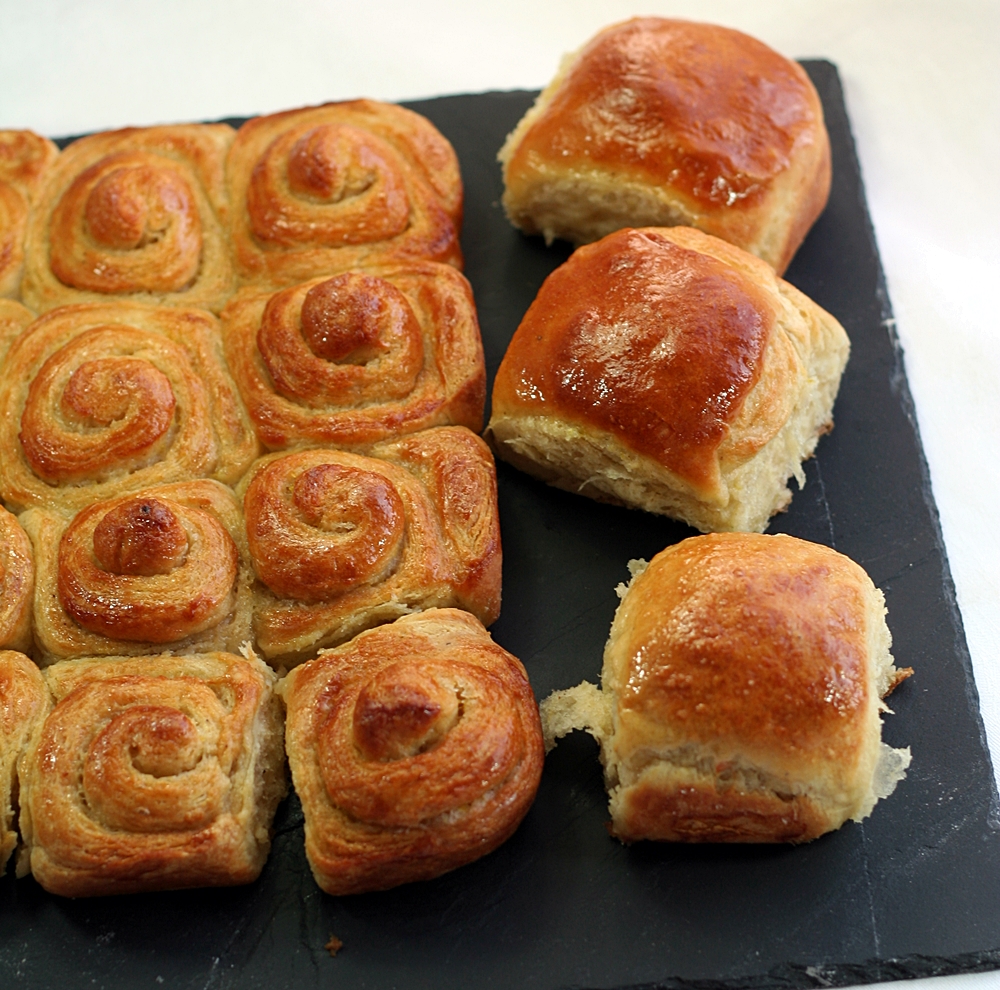
There was no mention of the fruit which adorns the modern version of the bun, neither was there mention of the spiral. The recipe I came up with was therefore fruitless and a regular bun shape. I couldn’t quite let go of the iconic spiral shape, though, so baked a version in this shape, too. Below is one of the original photographs taken for the book.

Chelsea Buns

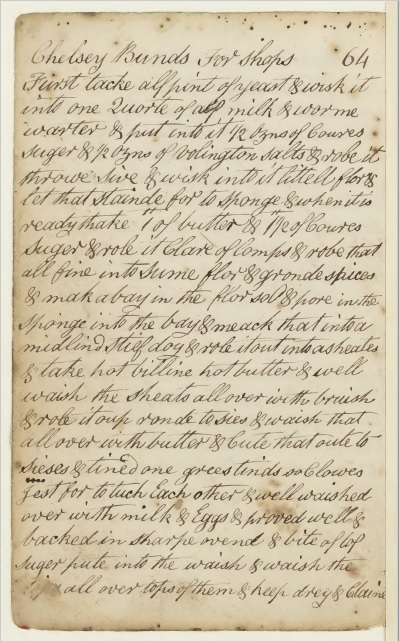
Fast forward to 2020 and last week I discovered a recipe for Chelsea Buns in a manuscript (MS10979) held by the National Library of Scotland. This was very exciting, because the manuscript was dated circa 1827, which is a time when the original Chelsea Bun House was still in business. (It was eventually torn down in 1839). Prior to this, the earliest recipe available had been the one published in 1854 in George Read’s The Complete Biscuit and Gingerbread Baker’s Assistant (p103).

Recipe for Chelsea Buns from a c1827 anonymous manuscript (MS10979) at the National Library of Scotland.

The recipe itself is rather challenging to read, but there are a couple of details that I think deserve pointing out. The recipe title “Chelsea Bunds for shops” suggests that the recipe was for an independant baker, who sold his/her wares wholesale. Perhaps s/he only had a baking premises and not a shopfront. The other detail is the tiny diagram  on the bottom left of the page, showing how the buns are to be laid out: laying the buns like this will ensure the characteristic square shape once the dough has risen.

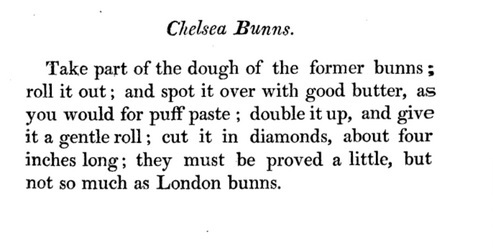
As luck would have it, and paraphrasing the well-known bus analogy, you wait seven years for a recipe, and then two come along at once. Also last week I spotted another early Chelsea Bun recipe, which had heretofore hidden from my internet searching by the cunning ruse of calling itself Chelsea Bunns. It appears in A Treatise on Confectionary, in all its branches, with practical notes, etc (1817) by Joseph BELL (p36, see below).

Chelsea Bunns

The previous recipe referred to is one for London Buns – flour, sugar, butter, yeast, and no spice. The shaping of the buns in this recipe is also unusual: I’ve never heard of Chelsea Buns being diamond-shaped, and it makes me wonder whether the author was confusing them with another bun, and if so, which?

I used to be rather evangelical about recipes for things being the PROPER recipe. Seven years ago, I was very firm in my conviction that a fruitless Chelsea Bun was the PROPER recipe and the fruit-filled, overblown, too-heavily-glazed monstrosities on sale in bakeries were borderline abominations. Now I’m much more laid back, having come to understand that, just like us, recipes have a lifespan, some longer than others, over the course of which changes happen. In the 18th and early 19th centuries, the light and gently-spiced Chelsea Buns were extremely popular. Over time, personal taste, or possibly economics (costs of dried fruit & sugar) saw a change to fruit-filled buns being favourite. It is absolutely possible to like one style of Chelsea Bun over another, and liking one style doesn’t invalidate the other in the slightest.

So enjoy whatever floats your boat – or in this instance, fills your bun.

Chelsea Buns

This recipe doesn’t contain any lemon, as mentioned in one of the anecdotes. Since it was the only reference I found that did mention lemon, I’m reserving judgement on whether it was a regular ingredient in the original. However, if you’d like to include some, I suggest the zest of one lemon, and just one teaspoon of spice.

1 sachet fast-action yeast
150ml hot water
150ml milk
500g strong bread flour
75g unsalted butter
110g soft brown sugar
2tsp mixed spice

150g melted butter for glazing

1 large egg
50ml milk

3-4tbs icing sugar

  • Mix the milk and water together, then add the yeast, 1tsp of sugar (from the listed amount) and 3-4tbs of flour (again from the given amount).
  • Whisk all together thoroughly, and stand aside for 15 minutes until the mixture starts to froth.
  • Put the rest of the flour, sugar, butter and spice in a food processor and blitz until thoroughly mixed.
  • Combine the wet and dry ingredients and knead for 10 minutes. Add more flour if the mixture seems a little too soft. If using a machine with a dough hook, make the last 2 minutes maximum speed, to pull the dough together.
  • Tip out the dough and roll into a thin (5-10mm) sheet on a floured surface.
  • Cover the whole surface with melted butter, using a pastry brush.
  • Roll up the dough from the long side, keeping it tight. This will be a little tricky to start, on account of the butter making it slippery.
  • Brush the outside of the roll with more melted butter.
  • Grease a 24cm square tin.
  • Starting from the centre of the roll, slice off 4cm rounds and place them cut-side upwards in the tin. You should get 16 well-shaped slices. The smaller end pieces can be placed in cupcake tins to bake.
  • Whisk the egg and the milk together to make a glaze and paint the cut surfaces of the buns.
  • Cover the glazed buns lightly with greased clingfilm and allow to prove for 45minutes or until doubled in size.
  • Heat the oven to 180°C, 160°C Fan.
  • Glaze the buns again just before going into the oven, and bake for 25-30 minutes until risen and golden. The smaller bun offcuts will only need 20 minutes
  • As the buns are baking, mix the sugar into the remainder of the glaze, and brush over the cooked buns as they come out of the oven. The heat of the buns will set the glaze and the sugar will make them extra shiny.
  • Cool in the tin to keep the sides soft. Cover with a clean cloth to cool if you like the tops soft as well.
  • Enjoy warm.

_ _ _ _ _ _ _ _ _ _

i“A Morning’s Walk from London to Kew”, p22, Sir Richard Phillips, J Adlard, London 1817

iiGentleman’s Magazine and Historical Chronicle, Volume 11, 1839, p466.

iiiThe Village of Palaces (1880) Vol II, p191

iv“By Chelsea Reach: some riverside records” Blunt, R. 1921. London. p55

v“Some Savoury Reminiscences”, The People’s magazine, May 4th, 1867, p331