Tunbridge Cakes

Here’s another recipe resurrection, but I’ll give you fair warning, it’s a little caraway-heavy. If you’re not a fan of the taste of caraway, then you’re not going to have a fun time.

The solution to that, of course, would be to substitute a different flavouring for the caraway – easy-peasy – aniseed or cumin if you want to keep it seedy, or lemon/orange zest to make it fresh but really, anything that appeals is fine.

ANYHOO – back to the cakes.

Despite the name, Tunbridge Cakes are actually a biscuit. In the mid nineteenth century, Alfred Romary set up a biscuit factory in the town and the biscuits were manufactured for over a hundred years. Queen Victoria was so delighted with them she awarded a royal warrant and the royal connection continued until the final batch was baked for the wedding of Prince Charles and Lady Diana Spencer in 1981.

The advertisements for the biscuits described them as being “As thin as lace, of a flavour so delicate as to be indefinable. The clubs serve them with port, but they are also excellent with ices or at afternoon tea. Many people prefer them to sweets and chocolate. In two flavours, Sweet and Ginger.” Interestingly, there’s no mention of caraway, nor does it appear on the ingredients list on the tins, which mention only flour, butter, shortening, sugar and salt. George Read’s “The complete biscuit and gingerbread baker’s assistant” (1854) makes a distinction between ‘Water Cakes with Caraways’ and ‘Tunbridge Water Cakes’, though whether these bear any resemblance to the Romary biscuits is unclear.

Tunbridge Cakes actually go back much further than mere Victorian times. Recipe books from the early half of the nineteenth century contain several mentions of Tunbridge Cakes, although, on closer examination. they all appear to be plagiarised copies of Mrs Eliza Rundell’s 1806 recipe. The earliest printed recipe I could find just managed to sidle into the eighteenth century – John Perkins’ 1796 recipe for Tunbridge Wafer Cakes. However, in my favourite recipe collection, that of the manuscripts of The Wellcome Library, I found not one but four recipes more than one hundred years older than any I could find in print.

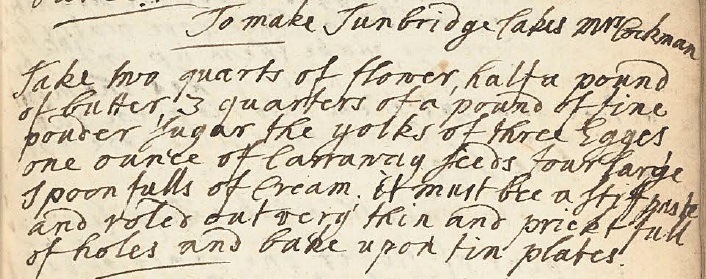
Sample Recipe
Source: MSMSL2, Wellcome Library Collection

Since the recipes were so similar, with only slight variations in proportions of flour, butter, sugar, eggs and seeds, baking a batch of each was the only way they could be fairly compared. I managed to scale down the recipes to a common quantity of flour, and then mixed and baked a batch of each.

It was immediately apparent that two of the batches stood out as being superior, but for different reasons. Batch A was incredibly light and delicate, friable and crumbly in texture, whilst the flavour of Batch B had that elusive je ne sais quoi deliciousness that was difficult to place, without knowing what the ingredients were. My dilemma was: I couldn’t decide which I liked better. Batch B was very heavy on the caraway seeds, but the background spices kept me coming back to nibble. The delicate texture of Batch A was a delight.

In the end I added the extra flavourings from Batch B to the mix of Batch A and baked a hybrid that seemed to being the best of both batches. If you want to try the original recipe, simply omit the optional flavourings in the ingredients listed below.

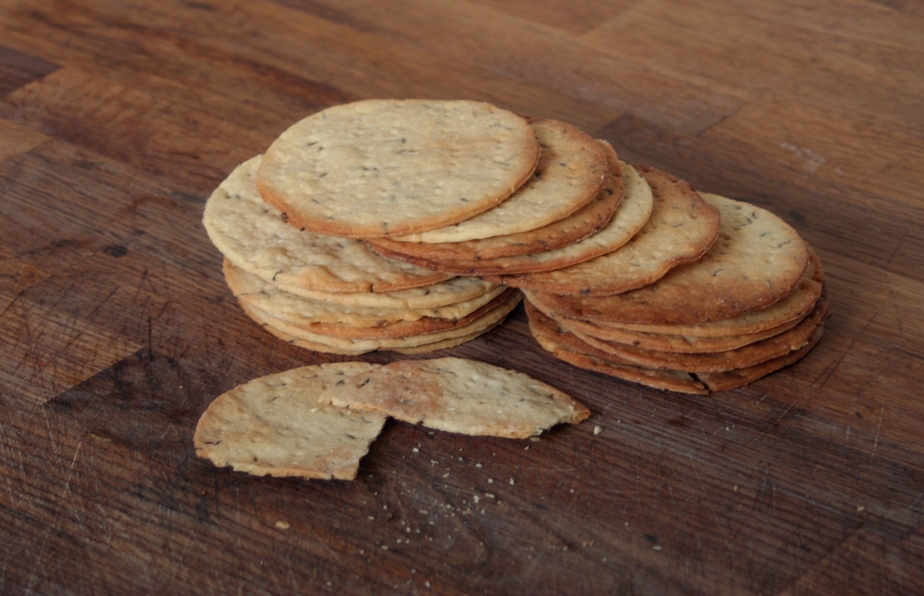
“Yes, but even after all the yaddah, yaddah, yaddah, they still don’t look very interesting” I hear you say. I know. They’ve not got much wow factor to look at, and if you’ve read this far, you might even be wondering why you should bother with them at all. So allow me to try and convince you. Firstly, their taste – the most basic quality for a recipe – they are delicious, and this should be reason enough. If you need further convincing,  it would be their delicate texture: crisp, crumbly and friable. And lastly, and for me this is their most enchanting quality, their age. Late 17th century. To put this in context, contemporaneous events include the English civil war, Roundheads & Cavaliers, Oliver Cromwell, the Great Fire of London, Peter The Great crowned Czar of Russia and the Salem witch trials are conducted in Massachusetts. And this is a delicious biscuit from those times. As Sue Perkins so eloquently put it in her Foreword for my first book, it’s taste-bud time travel!

Apart from the flavourings, the other key aspect of these biscuits is their thinness. And I mean thin. Really, really thin. Like 2mm. Even though the quantity of dough is small, I strongly suggest working with just half of it at a time, so that you can really concentrate on getting the dough as thin as possible. It will become translucent when rolled thinly enough. The biscuits will then take only minutes to bake.

Tunbridge Cakes

Based on recipes in The Wellcome Library 17th century manuscripts, dated 1650-1700

113g plain flour
23g unsalted butter
34g powdered sugar
1 large egg yolk
½tsp caraway seeds
½tsp ground ginger – optional
¼tsp salt – optional
50-70ml double cream to mix

  • Put the flour, butter, sugar and egg yolk into a food processor and blitz together to mix.
  • Tip mixture into a bowl and add the caraway seeds, ginger and salt, if using.
  • Stir together.
  • Gradually add the cream until the mixture comes together into a stiff paste.,
  • Tip the paste out of the bowl and knead smooth. The texture should be like a firm shortcrust pastry.
  • Wrap in plastic and chill for 1 hour.
  • Preheat the oven to 180°C, 160°C Fan.
  • Retrieve the paste from the fridge, divide in half and put one half back into the fridge to stay cool.
  • Lightly flour the work surface and a rolling pin and roll out the dough extremely thinly, until translucent and the work surface is visible through it.
  • Using a fork, dock (i.e. poke holes in) the whole surface of the paste. This is a little time consuming, but infinitely better than trying to dock the biscuits once they have been cut out.
  • Cut out biscuits using a plain, 8cm cutter.
  • Transfer the biscuits to baking sheets lined with parchment paper.
  • Bake for 4-6 minutes, until the edges are just beginning to brown. Check after 3 minutes and turn the baking sheet around if the biscuits are colouring unevenly.
  • Remove the biscuits from the baking sheet and cool on a wire rack.
  • Store in an airtight container.

Whitsun Cake

Wotchers!

Time was, we used to mark the passing of the year with festivals and their associated foods. The list of celebrations that have continued into the 21st century is a lot shorter than it used to be: pancakes on Shrove Tuesday, Simnel Cake on Mothering Sunday, Cross Buns on Good Friday are about all that remain in national consciousness.

Regionally, there are still pockets of celebration peculiar to that particular area. Whilst researching my book (shameless plug) Great British Bakes, I discovered two such celebrations with which I have a personal connection.

The first was that of Pax Cakes at King’s Capel, near Ross-on-Wye, where my father spend his final years and is now buried. Under the terms of the sixteenth century will of Lady Scudamore, cakes and ale were to be distributed to the parishioners of Hentland, Sellack and King’s Capel on Palm Sunday, to be consumed in church with the aim of fostering good will and letting the grievances of the past year be forgotten. The cakes became known as Pax Cakes and the toast/blessing was “Peace and good neighbourhood”.

The second was the celebration at Kidderminster, where I now live, held on Midsummer Eve, for all residents of Church Street. A bequest left by John Brecknell in 1778 added to an earlier bequest and provided cake for each child or unmarried woman born or living in the street. The men-folk were to gather together to oversee the distribution, and for this meeting both beer and tobacco were paid for by the bequest. Old quarrels had to be set aside in order for the meeting to proceed. Over the years, the celebration evolved into a Midsummer’s Even dinner for residents of the street, where the toast was “Peace and good neighbourhood”.

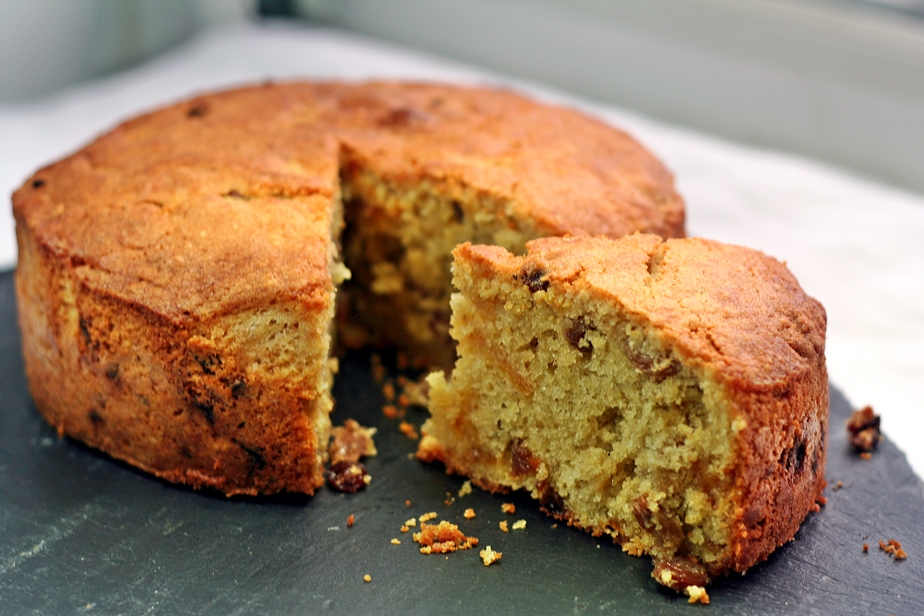
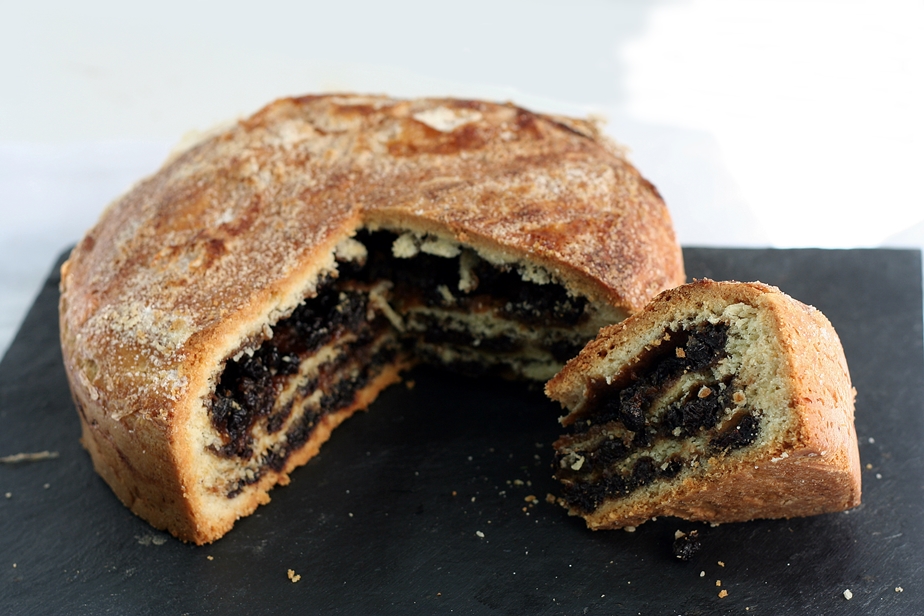
All of which leads me to this week’s recipe found in my grandmother’s cookery book. It’s for a cake to celebrate Whitsun, originating from Lincolnshire. The recipe was very insistent that, after baking, the cake be wrapped and carefully stored for “several days” in order for the flavours to mingle. The first time I made it, I dismissed this notion, as the aroma was so tantalising, and indeed, it was absolutely delicious, warm from the oven. This time I decided to follow the instructions as written, purely to compare taste. Long story short, although the cake I unwrapped this morning was nice, I still prefer the cake fresh and warm. The flavour is akin to an Eccles or Banbury cake, but with an enriched dough taking the place of pastry.

This recipe makes two, 20cm cakes. You can either do your own taste test, by eating one warm and trying the second several days later, or make just one cake by halving the recipe.

There’s no indication, other than the recipe title, what exactly this cake was meant to symbolise or celebrate, so whether you choose to make one cake or two, Peace and Good Neighbourhood to you!

Lincolnshire Whitsun Cake

Makes two 20cm diameter cakes.

170g unsalted butter
¼tsp salt
625g strong plain flour
2 sachets fast-action yeast

170g unsalted butter
300ml milk

450g currants
450g soft light brown sugar
60g butter
1 large egg yolk
2 tsp grated nutmeg
1 tsp allspice

1 large egg white for glazing
caster sugar

  • Grease and line with parchment paper two 20cm loose-bottom or spring-form cake tins. Tart tins are not suitable, as the sides need to be relatively high because of the cakes rising both before and during cooking.
  • Put the first four ingredients into the bowl of a food processor and blitz until the mixture resembles breadcrumbs.
  • Tip the mixture into a bowl.
  • Gently warm the butter and milk together until the butter has melted.
  • Allow to cool to blood temperature, then add to the flour mixture. It will form a very soft dough.
  • Knead for 10 minutes, then set aside to rise for 30 minutes.
  • Mix the fruit, sugar, yolk, butter and spices together in a saucepan and warm through until moist and the fruit soft.
  • After 30 minutes, divide the dough into two and then each half into four equal pieces.
  • Divide the fruit filling into six
  • Pat each piece of dough into a circle of diameter 20cm and place in the prepared tins, alternating with layers of the fruit mixture. The top layer will be of dough.
  • Set tins aside to rise for 30 minutes.
  • Preheat the oven to 180°C, 160°C Fan.
  • Bake the cakes for 30 minutes, then remove and quickly brush them with the beaten egg-white and sprinkle with caster sugar.
  • Return to the oven and bake for a further 25-30 minutes, until the top is browned and the cakes have shrunk away from the sides of the tin a little.
  • Cool in the tins for 10 minutes, then remove and cool on a wire rack.
  • Eat warm, or wait until completely cold before wrapping tightly in foil and storing in a tin, or wrap in plastic and freeze for later.

Honey Bunnies

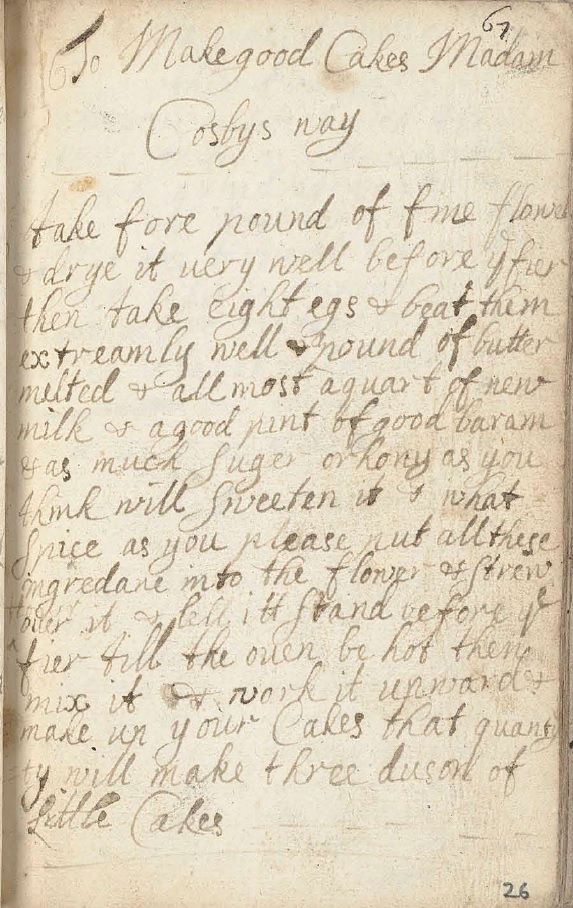
The recipe for this dough comes from one of the many digital manuscripts made available by The Wellcome Library, and dates from 1699. The original was a bit sparse in some of the instructions (“add honey to sweeten” “what spice you will”), but I’ve experimented and come up with a version that is rich, not too sweet and delicately spiced. I specifically wanted a recipe that did not contain fruit, but feel free to throw some in if you like. Additionally, mix it up with your own spice blends.

Bun recipe from MS.3107, p28, dated circa1699,  Wellcome Collection.
Bun recipe from MS.3107, p28, dated circa1699, Wellcome Collection.

Honey Bunnies

Makes 12 bunny buns

450g strong, white flour – plus extra for kneading.
1 sachet easy-blend yeast
2tsp ground cinnamon
2tsp ground nutmeg
1tsp ground allspice
250ml whole milk
113g honey
113g unsalted butter
2 large eggs

  • Put the honey, butter and milk into a small pan and warm gently until the butter has melted and the honey dissolved.
  • Whisk the eggs in a bowl.
  • When the milk mixture has cooled to blood temperature, pour into the whisked eggs, stirring briskly.
  • Add the remaining ingredients to a large bowl and stir to combine.
  • Make a well in the centre and pour in the wet ingredients.
  • Stir together until the mixture comes together in a soft dough. Important: The texture of the dough depends on the moisture content of the ingredients, including that of the flour, eggs, butter and honey. It is probably going to look too wet. Don’t panic. Knead in extra flour to bring it back to a consistency with which you’re happy. It is better to have it slightly too soft, than too dry.
  • Knead for 10 minutes until smooth.
  • Cover and set to rise until doubled in size. The butter and the honey will mean that it will take longer to rise than regular bread dough, so think more in terms of 2-3 hours than just a single hour.
  • When risen, tip out from the bowl and press out the air.
  • Fold the dough together loosely and weigh it.
  • Cut into 12 portions. Using a digital scale will give you the greatest accuracy and therefore a more even batch overall.
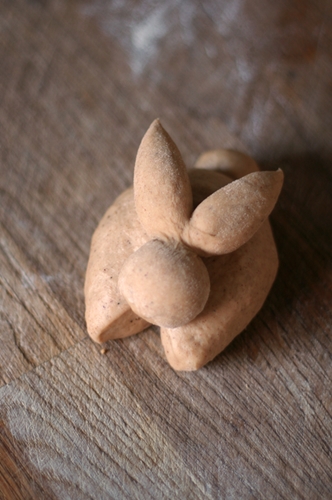
  • Shape into buns. To help you shape the dough into bunnies, I’ve prepared a photographic how-to:
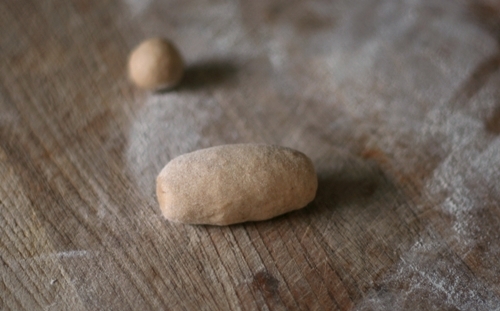
dough tail head
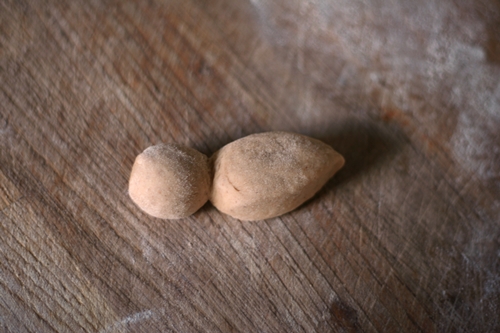
Divide each portion of dough into 3 – about 5g for the tail, 1/3 for the head/ears, and 2/3 for the body. Roll all three into smooth balls. Roll the medium ball into a sausage shape as above.
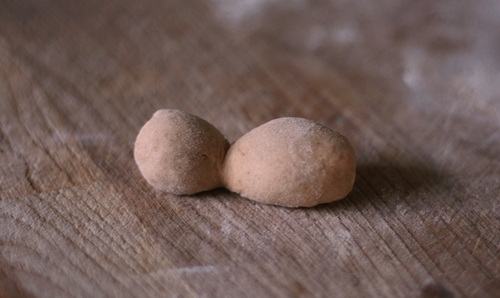
forming ears
Hold your hand as if you were going to do a karate chop, and roll the bottom edge of it back and forth over the sausage of dough, about 1/3 of the way from the left. The smaller portion of dough will form the head, and the remainder the ears.
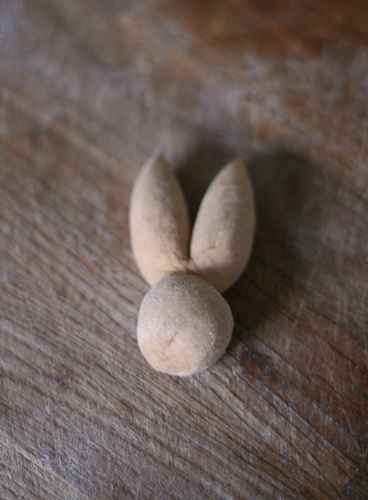
Shape the 'ears' portion by flattening it slightly and adding a point at the end. It will be roughly leaf-shaped, whilst the 'head' portion remains rounded.
Shape the ‘ears’ portion by flattening it slightly and adding a point at the end. It will be roughly leaf-shaped, whilst the ‘head’ portion remains rounded.
Using a sharp knife or the edge of a scraper, divide the ears by cutting down the middle of the dough.
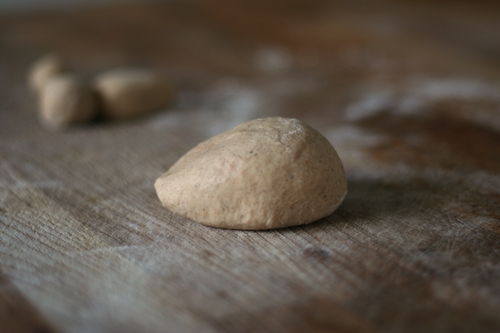
Shape the body. I pondered long and hard how to describe the shaping of this piece of dough, until I had a brainwave: make it into the shape of a computer mouse. Vaguely oval, with the back end higher and rounded and the front sloping downwards.
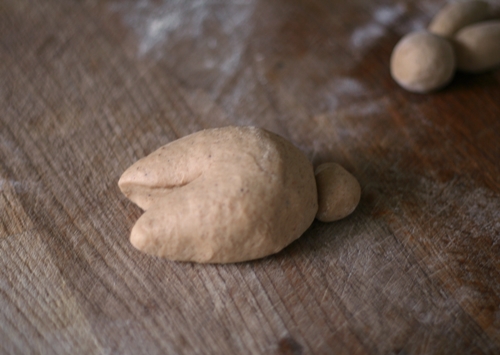
Using a little dab of water, attach the tail. Shape the two front paws by cutting approx. 1/3 of the length of the dough, dividing the front part into 2, just like with the ears.
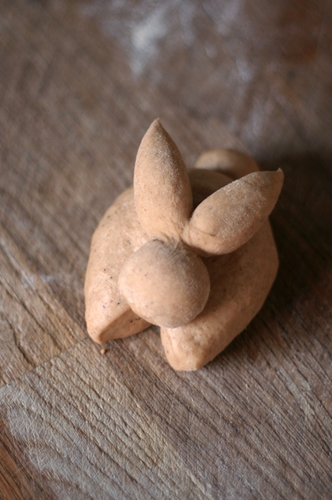
Raw honey dough bunny
Add another dab of water to moisten and lay the head/ears onto the body.
  • Set the buns onto a baking sheet lined with baking parchment while the oven heats up.
  • Heat the oven to 180°C, 160°C Fan.
  • I opted not to glaze the dough, but if you prefer to, brush with milk and/or egg yolk.
  • Bake for 20 minutes, turning the baking tray around 180 degrees after 10 minutes to ensure even baking.
  • Leave cooked buns on the baking sheet and cover with a clean cloth to cool. This will help to keep the crust soft.
  • Eat warm, either as is or with butter.

Radnor Cranberry Tart

If you have an extended social life in the run-up to Christmas, and sample nothing but mince pies throughout December, by the time you get to the 25th, what with the Christmas Cake and Christmas Pudding, you can be all mince-pied out.

Also, sometimes you find yourself fancying something a little savoury at the end of a meal, and this is why this recipe is perfect. It’s simple and straightforward – just two main ingredients of fresh cranberries and juicy raisins. The raisins take the edge off the sometimes eye-popping sharpness of the cranberries and the little dash of vanilla also gives the aroma of sweetness, so only the merest sprinkle of sugar is required. It’s festively reminiscent enough of a mince pie to deserve a place on the table, its fresh-tasting, palate-cleansing, sweet but not too sweet, can be served hot or cold, but ALWAYS with a slice of cheese. I’m thinking some vintage cheddar, crumbly white Cheshire or even one of the fruited cheeses – white Stilton and apricot anyone?

It is a traditional (Welsh) border tart, ideal for Christmas – just look at that glorious colour! The original 1930s recipe in Mrs Arthur Webb’s Farmhouse Cookery didn’t specify any particular pastry, so I’m taking the opportunity to offer for your delectation and amusement, a new pastry recipe! Yes, I know I love the cornflour pastry – and I really do, both sweet and savoury versions – but I can’t resist something that has the potential to add a new arrow to my pastry quiver, as it were, and in this case, I’m really glad that I did.

It’s Eliza Acton’s 1845 recipe for cream pastry and it has my seal of approval for several reasons:

  • Simplicity – in its basic form, it can be whisked together with just two ingredients.
  • Taste – when baked, it is crisp and dry, without any hint of greasiness or stodginess.
  • It can be enriched with butter, but at a ratio of just 1/4 fat-to-flour, it is not as indulgent as it tastes. When enriched with butter, the texture is moving towards the flakiness of flaky pastry, yet with the ‘dryness’ and crispness of the cornflour pastry – Nom!
  • And on the practical side, it handles and rolls really nicely.

You can, of course, use your own favourite pastry instead.

Radnor Cranberry Tart

Eliza Acton’s Cream Pastry
This quantity makes enough for a 20cm pie.

225g plain flour
0.5tsp salt
300-450ml double cream
56g butter

  • Put the flour and salt into the bowl of a food processor.
  • With the motor running, gradually add in the cream, a little at a time, until the mixture comes together.
  • Tip the mixture out and knead until smooth.
  • Roll out the pastry into a long rectangle.
  • Using the same method as for Flaky Pastry, dot over half the butter.
  • Fold the ends over, turn the pastry 90 degrees and repeat.
  • Roll out one last time, and fold the ends inwards.
  • Wrap in plastic and chill in the fridge for 30 minutes.
  • Make the filling (see below).
  • Remove the pastry from the fridge and cut into 2 pieces (2/3 + 1/3 is about right).
  • Roll out the large piece and use it to line a greased, 20cm loose bottomed tart tin. Ease the pastry into the sides, rather than just stretching it by pressing down too hard. Leave the excess hanging over the edge of the tin.
  • Roll out the smaller piece of pastry to make the lid, and lay it onto a cutting board.
  • Chill both pieces of pastry in the fridge for 20 minutes. This will make sure it is relaxed and less prone to shrinkage in the oven.
  • By this time, the filling should be cool enough to use.
  • Preheat the oven to 200°C, 180°C Fan.
  • Remove the two lots of pastry from the fridge.
  • Fill the lined tin with the cooled filling and smooth over.
  • Using a pastry brush, wet the edges of the pastry, then lay the lid across the top and press the edges together.
  • Trim off the excess using the back of a knife.
  • Crimp the edges to your liking – I used the tines of a fork to make for a good seal.
  • Brush the surface of the tart with milk and sprinkle with caster sugar.
  • Cut a steam vent in the middle of the pastry lid using a sharp knife.
  • Bake for 25-30 minutes until the pastry is crisp and golden brown.
  • Allow to cool for 10 minutes in the tin, then remove to a wire rack to cool, if not serving warm.
  • Serve with a nice wedge of cheese.

Filling
450g fresh cranberries
225g raisins
30g sugar
60ml cold water
0.5tsp vanilla extract

  • Rinse the cranberries and put them in a pan with the raisins, sugar and water.
  • Cover and warm on a low heat until the mixture comes to the boil and you can hear the cranberries starting to pop.
  • Simmer for just five minutes, then turn off the heat.
  • Taste to make sure of the sweetness, but remember, this is not supposed to be a really sweet tart, however, it shouldn’t be too sour either. If you think it needs a little more sugar, add it by all means.
  • Stir in the vanilla and leave to cool.

Orange Blossom Tart

Here’s a wonderfully aromatic and delicious dessert that I have adapted from a recipe that appears in Hannah Glasse’s “The art of cookery, made plain and easy”. It must have been popular, because Hannah gives no fewer than four recipes for Orange Pudding, each slightly different. Copyright infringement back then being rife, it is highly likely that Hannah is not the original author of this recipe, but I have yet to find an older version with these particular ingredients.

Hannah calls this a pudding – and indeed it is certainly something that you might eat after lunch or dinner, but it is in fact what we would term a tart, and I can honestly say it is unlike any tart I’ve ever tasted before, for the very best of reasons.

The most striking aspect is the flavour – a mixture of Seville orange, orange flower water, rosewater and white wine. Rather surprisingly, the word that popped into my head when breathing in its aroma was ice-cream – and that was before it was cooked! Once cooked and chilled, the flavours mingle together and taste extraordinary – the only way I can think to describe it is like plunging your face into a bunch of fresh flowers – but in a good way! This isn’t soapy/perfumed – it’s light and fresh and rounded. None of the flavours overpower, it’s just fantastically floral.

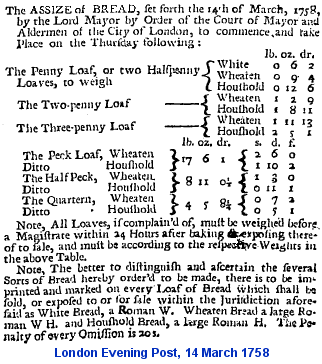
One of the challenges when adapting old recipes, is that specific quantities are sometimes a bit of a challenge. This recipe is a good example, because amongst other things it calls for “the crumb of a halfpenny loaf”. Although food prices were relatively stable before the industrial revolution, wheat, and by extension bread, was especially subject to price fluctuations due to harvest yield. So much so, specific laws were created concerning the manufacture and sale of the various types of bread (The Assize of Bread) and books of tables drawn up specifying the size of loaves depending on the cost of wheat.

Even with the Assize of Bread tables to hand, it’s still not clear which loaf the crumb should come from: white, wheaten or household. Household bread was the coarsest, and therefore unlikely, I reasoned, to have been used for such a delicate dessert. That left either white or wheaten and at just over 6oz and 9oz for a penny loaf, the difference in the quantity of crumb was going to be significant. The only solution was to make two tarts, and try each to see if one quantity was more suited than the other.

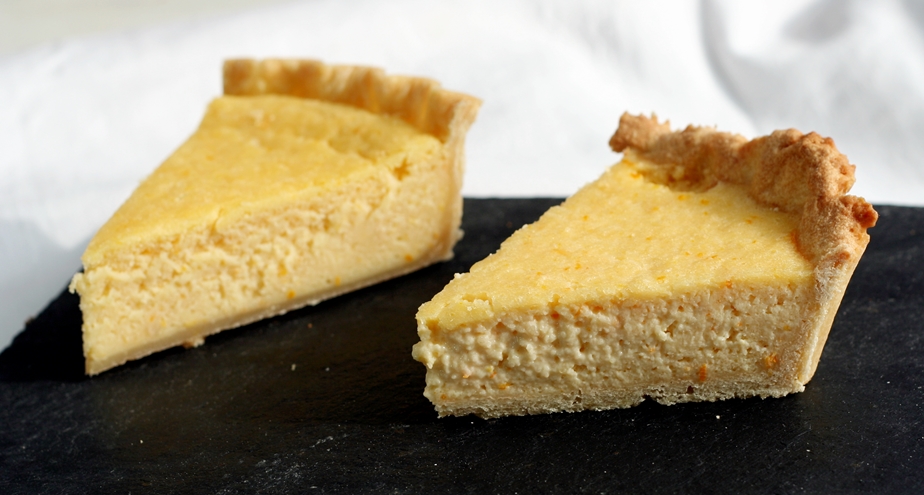
The photograph at the top shows the result. The slice on the left was cut from a tart made with 150g fresh white breadcrumbs. The slice on the right from a tart made with just 100g. Personally, I prefer the one on the left – the texture is like baked cheesecake, but not heavy and cloying. The slice on the right has a much softer consistency – if you’re a fan of baked custards, then this is the one for you. For an even more delicate texture, you could even try with just 50g of breadcrumbs – do let me know if you try this!

This is a wonderful springtime tart and I really hope you’ll give it a try.

Orange Blossom Tart

Sweet Shortcrust Pastry
225g plain flour
140g butter
60g cornflour
85g caster sugar
1 large egg
grated zest of 1 lemon
ice cold water
egg-white for glazing

  • Put all the ingredients except the water into the bowl of a food processor and blitz until the mixture comes together in a ball.
  • If the mixture is too dry, add some ice cold water 1 tablespoon at a time until the pastry forms a ball.
  • Tip the mixture onto a floured surface and knead smooth.
  • Wrap in plastic and chill for at least 30 minutes.
  • Grease a 22cm fluted, deep, loose-bottom tart tin – a lemon meringue tin if you have one, is ideal.
  • Remove the chilled pastry from the fridge and place on a floured surface.
  • Roll out thinly (7-8mm) and line the prepared tin, gently easing the pastry into the sides.
  • Let the excess pastry hang over the sides of the tin for now.
  • Prick the bottom of the pastry with a fork and put the lined tin back into the fridge to chill for another 30 minutes.
  • Preheat the oven to 200°C, 180°C Fan.
  • Remove the tart from the fridge and trim the excess pastry. Don’t remove too much – allow 3-4cm to overhand the side of the tin – this keeps the pastry from shrinking back into the tin and can be trimmed after cooking.
  • Line the pastry with baking parchment and fill with baking beads/beans/rice.
  • Bake for 12 minutes, then remove the parchment and beads and bake for another 5-6 minutes until the pastry is cooked through.
  • Brush the inside of the pastry with lightly beaten egg-white and return to the oven for 5 minutes. This seems like a faff, but it will ensure you pastry is both cooked AND resistant to the wetness of the filling until it is cooked. *lying* I deliberately undercooked the pastry on the left in the photo to demonstrate.

Filling
150g fresh white breadcrumbs
250ml double cream
75g caster sugar
5 large egg yolks
60ml white wine [1]
1 tablespoon orange flower water [2]
1 teaspoon rose water [2]
zest and juice of a Seville orange [3]
70g clarified butter – melted

  • Mix all of the ingredients together in a bowl and set aside to let the flavours mingle. It will have the consistency of porridge.
  • When the pastry base is finally cooked, turn the oven down to 160°C, 140°C Fan.
  • Cover the top edges of the pastry with tin foil, to prevent them from burning.
  • Pour the filling into the cooked pastry case and bake for 25-30 minutes until the filling is set. There should be a slight joggle to the middle of the tart, but nothing too fluid.
  • Set aside to cool for at least 1 hour.
  • When cold, trim off the excess pastry, remove from the tin and place on a serving plate.
  • Eat slightly warm or at room temperature. Alternatively (and my own personal preference) chill thoroughly in the fridge for at least 5 hours.

[1] The original recipe called for sack, a fortified wine similar to sweet sherry. You could use sherry, madeira even marsala if you like. Whilst I love the flavours of all three, I thought them a little rich for this recipe, so I chose a regular white wine. A sweet and aromatic dessert wine would also be delightful.

[2]Both of these fragrances are available in the baking aisle at the supermarket. They also tend to vary greatly in strength and aroma according to which brand you use. The original recipe called for equal quantities of both, but the rosewater I use is rather strong. In contrast, the orange flower water that I use is rather lightly perfumed, so I used slightly more. if you use different brands, my advice is to use just 1 teaspoon at a time and taste as you go until you’re happy with the flavourings.

[3] If, like me, you made Seville orange ice cubes with the zest and juice back in January, then all you need is one cube. If not, then use the zest only of a sweet orange, together with the zest of either a lemon or lime for added sharpness.

Apricot Jam

I’m a big fan of the sharp-sweet tang of apricots, and with a respectable amount of pectin, there’s no need to Faff About™ adding any extra. The small quantity lemon juice helps anyway, both in the set and in sharpening the flavour of the apricots.

This method, gleaned from several hand-written 17th century manuscripts, is slightly longer than your regular jam-making session might be, but it is seriously low on effort. Start-to-finish, it’s about 24 hours, but of that, there’s maybe only 1 hour of actually doing anything – bonus!

The result is so vibrant, so delicious, you’ll wish you’d made more – however many jars you make. I bought 6 x 350g punnets – and made six jars. One jar of finished jam for every 350g of raw fruit is also a handy way to work out how many jars your going to need. As a precaution, I always have one jar extra, all cleaned, heated and ready to go, in case of an overabundance. I’ve scaled the quantities down to use just 1 kg of fresh, pitted fruits (so 3 punnets from the shop), so it’s a little easier to scale up/down.

This method involves first macerating (or soaking) the fruit in sugar for several hours (or even overnight). The sugar draws out the juice from the fruit, and in turn a little of the sugar is absorbed. This absorption of sugar will help to firm up the fruit and keep it from disintegrating during the necessary boiling later on.

That being said, this is not a solid jam that has to be crowbar’d out of the jar (a particular dislike of mine). It’s definitely leaning more towards the conserve, although having sliced the fruit to manageable bite-sizes, I think that disqualifies it from the traditional definition of conserve (i.e. whole fruit in syrup).

ANYHOO….

Here’s how it goes:

Apricot Jam

3 x 350g punnets of Bergeron (for preference, but not compulsory) apricots, to give 1kg of prepared fruit
800g granulated sugar
Juice of 2-3 lemons
Day 1

  • Rinse the apricots and cut into halves, top to bottom, and remove the stone.
  • Layer the apricot halves, sugar and the juice of 2 of the lemons in a large bowl ensuring the cut surfaces of the apricots are covered with sugar.
  • Cover the bowl with cling film and set aside for 8-10 hours, or overnight.
  • Mop brow and declare loudly to any interested parties “This jam-making is EXHAUSTING! I must have a REST and watch a FILM”.
  • Put feet up.

8 hours later, or next morning if you started at night

  • Gently slide the apricot mixture (which will probably be quite runny by now) into a preserving pan and warm gently, until all the sugar is melted.
  • Try and avoid stirring, as the fruit will still be very fragile and might begin to break apart with too much spoon action.
  • When all the sugar is melted, bring the mixture to a boil.
  • As soon as it boils, remove the pan from the heat and gently pour the fruit mixture back into the bowl.
  • Re-cover with cling film and set aside overnight.
  • Mop brow and put feet up as above.

12-14 hours later

Here’s where things might get a little too Faffy™ for your liking, feel free to skip the next part if you prefer a slightly more rustic jam.

  • Removing the skins
    • Strain the fruit from the syrup. I prefer to lift the aricot gently with a skimmer, to avoid squishingthem too much, but you can pour it through a sieve if you like.
    • By this time, after their overnight soaking, the skins should be wrinkled and easy to separate from the flesh of the apricots. I usually start by picking up an apricot half by the skin in my left hand and then using a small, sharp knife to ease the flesh away. Sometimes the cut edge of the apricot next to the skin has hardened and needs a little encouragement to come free. If your apricots have a slightly thicker skin, this may not be as easy as described. In this case, give up.. Persevering will only mash the apricots to mush.
    • Discard skins.
  • Using some sharp scissors, cut the now skin-free apricots into strips about 0.5-1cm wide. Again, feel free to skip this if so inclined. It just makes the jam easier to spread. Set fruit aside for now.
  • Once the fruit is prepared, it’s time to boil the syrup to setting point.
  • But before you start heating it, taste. I like a particularly sharp jam, so I tend to add the juice of another lemon at this stage if necessary. Taste the syrup and make your own decision.
  • Also, put 2 saucers in the freezer. These will be used later to test whether your jam has reached setting point.
  • Pour all the syrup into the preserving pan and bring to a simmering boil. Keep an eye on it, as too high a heat may cause it to boil over.
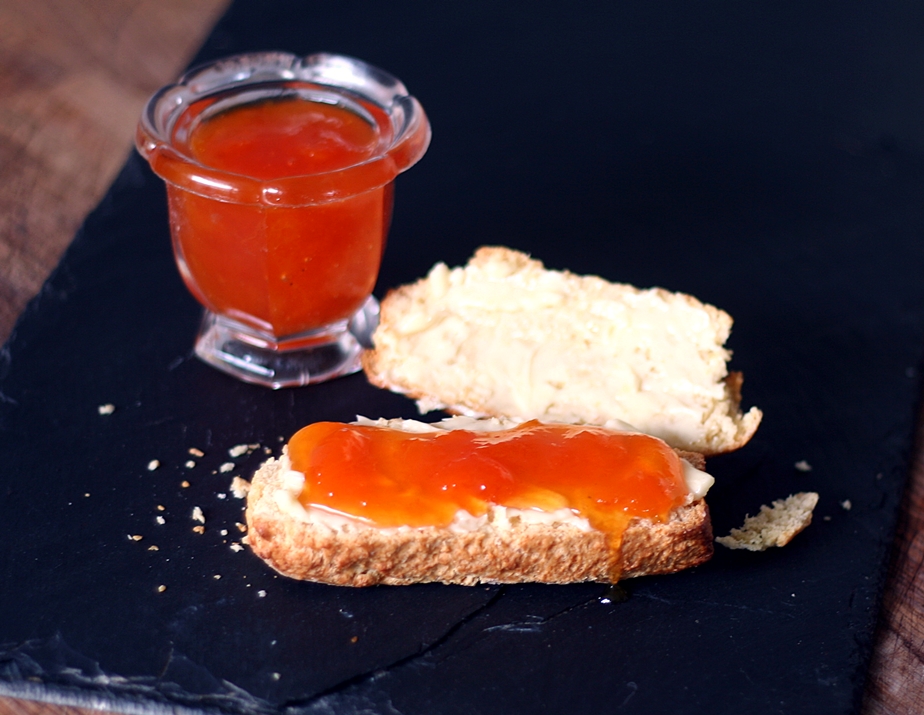
  • Skim the froth from the top of the simmering syrup – removing this will help give your finished jam that jewel-like clarity. Don’t throw the foam away, it’s still delicious, just bubbly. Enjoy on toast with some salty feta or goats cheese – NOM!
  • Setting point is reached at 105°C, when the excess water has evaporated – there will be a distinct lack of steam coming from the pan, but use a thermometer to double-check.
  • Add the apricots, sliding them gently into the syrup. It will immediately go off the boil, and as there will be quite a lot of syrup clinging to the apricots themselves, it will take several minutes to come back to setting point.
  • Use this time to wash your jam jars, rinse and arrange onto a baking sheet, together with their lids.
  • Put the jars into a cold oven, and turn the heat to 100°C, 80°C Fan.
  • When the jam has reached setting point for the second time, draw the pan to one side away from the heat and test the jam by putting a teaspoon onto one of the cold saucers from the freezer. Return the plate to the freezer for a minute or two then remove and slowly push a finger through the cooled jam. If the surface wrinkles, then the jam is done. If not, return to the heat for a few more minutes and test again.
  • Once the jam is set to your satisfaction, turn off the heat and leave it to cool a little. You want it to be cool enough to begin to form a thin skin on the surface. This means that it is starting to set, and you should put it in jars. Depending on how big a batch you’re making, this could be as long as 20 minutes. Have a cuppa while waiting!
  • Stir the jam gently, to distribute the fruit throughout the syrup. Now that the jam has cooled a little, the fruit will stay suspended evenly. Stirring when the jam is too hot will do nothing, and pouring too-hot jam into jars will just make all the fruit float to the top.
  • Remove the hot and now dry jars from the oven and, using a jam funnel, pour your jam into the jars. You might want to use oven gloves to hold the jar steady. Fill the jars as close as possible to the top – to within 5mm at least (bacteria love air gaps, so you want to keep them as small as possible).
  • Screw the lids on tightly and then wipe off any spillage from the outside of the jars. Leave to cool completely before labelling.

Candied Peel

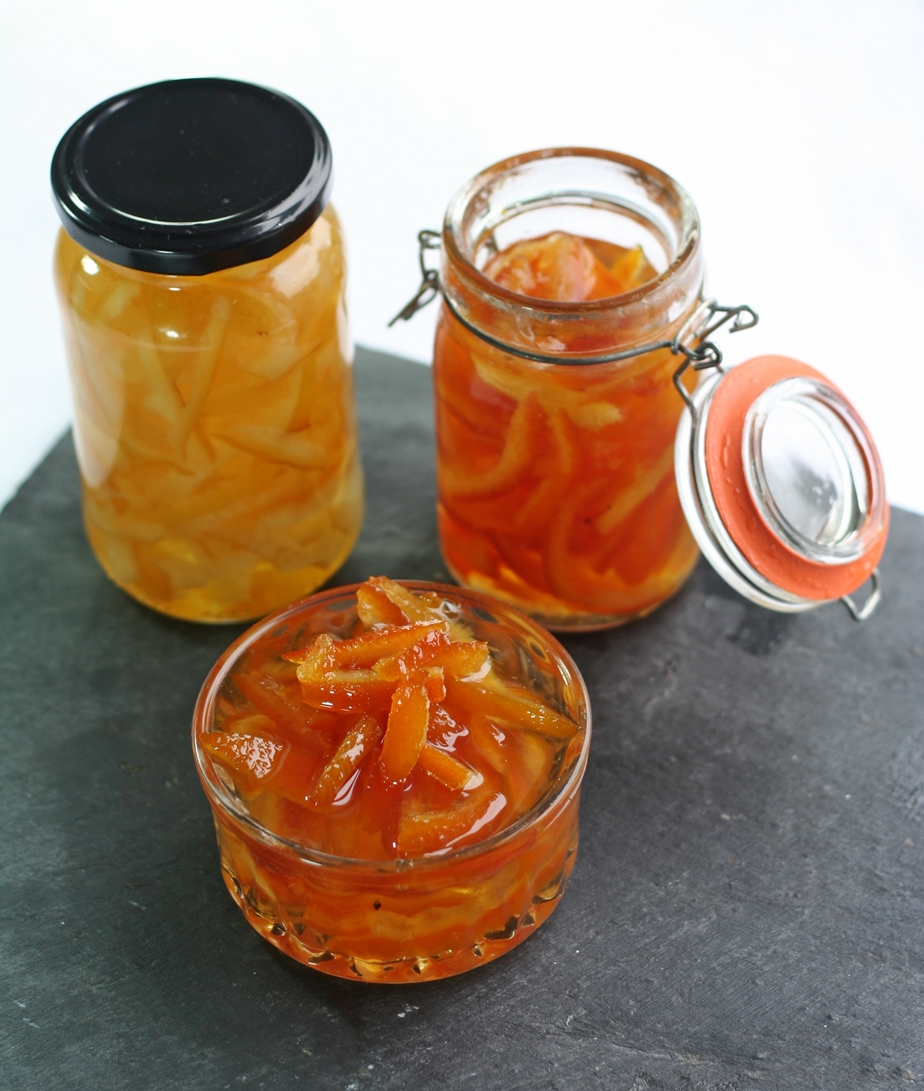
A forgotten art in British preserving is home-made candied peel. ‘But I can buy that!’ you shriek. Yes, I know. But if you’ve ever tasted fresh candied peel made with nothing more than sugar, peel and water – you’d understand. I used to hate store-bought candied peel, and avoided anything that included it, but home-made just blows it out of the water. The explosion of citrus flavour is amazing. The beauty of making it yourself is that you can candy any citrus peel you like, and not be limited to just orange and lemon. So here, for anyone who fancies having a go, is how to do it, gleaned from 17th century manuscript recipe books. It’s not difficult or complicated, but it is a bit repetitive. But make a decent amount at one time, and you won’t have to repeat it for a good few months. Oh – and it’ll make your house smell amazing.

How To Candy Peel

Citrus fruit of choice
Sugar
Water

  • Remove the skin from the fruit. Slice off the top and bottom (to make a flat surface to stand the fruit on) and then cut the peel from the sides of the fruit by slicing downwards. Keep as much of the pith as possible.
  • Scrape any flesh and membranes from the fruit rind. Don’t worry if you can’t get it all, it’ll become easier after the peel has been boiled. Leave the pith intact – it’s the pith absorbing the sugar that keeps the rind juicy and helps prevent it becoming hard.
  • Place the rind into a pan large enough to hold it plus an inch of water. Cover with clean water.
  • Bring water to a boil and boil for a minute or two then drain.
  • Rinse the peel thoroughly, and also scrub the sides of the saucepan thoroughly as well. Why? The bitterness of the peel comes from the citrus oil in the skin of the fruit. Bringing the water to the boil helps release this oil, but it then floats on the top of the water, coats the rind when the water is poured off, and also congeals onto the sides of the pan. If you don’t rinse the peel and scrub the pan well, you just end up basically boiling the peel in the bitter citrus oil, which kinda defeats the whole purpose of repeated boilings.
  • Repeat until the peels are semi translucent and very tender. This will greatly depend on the type and condition of the fruit itself, but as a rough guide, lemons = 4 times, oranges = 5 times, grapefruit = 6 times.
  • Leave in a colander to drain well.
  • While the peel is draining, make some sugar syrup: mix 1 part water to 2 parts sugar. 500ml water to 1kg sugar is straightforward, but might leave you with a lot of leftovers, if you’re not making much peel. Not very helpful I’m afraid, but to my mind, it is better to have a little extra syrup, than have to make more once you’ve added the peels because there isn’t enough. I usually guesstimate by eye – and use non-standard measures (i.e. large mug or jug) and just measure by volume.
  • Heat the sugar and water slowly until the sugar is dissolved, then bring to a boil and continue to heat until the mixture is clear.
  • Squeeze excess water from the peels by pressing them between several layers of kitchen roll – or I find that using a clean hand towel works best – they’re surprisingly soggy peels!
  • Scrape off any remaining flesh and membranes using the side of a teaspoon and cut the peels into 5mm strips.
  • Once the syrup is clear, drop in the drained peel. Make sure that there is enough syrup to allow all of the rinds to be submerged.
  • Bring syrup and rind to a boil then cover and put onto the lowest heat. Let it stew gently until the rinds become translucent and jewel-like (almost like coloured glass). Stir occasionally. This takes about an hour. Don’t be tempted to turn up the heat to speed things along, it’ll just harden the peel.
  • Store the candied peel in screw-top jars, making sure it’s completely covered by the syrup. This will keep it moist until required, and the high sugar content of the syrup will act as a preservative. When you need to use it in a recipe, rinse off the excess syrup and pat dry with a paper towel.
  • Any excess syrup can be bottled and saved to drizzle over cakes or desserts. It will have a wonderful flavour.

Coconut Gingerbread Cakes

Gingerbread is such a classic teatime treat – and I’m a huge fan of classics – it’s just that I don’t usually feel very inspired when I hear the word ‘gingerbread’. I think of a treacle-dark cake, rich, sticky and aromatic with ginger – sounds delicious, no? – but the main thing that springs to mind is something akin to a brick slab.

It probably goes back to the large, family bakes of my childhood, where the cake-of-the-week was kept wrapped in foil in a tin and slowly chiseled away at during the week until it was all gone. There wouldn’t be another cake until this cake had been eaten, and it used to lurk in the tin in all its brickiness, standing between me and any other baked treat. The chances were high that it would eventually be replaced with something equally heavy and fruity – but that new cake’s attraction would be, initially at any rate, mostly due to the fact that it wasn’t the gingerbread.

The image of heaviness and brick-like shape has lurked in my culinary memory ever since – which is a shame because what it SHOULD bring to mind is crisp winter nights, spiciness and fireworks, treacle-richness and bonfires. So I thought I should try and rehabilitate it, and bring it up to date. Ironically, I achieved this by referring to a recipe over 165 years old, from Miss Eliza Acton.

Heroines of Cooking: Elizabeth ‘Eliza’ Acton (1799 – 1859)

Originally a poet, Eliza Acton is considered by many to be the first to write a cookery book as we would recognise it today. Her Modern Cookery for Private Families (1845) was the first to separate a list of ingredients from the methodology, and was aimed specifically at small households. Additionally, the author’s observations on potential problems and recommendations for subtle variations were included, illustrating Eliza’s personal experience with the recipes, unlike many of her contemporaries and cookery authors that were to follow. It was an immediate success and remained in print for almost 60 years. She was to write only one other book The English Bread Book (1857), in which her strong views against the adulteration and processing of food would still be being echoed by Doris Grant almost a century later.

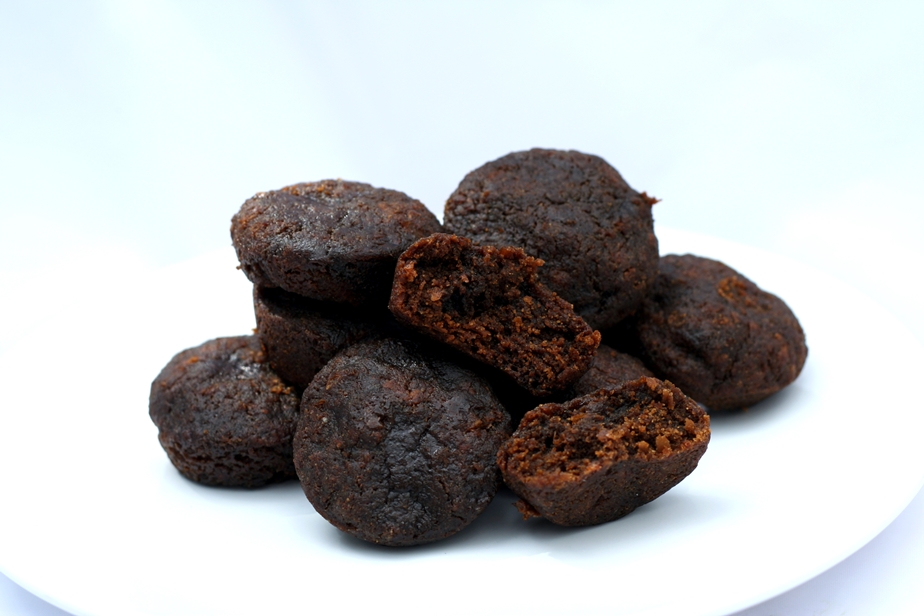
After several experimental baking batches, here is Eliza’s recipe for Coconut Gingerbread Cakes, scaled down to a manageable quantity. Baked in a mini muffin tin, the recipe makes approximately 24 bite -sized cakes with all the dark richness of traditional gingerbread, with the added coconut giving both a lighter texture and more complex flavour. Fresh coconut is a little time consuming to prepare, but very much worth the effort.

Coconut Gingerbread Cakes

Makes 24

75g plain flour
75g ground rice
2 tsp ground ginger
grated rind of 1 lemon
110g treacle
40g butter
40g dark brown soft sugar
80g fresh grated coconut

  • Mix flour, ground rice, ginger and lemon rind in a bowl and set aside.
  • Put the treacle, sugar and butter into a saucepan and heat gently until the butter is melted and the sugar dissolved. Remove from the heat.
  • Add the dry ingredients to the warm treacle mixture and stir to combined. Stir in the coconut and then set mixture aside to cool.
  • Heat oven to 120°C, 100°C Fan.
  • Divide cooled mixture into 20g pieces, roll into a ball and drop into greased mini-muffin cups.
  • Bake for 30 minutes. Cool on a wire rack.
  • Keeps very well in an airtight box/tin.

Banoffi Pie

I’d just like to take a moment to discuss a modern British classic pudding: Banoffi Pie.

Yes, Banoffi. Not Banoffee.

That’s just one of my little niggles regarding this dessert that have ultimately led to this post.

Done properly, to the original recipe, it is a classic, sophisticated and delicious dessert, worthy of a dinner party.

But it rarely IS done properly and, over the years, I’ve seen it churned out on television in worse and worse variations, until this past week when I saw an absolute shocker and so I was propelled into making this post just to set the record straight if nothing else.

I’m convinced that the fatty, over-sweetened mess that Banoffi Pie has evolved into, puts off a lot of people, which is a shame. Hopefully, if they can be persuaded to try it as it was originally conceived, they might just become fans.

I’ve mentioned in a previous post how Banoffi Pie came into being, and one of the co-creators has also published online the back-story as well as his original recipe.

Even though I am a fan of the original recipe, I’m going to change it a little.

I know, I know……I realise I’ve just spent three paragraphs banging on about people changing recipes, but in my head this is ALLOWED – because in the past I have actually eaten original recipe Banoffi Pie. Over the years I’ve developed a personal rule of first trying a recipe in it’s original form, out of respect to the original author. That done, you can tweak it how you like, but make it their way first. I’ve lost count of the times I’ve been pleasantly surprised with the results.

Once you’ve tried the original recipe too, you can pop back and we’ll carry on.

Back already? Excellent.

Before we begin, lets just have a quick whizz around the components, which gives me the opportunity to bang on about those too:

Pastry Base: Yes, contrary to popular belief, the original recipe called for a sweet, shortcrust pastry, which is actually ideal for this dessert. We’re going to draw a discrete veil over the crushed biscuit-and-butter and (my personal bête-noir) chocolate-biscuit-and-melted-chocolate bases, which push this dessert into being sickly. The filling is so rich and sweet, having the dry, crumbly pastry is a perfect foil. I actually have a copy of the original recipe published in the second book of recipes from the restaurant where it originated ( “The Deeper Secrets of The Hungry Monk” ) which just specified ‘shortcrust pastry’. This I interpreted as carte blanche to use whatever recipe I liked. What I have for you here is the original sweet cornflour pastry which I adapted to a savoury version for the Cheese and Potato Pies. It has that extra crispness that a regular all-butter pastry lacks.

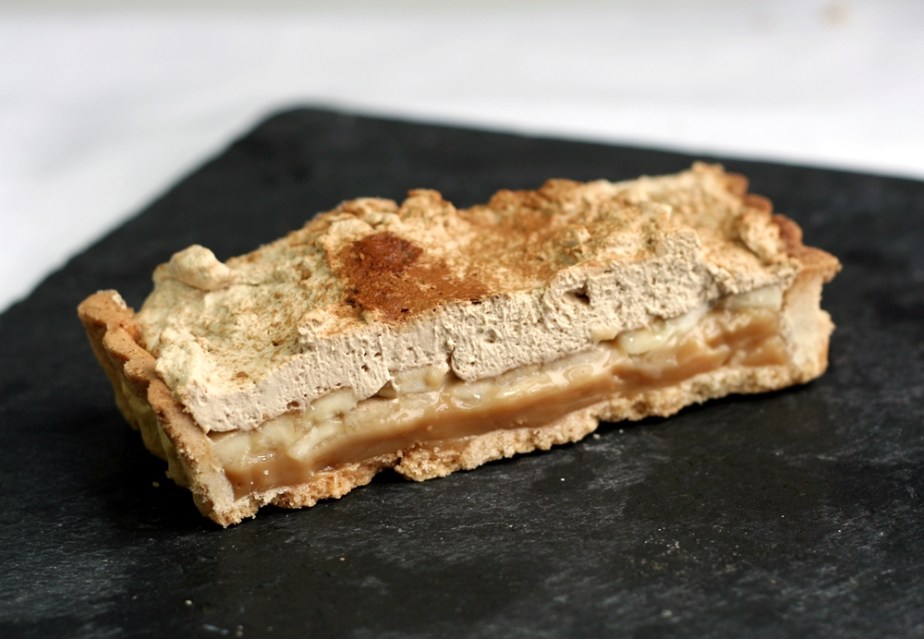
Filling: I’ve seen some people get very precious about the caramel “I make it all by hand!” they cry, ladling in the butter and cream. However, these caramels tend to be rather runny, and to be blunt, the filling can be doing without all that fat. The original is much simpler and is obtained by simmering unopened tins of sweetened, condensed milk for an extended length of time. This can be done in a variety of ways, but my method of choice is in the slow cooker because you can leave it unattended, and it won’t boil dry. Cover the tins with water, set it on Low and leave it for 8 hours. You can simmer them longer, up to 12 hours, and the caramel will gradually become darker the longer it is left in the water. The caramel in the picture was taken out of the slow cooker after 8 hours. In the UK, the most well-known producer of milk products (Carnation) have recently started selling tins of caramel. These are great if you need a dessert at short notice, but I find the caramel isn’t quite as firm as when you make it yourself, as well as being, to my taste at least, a great deal sweeter. If convenience is what you’re after, I suggest simmering more than one tin at a time and keeping the home-made spares in the cupboard.

Banana: This addition/improvement transformed Blum’s Coffee Toffee Pie into Banoffi Pie. The banana is laid on top of the caramel and underneath the cream, NOT on the pastry base. This would make spreading the caramel very difficult, as the sliced banana would stick to the caramel and slide about. And no, they don’t go on top of the cream either, because they’ll just turn brown and become very off-putting. And if you DO put them on top of the cream and then throw chocolate on top to disguise the browning, you’re fooling no-one. One variation that meets with Ian Dowding’s approval is to replace the banana with a thickened apple puree, making an Appleoffi Pie. Made with sharp, cooking apples such as Bramleys, I can just imagine the delicious contrast in both flavour and texture, although I’d probably leave out the coffee from the whipped cream for this version.

Coffee Cream:  Yes, coffee cream – whipped cream flavoured with coffee. So often this is replaced with plain whipped cream, or even vanilla flavoured cream, to the dessert’s great detriment. And, contrary to Mr Dowding’s original, in my opinion the coffee cream should be unsweetened and strong to the point of bitterness. Using espresso coffee powder turns it into a fantastic counterpoint to all the sweetness in the caramel and bananas, as well as lifting the dessert into dinner-party status. Coffee can do that. It’s almost as if it’s status as a grown-up flavour, confers adult status on everything it touches.

Chocolate for sprinkling/garnish: Whoa, whoa, whoa there, Nellie!? Whaddya doin’? You can’t go introducing a new flavour and shoving it on top of the pie just because you feel like it! Coffee, banana and caramel flavours are plenty busy enough, thankyousoverymuch! If you must sprinkle anything, a light dusting of espresso coffee powder is all the garnish it needs.

Baking Tin: You can make this dessert in any size and shape tin you like. A 20cm round tin, preferably with a loose bottom to help ease out the cooked pastry case, is traditional, but this time I used my loose-bottom rectangular flan tin (13cm x 35cm), which means the finished dessert can be neatly cut straight across in elegant, finger slices and the different layers are clean and clearly visible.

The Original(ish) Banoffi Pie

Pastry
60g cornflour
225g plain flour
140g butter
1 large egg
85g icing sugar
ice-cold water

  • Put all the ingredients into the bowl of a food processor and blitz until the mixture resembles breadcrumbs.
  • Gradually add the water, one tablespoon at a time, until the mixture comes together in a ball.
  • Knead smooth, then roll out thinly.
  • Line your chosen tart tin, easing the pastry into the corners/sides.
  • Leave the excess pastry overhanging the sides and chill in the fridge for 1 hour.
  • Preheat the oven to 200°C, 180°C Fan.
  • Remove the tin from the fridge and, now that the pastry has relaxed, trim the excess from the sides.
  • Prick the bottom of the tart tin with a fork.
  • Line the tin with baking parchment and weigh it down with baking beads/rice.
  • Bake for 12 minutes, then remove from the oven and take out the parchment and beans.
  • If the edges are already brown, cover them closely with foil and return the tart to the oven until fully baked (10-15 minutes).
  • Set aside to cool.

Filling
1 tin sweetened condensed milk turned to caramel, cooled

Unless you’re making a huge (30cm+) tart, then one tin is all you’ll need. Warmed carefully, it’ll spread a long way and a 1-2cm layer is rich enough for a treat without becoming sickly.

  • Open the cooled tin and tip into a small saucepan.
  • Warm the caramel gently until it becomes smooth and pourable.
  • Pour the warm caramel into the cooked pastry tart shell and spread it evenly over the base.
  • Lightly grease some clingfilm with butter and lay it closely over the caramel.
  • Chill until required.
To Assemble
300ml double cream
1tsp instant espresso powder + extra to sprinkle
2-3 bananas

  • Whisk the cream and coffee powder together until firm peaks.
  • Slice the bananas and lay a thin layer over the caramel.
  • Cover the bananas with the coffee cream. I like to just spoon it over, and keep it light and billowy, but if you prefer something more formal, you can pipe it. What you must do, is ensure that all the banana slices are completely covered. Just like the meringue on a lemon meringue pie, make sure the cream goes right to the edge of the tart, touching the edge of the pastry. Any banana left uncovered with start to discolour very quickly, but covered with the cream they remain delicately pale.
  • Dust the top lightly with espresso powder and chill until required.