Mini Chicken and Bacon Pies

Jane Newton, circa 1675

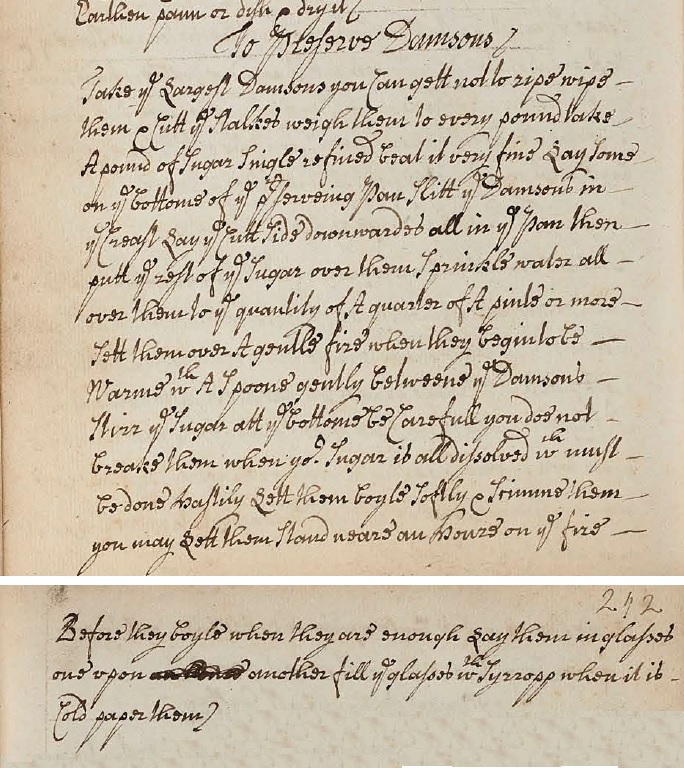
Jane Newton’s 17th century manuscript recipe book (MS1325 at The Wellcome Library) is unusual for the time, because it appears to have been written by the lady herself, rather than a scribe. It is meticulously set out, beginning with an alphabetical index and progressing through a range of recipes, informally grouped together: potages, roasts, boilings, collarings, puddings, picklings, tarts, wines and preserves.

The handwriting is regular, the lettering excessively flourished – Jane loves an upper-case letter and refuses to confine them to the beginning of sentences – the spelling quirky and capricious. The ink has faded to brown, but the scarlet margins and diligently underlined titles are still bright and bold.

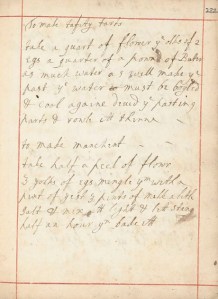
The book has a very informal tone, and on reading, it is possible to imagine Jane chattering away about her cookery recipes, complete with interruptions to her train of thought. In the recipe for Taffety Tarts, she gets as far as rolling out the pastry, only to leave the instructions hovering unfinished on the page as she then gets distracted into starting a recipe for Manchet. This too appears incomplete as, after setting the dough to rise, the recipe is hurriedly ended with the vague hand-wave of “yn bake itt.”.

Two incomplete recipes from the pen of Jane Newton

The title of this miniature pie recipe is a perfect example of the informal tone of most of the book. In the early pages,  Jane closes out a recipe for Partridge Pottage with the following comment:

This Pottage is proper to bee Garnished wth Pitti Patties or Little Pa∫sts a thing never yet in Print And I shall give yow the be∫t diretton for the makeing them when I treat of Bakemeates wch wil bee thereafter given yow

It takes more than twenty pages for this recipe to turn up. Rather than a succinct yet descriptive title, Jane opts to call it To make the Pufes I was Speaking of before in my Pottage. I don’t know about you, but I can almost hear Jane’s vague introductory “Oh…you know…. those things…. pastry bits…. whatchamacallits…. the ones I was talking about earlier!” and all-too-easily picture the accompanying distracted, flapping hand.

Jane was, justifiably, very proud of these tasty morsels:

The∫e are a thing wch is delightfull to the Eater & is not a u∫uall thing at many Tables to be had and Invented by an Italian

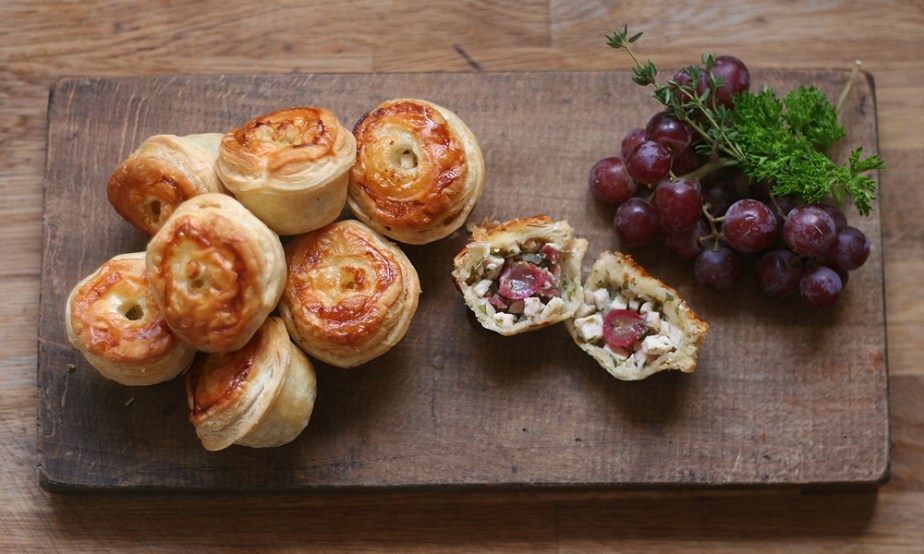
These pies are a true déja food recipe through the use of cooked meat in their composition. Although I’ve chosen to use just chicken, the original recipe suggests a combination of both chicken and veal. Other suitable alternatives would be most poultry and pork.  The filling also differs from most modern pies in that it contains neither sauce nor gravy. A mere squeeze of orange juice, possibly a Seville, and the moisture in the fresh ingredients keeps the filling from drying out and keeps the pastry from becoming soggy during baking. Once baked, a few drops of chicken stock are added into the pies to supply both seasoning and lusciousness.

The most unusual detail for these little savoury pies is the inclusion of a grape in the middle. Originally, these would have been from bunches taken as thinnings of the vines commonly grown by the great houses (there’s never enough room to allow every bunch of grapes to ripen) so they would be small, underripe and quite sharp to the taste. In the baking they soften a little and provide a bright burst of freshness to the cooked pie.  Small green gooseberries work equally well, if you don’t have a vine to hand.

Jane suggests serving these as garnishes to the aforementioned pottage (meaty soup) or even on a dish by themselves. I would widen this by recommending including them in lunchboxes, picnics or as nibbles/appetisers.

Mini Chicken & Bacon Pies

Makes 20 mini pies

shortcrust pastry – made with 300g flour
1 sheet ready rolled puff pastry.

150g cooked chicken
60g smoked, dry-cured streaky bacon – about 4 rashers
3tbs finely chopped fresh parsley(10g)
1tbs fresh thyme, stripped from the stalks
2 rounded tbs chopped shallot (1 ’round’ or ½ a smallish ‘banana’ shallot)
¼ tsp ground white pepper
a pinch of salt
juice of ½ an orange – about 2tbs/30ml
20 small, sharp grapes/gooseberries

Egg for glazing

100ml well-flavoured chicken stock

  • Dice the chicken and bacon finely and stir together with the herbs, onion and seasoning.
  • Add the orange juice and stir to combine.
  • Preheat the oven to 220°C, 200°C Fan.
  • Roll out the shortcrust pastry, cut out 20 rounds and line the greased cups of a mini muffin tin.
  • Spoon a little of the mixture into the cups, place a grape in top, then cover with more of the filling mixture.
  • Dampen the edges of the pastry with a little water.
  • Cut out 20 lids from the puff pastry and press them gently on top of the mini pies.
  • Trim any excess pastry.
  • Brush over with beaten egg and cut a small hole in the top of each pastry lid – a plastic straw works well.
  • Bake for 15-18 minutes until the pastry is cooked, the lids puffed and golden.
  • Use a small funnel or teaspoon to pour a little chicken stock into each pie to moisten the filling.
  • Cool on a wire rack.
  • Serve warm.

Lemon Biscuits

One of my favourite sets of books is a series for the Edwardian baking trade written by H.G.Harris and S.P.Borella. Published as part of The British Baker Library in the first years of the twentieth century, the “All About…” books are a fascinating record of the sheer range and variety of baked goods both fashionable and available at the time. The full set of books in the series comprises volumes devoted to:

  • All About Biscuits
  • All about Pastries
  • All About Gateaux & Dessert Cakes
  • All About Ices, Jellies, Creams & Conserves
  • All About Genoese, Petits Fours, Glacés and Bon Bons

I’ve collected my copies of these books via eBay and AbeBooks, so I recommend checking out both of these sites if you’re interested in acquiring some for yourself.

With recipe quantities suited to commercial batches, a certain amount of scaling is required in order to use any of the recipes for the home, but the effort is invariably worth it. These recipes date from an era when biscuits were sold either individually priced or by weight and you could thus make a selection specifically tailored to your entertaining or just personal needs.

These biscuits come from the All About Biscuits volume, from the chapter Dessert and Wine Biscuits. The chapter is filled with biscuits both elaborate and plain that would have been served in a range of contexts. In general terms, the dessert course was a selection of fruits, nuts, sweetmeats and sweet biscuits arranged along the centre of the table throughout the meal, acting also as table decoration. In addition, biscuits were served alongside the popular cream, syllabubs, jellies and trifles to add some textural crunch and contrast against the softness and richness.

I chose these biscuits partly for their simplicity and partly because they were labelled ‘old-fashioned’ over a century ago and I was struck that even in an era of great change and innovation, there was still enjoyment of confections which harked back to earlier times. There’s no excessive icing, decoration or filling; they are just a simple, elegant and pure-tasting delight.

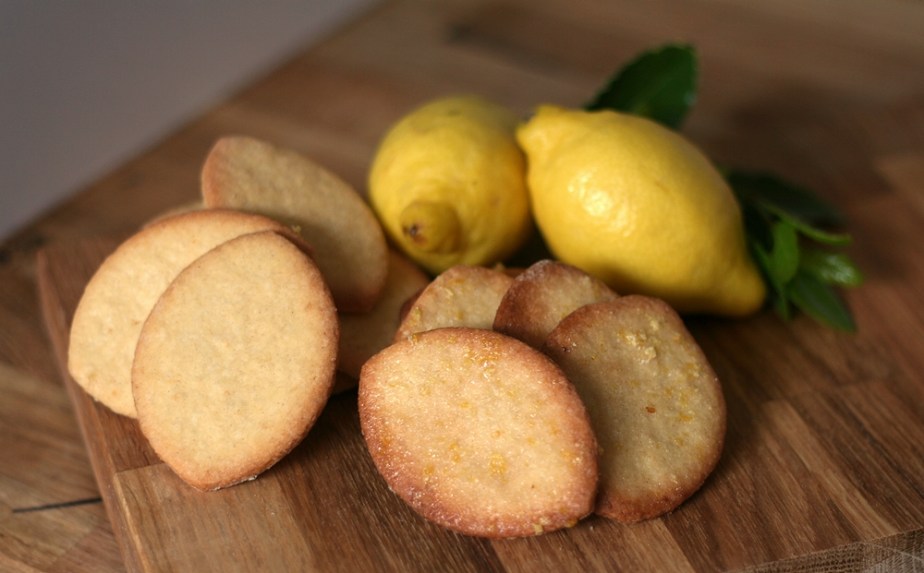
The original biscuits are crisp, with a delicate lemon flavour, ideal for serving with fruit fools, possets and fresh fruit, or even for enjoying with a mid-morning or afternoon cup of tea. I also thought they could stand a little embellishment, for an extra special treat, should the occasions arise. After a bit of experimentation I came up with the following: once baked and whilst still hot, brush the biscuits with what is essentially a lemon drizzle mixture of lemon zest, lemon juice and sugar. As the biscuits cool, this topping hardens into a glittery, lemon-flavoured crust, sweet but still eye-poppingly sharp with lemon juice. It is delicious.

This recipe makes 20-30 biscuits, so there is more than enough to have a mix of both glazed and unglazed biscuits.

Old Fashioned Lemon Biscuits

The original unglazed biscuits are on the left of the photo, the lemon-glazed biscuits are on the right.

225g plain flour
115g unsalted butter
110g caster sugar
zest and juice of 1 lemon
1 large egg – beaten

Lemon Drizzle Glaze – optional
zest & juice of 2 lemons
4-6 tbs caster sugar

  • Put the flour, sugar, zest and butter into a food processor and blitz until the mixture resembles breadcrumbs.
  • Add the lemon juice and blitz again.
  • Whisk the egg and, with the food processor running, gradually add a tablespoon at a time until the mixture comes together in a ball. Depending on the moisture in your flour and butter and the quantity of juice you get from your lemon, you might not need to use all of the egg.
  • Tip out the mixture and knead smooth.
  • Wrap in plastic and chill for at a least an hour until firm enough to roll.
  • Preheat the oven to 200°C 180°C Fan.
  • Line two baking sheets with baking parchment.
  • Roll the chilled dough out thinly (3-4mm) and cut out lemon-shaped  biscuits. You can use a 7cm plain circular cutter and then use it to cut off a crescent of dough to make the lemon shape. Press the trimmings together and re-roll.
  • Lay the biscuits onto the baking sheets, 1-2cm apart – there is little spreading during baking.
  • Bake for 11-12 minutes, turning the baking sheet around after 6 minutes to help even colouring.
  • While the biscuits are baking, make the glaze (if using). Use a fine grater to remove the zest of the lemons. If using a microplane grater, you will need to then chop the curls of zest into smaller pieces to achieve an even coverage when brushing on the glaze. Add the lemon juice and sugar to the zest and stir all together. There’s no need to ensure all the sugar is dissolved, as this will contribute to the crunchiness of the layer.
  • When the biscuits are baked and starting to colour at the edges, remove and brush the glaze onto as many biscuits as you like. Leave to cool on the baking sheets for 10 minute, then transfer to a cooling rack to cool completely.
  • The heat of the biscuits themselves, as well as that from the baking sheets, will help the glaze to set. After 30 minutes, if your biscuits aren’t as crisp as you would like, or the glaze isn’t fully dry, set the cooling racks into the oven, which should still be warm from the baking and allow the warmth there to work its magic.
  • Store in an airtight container.


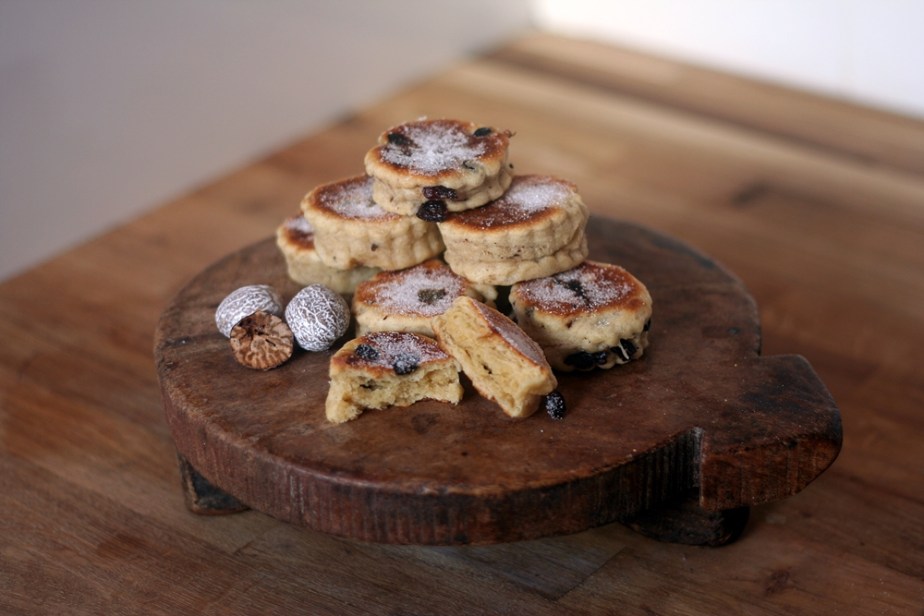
Welsh Cakes

I’ve always had a fondness for Wales. The first family holidays were amongst its lush and rolling hills and I became an avid fan of rugby through watching Wales during the glorious days of the mid-1970s.

In terms of its food, I’m constantly frustrated by the existence of so few old books from which to draw recipes. I have on my bookshelves just three in the Welsh language, all dating from the 19th century, and, disappointingly, not one of them contains recipes for either Bara Brith or Welsh Cakes. I have a feeling that there must be a very rich hoard of manuscript recipes lurking somewhere in storage, perhaps in a record office or some archive, just waiting to be discovered.

I have already brought you a couple of Bara Brith recipes, being unable to choose between the rich fruitiness of one and the delicate texture of the other. For years I have been in search of an authentic and worthy Welsh Cake recipe, with no joy. With the best will in the world, the modern Welsh Cake can be a little on the heavy side. The more tactful descriptions suggest ‘close-textured’, other spade-a-spade critiques might go with ‘stodgy’. And the stodginess would seem to be almost necessary, as too long on the griddle and the pastry-like dough of the modern Welsh cake recipe is prone to drying out and becoming tough.

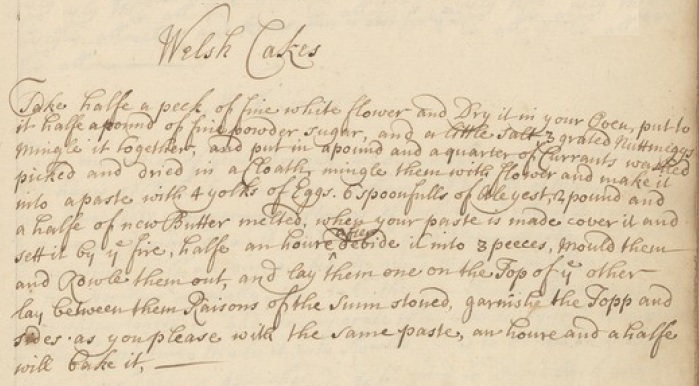
I have therefore been more than a little mollified by this week’s recipe, which I found in the digitised manuscript collection of the Welcome Library. It comes from the recipe book of Dorothea Repps (nee Fountaine) and dated 1703, when she was just 21 and already married to John Repps. I am extremely fond of this manuscript book, for Dorothea’s handwriting is bold, confident and easy to read, and adorned with swooping flourishes. This recipe for Welsh Cakes appears very early on in the book and consequently I feel confident that she must have recorded it  no later than 1710.

What I find curious, quite apart from it pre-dating most other Welsh Cake recipes by at least 150 years, is the fact that Dorothea spent her life in Norfolk, just about as far east and distant from Wales as you can get without falling in the sea. There’s nothing else in her book that is particularly Welsh, so its presence is something of an enigma. Also curious is the form that Dorothea’s Welsh Cakes take: a single, large, layered yeast cake sprinkled with currants and sandwiched with raisins.

Welsh Cakes Recipe
From MS 7788, Wellcome Library Collection

As with many recipes of this age, the quantities of ingredients are huge, and reflect the catering-size amounts required in a large house. I scaled them down to something more manageable and baked it as described and I have to be honest, it was a bit heavy. Nice, but decidedly door-stop. So I had another go, making even smaller, single-serving versions, with just two layers of the currant dough sandwiching the plump raisins. They were very neat, and baked to a lovely golden brown, but…..ordinary. Despite the richness of the mix, the oven heat, even without fan convection,  made the outsides of a crustiness that all the post-baking basting with milk failed to soften.

Having concentrated so much on the presentation, after carefully cutting and shaping these little filled cakes, I found myself left with quite a lot of trimmings. I can’t abide waste, so I decided to gather them together, re-roll and cut them like modern Welsh Cakes. Since the oven was in use baking the sandwich version, I thought I might cook these in a dry pan on the stove top. And this spur of the moment decision provided the secret to revealing the deliciousness of this recipe. For cooked in the traditional bakestone manner, they are extraordinary.

The thin crust that forms from contact with the warm pan (for a gentle heat is all they require) surrounds a yeast-raised interior so delicate and feather-light they almost disappear. They are at their best hot from the pan, sprinkled with a little caster sugar.

This combination of a centuries-old recipe, with a relatively modern form and method of cooking produces a real tea-time delicacy.  Wherever she gathered this delightful recipe from, I’m grateful to Dorothea Repps for recording it in her book so that we can enjoy them today. If you’re in Norfolk, you can stop by and thank her yourself: she is buried in the place where she lived until the ripe old age of 78 and lies surrounded by her family, in a vault in the magnificent church  of St Peter and St Paul, in Salle.

Dorothea Repps’ Welsh Cakes

You can, of course, use your own favourite spicing/flavourings for these Welsh cakes, instead of Dorothea’s suggestion of nutmeg. I suggest no more than a total of 1 teaspoon of whatever spices you choose.

Makes 16-20

225g plain flour
pinch of salt
½-1tsp freshly grated nutmeg
15g icing sugar
80g unsalted butter
1 large egg yolk
50-100ml milk
10g fresh yeast
40-60g currants

caster sugar for sprinkling

  • Mix the flour, icing sugar, salt and spices in a bowl.
  • Whisk 50ml of milk and the yeast together, then add the yolk and stir thoroughly.
  • Melt the butter and allow to cool a little before whisking in the milk/yeast mixture.
  • Add these wet ingredients to the dry and knead until the mixture comes together in a soft dough. Add more milk if necessary.
  • Knead for 10 minutes until smooth.
  • Knead in 40g of the currants. If it looks a little sparse to your tastes, add more until the desired level of fruitiness is achieved. Oooh, Matron!
  • Cover and set aside to rise until the dough has doubled in size. Due to the richness of the mixture, this may take between 1.5-2 hours.
  • When risen, tip the dough out and pat gently to deflate. Use a rolling-pin to roll the dough out to a thickness of 1.5cm.
  • Use a fluted, 5cm cutter to cut out little cakes, making sure each one contains a sprinkling of fruit. Re-roll trimmings until all dough has been used.
  • Cover lightly with plastic wrap and set aside to rise for 30-45 minutes.
  • When ready to cook, gently heat a thick-bottomed, heavy pan on your stove. My induction hob goes from 0-9, and I cook these on 5. I also place the cakes around the edge of the pan, avoiding the concentrated heat of the middle. The dough is rich with butter, so no further oil is required.
  • Bake the cakes until lightly browned on each side and the centre is cooked through: around 7 minutes for the first side, and 6 minutes on the second. Turn them gently, as the uncooked tops will have risen due to the heat and will be extremely light and easily deflated.
  • Remove the cooked cakes from the pan and sprinkle the tops lightly with caster sugar.
  • Serve warm, or allow to cool on a wire rack and store in an airtight box. Warm gently before serving

Soda Cake

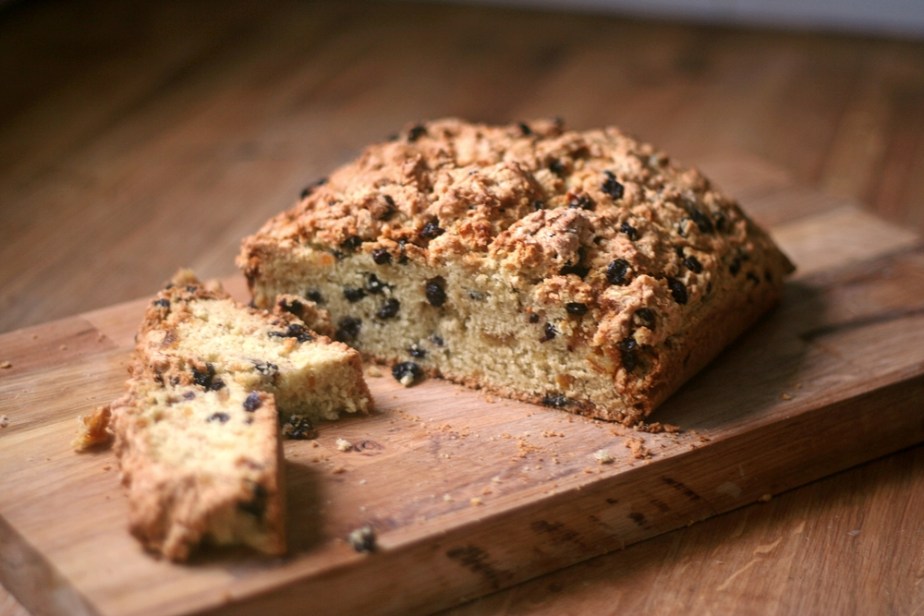
This was a spur-of-the-moment bake this week, and in just over 1 hour after reading the recipe, I was taking this picture. Not as fast as scones, admittedly, but made from store-cupboard ingredients and comes together in mere minutes.

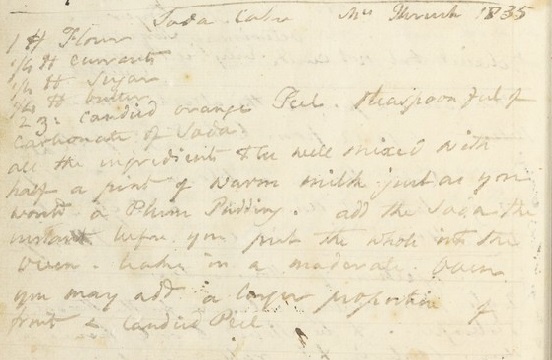
I found the recipe in a manuscript recipe book from The Wellcome Library, an impressively long-lived book containing over 100 years of family entries, starting around 1750.

The use of bicarbonate of soda became popular in the 19th century for its speed and ease of use, especially in areas where fresh yeast was difficult to come by.  This is a very early recipe – not the earliest I’ve found – that award goes to the recipe in “The Virginia Housewife” by Mary Randolph, published in the US in 1824, but this recipe has the added deliciousness of currants and candied peel.

Notes in the book suggest a larger proportion of peel and fruit can be used if liked, but I think it’s perfect as is. Best enjoyed fresh from the oven, it is delicious plain and also spread with an indulgent layer of butter.

You can add a little lemon juice to sour the milk if liked – the bicarbonate reacts best with acidity – or you could use buttermilk, a mixture of milk and plain yogurt or whey.

Soda Cake (1835) MS4645, Wellcome Library

Soda Cake

450g plain flour
115g currants
115g caster sugar
115g unsalted butter
60g candied orange peel – diced small
1tsp bicarbonate of soda
240ml milk/buttermilk/yogurt+milk/whey

  • Preheat the oven to 180°C, 160°C Fan.
  • Butter a square, 20cm tin or cover a baking sheet with parchment if you want to bake it freeform.
  • When the oven is heated, mix the flour, currants, sugar, peel and soda in a bowl.
  • Melt the butter in the microwave or in a pan on a low heat.
  • Add the milk (or whatever liquid you are using) to the melted butter and pour into the dry ingredients.
  • Mix thoroughly and either shape into a round on the baking sheet or in the tin, if using. Try and mound the mixture up into a dome shape, if possible, but don’t faff about too much The quicker you get the cake into the oven after adding the liquid, the more lift you’ll get from the reaction of the soda.
  • Bake for 50-55 minutes, until a skewer inserted into the middle comes out clean. Turn the sheet/tin around after 30 minutes to help with even colouring.
  • Cool the cake on a wire rack.
  • Enjoy warm.


Sally Lunn

The Sally Lunn is a traditional, enriched tea bread that hails from the West Country city of Bath. It is a completely separate item to a Bath Bun, which is an enriched dough, traditionally filled with fruit and peel, topped with a smattering of sugar nibs.

The Sally Lunn has been likened to a British brioche, rich with dairy and eggs, but not sweet. The traditional shape is round and tall, allowing it to be easily sliced horizontally, usually into three, before being loaded with lashings of butter or, as asserted by Dorothy Hartley in her 1954 book Food In England, cream. More descriptively, she actually wrote:

“This yellow-white bun was an infernal trouble to make, taking from sunrise to sunset to raise, was made gold on top with the beaten yolks of eggs, and split hot and embosomed in clouds of cream”.

I don’t know which recipe Ms Hartley was referring to, but the ones I have read seem straightforward enough. As with all yeast-raised goods, this requires only sufficient time to rise, which involves practically no input from the maker whatsoever.

The first mention of the Sally Lunn bun has for years been accepted as 1780 when, in his publication “The Valetudinarians Bath Guide”, Mr Philip Thicknesse wrote:

I had the misfortune to lose a beloved brother in the prime of life, who dropt down dead as he was playing on the fiddle at Sir Robert Throgmorton’s after drinking a large quantity of Bath Waters, and eating a hearty breakfast of spungy hot rolls, or Sally Luns.

making them arguably the first buns so good they were simply to die for.

Moving on from this grisly-yet-detatched account, I’m going to rock the Sally Lunn world with some newly discovered snippets of information that pushes their provenance back even earlier in the eighteenth century.

Firstly a song, published in 1778 in The Gentleman’s Magazine” the opening lines of which read:

A general Invitation to Sally Lund at Spring Garden

Ye Beaux and ye Belles, who resort to the Wells,
Come to Bath, your loose guineas to fund;
One and all I invite, free from envy or spite,
To feast upon sweet Sally Lund.

Spring Gardens were the pleasure gardens set out across the River Avon, east of Bath, which held public breakfasts twice a week, with musical accompaniment, at sixpence a head.

Just to, if not rain, then certainly drizzle a little, on Bath’s bun parade claim to fame, in 1776, a (long and, to be honest, rather dreary) poem published in The Westminster Magazine contained the lines:

Where Donnybrook surveys her winding rills,
And Chapelizod rears her sunny hills
Thy sumptuous board the little loves prepare,
And Sally Lun and Saffron cake are there.

placing these teatime treats surprisingly, but very firmly, in the Dublin countryside.

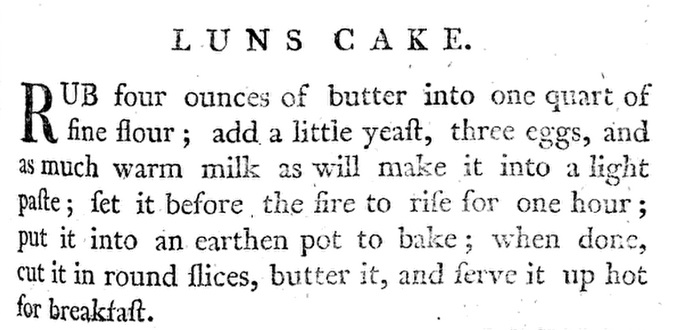
And finally, we have a recipe. The only recipe I’ve been able to find that actually dates from the eighteenth century. A recipe which predates all other mentions by several years and comes, not from elegant, regency Bath, but from Newcastle in the north-east of England. Discovered in a book published in 1772 by Mary Smith, it admittedly doesn’t have the exact same name, but it is recognisably similar. In addition, the recipe itself does indeed make a bun that fits the description of a Sally Lunn, right down to the traditional serving suggestion.

Luns Cake

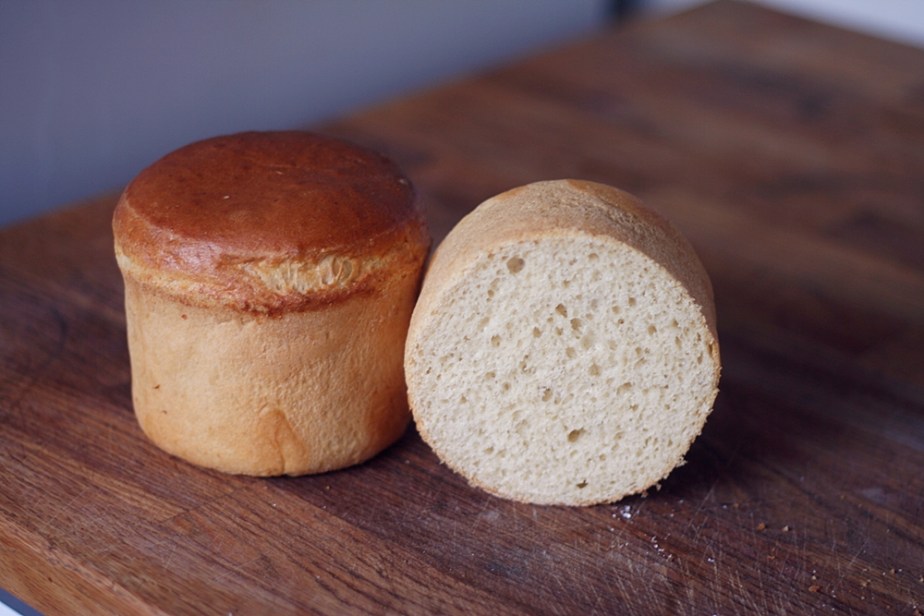
As well as the early date and surprising location of this recipe, there are two further interesting details: the single rise and the bakeware. When a dough is enriched with dairy and eggs, it lengthens the amount of time required for the yeast to do its work. This explains why, in old recipes, the dough is first set to rise, and only afterwards are the enriching ingredients kneaded in, just before the dough is shaped.  Enriching dough can be something of a double-edged sword, because yes, the result is very delicious, but also, without the correct proportion of liquid, or time, it can turn out heavy. The single rise here means that the initial, exuberant frothiness of the yeast is tempered with the rich ingredients, ultimately producing the perfect balance of both richness and lightness.

Luns Cake

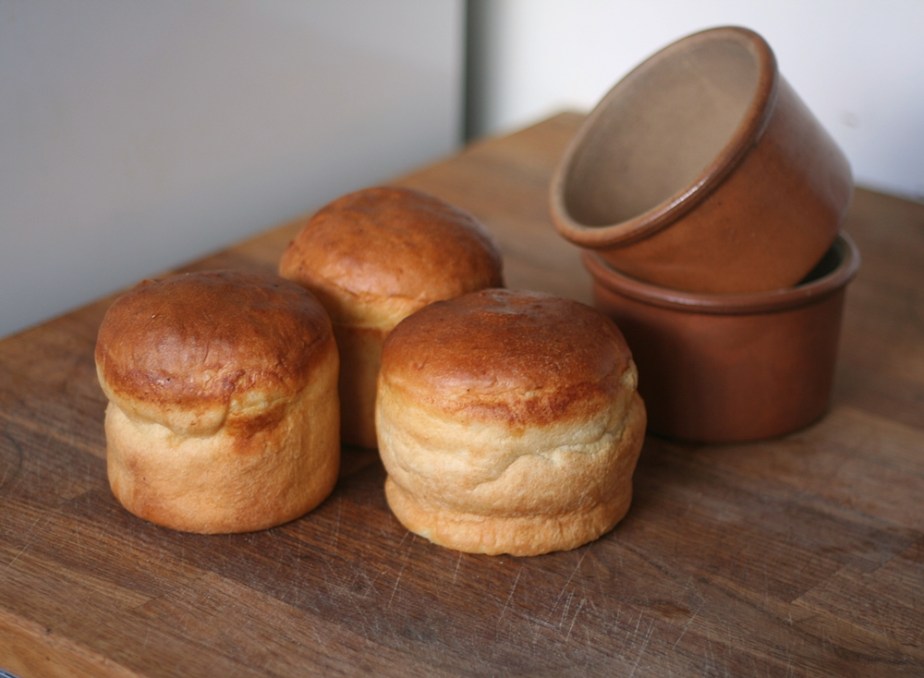
The second detail was the recommendation for an earthenware pot to bake it in. It makes sense – a metal tin would get very hot in the brick oven and the enriched dough would run the risk being scorched. Early test batches of this recipe were baked in some red, 10cm, tapas dishes like this. However, on a visit to a French market I found some ceramic mustard jars (shown in the top image) and they proved the perfect shape to allow the dough to really soar whilst still remaining protected from the heat of the oven.

Mary Smith’s (Sally) Luns Cake

1772

450g plain flour
20g fresh yeast
60g unsalted butter
300ml milk, plus more to mix (maybe)
2 large eggs

  • Put the flour into a bowl and crumble in the yeast.
  • Melt the butter in a small saucepan over a low heat, then remove from the heat and add in the milk. Swirl to mix.
  • Whisk the eggs, add about 2/3 of them to the milk mixture, then pour the liquids into the flour.
  • Mix to a soft dough, adding more liquid if required.
  • Knead for 10 minutes.
  • Divide the dough evenly between your baking dishes (or tins if you haven’t anything else). The mustard pots took 150g of dough, the tapas dishes about half of that. Shape into round, smooth balls and place in the greased dishes/tins to rise for about an hour.
  • Preheat the oven to 180°C/160°C Fan.
  • Use the remaining egg to gently brush the tops of the risen buns lightly. Make sure the egg doesn’t drip down the sides as it will cause the dough to stick.
  • Bake for 30-50 minutes, depending on the size of your buns, until well risen and golden brown on top.
  • Remove from the dishes promptly and allow to cool on a wire rack.
  • Store the cooled buns in an airtight box and warm gently in the oven before serving.

Robert May’s Chicken Pie

Robert May had an extensive and impressive career spanning over fifty-five years and the most tumultuous part of the seventeenth century, from the twilight of the reign of Elizabeth I, through the civil war, the protectorate and the restoration of the monarchy. His cookery book, The Accomplisht Cook, was first published in 1660, when he was in his mid seventies,

As a boy, he apprenticed in France and upon his return worked for many important Catholic families in England. As a consequence, his book not only chronicles multiple decades of British food, but thanks to the generosity of his patrons, that of France,  and via printed recipe books, of both Italy and Spain. In his preface, May praises the generosity of hs patrons in allowing him the funds to prepare food at the highest quality, and admits that not all purses will be able to stretch to all of the recipes he presents. He nevertheless holds it his responsibility to pass as much of his 55 years of knowledge as he can. For the most part he claims that with his book:

the Reader shall find most of the Compositions, and mixtures easie to be prepared, most pleasing to the Palate, and not too chargeable to the Purse; since you are at liberty to employ as much or as little therein as you please.

On which note we come to this recipe.

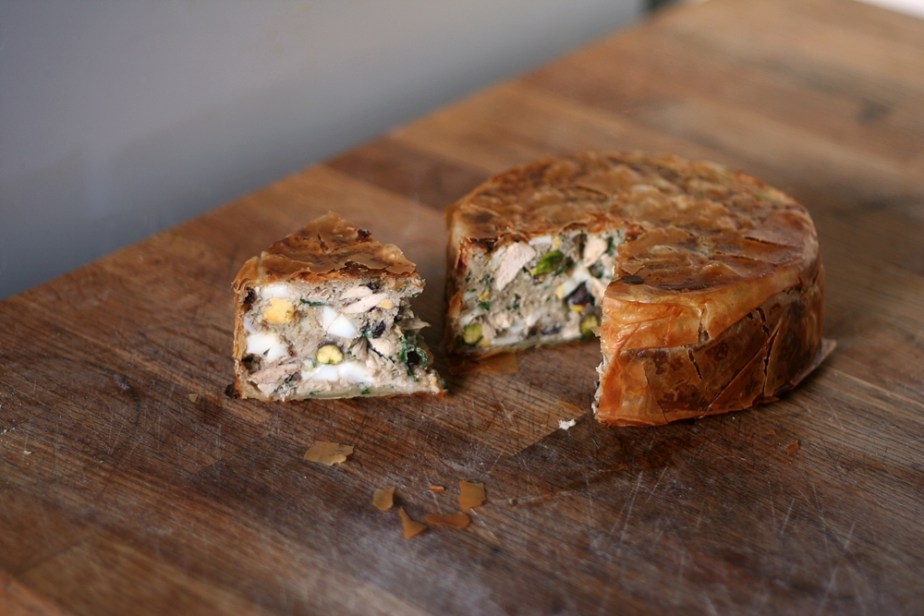
There are two variations of this recipe in The Accomplisht Cook, with only trifling differences between them: one has nutmeg and pistachios, the other cream and breadcrumbs. It is a fraction of a much larger and more ostentatious banqueting dish, and constitutes merely the centrepiece. Robert May has called it a “Pine-Molet”, which is later defined by Randle Holme¹ in 1688 as:

a Manchet of French Bread, with a hole cut in the top, and all the crum taken out, and filled with a composition of rost or boiled Capons minced and stamped to a Paste, with sweet Herbs, Eggs and Spices, &c. and so boiled in a cloth; and serve it in strong Broth, with several sorts of Fowls about it.

This definition seems to have come from a reading of May’s own recipes, as there is no indication of the name being used prior to 1660. It is quite possibly a corruption from French of “pain mollet” a light, spongy bread introduced to France in the early 17th century and much admired and sought-after by, if not the great and the good, then definitely the wealthy, including the queen, Marie de Medici. In following Robert May’s advice, I have decided to dispense with the ‘garnish’ of several cooked birds and focus on the stuffed loaf, because it is so deliciously original, and have opted for baking rather than boiling. Leftover chicken never looked so good!

I tried several variations of the recipe, in terms of both the filling and the exterior, and have made only slight adjustments in order to keep the flavours authentic, and appetising to our 21st century palates. I like all three variations seen here, each delicious in its own right.

Pine Molet Loaf

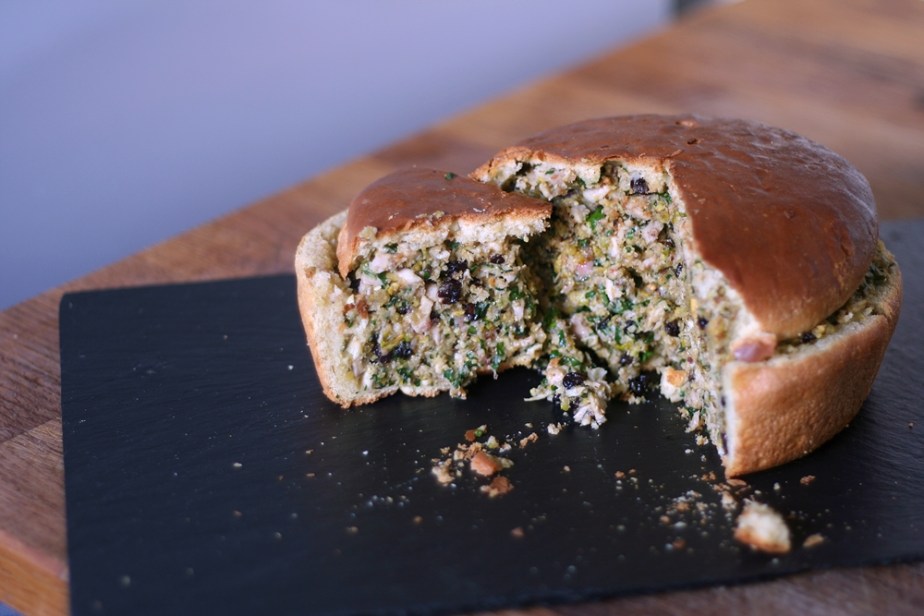
The filling is a wonderfully unusual but distinctly savoury jumble of meat, eggs, herbs, nuts and spices, bound with more egg and with a smattering of currants. Seen here, chopped uniformly and baked in an enriched milk bread loaf, the crust has been moistened with stock to prevent it drying out as it bakes in the oven. The result is a crisp outside and a moist and savoury inside. Delicious eaten hot, the pie firms up as it cools, making it ideal for picnics and outings.

Pine-Molet Loaf 2

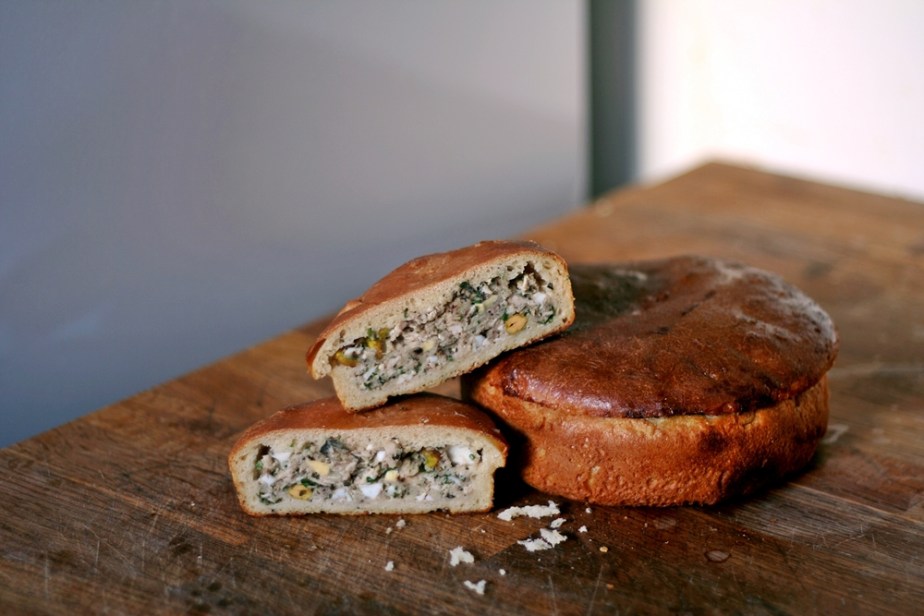
In this version, the filling has been chopped less finely, so that the different elements can be easily distinguished. In addition to the large loaf, I have also baked some smaller, individually-sized buns, perfect for a packed lunch.

Pine Molet Filo

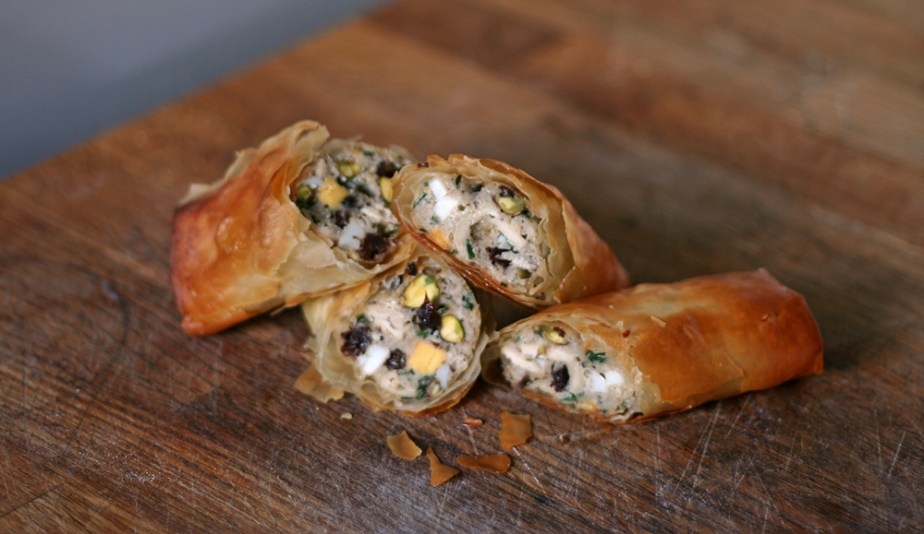
This third variation has been baked in filo pastry for a thin, friable but deliciously crisp and buttery exterior. This is the same mixture as the pie on the main photograph, with the filling pleasantly chunky and the different elements providing interest visually as well as through taste. This is best enjoyed at home, as the pastry doesn’t retain its crispness once cooled, and would therefore not travel well.

Robert May’s Chicken Pie

You can customise the proportions of the ingredients to suit your  own personal tastes, but the following is both flavourful and delightfully different.

75g breadcumbs
100g shelled pistachios
50g ground almonds
50g currants
4 large eggs – hardboiled, chopped²
2 large eggs – whisked
300g cooked chicken – chopped
1/2 nutmeg – grated
1/2 tsp ground cinnamon
1 tsp salt
1/2 tsp coarse ground black pepper
1tbs fresh chopped (or 1.5tsp dried) each of chopped thyme, chives, rosemary, marjoram
2tbs chopped fresh parsley.

(optional) chicken stock

A large round loaf/brioche, buns or 1 pack of filo pastry and butter for brushing.

  • Mix all of the ingredients together well. Set aside while you prepare the loaf/pastry.
  • If using a loaf or buns, cut off the ‘lid’ neatly and hollow out the interior. Keep enough structural integrity so that the walls remain standing (no thinner than 1cm). Blitz the insides to breadcrumbs and use in the filling if required.
  • If using filo pastry, generously butter a 24cm spring-form tin and line with sheets of filo.  Brush each sheet with melted butter and allow at least 10cm of the sheets to hang outside the tin.
  • Check the filling for moistness: the breadcrumbs and almonds will have absorbed some of the moisture, so if required, add in stock until the mixture is moist but not over-saturated. Check the seasoning by frying a little patty of the filling in a pan, then tasting and adjusting as necessary.
  • Spoon the filling into the prepared loaf/buns/tin.
  • For the stuffed loaf/buns: add the lid and brush the outsides with either stock or water. Wrap in foil.
  • For the pie:  fold over the excess filo pastry to cover the filling. Cover with a loose bottom from a springform tin, or a baking sheet, and add a weight. I use a large, smooth rock, wrapped in foil.
  • Preheat the oven to 200°C/180°C fan.
  • Bake for 30-40 minutes until the filling is cooked and the pastry/crust is crisp. To check, use a probe thermometer, which should read at least 75°C-80°C. If making the smaller filo parcels, cooking time is reduced to 20-25 minutes.
  • For the stuffed loaf/buns: remove the foil and place on serving dish, or if eating cold, keep wrapped until required.
  • For the pie, remove the weight and baking sheet/base. place your serving plate on top of the pie and flip over. Remove tin and serve.

¹ The academy of armory, or, A storehouse of armory and blazon (1688), Holme, Randle (1627-1699), Chester

² The original recipe (as seen in the first loaf picture) suggested yolks only. I subsequently chose to use the whites as well, to avoid having to find a use for them. If you have a favourite go-to recipe, then by all means omit the whites from the filling.

Malt Scones

My current lack of oven (for those interested the ETA is currently mid-February) has prompted me to delve into my small but eminently interesting collection of Victorian and Edwardian commercial bakery books in search of something to ‘bake’.

Back in the day, there were numerous recipes that could be baked on a griddle, a far more varied selection than the standard trio of Welshcakes, muffins and crumpets generally known today.

Admittedly, these do tend to be variations of a theme of ‘scones’, but the range available with just slight alterations of the ratio of ingredients is delightful.

The recipe I’ve chosen today is for an unusual griddle scone, as it is flavoured with malt, and every other version I have read has been for oven-baked scones only. I’m a great fan of malt loaves,  and have been since childhood, and they’re pretty straightforward to make at home. The 2-5 day wait for them to mature once baked, however, is frustratingly long.

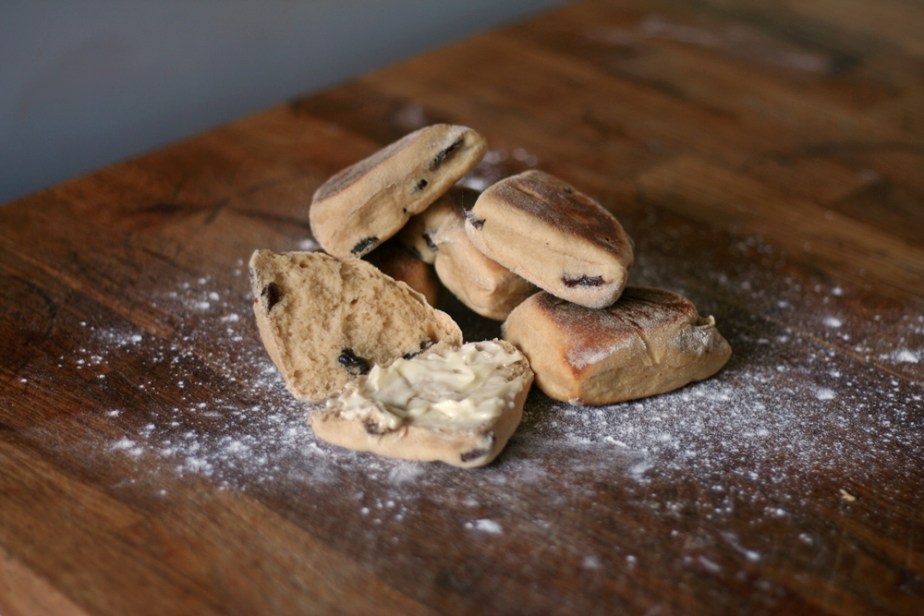
Not so with this recipe. Cooked in just 10 minutes on the stovetop, they can be enjoyed on day of making either fresh from the griddle or cooled, split and buttered. The delicate malt flavour is probably most pronounced when the scones are freshly baked and cooled. Interestingly, these use both yeast and raising agents to achieve their light and fluffy texture, as well as just a single proving.

These are not SWEET sweet scones, although the malt and the sultanas do place them on the sweet side. I was delighted to discover that, with the original quantity of sultanas (30g), they are delicious with cheese. For a sweeter bite, double this quantity and enjoy them split and buttered.

This batch makes twelve, so if this is rather too much for your needs for one day, you can either freeze some, warm them in the oven (just flaunt your oven-ness at me why don’t you!?) or enjoy them toasted and buttered.

Malt Scones

Makes 12

Ferment
150ml warm water
10g    fresh yeast
2 tsp sugar – brown or white
1tbs plain flour

225g plain flour
35g unsalted butter
30g sultanas
60g  malt extract
½tsp cream of tartar
¼tsp bicarbonate of soda

  • Whisk together the ferment ingredients and set aside in a warm place for 30 minutes until frothy.
  • Put the remaining ingredients except the sultanas, into a food processor and blitz until the malt and butter are fully incorporated,
  • Tip the flour mixture into a bowl.
  • Gradually stir in the frothy ferment until the mixture comes together as a soft dough. NB Depending on the moisture levels of the rest of the ingredients you might not need all of the ferment.
  • Knead for 10 minutes.
  • Add the sultanas and mix thoroughly.
  • Divide the dough into three (about 150g each, or 170g if using the larger amount of sultanas).
  • Roll into a smooth ball, then pat out by hand to a 12cm circle.
  • Cut into quarters and set the farls onto a floured board to rise for 45 minutes.
  • Heat a heavy-bottomed pan on the stove top. I use a cast iron, non-stick pan on the largest ring set to the lowest heat. Allow the pan 5-10 minutes to come to an even heat before you start cooking the scones. If your pan doesn’t have a thick base, then choose a smaller heat and watch carefully that the scones don’t become too dark.
  • Cook the scones in batches, for 5 minutes per side until risen and lightly browned.
  • Cool on a wire rack.
  • Store in an airtight container once cold.

Salmon Tartare

I find this recipe a delight because it’s such a modern-sounding dish, yet it is about 350 years old.

It comes from one of my favourite manuscripts at The Wellcome Library, MS3009, owned initially by Elizabeth Jacob, which has been dated to 1654-c.1685.

Intriguingly, I also found it in a second, anonymous manuscript, MS8097, dating more generally to the 17th and 18th centuries.

Usually, when I find recipe duplication such as this, it suggests that the recipes have been copied from a common third source or possibly from each other, but that doesn’t seem to be the case here. Whilst the recipes are broadly similar, they are also slightly different to each other: oil and olives in one, no oil and the addition of marjoram in the other.

Firstly, Elizabeth Jacob’s version, which at some subsequent date has incurred the wrath of a later owner and been severely crossed out. Nevertheless, it is still legible:

ejsalmon
MS3009, Wellcome Library Collection

And the second recipe:

anonsalmon
MS8097, Wellcome Library Collection

I have been unable to find anything in print even remotely similar to these recipes, in any century, quite part from limiting it to the seventeenth century. Most hashes that I found tended to involve either baking or poaching in their execution.

With the two manuscripts being acquired independently and over 70 years apart, there is little chance of a connectionbetween them and precious little biographical or geographical background details to pursue.

So the origins of these two variations are destined to forever remain an enigma.

A curious, but delicious, enigma.

SalmonTartareB.JPG
Hash of Fresh Salmon with black olives

Hash of Fresh Salmon

Mid 17th Century

I’ve opted for Elizabeth Jacob’s version, with the olives, and substituted pickled cockles for the oysters. If you’re not a fan of olives, why not try the other versionwith marjoram and the oil-less dressing?

Serves 4 as a starter

200g skinless fresh salmon fillet
8 olives – bright green Castelvetrano are eye-catching, black olives for contrast
1 x 155g jar pickled cockles
4 spring onions
3-4 sprigs curly-leaf parsley
zest of 1 lemon
1-2 tbs of a light vinegar, lemon juice or cockle pickle liquid
3-4 tbs salad oil
salt and pepper to taste

4 slices wholemeal toast

dill sprigs and lemon slices to garnish

  • Wrap the salmon in cling film and freeze for about 30 minutes until firm. This will help to slice it evenly.
  • When chilled, cut into 1cm slices. Remove any skin or blemishes, then dice into 1cm cubes. Be sure to use a sharp knife and try to keep the cuts as clean as possible. Put the prepared salmon into a bowl.
  • Cut the olives into 5mm dice and add to the salmon. Discard the stones.
  • Shred the white parts of the spring onions very finely and add 2 tbs to the salmon.
  • Strip the parsley from the stalks and chop finely. Add 4tbs to the salmon.
  • Drain the cockles, reserving the liquid, and add 4tbs to the salmon.
  • Grate the zest of half the lemon into the salmon.
  • Toss the salmon ingredients together gently.
  • Mix 1tbs vinegar or cockle pickle with 2tbs of oil and season with salt and pepper.
  • Pour the dressing over the salmon mixture and fold through.
  • Taste, and adjust seasoning if necessary. Add more onion/olives/cockles/parsley/zest if liked.
  • To serve:
    • Use a baking ring or round pastry cutter to cut out a circle of toast.
    • Divide the salmon mixture into four and pile one portion on top of the toast. Flatten the surface.
    • Transfer to the serving plate and remove the ring by pressing down onto the top of the salmon.Grate a little lemon zest on top of the tartare.
    • Garnish with lemon slices and sprigs of fresh dill.

Staffordshire Oatcakes

Staffordshire Oatcakes are, quite possibly, the best regional speciality you’ve never heard of.

In fact, that is much more of a generalisation than you may realise, because they’re specifically regional to North Staffordshire, centering on the area around Stoke-on-Trent.

It’s historic origins are mixed, with some anecdotes suggesting they originated from soldiers returning from India and trying to reproduce the chapatis they had eaten, with local produce. A more likely scenario, is as one of the various traditional ‘bakestone’ items found in workers cottages all over the country. With wheat being a valuable commodity, most people used flour from cheaper oats and barley, and with a cooking time of mere minutes, they are surprisingly sustaining.

They can be eaten hot from the pan, but as with other griddle bakes such as muffins, crumpets and pikelets, they can be made in batches, and then toasted as required, making, if anything, an even speedier snack.

Oatcake shops used to be small and plentiful, with sales being made through open windows. Alas, the last of this kind of  shop, the Hole In The Wall in Stoke-on-Trent, closed down due to re-development of the area in 2012. Commercial producers are still churning out batches in 6s and 12s, and they are even stocked by some of the large supermarket chains, but they taste best when home-made. Obvs.

Before we get to the recipe, a word or two about ingredients…

  • These oatcakes are made mostly of oats, in the form of oat flour. If you want to hunt out some oat flour, then have at it, but I’ve found, through trial and error, that whizzing some steel-rolled oats in a spice grinder is both easier and cheaper. You could probably use a blender as well, as they too have the off-set blades necessary to chop the oats into a suitable fineness. Whatever is easiest being the main order of the day.
  • You can use instant yeast, but I must admit, the batter made with fresh yeast always tastes better to me.
  • I’ve read a lot of recipes and watched many a documentary clip on Staffordshire Oatcakes and I’m going to confess up front that this recipe might be viewed poorly by oatcake devotees. It makes a batter that is rather thicker than the traditional, which results in a thicker oatcake. In my defence, it makes for a more durable oatcake which I can then turn easily in the pan without it breaking, and it ‘laces’ beautifully, with the surface becoming dappled with the characteristic pockmarks and holes seen also on pikelets and crumpets. The thickness also allows for a wonderful contrast when toasted between the crisp outsides and the fluffy insides. If all this is a heresy to you, feel free to dilute the batter down to your liking after the 1-hour rise.
  • If you have a decent non-stick pan, you can cook these fat-free.

Staffordshire Oatcakes

280g oat flour – ground from steel-rolled oats
110g stoneground wholemeal bread flour
110g strong white bread flour
1tsp granulated sugar
1tsp table salt
20g fresh yeast, crumbled or 1 sachet fast-action yeast
450ml whole milk – warmed
450ml warm water

  • Put everything into a large bowl and whisk together with a balloon whisk. Alternatively, use a stick blender.
  • Cover with cling film and leave in a warm place to rise.
  • Heat a non-stick pan over medium heat. If your pan is in need of a little help, use a sparing layer of fat (bacon fat or lard) to help prevent your oatcakes from sticking.
  • Gently stir your oatcake batter. The yeast and rising time will have turned it into a liquid with the consistency of frothy double cream.
  • Put 1 ladle/cup of batter into the middle of your pan and tilt the pan around until the batter has spread fully. Don’t be tempted to use the back of your ladle/cup to spread the batter out, as it’s very easy to spread it too thin and either make holes in the middle, or edges so thin they begin to burn before the middle is cooked.
  • The moisture in the batter will soon evaporate, leaving a lacy surface of holes and craters where bubbles from the batter burst.
  • Allow the oatcake to cook until there is no moisture visible on the surface – about 2 minutes.
  • Using a spatula or slice, loosen the edges and then the undersides of the oatcake until it is freely sliding around in the pan.
  • Flip the oatcake over and cook for another 2 minutes or until the surface is starting to brown (see photo).
  • When done, slide out of the pan onto a wire rack to cool.
  • Continue until all the batter is used up. This will make a batch of about 10 sturdy oatcakes.

As the oatcakes cool, they will soften and take on the appearance of a floppy pancake. Wrap in plastic and store in the fridge until required.

Oatcakes for Breakfast/Brunch/Snack/Whenever

You can put whatever you like in your oatcakes, but a filling of bacon and cheese is not only traditional but forms one of those rare, simple ingredient combinations that border the sublime.

You will need:

oatcakes
back bacon rashers – 2-3 per oatcake
grated vintage cheddar cheese

Sauce – brown or red (optional)

  • Grill your bacon or cook in a pan until beginning to caramelise. Set aside and keep warm.
  • Take your oatcake and put into a hot, dry pan – ideally the one you originally cooked it in. An oatcake has two very different sides, the pockmarked ‘front’ and the smooth, brown ‘back’. Put the ‘back’ of the oatcake into the pan first.
  • Allow the oatcake to heat through for 1.5-2 minutes.
  • Flip the oatcake.
  • Sprinkle the cheese over the hot ‘back’ (which is now uppermost) of the oatcake. It will melt as the other side toasts.
  • When the underside of the oatcake is warmed through and crisp, lay 2-3 rashers of bacon on top of the melted cheese on one half of the oatcake and fold the other half of the oatcake over (as in the photo).
  • Slide onto a plate and enjoy with sauce, if liked.
  • Repeat as often as necessary.


Hot-Pickled Herring

This recipe is something of a contradiction because, despite the name, it is eaten cold.

The slow poaching in a lightly flavoured vinegar neutralises the oiliness of the herring to a certain extent, and the herbs and onion make for a fine, delicate flavour.

This method is also much quicker than the traditional method of sousing herring, which involves both brining and marinading in spiced vinegar over several days. You can put this dish into the oven at 6pm, cook and then leave to cool in the oven overnight and it is ready to eat the following day. This method also has the advantage of dissolving all the tiny pin bones that abound in herring, leaving just the backbone to lift free when served.

The recommended dressing is for oil and vinegar, but a little crème fraiche or even the strained cooking liquid are also enjoyable.

Pickled Herring Recipe
Source: MS1795, Wellcome Library Collection

Hot Pickled Herring

1 herring or 2 herring fillets per person
1tsp salt
1tsp black pepper
100g butter
1 large bunch of thyme.
2 onions, sliced thinly into rings
1 litre white wine vinegar to cover

  • Cut off the herring heads and tails if necessary. Rinse and pat dry.
  • Sprinkle the herring wth salt and pepper.
  • Slice the butter thinly and lay half in the bottom of an oven-proof dish.
  • Arrange a layer of onion and thyme sprigs and lay the herrings on top.
  • Repeat the layers of butter, onion/thyme and herring until the dish is full (or ingredients are finished).
  • Pour over sufficient white wine vinegar to cover the herring, then cover the dish with a double layer of cooking foil, tied tightly with string.
  • Preheat the oven to 200°C/180°C fan/gas 6.
  • Bake for 4 hours, then remove and set aside to cool completely.
  • Serve cold.