Blog

Pickled Cherries

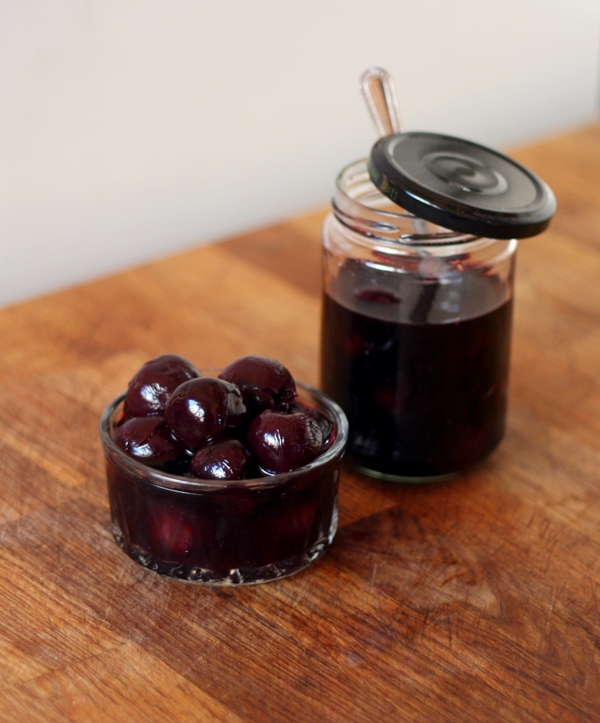
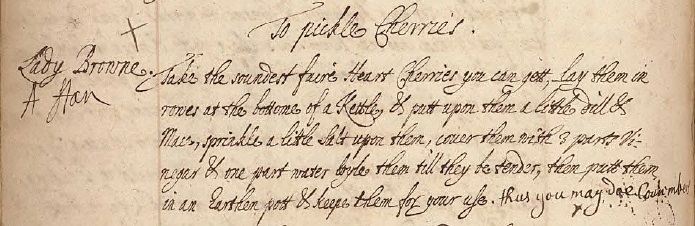
This recipe comes from the manuscript receipt book of Lady Ann Fanshawe at The Wellcome Library – page 292 by Lady Ann’s numbering. It is very quick and straightforward and not that different to the other pickled cherry recipes around, except for the seasonings.

Lady Ann favours mace and dill which were unusual enough to tempt me to try. The recipe also calls for the very best heart cherries, which are cherries that have a soft and rounded heart shape. A bit of research into old varieties reveals that heart cherries could be both dark or pale. I’ve gone with dark, and used a little red wine in place of the original water, in order to help preserve the colour of the fruit. If you can get pale dessert cherries, then swap the red wine for white.

The original recipe contained no sugar, which was a bit much even for a vinegar-lover like myself, so I have tweaked the recipe and added a little brown sugar to soften the flavour.

Original Recipe
Source: MS7113, Wellcome Library Collections

Pickled Cherries

2kg dark purple cherries
540ml light fruit vinegar – I used home-made gooseberry, but you could use whatever you like, as long as it doesn’t overpower the flavour of the fruit. A white balsamic, for example
180ml red wine
6tbs dark muscovado sugar
3 blades of mace
1 tbs dried dill
½ tsp salt

  • Stone the cherries and arrange them neatly in concentric circles in the bottom of a preserving pan. There should be enough to make a full single layer covering the bottom of the pan.
  • Add the sugar, mace, dill and salt.
  • Gently pour in the vinegar and red wine. This should just cover the cherries.  If you need more liquid add it in the proportion of 3 parts vinegar, 1 part wine.
  • Put the pan on medium heat and bring to a gentle simmer.
  • Cook for 10 minutes, until the cherries are just tender but still holding their shape.
  • Gently spoon the cherries into sterilised jars. Pour in the cooking liquid to cover and seal.
  • Can be enjoyed immediately with ham and terrines, as well as fatty meats such as roast lamb, duck and pork.


Shrewsbury Pudding Tart

Georgiana Hill, 1862

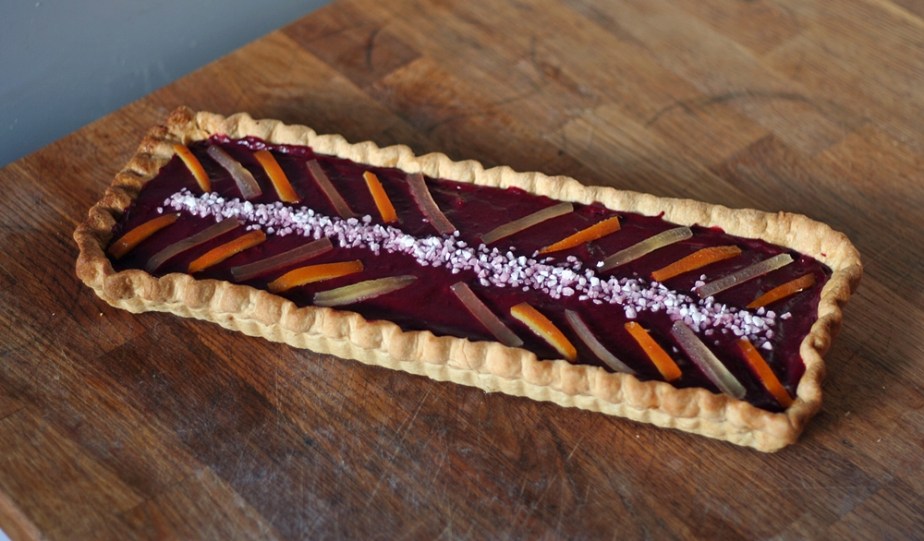
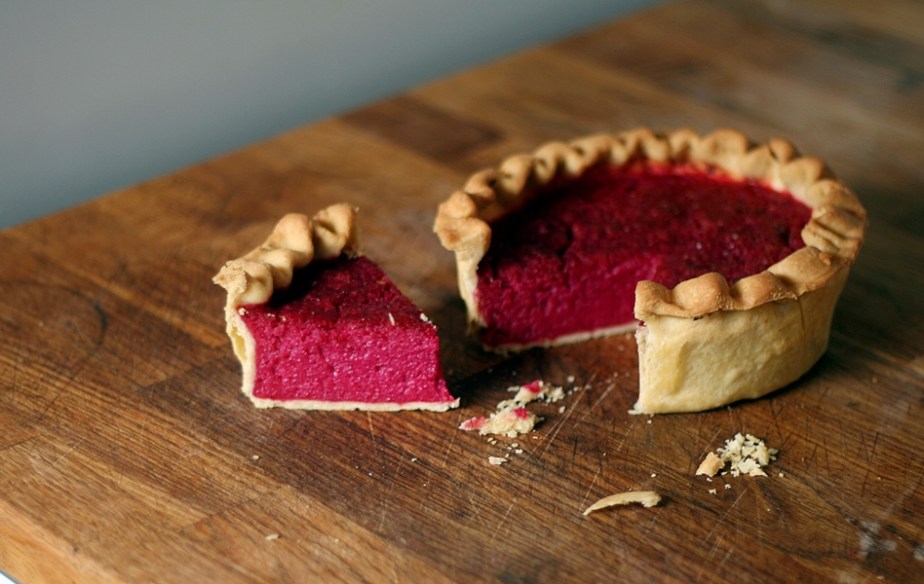
Here is something a little different for the adventurous, an unusual dessert in the form of a gloriously vibrant beetroot tart: given an official Thumb’s Up™ by my daughter. I’ve tweaked this recipe slightly and baked it in a pastry case, for ease of serving. The original method was for a buttered-and-breadcrumbed bowl. The cooking times are roughly the same. The flavour is very light and delicate, the lemon counteracting a lot of the beetroot’s sweetness.

1 x 24cm blind-baked pastry shell

225g cooked beetroot
115g unsalted butter – melted
150g icing sugar
zest of 1 lemon
juice of 2 lemons
3 large eggs
60ml brandy
150-200g fresh white breadcrumbs

  • Preheat the oven to 150°C, 130°C Fan.
  • Puree the beetroot until smooth.
  • Add the butter, sugar, lemon, eggs and brandy and whisk thoroughly.
  • Add in the breadcrumbs BUT not all at once. You want them to absorb a lot of the moisture in the filling, which will vary depending on the freshness of the eggs and the moisture in the beetroot. You might not need all of them. The texture should be similar to a sponge cake mix, but still pourable.
  • Add the filling to the pie shell and place the tin on a baking sheet.
  • Bake for 25-30 minutes until the filling has set. Turn the baking sheet around after 15 minutes to ensure even baking.
  • Cool on a wire rack.

Old-Fashioned Lemonades

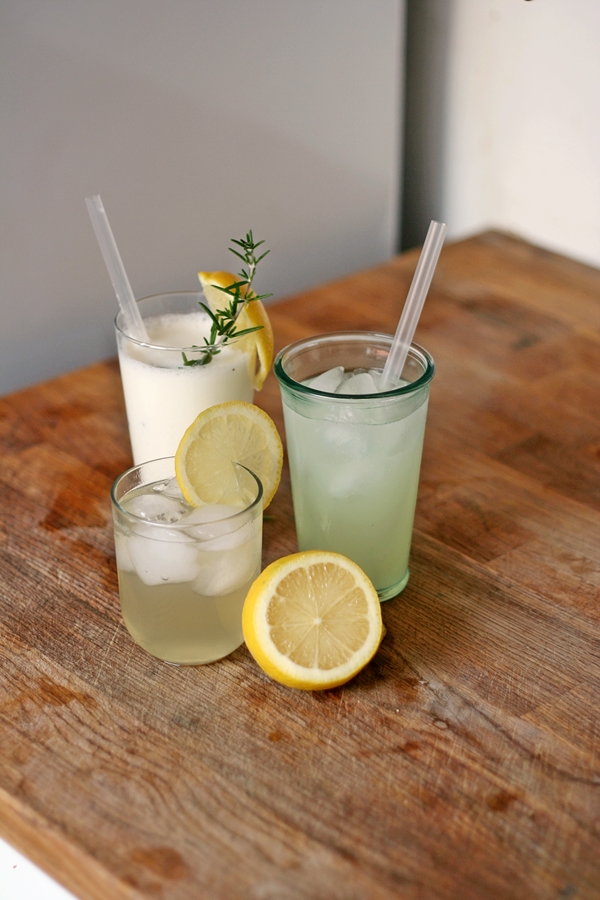
I don’t think I’ve done drinks on the blog before, but I’ve got a trio of delicious variations on lemonade, originating in the 17th century manuscript books at the Wellcome Library. They are each wonderfully thirst-quenching and will make for a delicious treat to have in the fridge.

Mrs Yorke’s Lemonade – the best that can be made

From the recipe book of Mary Rooke, 1770s (back right in photo).

Mary Rook's Original Recipe
Source: DDU 818/1, Essex Record Office

225g granulated sugar
225ml fresh lemon juice (from 4 juicy lemons – have 5, just in case)
Thin strips of peel from 4 lemons
900ml boiling water
450ml boiling milk

  • Put the sugar, lemon juice, thinly peeled lemon peel into a bowl.
  • Pour over the boiling water and stir to dissolve the sugar.
  • Cover with plastic and allow to cool.
  • When cold, pour in the boiling milk. NB The lemon juice will cause the milk to curdle. DON’T PANIC – THIS IS FINE.
  • Cover with plastic and allow to cool, then chill overnight in the fridge.
  • Strain the solids out by passing the lemonade through a fine-mesh sieve.
  • Strain the lemonade finely by passing it through a jelly bag, or a double layer of muslin. Be sure to scald the muslin first by pouring boiling water over it, then squeeze out the excess moisture.
  • To have your lemonade especially clear, rinse the muslin thoroughly and double the layers to 4 and pass the lemonade through it again. This will take longer than the first time, due to the greater number of layers of material.
  • Taste and add more sugar if liked. For adults only, you can add 225ml of white wine. Choose one with light, citrus flavours.
  • Chill thoroughly.
  • Serve over ice.

Cool Summer Drink

Anon., 17th century (back left in photo).

Original Recipe
Source: MS8097, Wellcome Library Collection

This is a very refreshing drink similar to an Indian lassi. The milk will tend to separate slightly, so blending the drink just before serving helps combat this.

450ml milk
400ml water
½ tsp rosewater – I use Nielsen Massey
Juice of 2 lemons
1/4 nutmeg, grated
1 sprig rosemary
1 tbs granulated sugar

Slices of lemon and sprigs of rosemary to serve

  • Bruise the rosemary to release its flavour by gently tapping the leaves with a rolling-pin.
  • Put all of the ingredients into a jug.
  • Cover with plastic and allow to infuse for 2 hours in the fridge.
  • Remove the rosemary and strain the drink by passing it through a fine-mesh sieve, which will catch any rosemary leaves that might have fallen from the stem.
  • Using a stick blender or liquidiser, thoroughly mix the drink to an even consistency.
  • Serve at once.

Lemonada

Anon., 17th century, (front left in photo).

Lemonada Original Recipe
Source: MS8097, Wellcome Library Collection

600ml light and fresh German white wine – Liebfraumilch or Reisling
450ml water
225g granulated sugar
Juice of 2 lemons
juice of 1 orange
5cm stick of cinnamon
1/4 nutmeg in 1 piece
thumb-sized piece of fresh ginger, sliced thinly

  • Put all of the ingredients into a pan over a low heat and stir until the sugar is dissolved.
  • Bring to the boil, cover and remove from the heat.
  • Allow to steep until cold.
  • Strain to remove solids and chill in the fridge until required.
  • Serve over ice.

Fruitbowl Tea Loaf

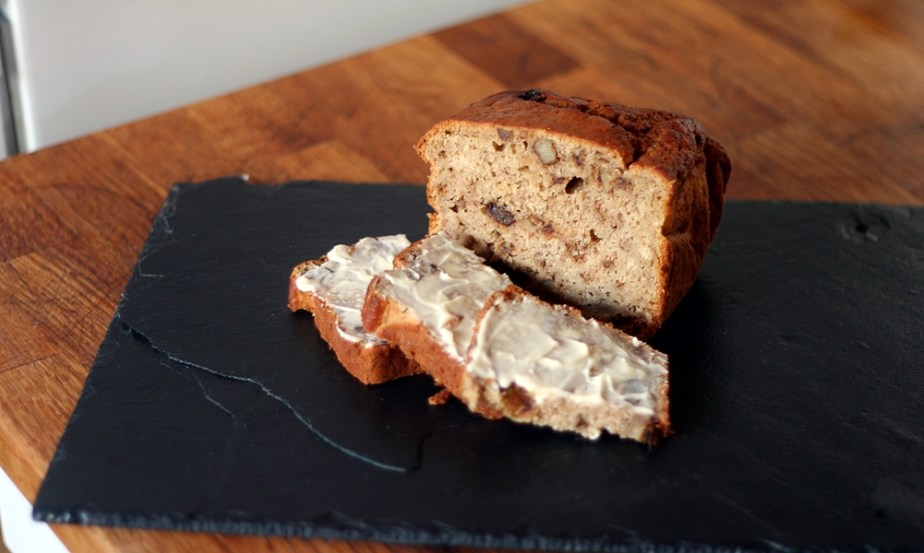
Retrieved from  an old farmhouse baking book, this recipe has dates and walnuts, which make for a delicious tea loaf, but can also make it a little dry, almost dusty, especially if the walnuts aren’t in their first flush of youth. Deliciously, the inclusion of mashed bananas helps with the moistness and the apple sauce really brightens the flavour with its freshness. Neither flavour dominates, making the loaf wonderfully flavoursome. Finally, it is brought to a rich, batter consistency by a splash-ette of lager – and indeed, Lager Loaf was the original recipe title – but that sounds too much like Lager Lout to my ears – which is far from tasty – so I feel justified in renaming it.

And it is a distinct improvement to eat spread with butter, with a cup of something hot.

Fruitbowl Tea Bread

You don’t HAVE to make this with the apple – if you have the eggs, just use two and no apple.

85g unsalted butter
1tbs golden syrup
85g soft brown or light muscovado sugar
1 sharp eating apple, e.g. Jazz or Braeburn
1 large egg
280g self-raising flour
¼ tsp bicarbonate of soda
½ tsp cream of tartar
pinch of salt
150ml lager
2 ripe bananas, peeled and mashed
125g chopped dates
50g walnuts, roughly chopped

  • Preheat the oven to 180°C, 160°C Fan.
  • Grease and line a 1kg loaf tin with parchment paper. Tear off a second piece of parchment and make a fold down the middle. This piece will be used during the baking.
  • Peel and core the apple, then grate finely into a small saucepan. Cover with a lid and heat gently until the apple has broken down into a puree. Sieve to remove any lumps. If you’re impatient, whizz it in a small food processor.
  • Gently warm the butter, syrup and sugar either in a pan or using the microwave, until melted.
  • Add the lager and apple puree, then whisk in the egg.
  • Mash the bananas. Make sure your dates and walnuts are also chopped and ready.
  • Sift the flour, bicarbonate of soda and cream of tartar into a bowl.
  • Add the liquid mixture and stir thoroughly.
  • Quickly fold through the bananas, dates and nuts and pour into the prepared tin.
  • Place into the oven and prop the second piece of parchment over the tin with the fold at the top, rather like a tent. This will prevent the top of the loaf from becoming too dark during baking.
  • Bake for 30 minutes, then remove the ‘tent’ and bake for a further 15-20 minutes.
  • Be sure to test the cake for done-ness using a cocktail stick/skewer/cake tester before removing from the oven – the moisture in the bananas and apple will make it very moist, so be sure it’s baked all the way through, especially towards the bottom.
  • Allow to cool in the tin for 10 minutes before removing to a wire rack to cool completely.
  • Serve sliced and buttered, and store in an airtight container.

18thC English French Bread

Bread is a curious topic to go a-hunting in the recipe archives because there are relatively so few recipes. Considering how central it was for such a large part of the population, the proportion of recorded recipes is surprisingly low.

The reason for this might be similar to that often cited as being behind Marco Polo’s failure to mention paper money in his account of travels in China: familiarity. It is a theory that Polo was so familiar with its usage after his many years in the country, and since his memoirs were written so long after his return, he completely forgot the surprise and wonder that the concept paper money would have for his readers. Perhaps the ability to make bread was so fundamental, so ingrained, few thought to write down the recipes since it was a skill everyone possessed.

It was also, however, a specialised craft, requiring both skill and equipment to produce on a large-scale, not to mention the unsociable hours and back-breaking work mixing huge quantities of dough without machinery. As such, as hard, manual labour, it was firmly in the province of the labouring classes, however skilled.

The more well-to-do, whose recipes have survived in household manuscript books, seem to have been partial to French bread, and it has been interesting to note the numbers of recipes for French bread consistently exceeding those for anything English. A large proportion of them are variations on this recipe, using egg whites as part of the liquid component.

French Bread recipe dating from 1703, MS7788 in the Wellcome Collection

I chose this 1703 recipe because of its simplicity – other recipes use whole eggs/butter/milk/cream, and I wanted to see whether the egg-whites had a noticeable effect on the flavour and texture of the loaf without any other distractions. The answer is yes – it is certainly different to a bread made without egg-whites. There’s no way to tell whether this is a genuine approximation of the French bread of the time, but I suspect that it wouldn’t have been too far removed from the sourdough bread enjoying a resurgence today.

Traditional sourdough, baked in a wood-fired oven, is a wonderful thing – insanely crusty with a great ‘chew’. It’s not to everyone’s tastes, though – which is where this loaf might gain favour. After baking, the crisp crust softens as it cools, making it easy to slice without the dangers of crust fragments ricocheting off at alarming speeds that comes with cutting a traditional sourdough. The crumb is open and springy with enough of a chew to make it very satisfying. From the photo above, it would appear that the centre of the loaf actually has a more open texture than the edges. It can be relished spread with just a little butter – and how long is it since you can say you honestly enjoyed a slice of white bread and butter?

I’ve obviously scaled this recipe down from the original and have made just one change: salt. True to my own code of conduct when working with old recipes, I did bake it ‘as written’ in the first instance, and while it had the great crust and texture described above, the flavour was lacking. Finally, I find it amusing to note that 300 years after it was jotted down, this recipe still takes just 30 minutes to bake.

18th Century English French Bread

450g strong white bread flour
1 sachet fast-action yeast
1tsp salt
50ml egg-white whisked with 300ml warm water
Additional warm water (maybe)

  • Mix the flour, yeast and salt in a bowl.
  • Whisk together the eggwhites and the warm water and add to the dry ingredients.
  • Mix thoroughly, adding more water if required (unlikely), to form a rather soft dough.
  • Knead for 10 minutes.
  • Cover lightly with plastic and set in a warm place to rise for 1 hour. If your kitchen is on the cool side, you can turn the oven to 160°C, 140°C Fan for 2 minutes, then switch it off and put in your dough to prove.
  • Tip out the risen dough and pat gently to deflate.
  • Shape the dough into a smooth ball and transfer to a greased 1kg loaf tin. The dough should half-fill the tin. If you’d prefer a taller loaf, use a smaller or longer shape.
  • Set aside to rise for 30 minutes. On cold days I put the loaf into the small top oven while the main oven below warms up.
  • Preheat the oven to 200°C, 180°C Fan.
  • Bake for 30 minutes, turning the loaf around after 20 minutes to help colour it evenly.
  • Cool on a wire rack.
  • Slice when cold.

Sweet Shortcrust Pastry

This pastry has been scaled down from a recipe I found in a Victorian/Edwardian commercial bakers’ book. It’s an all-butter (and therefore vegetarian) pastry  and includes a small proportion of cornflour. This makes the pastry extra crispy, which isn’t always easy with an all-butter pastry. It also gives it a really smooth, almost silken, dry feel which makes it very easy to handle.

60g cornflour
225g plain flour
140g butter
1 large egg
85g icing sugar
ice-cold water

  • Put all the ingredients into the bowl of a food processor and blitz until the mixture resembles breadcrumbs.
  • Gradually add the water, one tablespoon at a time, until the mixture comes together in a ball.
  • Knead smooth, then roll out.
  • Cover with plastic and chill for 30 minutes.


Hard Sauce

100g unsalted butter – softened
150g caster sugar
120ml cream sherry, or any favourite alcohol

  • Whisk the softened butter until extremely light and fluffy. This is easiest with a stand mixer and paddle attachment, but electric mixer is fine.
  • Add the caster sugar and continue whisking until even paler and fluffier.
  • Gradually add the sherry a tablespoon at a time until fully incorporated. The mixture should look like thick whipped cream.
  • You can either use as is, or do the following for a pourable sauce.
    • Spoon the mixture into a small pan and put over the lowest heat possible.
    • Allow the mixture to melt, and DO NOT stir. It will slowly form a creamy sauce the consistency of double cream.
    • Pour into a jug and serve at once.

Spiced Strawberry Tart

Jane Parker, 1651 adapted from The Good Huswife’s Jewell, 1587

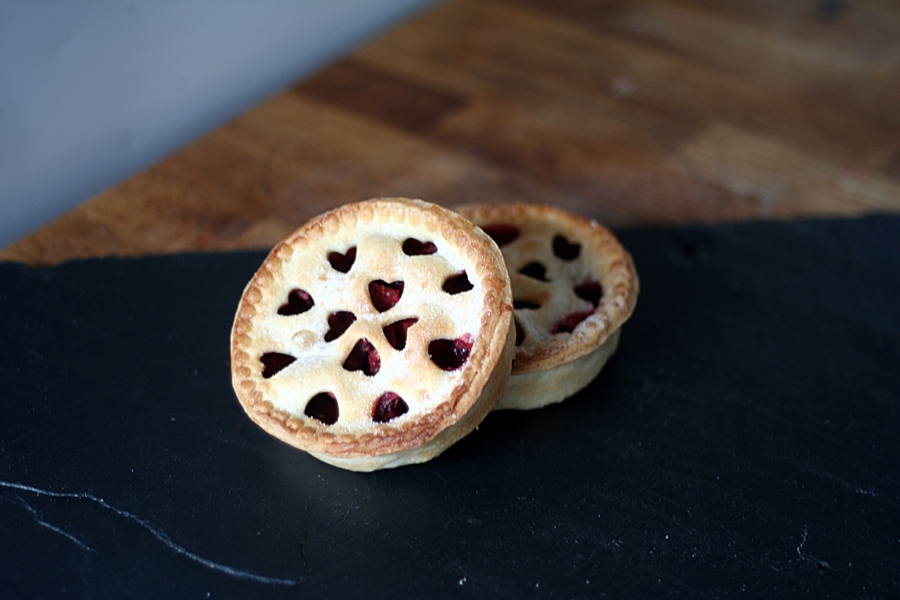
I was drawn to this recipe because it involved spicing strawberries and baking them in pastry, both details being so different from how we tend to use strawberries today. Originally, I was delighted to find the recipe in Jane Parker’s manuscript recipe book¹ but some months later, when I found an earlier version in a cookery book from the previous century, it became at once both more interesting and more delightful. Thomas Dawson’s recipe for strawberry tart², was published in the middle of the reign of Elizabeth I, and is, in all honesty, a little sparse on the level of detail to which our 21st century eyes are accustomed when it comes to recipes. Indeed, it is so brief I can quote it in full below:

To make a tart of strawberries

Wash your strawberries and put them into your Tarte and season them with sugar, cinnamon, and ginger and put in a little red wine into them.

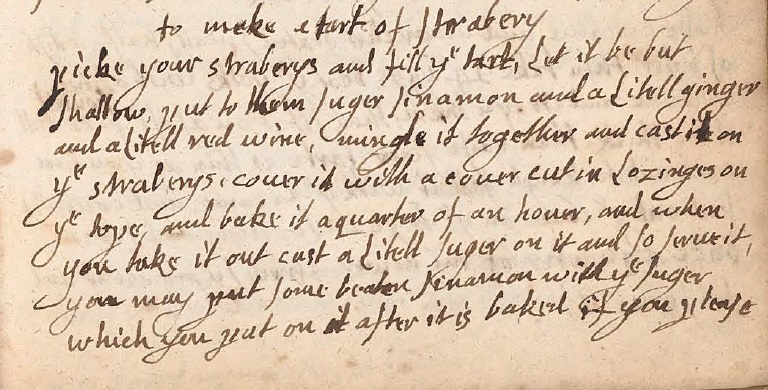
No quantities, cooking times, or even mention of a pastry recipe. It would appear Jane Parker also thought a little extra detail was required, and her recipe is as follows:

Jane Parker's Recipe
Source: MS3769, Wellcome Library Collection

Whilst there’s still no pastry recipe, we do have more detail in terms of presentation: the tart should be shallow, the pastry lid should have diamond cutouts, baking time of 15 minutes and a sprinkling of spiced sugar over the baked tart. These additional details, to my mind, highlight the fact that, even if she didn’t actually make the tart herself, Jane Parker definitely got the recipe from someone who had, as these details are precisely the kind of personal touches an experienced cook would note down for future reference.

After centuries of refinement, the strawberries we now use are impressively large but much milder in flavour than those that would have been used for this originally Elizabethan tart. If you can find sufficient wild strawberries either to mix with your ordinary strawberries or, decadently, to use on their own, their deep aromatic flavour, together with the wine and spices, will make for a much more robust flavour to this unusual Tudor tart.

Spiced Strawberry Tart

1 batch of Sweet Shortcrust Pastry

600g fresh strawberries
3 tbs caster sugar
1tbs cornflour
1tsp ground cinnamon
1 tsp ground ginger
½ tsp coarse ground black pepper
60ml red wine or port
Milk for glazing
1tbs caster sugar
1tsb ground cinnamon

  • Preheat the oven to 200°C/180°C fan/gas 6.
  • Roll out the shortcrust pastry thinly. The thinner the pastry, the less time it will need in the oven and the freshness of the strawberries will be all the better for it.
  • Cut out four lids for your tarts. Cut them generously so that there is sufficient pastry to form a seal with the pastry lining the tins. Use a small diamond cutter or any small shape, to cut a lattice into the lids. Be careful not to cut too close to the edge, otherwise they will be tricky to attach to the rest of the pastry.
  • Gather the trimmings and re-roll the pastry.
  • Grease and line four individual pie tins with the pastry. Let any excess pastry hang over the sides for now.
  • Prepare the strawberries: Remove the stalks and cut into small pieces, either 4 or 8, depending on the size of the strawberries.
  • Put the cut strawberries into a bowl and sprinkle over the red wine. Toss gently to coat.
  • Mix the sugar, cornflour and spices together. Sprinkle over the strawberries and toss gently to mix.
  • Divide the strawberry filling amongst the tins and smooth over.
  • Moisten the edges of the pastry and place the lids over each tart. Press firmly to seal, then trim and crimp the edges
  • Brush the tops with milk and bake for 12-15 minutes until the pastry is cooked and lightly golden.
  • Mix the remaining caster sugar and cinnamon together and sprinkle over the hot pies.
  • Cool on a wire rack.

¹ MS3769, Wellcome Library.
² The Good Huswife’s Jewell, 1587

Nectar Rice Pudding

I received an email from a friend this week, being very complimentary about this rice pudding recipe I’d given her. She wrote “This is so yummy on a chilly winter day in Melbourne!” I made a mental note to put it on the blog in the autumn, but then I got up this morning and looked out the window at the clouds and the cold and the rain and decided that you all needed this recipe today.

Adapted from May Byron’s wartime Pudding Book (1917) it is an absolute delight in a number of ways. It’s a variation of the traditional, some would say nursery, pudding, but these variations elevate it much higher than its list of ingredients might at first imply. For a start, the method is markedly different from the traditional, first boiling the rice in water  followed by a slow simmer on the stove top, then just a brief 20 minutes in the oven. Cooking time is practically halved, compared to the traditional method requiring 2 hours baking and the result is astonishingly soft and creamy. The best part of this recipe, however, is the flavourings. Against just a suspicion of vanilla, the mandarin peel imparts a light and fragrant note, which is in turn enhanced by the aromatic honey and flakes of coconut. The whole dish is lifted out of the nursery and into something altogether more elegant and refined, whilst still retaining it’s simplicity.

Very definitely a grown-up treat for a gloomy, rainy Sunday in June.

Nectar Rice Pudding

120g pudding rice
580ml whole milk
75g granulated sugar
1 large or 2 medium mandarin oranges
½ tsp vanilla extract
280ml double cream
4 large yolks
70ml aromatic honey – acacia, orange blossom, heather, etc
2tbs unsweetened dessicated coconut

  • Bring some water to the boil and add the rice.
  • Cook for five minutes, then drain well in a sieve.
  • Put the rice, milk, and sugar in a thick-bottomed, lidded pan.
  • Peel the mandarins.
  • Eat the mandarins.
  • Put the peel into the pan with the rice.
  • Add the vanilla.
  • Cover the pan and put over the lowest heat available.
  • Simmer softly for 40 minutes, stirring every 10 minutes.
  • Mix the cream, yolks and honey together.
  • Preheat the oven to 140°C/120°C Fan.
  • After the 40 minutes is up, remove the mandarin peel and discard.
  • Pour in the cream and honey mixture. Stir briskly whilst pouring to ensure the eggs don’t cook immediately and curdle.
  • Stir the mixture over the heat until the mixture almost simmers, then pour into a deep oven-proof bowl. To achieve the perfect consistency after baking, the mixture should be about 5cm deep in the dish.
  • Sprinkle the coconut over the surface.
  • Bake for 20 minutes until just wobbling in the middle, and golden brown and bubbling on top.
  • Allow to cool for at least 10 minutes.
  • Serve warm.

Old English Bread Pudding

Mary Bent, circa 1670

I adore everything about this recipe. For a start, it epitomises the very British traits of not only being a hot pudding, but also having been created from almost nothing. The ingredients are modest, the flavouring minimal, yet these simple, little puddings are a real delight. Even more so when you realise that these were already being looked upon with nostalgic fondness when Mary Bent recorded this recipe in the middle of the seventeenth century. Where modern bread puddings tend towards the solid and the fruited, this 350 year old recipe is light and delicate as a souffle.

Original Recipe
Source: MS1127, Wellcome Library Collection

Old English Bread Pudding

125g fresh breadcrumbs
300ml milk
2 large yolks
1 large egg
2tbs caster sugar
1/4tsp salt
freshly grated nutmeg

  • Warm the milk until just below boiling then pour over the breadcrumbs and allow to soak for 15 minutes.
  • Preheat the oven to 160°C/140°C fan/gas 3.
  • Whisk the egg and yolks and pour into the breadcrumb mixture. Add the sugar, salt and grate the nutmeg.
  • Stir everything together until a smooth mixture.
  • Generously butter four pudding basins and pour the breadcrumb mixture evenly amongst them.
  • Arrange the basins on a lipped baking sheet.
  • Bake for 45 minutes, turning the baking sheet around after 20 minutes to ensure even browning.
  • When cooked, allow the puddings to rest for a couple of minutes, then run a knife around the sides of the pudding bowls and turn out.
  • Serve with a few fresh berries and whipped cream or Hard Sauce .