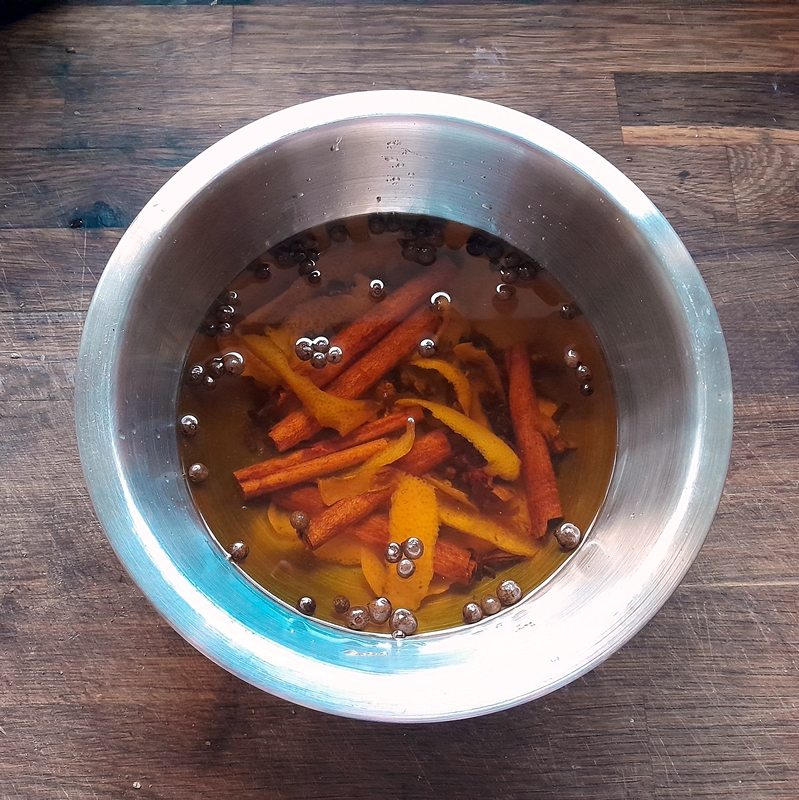
Christmas Spiced Butter

With only a month to go, I recently realised it’s high time I got my act into gear vis-à-vis some festive recipes.

I have for you here something that I’ve been making for the past few years and, with spectacular timing, only remembering about it come the 24th or so, which is far too late to go about suggesting people add to their military campaign-esque festive ToDo list.

I initially got the idea a few years ago whilst making a batch of Niter Kibbeh, the very aromatic Ethiopian spiced butter used in making the red lentil stew Misir Wat.

It is butter that is flavoured with seasonal spices, and is a doddle to make. I use clarified butter in the form of a tin of ghee, because delicious though browned butter is, the milk solids are easily burned. I simmer – although that is rather too strong a word for sitting on heat 1 of the hob, so perhaps ‘infuse’ is more fitting – whole spices and citrus peels and then allow the flavours to infuse overnight as the butter cools. The use of whole spices keeps the spicing soft – although I have opted to add in ground spices if the whole ones are unavailable. The only downside of using ground spices is that they will speckle the butter, being too small to strain out. Depending on your use of the finished butter, this may not be an issue. Next day, I slowly warm the mixture and, when melted, strain out the solids and pour the beautifully aromatic and flavourful butter back into the tin in arrived in, for ease of storage.

You are then free to use it wherever you see fit in your festive baking.

Brandy Butter and Spiced Hard Sauce: These are rich and delicious accompaniments to both mice pies and Christmas pudding. Equal quantities of icing sugar and butter are whisked with brandy, or indeed any alcohol of your choice, and/or vanilla to produce a light and frothy mixture that you can spoon onto your bakes where it will gently melt and turn into a sauce.

Mincemeat: In case you haven’t seen the recipe, my guilt-free Mincemeat (based on Hannah Glasse’s 1747 recipe) offers all the delights of traditional mincemeat, but without suet, fat or any added sugar and is both vegetarian and vegan. Delicious as it is, you can elevate it to luxury levels by adding a little Spiced Christmas Butter for added richness.

Pastry: Using Spiced Christmas Butter in pastry  adds a whole new dimension to your mince pies and other Christmas fare such as this Welsh cranberry tart.

Shortbread: Why not try your favourite shortbread variation using festive spiced butter?

What Spices Do I Need?

Basically, anything you like. Whilst this might not seem very helpful, I say it to illustrate just how much free reign you can have with this. Either stick to a more traditional mix (see below) or spice it up a little (excuse the pun) with some unusual bits and bobs. You can’t really go wrong, as using whole spices means there’s only ever a gentle flavouring.

A traditional mix might include:

  • cinnamon sticks
  • allspice berries
  • blades of mace
  • whole nutmegs (sliced)
  • cloves
  • orange peel
  • lemon peel
  • sliced ginger (fresh or dried)

Other items you may want to use include:

  • cardamom pods – both green and black
  • star anise
  • aniseeds
  • black pepper
  • cubeb pepper
  • long pepper
  • grains of paradise
  • vanilla
  • saffron
  • licorice sticks
  • caraway seeds
  • coriander seeds
  • cumin seeds
  • rosepetals

All of the spices should be whole, wherever possible. Use anything from 1tsp to 1tbs to your taste.
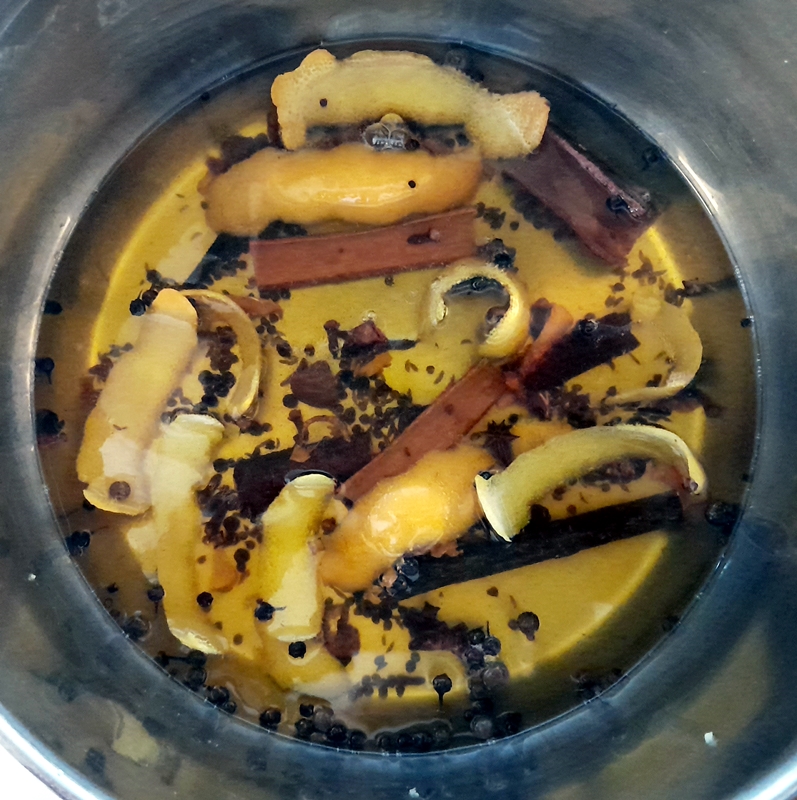
Spiced butter with different whole spices
Another version of spiced butter, this time with grains of paradise, cubeb pepper and aniseed.

Dietary Guidelines

As ghee has had all the milk solids removed, I would venture to suggest that it might even be suitable for the lactose intolerant.

If you are vegan, you can make your own version using solid coconut oil. If you’re not a fan of the accompanying coconut aroma, this odourless brand is available to order online.

Christmas Spiced Butter

I rarely recommend any particular brand, but in this instance I strongly urge you to seek out (it’s not that hard to find – most supermarkets carry this distinctive green and gold tin) East End ghee. It has a heady, perfumed aroma in its natural state, which greatly enhances the end product.

1 x 600g tin of East End ghee.
3-4 cinnamon sticks
1tbs whole cloves
1tbs allspice berries
4 blades of mace
2 whole nutmegs – sliced
thinly peeled skin of 1 orange
thinly peeled skin of 1 lemon
5 slices of fresh/dried ginger
5 star anise

  1. Put everything into a small saucepan.
  2. Cover and set on the lowest heat possible on your stove/hob.
  3. Leave to infuse for 1-2 hours.
  4. Switch off the heat and leave overnight.
  5. Next day, warm slowly over very low heat until melted, then strain the solids out by pouring through a sieve.
  6. When the butter has completely drained, pour it back into the tin.
  7. Label and store in the cupboard for use.

Mince Pie Shortbread

I seem to be on a bit of a shortbread obsession lately, but this is the last post on it for now, promise.

Today I have for you a combination of two festive treats: Mince Pies & Shortbread.

Back in the far off days of the 1980s, I had the distinct pleasure of discovering Jocelyn Dimbleby’s “Cooking for Christmas” – a slim paperback book of recipes, produced in association with Sainsbury’s. Amongst its pages I found Deluxe Mince Pies, a version of which I have had posted over on my other blog for over 12 years now. With their orange pastry and decadent cream cheese and mincemeat filling, if you’re only going to eat one mince pie during the season, it really should be those.

However, even I will admit that they are a bit of a faff and since they are best served warm, it does limit their accessibility. So recently, whilst experimenting with the butterscotch shortbread, I got to thinking whether I could make a mincemeat version, and from there it was just a hop and a skip to re-imagining Jocelyn’s recipe.

This recipe is also an adaptation of recipes I’ve already posted on here, which I love as an example of some real Lego™ thinking, taking two different recipes and smushing them together to create something new.

The shortbread here is standing in for the mince pie pastry, so the only thing I changed was to add some orange zest. The mincemeat is an adaptation of the guilt-free mincemeat, based on Hannah Glasse’s 1747 Lenten mince pie recipe. The potential problem here was whether it would hold together on top of the shortbread, so the slight tweak I made was to increase the quantity of dates, which break down into a sweet and sticky paste during the simmering of the fruit, and firm up when cooled. I increased the spices a little, to compensate for the mincemeat being eaten cold, which tends to dull their potency. I also used an egg-white wash over the top of the shortbread, which when briefly baked forms something of a barrier to keep the moisture from the mincemeat compromising the crispness of the shortbread. Finally, I decided to top things off with white chocolate flavoured with lemon zest, to mimic the cream cheese element of the original mince pies.

Baking a slab of shortbread is a lot more straightforward than battling with pastry and filling and fretting whether the lids are sealed properly and whether the bottoms are properly cooked, etc. Bonus: you can cut your shortbread into as many pieces of whatever size you like.

Mince Pie Shortbread

The Mincemeat

You can make this several days beforehand and store in the fridge, if liked. When required, to make it easier to then spread over the shortbread, put it into a pan, cover and heat on the lowest setting. You might want to add a little more liquid (apple juice/orange juice/brandy/sherry) to help it loosen up. The additional dates add to the sweetness, so if you don’t have a sweet tooth, you might want to substitute the apple juice for the juice of an extra orange or even lemon

50g currants
50g raisins – crimson raisins look pretty
50g sultanas
200g dates – finely chopped
25g candied orange peel
25g candied lemon peel
25g candied grapefruit or citron peel
35g dried cranberries
25g slivered almonds or flaked almonds – chopped
2tbs sherry
1tbs brandy
juice & grated rind of 1 orange
¼ tsp of ground ginger
¼ tsp of nutmeg,
¼ tsp of ground cinnamon
¼ tsp of mixed spice
¼ tsp of ground cloves

60-100ml apple juice or juice of 1 orange/lemon

  • Put the dried fruits into a small saucepan.
  • Cut the candied peel into small pieces with scissors and add to the pan with the spices. NB If you’re using your home-made candied peel that has been stored in syrup, then there’s no need to soften it in the saucepan – just stir it in with the nuts once the fruit has plumped.
  • Add the orange juice and zest, brandy, sherry and 60ml of apple juice (or the extra orange/lemon juice).
  • Stir gently to combine and set pan over the lowest possible heat.
  • Cover and let the mixture stew gently until all the liquid has been absorbed.
  • If the fruit isn’t as plumped and juicy as you would like, add a little more liquid.
  • The mixture should be moist, but with no liquid visible in the bottom.
  • When you’re happy with the consistency, stir through the almonds.


The Shortbread

Make whichever shortbread variation you prefer, regular or gluten-free.

60g soft brown sugar
120g unsalted butter, chilled
180g plain flour – or gluten-free flour
60g your choice of additional flour (rice flour, cornflour, cornmeal, semolina, etc)
¼ tsp salt
zest of 1-2 oranges, depending on size

1 egg-white for glazing

  • Line a small baking tin (18cm x 25cm) with baking parchment. Leave extra parchment overlapping the sides, to assist in moving the baked shortbread.
  • Heat the oven to 160°C, 140°C Fan.
  • Cut the butter into cubes and add to the bowl of a food processor fitted with a blade.
  • Add the remaining dry ingredients and zest to the butter and pulse briefly until the mixture resembles breadcrumbs.
  • Tip the mixture onto the parchment, and press into an even layer.
  • Use a round skewer or cocktail stick to poke holes all over the surface of the slab of shortbread.
  • Bake the shortbread for 30 minutes, turning the tin around after 15 minutes to ensure even baking.
  • Once the shortbread is baked,
    • Remove the shortbread from the oven. Keep the oven on.
    • Whisk the egg white until frothy, then paint a layer onto the hot shortbread and return it to the oven for 3 minutes to set.
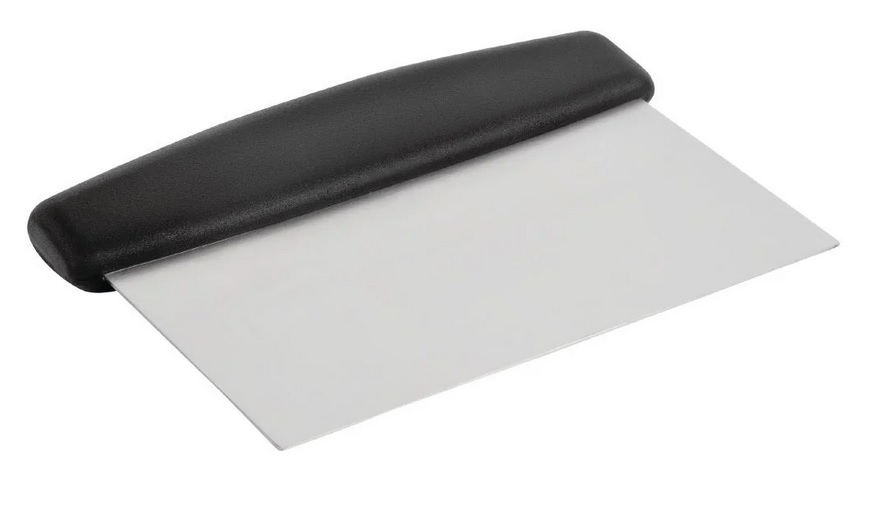
    • Remove the tin from the oven, switch off the heat and using a very thin bladed knife or (ideally, in my opinion) a metal dough scraper, cut the shortbread into pieces. I cut mine lengthwise in half, then across into fingers 2-3cm wide.
    • Return the tin to the cooling oven to cool.

The Topping

250g white chocolate
zest from 1 lemon

  • Break the chocolate into pieces and melt in a bowl either over simmering water, or by zapping in the microwave in short bursts.
  • Stir through the lemon zest.

To Assemble

  • Spread a layer of mincemeat over the cooled shortbread. I didn’t use all of the batch, only about 2/3, but if you’d prefer a thicker layer, have at it by all means.
  • Smooth over the top with a palette knife or similar.
  • Pour over the lemon-flavoured white chocolate and smooth over.
  • Put it in the fridge to set (optional – you can leave it on the worktop if you have the room).

To Divide

In a repeat of the instructions from Butterscotch Shortbread, here is how to ensure your slab of mince pie shortbread emerges in sharp and clean slices.

  • When you’re ready to portion it out, remove your slab of mince pie shortbread from the fridge and set it on the countertop. Leave it to come to room temperature. Trying to cut through the chocolate layer whilst chilled will just shatter it. If your shortbread cooled on the worktop, you can, if course, skip this step.
  • Take a clean cloth or a double layer of kitchen roll and lay it on top of the set chocolate.
  • Lay a cutting board on top of that, and carefully turn the whole slab over, so that once the tin and the baking parchment are removed, the shortbread is uppermost.
  • The lines from cutting the shortbread earlier should be clearly visible.
  • Slide your dough blade into the cuts in the shortbread, then press down sharply to cut through both the mincemeat and the chocolate layers in one clean movement.
  • Make sure you have cut – or rather re-cut – through all of the pieces before trying to move your mince pie shortbread.
  • Store your shortbread in an airtight container. Use a piece of parchment between layers to keep crumbs off your pristine chocolate finish.

Mincemeat a la Royale

This recipe dating from 1900 sits right on the cusp of the centuries and comes from the pastry manual “Savoury Pastry” written by Frederick T. Vine.

I have a bit of a thing for Mr Vine and his manuals. Written for the bakery trade, they are packed with recipes for the variations and huge range of goods that made Victorian bakeries so amazing. Mr Vine also published books on ‘Practical Pastry’, cakes, biscuits, ‘Saleable Shop Goods’ (covering a range of small items), Christmas puddings and bread.

A little trouble needs to be taken in order to scale down the recipes to a more manageable domestic size (the original size of this batch was over 120kg), but it is well worth it in terms of flavour as well as delight in the sheer number of (to our 21st century eyes) innovative and unique baked goods.

Here’s the thing, though.

This traditional mincemeat contains meat.

Stop! Wait! Come back!

I thought it best to be up front about it, because I can then explain why I can thoroughly recommend you try it.

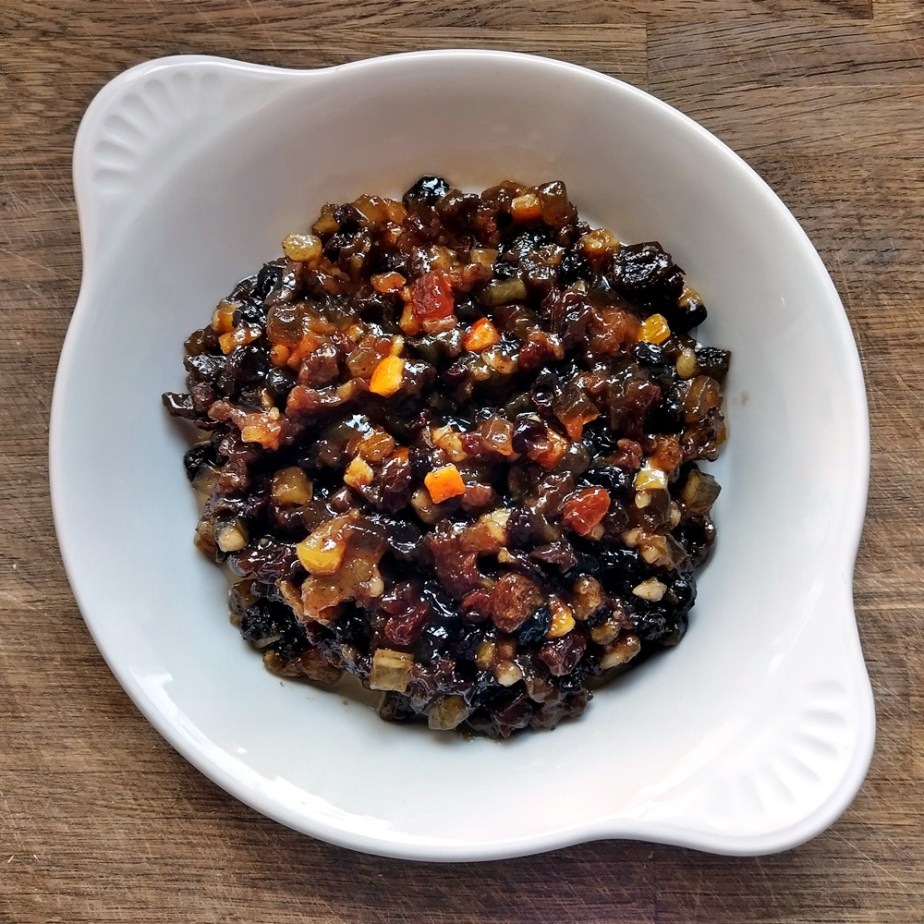
You don’t taste the meat. Well, actually you do, but you don’t realise that you do. It’s an underlying umami taste that makes the whole flavour experience much richer, deeper and just generally bigger. Can you honestly see the meat in the above photograph? No, I can’t either – and I made it!

Having read probably close to a hundred mincemeat recipes spanning five centuries of books and manuscripts, I feel confident in stating that, overwhelmingly, the best meat for mince pies, according to the recipe writers and my own taste testing, is ox-tongue. But I appreciate that that is a bit ‘full on’ for the meaty mincemeat novice, so I have chosen this recipe as a ‘gateway recipe’ to all the wonderful savoury-sweetness that traditional mincemeat recipes hold.

The recipe calls for lean beef. Some recipes I have read suggest that this should be beef fillet, but personally, I think that too extravagant, so my recommendation is for beef skirt, as it’s widely available, lean and economical.

Another reason why I like this recipe is the use of a couple of ingredients that don’t usually get included in modern recipes.

Mincemeat a la Royale

Makes approx. 1.5kg, enough for 36 individual mince pies. Be sure to read the ingredient notes at the bottom of the post.

140g beef skirt
170g fresh suet [1]
265g sharp apples
112g raisins
190g currants
95g sultanas
95g raw sugar [2]
60g citron peel
70g preserved ginger
50g glace fruits [3]
50g candied orange peel
50g candied lemon peel
25g brandied cherries [4]
25g chopped almonds
½ lemon – zest and juice
3tbs/45ml brandy
2tbs/30ml sherry
1/2 tsp each of ground cinnamon, nutmeg, mace, cloves, allspice, ginger, salt

  • Trim any fat/silverskin from the meat and cut into 1cm cubes. The aim for mincemeat is for everything to be roughly the same size. Small, but not so small that it goes to a mush. The meat will shrink as it cooks.
  • Cut the suet into 5mm cubes (obviously skip this step if using dried).
  • Peel, core and cut the apples into 1cm dice.
  • Leave the dried fruit whole, unless, for example, the raisins are very large, in which case cut them in half.
  • Cut the preserved fruit and peel into small dice (5-10mm).
  • Mix everything, including the liquids and spices, together thoroughly.
  • Check the seasoning by heating some in a pan or by zapping in the microwave until the suet has melted, and tasting. Add more spices/salt/alcohol as you think fit.
  • Keep in an airtight container in the fridge until required.


[1] If you can’t get fresh suet, dried is absolutely fine. Atora is the main brand in the UK. NB If using dried, reduce the weight to 120g.

[2] Not 100% sure what Mr Vine means here, so since I had some in the cupboard, I used jaggery. Soft, light-brown or light muscovado is also fine.

[3] Don’t splurge on expensive boxes of preserved fruits just for 50g for this recipe, use a mix of any sweetened and dried fruit you have to hand – glace cherries, pineapple, mango, etc.

[4] I didn’t have any of these, and couldn’t find any in the supermarket, so I used dried cherries and soaked them in brandy. Verr’ nishe. *hic!*.

Mince Pies Royale

Here is a great recipe for stretching a small amount of mincemeat into 30+ rich and delicious seasonable bites.

It is adapted from a recipe by Eliza Acton, and I’ve taken the opportunity to pair it with another of her recipes which she refers to as “Superlative Mincemeat”. Taking as an example my adaptation of Hannah Glasse’s Lenten mincemeat, I decided to try making this recipe suet-free. Now I still absolutely love Hannah’s recipe, but I also love discovering new things as well.

The mincemeat recipe is a delight for anyone who loves citrus fruit. It’s also a delight for anyone who loves a healthy slug of booze in their mincemeat. I’ve actually toned down the quantity of brandy because the alcoholic haze rising from the first test batch made my eyes water. Unusually, this mincemeat includes two boiled lemons, chopped finely, which add a real zing to the overall flavour. Once the lemons have been prepared, the method is very similar to the original fat-free mincemeat.

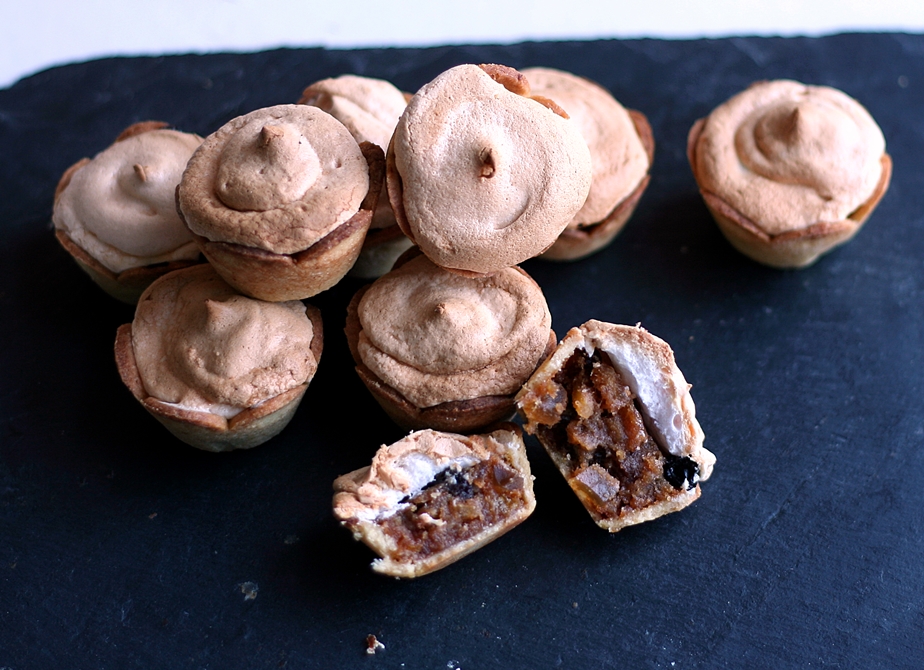
A portion of this mincemeat is then enriched and sweetened with sugar, fresh lemon, egg yolks and butter and used to fill pastry-lined mini tins. The pastry I’ve used is the sweet version of the cornflour shortcrust, flavoured with orange zest, and cut out using a flower cookie cutter. After an initial baking, the pies are topped with meringue and then baked for a further few minutes until nicely browned.

These little pies are extremely rich, which is why baking them in a mini muffin pan is ideal. The filling sets into a dense cross between Christmas pudding and Christmas cake and the crunchy meringue is a great contrast. This quantity makes about 30 mini pies, perfect as petites fours or to serve with coffee. You can keep them in a tin, but the meringues will go a little soft after 24 hours.

You can, of course, use any mincemeat and pastry you have to hand instead.

Citrus mincemeat

Makes about 1kg of mincemeat
2 small lemons (about 170g)
The weight of the lemons in raisins, currants and chopped dates
85g candied orange peel, chopped small
85g candied citron peel, chopped small
30-50g caster sugar
60ml  brandy
60ml apple juice
0.5tsp salt
1tsp grated nutmeg
0.5tsp ground mace
1tsp ground ginger

  • Put the lemons into a small saucepan and cover with cold water.
  • Bring to the boil and simmer for 15 minutes.
  • Drain the water and scrub the sides of the pan to remove the bitter lemon oil.
  • Rinse the lemons also.
  • Repeat 3 times, until the lemons are tender and a clove can be pushed through the skin.
  • Cut open the lemons and remove the pips.
  • Dice the pulp and rind finely.
  • Put the lemons and the rest of the ingredients into a small pan over a low heat.
  • Cover and allow the fruit to plump up. Stir occasionally.
  • If the fruit seems a little dry, add more liquid – your choice whether it’s alcoholic or not.
  • If the mixture seems too wet, uncover and allow the excess to evaporate.
  • Set aside to cool.

Orange Cornflour Pastry

225g plain flour
60g cornflour
140g unsalted butter
85g caster sugar
zest of 1 orange
1 large egg

  • Put everything except the egg into the bowl of a food processor and blitz until the mixture resembles breadcrumbs.
  • Whisk the egg and, with the motor running, gradually add to the mixture until it comes together in a ball. You might not require all the egg, or you might need additional liquid if the mix looks a little dry. If you have extra egg-white, tat would be ideal, otherwise use water.
  • Knead the pastry smooth and wrap in plastic.
  • Chill in the fridge for at least 30 minutes or until required.

Eliza Acton’s Mince Pies Royale

225g mincemeat
3 large eggs
30g clarified butter
juice and zest of 1 lemon
40g caster sugar
pinch of salt
caster sugar

  • Preheat the oven to 200°C, 180°C Fan.
  • Separate the eggs.
  • Mix together the mincemeat, egg yolks, lemon zest and juice and the sugar.
  • Warm the butter until just melted and stir in.
  • Grease a large (24 cup) mini muffin pan.
  • Roll out the pastry very thinly. It is easier to work with either 1/3 or 1/2 of the pastry at a time.
  • Cut out pastry and use it to line the mini muffin pan. For a lovely, neat edge to your pies, I recommend using a flower-shaped pastry cutter. The petals help to avoid the dreaded folds which can sometimes be an issue with the pastry for mini tarts.
  • Add a teaspoon of the enriched mincemeat mixture to each tartlet.
  • Bake for 7-8 minutes until the middle has set and the pastry is cooked.
  • If you’ve got filling and pastry left over (and you probably will), use them up first by making a second batch of tartlets before making the meringue. Arrange the cooked tartlets on a baking sheet, ready for the meringue.
  • While the tarts are baking, make the meringue.
    • You won’t need to use all of the egg white, so I suggest using just half.
    • Put a bowl onto your scales and set them to zero.
    • Pour in the amount of egg-white you will be using and make a note of the weight.
    • Measure out an equivalent amount of caster sugar.
    • Whisk the egg-whites with a pinch of salt until soft peaks.
    • Whisk in the sugar, a spoonful at a time until the meringue is firm and glossy.
    • Spoon the meringue into a piping bag. You choose what style of nozzle to fit.
  • When all the tarts are baked and arranged on a baking sheet, pipe the meringue on top. Make sure the meringue covers all of the filling and goes right to the edge of the pastry.
  • Return the tarts to the oven for 5-7 minutes until the meringue is nicely browned.
  • Cool the tartlets on a wire rack.

Fat-free Mincemeat

This recipe is adapted from Hannah Glasse’s 1747 recipe for Mince Pies for Lent.

Nowadays, we traditionally make mincemeat far in advance of the festive season, so that it can mature in flavour. Both the sugar and the suet act as preservative and so when Christmas rolls around, you’ve got a jar of deliciously spicy sweetmeat and not a fizzing, fermenting jar of goo.

The downside of course is having to be organised enough to remember to make it far enough in advance, making enough for those unexpected baking moments (such as surprise visitors, or a last minute school bake sale contribution), and not making too much so you have storage problems. Quite apart from it not being suitable for either vegetarians or vegans.

Here, hopefully, is a solution. No suet means it’s vegetarian and vegan. No added sugar means its more suited to people needing to control their sugar intake, for whatever reason – although there IS sugar in the candied peel, so this isn’t quite a sugar-free recipe. Best of all it doesn’t need maturing, it’s literally mix and go.

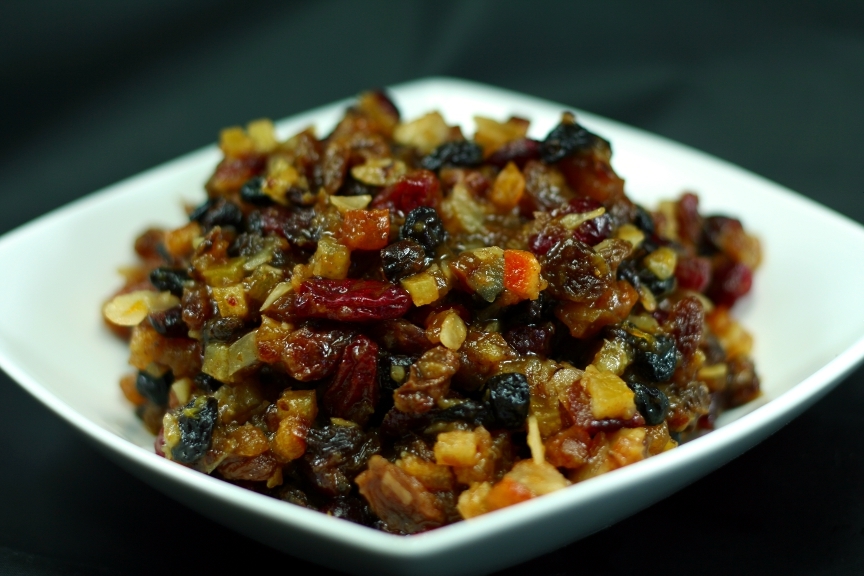
The mixture is gently warmed and the fruits absorb the sherry, brandy and fruit juices. The finely-chopped dates break down and bind everything together. The result is packed full of flavour and with a much cleaner and fresher taste. This mix makes just under 500g of ready-to-use mincemeat.

NB This will keep for up to a week in the fridge, but no longer. Cooked as mince pies and frozen – up to 3 months.

Fat-free Mincemeat

50g currants
50g raisins – crimson raisins look pretty
50g sultanas
50g dates – finely chopped
25g candied orange peel [1]
25g candied lemon peel [1]
25g candied grapefruit peel [1]
35g dried cranberries
25g flaked almonds – chopped
2tbs sherry
1tbs brandy
juice & grated rind of an orange
pinch of ground ginger
a grating of nutmeg,
pinch of ground cinnamon
pinch of mixed spice
pinch of ground cloves

60-100ml apple juice

  • Put the dried fruits into a small saucepan.
  • Cut the candied peel into small pieces with scissors and add to the pan with the spices. NB If you’re using your home-made candied peel that has been stored in syrup, then there’s no need to soften it in the saucepan – just stir it in with the nuts once the fruit has plumped.
  • Add the orange juice and zest, brandy, sherry and 60ml of apple juice.
  • Stir gently to combine and set pan over the lowest possible heat.
  • Cover and let the mixture stew gently until all the liquid has been absorbed.
  • If the fruit isn’t as plumped and juicy as you would like, add a little more apple juice.
  • The mixture should be moist, but with no liquid visible in the bottom
  • When you’re happy with the consistency, stir through the chopped, flaked almonds.

[1] If you’ve made some candied peel yourself, then these are pretty straightforward. If not, then use 75g of what you have/can get. Buy whole peel pieces if possible – they retain their flavour much better than chopped – and cut them just before use.