Soda Cake

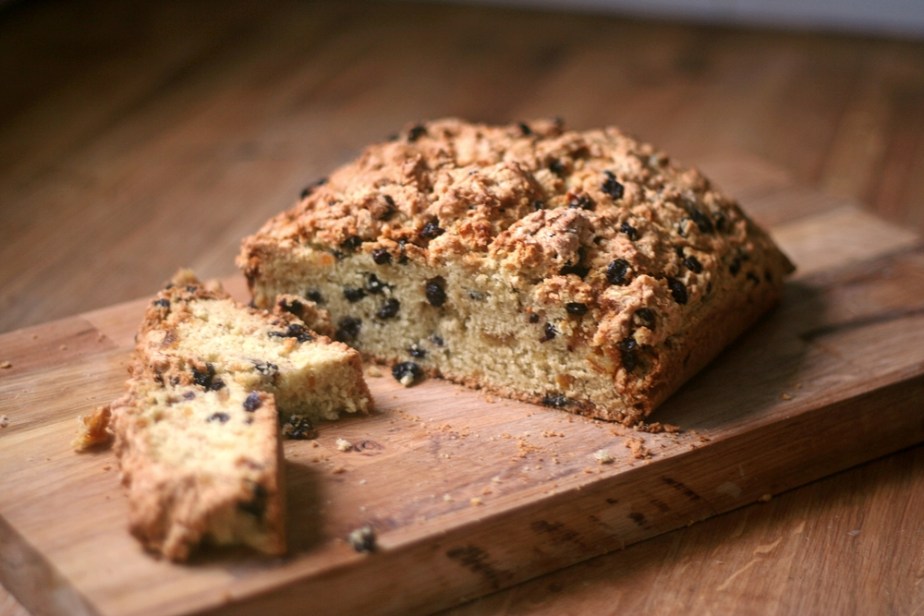
This was a spur-of-the-moment bake this week, and in just over 1 hour after reading the recipe, I was taking this picture. Not as fast as scones, admittedly, but made from store-cupboard ingredients and comes together in mere minutes.

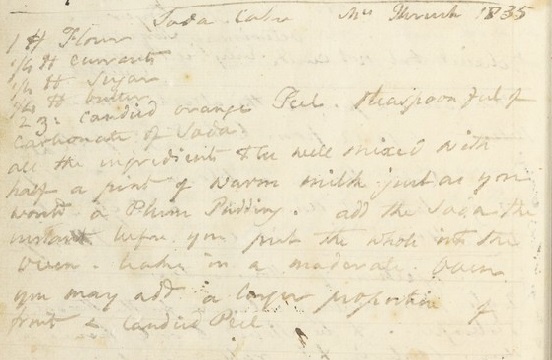
I found the recipe in a manuscript recipe book from The Wellcome Library, an impressively long-lived book containing over 100 years of family entries, starting around 1750.

The use of bicarbonate of soda became popular in the 19th century for its speed and ease of use, especially in areas where fresh yeast was difficult to come by.  This is a very early recipe – not the earliest I’ve found – that award goes to the recipe in “The Virginia Housewife” by Mary Randolph, published in the US in 1824, but this recipe has the added deliciousness of currants and candied peel.

Notes in the book suggest a larger proportion of peel and fruit can be used if liked, but I think it’s perfect as is. Best enjoyed fresh from the oven, it is delicious plain and also spread with an indulgent layer of butter.

You can add a little lemon juice to sour the milk if liked – the bicarbonate reacts best with acidity – or you could use buttermilk, a mixture of milk and plain yogurt or whey.

Soda Cake (1835) MS4645, Wellcome Library

Soda Cake

450g plain flour
115g currants
115g caster sugar
115g unsalted butter
60g candied orange peel – diced small
1tsp bicarbonate of soda
240ml milk/buttermilk/yogurt+milk/whey

  • Preheat the oven to 180°C, 160°C Fan.
  • Butter a square, 20cm tin or cover a baking sheet with parchment if you want to bake it freeform.
  • When the oven is heated, mix the flour, currants, sugar, peel and soda in a bowl.
  • Melt the butter in the microwave or in a pan on a low heat.
  • Add the milk (or whatever liquid you are using) to the melted butter and pour into the dry ingredients.
  • Mix thoroughly and either shape into a round on the baking sheet or in the tin, if using. Try and mound the mixture up into a dome shape, if possible, but don’t faff about too much The quicker you get the cake into the oven after adding the liquid, the more lift you’ll get from the reaction of the soda.
  • Bake for 50-55 minutes, until a skewer inserted into the middle comes out clean. Turn the sheet/tin around after 30 minutes to help with even colouring.
  • Cool the cake on a wire rack.
  • Enjoy warm.


Malt Scones

My current lack of oven (for those interested the ETA is currently mid-February) has prompted me to delve into my small but eminently interesting collection of Victorian and Edwardian commercial bakery books in search of something to ‘bake’.

Back in the day, there were numerous recipes that could be baked on a griddle, a far more varied selection than the standard trio of Welshcakes, muffins and crumpets generally known today.

Admittedly, these do tend to be variations of a theme of ‘scones’, but the range available with just slight alterations of the ratio of ingredients is delightful.

The recipe I’ve chosen today is for an unusual griddle scone, as it is flavoured with malt, and every other version I have read has been for oven-baked scones only. I’m a great fan of malt loaves,  and have been since childhood, and they’re pretty straightforward to make at home. The 2-5 day wait for them to mature once baked, however, is frustratingly long.

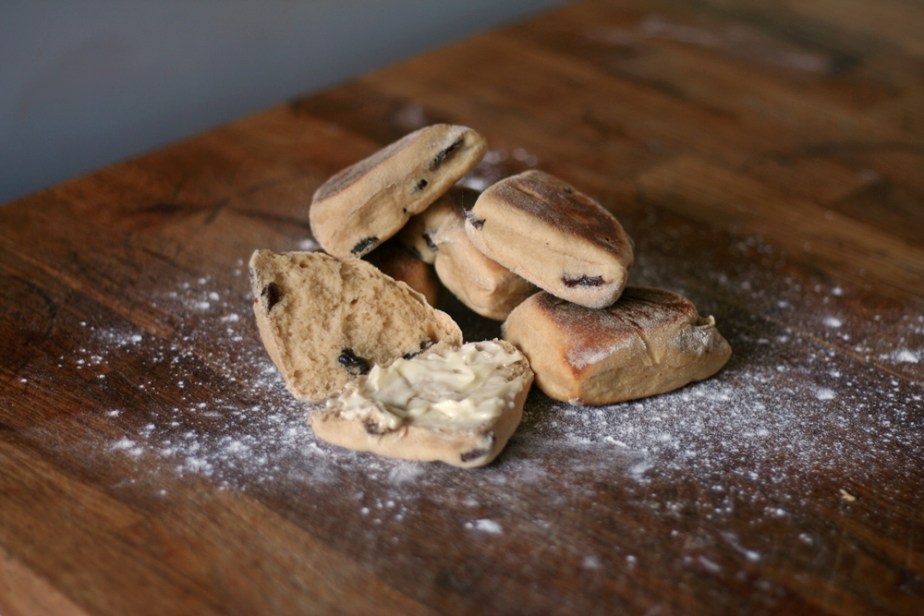
Not so with this recipe. Cooked in just 10 minutes on the stovetop, they can be enjoyed on day of making either fresh from the griddle or cooled, split and buttered. The delicate malt flavour is probably most pronounced when the scones are freshly baked and cooled. Interestingly, these use both yeast and raising agents to achieve their light and fluffy texture, as well as just a single proving.

These are not SWEET sweet scones, although the malt and the sultanas do place them on the sweet side. I was delighted to discover that, with the original quantity of sultanas (30g), they are delicious with cheese. For a sweeter bite, double this quantity and enjoy them split and buttered.

This batch makes twelve, so if this is rather too much for your needs for one day, you can either freeze some, warm them in the oven (just flaunt your oven-ness at me why don’t you!?) or enjoy them toasted and buttered.

Malt Scones

Makes 12

Ferment
150ml warm water
10g    fresh yeast
2 tsp sugar – brown or white
1tbs plain flour

225g plain flour
35g unsalted butter
30g sultanas
60g  malt extract
½tsp cream of tartar
¼tsp bicarbonate of soda

  • Whisk together the ferment ingredients and set aside in a warm place for 30 minutes until frothy.
  • Put the remaining ingredients except the sultanas, into a food processor and blitz until the malt and butter are fully incorporated,
  • Tip the flour mixture into a bowl.
  • Gradually stir in the frothy ferment until the mixture comes together as a soft dough. NB Depending on the moisture levels of the rest of the ingredients you might not need all of the ferment.
  • Knead for 10 minutes.
  • Add the sultanas and mix thoroughly.
  • Divide the dough into three (about 150g each, or 170g if using the larger amount of sultanas).
  • Roll into a smooth ball, then pat out by hand to a 12cm circle.
  • Cut into quarters and set the farls onto a floured board to rise for 45 minutes.
  • Heat a heavy-bottomed pan on the stove top. I use a cast iron, non-stick pan on the largest ring set to the lowest heat. Allow the pan 5-10 minutes to come to an even heat before you start cooking the scones. If your pan doesn’t have a thick base, then choose a smaller heat and watch carefully that the scones don’t become too dark.
  • Cook the scones in batches, for 5 minutes per side until risen and lightly browned.
  • Cool on a wire rack.
  • Store in an airtight container once cold.

Staffordshire Oatcakes

Staffordshire Oatcakes are, quite possibly, the best regional speciality you’ve never heard of.

In fact, that is much more of a generalisation than you may realise, because they’re specifically regional to North Staffordshire, centering on the area around Stoke-on-Trent.

It’s historic origins are mixed, with some anecdotes suggesting they originated from soldiers returning from India and trying to reproduce the chapatis they had eaten, with local produce. A more likely scenario, is as one of the various traditional ‘bakestone’ items found in workers cottages all over the country. With wheat being a valuable commodity, most people used flour from cheaper oats and barley, and with a cooking time of mere minutes, they are surprisingly sustaining.

They can be eaten hot from the pan, but as with other griddle bakes such as muffins, crumpets and pikelets, they can be made in batches, and then toasted as required, making, if anything, an even speedier snack.

Oatcake shops used to be small and plentiful, with sales being made through open windows. Alas, the last of this kind of  shop, the Hole In The Wall in Stoke-on-Trent, closed down due to re-development of the area in 2012. Commercial producers are still churning out batches in 6s and 12s, and they are even stocked by some of the large supermarket chains, but they taste best when home-made. Obvs.

Before we get to the recipe, a word or two about ingredients…

  • These oatcakes are made mostly of oats, in the form of oat flour. If you want to hunt out some oat flour, then have at it, but I’ve found, through trial and error, that whizzing some steel-rolled oats in a spice grinder is both easier and cheaper. You could probably use a blender as well, as they too have the off-set blades necessary to chop the oats into a suitable fineness. Whatever is easiest being the main order of the day.
  • You can use instant yeast, but I must admit, the batter made with fresh yeast always tastes better to me.
  • I’ve read a lot of recipes and watched many a documentary clip on Staffordshire Oatcakes and I’m going to confess up front that this recipe might be viewed poorly by oatcake devotees. It makes a batter that is rather thicker than the traditional, which results in a thicker oatcake. In my defence, it makes for a more durable oatcake which I can then turn easily in the pan without it breaking, and it ‘laces’ beautifully, with the surface becoming dappled with the characteristic pockmarks and holes seen also on pikelets and crumpets. The thickness also allows for a wonderful contrast when toasted between the crisp outsides and the fluffy insides. If all this is a heresy to you, feel free to dilute the batter down to your liking after the 1-hour rise.
  • If you have a decent non-stick pan, you can cook these fat-free.

Staffordshire Oatcakes

280g oat flour – ground from steel-rolled oats
110g stoneground wholemeal bread flour
110g strong white bread flour
1tsp granulated sugar
1tsp table salt
20g fresh yeast, crumbled or 1 sachet fast-action yeast
450ml whole milk – warmed
450ml warm water

  • Put everything into a large bowl and whisk together with a balloon whisk. Alternatively, use a stick blender.
  • Cover with cling film and leave in a warm place to rise.
  • Heat a non-stick pan over medium heat. If your pan is in need of a little help, use a sparing layer of fat (bacon fat or lard) to help prevent your oatcakes from sticking.
  • Gently stir your oatcake batter. The yeast and rising time will have turned it into a liquid with the consistency of frothy double cream.
  • Put 1 ladle/cup of batter into the middle of your pan and tilt the pan around until the batter has spread fully. Don’t be tempted to use the back of your ladle/cup to spread the batter out, as it’s very easy to spread it too thin and either make holes in the middle, or edges so thin they begin to burn before the middle is cooked.
  • The moisture in the batter will soon evaporate, leaving a lacy surface of holes and craters where bubbles from the batter burst.
  • Allow the oatcake to cook until there is no moisture visible on the surface – about 2 minutes.
  • Using a spatula or slice, loosen the edges and then the undersides of the oatcake until it is freely sliding around in the pan.
  • Flip the oatcake over and cook for another 2 minutes or until the surface is starting to brown (see photo).
  • When done, slide out of the pan onto a wire rack to cool.
  • Continue until all the batter is used up. This will make a batch of about 10 sturdy oatcakes.

As the oatcakes cool, they will soften and take on the appearance of a floppy pancake. Wrap in plastic and store in the fridge until required.

Oatcakes for Breakfast/Brunch/Snack/Whenever

You can put whatever you like in your oatcakes, but a filling of bacon and cheese is not only traditional but forms one of those rare, simple ingredient combinations that border the sublime.

You will need:

oatcakes
back bacon rashers – 2-3 per oatcake
grated vintage cheddar cheese

Sauce – brown or red (optional)

  • Grill your bacon or cook in a pan until beginning to caramelise. Set aside and keep warm.
  • Take your oatcake and put into a hot, dry pan – ideally the one you originally cooked it in. An oatcake has two very different sides, the pockmarked ‘front’ and the smooth, brown ‘back’. Put the ‘back’ of the oatcake into the pan first.
  • Allow the oatcake to heat through for 1.5-2 minutes.
  • Flip the oatcake.
  • Sprinkle the cheese over the hot ‘back’ (which is now uppermost) of the oatcake. It will melt as the other side toasts.
  • When the underside of the oatcake is warmed through and crisp, lay 2-3 rashers of bacon on top of the melted cheese on one half of the oatcake and fold the other half of the oatcake over (as in the photo).
  • Slide onto a plate and enjoy with sauce, if liked.
  • Repeat as often as necessary.


Venison Pie

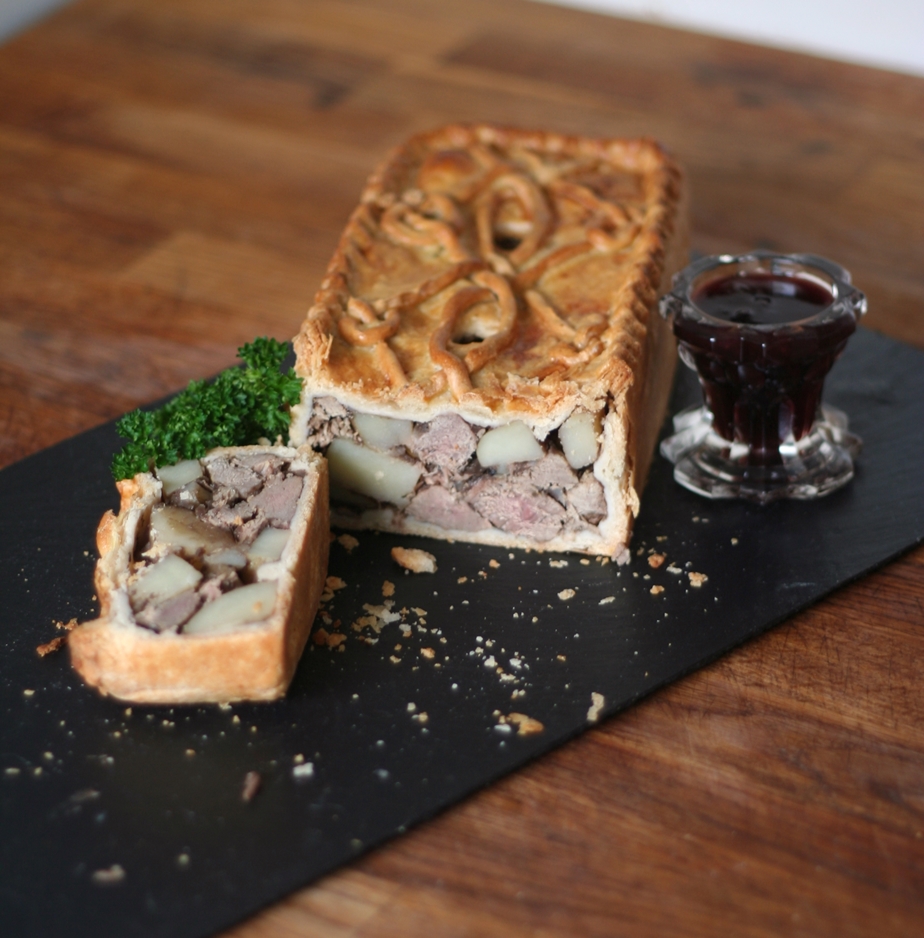
This is a great Deja Food way to transform the cooked venison from a joint into another meal. Since the filling has already been cooked, there is little shrinkage during baking, thus making it a fabulously sturdy picnic pie once cold.

Whichever way you choose to enjoy it, remember to serve with redcurrant jelly.

Venison Pie

500g cooked venison
salt and pepper
300g cooked potatoes
venison, beef or lamb stock, thickened with a little cornflour
beef or lamb dripping pastry, made with stock instead of water.
1 large egg to glaze

A 24cm spring-form tin.

  • Divide the chilled pastry into two pieces, one large than the other.
  • Cut off about 1/3 of the pastry and roll out for the lid of the pie. Cut it to size with 2cm extra all round. Cover with cling film and set aside.
  • Gather the trimmings together with the rest of the pastry and roll out for lining your greased pie tin. Be sure not to have your pastry too thin, as it will have to support a lot of filling – no less than 1cm on the sides and a little thicker over the bottom half of the pie. Let any excess pastry lie over the edges of the tin.
  • Chill the tin in the fridge until required.
  • Preheat the oven to 200°C/180°C fan/gas 6.
  • Cut the meat into cubes, discarding any fat or connective tissue.
  • Season well with salt and pepper.
  • Cut the potatoes into cubes roughly the same size as the meat.
  • Add the cubed potatoes to the seasoned venison, together with enough gravy to coat.
  • Add the filling to the pie and press down firmly. Spoon over a little extra gravy.
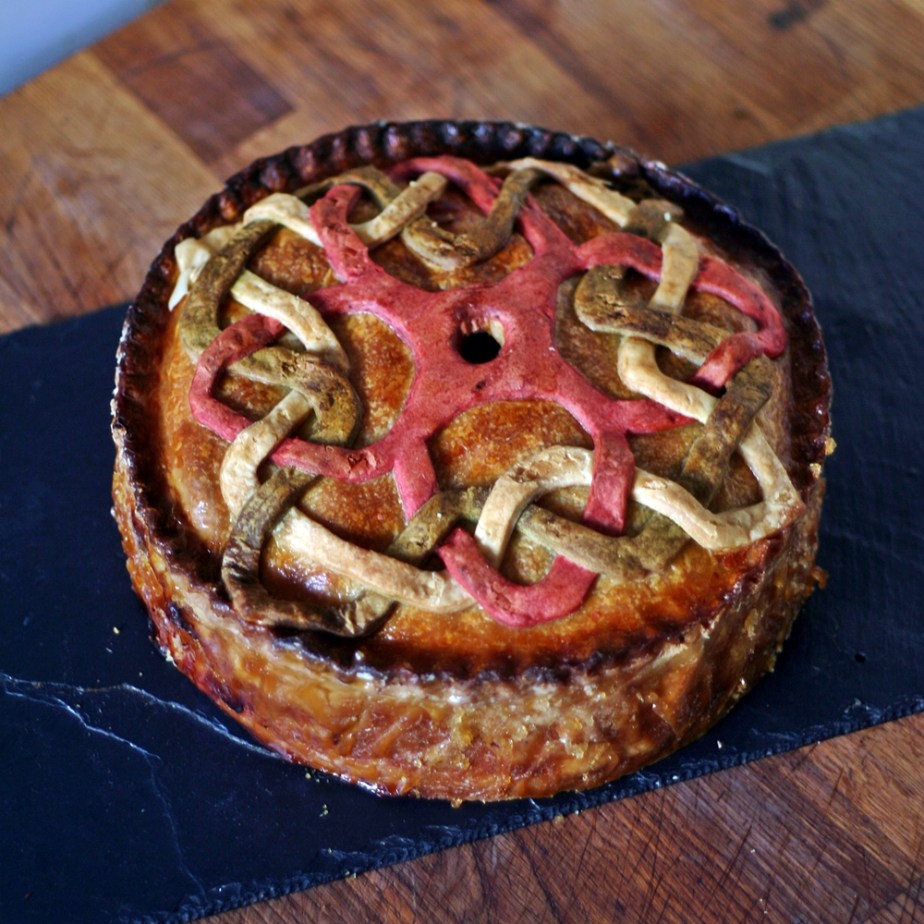
  • Moisten the top edges of the pastry with water and cover with the pre-cut lid. Press firmly to seal, then crimp the edges either by hand or with the tines of a fork. Use the offcuts of pastry to form decorations and secure to the lid using a little water.
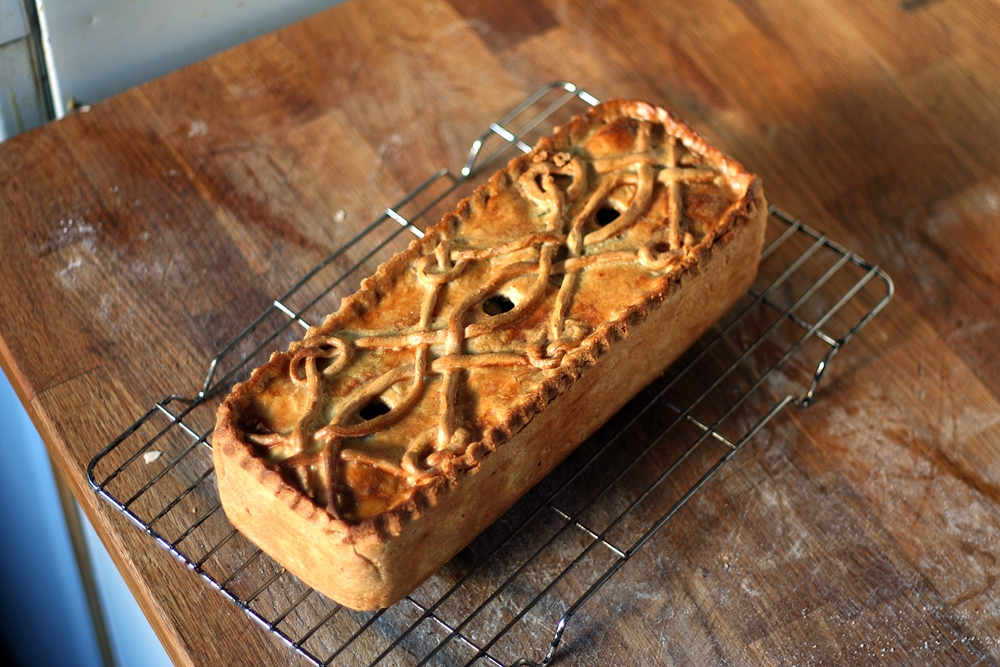
Venison and Potato Pie decoration
Pie decoration example
  • Cut a vent hole for steam, then whisk the egg and brush over the top of the pie.
    Bake for 30-40 minutes until the pastry is crisp and brown and the filling hot.
  • Allow to cool for 10 minutes in the tin, then remove and serve, or if eating cold, allow to cool fully in the tin.

Christmas Pie

Charles Elmé Francatelli, 1863

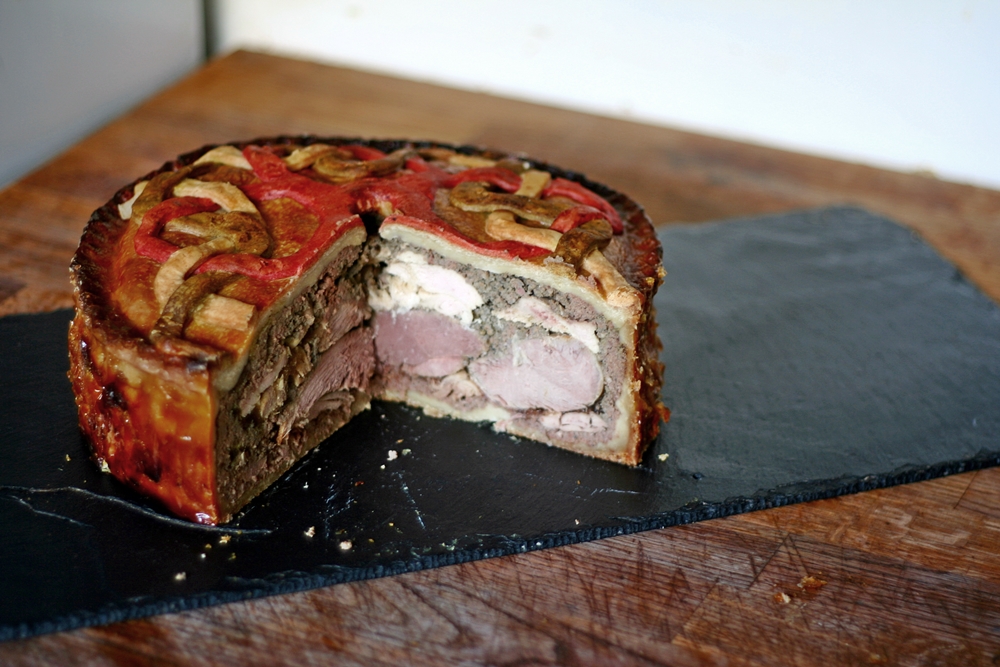
This is a version of the traditional raised pie that graced the sideboards of many a rich household going back centuries. With much time being devoted to celebrating the festive season, the amount of time spent waiting on the kitchen could be drastically reduced with a sideboard groaning under selection of cold cuts and pies to slice throughout the twelve days of Christmas.

The most famous Christmas pies were undoubtedly from Yorkshire, whose frequently gargantuan sizes inspired both awe and wonder, not to mention expense.

“The host of the Angel Hotel, at Whitby, last week, set before his friends a Yorkshire Christmas Pie, seven feet in circumference and containing four stones of flour, 12lbs butter and suet, a brace of pheasants, a brace of partridges, two geese, two rabbits, ten chickens, six ducks, two tongues, one turkey, and six pounds of ham.” ¹

The traditional format of these pies consisted of the birds being boned, seasoned, rolled and then stuffed one inside the other, in the manner of Russian babushka dolls, quite putting the modern ‘turducken’ to shame for its amateurishness. Hannah Glasse’s recipe of 1747 called for a turkey, a goose, a fowl, a partridge and a pigeon. In addition, to fill up the gaps around the main bird, on one side was laid a jointed hare, on the other side woodcock, and “more Game, and what Sort of wild Fowl you can get.”

These large pies were frequently packaged up and sent to London as gifts, or merely as provisions for the festive season. Unfortunately, their size and sturdiness wasn’t always a guarantee of safe travel. In 1832, The Age newspaper carried the following morsel of information in it’s roundup of news snippets column, the Georgian newspaper equivalent of an “And finally…” news item:

“The Lord Chancellor’s Christmas Pie upset, broken and devoured by dogs.”

Adapted from his book The Cook’s Guide and Housekeeper’s & Butler’s Assistant, Francatelli’s recipe simplifies the difficulty of baking so many different types of game and poultry from raw, by pre-cooking the birds to medium rare, filling the pie with the meat, and then finishing the cooking when the pie is baked. The baking time is also considerably reduced.

Christmas Pie cut

This recipe has a lot of steps, none of which are particularly difficult, but you can spread them out over a couple of days rather than feel obliged to have one mammoth kitchen session.

Christmas Pie

Seasoning
1/2 tsp nutmeg
1/4 tsp mace
1/4 tsp cloves
1 tsp peppercorns
2 crushed dried bay leaves
1.5tsp dried basil
1.5 tsp marjoram
1.5 tsp winter savoury
1.5 tsp thyme
0.25tsp chilli pepper
0.5tsp sumac dried mango powder
1tsp garlic powder

Forcemeat
150g butter
1 clove of garlic, chopped fine
1tsp salt
500g rindless streaky bacon, chopped
500g chicken livers, rinsed

Filling
1 whole turkey leg, slow-cooked overnight on a raft of celery, carrot and onion
An assortment of game birds, preferably with carcass, such as:
1 duck crown
1 goose crown
1 pheasant
2 woodcock

Savoury jelly
1 litre of beef stock
turkey stock from cooking the turkey leg
Any trimmings/bones from cooking the game birds
1 onion
2 carrots
3 sticks celery
2 bay leaves
1tbs black peppercorns
3 sprigs thyme
1 blade mace
1 batch game pie pastry (see page xx)
1 large egg for glazing.

  • Preparing The Pie Components
  • Set aside 1 tablespoon of the seasoning mixture for use on the filling.
  • Melt the butter for the forcemeat in a large pan with the chopped garlic.
  • Add the chopped bacon and cook for 5-10 minutes.
  • Add the chicken livers and sprinkle with the seasoning mixture.
  • Cook until just pink in the middle.
  • Remove from the heat and tip into a food processor fitting with a chopping blade.
  • Blitz until smooth, pour into a bowl, cover and set aside until required.
  • Preheat the oven to 180°C/160°C fan/gas 4.
  • Season the game birds with salt, pepper, and the tablespoon of the seasoning mix.
  • Spread with a thin layer of the forcemeat.
  • Arrange in a baking tray and brush over with melted clarified butter.
  • Bake until just cooked through (internal temperature of 74°C).
  • Remove from the oven and allow to cool for 15 minutes.
  • If using crowns or whole birds remove the breasts, as whole as possible, from the carcass and strip the rest of the meat from the bones. Allow to cool completely then cover and chill in the fridge until needed.
  • Put the remnants of the carcasses into a large pan, together with the stocks, seasonings and vegetables for the savoury jelly.
  • Bring to a boil, then cover, turn down the heat and simmer for 2-3
    hours to allow the flavours to develop.
  • Strain the stock twice: once through a fine sieve and then again through dampened muslin to remove all the unwanted solids.
  • Allow the stock to cool, then chill in the fridge. Remove the fat from the surface of the chilled stock and decant the stock into suitable containers.
  • Make a note of how solid, or not, the stock is when cold, and when the time comes to mix the gelatine, adjust accordingly: if the stock is fairly stiff,
    then little or no gelatine will be required, if it is a soft-set, then just half the regular quantity of gelatine may be all that is required.
  • Constructing The Pie
  • Cut off about 1/3 of the pastry and roll out for the lid of the pie. Cut it to size with 2cm extra all round. Cover with cling film and set aside.
  • Gather the trimmings together with the rest of the pastry and roll out for lining your greased pie tin. Be sure not to have your pastry too thin, as it will have
    to support a lot of filling – no less than 1cm on the sides and a little thicker over the bottom half of the pie. Let any excess pastry lie over the edges of the tin.
  • Spread a 1cm layer of forcemeat all over the inside of the pie. Arrange a layer of the meat and cover with a layer of forcemeat to fill in any gaps. Continue layering until all the filling and forcemeat has been used up.
  • Brush the top edges of the pastry with water. Lay the pie lid over the top of the pie. Press firmly around the edges to seal. Trim any excess pastry using the back of a knife, then crimp the edges of the pie to decorate. Use the trimmings to make decorations for the top of the pie.
  • Cut a 1-2cm steam vent in the top of the pie, large enough for the savoury jelly to be poured through once the pie is baked.
  • Preheat the oven to 200°C/180°C fan/gas 6.
  • Brush the lid of the pie with beaten egg and bake for 1 hour and 15 minutes, or until the internal temperature reaches 70°C. If the top starts browning too much, cover loosely with a sheet of baking parchment or foil.
  • Remove from the oven and set aside to cool for several hours. When almost cold, measure out 600ml of the savoury jelly and warm in a pan. If using gelatine, soak as many leaves as required in cold water before draining and adding to the stock.
  • Stir until the gelatine has melted.
  • Before you start pouring the savoury jelly into the pie, you might want to check whether there are any holes in your pastry. Carefully remove the pie from the tin and inspect closely. You can either mix up a flower and water paste to fill any cracks, or wrap the sides and bottom of the pie tightly in cling film: this won’t stop the leaks, but it will keep everything contained until the jelly has set.
  • Return the wrapped pie to the tin before adding the jelly.
  • Pour the jelly a little at a time through the hole in the top of the pie. Use a jug and/or a fine funnel.
  • Allow time between pourings for the liquid to permeate the pie filling – it has to find and fill all the air pockets between the meat.
  • Leave to set in a cool place, or, if you have room, in the fridge overnight. The jelly will seal off any air pockets and thus prolong the shelf-life of the pie.
  • Properly stored, it can adorn a sideboard buffet all the way from Christmas almost to the New Year.

1 “Local and General Intelligence”, The Northern Star and Leeds General Advertiser (Leeds, England), Saturday, January 7, 1843; Issue 269. p3.

Potted Prawn, Shrimp or Crayfish

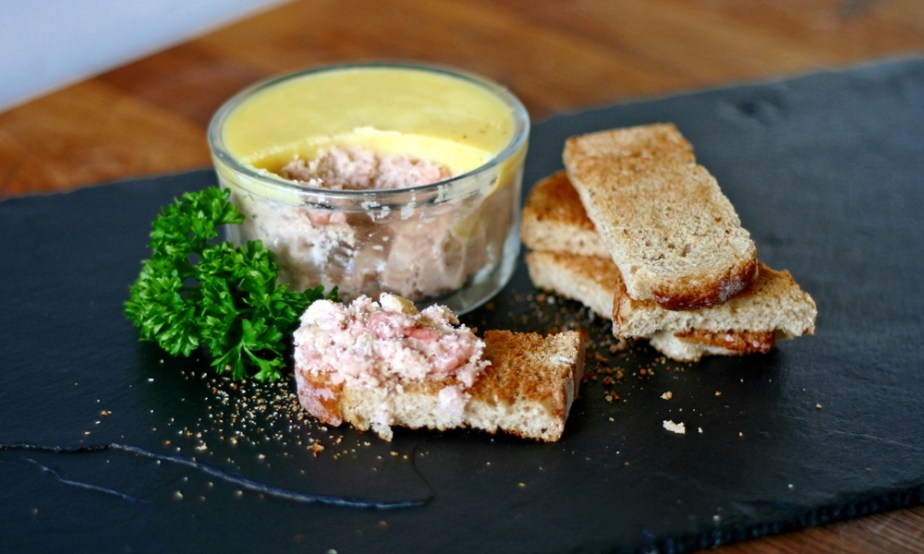
This recipe was chosen for it’s multi-purposeness , because you can use this method for any of the above-mentioned seafood, or perhaps even a mixture of two or three.

Potting used to be a means of preserving, the clarified butter being used to make the contents impervious to air-borne microbes, etc. Properly potted food could last days, if not weeks, without the need for refrigeration. When required, the butter was removed and the potted food used for whatever purpose the cook had in mind.

Nowadays, potted food is consumed in much the same way as a pate, spread on crisp toast or crackers. In this adaptation, the butter used to bind the seafood is delicately infused with spices before being combined with the fish and seasoning.

Potted Shrimp, Prawn or Crayfish

100g clarified, unsalted butter
1 blade mace
2 cloves
1 slice nutmeg
270g cooked brown shrimp, prawns or crayfish
black pepper
salt
Extra clarified butter to seal

  • Put the clarified butter and spices into a small pan and heat over a very low flame for 10 minutes.
  • Remove from the heat and allow to infuse for a further 20 minutes.
  • Remove the spices and combined with the seafood. NB British brown shrimp are tiny and perfect for spooning onto a finger of toast, so you might prefer to omit the next stage, and just season and pot them directly. Prawns and crayfish are larger and thus require chopping to make them easier to
    pot as well as easier to spread when served.
  • If you opt for chopping up the seafood, pour the mixture int a food processor and blitz intermittently until combined.
  • Taste and add salt and pepper as required.
  • Spoon into small pots or ramekins.
  • Pour over a thin layer of clarified butter to seal.
  • Chill in the fridge until required.
  • Serve with hot buttered toast

Fruit Charlotte

This is a deliciously simple, autumnal dessert that, although it can be assembled from very few, ordinary ingredients, ends up tasting so much better than the sum of its parts – the crisp, golden outside, hot and sharp insides and cool cream or hot, rich custard make this a dish of delicious contrasts. It is one of the many British desserts that evolved to use up stale bread and cooked fruit. Whilst the filling can be almost any fruit purée you have to hand, the construction needs to observe a few rules if it is going to look as impressive when served as it tastes.

Firstly, the fruit purée needs to be relatively firm and ‘dry’, with little or no visible liquid. If your cooked fruit is especially moist, then just set it in a sieve to drain – the resultant liquid can be sweetened and served as a pouring syrup or saved for use in/on other desserts. Alternatively, set it over a low heat in a wide pan, to help evaporate the excess liquid. If you think your fruit is still too soft, you could consider whisking in an egg yolk or two to help thicken it during cooking, making it more of a fruit custard.

The bread should not be plastic-wrapped and pre-sliced. The best charlottes are made when the bread can absorb some moisture from the filling in much the same way as it does in Summer Pudding, and sliced bread just doesn’t have a suitable surface for this. Not that having your bread sliced by a machine is bad – it can make it wonderfully thin and regular – just buy a whole loaf and get the bakery to cut it for you on their machine. If it’s not stale, just leave the slices you intend to use out on the counter for an hour, they’ll dry just enough. During baking, the dry outside will, thanks to the coating of butter, crisp up and turn wonderfully golden, and the inside will draw moisture from the filling and pull everything together, so that you have a firm pudding to turn out.

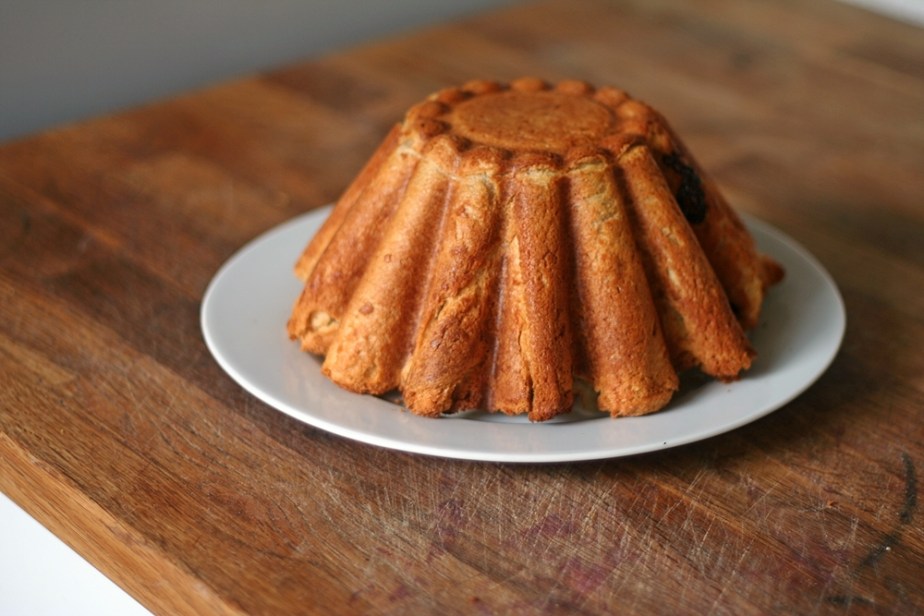
The final important consideration is the shape of the bowl in which you construct your charlotte. It needs to be both oven-proof and domed/tapering. Straight-sided charlottes are usually cold desserts such as the Charlotte Russe, which uses sponge fingers and a firmly set cream and is also thoroughly chilled before being served, which helps greatly with presentation. A traditional, domed pudding bowl, or individual pudding bowls, are ideal. Their tapering form is most conducive to maintaining an impressive shape of your hot charlotte. The fluted tins commonly marketed as brioche tins are also the ideal shape, with the added detail of fluting giving the turned-out dish a very elegant appearance.

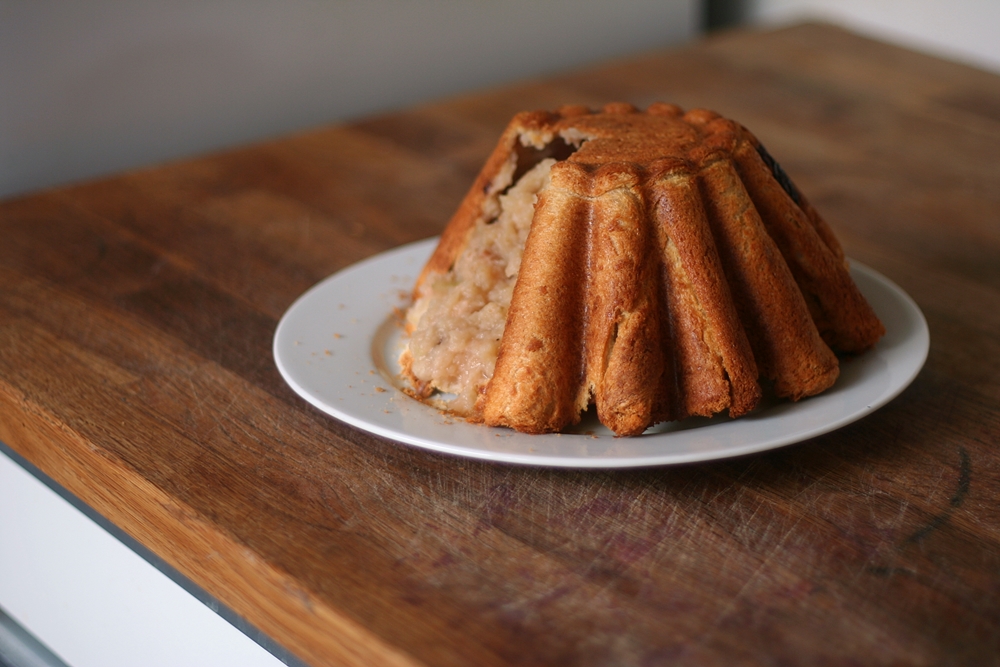
This is an adaptation of Mrs Rundell’s recipe from 1808. Her version calls for raw apples, sugar and butter and is baked slowly for 3 hours with a weight on top to help compress the apples as they shrink during cooking. This recipe is much shorter, just over one hour, but this length of time is necessary for the bread to crisp, turn golden and be sturdy enough to support the fruit filling until serving time. Higher heat and baking for a shorter time means that, when turned out, the pudding slowly sags and collapses, like a Victorian matron with her corset removed. The use of an already-cooked puree makes preparation that much quicker and the cooked pudding less prone to loss of volume.

Fruit Charlotte cut

Fruit Charlotte

I used some apples from a friend’s garden for this recipe, and added no sugar – the sharpness was a great contrast against the rich, buttery crust. I highly recommend this approach. If your fruit is especially sharp, consider using a sweet custard as an accompaniment.

750g fruit pulp
stale white bread slices
softened butter

pouring cream or custard to serve

  • Preheat the oven to 200°C/180°C fan.
  • Butter the inside of your bowl(s) generously with softened butter.
  • Cut the crusts from the bread. Cut a circle or flower shape for the bottom of your bowl and put it in first. It will make for a neat top once you turn out the pudding, and also hide the ends of all the side pieces of bread.
  • Line your bowl(s) with the crustless bread. How you choose to do this is up to you. Personally, I keep the pieced of bread whole and patch where necessary. If your bread is fresh and springy, you can make things easier for yourself by using a rolling pin to flatten them slightly. If you are using individual pudding bowls, you might want to reduce this to a width of 1.5cm, as the smaller form will need thinner slices if it is still to look dainty when turned out.  Place the slices inside the pudding at a slight angle and press into the butter. Leave the excess sticking out of the top of the bowl for now. Make sure  there are no spaces or holes for fruit to leak through. You can see on the above photo that a little apple juice has squeezed out and been caramelised by the heat of the oven. Delicious, but a flaw if you’re after an unblemished exterior to your charlotte.
  • Fill the lined mould with the fruit puree.
  • Butter slices of crustless bread for the top of the mould. Fold the ends of the bread at the sides inward and place the final pieces of bread butter-side upward over the top.
  • Spread a little butter onto a sheet of parchment and place this butter-side down over your filled bowl.
  • Add a cake tin on top together with an oven-safe weight, such as a foil-wrapped metal weight or quarry tile.
  • Bake for about an hour until the outside of the buttered bread is crisp and golden brown and the filling piping hot. For individual puddings, bake for 30-40minutes.
  • Remove the weight/tin/parchment and bake for a further 10 minutes, to allow the lid to crisp up.
  • Remove from the oven and turn out onto your serving dish.

Shrewsbury Pudding Tart

Georgiana Hill, 1862

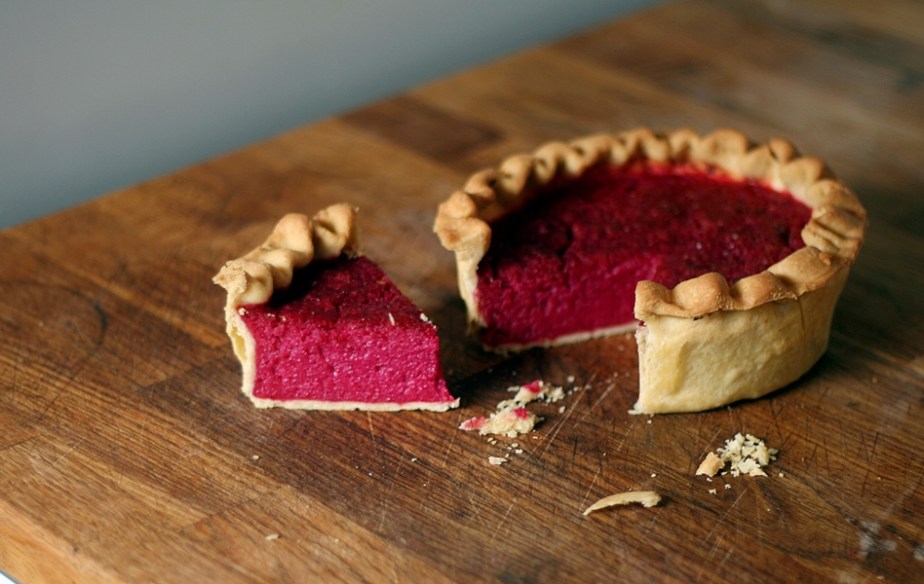
Here is something a little different for the adventurous, an unusual dessert in the form of a gloriously vibrant beetroot tart: given an official Thumb’s Up™ by my daughter. I’ve tweaked this recipe slightly and baked it in a pastry case, for ease of serving. The original method was for a buttered-and-breadcrumbed bowl. The cooking times are roughly the same. The flavour is very light and delicate, the lemon counteracting a lot of the beetroot’s sweetness.

1 x 24cm blind-baked pastry shell

225g cooked beetroot
115g unsalted butter – melted
150g icing sugar
zest of 1 lemon
juice of 2 lemons
3 large eggs
60ml brandy
150-200g fresh white breadcrumbs

  • Preheat the oven to 150°C, 130°C Fan.
  • Puree the beetroot until smooth.
  • Add the butter, sugar, lemon, eggs and brandy and whisk thoroughly.
  • Add in the breadcrumbs BUT not all at once. You want them to absorb a lot of the moisture in the filling, which will vary depending on the freshness of the eggs and the moisture in the beetroot. You might not need all of them. The texture should be similar to a sponge cake mix, but still pourable.
  • Add the filling to the pie shell and place the tin on a baking sheet.
  • Bake for 25-30 minutes until the filling has set. Turn the baking sheet around after 15 minutes to ensure even baking.
  • Cool on a wire rack.

Bara Brith

This week it’s the classic Welsh speckled bread Bara Brith. Nowadays, this is usually made using baking powder as the leavener, but personally I prefer the more traditional yeast.

And bonus! There’s two recipes for you to choose from!

When looking at an old recipe, I usually study the range of recipes available and select the one that, to my imagination, sounds the nicest. If there is a tie, then I will make both and decide which makes the cut by taste. This time, however, it was too difficult to decide, so I chose not to choose and leave that decision to you.

Both recipes have their strongpoints, not least from their provenance and pedigree.

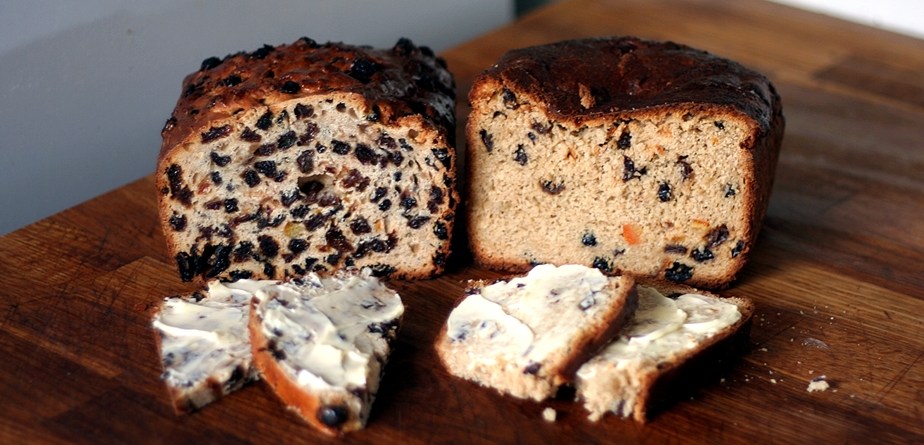
On the left of the photo above, we have the recipe from Walter Banfield’s classic book “Manna”: A Comprehensive Treatise on Bread Manufacture (1937), a book admired by Elizabeth David and breathtaking in its breadth and scope. It is based on additions made to ordinary white bread dough after its first proving. The large quantity of fruit and peel contrast brightly against the white of the dough and make for a very sturdy slice that will keep moist for a long time.

On the right of the photo, a possibly more authentic Bara Breith from Mrs E.B.Jones, who, for many years, ran the Powys Temperance Hotel on Market Square, Llanrhaeadr-Ym-Mochnant in the first half of the 20th century. The recipe was collected by Dorothy Hartley and included in her iconic book Food in England, first published in 1954. As can be seen from the picture, this recipe isn’t as heavily fruited as the first one, but it has the added interest of being made from half wheat flour and half oat flour (finely ground oatmeal). Against expectation, the crumb is very light, making it a much more delicate slice.

I love the richness of the fruit in the bread dough version, but also really enjoy the delicate flavours of Mrs Jones’ version. I suggest you make both and decide for yourself.

Both loaves will keep well wrapped in parchment and foil, in a cake tin. Both are best enjoyed sliced and buttered, with a hot cup of something in front of a roaring fire.

Mrs Jones’ Bara Brieth

Don’t feel the need to order oat flour especially for this recipe, you can make your own by blitzing rolled oats in a spice grinder, or just use medium oatmeal for a more robust texture.

60g candied orange peel – diced
100g currants
70g sultanas
225g strong white flour
225g oat flour or medium oatmeal
115g lard
115g Demerara sugar
¼ tsp salt
1 large egg
1 tsp mixed spice
1tsp soft brown sugar
30g fresh yeast

  • Put the peel and the fruit into a bowl and pour over boiling water. Set aside to plump for about 30 minutes.
  • After 15 minutes, cream the yeast and the soft brown sugar together.
  • Put the flours and the lard into the bowl of a food processor and blitz until the mixture resembles breadcrumbs.
  • Tip into the bowl you will be using for mixing and add the Demerara sugar, spice and salt
  • Drain the fruit, retaining the water, and use it to mix the dough. Keep the fruit warm in a low oven while the dough is kneaded.
  • Add the yeast to the flour mixture with the egg, lightly whisked. Use the (by now just) warm fruit-soaking water to mix everything to a soft dough.
  • Knead for 10 minutes.
  • Mix in the warm fruit, cover with plastic and allow to rise until doubled in size. Due to the richness of the ingredients, this may take anything between 1 and 2 hours.
  • Grease a large loaf tin.
  • When the dough has risen, tip it out and pat down to deflate. Form into a loaf shape and lay into the prepared tin.
  • Cover lightly and allow to rise for about 45 minutes.
  • Preheat the oven to 170°C, 150°C Fan.
  • Bake for 30 minutes.
  • Turn the tin around 180 degrees and lay a sheet of foil lightly over the top, to prevent the loaf browning too much.
  • Bake for a further 25-30 minutes.
  • Remove from the tin and if the bottom doesn’t sound hollow, return to the oven for 5-10 minutes to crisp up. You can place the loaf directly onto the oven bars.
  • Cool on a wire rack.

Walter Banfield’s Bara Brith

450g strong white flour
½ tsp salt
1tsp soft brown sugar
30g fresh yeast
warm water to mix

115g lard in small cubes
5g mixed spice
65g Demerara sugar
1 large egg
300g currants
90g sultanas
90g raisins
60g candied orange peel – diced
50g plain flour

  • Cream the sugar and yeast together with a tablespoon of the flour and a little warm water and set aside to work
  • Mix with the rest of the ingredients into a soft dough.
  • Cover with plastic and set aside to rise for 1 hour.
  • After 30 minutes, spread the fruit (not the peel) out on a baking sheet lined with parchment and put into the oven on its lowest setting, just to warm through.
  • Grease a large loaf tin.
  • When the dough has risen to twice its original size, add in the finely cubed lard, spice, egg and sugar and knead smooth.
  • Add the warmed fruit and peel and mix thoroughly.
  • Sprinkle over the flour and mix thoroughly.
  • Shape into a large loaf and place into the prepared tin.
  • Allow a long second rise, of 1-2 hours.
  • Preheat the oven to 170°C, 150°C Fan.
  • Bake for 30 minutes.
  • Turn the tin around 180 degrees and lay a sheet of foil lightly over the top, to prevent the loaf browning too much.
  • Bake for a further 25-30 minutes.
  • Remove from the tin and if the bottom doesn’t sound hollow, return to the oven for 5-10 minutes to crisp up. You can place the loaf directly onto the oven bars.
  • Cool on a wire rack.

Fresh Yeast Muffins

Some of you might know that there’s already a muffin recipe on the blog. Nevertheless, I decided to revisit muffins in part because it is now ridiculously easy to get hold of fresh yeast, but also because a lot of muffin recipes and videos Out There™ are just plain wrong when it comes to the method of shaping them. There, I said it. Oh yes, there’s no holding me back when my dander is up.

Because there’s no need to go faffing about with rolling out the dough and using *in her best Lady Bracknell voice of disapproval* a pastry cutter. Apart from anything else, it ruins the iconic shape of the muffin (a flattened top and bottom with a smooth, soft and pale crust around the middle) with an ugly seam where the dough has been compressed as it was cut.

This recipe is adapted from one listed in Florence White’s Good Things in England and dates from 1826, and without being overly dramatic, eating them is like biting into a cloud. To keep them as soft as possible, I’ve used ordinary plain flour and used the whey from some curd cheese I made earlier this week as part of the mixing liquid, as it gives a beautifully soft crumb. Don’t worry about having to use whey, you can just make the mixture equal parts whole milk and water.

Fresh Yeast Muffins

Makes 14

560g plain flour
20g fresh yeast
1 tsp granulated sugar
1tsp salt
300ml whey + 150ml whole milk OR 225ml water + 225ml milk

cornflour for dusting

semolina for cooking (optional)

  • Put the flour and salt into a bowl. I use my stand mixer fitted with a dough hook.
  • Crumble the yeast into a small bowl  and add the sugar. Work the sugar into the yeast then set aside for five minutes until it becomes liquid.
  • Mix the whey and milk (or milk and water) in a small pan and warm gently to blood temperature.
  • Pour the yeast into the milk mixture and then pour the whole into the flour.
  • Mix thoroughly and knead for 10 minutes – five if using a dough hook.
  • Cover and leave to rise for 1.5-2 hours.
  • Deflate the dough, knead briefly, cover, and allow to rise for another 30 minutes.
  • Sprinkle the work surface with cornflour. The dough is rather loose and prone to stickiness. The cornflour doesn’t stick to itself, and will therefore act as a non-stick layer between the dough and the work surface.
  • Tip the dough out and divide it into 75g portions. This quantity of dough will, when risen and cooked, make the perfectly-sized muffin – 8-9cm across and 4cm thick. You can make them larger, but remember to adjust the cooking time accordingly.
  • For each piece of dough, fold the edges in towards the middle, then turn over so that the folds are underneath and the top is smooth. Cup your hand over the dough and roll it in small circles, shaping the dough into a smooth ball. Set the ball on a cornflour-dusted surface to rise. Don’t put the balls of dough too close together, or they might rise into each other.
  • Allow the dough to rise for 30 minutes from the moment the first ball of dough is shaped. They will take time to cook in batches, so with the staggered batch cooking, the last few will have risen just in time to be cooked.
  • Put a heavy-based pan onto a large ring on a low heat.
  • Cook the muffins in batches. Depending on the size of your pan, you can cook 4 or 5 at a time. Sprinkle the pan with semolina if you like, although if your pan is non-stick, this can be omitted.
  • Gently slide a thin spatula under one of the risen balls of dough and transfer it to the pan turning it upside down as you do so, so that the top of the muffin cooks first. This will help create the perfect muffin shape, because the base of the dough is already flat and the top is rounded. If you cook the base first, the top continues to rise and curve, and the drying effect of the radiated heat from the pan will dry the surface of the dough and will make it ‘reluctant’ to flatten into the traditional muffin shape. Cooking the top first, the weight of the dough allows it to settle like a gently deflating cushion, into the flattened shape, and a partial hardening of the already flat bottom (which is currently the top) is fine.
  • Cook for five minutes, then gently turn the muffins over and cook for another 5 minutes. When done, they should sound hollow when tapped.
  • Transfer to a wire rack to cool.
  • Wipe the pan free of semolina, then repeat until all the muffins are cooked.

To serve – very important

These instructions are adapted from Hannah Glasse, who insisted that no knife should touch muffins, as they would become heavy. Here is a guide to enjoying your fresh muffins.

You will need:
chilled butter cut into thin slices.
toppings such as jam, honey or sausage, egg and bacon, depending on degree of hunger.

  • Whilst perfectly delicious soft pillows when freshly cooked, unless you are able to eat them hot from the pan, muffins should be toasted on the outside before being served. The insides are best left un-toasted, so you can bite down through the softness to the crunchy outside. The contrast is sensational.
  • Grill  for 2-3 minutes each side until the outsides have crisped, but not darkened.
  • While the muffin is still warm, take a serrated knife – yes, I know Hannah said no to knives, but a little help is needed in order to divide the muffin.  Take your knife and gently draw it around the side of the muffin like an equator, if you will – just breaking the soft crust to a depth of 1-2mm.
  • Once the ‘skin’ (it really is too soft to be called a crust) has been scored all the way around, hold the muffin sideways and with the tips of your fingers, gently pull the muffin apart. The cutting will help it divide evenly into two halves.
  • Quickly lay a slice of cold butter between the two halves and put them together again.
  • Cover with a cloth to keep warm.
  • After about a minute, turn each buttered muffin upside down, so that the now melted butter can seep into the other half of the muffin.
  • Your muffin is now ready to be enjoyed as is, or to drizzle over the toppings of choice. Remember, do not spread your toppings, or the pressure will deflate your soft, billowy muffin.