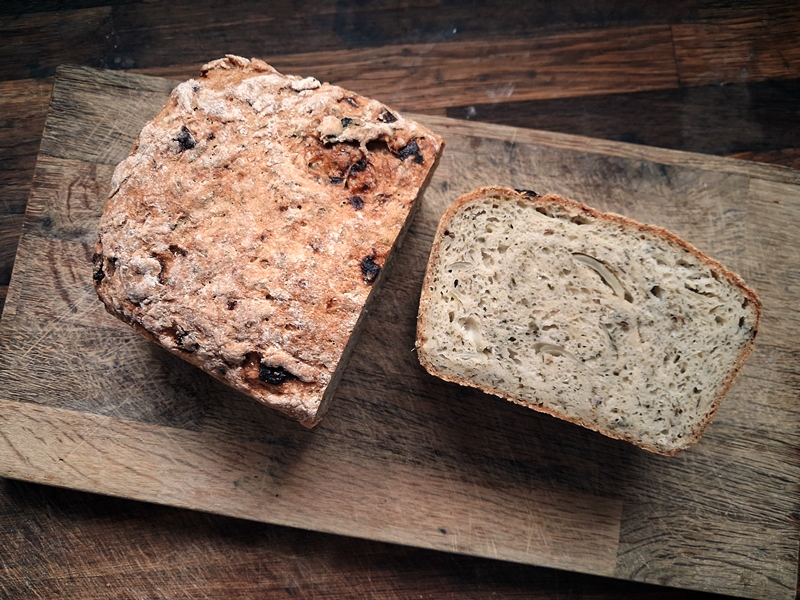
Stuffing Loaf

This recipe might be my finest creation since The Ploughman’s Loaf!

If the name of the blog weren’t already a huge clue, I am a big fan of leftovers, and the bigger the occasion, the greater my happiness.

Because however wonderful the celebratory meal, opening the fridge the next day to an array of already-cooked food requiring only a little reheating – or in the best cases, none at all – is a thing of beauty.

Boxing Day is arguably the Christmas Day of deja food, with the greatest selection of food possibilities. The simplest way to sample these delights is the humble sandwich: a little turkey or chicken, a little ham, a little cranberry, some stuffing…

But the problem with all these little bits here and there is that before long, you’re quickly headed towards a sandwich of Dagwood proportions.

In addition, I love some texture to my sandwiches – the popularity of adding crisps to sandwiches in the UK is well acknowledged. In traditional roast dinners, the stuffing is frequently the star on the plate: crunchy on top, soft underneath, and packed with savoury flavour. However, as a deja food, it loses much of its appeal, being rather bulky and in texture, veering towards the claggy.

The recipe I have here is the solution, and is so simple, I’m surprised it hasn’t occurred to me before: instead of breadcrumbs in the stuffing, put the stuffing flavourings into the bread. The bread can then be toasted for a sandwich and provide crunch and taste without the resulting sandwich requiring the unhinging of one’s jaw.

This recipe is based on my Traditional Stuffing recipe, although you can also use it as a basis for making a loaf from your own family stuffing recipes. To my lovely American readers, I hope you’ll enjoy saving money by making sandwiches at home with this bread on the day after Thanksgiving, instead of joining the wrestling matches at the Black Friday sales.
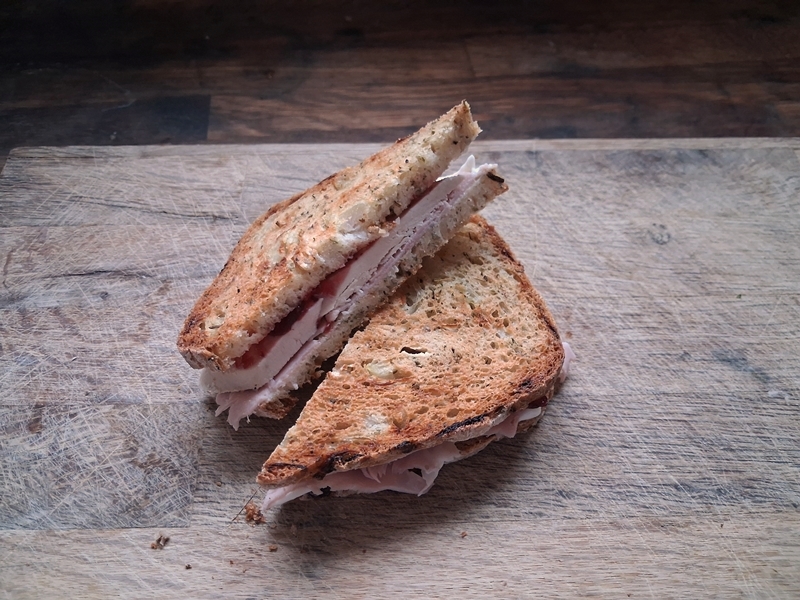
A toasted Stuffing Loaf sandwich with cold chicken, ham and cranberry sauce

Stuffing Loaf

When cooked, this loaf will be a lot heavier than your regular white loaf – after all, it will have an additional half a kilo of onions in it – but provided you let it have sufficient rising times, the crumb will be open and moist (see top photo).

500g onions
60ml vegetable oil
salt and pepper
1 tbs  each dried “Scarborough Fair” herbs, i.e. parsley, sage, rosemary, thyme
1 tbs chicken bouillon powder (optional)
2 sachets fast action yeast
600g strong white bread flour
500ml warm water

  • Peel and chop the onions into 2cm squares.
  • Add the oil to a pan and set over medium-low heat (4 on a 1-9 scale).
  • Add the onions and toss in the oil to coat.
  • Sprinkle with 1tsp of salt to help draw out the moisture.
  • Cook gently until the onions are softened but not coloured, stirring occasionally  – about 15-20 minutes.
  • Season with pepper and sprinkle in the dried herbs and stir to mix in. Cook for another 2 minutes, then remove from the heat and set aside.
  • Mix the bouillon (if using), yeast and flour together.
  • In a large bowl – stand mixer or other – pour in the warm water and add the onion mixture.
  • Add the flour mixture and knead into a dough – around 10 minutes.
  • Cover the bowl with plastic and set in a warm place to rise for at least 1 hour, probably a little longer, until doubled in size.
  • Tip the risen dough out onto a floured work surface and form into a loaf shape.
  • Drop the dough into a large (1kg/2lb) greased loaf tin. Dust the top with flour and lightly cover with plastic. The dough will fill the tin to about 3/4 of its height.
  • Set the loaf aside to rise for at least 30 minutes.
  • Heat the oven to 220°C, 200°C Fan.
  • Arrange the oven shelves so that there is a solid shelf below the rack shelf.
  • Fill a cup with water.
  • When the loaf has risen (and nicely rounded above the edge of the tin), move it into the oven and onto the rack shelf.
  • Pour the cup of water onto the solid shelf and close the oven. The steam will help the formation of the crust.
  • Bake for 30 minutes.
  • Turn the loaf tin around and bake for another 20 minutes.
  • Remove the loaf from the tin and return it to the oven on the rack shelf and bake without the tin for 10 minutes to crisp the crust.
  • Remove the loaf from the oven and cool on a wire rack.
A hot toasted Stuffing Loaf sandwich with chicken and gravy

The Day After Sandwich

Whether it’s Thanksgiving, Christmas, Easter or just your regular Sunday roast, The Day After Sandwich made with Stuffing Loaf is a delicious treat. Obviously, you can make a sandwich any way you like, but I thought I’d offer a couple of suggestions with special reference to using your stuffing loaf.

  • Toast the bread: You’ll get the best stuffing flavour from the bread if its toasted, but here’s my recommendation – ONLY TOAST ONE SIDE OF EACH SLICE. This will give a nice crunch to the outsides and a good contrast with the softness of the filling. Toast both sides by all means, but I found that a bit too crunchy (tho’ that’s probably because I cut the slices thin – approx 1cm).
    Now my kitchen has a minuscule amount of counter space, so I don’t have room for a toaster. Consequently, when I want to make toast, I use the oven grill, so it’s easy for me to only toast one side (move rack to highest level, put in cold, turn on grill setting, 8 minutes). If you have a toaster with a nice wide opening, you can put two slices in together, and then only the outer sides will get toasted.
  • Preparing the inside of the bread/toast. Another of the great choices you can make is to have either a hot or cold filling. I recommend spreading the insides of your bread/toast slices with mayonnaise if planning a cold sandwich, and butter if going for a hot sandwich.
  • For a hot sandwich, warm some slices of chicken/turkey in  gravy and spoon generously into your sandwich.
  • For a cold sandwich, arrange slices of turkey/chicken/ham or a combination, and add a teaspoon of cranberry sauce.

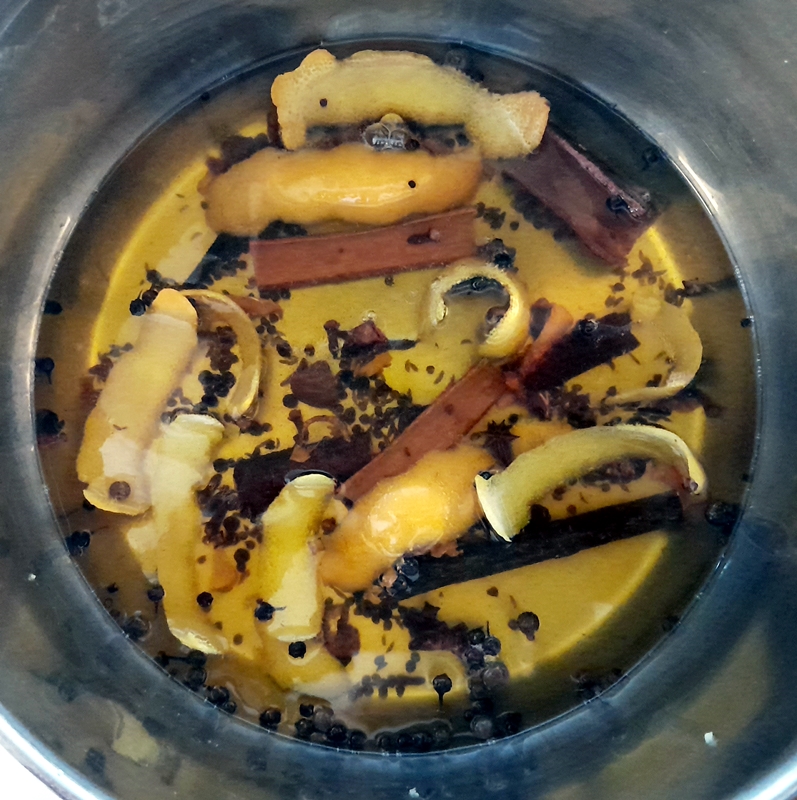
Christmas Spiced Butter

With only a month to go, I recently realised it’s high time I got my act into gear vis-à-vis some festive recipes.

I have for you here something that I’ve been making for the past few years and, with spectacular timing, only remembering about it come the 24th or so, which is far too late to go about suggesting people add to their military campaign-esque festive ToDo list.

I initially got the idea a few years ago whilst making a batch of Niter Kibbeh, the very aromatic Ethiopian spiced butter used in making the red lentil stew Misir Wat.

It is butter that is flavoured with seasonal spices, and is a doddle to make. I use clarified butter in the form of a tin of ghee, because delicious though browned butter is, the milk solids are easily burned. I simmer – although that is rather too strong a word for sitting on heat 1 of the hob, so perhaps ‘infuse’ is more fitting – whole spices and citrus peels and then allow the flavours to infuse overnight as the butter cools. The use of whole spices keeps the spicing soft – although I have opted to add in ground spices if the whole ones are unavailable. The only downside of using ground spices is that they will speckle the butter, being too small to strain out. Depending on your use of the finished butter, this may not be an issue. Next day, I slowly warm the mixture and, when melted, strain out the solids and pour the beautifully aromatic and flavourful butter back into the tin in arrived in, for ease of storage.

You are then free to use it wherever you see fit in your festive baking.

Brandy Butter and Spiced Hard Sauce: These are rich and delicious accompaniments to both mice pies and Christmas pudding. Equal quantities of icing sugar and butter are whisked with brandy, or indeed any alcohol of your choice, and/or vanilla to produce a light and frothy mixture that you can spoon onto your bakes where it will gently melt and turn into a sauce.

Mincemeat: In case you haven’t seen the recipe, my guilt-free Mincemeat (based on Hannah Glasse’s 1747 recipe) offers all the delights of traditional mincemeat, but without suet, fat or any added sugar and is both vegetarian and vegan. Delicious as it is, you can elevate it to luxury levels by adding a little Spiced Christmas Butter for added richness.

Pastry: Using Spiced Christmas Butter in pastry  adds a whole new dimension to your mince pies and other Christmas fare such as this Welsh cranberry tart.

Shortbread: Why not try your favourite shortbread variation using festive spiced butter?

What Spices Do I Need?

Basically, anything you like. Whilst this might not seem very helpful, I say it to illustrate just how much free reign you can have with this. Either stick to a more traditional mix (see below) or spice it up a little (excuse the pun) with some unusual bits and bobs. You can’t really go wrong, as using whole spices means there’s only ever a gentle flavouring.

A traditional mix might include:

  • cinnamon sticks
  • allspice berries
  • blades of mace
  • whole nutmegs (sliced)
  • cloves
  • orange peel
  • lemon peel
  • sliced ginger (fresh or dried)

Other items you may want to use include:

  • cardamom pods – both green and black
  • star anise
  • aniseeds
  • black pepper
  • cubeb pepper
  • long pepper
  • grains of paradise
  • vanilla
  • saffron
  • licorice sticks
  • caraway seeds
  • coriander seeds
  • cumin seeds
  • rosepetals

All of the spices should be whole, wherever possible. Use anything from 1tsp to 1tbs to your taste.

Spiced butter with different whole spices
Another version of spiced butter, this time with grains of paradise, cubeb pepper and aniseed.

Dietary Guidelines

As ghee has had all the milk solids removed, I would venture to suggest that it might even be suitable for the lactose intolerant.

If you are vegan, you can make your own version using solid coconut oil. If you’re not a fan of the accompanying coconut aroma, this odourless brand is available to order online.

Christmas Spiced Butter

I rarely recommend any particular brand, but in this instance I strongly urge you to seek out (it’s not that hard to find – most supermarkets carry this distinctive green and gold tin) East End ghee. It has a heady, perfumed aroma in its natural state, which greatly enhances the end product.

1 x 600g tin of East End ghee.
3-4 cinnamon sticks
1tbs whole cloves
1tbs allspice berries
4 blades of mace
2 whole nutmegs – sliced
thinly peeled skin of 1 orange
thinly peeled skin of 1 lemon
5 slices of fresh/dried ginger
5 star anise

  1. Put everything into a small saucepan.
  2. Cover and set on the lowest heat possible on your stove/hob.
  3. Leave to infuse for 1-2 hours.
  4. Switch off the heat and leave overnight.
  5. Next day, warm slowly over very low heat until melted, then strain the solids out by pouring through a sieve.
  6. When the butter has completely drained, pour it back into the tin.
  7. Label and store in the cupboard for use.

Cheese biscuits

Three recipes for you this week, all originating from a single idea. I thought I’d take the opportunity to show how it is possible to play with recipes you already know and love, and adapt a favourite one to different flavourings and pairings.

I was catching up on the latest season of the Great British Bake Off the other day, and for Biscuit Week the bakers were asked to make Viennese Whirls for their signature bake. I made a similar biscuit in Season Two – except I called them Melting Moments – so I was interested to see what variations this season’s bakers would bring to the table.

The range was wide and the flavour combinations a mix of both unusual and familiar (you can read more details on the specific flavourings/pairings here), and I got to pondering what I would have made. I think I would probably have gone savoury, and what better place to start than with my original recipe, and seeing if it could be tweaked to a more salty flavouring.

Obviously, the main stumbling block is the Melting Moments I made were sweet. Messing about with other recipes I’ve found that substituting cheese for the sugar on a 1:1 basis can get you a long way down the savoury route. I didn’t want the biscuits to spread much, and I also didn’t want the cheese to clump together and produce blobs, so rather than grating fresh from a block, I chose to use already-finely-grated Parmesan cheese (still fresh, just not grated by me). Test Batch 1 (a half batch of the original quantities – another Top Tip when you’re experimenting – no need for a full batch of anything until you get it right) was a straight substitution of cheese for sugar. To compliment the cheese, I also added dry mustard and ground nutmeg, as well as salt.

The results were cheesy-ish but also a little greasy, so Test Batch 2 involved more cheese (for taste) and more cornflour (to help with the greasiness). Batch 1 also didn’t hold their shape very well, but when I was looking at the tweaked ingredient proportions, I saw they were veering close to those of the best kind of shortbread (I made so many batches the proportions are burned into my brain), and so I opted to bake the dough in a shallow-sided pan, just like the shortbread. I didn’t want to dough to blister or rise up, so I poked holes in the dough, also like shortbread. The baking was also done long and low, and the result was absolutely delicious: strong cheese flavour, with the subtle hints of the mustard and the nutmeg rounding it out. The long, slow baking had toasted the cheese particles, which now had the bonus of adding little nuggets of crunchiness to the texture. Finally, cutting the cooked dough into pieces hot from the oven, then putting the tin back in as the oven cooled, made for a gloriously toasted flavour and appearance. It was an amazingly savoury, cheesy, shortbread, but a bit far from a Viennese Whirl.

In addition, the original prompt required a filling of some sort, so I went back to the drawing board and recalled a recipe for a favourite pull-apart bread flavoured with walnuts and blue cheese. After toying with the idea of adding the nuts to the biscuit filling, I opted for adding them to the biscuit dough, and making the filling with blue cheese.

Test Batch 2 was much better in terms of crumbly texture, but the flavour of the walnuts wasn’t really there. So for what would be the final Test Batch, I reduced the Parmesan cheese to keep it savoury but not intrusive, and toasted the walnuts. I kept the amount of cornflour the same, since walnuts have their own oil and this would also need to be absorbed in order to keep the biscuit texture. The result was just what I was going for: crumbly melt in the mouth biscuit texture, robust walnut taste with just a hint of Parmesan.

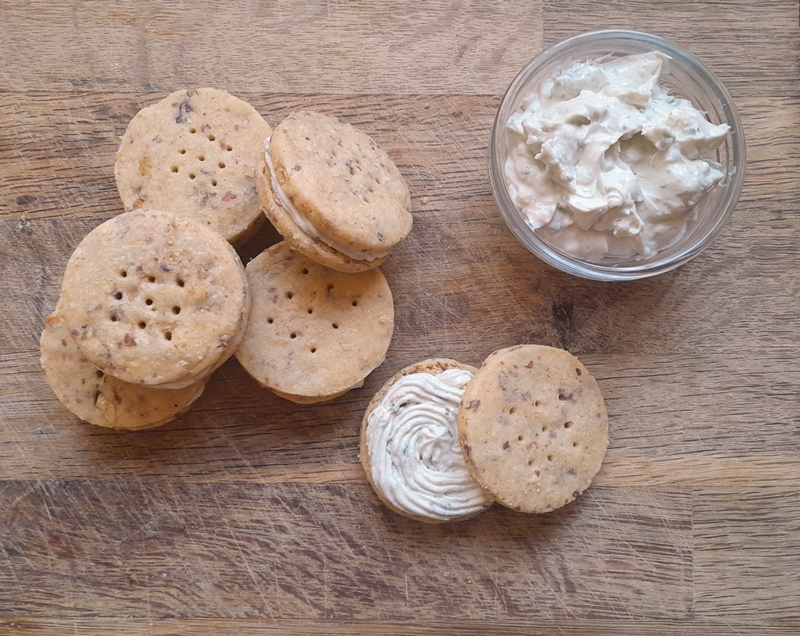
The last step was to sort out the filling. I opted for Saint Agur, which is a soft and creamy, relatively mild blue cheese, and mixed it with some cream cheese to make it pipe-able. These biscuits lack the piped form of traditional Melting Moments, so adding the swirl in the filling is a neat compromise. If you’re a blue cheese fiend, then use stronger-flavoured cheeses by all means – you might have to work a little harder to get them blended with the cream cheese. I don’t usually recommend brands, but Philadelphia cream cheese has the firmness and creaminess that is just perfect here. If you use a different cream cheese and the result seems a little watery or not as dense as you would like, you can firm it up by placing it directly onto 4-6 folded layers of kitchen roll (in a sealable plastic box or similar) and chilling in the fridge overnight. The excess moisture will be drawn out into the paper towel, firming the cheese mixture up and making the mix easier to pipe. If you don’t have the time to do this, just use your cream/blue cheese mixture as a dip. There is also a Saint Agur Blue Crème product with the cream cheese already mixed in. It is very smooth indeed, but too soft to pipe. Perfect to use as a dip, though.

So there we are. Arguably three different recipes (yes, yes – I know the dip is a bit of a stretch, recipe-wise) from a single inspiration. I do hope you try them, and then have fun experimenting with tweaking your own recipe favourites.

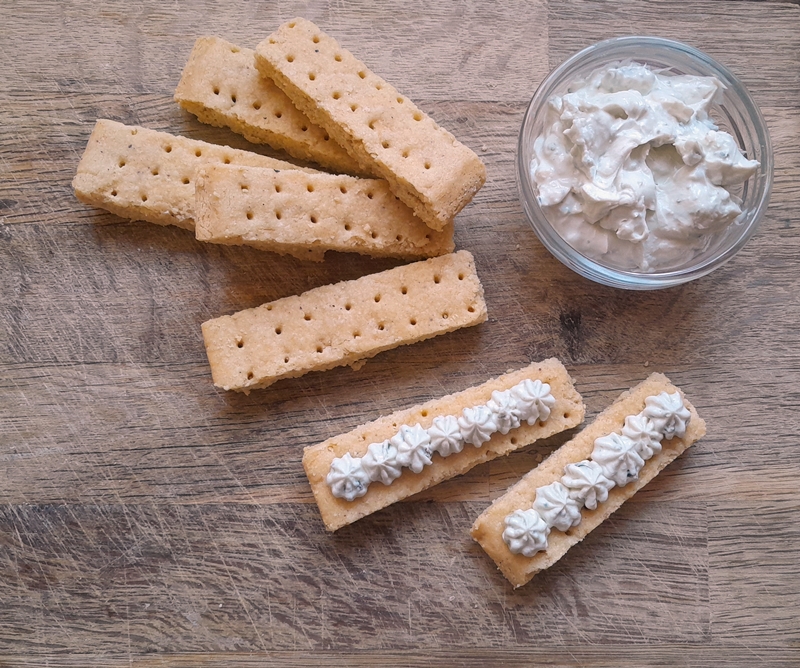
Cheese Shortbread with blue cheese topping and dip

Cheese Shortbread

125g plain flour
50g cornflour
125g unsalted butter – chilled
½tsp salt
½tsp ground nutmeg
½tsp yellow mustard powder
50g ground Parmesan cheese

  • Heat the oven to 160°C, 140°C Fan.
  • Line a shallow baking tin with parchment. I used one of dimensions 26cm x 18cm, but a 20cm square would also work.
  • Put all of the ingredients into a food processor and blitz in brief bursts until the mixture comes together in a soft paste.
  • Press the paste into the prepared tin and smooth over. Using a skewer or a cocktail stick, poke holes evenly over the whole surface area.
  • Bake for 30 minutes, turning the tin around halfway through to ensure even baking.
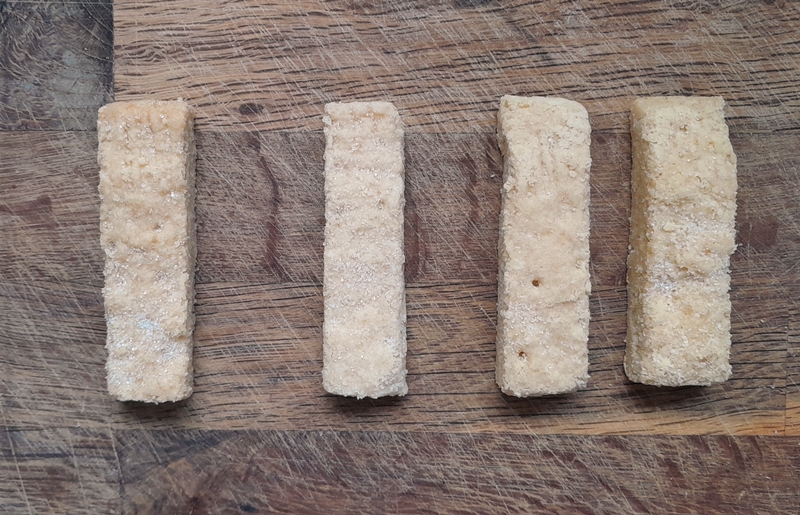
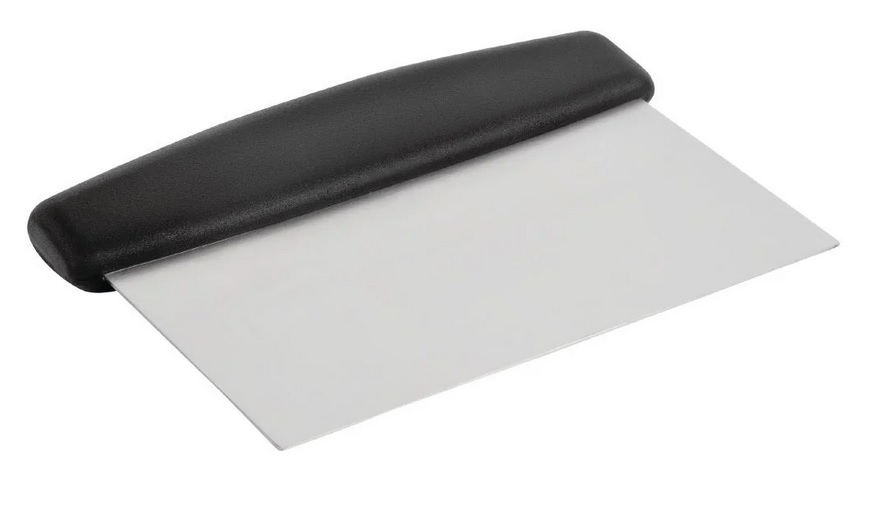
  • When baked, turn off the oven, remove the shortbread and cut into pieces. I prefer to use my metal dough scraper, which is super thin, to get nice, clean, sharp cuts.
  • Put the shortbread back into the cooling oven, to finish off.
  • When cold, store in an airtight container.

Walnut & Blue Cheese Melting Moments

30g walnuts
125g plain flour
50g cornflour
125g unsalted butter – chilled
½tsp salt
30g ground Parmesan cheese

  • Toast the walnuts:
    • Heat the oven to 200°C, 180°C Fan.
    • Lay the nuts on a baking tray lined with parchment paper.
    • Bake for 8 minutes, turning the tray around halfway through to ensure even browning.
    • Set aside until cool, then chop with a knife into small pieces.
  • Put the remaining ingredients into a food processor and blitz in brief bursts until the mixture comes together in a soft paste.
  • Tip the mixture out onto a piece of parchment and knead in the chopped walnuts.
  • Lay clingfilm over the dough and roll it out thinly (5mm).
  • Slide the sheet of covered dough onto a chopping board and freeze for 20 minutes. The dough is very soft and chilling it hard will make cutting the biscuits out and transferring them to the baking sheet much easier and with no loss of shape.
  • Turn the oven to 160°C, 140°C Fan.
  • Cut the dough into biscuits using a plain 5cm round cutter. Lay the biscuits on a baking sheet covered with baking parchment. There’s little to no spreading during baking, so you can lay them as close as 1cm from each other.
  • Poke holes in the centre of your biscuits using a cocktails stick. Or not. I tried both ways, and to be honest, there wasn’t really a difference. Arguably the biscuits with the perforations, as in the photo at the top, maybe look a little more aesthetically pleasing, but not by much. You choose.
  • Bake for 30 minutes, turning the baking sheet around halfway through to ensure even baking.
  • Remove from the oven and allow to cool on the tins. The biscuits are rather friable when warm, so don’t be too eager to move them.
  • Store in an airtight container when cold.

Blue Cheese Filling/Dip

150g (1 pack) Saint Agur blue cheese
280g (1 large box) Philadelphia cream cheese

  • Remove both ingredients from the fridge and allow to come to room temperature.
  • Crumble the blue cheese into a bowl and mash with a fork or the back of a spoon until smooth.
  • Add half the cream cheese and mix thoroughly, making sure there are no lumps.
  • Add the rest of the cream cheese and mix until smooth and fully incorporated.
  • Fill a piping bag fitted with a 5mm star nozzle, and pipe onto half your biscuits.
  • Top with the remaining biscuits and arrange on a serving plate.
  • Use any remaining filling as a dip by adding a little cream/creme fraiche, yogurt until the desired consistency is reached.

Summer Ice-creams

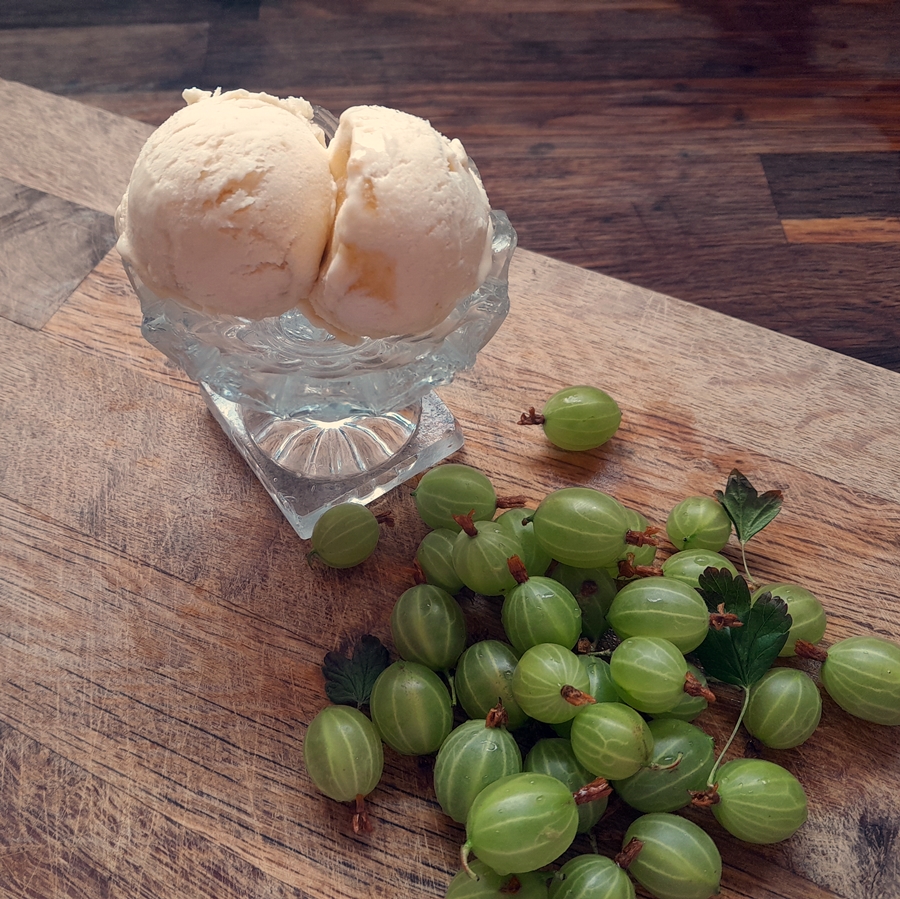
The brief green gooseberry season is upon us and their delicate but sharp taste is a wonderfully aromatic taste of summer. Reddish dessert gooseberries ripen later in the season, but the sharpness of the green is my preference. They’re a thorny bush, so be prepared for having multiple jabs in your hands. I picked some at a local Pick Your Own fruit farm. Top Tip: most berries conceal themselves on the undersides of branches, so always lift them up for maximum harvesting efficiency. If your local fruit farm doesn’t have PYO gooseberries (and many don’t, sadly) they can also sometimes be found in the freezer of your local Farm Shop.

After laying down a batch of my bi-annual batch of gooseberry vinegar (a doddle to make, but a year in the fermenting/clearing), I decided to make a batch of gooseberry ice-cream. As the owner of a tiny kitchen (2m x 3m), I have neither the counter/cupboard space for an ice-cream maker, nor the patience to keep stirring a semi-frozen mixture in order to break up the ice-crystals, so the ‘set it and forget it’ no-churn recipe employing sweetened condensed milk is pretty much a no-brainer in this household.

The method is practically the same as that given for Damson Ice-Cream from a couple of years ago: Mix most of a fruit puree into the cream/milk mixture, then ripple through a ribbon of the remaining puree and set in the freezer.

The means of obtaining your gooseberry puree is a little different than usual, mainly due to their water content, which will wreak icy-crystal havoc with your ice-cream if it is too high. Rather than simmer with water until they break down, the gooseberries are coddled in a closed vessel over simmering water. The result will be a clear-ish liquid (which can be poured off) and the fruit pulp, which is then used for the ice-cream. This approach preserves not only the colour, but also the flavour, as prolonged cooking and/or high heat impairs both.

The second recipe is my re-creation of an ice-cream I had several years ago in Yorkshire. It’s actually not really a summer ice-cream, because citrus isn’t really in season in July, but oranges are in the shops and marmalade is on the shelves, and I am in love with it, so here we are.

The bitterness of Seville oranges, just as the tartness of gooseberries, is the perfect pairing with this ice-cream method, because the condensed milk is SO sweet, it needs something sharp to cut through all that sugar. Interestingly, in developing this version, I did learn that there is such a thing as too much bitterness. An early version contained both the zest and juice of Seville oranges (which I keep in my freezer as frozen cubes for year-round zestiness), and while I liked the end result, it really leaned heavily into bitterness, so I had to dial it back somewhat. This version uses the zest of regular oranges and no juice, with the slivers of peel from the marmalade providing delicious pops of intense Seville bitterness, tempered with sugar.

Both of these ice-creams will need to be removed from the freezer for 20-30 minutes before serving, in order to soften.

Gooseberry Ice-Cream

I have left the gooseberries without sugar, as there is more than enough sweetness with the condensed milk. Feel free to add some sugar if you feel they need it.

500g green gooseberries

1 x 397g tin of sweetened condensed milk
600ml double cream

  • Put the gooseberries in a lidded pan without any additional water and set it inside a larger pan. Add water until the larger pan is half filled. Heat over medium high heat until the water is simmering and coddle the gooseberries until soft. if you don’t have suitable pans to do this, you can put them into a casserole with a close-fitting lid and bake in the oven at 170°C, 150°C Fan. for 20-30 minutes.
  • Tip the coddled gooseberries into a sieve over a bowl and allow the clear liquid to drain through. Set the liquid aside.
  • Rub the gooseberry pulp through the sieve until all that remains are the seeds. Discard the seeds and set the pulp aside to cool.
  • Put the condensed milk and double cream into a bowl and whisk together until light and billowly.
  • Fold through 3/4 of the gooseberry pulp until well combined.
  • Spoon the ice-cream mixture into containers and then stir through the remaining puree in a ripple.
  • Cover and freeze at least overnight before serving.
  • Waste not, want not: You can add sugar to the clear gooseberry liquid and simmer it down to a syrup to pour over your ice-cream.
  • Bonus: Add a splash of elderflower cordial to taste to the puree, but beware of adding too much liquid.

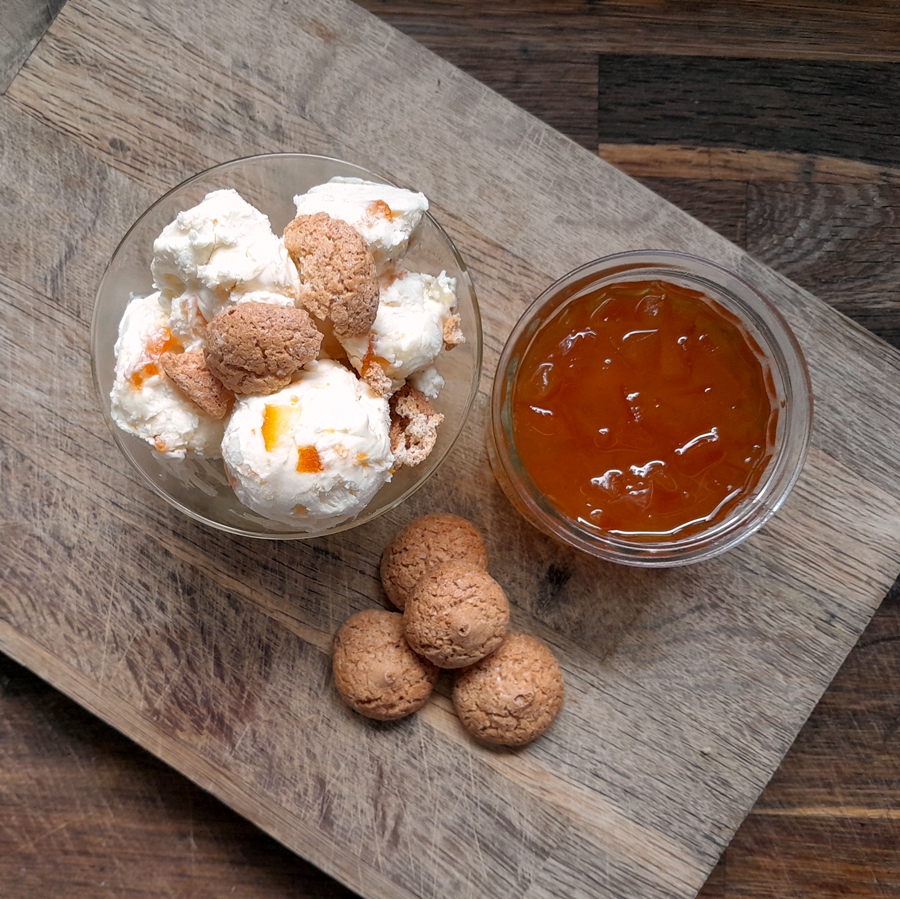
Marmalade Cheesecake Ice-Cream

There is a slight difference in the method of this ice-cream, in order to get the cream cheese fully incorporated with the other ingredients. There’s no added sugar, as the condensed milk add more than enough. The amount of marmalade you’ll need will depend very much on the whatever marmalade you are using. I used a jar of my Dundee Marmalade, which is quite peel-heavy, so I only needed one jar.  Top Tip: An efficient way to get your marmalade shreds separated from your marmalade jelly, tip your jar(s) of marmalade into a pan and warm it gently until the jelly liquefies, then pour it through a sieve over a bowl. The jelly can then be poured back into the jar(s) for use later. Cut your shreds into smaller pieces if liked.

100g of orange shreds from your favourite marmalade – about half a cup.

zest of 3 oranges
330g cream cheese, Philadelphia for preference – at room temperature
1 x 397g tin of sweetened condensed milk
600ml double cream

  • Put the orange zest and cream cheese into a bowl and whisk until smooth.
  • Pour in the condensed milk and whisk again until smooth.
  • Add the double cream and whisk until light and billowy.
  • Stir through the marmalade shreds.
  • Spoon the ice-cream mixture into containers.
  • Cover and freeze at least overnight before serving.

Serving suggestion

To emulate a regular cheesecake, serve with some crisp/crunchy biscuits – Digestive biscuits/Graham crackers are a favourite. I used amaretti in the picture because that’s what I had, and regular readers will know we don’t make special trips to the supermarket for just one ingredient.

Mince Pie Shortbread

I seem to be on a bit of a shortbread obsession lately, but this is the last post on it for now, promise.

Today I have for you a combination of two festive treats: Mince Pies & Shortbread.

Back in the far off days of the 1980s, I had the distinct pleasure of discovering Jocelyn Dimbleby’s “Cooking for Christmas” – a slim paperback book of recipes, produced in association with Sainsbury’s. Amongst its pages I found Deluxe Mince Pies, a version of which I have had posted over on my other blog for over 12 years now. With their orange pastry and decadent cream cheese and mincemeat filling, if you’re only going to eat one mince pie during the season, it really should be those.

However, even I will admit that they are a bit of a faff and since they are best served warm, it does limit their accessibility. So recently, whilst experimenting with the butterscotch shortbread, I got to thinking whether I could make a mincemeat version, and from there it was just a hop and a skip to re-imagining Jocelyn’s recipe.

This recipe is also an adaptation of recipes I’ve already posted on here, which I love as an example of some real Lego™ thinking, taking two different recipes and smushing them together to create something new.

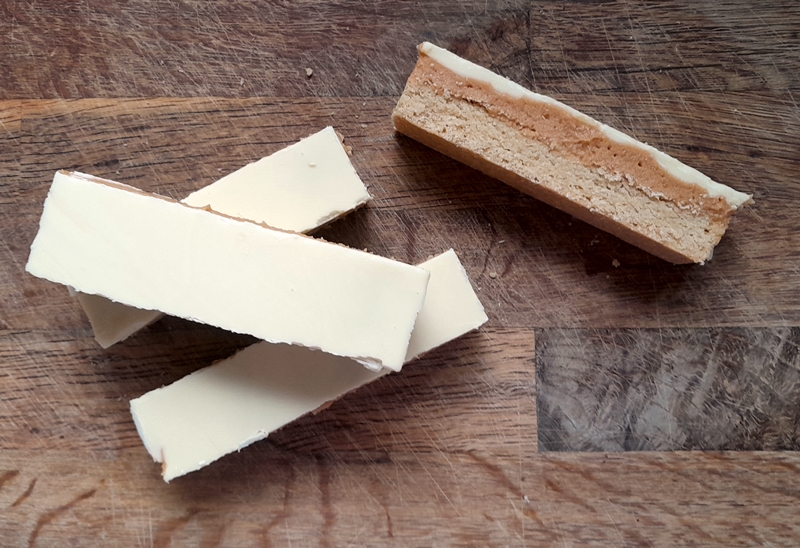
The shortbread here is standing in for the mince pie pastry, so the only thing I changed was to add some orange zest. The mincemeat is an adaptation of the guilt-free mincemeat, based on Hannah Glasse’s 1747 Lenten mince pie recipe. The potential problem here was whether it would hold together on top of the shortbread, so the slight tweak I made was to increase the quantity of dates, which break down into a sweet and sticky paste during the simmering of the fruit, and firm up when cooled. I increased the spices a little, to compensate for the mincemeat being eaten cold, which tends to dull their potency. I also used an egg-white wash over the top of the shortbread, which when briefly baked forms something of a barrier to keep the moisture from the mincemeat compromising the crispness of the shortbread. Finally, I decided to top things off with white chocolate flavoured with lemon zest, to mimic the cream cheese element of the original mince pies.

Baking a slab of shortbread is a lot more straightforward than battling with pastry and filling and fretting whether the lids are sealed properly and whether the bottoms are properly cooked, etc. Bonus: you can cut your shortbread into as many pieces of whatever size you like.

Mince Pie Shortbread

The Mincemeat

You can make this several days beforehand and store in the fridge, if liked. When required, to make it easier to then spread over the shortbread, put it into a pan, cover and heat on the lowest setting. You might want to add a little more liquid (apple juice/orange juice/brandy/sherry) to help it loosen up. The additional dates add to the sweetness, so if you don’t have a sweet tooth, you might want to substitute the apple juice for the juice of an extra orange or even lemon

50g currants
50g raisins – crimson raisins look pretty
50g sultanas
200g dates – finely chopped
25g candied orange peel
25g candied lemon peel
25g candied grapefruit or citron peel
35g dried cranberries
25g slivered almonds or flaked almonds – chopped
2tbs sherry
1tbs brandy
juice & grated rind of 1 orange
¼ tsp of ground ginger
¼ tsp of nutmeg,
¼ tsp of ground cinnamon
¼ tsp of mixed spice
¼ tsp of ground cloves

60-100ml apple juice or juice of 1 orange/lemon

  • Put the dried fruits into a small saucepan.
  • Cut the candied peel into small pieces with scissors and add to the pan with the spices. NB If you’re using your home-made candied peel that has been stored in syrup, then there’s no need to soften it in the saucepan – just stir it in with the nuts once the fruit has plumped.
  • Add the orange juice and zest, brandy, sherry and 60ml of apple juice (or the extra orange/lemon juice).
  • Stir gently to combine and set pan over the lowest possible heat.
  • Cover and let the mixture stew gently until all the liquid has been absorbed.
  • If the fruit isn’t as plumped and juicy as you would like, add a little more liquid.
  • The mixture should be moist, but with no liquid visible in the bottom.
  • When you’re happy with the consistency, stir through the almonds.


The Shortbread

Make whichever shortbread variation you prefer, regular or gluten-free.

60g soft brown sugar
120g unsalted butter, chilled
180g plain flour – or gluten-free flour
60g your choice of additional flour (rice flour, cornflour, cornmeal, semolina, etc)
¼ tsp salt
zest of 1-2 oranges, depending on size

1 egg-white for glazing

  • Line a small baking tin (18cm x 25cm) with baking parchment. Leave extra parchment overlapping the sides, to assist in moving the baked shortbread.
  • Heat the oven to 160°C, 140°C Fan.
  • Cut the butter into cubes and add to the bowl of a food processor fitted with a blade.
  • Add the remaining dry ingredients and zest to the butter and pulse briefly until the mixture resembles breadcrumbs.
  • Tip the mixture onto the parchment, and press into an even layer.
  • Use a round skewer or cocktail stick to poke holes all over the surface of the slab of shortbread.
  • Bake the shortbread for 30 minutes, turning the tin around after 15 minutes to ensure even baking.
  • Once the shortbread is baked,
    • Remove the shortbread from the oven. Keep the oven on.
    • Whisk the egg white until frothy, then paint a layer onto the hot shortbread and return it to the oven for 3 minutes to set.
    • Remove the tin from the oven, switch off the heat and using a very thin bladed knife or (ideally, in my opinion) a metal dough scraper, cut the shortbread into pieces. I cut mine lengthwise in half, then across into fingers 2-3cm wide.
    • Return the tin to the cooling oven to cool.

The Topping

250g white chocolate
zest from 1 lemon

  • Break the chocolate into pieces and melt in a bowl either over simmering water, or by zapping in the microwave in short bursts.
  • Stir through the lemon zest.

To Assemble

  • Spread a layer of mincemeat over the cooled shortbread. I didn’t use all of the batch, only about 2/3, but if you’d prefer a thicker layer, have at it by all means.
  • Smooth over the top with a palette knife or similar.
  • Pour over the lemon-flavoured white chocolate and smooth over.
  • Put it in the fridge to set (optional – you can leave it on the worktop if you have the room).

To Divide

In a repeat of the instructions from Butterscotch Shortbread, here is how to ensure your slab of mince pie shortbread emerges in sharp and clean slices.

  • When you’re ready to portion it out, remove your slab of mince pie shortbread from the fridge and set it on the countertop. Leave it to come to room temperature. Trying to cut through the chocolate layer whilst chilled will just shatter it. If your shortbread cooled on the worktop, you can, if course, skip this step.
  • Take a clean cloth or a double layer of kitchen roll and lay it on top of the set chocolate.
  • Lay a cutting board on top of that, and carefully turn the whole slab over, so that once the tin and the baking parchment are removed, the shortbread is uppermost.
  • The lines from cutting the shortbread earlier should be clearly visible.
  • Slide your dough blade into the cuts in the shortbread, then press down sharply to cut through both the mincemeat and the chocolate layers in one clean movement.
  • Make sure you have cut – or rather re-cut – through all of the pieces before trying to move your mince pie shortbread.
  • Store your shortbread in an airtight container. Use a piece of parchment between layers to keep crumbs off your pristine chocolate finish.

Butterscotch Shortbread

The deliciousness I have for you this week is something of a Lego™ recipe in that it started with A New Thing, which was exciting and delicious, but for which I had no use for at the time. However, if you then clip it together with two other things, Voila! A NEW New thing that VERY usable anytime, but especially as a delicious-mouth-filler-round-about-mid-morning-with-some-hot-strong-coffee-thankyousoverymuch.

OK, enough code-talking. The New Thing to which I refer is something that I found on the internet which is Whipped Caramel. A simple and straightforward combination of sugar, cream and butter which is whipped as it cools to incorporate air into the mixture, thus making it light and creamy. It holds it’s shape very well, making it an indulgent means of filling and topping cakes, large and small.

However, I must confess to taking issue with the name, because it’s not so much caramel as butterscotch. Because, and I don’t feel this is too much of an exaggeration, it has butter in it. I also think it has something to do with the incorporation of the air. It’s almost as if it tastes lighter. Anyway, I only mention this because if you’re expecting a caramel from a recipe and you end up with a butterscotch, it might throw a spanner in your recipe works. A delicious spanner, but a spanner nonetheless.

So there I was, with some delicious whipped butterscotch, and nothing to use it on, so I popped it in the fridge, reasoning that, if nothing else, I could determine how long it would last.

Well, as luck would have it, my daughter came home from school the very next day with news that the school’s Macmillan Coffee Morning was scheduled for the end of the week and she needed ALL the bakes. Also lucky was the fact that I’d just finished my mammoth shortbread testing session, so it was just a matter of thinking what to top it off with, found I had some white chocolate in the cupboard, and the Coffee Morning was saved!

I was pleased with the way that the white chocolate finished it all off, and the overall result is very similar to Millionaire’s Shortbread (Sidebar: the difference between Millionaire’s and Billionaire’s Shortbread is, apparently, Billionaire’s Shortbread has a little salt in the caramel – who knew!?) to look at. The butterscotch and white chocolate gives it a flavour combination which is both decidedly different, and rather moreish. Teamed with your favourite 1:2:4 shortbread, and you have a customised treat fit for bake sales, gifting or even just hiding away for your own special treat.

The only changes I’ve made to the Whipped Caramel are a couple of suggestions for the method, which, due to the somewhat Faffy™ approach, will markedly reduce your chances of failure.

I am suggesting making a large batch here, mainly due to the Faff™ Factor, because you don’t want to end up having to go through it all again because it has been inhaled by your nearest and dearest. That said, you could make a batch of the caramel and just a regular batch of shortbread, and keep the extra in the fridge for later (it will keep a week at least).

Butterscotch Shortbread

There are three elements to this recipe: the shortbread, the whipped butterscotch and the white chocolate topping. I recommend that they are made in that order, or if you want to spread out the tasks, make the whipped butterscotch the day before.

The Shortbread

  • Make a batch of 1:2:4 shortbread.
    • For a small batch, that uses only half the quantity of whipped caramel, use a tin of size 18cm x 25cm.
    • For the large amount of butterscotch shortbread, I used a double batch of shortbread and a tin of dimensions 30cm x 22cm and bake for a total of 40 minutes, turning the tin around halfway through.
  • Take the cooked shortbread out of the oven and cut it to the size pieces you wish to serve your butterscotch shortbread. I cut fingers of dimensions approximately 3cm by 10cm. NB The finished shortbread is very rich, so smaller is better – with hindsight, a more reasonable size would have been 5cm x 3cm. Remember, you can always go back for another piece, but a too-large piece… well, let’s just say it IS possible to have too much of a good thing.
  •   Set the shortbread aside to cool, either in the cooling oven or on the worktop.

The Whipped Butterscotch

375g caster sugar
100ml water
100g unsalted butter cut into cubes
300ml double cream[1]

  • Add the sugar and water to a pan. A broad (frying) pan will help with moisture evaporation more than a saucepan. A non-stick pan for preference.
  • Stir the sugar and water together over low heat until dissolved. It is possible to skip using the water and just melt the sugar, but you then run the risk of burning the sugar, and once burnt, there’s no disguising the bitterness. And I know this because I did it myself. I was melting the sugar without water, and I thought I’d smelled a touch of burn, but ploughed on regardless. After going through all the whipping and cooling and more whipping, it was very disappointing to be able to taste the burn in the finished butterscotch. So making a syrup and evaporating the water is worth it for peace of mind and guaranteed success, and doesn’t lengthen the process by much.
  • Simmer the syrup to evaporate the water, and allow it to bubble until it has reached a golden caramel colour. Once all the water has evaporated, it will caramelise quickly, so keep a beady eye on it.
  • When the caramel has darkened to your liking, add in the butter and whisk it as it melts.
  • Add the cream and continue whisking over heat until combined – about 2 minutes.
  • Pour the butterscotch into a bowl and cool in the fridge for 20 minutes. It won’t be cold, but it will be much cooler than it was, and quicker than waiting for it to cool on the side.
  • Using a hand whisk, or a stand mixer, whisk the butterscotch for 1-2 minutes. The aim is to incorporate as much air into the butterscotch as it cools. It will thicken as it cools and the colour will become lighter.
  • Put the butterscotch bowl into the freezer and chill for 10 minutes, then whisk again. Each time you whisk, the butterscotch will thicken and get lighter again.
  • You can now use your whipped butterscotch, or keep it in the fridge until required.

To Assemble

400g white chocolate

  • If you’ve stored your whipped butterscotch in the fridge, you might want to give it an extra whisk, to make it easier to spread.
  • Spread the butterscotch over your shortbread in as thick a layer as you wish. I recommend erring on the side of caution, as it is very rich. Smooth over the surface and chill in the fridge while the chocolate is prepared. If you don’t use all your whipped butterscotch, you can store it in the fridge in a covered container. When needed, just whisk it briefly to get it to a suitable softness.
  • Break the chocolate into squares and melt – either over hot water or in 30 second intervals in the microwave. Stir the chocolate until fully melted, and then for 1-2 more minutes in order to cool it down: too hot, and it will start to melt the butterscotch and you won’t get a clean finish. Then again, a few swirls of butterscotch in the chocolate isn’t the end of the world by any means.
  • Take the shortbread and butterscotch slab out of the fridge and pour over the melted chocolate. Smooth it to an even layer using an offset spatula.
  • Return the tin to the fridge to set completely.

To Divide

Regular listeners will be aware of how much I love a clean, sharp slice. Even the humblest of recipes can become eye-catching with the cunning wielding of a sharp blade.

That said, I’ve found one of the best blades is one of these dough scrapers. The blade itself isn’t sharp, but it is super thin and can make an excellent and clean cut.

Here is how to ensure your slab of butterscotch shortbread emerges in sharp and clean slices.

  • Remove your slab of butterscotch shortbread from the fridge and set it on the countertop.
  • Take a clean cloth or a double layer of kitchen roll and lay it on top of the set chocolate.
  • Lay a cutting board on top of that, and carefully turn the whole slab over, so that once the baking parchment is removed, the shortbread is uppermost.
  • The lines from cutting the shortbread earlier after it was baked should be visible.
  • Slide your dough blade into the cuts in the shortbread, then press down sharply to cut through both the butterscotch and the chocolate in one clean movement.
  • Make sure you have cut – or rather re-cut – through all of the pieces before transferring your butterscotch shortbread to an airtight container. Use a piece of parchment between layers to keep crumbs off your pristine chocolate finish.
  • NB I recommend storing your butterscotch shortbread in an airtight container in the fridge, or failing that, somewhere cool, in order to preserve the clean, sharp edges of the butterscotch. Allow it to come to room temperature before serving.

[1] You can also use whipping cream, which will give a softer textured butterscotch, that might be more suitable for frosting/filling cakes/cupcakes.

Colcannon

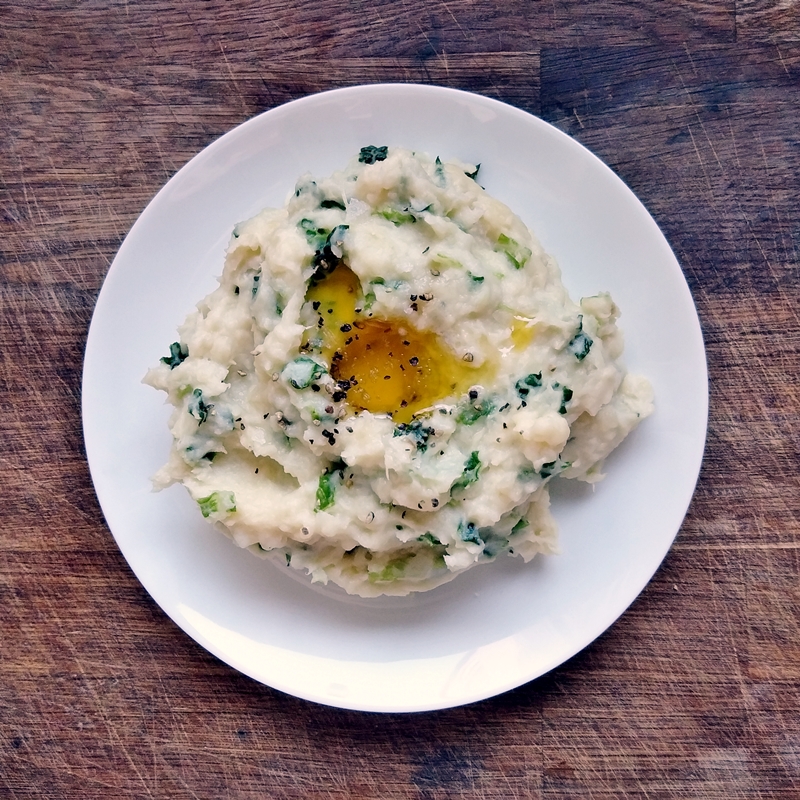
There are many traditional foods associated with All Hallow’s Eve/Hallowe’en, November Night, but one which might be new (and deliciously simple to prepare), is the Irish potato dish of Colcannon.

Back in the beforetimes, when cakes of bairín breac were considered a luxury, people used to celebrate All Hallow’s Eve with a big pot of Colcannon. A ring was hidden in the depths of the creamy, mashed potatoes, and whoever ended up with it on their spoon, was said to be going to be the first to marry, within the next 12 months.

There aren’t many Irish cookery books of this time, so my favourite place to find accounts of the Irish food actually eaten by the population (as opposed to some publisher’s imagined scenario), is The School’s Collection at the National Folklore Collection, held at University College, Dublin. The Schools Project was an ambitious and wide-ranging collection of everything to do with Irish Folklore and Culture, gathered and recorded by school pupils between 1937 and 1939. More information about the project can be found here.

With information gathered from all across the country, it is fascinating to see both the common threads that bind the Irish people together, as well as discover the little differences that make each community unique. For instance, you might be aware of the popular Irish potato dish of Boxty, you might also be aware that it can be served in three different ways (loaf, dumplings, pan), but you might be surprised to learn that The Schools Collection contains over 150 different ways of making Boxty. I recently wrote a paper about this, the appendices of which, including the list of 150+ different ways of making Boxty, you can access here.

So it is, to a certain extent, with Colcannon. It also appears under the names Brúitín, Brúchin, Champ and Poundies, to name but a few. “No, no no!” I hear you exclaim, “Champ is its own thing! It’s made with spring onions!”

Well yes, but actually no.

It might actually be a Stampy/Boxty situation, where the same dish has different names, depending on the part of the country you come from. I shall be looking into this more soon.

Similarly, there can be interpretation as to what exactly the dish comprises. At it’s simplest, it is cooked potatoes, mashed with a little milk, pepper and salt, and served in a mound with a lump of butter in the middle. It is eaten by scooping some potato from around the edge and then dipping it in the growing pool of melted butter in the middle before consuming.

Many accounts of Colcannon have additional items of flavouring added. “A bit of greenery” is probably the easiest way to describe a large proportion of them, which include young (spring) onion, chives, nettles, leeks, shredded cooked cabbage or kale, parsley, regular onions.

The accompaniments can be anything you enjoy, but traditionally they include: sweet milk, buttermilk or sowans to drink, and crisp, crunchy oat bread (oatcakes) to use as a scoop.

I was delighted to find just how old the dish of Colcannon is: there’s mention of it back in the eighteenth century. William Ellis (1750) includes a recipe for an “Irish Country Dish” in his The Country Housewife’s Family Companion, p366.

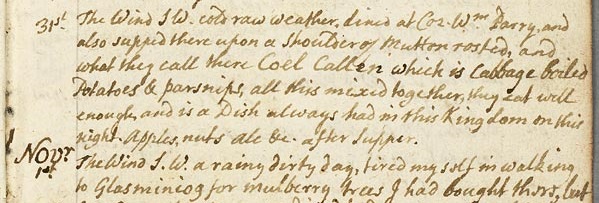
And Welsh diarist William Bulkeley (1691-1751), whose diaries are kept at Bangor University, mentions dining on “Coel Callen” at Halloween in 1735, whilst on a trip to Ireland.

Even earlier, a poem published in Dublin in 1723, speaks of what certainly seems to be a dish of Colcannon being prepared for a wedding feast.

From “Mendico-hymen seu, tuphlo-pero-gamia. The beggar’s match. Translated from the Latin.”, W. Thompson, printed by Tho. Hume, for Jer. and Sil. Pepyat, Dublin, 1723.

Colcannon

This is more of a guideline than hard-and-fast recipe. Use quantities to your own personal needs and taste.

potatoes
greenery 
milk
salt & pepper
butter

ring (optional)

  • Cook your potatoes. The method doesn’t really matter: boil or bake. The important detail is to mash them smooth whilst hot. I use a ricer to make sure all lumps have been dealt with, but you can also press them through a coarse sieve or use some elbow grease and a masher utensil.
  • Smooth out the mixture by adding milk. NB Use hot milk, otherwise you run the risk of cooling down your potatoes too much. If you’re using any kind of onion, you might like to simmer them in milk for 10 minutes to both flavour the milk and reduce the harshness of the onions themselves. Strain out the onions, keeping the warm milk for mixing, and chop the onions finely – or to your taste. Cover and keep hot while the greens are prepared.
  • Add your greens – this may be in the form of herbs (chives/parsley) green onions/spring onions/cibol/leeks, Savoy cabbage, spring greens, kale, sweetheart cabbage, white cabbage, Brussels sprouts, spinach, nettles, etc. The cabbage and/or leeks should be shredded to your liking (fine/coarse) and blanched/steamed for five minutes. Add sufficient to your own personal taste.
  • When everything is piping hot, serve your Colcannon in a large communal dish, with a generous amount of butter in a hollow in the centre, and hand round spoons for all. Don’t forget to pop a ring  into the mix before serving, if matrimony is in your plans.

Shortbread Variations

This week’s recipe subject came about, as it increasingly does of late, with a casual thought when looking for something else.

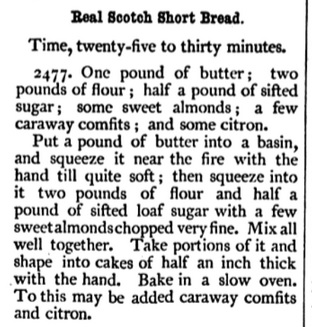
Behold this recipe from Mary Jewry, editor of Warne’s Model Cookery and Housekeeping Book (1868). The first thing that caught my eye, and got me thinking, was the proportions of the ingredients. Nowadays, a proportion of 1:2:3 (of sugar, butter and flour) is touted by many as traditional, but here was a proportion of 1:2:4. Also of interest was the addition of ground almonds to add texture, whereas modern purist recipes staunchly abide by the ‘rule of three’ (i.e. no additions, especially not caraway comfits and citron). Lastly, there was the cooking temperature – a slow oven – which is different to the short sharp bake at high temperature in use today.

I resolved to put these variations to the test, but then the addition of the almonds got me thinking some more: what else has been added to traditional shortbread, and to what end? The answer turned out to be: quite a bit. I ended up baking twelve batches of 1:2:4 shortbread, each with a different ingredient making up 1/4 of the flour component, and performing a giant taste test to see which was, for me, the ultimate combination. And here’s a key point: it’s all down to personal taste. What I might find delightful, others may find not to their taste. I’m hoping that by presenting a wide range of options, you too may find your ultimate shortbread recipe.

Here are the choices I made:

  • Sugar: I chose to use soft light brown. This was to give a more rounded flavour to the shortbread. White caster (superfine) sugar is sweet, but only that – rather one note.
  • Butter: unsalted, but with a small quantity of salt added. I had made some shortbread recently, and used salted butter, and the shortbread was delicious, but the finishing lick of saltiness might be an acquired taste. I tried another batch with unsalted butter, and this proved less popular, so for the run of test batches I resolved to split the difference and use unsalted butter, with just a quarter teaspoon of salt.
  • Flour: regular, unbranded white plain flour. After baking a control batch using 100% flour, the remaining batches each had 1 part of the flour component as a different ingredient. These comprised: ground almonds, rice flour, ground rice, cornflour, ground almonds, semolina, fine cornmeal and coarse cornmeal (caveat: I was unable to find any coarse cornmeal, and used polenta instead).

The Results

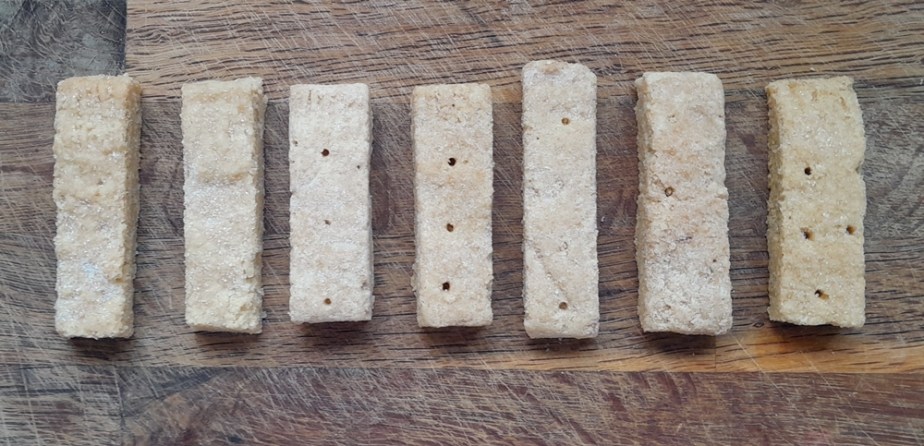
There are several outcomes from this mammoth bake and taste test. (Top image, Shortbread Variations: From the left, classic (butter, sugar, flour), then baked with: cornflour, rice flour, semolina, ground rice, ground almonds, polenta).

  • The ‘flours’ – these can be divided into two groups, the powders and the granules. Both affect the texture of the finished shortbread.
    • The powders include cornflour, rice flour, fine cornmeal (and possibly by extension, arrowroot, potato starch). The effects of using these powder-fine flours is to make the texture of the shortbread crisp and ‘melt in the mouth’.
    • The granules include ground almonds, ground rice, semolina, coarse cornmeal, polenta. The  effects of using these granules is to make the shortbread both crisp and crumbly. They create a thin, outside ‘crust’ and inside deliciously friable and crumbly. Ground almonds obviously bring a nuttiness to the cooked shortbread, which, if it’s your favourite, could be intensified by using ground hazelnuts. The polenta/cornmeal versions also baked to a gorgeous golden colour.
  • The long, slow baking allows the shortbread to cook though thoroughly. Sometimes I have had shortbread where the outsides are cooked, but the insides moist, dense and almost doughy. This method of cooking eliminates that.
  • To further improve the texture of the shortbread, it was returned to the oven to cool, to ensure all moisture is eliminated. The shortbread should not be stored until completely cold.
  • A number of gluten-free batches were made, although fewer that those using regular flour. I have always had good results by substituting Doves Farm gluten-free flour on a 1-for-1 basis, and so it proved here. NB Gluten-free shortbread is extremely delicate when freshly baked, and will need a very careful approach (see below). However, if my advice is followed, once cooled they will be much more sturdy.

Gluten-free shortbread variations: classic, ground rice, fine cornmeal, polenta

To summarise: All the shortbread versions were delicious, and unless you line them up side by side like I did, it is unlikely that you would be able to rate one over another, It’s really almost splitting hairs to rank them – everyone’s personal taste is different – so I won’t. One observation of mine, which you are free to discard, is that, for my tastes, the shortbreads were a little sweet, so in my perfect recipe (below), I reduced the amount of sugar to just 45g – it’s practically health food! With the sprinkling of sugar on the top, it made for the perfect amount of sweetness.

People with gluten sensitivity: At the risk of stating the obvious, almost all of the flours can be enjoyed – rice flour, corn flour, ground rice, fine corn meal, coarse cornmeal/polenta, ground almonds, ground hazelnuts – and as already mentioned, probably arrowroot and potato starch as well. A gentle reminder that the one exception is semolina. SEMOLINA is made from durum wheat and is NOT GLUTEN-FREE.

The Recipe

60g soft brown sugar
120g unsalted butter, chilled
180g plain flour – or gluten-free flour
60g your choice of additional flour
¼ tsp salt
a little caster sugar for sprinkling

  • Line a small baking tin (18cm x 25cm) with baking parchment. Leave extra parchment overlapping the sides, to assist in moving the baked shortbread.
  • Heat the oven to 160°C, 140°C Fan.
  • Cut the butter into cubes and add to the bowl of a food processor fitted with a blade.
  • Add the remaining ingredients to the butter and pulse briefly until the mixture resembles breadcrumbs.
  • Tip the mixture onto the parchment, and press into an even layer.
  • Use a round skewer to poke holes all over the surface of the slab of shortbread.
  • Use the tines of a fork to mark the shortbread along the long edges of the tin.
  • Bake the shortbread for 30 minutes, turning the tin around after 15 minutes to ensure even baking.
  • Once the shortbread is baked, there are additional steps you need to take in order to make your shortbread the very best,
    • Remove the shortbread from the oven. Keep the oven on.
    • Sprinkle the surface of the shortbread with a little caster sugar.
    • Using a very thin bladed knife or (ideally, in my opinion, a metal dough scraper), cut the shortbread into pieces. I cut mine lengthwise in half, then across into fingers 3cm wide.
    • Allow to cool in the tin for 15 minutes.
    • Gently slide the parchment out of the tin and onto a baking sheet. Smooth out the parchment.
    • Using the dough scraper (or palette knife turned sideways), ease the shortbread pieces apart to leave a 5mm gap in-between. You want to gently push them apart, not try and slide anything underneath, because the shortbread will break. NB The gluten-free shortbread will be EXTREMELY delicate, take extra care at this point.
    • Return the shortbread to the oven, switch the oven off and leave to cool until both oven and shortbread are completely cold. I baked most batches in the evening and let the shortbread cool overnight. If baking during the day, it will take between 3-4 hours.
    • When completely cold, transfer the shortbread to an airtight container to store.

Bonus

On a personal level, I discovered that I much preferred the gluten-free shortbread made with the grains, specifically cornmeal, the texture being surprisingly moreish. I think the natural sweetness of maize and the greatness of the flavour when pairing with butter is a significant contribution. To this end, I decided to make one more batch, with cornmeal, and some raw butter (made from unpasteurised milk). In the 19th century all butter was raw butter, so I reasoned that this would be even more authentic (I had brought some raw butter back from France this summer). To cut a long, rambling story short – it was amazing. If you have the opportunity to get your hands on some raw butter made from unpasteurized milk, do it, and then make shortbread. It’s sublime. It is possible to get raw butter in the UK, but it is more expensive than regular, and in the current cost of living crunch, it might not be your number one priority. However, if you fancy treating yourself, then Sainsbury’s stocks Isigny Sainte-Mère salted raw butter, whilst Ocado has both salted and unsalted (doux).

My Perfect Shortbread

45g soft brown sugar
120g raw butter made from unpasteurized milk, chilled
180g plain white gluten-free flour
60g coarse cornmeal
¼ tsp salt
a little caster sugar for sprinkling

Make and bake as above.

Improving Strawberries

On a recent holiday in France I had some wonderful strawberries: heady, aromatic and bursting with flavour.¹

Still a bit mesmerised, two punnets of strawberries were one of the first things I bought when we got back. Alas, compared to the French ones, they were decidedly underwhelming. I know it’s late in the season for strawberries, but even so, a great disappointment.

Since we now have the luxury of strawberries year-round, I thought I’d bring you this method of not only rescuing below-par strawberries, but also demonstrating how you can use them in a couple of recipes, as well as enjoying them in their new and improved, glow-up form.

The method is very simple, too. Cut up your strawberries and sprinkle them with a little sugar – NOT icing sugar, because it contains an anti-caking agent. Use white caster or granulated. The sugar will gradually draw out the juices from the strawberries, which will in turn absorb some of the sugar.

You can enjoy them as is, and luxuriate in their much improved flavour, or you can use them in other things. Below I have two suggestions – a strawberry scone and in a mille feuille made from stale croissants.

To Confit strawberries

I’ve gone back and forth quite a bit to come up with a term for this method and, to be honest, I’m not entirely happy with ‘confit’, because to confit something generally involves the use of heat to cook the items, which this patently doesn’t. However ‘macerating’ wasn’y really suitable either, because that involves adding liquid, and here the liquid comes from the fruit itself. If someone can find a word that fits better, do please leave a comment.

strawberries
caster or granulated sugar – 1tbs per 100g strawberries

  • Remove the green stalks and leaves from the strawberries and cut each one into 6-8 pieces, depending on size.
  • Put the cut strawberries into a bowl and sprinkle over the sugar.
  • Turn the berries over gently so that the sugar is distributed evenly.
  • Cover with plastic and set somewhere cool. I prefer to keep them at room temperature rather than chilled, at least in the initial stages as I believe it produces a better overall flavour, but keep in the fridge if you prefer.
  • Gently stir occasionally.
  • Allow your strawberries to macerate for up to 24 hours. The longer you leave them, the more juice will be drawn out. After about 24 hours, the  strawberries will be practically floating in a light syrup and their flavour will be deliciously intense.
  • You can choose when to eat/use your strawberries. For the two recipes below I used berries that had been macerating for 24 hours.

Strawberry Scones

Fresh strawberries release too much juice to be included in regular scones, but by using confit strawberries, you can get all the concentrated flavour and still maintain the integrity of your scones. This recipe is based on that of Mrs McNab (19thC farmer’s wife from Ballater, Scotland – see Great British Bakes). It makes 8 scones. It is deliberately unsweetened, as I believe the plainness of the scone dough highlights the flavour of the strawberry pieces much better than a sweet dough. You might disagree, and that’s fine. You can add 30g of sugar to the mixture before baking if you like, or sprinkle some sugar over the hot scones after baking (as in the picture).

225g plain flour
2tsp baking powder, or 1 tsp cream of tartar, ½ tsp bicarbonate of soda.
½ tsp salt
30g unsalted butter
1 large egg
60ml plain yogurt
60ml milk

100g drained, confit strawberries.

Milk for glazing
sugar to sprinkle (optional)

  • Heat the oven to 220°C, 200°C Fan.
  • Put the flour, powder(s), salt, butter, sugar if using, and egg into the bowl of a food processor fitted with a blade and blitz until the mixture resembles breadcrumbs.
  • Tip the mixture into a bowl.
  • Add the drained strawberries and fold in.
  • Mix the yogurt and milk together until smooth.
  • Fold in the yogurt mixture little by little, ideally with a round-ended knife. NB Do NOT slosh it in all at once. You may not need all of the liquid, especially if the strawberries are juicy. You want just enough liquid to bring the dough together.
  • NB The faster you do the shaping/cutting/getting the scones in the oven, the more they will rise.
  • Turn the dough out onto a floured surface and pat into a circle about 4cm thick. NB Don’t roll it with a rolling pin, you’ll just squash out all the lift from the raising agents.
  • Using a dough scraper or thin-bladed knife, cut the disk of dough into eight triangles. They will look small, but they will rise splendidly in the oven.
  • Transfer the triangles to a parchment covered baking sheet and brush over with milk to glaze.
  • Bake for 15 minutes, turning the baking sheet around after 10 minutes to ensure even colouring.
  • Remove from the oven and sprinkle caster sugar over the hot scones if liked.
  • Transfer to a wire rack to cool.
  • Enjoy warm as is, or with butter or cream.

Strawberry Croissant Mille Feuille

You know when you have stale croissants lying around?

*crickets*

Of course not. No-one does.

HOWEVER!

The thought “What if…” did cross my mind over the aforementioned holidays, and that led me to thinking about how they might be used in a new and exciting way. The idea is related to the puff pastry more traditionally used insofar as I brought back some delicious French butter with the intention of making a batch, and now I’m procrastinating like mad because, although delicious, it’s SUCH A FAFF™! Bonus: You can use gluten-free croissants (Schar is one brand I have tried – find them in the freezer section of your local supermarket).

Using a croissant reduces the Faff to almost non-existant levels and provides another opportunity to use the strawberries prepares above – this time using the juice as well. Slicing, toasting and then bruléeing the croissants will give both crunch and shine. The last two things needed for our croissant mille feuille are Brulée Sugar and some whipped cream.

To thicken liquid with Arrowroot

Why arrowroot, you may be asking? Well, it thickens and turns clear when heated, but unlike cornflour, when cooled it does not go ‘gloopy’ as such, rather it forms a loose jelly-like texture that clings wonderfully to the fruit (see top photo) making it bright and glossy, and doesn’t form a skin.

For each 80ml of liquid/syrup, use 1tsp arrowroot, or 1 tablespoon per 250ml.

  • Mix your arrowroot with an equal quantity of cold water until smooth.
  • Add the arrowroot slurry to your syrup and heat gently, stirring all the while.
  • NB Do not boil the mixture. High heat will break down the thickening properties. Remove from the heat when thickened and clear.
  • Stir in your strawberries and chill until required.

To Assemble

  • Slice your croissant(s) into three, horizontally.
  • Toast the slices lightly on both sides. Be careful, they will take less time to toast than regular bread, due to the higher fat content.
  • Dust the slices thickly with brulée sugar, then either grill them or use a blow torch to melt the sugar. The sugar will melt quickly, so keep an eye. Allow to cool, so that the sugar hardens.

  • To serve: pipe a rim of cream around the edge of the bottom two layers, and fill the middle with your strawberries in thickened juice.

  • Stack the layers together and serve.

¹ From the Calais Cité Europe Carrefour near the Tunnel, which I can highly recommend for all those last minute foodie purchases on your way home. If you’re interested in growing your own, the variety I recommend is Charlotte.

Turkey Salmi

This week I’d like to talk turkey and making champagne tastes on a beer budget.

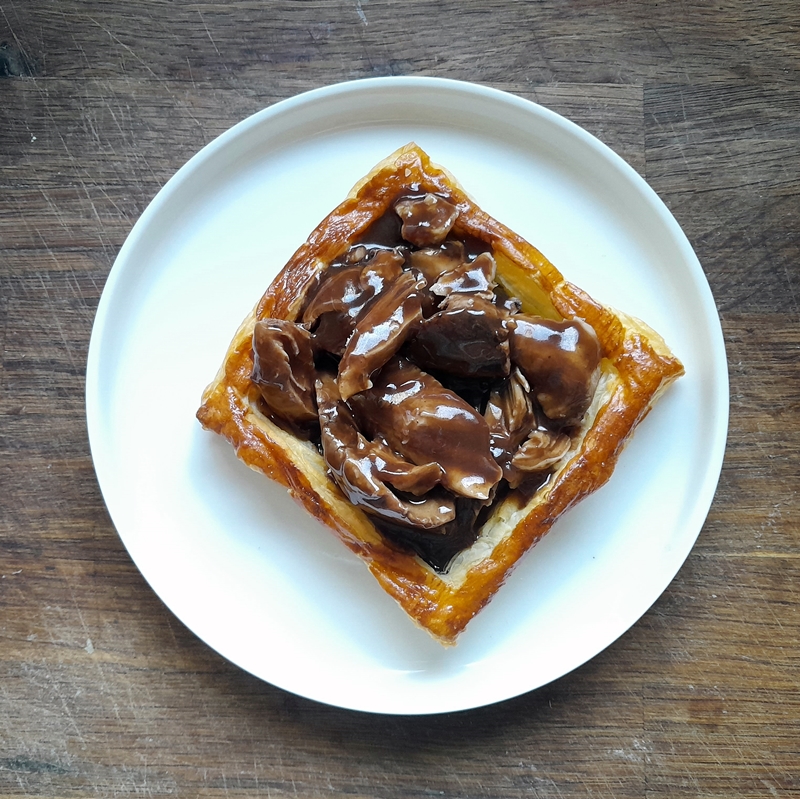
Just look at that crisp, golden pastry and glossy, rich sauce covering the tender pieces of turkey!

Turkey is a staple on the festive dinner table, but the preference for the pale breast meat has seen the rise of the turkey crown. Since science has yet, one fervently hopes, to develop a limbless turkey, those extra bits don’t just disappear, but are still around to purchase and enjoy.

Actually, I have no idea what happens to the trimmed turkey wings – one of life’s great mysteries – but turkey legs are available in both drum and thigh formats, and should be snapped up whenever you see them because they are fantastic value for money, robustly flavoured and, treated properly, can make for delicious and relatively fuss-free meals.

A quick gallop around the aisles this week tells me that turkey thigh and turkey drumsticks are available in Sainsbury’s, Asda (drumstick only) and Tesco (thigh only). The Tesco thigh is the best value, at only £2.80/kg, but the Sainsbury’s drumstick (£3.30/kg) and thigh (£4.67/kg) and Asda’s drumstick (£3.71/kg) are also very budget friendly, especially when compared to other proteins.

I also took a look at what people out there on the t’Internet are doing with turkey drumsticks and thighs and long story short, not a lot. Both are almost exclusively roasted, and whilst knawing on a joint the size of your arm is certainly a look, here we’re going to be more concerned about taste, tenderness and the use of cutlery.

Rather than the harsh heat of the oven or the barbecue, the method I’m proposing is to use our old friend the slow cooker. A long, low, braise will render even the sturdiest of turkey legs tender and melt-in-the-mouth. And it is so EASY! Literally plonk in the turkey, slosh over some braising liquid, switch it on and you’re set for several hours. You can choose whatever stock you like for the braising, but the simplest and best, in my opinion, is beef stock. Using the jelly-like  beef stock pots made up to double strength (so using only half the water), gives the turkey both flavouring and seasoning in one. Being strongly flavoured, the leg meat also flavours the stock in return, to give a fantastic base for gravy or, as we have here, a sauce.

This recipe is an adaptation of the numerous game bird salmis so favoured by the Victorians. You can serve the meat in the sauce over rice, noodles or potato snow¹, but my recommendation is for a puff pastry vol-au-vent case, to add a fantastic contrast in colour and texture.

In another tip gleaned from the history books, for the vol au vents you can use just a single roll to make six, large vol-au-vent cases. I used to buy two rolls of puff pastry, and cut the bases from one and the borders from another, but this way you can get both from a single roll. Simply cut out the centre of each base and re-roll it until it is as big as the border, then slide it under the pastry border and trim neatly.

Turkey Salmi

You can start this the day before and cook the turkey overnight, else cook on High for about 5 hours to eat the same day. You can also cook the pastry cases the day before and just warm them in the oven before serving.

For the Turkey
Bone-in turkey thigh and/or drumstick – however many will fit in your slow cooker
Rich beef stock pots x 6

1 sheet ready-rolled puff pastry
1 egg for glazing

For the Sauce
30g butter
1 small onion finely chopped
1 bay leaf
3 cloves
1 blade of mace
100g streaky bacon – chopped
200ml red wine (or red grape juice/pomegranate juice/more stock)
300ml beef turkey stock
1 heaped tbs cornflour mixed with a little cold water

  • Put your turkey meat into your slow cooker.
  • Make up the beef stock with just 1.5 litres hot water. Make sure they have melted fully before adding to your slow cooker. If you need more liquid, just add water.
  • Turn the heat to LOW and cook for 8 hours-10 hours. Overnight is perfect. You can also cook on HIGH for about 5 hours if that suits your timings better.
  • When the meat is tender, lift the joints from the slow cooker (a large strainer spoon is helpful here, if you have it), and remove and discard the bones, skin, tendons and cartilage. Try and keep the meat in large pieces. Strain the stock through a sieve and set aside 300ml. Save/freeze the rest for other uses.
  • For the sauce:
    • Melt the butter in a pan and add the onion, bacon and flavourings.
    • Fry for 10 minutes over medium heat until the onions have begun to caramelise.
    • Add the red wine, if using, and simmer for five minutes.
    • Add the stock and let all simmer together for a further 10 minutes, allowing all the flavours to mingle.
    • Optional: Strain through a fine-meshed sieve and return the liquid to the pan. The sauce in the photograph has been strained, and as such gives a really shiny and glossy finish. (I had the bacon and onion in some of the sauce later, on a baked potato. It was delicious.) But there’s nothing wrong with leaving the bacon and onion in the sauce (waste not, want not and all that) – the choice is yours.
    • Taste the sauce and add salt and pepper as required.
    • Add any flavouring sauces to your own taste. These include, but are not limited to, oyster sauce, Worcester sauce, Henderson’s Relish, Soy Sauce, Mirin, Shaoxing wine, anchovy essence, Hoisin sauce, Teryaki sauce, etc.
    • When seasoned to your satisfaction, whisk in the cornflour mixture and slowly bring to the boil, stirring, until the sauce clears, thickens and becomes glossy.
    • Reduce the heat to low and add the cooked turkey pieces.
    • Serve over rice/noodles/riced potatoes, or keep warm while you bake the pastry cases.
  • For the pastry:
    • Heat the oven to 220°C, 200°C Fan.
    • Unroll the pastry and cut into 6 squares (lengthwise in half, then vertically in thirds to give 2 rows of 3)
    • Cut out the centre of each square, leaving a 2cm-ish border.
    • Roll out the middle pieces until they match the size of the borders.
    • Dampen the edges of the now very thin, centre pieces and slide the borders on top. Trim the edges neatly. Prick over the bases with a fork to help keep them from rising during baking.
    • Whisk the egg and paint it over the borders using a pastry brush. Try and keep the egg from dripping down the sides, as this will glue the layers together as it bakes and keep the pastry from rising to its fullest extent.
    • Bake for 25-30 minutes until crisped, risen and golden, turning the baking sheet around halfway through.
    • Cool on a wire rack. Once cold, store in an airtight container (if making ahead).
  • Spoon the warmed turkey and sauce into the baked pastry shell and serve.

¹ Baked or boiled potatoes put through a ricer into a bowl. The riced potato should be allowed to fall into the serving dish in a mound and then served immediately untouched by anything else, spoon or seasoning, to maintain the lightness. Great for dishes with a rich sauce or gravy such as this.