Irish Halloween Treats

There are several Halloween traditions around these isles, but arguably the strongest traditions abide in Ireland.

Several years ago, I discovered online a trove of fascinating Irish social history at the National Folklore Collection. This project is the digitisation of thousands of essays written by Irish schoolchildren and teachers from over 5000 primary schools in the Irish Free State, between the years 1937-1939. These social history essays contain information gleaned from parents and grandparents, and give a fascinating insight into hearth and home stretching back to famine times in the nineteenth century. This amazing resource is searchable on an abundance subjects, but of course the food essays are going to be my main interest.

If you’d like a deep-dive into just how much information is available to explore, my paper “The Boxty Paradox: Everything, Everywhere, All At Once” can be downloaded from the Books and Writing page. One thing that became aparrent during the research of that paper was just how bleak the food choices of so many families were. Consequently, the celebratory foods might seem to us rather plain. However, they can also demonstrate an appreciation for, if not the finer things in life, then life’s simple pleasures.

“Hallowe’en was a great night among the Irish people long ago and they looked forward to it for many weeks. All the boys and girls would gather together in one house and they would have great feasting & merrymaking.”

Collected by Annie Fallon from Mr John Harley, Farmhill, Co. Mayo1

The Halloween/November’s Night/Oidhche Shamhna foods most mentioned are barn brack/bairín breac – a ‘speckled loaf’ originally of caraway seeds, but more recently dried fruit – boxty, apples and nuts.

“In this locality the popular food at Halloween are apples, nuts, and boxty, also dumplings of many kinds.”

Collected by Mrs A. Montgomery from Mrs Kelly, Corr, Co. Cavan2

According to many accounts, the Halloween barn brack was saved up for and bought from a bakery. These cakes were baked containing a ring, and whoever got the piece of cake with the ring was supposed to get married within a year.

“Halloweve night falls on the last night of October. On that day my mother goes to town and she buys apples, nuts and a barn-brack. “

Collected by Jerard Jordan from Mrs Gara, Tivannagh, Co. Roscommon.3

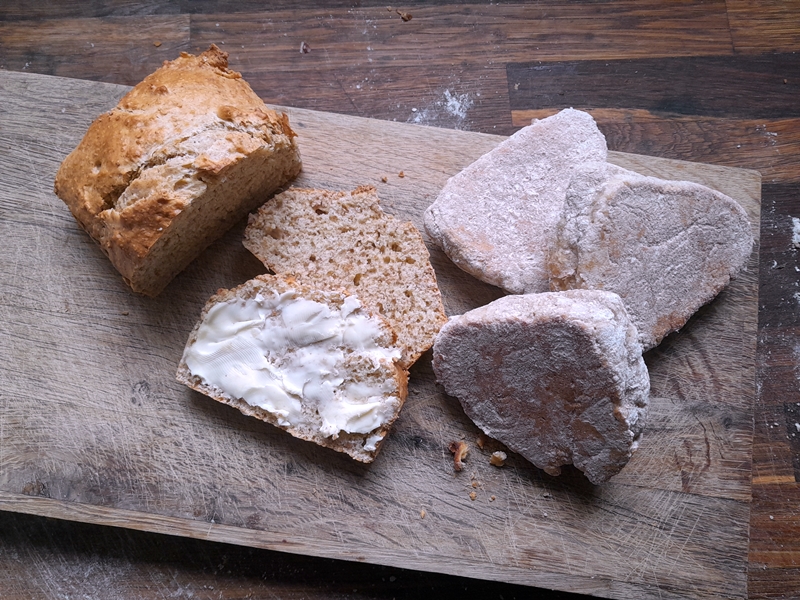
Alternately, during hard times, a soda cake would be baked at home either on the griddle or inside a bastible (lidded pot). The most coveted cake was baked with sour cream, but apples and hazelnuts could also be added.

“apples are put in cakes for November night.”

Collected by Tommy Kelleher from Mrs Margaret Kelleher, Mullaghroe South, Co. Cork4

The cream cake was a soda cake with plenty of cream in it and baked in the griddle.”

Collected by Beití Ní Dhomhnaill from Mrs Ashe, teacher, Dún Beag5

“On special occasions … a cream cake was made. Cream was mixed through the milk when mixing the dough. Currants, sugar and raisins were also put in the cream cake to make it rich and sweet.”

Collected by Seamus Daly, Kilclooney, Co. Waterford6

“On festive occasions a special cake was baked of such ingredients as flour, eggs, sour cream and a little sugar.”

Collected by Mary Jones from Mr M. Jones, Bruree, Co. Limerick7

“… cream cakes were made. These were made thin, but otherwise were made in the same way as ordinary soda cake.”

Collected by Michael Collins, Woodcock Hill, Co. Clare8

The recipes this week are two versions of soda cake mentioned in accounts in The Schools Collection: the cream cake and a fruit cake. According to the written accounts, the cream cake was considered the pinnacle of social delicacies, in numerous accounts warranting special mention. The fruit soda cake has more oblique mentions, but is absolutely symbolic of the foods enjoyed at Halloween. You can, of course, choose to add apples and nuts to the cream cake, if liked.

 Cream Cake

In the 19th century in Ireland, white flour was expensive, so if wheat flour was used at all, in most households it was wholemeal. I’ve opted for a less dense mixture of white and brown. Choose your own variation.

If you’d like to add apples and nuts to your cream cake, use the proportions in the recipe below, and reduce the sugar to 50g.

450g plain flour/wholemeal/brown/mixture
1tsp bicarbonate of soda
1 tsp salt
2 large eggs
85g sugar – caster, light/dark brown – your choice
300ml sour cream
100ml milk

  • Prepare your baking tin(s). You can, of course, bake your soda cake freeform, but a tin is also fine. My tin of preference is a 24cm shallow square tin, but you can also choose smaller tins or indeed choose to bake them in a pan on the ob over medium-low heat. If using a tin, line with baking parchment.
  • Heat the oven to 200°C, 180°C Fan. If using the hob, put a non-stick pan over medium-low heat (4 on a 1-9 scale) and allow to heat thoroughly.
  • Put the flour(s), soda, salt, sugar and eggs into a food processor and blitz briefly until well combined.
  • Tip the mixture into a large bowl.
  • Mix the milk and cream together until smooth, then add to the dry ingredients bit by bit. NB You might not need all of the milk mixture, as it will depend on the amount of moisture already in the flour and eggs. You want a soft dough, so a little extra is fine, but not enough moisture will lead to a dense loaf too stiff to rise.
  • When your dough is fully combined, tip out onto a floured surface.
    • For soda farls to cook on the hob, divide the dough into two, and lightly shape each half into rounds. Gently pat down until 4cm in height. Using a dough scraper or similar, cut each round into six or eight triangles.
    • For a large loaf, shape into a round and transfer to your prepared tin. Cut a deep cross in the top to assist in even cooking. If you have any of the cream mixture left, you can brush it over the top of your loaf as a glaze.
  • To cook your cream cake(s)
    • For a large loaf, bake for 45-50 minutes, turning the oven half-way through to ensure even baking.
    • For cream farls, bake gently in your pan for around 10 minutes each side, turning carefully when the first side is toasted and lightly browned.
  • Cool briefy on a wire rack and serve warm with plenty of good butter.
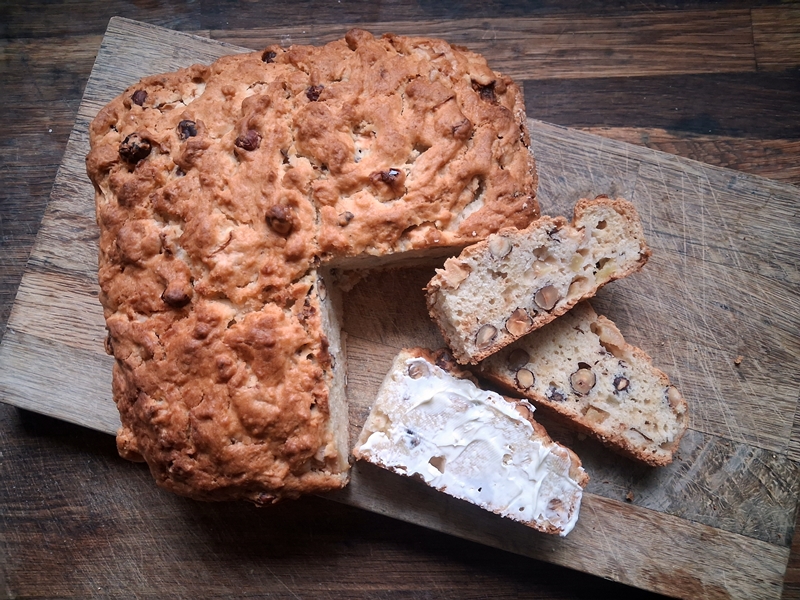
Apple and Hazelnut Soda Cake

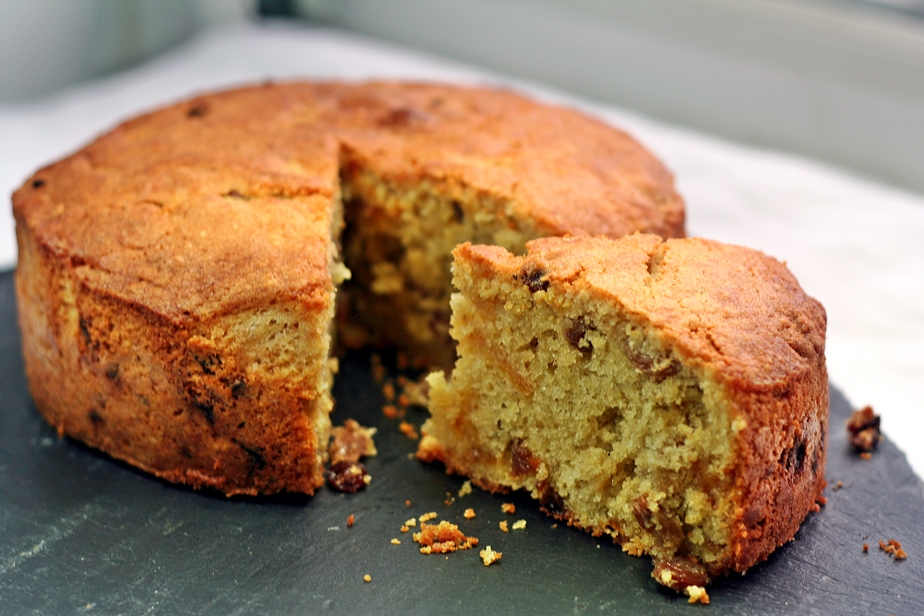
Apples and nuts were central to the feasting at Halloween and this sweet soda cake is rich with both kinds of autumnal bounty. Enjoy warm from the oven or toasted, with a generous spreading of good butter. I’ve chosen to use Bramley cooking apples, as they break down into fluff when cooked.

100g whole unblanched hazelnuts
450g plain flour
1tsp bicarbonate of soda
1 tsp salt
50g sugar – caster, granulated, Demerera, light/dark brown – your choice
2 Bramley Apples – or 500-600g of similar cooking/sharp apples
200ml plain yogurt
200ml whole milk

  • Prepare your baking tin. My tin of preference is a 24cm shallow square tin. Line with baking parchment.
  • Heat the oven to 200°C, 180°C Fan.
  • Put the hazelnuts onto a baking tin and bake for 10 minutes until lightly browned and toasty. You can remove the skins by rubbing the nuts in a clean cloth, but I prefer to leave them as is.
  • Put the flour, salt, sugar and soda into a bowl and whisk together.
  • Peel and core your apples, and chop into 2cm pieces. Add the chopped apple and nuts to your dry ingredients and mix.
  • Whisk together the yogurt and milk, then gradually add to the rest of the ingredients. I find it best to stir the liquid through with a round-ended knife, which is less rough than a larger utensil. You might not need all of the liquid as the apples will contribute to the moisture of the mix.
  • Tip out your dough and shape lightly into a round. Transfer the dough to your baking tin, and cut a deep cross in the top to facilitate even baking.
  • Bake for 50-60 minutes until risen and browned, turning the tin around after 30 minutes.
  • Cool briefly on a wire rack and enjoy warm or toasted with lots of good butter.

1 The Schools’ Collection, Volume 0096, Page 84
2The Schools’ Collection, Volume 0982, Page 233
3 The Schools’ Collection, Volume 0234, Page 307
4 The Schools’ Collection, Volume 0359, Page 144.
5 The Schools’ Collection, Volume 0626, Page 350.
6 The Schools’ Collection, Volume 0654, Page 447.
7The Schools’ Collection, Volume 0498, Page 131
8 The Schools’ Collection, Volume 0598, Page 249
Marmalade Cake

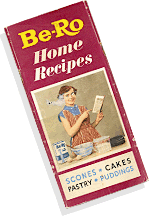
The recipe I have for you today comes from the classic and ever-reliable Be-Ro baking booklet.


My copy dates from somewhere between 1930 and 1950 (going on the fashions worn in the illustrations), and contains tried and tested recipes both for the everyday and special occasions.

I chose this recipe for a number of reasons:

  • It tastes absolutely delicious.
  • It’s a genuine store-cupboard cake, requiring everyday ingredients.
  • It is an excellent way to use up last year’s marmalade to make way for this year’s batch(es).
  • It is an excellent way to start making use of this year’s batch of marmalade, bursting with freshness.
  • It can be varied with whatever preserves you have on hand (within reason).

It being marmalade season, I have recently been preserving up a storm and entering some marmalades in the annual Marmalade Awards competition.

The method I used was extremely small-batch, but still provided me with more than the single jar required for each entry. Now, this year I entered six categories. I have six lots of extra marmalade. So I was KEENLY in the market for some way to increase marmalade consumption.

Enter the Be-Ro booklet and its recipe for Marmalade Cake with its short list of simple ingredients: flour, fat, sugar, marmalade, eggs, milk.

I’ve increased the amounts of each ingredient to 1.5 times the original quantities, because I had almost exactly that amount of Stork baking margarine in the fridge, and the first cake was so successful I made a second with a different marmalade and used butter, which was just as nice.

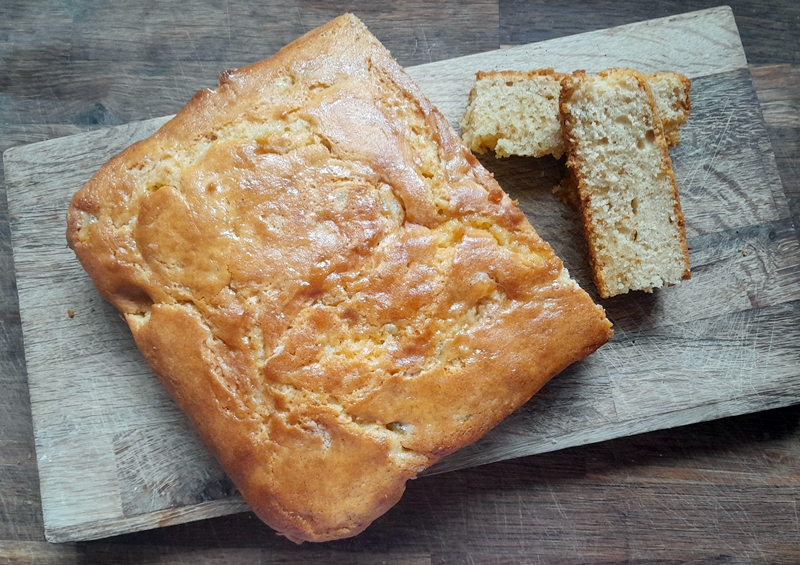
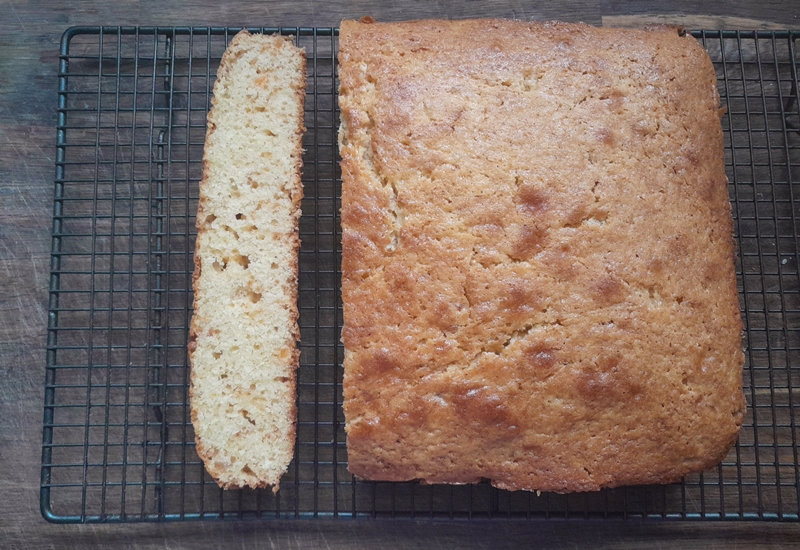
A square lime marmalade cake with two pieces cut off and displayed, on a wooden cutting board.

The first cake was made with lime marmalade (see above pic) and was very delicate in flavour and the cake was soft of crumb. The second cake was made with Seville Orange marmalade (see recipe for Dundee Marmalade here), and was just as delicious, possibly even more so. The striking difference was the aroma when the cake was cut – it was like a cloud of intense orange that wafted up. Amazing. I would venture that you could also substitute the marmalade for other jams or preserves, with the caveat that it should be one of the stronger and preferably tart-flavoured fruit: apricot, plum, damson, etc. because the sharpness of the fruit is a delicious contrast to the sweetness of the crumb.

This isn’t the flashiest, most exotic bake you’ll make, but it is easy and very fine-tasting and can be whipped up in about an hour start to finish from the contents of your cupboard/fridge.

Marmalade Cake

This is for the enlarged mix, and requires a 20cm square tin.

170g butter/Stork
170g sugar
170g marmalade
340g plain flour + 1tbs baking powder OR 340g self-raising flour
3 large eggs
80ml milk

  • Heat the oven to 170°C, 150°C Fan.
  • Grease and line a 20cm square tin with baking parchment.
  • Cream the fat and sugar together until light and fluffy.
  • Add the marmalade and mix thoroughly.
  • Sift together the baking powder and flour if using. Otherwise, sift the self-raising flour.
  • Whisk together the eggs and milk.
  • Alternately add these two ingredient mixtures to the mixture in the bowl, stirring, until everything is fully combined.
  • Pour the cake mixture into the prepared tin and smooth evenly.
  • Bake for a total of 45 minutes, turning the tin around after 25 minutes to ensure even baking.
  • Allow to cool for 10 minutes in the tin, then carefully transfer to a wire rack to cool completely.
  • Store in an airtight container.

Gossiping Cakes

I have a confession to make. I chose these recipes because I loved the idea of women baking cakes specifically for having a get-together and swapping gossip. Alas, that’s not where these cakes originate, but the truth just as interesting.

As I’ve mentioned before, I have spent quite a considerable amount of time cataloguing household manuscripts that have been digitised by various libraries around the world. Obviously, there is going to be a certain degree of repetition of the most popular recipes, but there are also those that stand out as original either by name or by ingredient, etc. Whenever I come across such a recipe, I mark it in the spreadsheet with an asterisk, so when I’m looking back over the thousands of recipes, those asterisked ones are easily highlighted as worthy of a second look. And for the other type of recipes, such as the 200+ recipes simply entitled “A cake”, I’ll get to looking at you in all your (presumed) variety  soon, but to be blunt, you’re pretty low on the ToDo list.

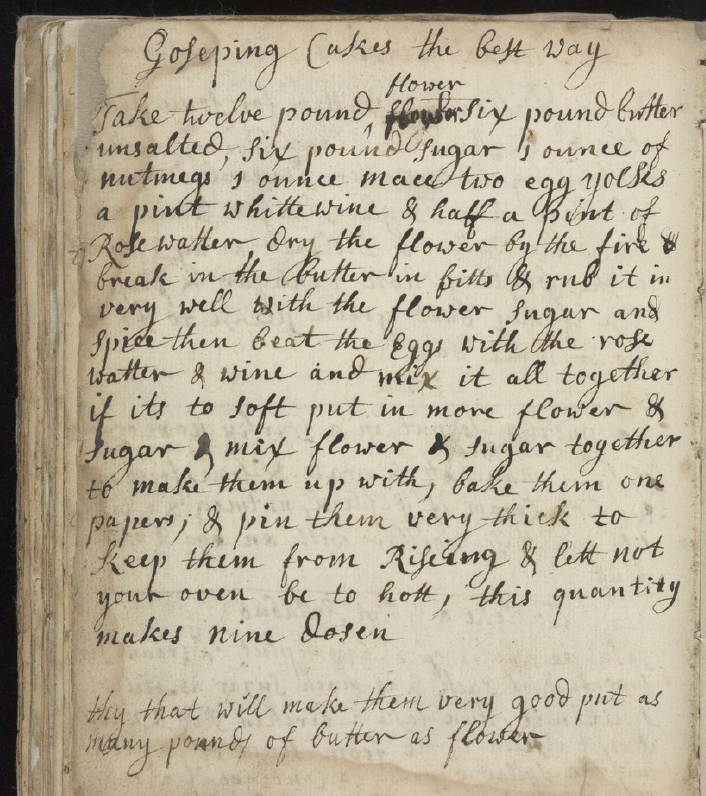
The first recipe I found was this one, dated early 18th century (1738), at the Wellcome Collection.

Recipe for Goseping Cakes The Best Way, from the manuscript of Rebecca Tallamy, (1738), MS4759, Wellcome Collection

It appears to be a spiced variation of shortbread, and obviously one to make in quantity, because the yield of the recipe is over 100 biscuits. It’s demonstrating one of the many interpretations of the word ‘cake’, in this case meaning small, circular biscuits. The last line also caught my eye, because it recommends using equal quantities of butter and flour to make them “very good”.

Regular listeners will have read about my shortbread variation testing a few months ago, where the ratio of butter to flour can range from 1:3 to 1:2, so the assertion that 1:1 is the best, had me intrigued.

This recipe was very much on the back burner until I came across another recipe, similarly named, while indexing the digitised manuscripts at the National Library of Scotland.

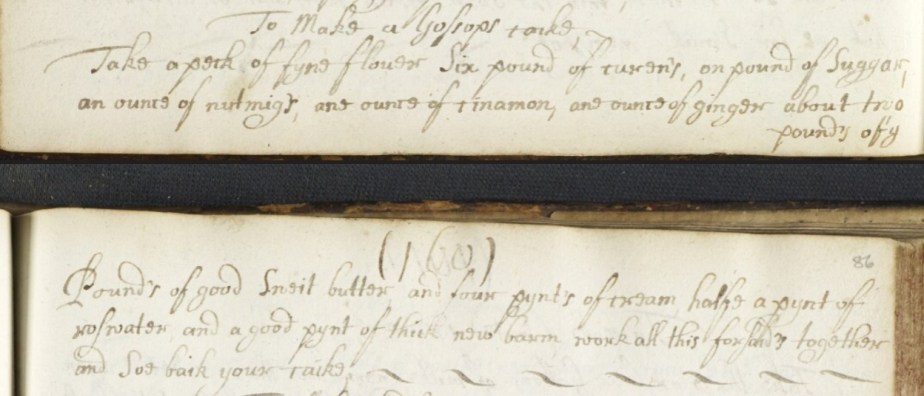
Recipe for a Gossops Cake, from MS103093966.23, (1660-1699), National Library of Scotland

This recipe is in a manuscript older by almost a century (1660-1699), and differs in that it contains fruit, and is a large yeasted cake – exceedingly large, going by the peck/14lb/9kg of flour required – the term cake being used in this instance more akin to our modern usage.

To delve deeper into this mystery, I turned to the internet, and found the following passage:

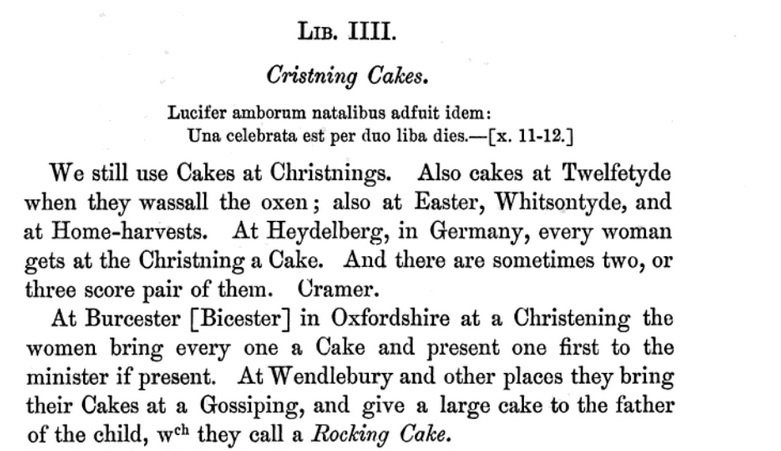
Christening cake traditions, from “Remains of Gentilisme and Judaisme 1686-87”, John Aubrey, James Britten, 1881, p65

This threw up the question: What is a Gossiping? And so I went hunting in the Oxford English Dictionary which I learned that a Gossiping is  a christening, or christening feast, derived and corrupted from “Godsibb”, which is an old English word for Godparent.

Not entirely relevant, but interesting nontheless, the oldest usage of Godshib I found was over a thousand years ago in Sermo Lupi ad Anglos, or the Sermon of the Wolf to the English, a sermon given by Wulfstan II, Bishop of Worcester and Archbishop of York (d. 1023) in 1014:

“And godsibbas and godbearn to fela man forspilde wide gynd þas þeode toeacan oðran ealles to manegan þe man unscyldgige forfor ealles to wide.”

Trans: And too many godparents and godchildren have been killed widely through-out this nation, in addition to entirely too many other innocent people who have been destroy­ed entirely too widely.”

Later usages of the word referred to a gathering of women/midwives when a woman was in labour, and hence to the modern usage.

So with a history stretching back many centuries, the account of christening traditions at Wendlebury would appear to neatly explain the differences between our two recipes: a large cake was presented to the father – presumably for all his hard work in the proceedings *eyeroll* – and the smaller cakes were shared with the guests.

So let’s get on with some gosseping!

A Gossop’s Cake

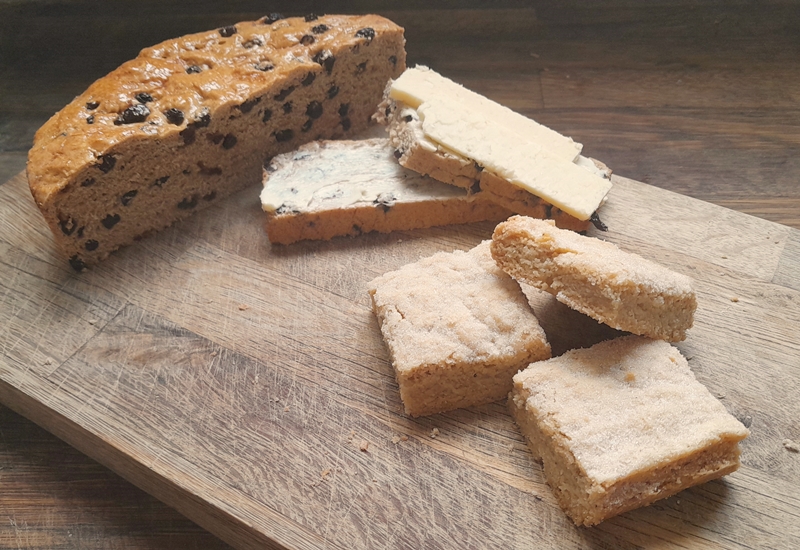
This is a fruited, lightly spiced and yeast-raised cake. If you’re British, it’s like an enriched teacake: delicious fresh, delicious toasted, and delicious either way with butter and a slab of cheese (but better with toasted). I’ve scaled the recipe down to make for a modest sized cake, but you can always double the recipe if it turns out to be a favourite.

315g plain flour
135g raisins
25g caster sugar
1tsp ground nutmeg
1tsp ground cinnamon
1tsp ground ginger
50g unsalted butter
150ml single cream
100ml water
1½tsp rosewater
1 sachet fast-acting yeast

single cream to glaze

  • Plump the raisins: put the raisins in a saucepan and cover with water. Warm gently on a low heat for 10 minutes while the dough mixes. Strain and pat dry.
  • Sift together the flour, yeast, sugar and spices.
  • Put the butter, cream, water and rosewater into a small pan and warm gently over low heat just until the butter has melted.
  • Put all ingredients except the raisins into the bowl of a stand mixer fitted with the dough hook and mix on slow until the dough comes together, then continue to knead for 10 minutes until smooth.
  • Add in the plumped raisins and mix on slow to combine.
  • Grease and line a tall, 20cm cake tin, preferably loose bottomed, with parchment.
  • Form the dough into a smooth cake and place in the prepared tin.
  • Set aside to rise until doubled in size. The enrichments to the dough (cream/sugar/fruit) will impact the rise, which is why there is only a single rise for this cake, thus taking advantage of the initial vigorousness of the yeast.
  • Heat the oven to 190°C, 170°C Fan.
  • When the cake has risen, gently brush the surface with single cream, and bake for 30-40 minutes until well risen and golden brown.
  • Cool the cake for 10 minutes in the tin, then remove and set on a wire rack to cool completely.
  • Store in an airtight container.

Goseping Cakes The Best Way

I’ve opted for the proportions where butter = flour because, contrary to my expectations, it really did taste much better that with just half the amount of butter.

250g plain flour
250g unsalted butter
125g caster sugar
1tsp ground nutmeg
1tsp ground mace
1.5tsp rosewater
1 large egg yolk
30ml white wine

1tbs caster sugar for sprinkling

  • Put the dry ingredients into the bowl of a food processor.
  • Cube the butter and add to the dry ingredients.
  • Blitz the mixture a few times until it resembles breadcrumbs.
  • Whisk together the yolk, wine and rosewater.
  • Add the wet ingredients to the dry and blitz until the mixture comes together in a soft dough.
  • Line a 20cm square tin with parchment paper.
  • Turn the dough out onto parchment paper.
  • Press the dough out evenly and smooth over.
  • Chill in the freezer for 20 minutes.
  • Heat the oven to 160°C, 140°C Fan.
  • Poke holes all over the surface with a fork or using a cocktail stick, in the manner of shortbread.
  • Bake for 30 minutes, turning the tin around after 15 minutes to ensure even baking.
  • Remove from the oven and turn off the heat. Sprinkle the caster sugar over the hot shortbread.
  • Cut the shortbread into pieces using a thin bladed knife or metal dough scraper.
  • Return the tin to the cooling oven until cold, to ‘dry out’.
  • When cold, store in an airtight container.

Fruitbowl Tea Loaf

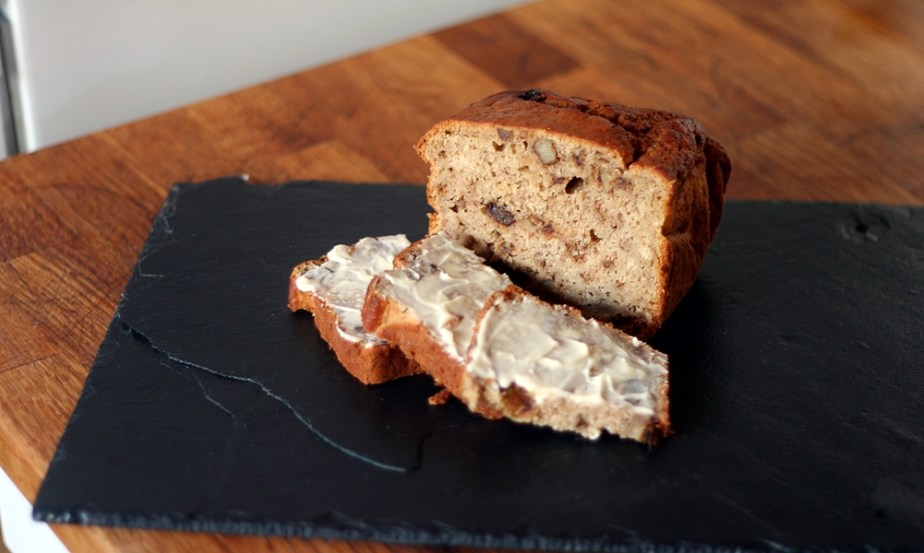
Retrieved from  an old farmhouse baking book, this recipe has dates and walnuts, which make for a delicious tea loaf, but can also make it a little dry, almost dusty, especially if the walnuts aren’t in their first flush of youth. Deliciously, the inclusion of mashed bananas helps with the moistness and the apple sauce really brightens the flavour with its freshness. Neither flavour dominates, making the loaf wonderfully flavoursome. Finally, it is brought to a rich, batter consistency by a splash-ette of lager – and indeed, Lager Loaf was the original recipe title – but that sounds too much like Lager Lout to my ears – which is far from tasty – so I feel justified in renaming it.

And it is a distinct improvement to eat spread with butter, with a cup of something hot.

Fruitbowl Tea Bread

You don’t HAVE to make this with the apple – if you have the eggs, just use two and no apple.

85g unsalted butter
1tbs golden syrup
85g soft brown or light muscovado sugar
1 sharp eating apple, e.g. Jazz or Braeburn
1 large egg
280g self-raising flour
¼ tsp bicarbonate of soda
½ tsp cream of tartar
pinch of salt
150ml lager
2 ripe bananas, peeled and mashed
125g chopped dates
50g walnuts, roughly chopped

  • Preheat the oven to 180°C, 160°C Fan.
  • Grease and line a 1kg loaf tin with parchment paper. Tear off a second piece of parchment and make a fold down the middle. This piece will be used during the baking.
  • Peel and core the apple, then grate finely into a small saucepan. Cover with a lid and heat gently until the apple has broken down into a puree. Sieve to remove any lumps. If you’re impatient, whizz it in a small food processor.
  • Gently warm the butter, syrup and sugar either in a pan or using the microwave, until melted.
  • Add the lager and apple puree, then whisk in the egg.
  • Mash the bananas. Make sure your dates and walnuts are also chopped and ready.
  • Sift the flour, bicarbonate of soda and cream of tartar into a bowl.
  • Add the liquid mixture and stir thoroughly.
  • Quickly fold through the bananas, dates and nuts and pour into the prepared tin.
  • Place into the oven and prop the second piece of parchment over the tin with the fold at the top, rather like a tent. This will prevent the top of the loaf from becoming too dark during baking.
  • Bake for 30 minutes, then remove the ‘tent’ and bake for a further 15-20 minutes.
  • Be sure to test the cake for done-ness using a cocktail stick/skewer/cake tester before removing from the oven – the moisture in the bananas and apple will make it very moist, so be sure it’s baked all the way through, especially towards the bottom.
  • Allow to cool in the tin for 10 minutes before removing to a wire rack to cool completely.
  • Serve sliced and buttered, and store in an airtight container.

Dundee Cake

This recipe is fabulous – and this recommendation is coming from an until-recently Dundee-Cake-Disliker. The crust is crisp but delicately thin, the insides delicately moist and buttery, rich with the sweetness of sultanas and the tang of candied orange peel.

The modern Dundee Cake has an iconic appearance: the carefully laid-out pattern of whole, blanched almonds immediately distinguishes it from other fruit cakes. For many years I’ve not been a fan, based on the Dundee Cakes I’d been served as a child: dry, crumbly, tasteless, overly-fruited masses with burnt nuts on the top and, horror of horrors, glacé cherries studding their depths.

After a bit of digging around in the cake history books, it turns out that the Dundee Cake known today is quite a few steps removed from the original. So I had high hopes that with a little experimentation I could, as with other recipes I’ve managed to rehabilitate from childhood dislikes, bring Dundee Cake back to its former glory and once again make it a teatime favourite.

Dundee Cake was first made by the Dundee-based Keiller company, as an off-season sideline to their marmalade business, as a way of using up excess peel generated by the marmalade manufacturing process. By gentleman’s agreement, no other bakers in the city made the cake. Keiller’s were also responsible for popularising their creation under the name Dundee Cake, described by Alan Davidson in the Oxford Companion to Food as light, buttery delicacy stuffed with sultanas, almonds and candied orange peel.

Quite when the cake was first made is a bit of a mystery, but it is mentioned in stories and novels of the mid-nineteenth century. An 1853 edition of The Lancet carries an advertisement for a Regent Street caterer, which includes Dundee Cake in its list of available cakes. This recipe is based on Madam Marie de Joncourt’s 1882 recipe, but tweaked to conform to the description of the original delicate and rich cake: more butter, almonds, sultanas and peel, no currants, no almonds on top. I’ve left off the distinguishing almonds, because they’re not mentioned in the original recipe, but you can make your own decision on that.

Dundee Cake

180g butter – softened
112g caster sugar
4 eggs
1tsp vanilla extract
180g flour
150g sultanas
2 tsp baking powder
1/3 grated nutmeg
100g ground almonds
125g candied peel, cut into thin, 2cm slivers

  • Preheat the oven to 170°C, 150°C Fan.
  • Grease a 20cm, deep (at least 10cm) loose-bottomed cake tin.
  • Line the base with a circle of parchment.
  • Tear off a long strip of parchment, long enough to wrap around the whole tin.
  • Fold the strip of parchment in half lengthwise.
  • Unfold, then fold in each long edge towards the centre fold.
  • Fold both halves together, making for four layers of parchment.
  • Line the tin with this 4-ply strip of parchment. Any fruit-filled cake needs protecting from the high temperatures that baking in a tin will generate.
    Grease the parchment on the sides and base of the tin.
  • Put the softened butter into a bowl and whisk until light and creamy.
  • Add the sugar and whisk until pale and fluffy.
  • Whisk in the eggs one at a time. Whisk for a good 3-4 minutes before adding the next egg.
  • Stir in the vanilla.
  • Gently stir the remaining ingredients together, then fold into the wet ingredients. Don’t over-mix, or you run the risk of deflating all the air you’ve just whisked into it.
  • Spread the mixture into the tin and level the top.
  • Bake for one hour, gently turning the tin around 180 degrees after 40 minutes.
  • Check for done-ness by inserting a wooden toothpick deep into the centre of the cake. If no liquid batter is clinging to it when removed, the cake is done.
    Cool for 10 minutes in the tin, then remove to a wire rack to cool completely.
  • Store, wrapped in foil, in an airtight tin.

Snow Cake

An unusual and simple cake, with the bonus of being gluten-free!

As I was perusing one of my several vintage baking books, I came across this recipe – not in any specific allergy-related book or even chapter of a book. No, it was just included with a bunch of other recipes in a book aimed at the commercial baker, dating from the early 20th century. I have scaled the recipe down from the originally huge quantities, but otherwise, it is unchanged.

This cake is made using potato flour. IMPORTANT: Potato flour is made from RAW potatoes and is a bright white and very fine powder, with no discernible taste. It is NOT dehydrated cooked potato, which is coarse, yellowish and tastes of potato. That makes mashed potatoes when reconstituted and will add a similar texture to your cake. Readers in the US: use potato starch flour.

At first, I thought the cake got its name from it colour, because, as you can see from the photo, it is indeed a very pale cake. However, after tasting the cake, I’m now of the opinion that its name comes from its texture. It has the same quality of settled snow, in that there is a thin ‘crust’ on the top and soft, friable, almost powder-like substance underneath. The cake dissolves in the mouth – but in a different way to, say, Melting Moments. It’s incredibly light and tender and is best enjoyed simply, where it can really shine.

That said, the cream that I have teamed with it is pretty awesome itself. It is a variation of the filling I used for the mille-feuilles in the final of The Great British Bake Off. The mixture of sweetened cream cheese and whipped double cream is given a firmer set by the addition of gelatine, which helps to hold in the moisture and makes for a very luscious, rich, creamy and mousse-like texture. Just to continue the frozen theme, it’s like the very best soft-serve ice-cream, without the cold.

I’ve brightened the filling with some Apricot Jam, but any other sharp jam would also work well.

I bought the potato flour at Holland & Barrett.

Snow Cake

112g unsalted butter – softened
112g caster sugar
2 large eggs
zest of 1 lemon
2 level tsp baking powder
225g potato flour

  • Preheat the oven to 170°C, 150°C Fan.
  • Grease and line the base of a 20cm diameter, tall cake tin – not a sandwich tin. The high sides will help shield the cake from the direct heat of the oven and keep it from becoming over-coloured.
  • Beat the butter and sugar together until light and fluffy – 5-10 minutes.
  • Add the eggs one at a time, beating well each time.
  • Add the remaining ingredients and beat thoroughly – a good 5-10 minutes. Ordinarily, you’d run the risk of over-beating a cake mixture, which would develop the gluten in the flour, leading to a tough cake. Since the potato flour has no gluten, there’s no need to worry about this. You want to try and get as much air into the mixture as possible to make for a light texture in the cooked cake.
  • Turn the mixture into the prepared tin and smooth the surface.
  • Bake for 20 minutes, then turn the tin 180 degrees and bake for a further 10-15 minutes, for a total of 30-35 minutes. When you turn the cake after 20 minutes, slip a sheet of baking parchment over the top of the tin to keep the colour from getting too dark.
  • When cooked, remove from the oven and let rest for 10 minutes, then remove from the tin and cool on a wire rack.

Luscious Cream Filling

50ml double cream
50g caster sugar
2 leaves gelatine

1tsp vanilla extract
150g cream cheese,  room temperature
250ml double cream

  • Soak the leaves of gelatine in cold water for 15 minutes.
  • Warm the double cream and caster sugar until the sugar is dissolved.
  • Shake off the excess water from the gelatine and add to the pan.
  • Stir until the gelatine has melted, then remove from the heat and set aside.
  • Once the mixture has cooled a little, pour it into a bowl and add the remaining ingredients.
  • Whip the mixture until the cream has thickened and it is soft and pillowy.

To Assemble

Even though this is a light sponge cake, the weight of the top half will be too heavy initially, to avoid squidging (technical term) the cream out of the sides of the cake. Therefore, I strongly recommend using the following method to assemble your cake.

200g apricot jam – warmed and pureed

  • Using cocktail sticks, mark the midpoint of the cooled cake around the edge and cut it horizontally.
  • Spread the cut side of each cake half with apricot jam.
  • Put the bottom half of the cake back into the tin in which it was baked.
  • Slip a band of parchment or food-grade acetate around the inside of the tin, between the cake and the inside of the tin.
  • Smooth or pipe the cream filling over the bottom of the cake, making sure it reaches the edges of the cake.
  • Place the other half on top and press gently.
  • Cover with cling-film and chill for 2-3 hours, until the gelatine in the cream has set.
  • Remove from the fridge and allow to come to room temperature.
  • Remove the cake from the tin and gently peel the parchment/acetate from around the filling.
  • Smooth with a knife if necessary.
  • Dust with icing sugar to serve.