Christmas Spiced Butter

With only a month to go, I recently realised it’s high time I got my act into gear vis-à-vis some festive recipes.

I have for you here something that I’ve been making for the past few years and, with spectacular timing, only remembering about it come the 24th or so, which is far too late to go about suggesting people add to their military campaign-esque festive ToDo list.

I initially got the idea a few years ago whilst making a batch of Niter Kibbeh, the very aromatic Ethiopian spiced butter used in making the red lentil stew Misir Wat.

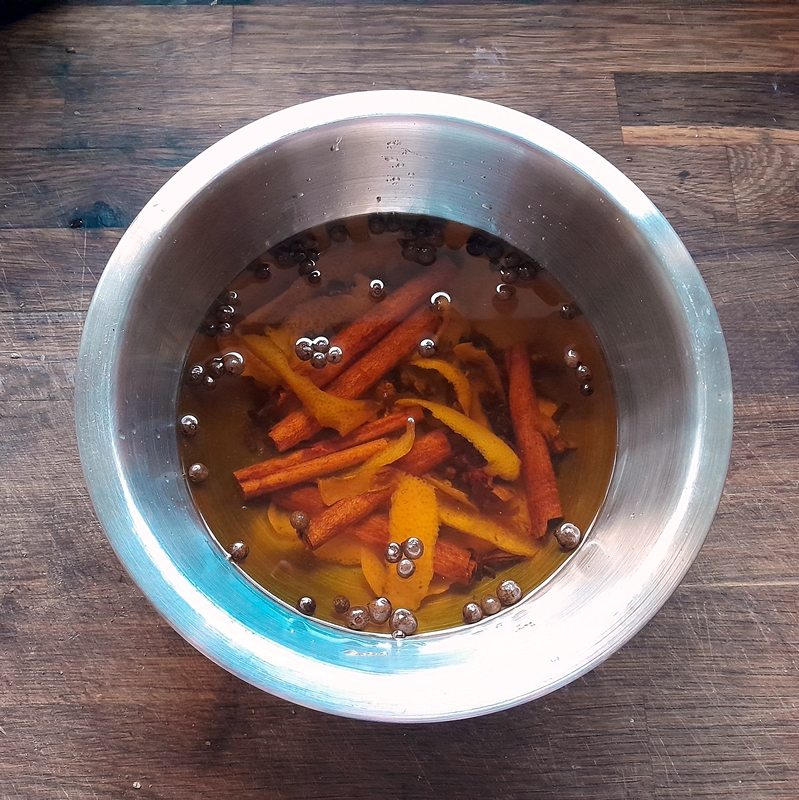
It is butter that is flavoured with seasonal spices, and is a doddle to make. I use clarified butter in the form of a tin of ghee, because delicious though browned butter is, the milk solids are easily burned. I simmer – although that is rather too strong a word for sitting on heat 1 of the hob, so perhaps ‘infuse’ is more fitting – whole spices and citrus peels and then allow the flavours to infuse overnight as the butter cools. The use of whole spices keeps the spicing soft – although I have opted to add in ground spices if the whole ones are unavailable. The only downside of using ground spices is that they will speckle the butter, being too small to strain out. Depending on your use of the finished butter, this may not be an issue. Next day, I slowly warm the mixture and, when melted, strain out the solids and pour the beautifully aromatic and flavourful butter back into the tin in arrived in, for ease of storage.

You are then free to use it wherever you see fit in your festive baking.

Brandy Butter and Spiced Hard Sauce: These are rich and delicious accompaniments to both mice pies and Christmas pudding. Equal quantities of icing sugar and butter are whisked with brandy, or indeed any alcohol of your choice, and/or vanilla to produce a light and frothy mixture that you can spoon onto your bakes where it will gently melt and turn into a sauce.

Mincemeat: In case you haven’t seen the recipe, my guilt-free Mincemeat (based on Hannah Glasse’s 1747 recipe) offers all the delights of traditional mincemeat, but without suet, fat or any added sugar and is both vegetarian and vegan. Delicious as it is, you can elevate it to luxury levels by adding a little Spiced Christmas Butter for added richness.

Pastry: Using Spiced Christmas Butter in pastry  adds a whole new dimension to your mince pies and other Christmas fare such as this Welsh cranberry tart.

Shortbread: Why not try your favourite shortbread variation using festive spiced butter?

What Spices Do I Need?

Basically, anything you like. Whilst this might not seem very helpful, I say it to illustrate just how much free reign you can have with this. Either stick to a more traditional mix (see below) or spice it up a little (excuse the pun) with some unusual bits and bobs. You can’t really go wrong, as using whole spices means there’s only ever a gentle flavouring.

A traditional mix might include:

  • cinnamon sticks
  • allspice berries
  • blades of mace
  • whole nutmegs (sliced)
  • cloves
  • orange peel
  • lemon peel
  • sliced ginger (fresh or dried)

Other items you may want to use include:

  • cardamom pods – both green and black
  • star anise
  • aniseeds
  • black pepper
  • cubeb pepper
  • long pepper
  • grains of paradise
  • vanilla
  • saffron
  • licorice sticks
  • caraway seeds
  • coriander seeds
  • cumin seeds
  • rosepetals

All of the spices should be whole, wherever possible. Use anything from 1tsp to 1tbs to your taste.
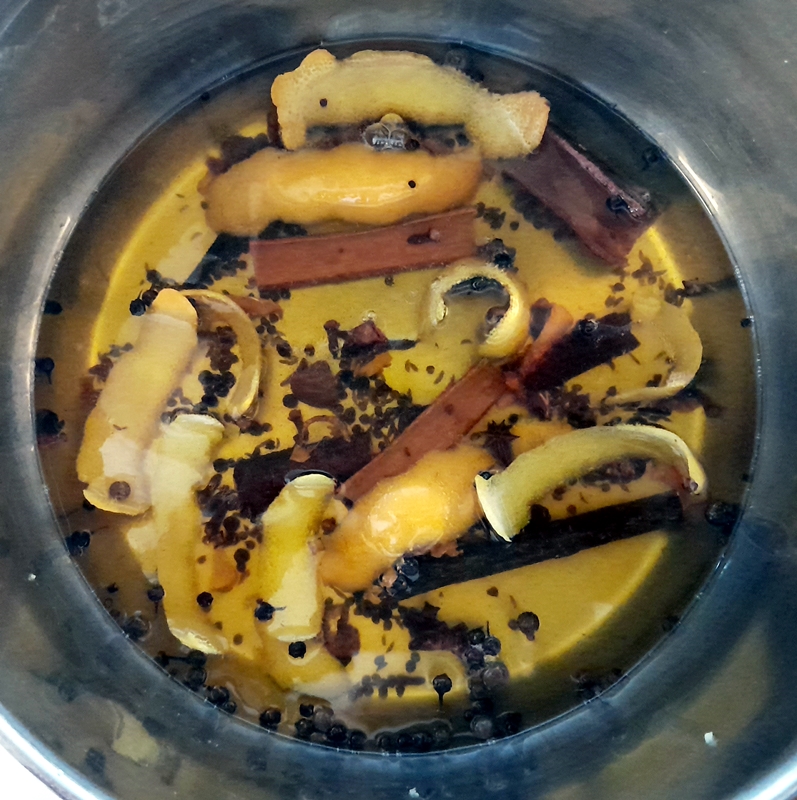
Spiced butter with different whole spices
Another version of spiced butter, this time with grains of paradise, cubeb pepper and aniseed.

Dietary Guidelines

As ghee has had all the milk solids removed, I would venture to suggest that it might even be suitable for the lactose intolerant.

If you are vegan, you can make your own version using solid coconut oil. If you’re not a fan of the accompanying coconut aroma, this odourless brand is available to order online.

Christmas Spiced Butter

I rarely recommend any particular brand, but in this instance I strongly urge you to seek out (it’s not that hard to find – most supermarkets carry this distinctive green and gold tin) East End ghee. It has a heady, perfumed aroma in its natural state, which greatly enhances the end product.

1 x 600g tin of East End ghee.
3-4 cinnamon sticks
1tbs whole cloves
1tbs allspice berries
4 blades of mace
2 whole nutmegs – sliced
thinly peeled skin of 1 orange
thinly peeled skin of 1 lemon
5 slices of fresh/dried ginger
5 star anise

  1. Put everything into a small saucepan.
  2. Cover and set on the lowest heat possible on your stove/hob.
  3. Leave to infuse for 1-2 hours.
  4. Switch off the heat and leave overnight.
  5. Next day, warm slowly over very low heat until melted, then strain the solids out by pouring through a sieve.
  6. When the butter has completely drained, pour it back into the tin.
  7. Label and store in the cupboard for use.
Chipstead Churdles

I’ll be the first to admit that I love a good story behind a recipe. However, what winds me up no end are stories that have been made up to make a recipe appear more ‘authentic’ than it actually needs to be.

And so we have Chipstead Churdles. Chipstead is a small village in Surrey, southeast of Croyden. Churdle Pies are also claimed by Sussex, though I have yet to find any recipe predating this one.

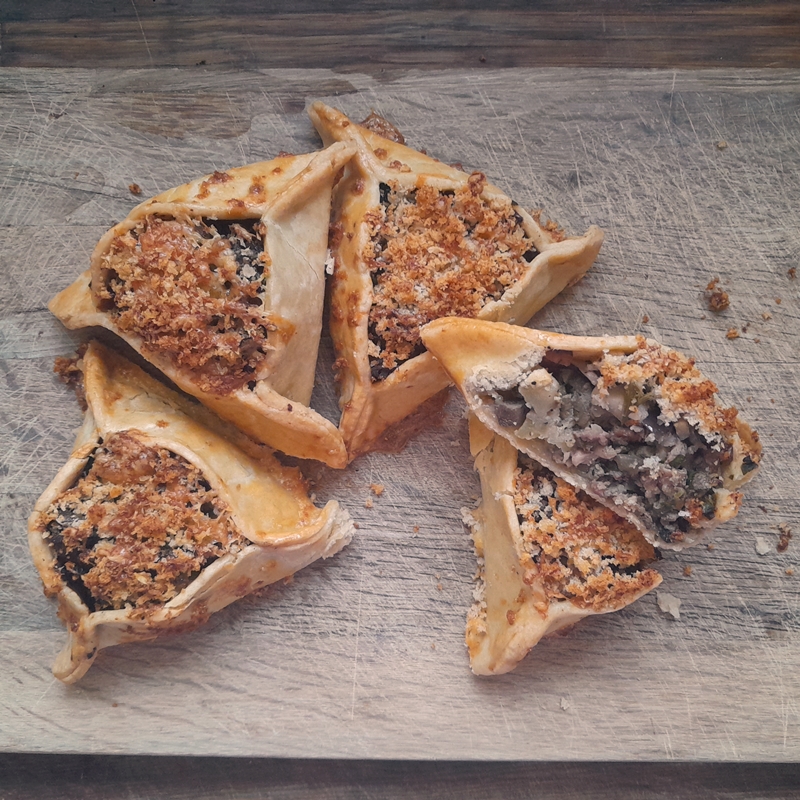
These little triangular pasties are a pleasant way to enjoy the classic and flavoursome combination of liver and bacon, aside from the traditional grilling. As you’ve probably already surmised, they have also managed to develop quite a colourful, and largely fictitious, provenance. Touted online as ‘an ancient recipe’, ideal for the farm worker to stuff into his pocket as he headed out to the fields, no-one seems to know specifically where and when they date from, although I’ve read many a vague “…Seventeenth century…” claim.

Even without any provenance, neither the shape nor the style of the pies would appear to support this. These are tricorn-shaped pies – although easy to form, hardly the most robust nor the most practical of shapes – with the top being left open to be filled with a cheese and breadcrumb mixture (this crunchy topping being much more of a 20thC style). Any farm worker worth his salt would end up with a pocketful of crumbs within an hour.

No, in actual fact, the recipe actually originates in Doreen Fulleylove’s “Simple Country Fare” (1970). Now to me, that’s not that long ago – good gravy, I remember 1970 – but then I have to stop and remind myself that that is now over fifty years ago.

The Churdles name, however, can be traced back much further, all the way to the 1920s. In his fabulously-titled “Away Dull Cookery!” (1932), Earle Welby recorded an entertaining nonsense menu devised by the dramatist Henry Arthur Jones for his grandchildren. It is, perhaps, the greatest menu I have ever read, and I reproduce it below:

  • Pickled Trunnions
  • Filets of Poucher Bonne Femme
  • Baked Banbury Mush
  • Squibbles on Toast
  • Truffled Guffins
  • Boogoose Bordelause
  • Varicose Beans
  • Danderchits in Aspic
  • Wombles
  • Stuffed Spanish Crippets
  • Churdle Pie
  • Mulligatawny Fritters
  • Nostrum Roes à la Diable
  • Piblets
  • Trundleberry Gin

It’s on my ever-lengthening list of Things To Do to devise and make dishes for this menu.

But back to the Chipstead Churdles. It seems to me that a far more likely scenario would be for the name Churdle to have been borrowed to grace a heretofore unnamed but very toothsome pie. And there’s nothing wrong with that at all.

Chipstead Churdles

The savoury flavours of liver and bacon are here paired with mushroom, onion and sharp apple to make for a lighter and fresher mouthful.

shortcrust pastry

1 onion
30g unsalted butter
200g smoked back bacon, rind removed
200g lamb’s liver
60g mushrooms, chopped
1 small Bramley apple, peeled and finely chopped
2-3tbs chopped parsley
½tsp ground black pepper
½tsp salt

4tbs fresh breadcrumbs
4tbs finely grated strong cheddar cheese

1 large egg for glazing

  • Peel and chop the onion finely.
  • Melt the butter in a frying pan and add the onion. Fry gently for 8-10 minutes until softened and translucent.
  • Add the bacon and fry for a 1-2 minutes and then turn the slices over.
  • Add the liver and fry for 2 minutes, turning the slices over after 1 minute. This should cook the liver enough to remain pink in the centre. As it will be cooked again during the baking of the pies, you don’t want to overdo it at this stage.
  • Lift the meat from the pan and chop finely.
  • Scrape the cooked onion and butter into a bowl and add the chopped meat.
  • Stir in the mushrooms, apple, parsley and seasoning. Set aside.
  • Preheat the oven to 180°C/160°C Fan.
  • Roll out the pastry to a thickness of about 5mm.
  • Cut 8 circles of pastry 10-12cm in diameter. You can make 4 large pies, but the larger the pie, the more difficult the pastry is to handle.
  • Divide the filling into 8 and add one portion to the middle of each circle of pastry.
  • Damp the edges of the pastry with water.
  • Pinch the edges together to make a triangle base, folding the sides of the pastry inwards and pressing the edges together to make a three-cornered hat shape. Leave the middle of the pie open.
  • Mix the cheese and breadcrumbs and sprinkle one spoonful over the opening at the top of the pies, and transfer the pies to a baking sheet lined with baking parchment.
  • Whisk the egg with a tablespoon of water and use it to glaze the sides of the pies with a pastry brush.
  • Bake for 25-30 minutes until crisp and golden. Turn the baking sheet around after 15 minutes to help even the browning.
  • Cool on a wire rack.
  • Serve warm.

Mince Pie Shortbread

I seem to be on a bit of a shortbread obsession lately, but this is the last post on it for now, promise.

Today I have for you a combination of two festive treats: Mince Pies & Shortbread.

Back in the far off days of the 1980s, I had the distinct pleasure of discovering Jocelyn Dimbleby’s “Cooking for Christmas” – a slim paperback book of recipes, produced in association with Sainsbury’s. Amongst its pages I found Deluxe Mince Pies, a version of which I have had posted over on my other blog for over 12 years now. With their orange pastry and decadent cream cheese and mincemeat filling, if you’re only going to eat one mince pie during the season, it really should be those.

However, even I will admit that they are a bit of a faff and since they are best served warm, it does limit their accessibility. So recently, whilst experimenting with the butterscotch shortbread, I got to thinking whether I could make a mincemeat version, and from there it was just a hop and a skip to re-imagining Jocelyn’s recipe.

This recipe is also an adaptation of recipes I’ve already posted on here, which I love as an example of some real Lego™ thinking, taking two different recipes and smushing them together to create something new.

The shortbread here is standing in for the mince pie pastry, so the only thing I changed was to add some orange zest. The mincemeat is an adaptation of the guilt-free mincemeat, based on Hannah Glasse’s 1747 Lenten mince pie recipe. The potential problem here was whether it would hold together on top of the shortbread, so the slight tweak I made was to increase the quantity of dates, which break down into a sweet and sticky paste during the simmering of the fruit, and firm up when cooled. I increased the spices a little, to compensate for the mincemeat being eaten cold, which tends to dull their potency. I also used an egg-white wash over the top of the shortbread, which when briefly baked forms something of a barrier to keep the moisture from the mincemeat compromising the crispness of the shortbread. Finally, I decided to top things off with white chocolate flavoured with lemon zest, to mimic the cream cheese element of the original mince pies.

Baking a slab of shortbread is a lot more straightforward than battling with pastry and filling and fretting whether the lids are sealed properly and whether the bottoms are properly cooked, etc. Bonus: you can cut your shortbread into as many pieces of whatever size you like.

Mince Pie Shortbread

The Mincemeat

You can make this several days beforehand and store in the fridge, if liked. When required, to make it easier to then spread over the shortbread, put it into a pan, cover and heat on the lowest setting. You might want to add a little more liquid (apple juice/orange juice/brandy/sherry) to help it loosen up. The additional dates add to the sweetness, so if you don’t have a sweet tooth, you might want to substitute the apple juice for the juice of an extra orange or even lemon

50g currants
50g raisins – crimson raisins look pretty
50g sultanas
200g dates – finely chopped
25g candied orange peel
25g candied lemon peel
25g candied grapefruit or citron peel
35g dried cranberries
25g slivered almonds or flaked almonds – chopped
2tbs sherry
1tbs brandy
juice & grated rind of 1 orange
¼ tsp of ground ginger
¼ tsp of nutmeg,
¼ tsp of ground cinnamon
¼ tsp of mixed spice
¼ tsp of ground cloves

60-100ml apple juice or juice of 1 orange/lemon

  • Put the dried fruits into a small saucepan.
  • Cut the candied peel into small pieces with scissors and add to the pan with the spices. NB If you’re using your home-made candied peel that has been stored in syrup, then there’s no need to soften it in the saucepan – just stir it in with the nuts once the fruit has plumped.
  • Add the orange juice and zest, brandy, sherry and 60ml of apple juice (or the extra orange/lemon juice).
  • Stir gently to combine and set pan over the lowest possible heat.
  • Cover and let the mixture stew gently until all the liquid has been absorbed.
  • If the fruit isn’t as plumped and juicy as you would like, add a little more liquid.
  • The mixture should be moist, but with no liquid visible in the bottom.
  • When you’re happy with the consistency, stir through the almonds.


The Shortbread

Make whichever shortbread variation you prefer, regular or gluten-free.

60g soft brown sugar
120g unsalted butter, chilled
180g plain flour – or gluten-free flour
60g your choice of additional flour (rice flour, cornflour, cornmeal, semolina, etc)
¼ tsp salt
zest of 1-2 oranges, depending on size

1 egg-white for glazing

  • Line a small baking tin (18cm x 25cm) with baking parchment. Leave extra parchment overlapping the sides, to assist in moving the baked shortbread.
  • Heat the oven to 160°C, 140°C Fan.
  • Cut the butter into cubes and add to the bowl of a food processor fitted with a blade.
  • Add the remaining dry ingredients and zest to the butter and pulse briefly until the mixture resembles breadcrumbs.
  • Tip the mixture onto the parchment, and press into an even layer.
  • Use a round skewer or cocktail stick to poke holes all over the surface of the slab of shortbread.
  • Bake the shortbread for 30 minutes, turning the tin around after 15 minutes to ensure even baking.
  • Once the shortbread is baked,
    • Remove the shortbread from the oven. Keep the oven on.
    • Whisk the egg white until frothy, then paint a layer onto the hot shortbread and return it to the oven for 3 minutes to set.
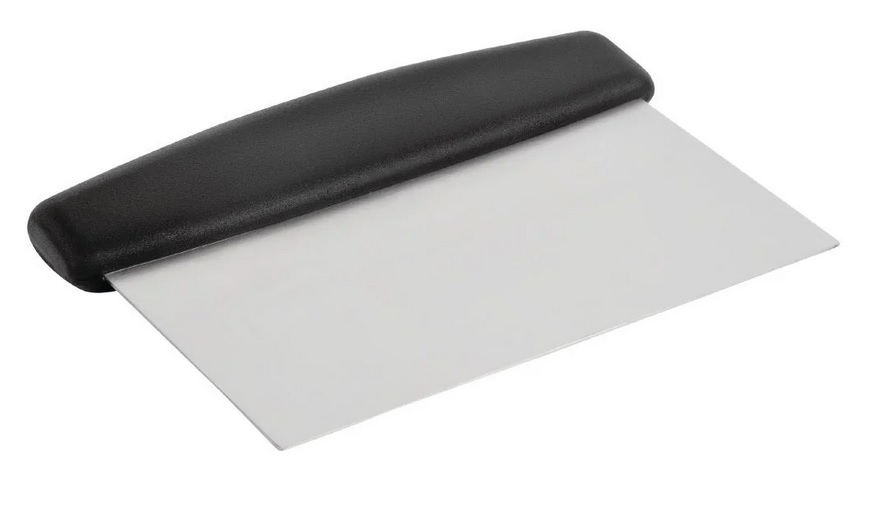
    • Remove the tin from the oven, switch off the heat and using a very thin bladed knife or (ideally, in my opinion) a metal dough scraper, cut the shortbread into pieces. I cut mine lengthwise in half, then across into fingers 2-3cm wide.
    • Return the tin to the cooling oven to cool.

The Topping

250g white chocolate
zest from 1 lemon

  • Break the chocolate into pieces and melt in a bowl either over simmering water, or by zapping in the microwave in short bursts.
  • Stir through the lemon zest.

To Assemble

  • Spread a layer of mincemeat over the cooled shortbread. I didn’t use all of the batch, only about 2/3, but if you’d prefer a thicker layer, have at it by all means.
  • Smooth over the top with a palette knife or similar.
  • Pour over the lemon-flavoured white chocolate and smooth over.
  • Put it in the fridge to set (optional – you can leave it on the worktop if you have the room).

To Divide

In a repeat of the instructions from Butterscotch Shortbread, here is how to ensure your slab of mince pie shortbread emerges in sharp and clean slices.

  • When you’re ready to portion it out, remove your slab of mince pie shortbread from the fridge and set it on the countertop. Leave it to come to room temperature. Trying to cut through the chocolate layer whilst chilled will just shatter it. If your shortbread cooled on the worktop, you can, if course, skip this step.
  • Take a clean cloth or a double layer of kitchen roll and lay it on top of the set chocolate.
  • Lay a cutting board on top of that, and carefully turn the whole slab over, so that once the tin and the baking parchment are removed, the shortbread is uppermost.
  • The lines from cutting the shortbread earlier should be clearly visible.
  • Slide your dough blade into the cuts in the shortbread, then press down sharply to cut through both the mincemeat and the chocolate layers in one clean movement.
  • Make sure you have cut – or rather re-cut – through all of the pieces before trying to move your mince pie shortbread.
  • Store your shortbread in an airtight container. Use a piece of parchment between layers to keep crumbs off your pristine chocolate finish.

Improving Strawberries

On a recent holiday in France I had some wonderful strawberries: heady, aromatic and bursting with flavour.¹

Still a bit mesmerised, two punnets of strawberries were one of the first things I bought when we got back. Alas, compared to the French ones, they were decidedly underwhelming. I know it’s late in the season for strawberries, but even so, a great disappointment.

Since we now have the luxury of strawberries year-round, I thought I’d bring you this method of not only rescuing below-par strawberries, but also demonstrating how you can use them in a couple of recipes, as well as enjoying them in their new and improved, glow-up form.

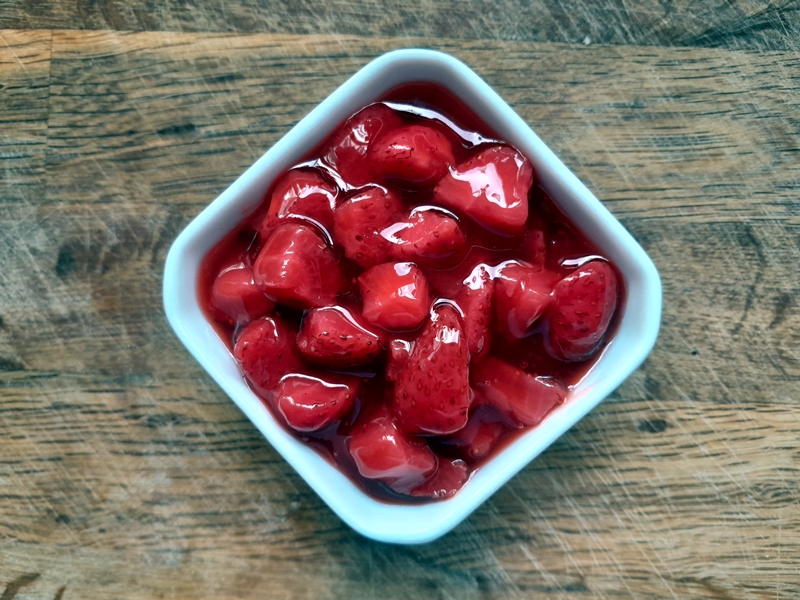
The method is very simple, too. Cut up your strawberries and sprinkle them with a little sugar – NOT icing sugar, because it contains an anti-caking agent. Use white caster or granulated. The sugar will gradually draw out the juices from the strawberries, which will in turn absorb some of the sugar.

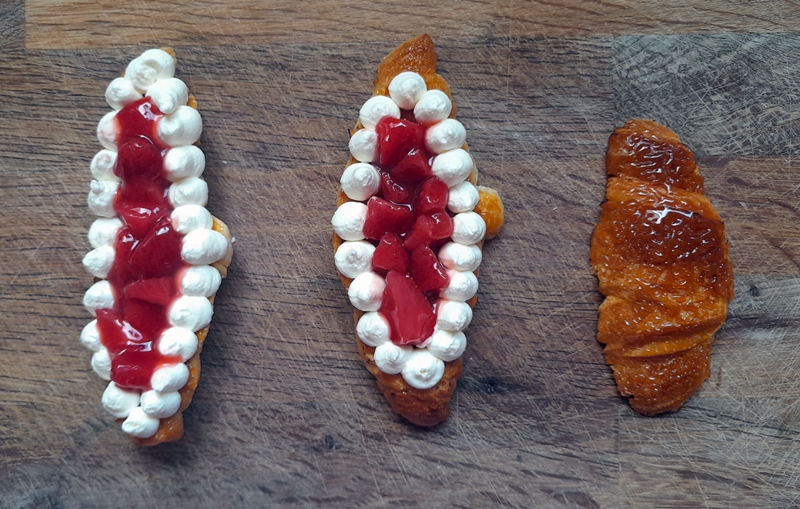
You can enjoy them as is, and luxuriate in their much improved flavour, or you can use them in other things. Below I have two suggestions – a strawberry scone and in a mille feuille made from stale croissants.

To Confit strawberries

I’ve gone back and forth quite a bit to come up with a term for this method and, to be honest, I’m not entirely happy with ‘confit’, because to confit something generally involves the use of heat to cook the items, which this patently doesn’t. However ‘macerating’ wasn’y really suitable either, because that involves adding liquid, and here the liquid comes from the fruit itself. If someone can find a word that fits better, do please leave a comment.

strawberries
caster or granulated sugar – 1tbs per 100g strawberries

  • Remove the green stalks and leaves from the strawberries and cut each one into 6-8 pieces, depending on size.
  • Put the cut strawberries into a bowl and sprinkle over the sugar.
  • Turn the berries over gently so that the sugar is distributed evenly.
  • Cover with plastic and set somewhere cool. I prefer to keep them at room temperature rather than chilled, at least in the initial stages as I believe it produces a better overall flavour, but keep in the fridge if you prefer.
  • Gently stir occasionally.
  • Allow your strawberries to macerate for up to 24 hours. The longer you leave them, the more juice will be drawn out. After about 24 hours, the  strawberries will be practically floating in a light syrup and their flavour will be deliciously intense.
  • You can choose when to eat/use your strawberries. For the two recipes below I used berries that had been macerating for 24 hours.

Strawberry Scones

Fresh strawberries release too much juice to be included in regular scones, but by using confit strawberries, you can get all the concentrated flavour and still maintain the integrity of your scones. This recipe is based on that of Mrs McNab (19thC farmer’s wife from Ballater, Scotland – see Great British Bakes). It makes 8 scones. It is deliberately unsweetened, as I believe the plainness of the scone dough highlights the flavour of the strawberry pieces much better than a sweet dough. You might disagree, and that’s fine. You can add 30g of sugar to the mixture before baking if you like, or sprinkle some sugar over the hot scones after baking (as in the picture).

225g plain flour
2tsp baking powder, or 1 tsp cream of tartar, ½ tsp bicarbonate of soda.
½ tsp salt
30g unsalted butter
1 large egg
60ml plain yogurt
60ml milk

100g drained, confit strawberries.

Milk for glazing
sugar to sprinkle (optional)

  • Heat the oven to 220°C, 200°C Fan.
  • Put the flour, powder(s), salt, butter, sugar if using, and egg into the bowl of a food processor fitted with a blade and blitz until the mixture resembles breadcrumbs.
  • Tip the mixture into a bowl.
  • Add the drained strawberries and fold in.
  • Mix the yogurt and milk together until smooth.
  • Fold in the yogurt mixture little by little, ideally with a round-ended knife. NB Do NOT slosh it in all at once. You may not need all of the liquid, especially if the strawberries are juicy. You want just enough liquid to bring the dough together.
  • NB The faster you do the shaping/cutting/getting the scones in the oven, the more they will rise.
  • Turn the dough out onto a floured surface and pat into a circle about 4cm thick. NB Don’t roll it with a rolling pin, you’ll just squash out all the lift from the raising agents.
  • Using a dough scraper or thin-bladed knife, cut the disk of dough into eight triangles. They will look small, but they will rise splendidly in the oven.
  • Transfer the triangles to a parchment covered baking sheet and brush over with milk to glaze.
  • Bake for 15 minutes, turning the baking sheet around after 10 minutes to ensure even colouring.
  • Remove from the oven and sprinkle caster sugar over the hot scones if liked.
  • Transfer to a wire rack to cool.
  • Enjoy warm as is, or with butter or cream.

Strawberry Croissant Mille Feuille

You know when you have stale croissants lying around?

*crickets*

Of course not. No-one does.

HOWEVER!

The thought “What if…” did cross my mind over the aforementioned holidays, and that led me to thinking about how they might be used in a new and exciting way. The idea is related to the puff pastry more traditionally used insofar as I brought back some delicious French butter with the intention of making a batch, and now I’m procrastinating like mad because, although delicious, it’s SUCH A FAFF™! Bonus: You can use gluten-free croissants (Schar is one brand I have tried – find them in the freezer section of your local supermarket).

Using a croissant reduces the Faff to almost non-existant levels and provides another opportunity to use the strawberries prepares above – this time using the juice as well. Slicing, toasting and then bruléeing the croissants will give both crunch and shine. The last two things needed for our croissant mille feuille are Brulée Sugar and some whipped cream.

To thicken liquid with Arrowroot

Why arrowroot, you may be asking? Well, it thickens and turns clear when heated, but unlike cornflour, when cooled it does not go ‘gloopy’ as such, rather it forms a loose jelly-like texture that clings wonderfully to the fruit (see top photo) making it bright and glossy, and doesn’t form a skin.

For each 80ml of liquid/syrup, use 1tsp arrowroot, or 1 tablespoon per 250ml.

  • Mix your arrowroot with an equal quantity of cold water until smooth.
  • Add the arrowroot slurry to your syrup and heat gently, stirring all the while.
  • NB Do not boil the mixture. High heat will break down the thickening properties. Remove from the heat when thickened and clear.
  • Stir in your strawberries and chill until required.

To Assemble

  • Slice your croissant(s) into three, horizontally.
  • Toast the slices lightly on both sides. Be careful, they will take less time to toast than regular bread, due to the higher fat content.
  • Dust the slices thickly with brulée sugar, then either grill them or use a blow torch to melt the sugar. The sugar will melt quickly, so keep an eye. Allow to cool, so that the sugar hardens.

  • To serve: pipe a rim of cream around the edge of the bottom two layers, and fill the middle with your strawberries in thickened juice.

  • Stack the layers together and serve.

¹ From the Calais Cité Europe Carrefour near the Tunnel, which I can highly recommend for all those last minute foodie purchases on your way home. If you’re interested in growing your own, the variety I recommend is Charlotte.

Steak and Kidney Pudding

I enjoyed reading this tweet a few weeks ago:

I feel it’s only fair to warn you: This is an “Okay, so..” post. Click here to skip to the recipe.

This post is in response to a request made over on Time To Cook Online, and I was happy to take a deep dive into this dish because of both its convenience and cheapness. This steak and kidney pudding can be made using a slow cooker and thus uses only a small amount of electricity. It also uses the cheaper cuts of beef (although it can be used with other fillings) as well as (by some) low-regarded and lowly offal. This notwithstanding, it makes for a fantastically satisfying meal that can be ready and waiting for you when you come home from work, with very little to do other than lift it out of the slow cooker and onto a plate. You can also make it ahead and reheat easily, again using the slow cooker.

This recipe goes back a long way, into the Georgian Era of the early nineteenth century, and is a development of the even older Beef Pudding. Contributors to the Wikipedia article on Steak and Kidney pudding rely on Jane Grigson’s assertion that Mrs Beeton was the first to include both steak and kidney in a suet pastry. However, there are at least two recipes in print that pre-date Beeton. One of the quirks of British recipes is that their names are rather fluid, and the same recipe can exist under numerous names. In short, you’re not going to get very far recipe hunting if you only look for ones that bear the same name as modern ones. Differences might be related to geography, or in this case, decades of time.

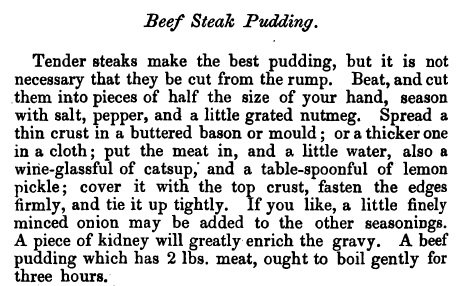
Anne Cobbett published the following recipe in her (undated, but generally believed to be) 1835-ish book The English Housekeeper.

From The English Housekeeper, Anne Cobbett, 1835-ish.

An even earlier recipe can be found in Alexander Murray’s The Domestic Oracle, also undated, but believed to be around 1826. where the star of the dish would appear to be the kidney, and the steaks almost an afterthought.

From The Domestic Oracle, Alexander Murray, 1826ish.

In the almost two centuries since then, as with any recipe, there have been various tweaks and adjustments made to the basic recipe. Additions that I’ve noted include oysters, oyster sauce, mushrooms, mushroom ketchup (the catsup of Anne Cobbet’s recipe), lemon pickle, mustard, beer, wine.. it really can be whatever you want to make it.

Which brings me to my next point: there are some things you should not skirt, if you want your steak and kidney pudding to taste delicious, and I’m going to take a bit of time to explain what you should do and why you should do it. If you follow these key points, you will have the knowledge to turn out a pretty darn near perfect steak and kidney pudding right from the get-go. In addition, much of it will be adaptable to other, suet pastry puddings, both sweet and savoury. If you’re already impatient to get to the recipe, you can skip ahead by clicking here.

  • Raw or Cooked Filling
    • The Old School way was to put the filling in raw. For the past 50 years or so, people have been following Jane Grigson’s advice to cook the filling first, to stop your pudding becoming soggy. This approach increases both the length of time it takes as well as the Faff Factor™ quite considerably: First you have to cook it, then you cook it again. Well, as will be demonstrated below, if you take a little care with your preparation, there’s no danger of your pudding becoming soggy, so sorry Jane Grigson, we’re going to cut out about two hours of fiddling around on the stove, and fill the pies raw.
  • The Suet Pastry: As with baked pastry crusts, people gradually realised that it didn’t need to be just an outer casing of food, it tasted pretty darn good too, infused with all the juices from the filling. These are some steps you can take to make sure your suet pastry is the crowning glory of your pudding.
    • Suet: Back in the Dayes of Yore, suet came fresh from the butcher and had to be soaked and then grated by hand. You can still find friendly butchers that will supply you with lumps of fresh suet if you ask, and it really is worth the effort in terms of the texture and flavour of the suet crust it produces. I understand not everyone has the time for such Faff,™ and luckily we have the convenience of packs of suet on the supermarket shelves. The suet in these packs has an amazingly long shelf life, because it differs from fresh suet in that it is dried. Here’s the important point for this and any old recipe you might want to try: you need to use LESS dried suet than usual. Most old suet paste recipes are pretty much ‘half fat to flour’, which is fine if you’re using fresh suet, but when using dried, it can make the pastry heavy. So when using dried suet, you should aim to use about 10% less. For example, if a recipe called for 225g of flour, I would use 115g of fresh suet, or just 100g of dried.
    • Baking powder: The original suet pastry would have been rather heavy, but with the advent of baking powder, it can now puff up to a delightfully light texture. The general rule of thumb is 1 teaspoon of baking powder for every 115g flour.
    • Breadcrumbs: You can also lighten the pastry further by incorporating some fresh breadcrumbs into your suet pastry. Again, it is proportional to your flour, so 1 part breadcrumbs to 4 parts flour (divide the weight of your flour by 4 and that’s the weight of the breadcrumbs to use).
    • Seasoning: You don’t want your suet pastry to be a lump of nothingness, so season it! The very minimum should be salt and pepper. If you’re feeling bold, add in some chopped, fresh herbs, or a bit of mustard powder or horseradish – something to give it a bit of personality.
  • The Meat – Beef
    • For all its high-falutin’ title, the very best beef for this pudding is not going to be steak. At least, not STEAK steak. You should actually pick one of the less-prime cuts, ones that are full of flavour and do well with long, slow cooking. I recommend beef cheek, if you can find it (Morrisons supermarket in the UK has an excellent meat department and has always had it in stock whenever I’ve needed some). Also excellent is beef skirt (also carried by Morrisons). Although I haven’t tried it, beef shin is another cut that benefits from long, slow cooking. Finally you could try hangar and/or flat-iron steak, both of which have the marbling to make for a very succulent filling. Cut your meat into 1.5cm dice, so they can be packed tightly into your puddings and be perfectly cooked at serving time.
  • The Meat – Kidneys
    • I appreciate that offal is very divisive, but it tends to be cheap and it is packed with valuable vitamins and nutrients. Even within the offal world, kidneys are somewhat niche. And having researched numerous recipes to prepare for this post, I can understand why people might be kidney averse, or even be in the ‘tried it once, hated it’ camp. Because I was horrified to discover that the majority of recipes fail to prepare the kidneys properly. Everyone is very gung-ho with chopping them up and throwing them in, and I am APPALLED. There are two important stages to preparing kidneys:
      • Removing the core. The core is the hard, white ‘business part’ of kidneys and should be cut away completely. It’s not nice to chew and it never gets soft, even with extended cooking. Cut the trimmed meat into 1.5cm pieces.
      • Soaking the kidney. THIS IS IMPORTANT! The function of kidneys is to filter out the waste products from the blood and send them, and excess water to the bladder. If you don’t soak the kidney in acidulated water or similar (which will draw out the bad-tasting waste products), then they will still be full of all those waste products. That’s going to make the kidney, and everything it’s cooked with, rather ‘funky’ to say the least. Now some people might like that flavour, but for those that think they hate kidney, they probably ate a dish where the kidneys had not been soaked prior to cooking. To soak your kidney, put them in a bowl of cold water to cover, with a teaspoon of salt and the juice of half a lemon (or 2 tablespoons of vinegar) added. Cover the bowl with clingfilm and place it in the fridge for 2 hours, after which drain and discard the soaking liquid and pat the meat dry with kitchen paper.
  • Flouring The Meats
    • When cooking your pudding using a raw filling, you don’t want your pudding to become soggy during cooking, so it is advisable to toss your meats in seasoned flour beforehand, so the flour can act as a thickening agent for all the juices released during cooking. What is lacking in all the recipes I’ve read is the important point that THIS SHOULD BE CORNFLOUR. This is because cornflour doesn’t stick to itself, and consequently, unike regular flour, it doesn’t clump, so there’s only ever a very light covering on the meats and no lumps. In addition, cooked cornflour is transparent, which makes for a wonderfully clear gravy inside your pudding.
  • Gravy:
    • With your puddings properly sealed, the juices from the meats (and vegetables if using) will mingle together to keep it moist. But they will need a little help. You can choose to add water to your puddings, but the better choice is to use beef stock. I use a beef-flavoured stock cube (actually it’s a pot of jelly-like stuff) to make some double strength stock, and add in a splash or two of Worcester Sauce. You can also use beer or wine instead, which can be nice but also something of a hit-and miss in that you need to guesstimate how much to put in at the very start, instead of tasting and adjusting as you go.
    • You should also have some gravy ready to serve with the meal, either on the side or to pour directly into your puddings. Raw ingredients shrink during cooking, so there will always be a gap between filling and the top of the pudding, whatever the size.
  • Add-Ins
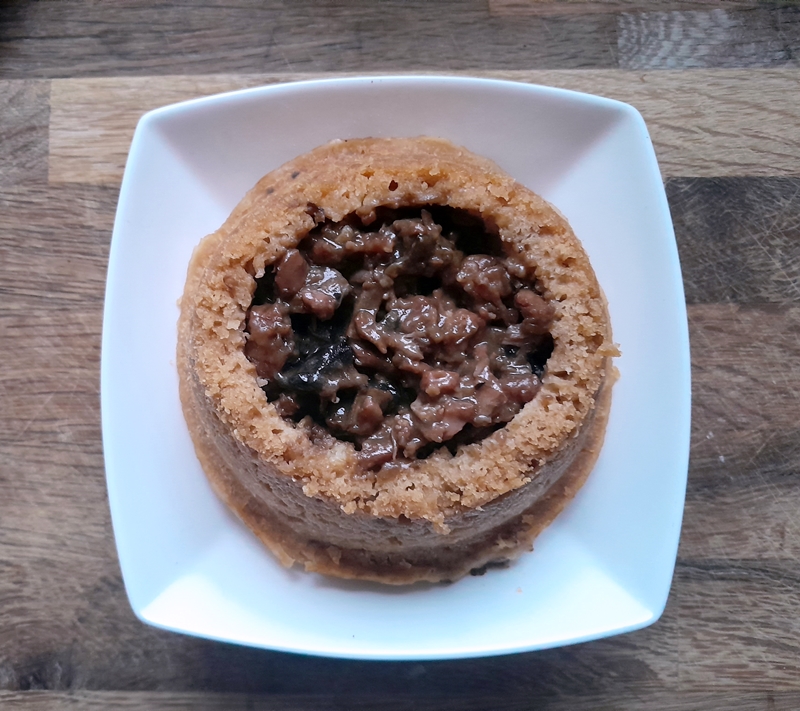
    • As mentioned above, there are lots of little tweaks you can do to both the pastry and the filling to jazz it up. Onions are mentioned by many of the old recipes, but are only recommended in very small quantities. They don’t break down during the cooking, which some might find noticeable pieces of onion off-putting. I recommend using onion powder/granules instead, which give the flavour without distracting from the richness of the meat filling. Carrots are another popular choice, but with a raw filling, you have to either dice them rather small, or add in already cooked carrots and run the risk of them turning to mush. Personally, I’m a bit of a purist, and believe the filling should be richly and unapologetically meaty. Perfectly cooked vegetables can be served on the side. However, as can just be made out in the photos, I have taken Dorothy Hartley’s advice and added some black-gilled mushrooms to the mix. Mushrooms have a complementary ‘meaty’ texture and their juices make a flavoursome addition to the gravy, as well as darkening it to a rich brown.
  • Buttering Your Bowls
    • This is what is going to make your puddings turn out beautifully. Use REALLY softened butter and a pastry brush to paint it on. The secret to the beautiful golden colour of the suet crust in the pictures above and below? Butter and a long slow cook in the slow cooker. Taking care to ensure every part of the inside of the bowl is buttered, will ensure a perfect pudding turnout every time.
  • Covering Your Bowls
    • The water in your slow cooker needs to come at least 3/4 of the way up your bowl(s). It never boils furiously, so there’s no danger of the water splashing over the top of the bowls. The main reason for covering your puddings is to protect from the drip of condensation from the lid. Before the advent of the pudding bowl, steamed puddings used to be covered with a floured pudding cloth, but the modern method of greased and pleated parchment and foil works very well.
  • Cooking Your Puddings Long Enough
    • This is probably the main reason things go wrong with steamed puddings, sweet or savoury. All of the old recipes suggest puddings be cooked for many hours, simmering in water which must be constantly topped up to ensure the puddings don’t boil dry. Five hours is a time frequently mentioned. Using a slow cooker has the advantage of being able to, literally, set it and forget it. No need to constantly monitor the water, as the lid keeps it all inside. No need to top up or check if it’s boiling dry. It is very difficult to overcook a suet pudding in the slow cooker. What is very easy to do, is under-cook a pudding. In her column “How To Cook The Perfect Steak and Kidney Pudding”, Felicity Cloake had little complimentary to say of Constance Spry’s cook-from-raw recipe, “The raw beef … comes out gloopy with flour, and tough as a Victorian boarding school”. In Constance’s defence, she did specify beefsteak and stewing steak had been used instead, but in my opinion the main problem was probably cook time. I trialled cooking these puddings in the slow cooker on both High and Low heat settings using raw ingredients. On High, they take 5 hours – not too bad if you’re at home all day, but not really helpful in terms of having a meal ready when you get in from work. On Low I tested puddings with cooking times of 8 hours and 10 hours. Both ended up with golden fluffy pastry and meltingly cooked filling. So provided you can get up early enough to assemble your puddings and get them cooking before you leave for work, they can be ready for supper at the end of a long day. The only suggestion I would make would be to have lots of extra gravy to hand if you’re cooking your puddings 8+ hours.

Last thing I want to have a little rant about in this marathon of a blog post, is the falsehoods I found being perpetrated ‘out there’ with respect to photographs of steak and kidney puddings. The images being posted were frequently not of the recipe they appear alongside. The worst example I found was of a photograph that has been on the internet since 2009 being posted alongside a recipe from 2022. Also, do not be deceived into thinking if you cut a wedge out of your steak and kidney pudding, the meat will tumble artfully onto the plate like many of these pictures suggest. If it does, it will leave your crust rather empty. What it will also do is ruin the structural integrity of your pudding and, if it is undercooked, cause its slow and heartbreaking collapse into a heap on the plate. Setting aside the very insipid colour of some of the pastry, even if the photo is of the actual recipe, it will have been staged for maximum eye appeal, and probably had extra filling added in order to make the image seem plentiful. I am puzzled, for example, how all this filling fit inside this pudding? If your pastry is no oil painting, do not despair, you can always drown it with the gravy (that this recipe doesn’t even tell you how to make).

So in light of these criticisms, I feel compelled to admit to the shenanigans I’ve employed in the pictures on this post. This image is from another of the test puddings, made on a different day (hence the different lighting) in a slightly smaller bowl to the one in the top picture. The ‘manipulations’ I have used include removing the top of the pudding pastry to reveal the filling, and adding in some extra gravy to increase the eye appeal. No extra filling was added and this pudding is absolutely made from the recipe below.

Steak and Kidney Pudding


These quantities are sufficient for two generous puddings in bowls of diameter 12cm. You can also put everything into a large bowl and use the longer of the cooking times. You can also increase the quantities to suit your needs. As a general guide, you need 100g beef, 40g kidney, 1 large, flat mushroom per person, but you can adjust these ratios to your liking.

For the filling:
200g beef cheek/skirt/hangar/flatiron steak, in 1.5cm pieces
80g prepared and soaked beef/ox kidney (see above), in 1.5cm pieces
2 large, dark-gilled mushrooms, chopped into 1.5cm pieces
60g cornflour
½ tsp salt
¼ tsp ground black pepper
1 tsp onion powder/granules
250ml strong beef stock
2-3tsp Worcester Sauce (optional)

For the pastry:
340g plain flour
3tsp baking powder
1 tsp salt
½ tsp ground black pepper
150g dried suet (170g fresh)
85g fresh breadcrumbs

softened butter to grease the bowls

  • Butter your pudding bowls generously.
  • Tear off and butter 2 pieces of parchment to cover your puddings. The butter will help brown the pastry, and keep it from sticking. Fold a pleat across the middle of each. Set aside.
  • Tear off two pieces of foil to cover your puddings. Fold a pleat across the middle of each. Set aside.
  • Cut lengths of string to tie around the foil to keep it in place. Set aside.
  • Mix all the ingredients for the pastry.
  • Add cold water and stir gently until the mixture comes together into a soft dough.
  • Divide the dough into two. Cut off a small piece of dough to make the lid.
  • The dough is too soft to warrant using a rolling pin. Pat out the larger pieces of dough on a floured surface until about 1cm thick. Lift the dough and drop it gently into each bowl, allowing about 3cm to hang over the rim of the bowls. Be sure to patch any holes that form with extra pastry. The pastry must be ‘watertight’ to keep all the gravy from leaking out.
  • Pat out the smaller pieces of dough until 1cm thick and set aside.
  • Mix the cornflour, salt, pepper and onion powder together.
  • Toss the pieces of kidney in the seasoned cornflour . Remove any excess cornflour by tossing the pieces in a sieve over the bow. Set aside.
  • Repeat for the pieces of beef, including tossing the coated pieces in the sieve (you may need to work in batches).
  • Layer the beef, kidney and chopped mushroom until the bowls are full. The filling can be a little higher than the edge if necessary.
  • Add the Worcester sauce to the stock if using, and then pour into the puddings until the liquid is just visible below the top layer of meat.
  • Lay on the pastry lid and moisten the edges with water.
  • Fold the excess pastry over onto the lid and use a fork to seal the edges well.
  • Cover the tops of the puddings with the buttered parchment, butter side downwards.
  • Cover the parchment with foil and press closely to the sides of each bowl.
  • Tie string just under the rim of the bowls to keep the parchment/foil in place.
  • Turn your slow cooker to High or Low, depending on your schedule.
  • Place your puddings into the slow cooker.
  • Boil some water and pour carefully into the slow cooker, until the water level is ¾ of the way up the sides of the bowls.
  • Cover with the lid and cook according to your needs. On High, the puddings will take about 5 hours. On Low, they will be done in 8 hours, but can go as long as 10 hours with no deterioration in quality.
  • To serve, switch off the slow cooker and remove the puddings from the water. I find a long-handled skimmer/strainer spoon useful.
  • Cut the strings and remove the foil and parchment.
  • Place your serving dish/bowl over the puddings and turn over.
  • Lift off the bowls.
  • Serve as is with extra gravy and freshly cooked vegetables on the side, or cut the tops off the puddings and stir in some gravy to moisten before serving.
  • You can reheat the puddings by wrapping in foil (to keep from drying out) and putting into a 170°C, 150°C Fan oven, or, if using ceramic bowls, in the microwave. Alternately, keep the parchment and foil on from the original cooking, and reheat in hot water in the slow cooker on High.

Chestnut Apple Pie

Lady Grisel Baillie was a Scottish noblewoman who lived in the 17th/18th century. She was married to a Scottish MP, and became known to social historians for the meticulously detailed account books she kept, which  offer a glimpse into the cost of living during that time, including food and drink, servants wages, travel costs and entertainment. Lady Grisel was also something of a foodie, as she noted down many a menu from various dinners she and her husband attended.

Extracts of Lady Grisel’s household books were published by the Scottish Historical Society in 1911 and over the years I have dipped into this book many times, and have been somewhat frustrated that menus are recorded, but not recipes. She definitely had a recipe book, because the Scottish Historical Society lists it amongst her papers:

“Lady Grisell left three ‘Day Books’ folio size, the first running from 1692 to 1718 inclusive, and containing 442 pages ; the second from 1719 to 1742 inclusive, and containing 354 pages, and the third from 1742 to the date of her death (6th December 1746), continued by her daughter, Lady Murray. She also left books containing the accounts of expenses in connection with their journeys to Bath and to the Continent ; Books containing Inventories of Bottles, etc. ; a Book of Receipts ; a Book of Bills of Fare ; Books relating to estate management during the years 1742, 1743 and 1744, and many other Account and Memoranda Books.”

A few years ago, I revisited a manuscript at the Folger Library to study a recipe for Stilton Cheese that had caught my eye, (the results of which can be found in Petits Propos Culinaires 114, June 2019), and in the course of my research, discovered that the manuscript in which it appeared was the long-lost recipe book of Lady Grisel Baillie! The manuscript had been purchased by the Folger Library in June, 1959 from the London bookseller Francis Edwards, Ltd. for the princely sum of £35.00. More intriguing is what happened to it during the preceding 48 years, from 1911, when its existence was noted by the Scottish Historical Society, and its purchase and trans-Atlantic voyage in 1959, and why the current Mellerstain estate owners didn’t know where it was. Very mysterious!

The point of this extended preamble is that this recipe comes from that self-same, long-lost recipe book. It has been on my radar for a while, because it is a sweet pie with chestnuts, and when I spotted nets of fresh chestnuts in the shops this week, I was enthused to have a stab at it.

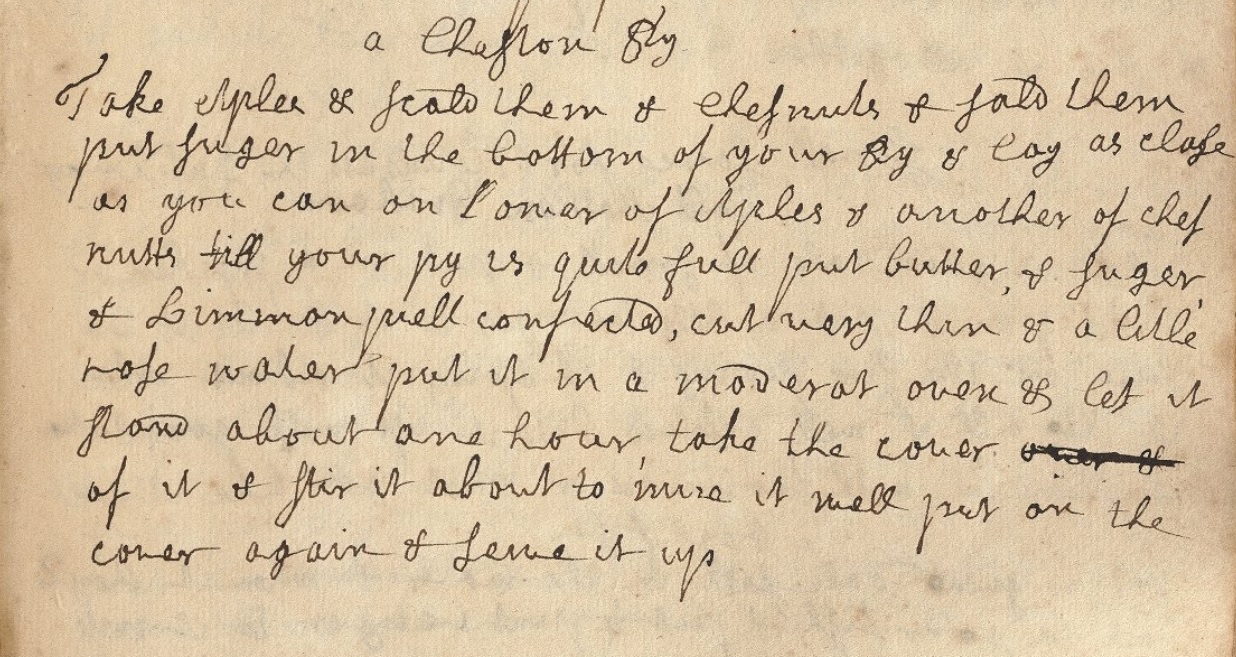
A Cheston Pye, from the cookbook of Lady Grisel Baillie, Folger Digital Image Collection, Ms W.a.111, p289, circa 1706.

Which also brings me to the word of the day: scald. Both apples and chestnuts are scalded in this recipe, and after much hunting about reading other usages, the best definition I can come up with is: cooked gently in their skins. When scalded, the apple skin will peel off by itself freely, leaving the partially cooked flesh intact. I suspect this was done to prevent wastage, preserve flavour and minimise juice. Similarly, the chestnuts are scalded in order to soften them and to loosen both the skin and the pith surrounding the nut. This all sounds simple, but, from experience, left unsupervised, things can get a little tricky. It doesn’t take much for the water in which the apples are scalding to become too hot, thereby causing the apples to burst, and then you have to retrieve your apple pulp from the ‘soup’ in the saucepan. Scald the chestnuts for too long, and then you will have difficulty extracting them whole. This isn’t too much of a disaster, as the crumbled pieces are perfect for this dish, but if you were wanting them for another use – candying, for example – the wastage in broken nuts can get quite high.

Why you should make this pie

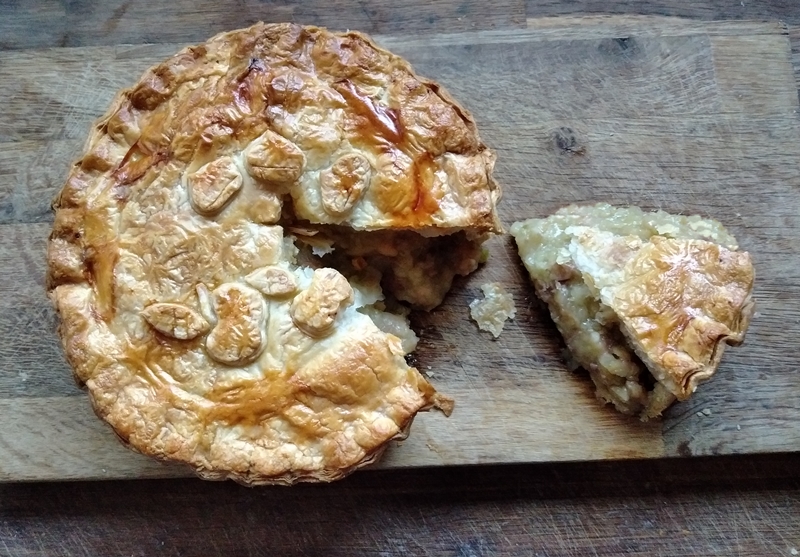
Well, it’s absolutely delicious, that’s why! It’s unusual, in that it is a sweet pie with chestnuts, and thus something of a novelty in modern recipes. During the long, slow baking, the pastry crisps up beautifully, and the chestnuts and candied lemon soak up some of the apple juice and become soft. The texture of the apples and the chestnuts is much more interesting that a regular apple pie and the contrast between the filling and the two different types of pastry is a delight. This pie embodies autumn in a deliciously comforting way, you’ll be elbowing your way back to the nets of chestnuts to make it again. Perfect for the upcoming holiday season!

Sliced of Chestnut Apple Pie
Slices of Chestnut Apple Pie: The pie slices very neatly when cold, and the chestnuts and candied lemon peel are shown.

Chestnut and Apple Pie

These quantities are for a 20cm diameter pie. You can obviously use as many or as few chestnuts as you like. You can, of course, shorten the prep time by using stewed apple and ready-cooked chestnuts. The only caveat to this I would add is that the ready-cooked chestnuts you can buy tend to be a little dark, whereas if you scald them yourself, they come out very similar in colour to the apple pulp.

If you’re making this from scratch, prepare the apples and chestnuts a day or so ahead, and then assemble the pie when required. The cooked apples and chestnuts will keep in the fridge several days.

Filling
4 Bramley Apples (or 600g unsweetened stewed apple)
1 x 400g net of raw chestnuts (or 300g cooked chestnuts)
30g candied lemon peel
30g unsalted butter
3-4tbs caster sugar
3tbs cornflour
zest of 1/2 a lemon (optional)

1 x box of ready rolled puff pastry
egg-white for glazing

Base Pastry
225g plain flour
60g cornflour
140g unsalted butter
ice cold water

  • Put the flours and butter into the bowl of a food processor and blitz until the mixture resembles breadcrumbs.
  • With the machine running, gradually add the cold water a tablespoon at a time until the mixture comes together in a ball.
  • Tip the mixture onto a floured surface, knead smooth.
  • Roll out the pastry to the desired thickness (5mm) and line a greased, 20cm pie tin. Ease the pastry into the corners of the tin, rather than stretch it, and allow the excess to hang over the edges of the tin.
  • Place in the fridge to chill until required.

To scald the apples

  • Put the apples, whole, into a saucepan and add just enough water to cover.
  • Lay a saucer upside-down on top of the apples, to keep them submerged.
  • Put the saucepan on a gentle heat (I use 5 on a 1-9 scale) and allow the apples to barely simmer for 30 minutes. Keep an eye on them, and if the skin starts to split, remove from the heat and the water immediately.
  • Lift the scalded apples out of the pan and set aside to cool.
  • When cool enough to handle, peel away the skin and then scoop all the flesh from the core.
  • Mash the apple pulp with a fork. You don’t need to make it puree-smooth, just get rid of the larger lumps.
  • Mix the sugar and cornflour together and then add to the apple pulp and mix thoroughly.
  • Taste the apple pulp and add more sugar to taste.
  • Set the apple pulp aside until required.

To scald the chestnuts

  • Using a sharp knife, cut a slit ito each nut, being sure to pierce bith the hard outer shell and the soft skin underneath.
  • Put the nuts into a saucepan and cover with cold water.
  • Set pan on a gentle heat, and simmer the chestnuts for 30 minutes.
  • Remove from the heat and allow to cool in the water.
  • Remove the chestnuts one at a time and peel away the softened shell and skin. Don’t worry if the nut doesn’t come out whole, as pieces are perfect for this recipe. Don’t drain the chestnuts, because the shells will harden quickly once out of the water, and make peeling them difficult.
  • Crumble the chestnuts into pieces – not too small – and store in a covered container in the fridge until required.

To assemble the pie.

  • Heat the oven to 180°C, 160°C Fan.
  • Slice the candied lemon peel into thin slivers. If you don’t have whole pieces, diced is fine, just make sure they’re not too big.
  • Divide the butter into three. Keep chilled until required.
  • Remove the pie tin from the fridge and trim the excess pastry. Leave about a 2cm overhang from the edge of the tin.
  • Fill the pie
    • Add a layer of apple pulp.
    • Add half the chestnuts in a layer
    • Add half the lemon peel
    • Dot over 1 portion of the butter in thin slices.
    • Add a layer of apple pulp.
    • Add half the chestnuts in a layer
    • Add half the lemon peel
    • Dot over 1 portion of the butter in thin slices.
    • Add a layer of apple pulp.
    • Dot over the last portion of the butter in thin slices.
    • Grate over the zest of half a lemon (optional). I like the lemony zing, but it can be omitted if you prefer.
  • Unroll the puff pastry and smooth out with a few strokes of the rolling pin.
  • Wet the edges of the shortcrust pastry with water.
  • Lay the puff pastry over the top of the pie and press the edges together gently.
  • Trim the puff pastry to the size of the shortcrust pastry.
  • Crimp the pastry edges as shown in the top photograph.
  • Cut out decorations for the top of the pie from the puff pastry offcuts and lay them on the pastry lid. I did a few apples and chestnuts.
  • Brush the top of the pie with eggwhite.
  • Bake the pie for 60 minutes. Turn the pie around after 30 minutes to ensure even colouring.
  • After a further 20 minutes, if your puff pastry isn’t quite cooked through, turn the heat up to 220°C, 200°C Fan for the last 10 minutes.
  • Remove the pie from the oven and cool on a wire rack for 10 minutes.
  • Remove the pie from the tin and allow to cool until just warm.
  • Serve with double cream.

Empty Pudding

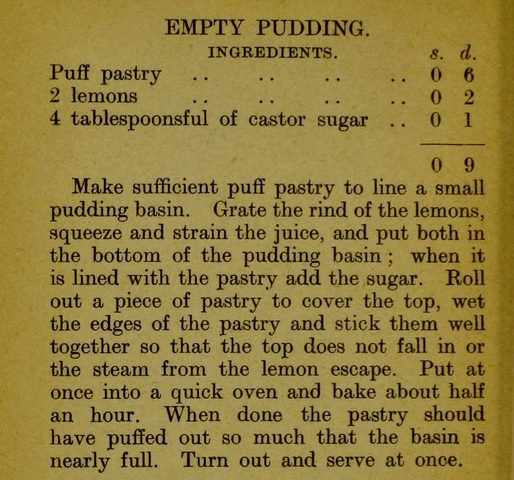
Sometimes I stumble across a hidden gem of a recipe when I am supposed to be hunting out something else. Thus it is with this recipe that I found in a nondescript Edwardian cook book¹.

There are several things that drew me to this recipe. Firstly, the name, which is curious, and after following the recipe, is also extremely accurate. Secondly, the ingredients list. It is incredibly short. Just three ingredients. Which I find rather exciting – the possibility of creating something out of practically nothing is great fun. Especially since, in this case, the recipe has been costed at 9d, nine old pence, less than a shilling for, what appears to be, pudding for four. More so if it is delicious. Which this is. But I’m getting ahead of myself.

This recipe so caught my attention, I don’t even remember what recipe I was searching for in the first place, so I was keen to read on and discover the secrets within. Alas, the fourth thing that drew me to this recipe is the confusing way it is written.
EmptyPuddingRecipe
As can seen above, the instructions call for one to:

  • Make pastry
  • Put zest & juice in the pudding basin
  • When basin is lined with pastry, add sugar.
  • Seal a pastry lid on top.

This didn’t seem right at all: juice trapped between the basin and the pastry would steam in the heat of the oven and prevent the pastry from becoming crisp, surely? Why use puff pastry if you didn’t want it crisp? How can you seal the pastry and prevent the steam escaping if the thing making the steam (the lemon juice) isn’t inside? This last instruction was, for me, the key, or rather the ‘permission’ to break my number one rule with old recipes and NOT bake it as written in the first place, and put the zest and juice inside the pastry.

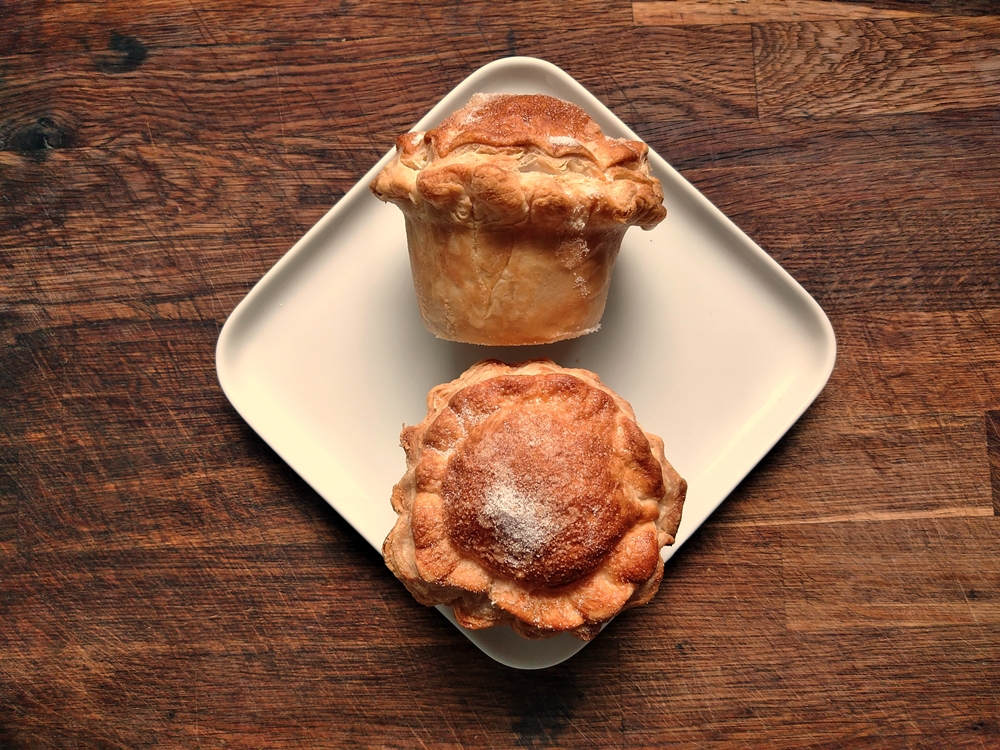
And it worked wonderfully. I baked my puddings in individual-sized metal pudding bowls, to shorten the cooking time.

EmptyPie

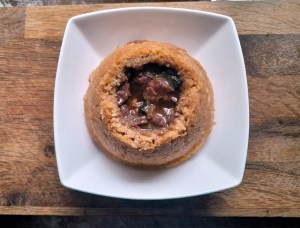
And here’s how they turned out. Beautiful, golden pastry and a puffed and crispy lid. Inside, the lemon zest and juice combined with the sugar to make an incredibly zingy lemon syrup, which really packs a punch.

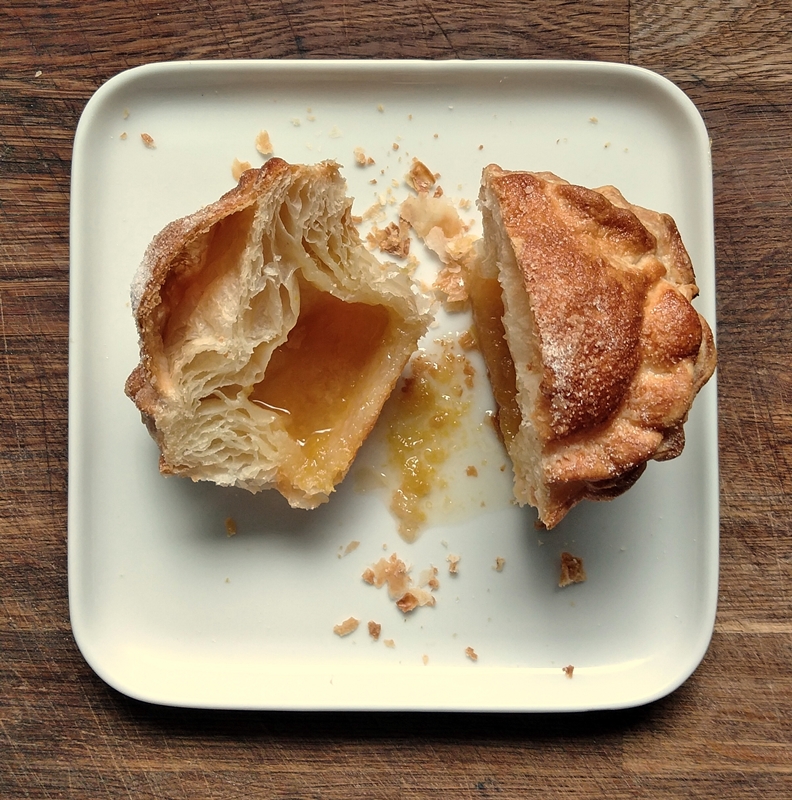
LiquidPie

The heat from the oven creates steam from the lemon juice inside the pudding, which in turn helps fluff the puff pastry into soft, delicate layers. The contrast of flavours and textures is amazing.

But there’s more.

Because not all of my puddings turned out perfectly. Two of them sprung a leak during baking, as can be seen here (arranged upside down).

LeakedEmptyPie

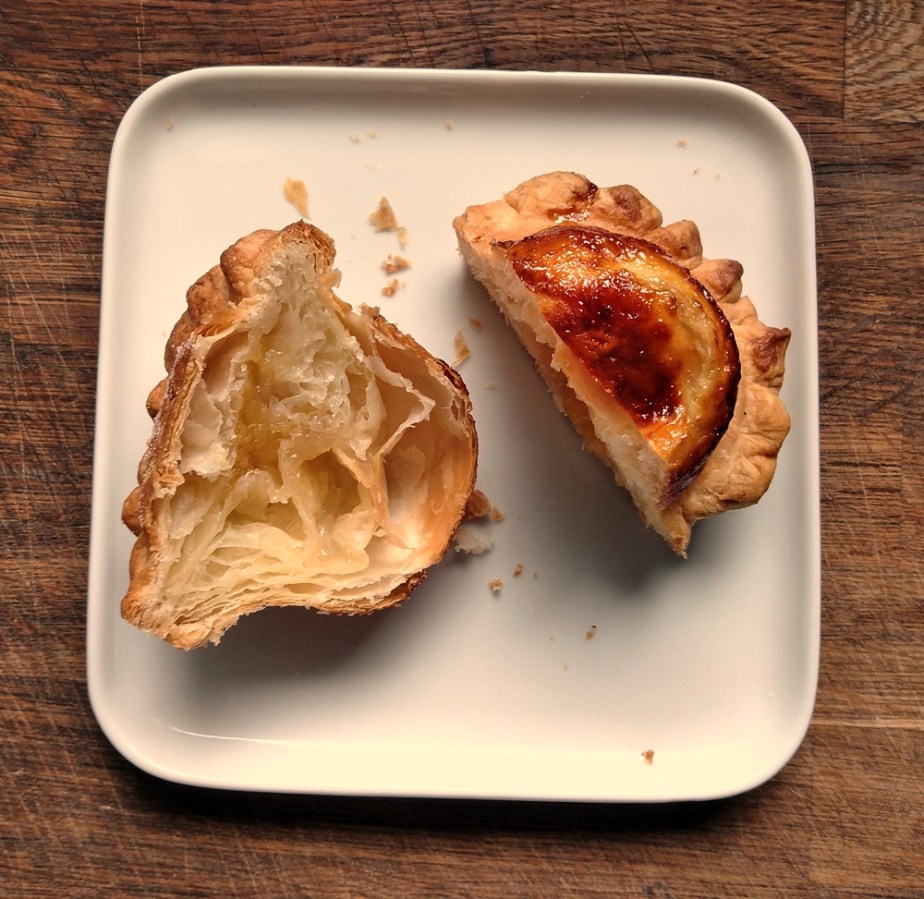
But here’s the thing: it’s not a disaster! The zest and juice still combined with the sugar to make a syrup, which, after the leak, coated the outsides of the pastry and made an amazing lemon caramel. Not all the liquid leaked out, so the insides still benefitted from steam, and puffed out fantastically. The photo at the top shows the insides of one of the ‘leaky’ puddings. These are also brilliant, as the lemon caramel hardens in the best traditions of creme brulee, and gives even more flavourful contrasts with the crisp pastry and soft interior. I might even like this variation more than the original. So if your puddings bake perfectly, or whether they spring a leak, it really is a win:win situation!

An extravagance: I used two blocks of puff pastry for just 4 puddings, because I wanted to use freshly-rolled pastry for the lids and the linings, in order to get the best ‘puff’ during baking. On reflection, this might have been unnecessary, as the basins do such a good job of ensuring the pastry puffs inwards whilst keeping the outsides smooth. Certainly, the lids were spectacular, so I’m going to recommend cutting lids from freshly-rolled pastry, and then re-roll the trimmings for the basin linings, which means you could probably get everything from a single block of puff pastry. I haven’t tested this, so I recommend having the second block of pastry on standby, just in case.

Empty Pudding

Serves 4

2 blocks puff pastry
2 lemons
4tbs caster sugar
butter for greasing
milk and caster sugar for glazing

  • Butter your pudding bowls generously. If your puddings spring a leak, you want to ensure you can still get them out of the bowls.
  • Roll out your pastry and cut 4 lids. Make sure the pastry is a little larger than the diameter of your pudding bowls, to ensure there is enough to make a firm seal.
  • Cut pastry to line your pudding bowls. Make sure the pastry overhangs the bowls a lttle to make a firm seal. Re-roll the trimmings if necessary.
  • Put the zest of half a lemon into each pastry-lined bowl.
  • Put the juice of half a lemon into each pastry-lined bowl.
  • Put 1tbs caster sugar into each pastry-lined bowl.
  • Moisten the edges of the pastry lids and attach to the rim of the bowls by pressing down firmly.
  • Chill the bowls in the fridge for at least 30 minutes to allow the pastry to relax and firm up.
  • Preheat the oven to 200°C, 180°C Fan.
  • Place the chilled bowls on a baking sheet and crimp the edges between finger and thumb.
  • Brush the tops with milk and sprinkle with a little caster sugar.
  • Bake for 20 minutes, then turn the baking tray around and bake for a further 10-15 minutes. NB Puff pastry takes a surprisingly long time to be properly cooked, so when in doubt, cook a little longer. You can also return them to the oven for extra browning when turned out. See below.
  • Remove from the oven and turn out as follows.
    • Ease a knife around the edge of the pastry to loosen it from the sides of the bowl.
    • Gently test whether you can lift out an un-leaky pudding.
    • If you suspect your pudding has leaked, turn your pudding out upside down.
    • Depending on your pastry colour, you might want to return your puddings to the oven for some extra colouring. If your pudding has leaked, I would definitely recommend returning them to the oven (still upside down) to harden the lemon syrup/caramel mixture until glossy and brown.
  • Serve with custard, cream or as they come.

¹ A little book of cookery by Dora Luck, 1905, Sands & Compy., London ; Edinburgh.


Banyon Toat Pie

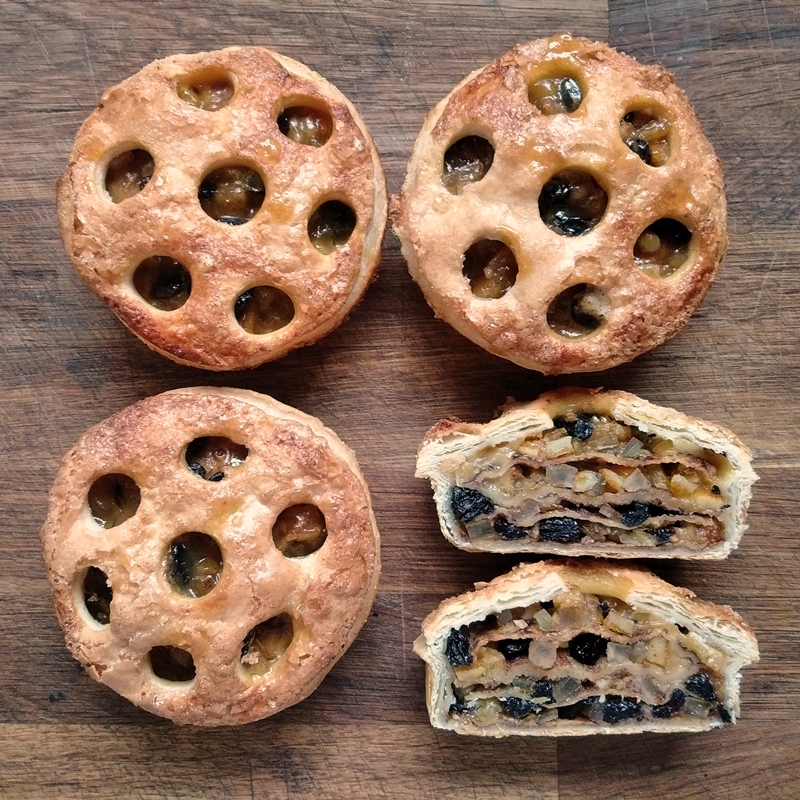
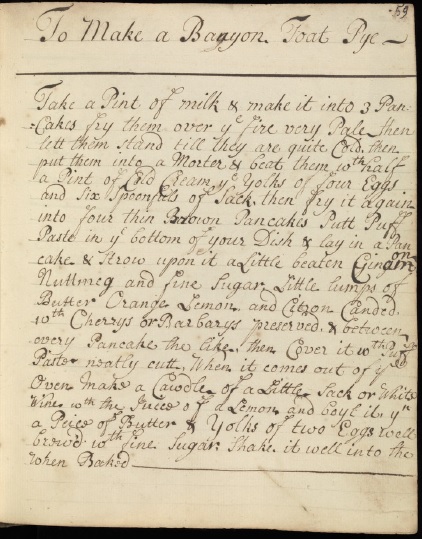
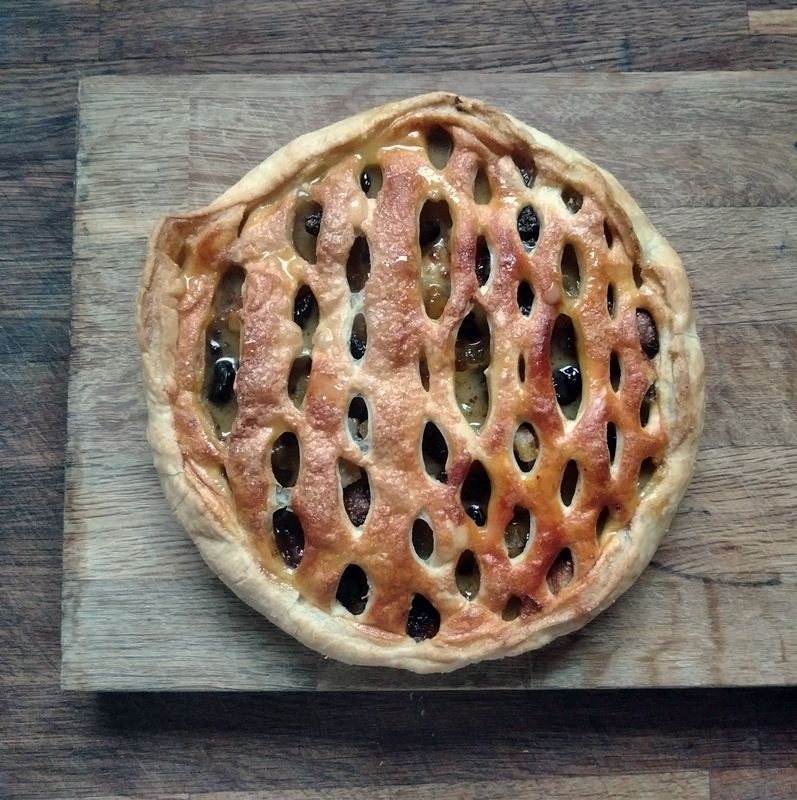
This recipe is bonkers: bonkers name, bonkers method. I’ve spent ages trying to work out what, in the 18th century world of erratic spelling, the name is supposed to be, and drawn a blank¹. I’ve pondered many an hour over the pancake-ception involved in the filling, and been baffled. It’s a true one-off. I’ve never read anything like it – and I’ve read a LOT of recipes. Finally, ealier this month, I decided to grab the bull by the horns and just make it, and see how things go. The result, after a little tweaking, is insanely delicious, so I thought I would share in time for Pancake Day (February 16th), so you can enjoy the deliciousness yourself.

Banyon Toat Pye
Banyon Toat Pye (1700-1735), MS1797, Wellcome Collection

Aside from the already-mentioned bonkers title, the method of this pie is very unusual: make some pancakes, mash them up, mix in yolks, cream and sherry, fry this mixture as thin pancakes, then layer them in puff pastry with candied peel, dried fruit, sugar and butter. When baked, pour a sherry/lemon custard (caudle) through the holes in the lid.

The adding-the-sauce-after-baking was an acceptable approach for pies at this time. Usually the pastry served mostly as a container for the contents and to keep in steam and moisture, and an interesting sauce was added at the end.

It was the pancakes-made-from-pancakes that really intrigued. And so I set to with a vengeance, and initially, it all went swimmingly. Unfortunately, the second batch of batter proved a giant stumbling block. The recipe called for it to be made into thin pancakes, but even using single cream, it was more like bread sauce. Trying to dilute the batter with more cream meant it just wouldn’t hold together. Batch after batch was scrapped, which meant I then had to re-make the first batch and pancakes before working on the second. I must confess, I got a little tetchy, telling myself: it’s a pancake batter! How can I mess up a pancake!?

Eventually, I came up with a compromise, and made just a single, standard pancake batter, but with the flavourings and enrichment that had been used in the second batch. This did indeed make wonderfully thin pancakes, which were delicious in their own right.

Once this hurdle had been successfully leapt, the rest of the recipe was almost straightforward. The pancakes are layered in a puff pastry case, with each layer being sprinkled with sugar, spices, dots of butter, candied peel and dried fruit. A cut-pastry top, 40 minutes in the oven and the addition of the caudle sauce finished it off quite easily, and I must admit, being rather impatient to taste the result.

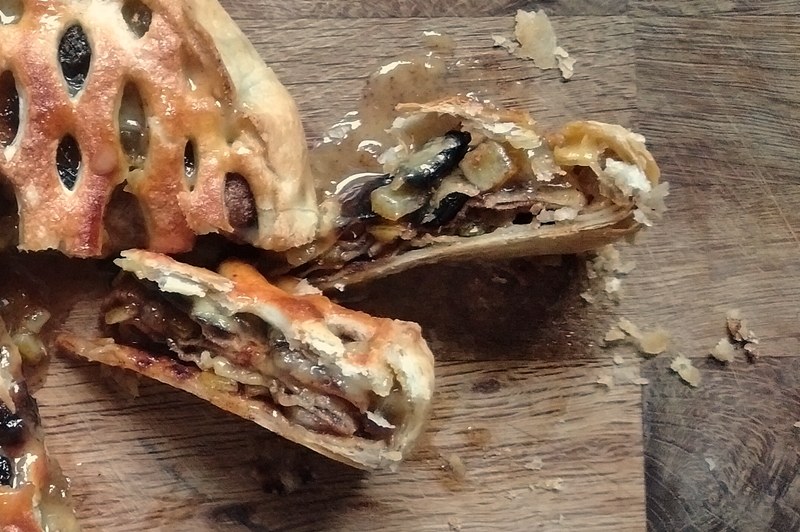
Well, gentle reader, you’ll be pleased to discover that it is bonkers. DELICIOUSLY bonkers! The pancake layers keep the filling evenly spread, but are light and delicately flavoured with no hint of ‘stodge’. The spiced filling mixture is reminiscent of mince pies, and rich-tasting and thanks to the sharpness of the sour cherries/barberries neither heavy nor cloying. The sauce/caudle really brings the zing, with the sherry and lemon-juice adding freshness and richness. I commented on Twitter after the first trial that it was ridiculously delicious, and I stand by that claim. I literally had to hold my daughter at bay until I had photographed the smaller pies, as she is so taken with them!

Now that I have sorted out the pancake problem, it’s a very straight-forward recipe: much more an assembly rather than anything complicated. If you’re short of time, you could even opt to buy the pancakes rather than make them, although that would mean on missing out on their delicate flavour.

Slices of hot Banyon Toat Pie

There are no quantities given in the original recipe for the filling, so you can be as generous or as careful as you like. The quantities below make for a flavourful, rich pie without overdoing it, but for special occasions, you could really layer them thickly.

Banyon Toat Pie

This can make whatever size and shape of pie(s) you like. One large (20cm) pie will serve 8 generously. Due to the richness, a smaller, 10cm pie can be shared between two. The instructions and quantities below are for one large pie, but, as mentioned above, can be scaled up or down easily.

For the pancakes
50g plain flour
1 large egg
1 large yolk
100ml milk
50ml cream sherry

butter for frying

1 x 500g block of puff pastry

Filling
40g candied citron peel, diced small
40g candied orange peel, diced small
40g candied lemon peel, diced small
40g dried sour cherries or barberries
40g butter
4tbs caster sugar
1tsp ground cinnamon
1tsp ground nutmeg

Caudle
2 large egg yolks
juice 1 lemon, strained
50ml cream sherry
15g butter
2tbs caster sugar
2tsp cream sherry to finish

Egg white and caster sugar for glazing

  • Whisk together the pancake ingredients and make four thin pancakes. Use a 1/4 cup measure to ensure the batter equally. Lay the cooked pancakes on kitchen paper and leave to cool.
  • Grease your pie tin(s) and line with thinly (5mm) rolled puff pastry. Leave a generous edge overlapping the sides of the tins, to help secure the lid. Cut a lid a little larger than your pie. Chill the lid in the fridge.
  • Pile the pancakes on top of one another, and place your  lined pie tin on top. Cut around the base of the tin, to make four pie-sized pancakes. Eat the pancake offcuts and enjoy!
  • Layer the pie contents as follows. For each layer:
    • Place a pancake.
    • Sprinkle 1tbs caster sugar.
    • Sprinkle ¼tsp ground cinnamon.
    • Sprinkle ¼tsp ground nutmeg.
    • Sprinkle 10g candied citron peel.
    • Sprinkle 10g candied lemon peel.
    • Sprinkle 10g candied orange peel.
    • Sprinkle 10g sour cherries or barberries.
    • Cut 10g butter into tiny pieces and dot over.
    • Repeat for all 4 layers.
  • Heat the oven to 200°C, 180°C Fan.
  • Remove the pastry lid from the fridge.
  • Cut holes in the lid. You can do this by using a lattice wheel, or by cutting a lattice by hand. Alternatively, use small pastry cutters or even the wide end of a piping nozzle, to cut random holes in the pastry.
  • Moisten the pie edge with water and carefully lay the lid over the filling. Press the edges together firmly, to seal, and then trim the excess with a sharp edge (I use my metal bench scraper).
  • Whisk an egg-white to froth and brush it over the pastry lid. Sprinkle with caster sugar.
  • Bake for 35-40 minutes until the pastry is crisped and brown. Turn the pie around midway through cooking, to ensure even colouring. When fully baked, it will be easy to lift the edge of the pie and check that the base is also browned. If you’re making mini pies in 10cm tins, cooking time is 25 minutes, turning the tray around after 15 minutes.
  • While the pie is baking, make the caudle, You can do this after the pie has been turned, so that it is ready to go when the pie is fully baked.
  • Whisk the ingredients (except the final 2tsp sherry) in a pan over medium-low heat until the sugar has dissolved and the sauce has thickened. It should be of the consistency of single cream. If you think it looks too thin, whisk in an extra yolk. Taste, and add more sugar if needed. When ready to add to the pie, add the remaining sherry.
  • Remove the pie from the tin to a wire cooling rack. Spoon/pour the caudle into the pie through the holes in the pastry lid. Gently shake the pie to help distribute the caudle.
  • Allow the pie to cool for 15 minutes before enjoying.
  • Best served warm. Delicious by itself, if you wanted to ‘gild the lily’, you could serve it alongside some unsweetened whipped cream.

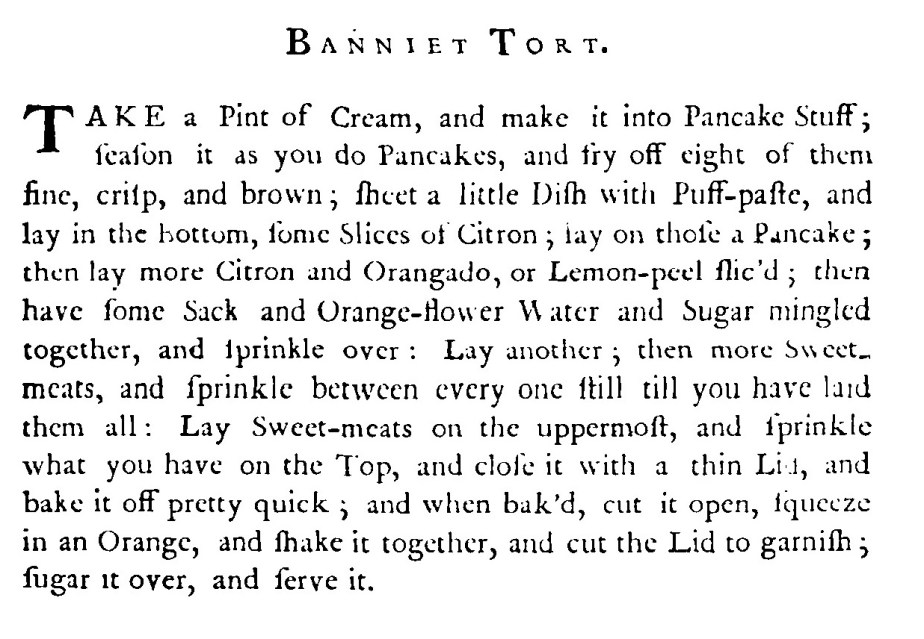
¹ Of course, a week after publishing this post, I worked out that ‘Banyan Toat’ was a variation in spelling of ‘Banniet Tort’. a recipe published in Charles Carter’s “The Complete Practical Cook”, 1730.

Sultana Tarts

This recipe comes, once again, from the pen of Frederick T. Vine. I like it because it shows how much can be achieved with a very small number of ingredients.

I chose it because ’tis the season and is also a great way to present mince pies, making the most of each component.

Mince pies are delicious, but they can be fiddly – especially if you have sausage fingers like me. Trying to get the pastry rolled thin enough, and neatly into the tins, is a challenge. Then too, with a very rich filling, a little variation in cooking times and they can either be a little greasy, or overcooked and dry, and an overall disappointment. With Mr Vine’s approach, everything is prepared separately, and then merely assembled when required. This allows for everything – mincemeat, cream, pastry – to be at it’s absolute best and remove much Faff and stress.

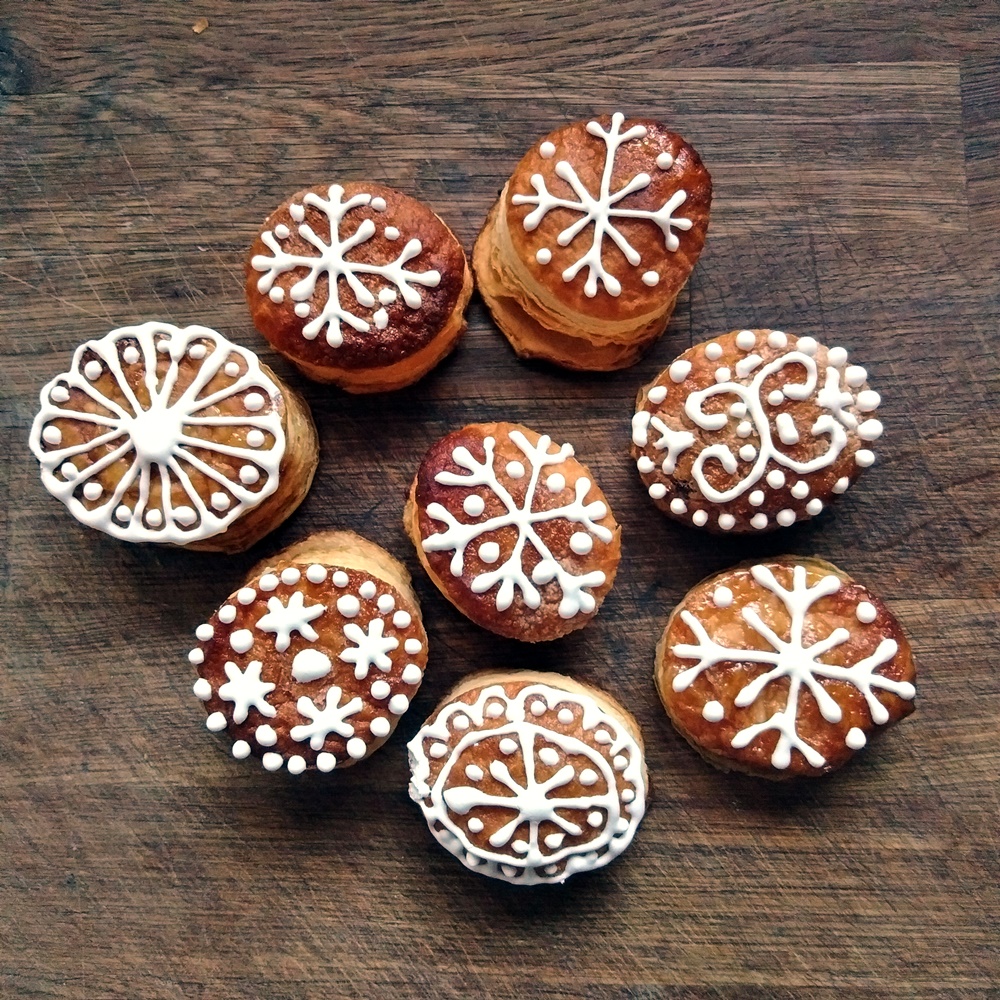
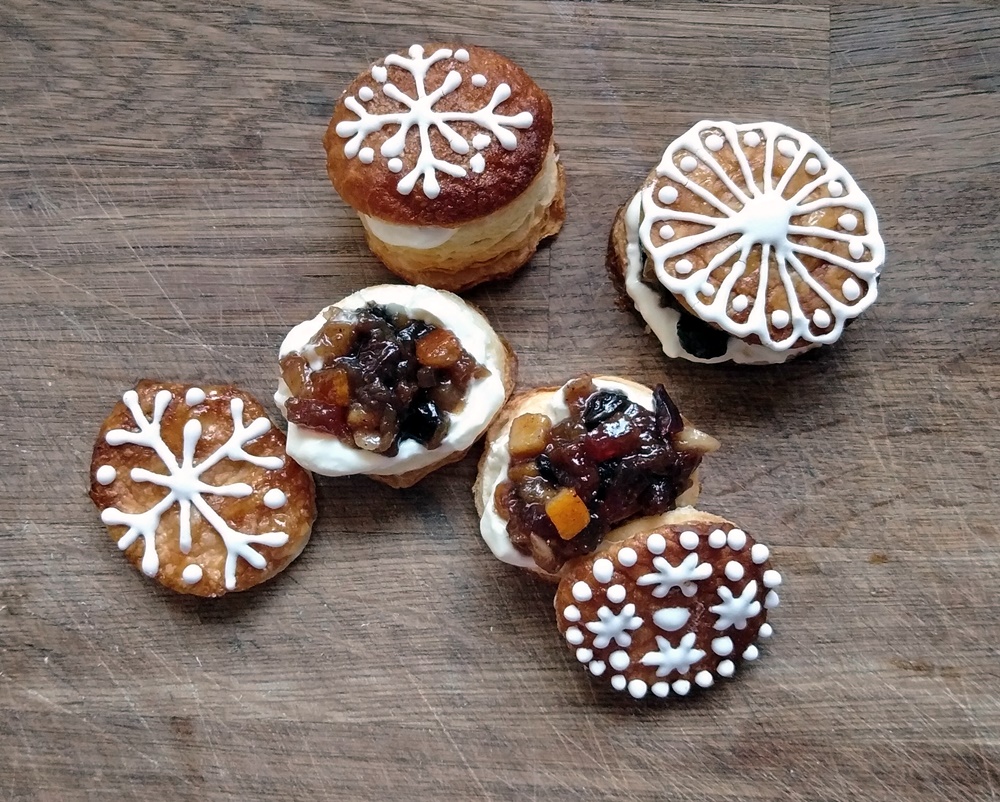
The pastry is baked by itself: rolled slightly thicker than usual – although ready-rolled is fine – the pastry is glazed and baked in whatever shape you like. Once cooled, you can decorate with royal icing (optional), split them open and add your filling.

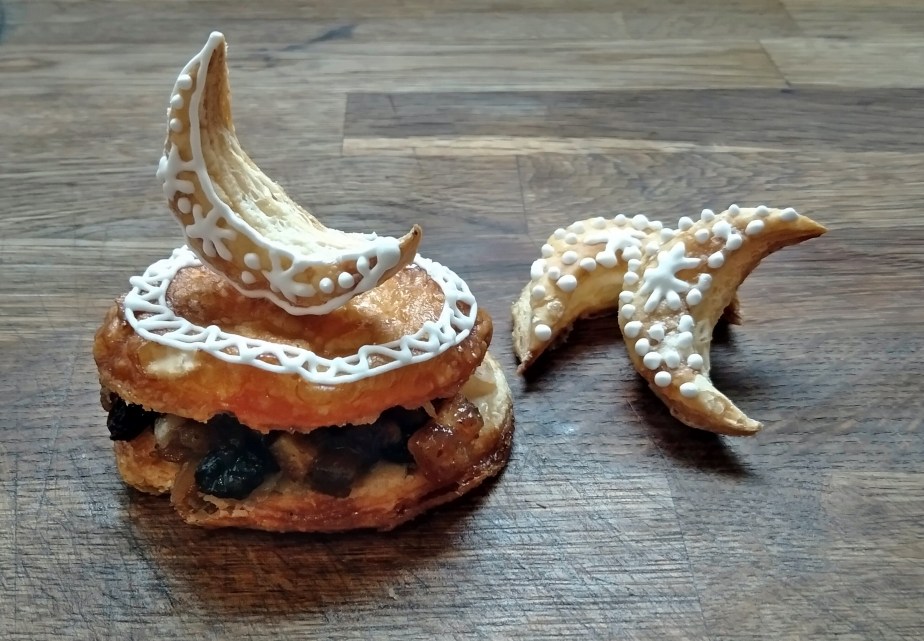
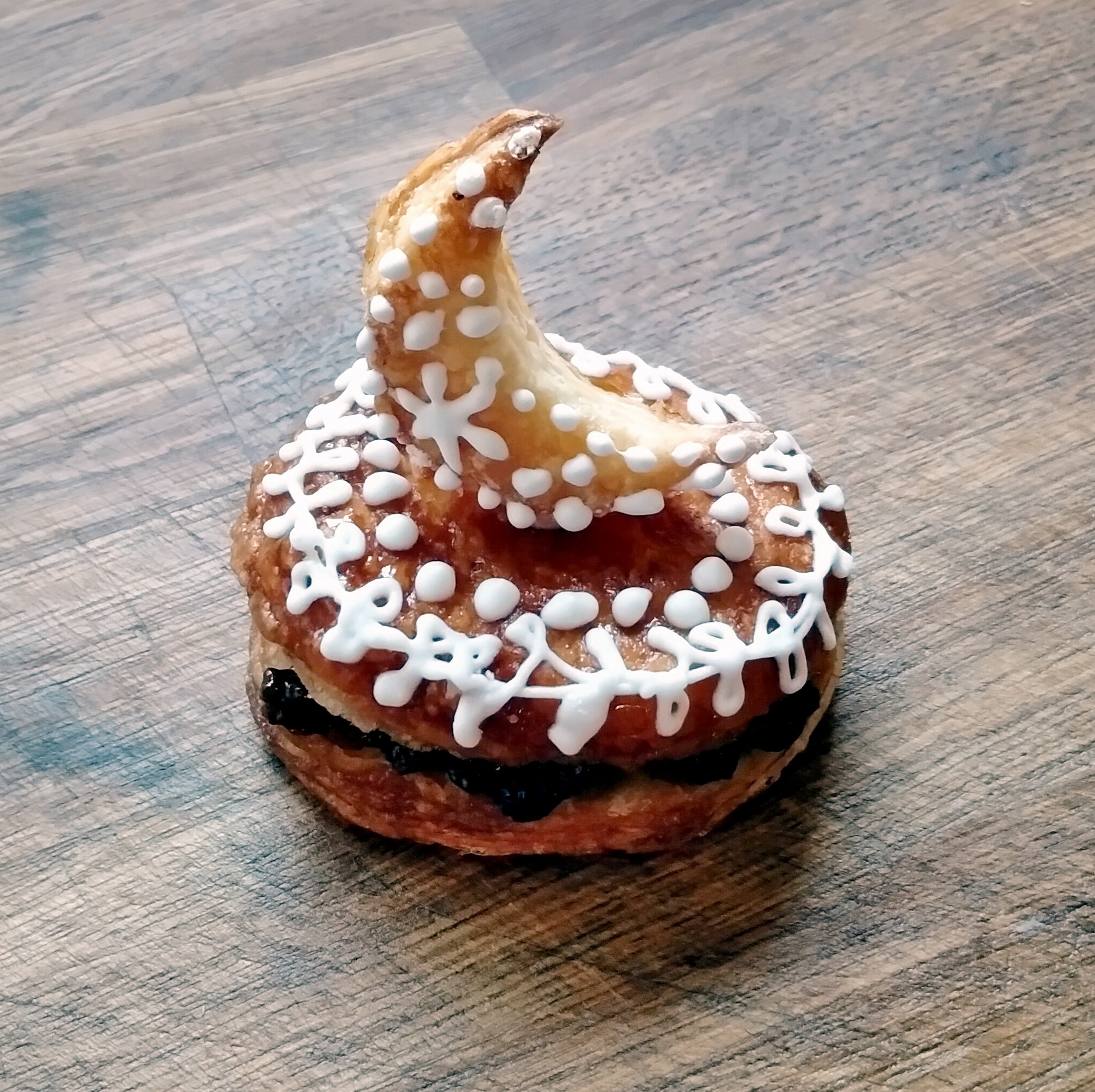
These are called Sultana Tarts because the original recipe has a crescent of puff pastry added as a garnishing flourish, held in place with royal icing, and with both pieces of pastry being  decorated with patterns also in royal icing. Neither is compulsory, of course, but the dazzling white of the royal icing and the glossy burnished surface of the pastry does make for a very striking appearance.

Iced Pies

I think the pies look just as attractive without the crescent of pastry and some dots of royal icing, in as simple or as elaborate a style as you can muster.

If you want to serve mince pies with the minimum of fuss and the maximum of impact both of taste and visual appeal, I don’t think you could do any better than to serve these delightful Victorian versions.

Sultana Tarts

Puff pastry – home-made, block or ready rolled.
sieved icing sugar for dusting
To serve:
mincemeat of choice – delicious vegan version here
cream – double, whipped or clotted

  • Heat the oven to 200°C, 180°C Fan.
  • Roll out your puff pastry if necessary, slightly thicker than usual, about 8mm.
  • Cut your pastry into the shape you want, although it will probably change shape during baking. NB My circles never stay circles,  despite being fastidious in letting the pastry rest for ages.
  • Put the sieved icing sugar onto a tray or piece of parchment.
  • Wet the tops of the pastry with water, turn them over onto the powdered sugar, then set them right side up onto a baking sheet lined with parchment. The bit of moisture is enough to melt the sugar which will turn a rich, glossy brown during baking.
  • Now, a word or two about baking. Puff pastry is capricious and will rise like a phoenix, but all too often a phoenix that has been on the Christmas lollywater, i.e. in many a lopsided way. To mitigate this, you can balance a cooling rack over the top, resting it on top of some metal egg-cups or small pudding tins, to help control the rising to a set height. Due to the sugar glaze, it is probably best to have a layer of parchment between the rack and the pastry, to prevent any sticking.
  • Bake for 20-30mins, depending on size. Puff pastry can be tricksy, in that it looks done long before it actually IS done. It needs a surprisingly long time to both puff up and crisp up.
  • Cool on a wire rack.
  • Decorate with royal icing when cold.
  • Store in an airtight container until required.
  • Warm in a 160C, 140C Fan oven for  10 minutes before splitting, filling and serving. Be sure to warm your mincemeat enough to allow the suet to melt, before filling.


Coventrys, Godcakes and Congleton Cakes

It’s all about triangular pastries this week.

Let us start with Coventreys (middle pastry in the above photo). Essentially, these are jam turnovers, but there are a few key characteristics that set them apart from your average turnover. For a start they are triangular, formed by cutting circles of puff pastry, adding a teaspoon of raspberry jam and folding in the edges of the pastry to form an equilateral triangle. These are then turned over and laid on the baking sheet with the seal underneath. The edges of the pastry are notched using either a flat-ended spatula, or a knife. This has two purposes. Firstly, it allows the steam to scape during baking, and secondly, it permits the jam to peek through in an attractive manner.

Godcakes (on the left in the above photo) also hail from Coventry, but according to Harris & Borella (All About Pastries, c1900) are actually more well known in their home town than regular Coventrys. Godcakes too are triangular, formed in the same way as regular Coventreys, but are baked with the seals upwards and visible. Their filling is of a rich mincemeat, and derived their popularity from being given as blessings by godparents to their godchildren, the three sides being symbolic of the Holy Trinity.

There’s some differing opinions as to when this gifting of pastries might have taken place. Harris & Borella maintain it was at Easter, whereas other sources claim New Year’s Day or even the festive season itself. This might be down to the filling. Nowadays we tend to associate mincemeat very much with Christmas, but originally it was eaten pretty much all year round, and a number of eighteenth century cookery writers, including Hannah Glasse, have recipes specially tailored for consumption during Lent.

There’s certainly a long history of symbolic cakes tied to the church. A ‘God’s Kichel’ is mentioned in Chaucer’s Summoner’s Tale, and defined as

Kichel: A flat Christmas cake, of a triangular shape, with sugar and a few currants strow’d over the top – differing, only in shape, I believe, from a bun. Cocker says “Kichel is Saxon – a kind of cake of God’s Kichel, a cake given to God-children when they ask blessing of their God father.”¹

The third pastry is, I confess, something of a mystery in that I have not been able to find much detail about them at all. Congleton Cakes, aka Count Cakes, have long been celebrated. They are of triangular form, with a raisin inserted at each corner; and, from being eaten at the quarterly account meetings of the Corporation for more than a century, they are called ‘Court Cakes’. The three raisins are thought to represent the mayor and two justices, who were the governing body under the charter of James I. By others, they are supposed to symbolise the Trinity. ²

Aside from their shape, and the detail of the three raisins at the corners, there’s no further information that I have been able to find. The pastry, if indeed it is that, might be shortcrust, sweet shortcrust, puff or hot water crust. It might even be bread dough, either plain or enriched. The filling might be jam or mincemeat or apple or currants or something else entirely. I’ve gone with puff pastry and a mincemeat filling, as the names ‘court’ and ‘count’ have a whiff of expense. However, the high temperature needed to bake the puff pastry well and truly crisped the three raisins, which is what got me thinking the paste might be something plainer, shortcrust perhaps (like Chorley cakes), or even an enriched dough (like the original Banbury Cakes). They might not even be a filled pastry at all, but a fruited dough which has merely been cut into triangles, but it’s all guesswork unless someone can fill in the gaps.

If anyone has any information on these mysterious baked treats, please do get in touch.

Coventrys, Godcakes & Congleton Cakes

The instructions can easily be adapted to whichever of the three pastries you’d like to make, so it’s going to be a one-size-fits-all kinda recipe. To make about 8 cakes.

1 sheet of ready-rolled puff pastry
raspberry jam (Coventrys) OR mincemeat (Godcakes/Congleton cakes)
large raisins (Congleton cakes)
eggwhite (for glazing)
caster sugar (for glazing)

  • Heat the oven to 220°C, 200°C Fan.
  • Sprinkle the pastry with flour and roll out a little thinner (3-4mm).
  • Cut plain circles of pastry, about 10cmin diameter.
  • Dampen the edges with a little water to help with sealing the cakes/
  • For Coventrys, spread a teaspoon of raspberry jam in the centre, then fold the edges in over the jam to make a triangle. Press gently, then turn the pastry over and place seal-side down on a baking sheet lined with parchment.
  • For Godcakes, spoon a rounded teaspoon of mincemeat into the centre, then fold the edges in over the mincemeat to make a triangle. Press gently, then place seal-side uppermost on a baking sheet lined with parchment.
  • For Congleton Cakes, place three large raisins at equal distance around the edge of the pastry. Spoon a rounded teaspoon of mincemeat into the centre, then fold the edges in over the mincemeat to make a triangle, ensuring the raisins are closely folded in the pastry.
  • Whichever style you have made, brush over with lightly whisked egg-white and sprinkle with caster sugar.
  • Using a flat-ended spatula, or a knife, make notches in all three sides of each pastry. For Coventrys, don’t make the cuts too deep, as the jam might leak out during cooking.
  • Bake for 18-20 minutes, turning the baking sheet around after 10 minutes to ensure even colouring.
  • Cool on a wire rack.

¹ “Suffolk Words and Phrases: Or, An Attempt to Collect the Lingual Localisms of that County”, Edward Moore, 1823

² “The English dialect dictionary”, J. Wright, Volume 1 A – C, 1898