Stuffing Loaf

This recipe might be my finest creation since The Ploughman’s Loaf!

If the name of the blog weren’t already a huge clue, I am a big fan of leftovers, and the bigger the occasion, the greater my happiness.

Because however wonderful the celebratory meal, opening the fridge the next day to an array of already-cooked food requiring only a little reheating – or in the best cases, none at all – is a thing of beauty.

Boxing Day is arguably the Christmas Day of deja food, with the greatest selection of food possibilities. The simplest way to sample these delights is the humble sandwich: a little turkey or chicken, a little ham, a little cranberry, some stuffing…

But the problem with all these little bits here and there is that before long, you’re quickly headed towards a sandwich of Dagwood proportions.

In addition, I love some texture to my sandwiches – the popularity of adding crisps to sandwiches in the UK is well acknowledged. In traditional roast dinners, the stuffing is frequently the star on the plate: crunchy on top, soft underneath, and packed with savoury flavour. However, as a deja food, it loses much of its appeal, being rather bulky and in texture, veering towards the claggy.

The recipe I have here is the solution, and is so simple, I’m surprised it hasn’t occurred to me before: instead of breadcrumbs in the stuffing, put the stuffing flavourings into the bread. The bread can then be toasted for a sandwich and provide crunch and taste without the resulting sandwich requiring the unhinging of one’s jaw.

This recipe is based on my Traditional Stuffing recipe, although you can also use it as a basis for making a loaf from your own family stuffing recipes. To my lovely American readers, I hope you’ll enjoy saving money by making sandwiches at home with this bread on the day after Thanksgiving, instead of joining the wrestling matches at the Black Friday sales.

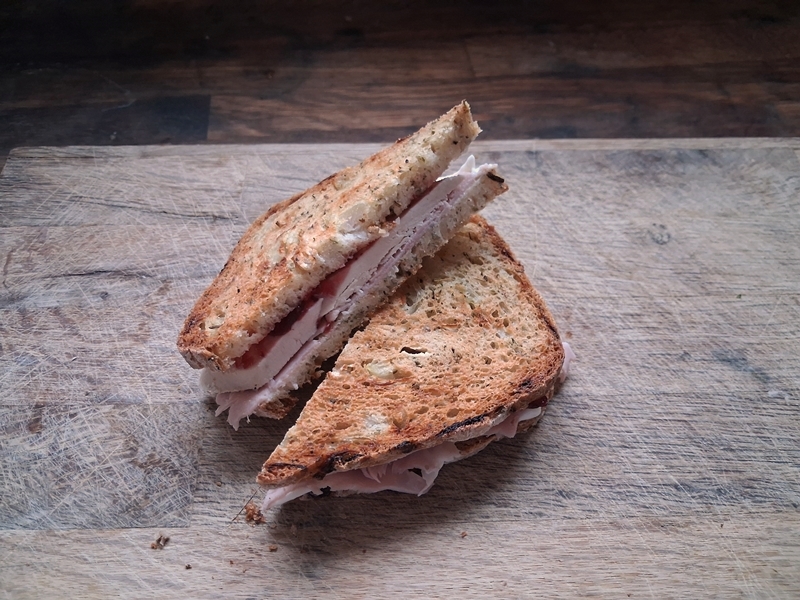
A toasted Stuffing Loaf sandwich with cold chicken, ham and cranberry sauce

Stuffing Loaf

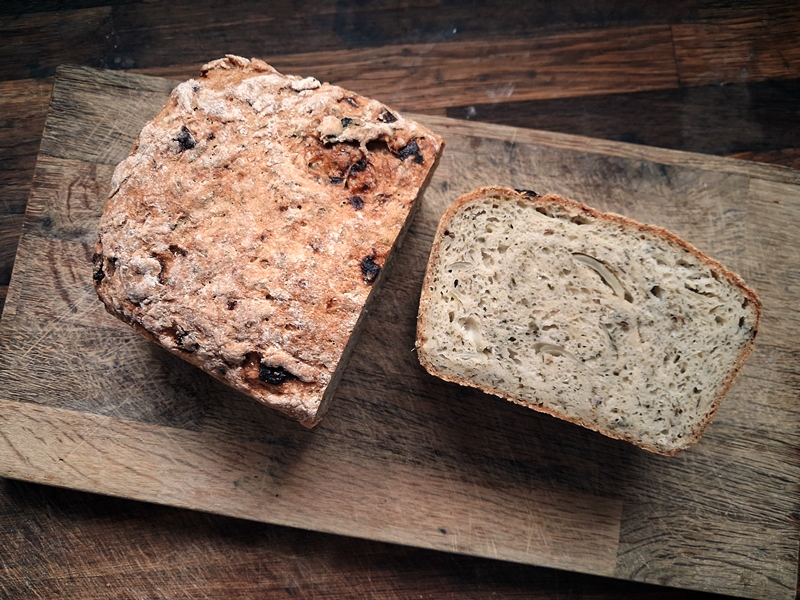
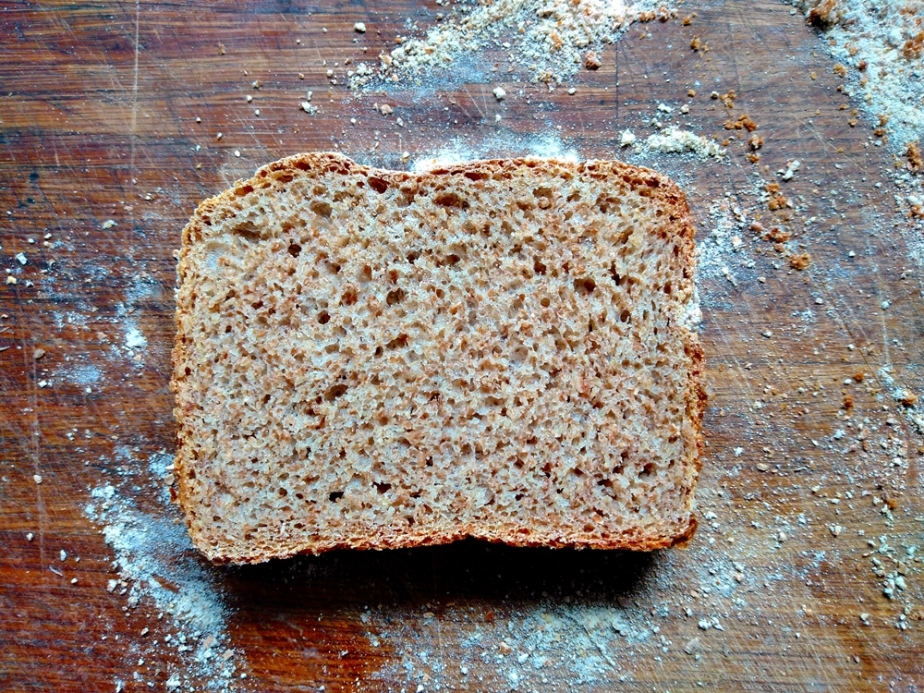
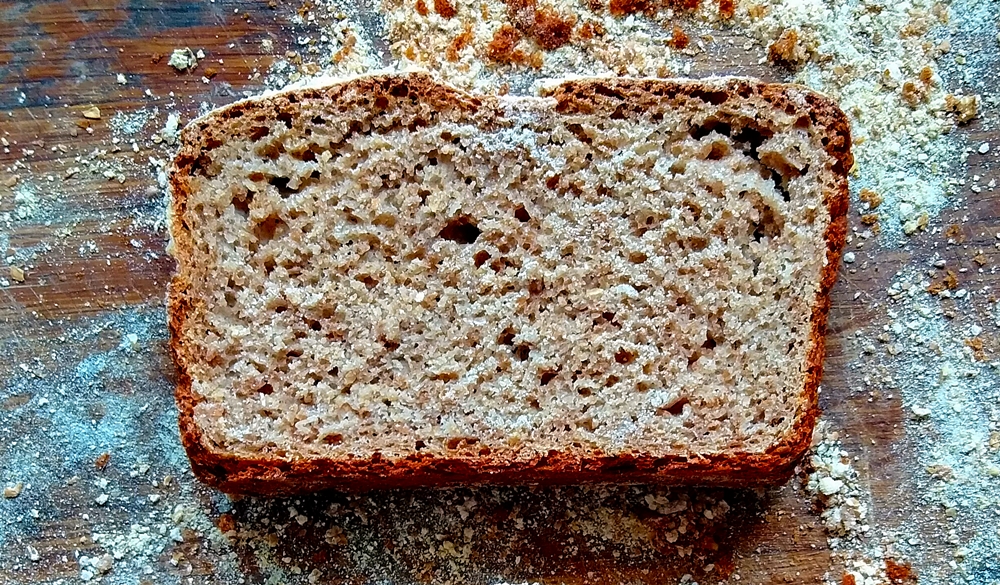
When cooked, this loaf will be a lot heavier than your regular white loaf – after all, it will have an additional half a kilo of onions in it – but provided you let it have sufficient rising times, the crumb will be open and moist (see top photo).

500g onions
60ml vegetable oil
salt and pepper
1 tbs  each dried “Scarborough Fair” herbs, i.e. parsley, sage, rosemary, thyme
1 tbs chicken bouillon powder (optional)
2 sachets fast action yeast
600g strong white bread flour
500ml warm water

  • Peel and chop the onions into 2cm squares.
  • Add the oil to a pan and set over medium-low heat (4 on a 1-9 scale).
  • Add the onions and toss in the oil to coat.
  • Sprinkle with 1tsp of salt to help draw out the moisture.
  • Cook gently until the onions are softened but not coloured, stirring occasionally  – about 15-20 minutes.
  • Season with pepper and sprinkle in the dried herbs and stir to mix in. Cook for another 2 minutes, then remove from the heat and set aside.
  • Mix the bouillon (if using), yeast and flour together.
  • In a large bowl – stand mixer or other – pour in the warm water and add the onion mixture.
  • Add the flour mixture and knead into a dough – around 10 minutes.
  • Cover the bowl with plastic and set in a warm place to rise for at least 1 hour, probably a little longer, until doubled in size.
  • Tip the risen dough out onto a floured work surface and form into a loaf shape.
  • Drop the dough into a large (1kg/2lb) greased loaf tin. Dust the top with flour and lightly cover with plastic. The dough will fill the tin to about 3/4 of its height.
  • Set the loaf aside to rise for at least 30 minutes.
  • Heat the oven to 220°C, 200°C Fan.
  • Arrange the oven shelves so that there is a solid shelf below the rack shelf.
  • Fill a cup with water.
  • When the loaf has risen (and nicely rounded above the edge of the tin), move it into the oven and onto the rack shelf.
  • Pour the cup of water onto the solid shelf and close the oven. The steam will help the formation of the crust.
  • Bake for 30 minutes.
  • Turn the loaf tin around and bake for another 20 minutes.
  • Remove the loaf from the tin and return it to the oven on the rack shelf and bake without the tin for 10 minutes to crisp the crust.
  • Remove the loaf from the oven and cool on a wire rack.
A hot toasted Stuffing Loaf sandwich with chicken and gravy

The Day After Sandwich

Whether it’s Thanksgiving, Christmas, Easter or just your regular Sunday roast, The Day After Sandwich made with Stuffing Loaf is a delicious treat. Obviously, you can make a sandwich any way you like, but I thought I’d offer a couple of suggestions with special reference to using your stuffing loaf.

  • Toast the bread: You’ll get the best stuffing flavour from the bread if its toasted, but here’s my recommendation – ONLY TOAST ONE SIDE OF EACH SLICE. This will give a nice crunch to the outsides and a good contrast with the softness of the filling. Toast both sides by all means, but I found that a bit too crunchy (tho’ that’s probably because I cut the slices thin – approx 1cm).
    Now my kitchen has a minuscule amount of counter space, so I don’t have room for a toaster. Consequently, when I want to make toast, I use the oven grill, so it’s easy for me to only toast one side (move rack to highest level, put in cold, turn on grill setting, 8 minutes). If you have a toaster with a nice wide opening, you can put two slices in together, and then only the outer sides will get toasted.
  • Preparing the inside of the bread/toast. Another of the great choices you can make is to have either a hot or cold filling. I recommend spreading the insides of your bread/toast slices with mayonnaise if planning a cold sandwich, and butter if going for a hot sandwich.
  • For a hot sandwich, warm some slices of chicken/turkey in  gravy and spoon generously into your sandwich.
  • For a cold sandwich, arrange slices of turkey/chicken/ham or a combination, and add a teaspoon of cranberry sauce.

Irish Halloween Treats

There are several Halloween traditions around these isles, but arguably the strongest traditions abide in Ireland.

Several years ago, I discovered online a trove of fascinating Irish social history at the National Folklore Collection. This project is the digitisation of thousands of essays written by Irish schoolchildren and teachers from over 5000 primary schools in the Irish Free State, between the years 1937-1939. These social history essays contain information gleaned from parents and grandparents, and give a fascinating insight into hearth and home stretching back to famine times in the nineteenth century. This amazing resource is searchable on an abundance subjects, but of course the food essays are going to be my main interest.

If you’d like a deep-dive into just how much information is available to explore, my paper “The Boxty Paradox: Everything, Everywhere, All At Once” can be downloaded from the Books and Writing page. One thing that became aparrent during the research of that paper was just how bleak the food choices of so many families were. Consequently, the celebratory foods might seem to us rather plain. However, they can also demonstrate an appreciation for, if not the finer things in life, then life’s simple pleasures.

“Hallowe’en was a great night among the Irish people long ago and they looked forward to it for many weeks. All the boys and girls would gather together in one house and they would have great feasting & merrymaking.”

Collected by Annie Fallon from Mr John Harley, Farmhill, Co. Mayo1

The Halloween/November’s Night/Oidhche Shamhna foods most mentioned are barn brack/bairín breac – a ‘speckled loaf’ originally of caraway seeds, but more recently dried fruit – boxty, apples and nuts.

“In this locality the popular food at Halloween are apples, nuts, and boxty, also dumplings of many kinds.”

Collected by Mrs A. Montgomery from Mrs Kelly, Corr, Co. Cavan2

According to many accounts, the Halloween barn brack was saved up for and bought from a bakery. These cakes were baked containing a ring, and whoever got the piece of cake with the ring was supposed to get married within a year.

“Halloweve night falls on the last night of October. On that day my mother goes to town and she buys apples, nuts and a barn-brack. “

Collected by Jerard Jordan from Mrs Gara, Tivannagh, Co. Roscommon.3

Alternately, during hard times, a soda cake would be baked at home either on the griddle or inside a bastible (lidded pot). The most coveted cake was baked with sour cream, but apples and hazelnuts could also be added.

“apples are put in cakes for November night.”

Collected by Tommy Kelleher from Mrs Margaret Kelleher, Mullaghroe South, Co. Cork4

The cream cake was a soda cake with plenty of cream in it and baked in the griddle.”

Collected by Beití Ní Dhomhnaill from Mrs Ashe, teacher, Dún Beag5

“On special occasions … a cream cake was made. Cream was mixed through the milk when mixing the dough. Currants, sugar and raisins were also put in the cream cake to make it rich and sweet.”

Collected by Seamus Daly, Kilclooney, Co. Waterford6

“On festive occasions a special cake was baked of such ingredients as flour, eggs, sour cream and a little sugar.”

Collected by Mary Jones from Mr M. Jones, Bruree, Co. Limerick7

“… cream cakes were made. These were made thin, but otherwise were made in the same way as ordinary soda cake.”

Collected by Michael Collins, Woodcock Hill, Co. Clare8

The recipes this week are two versions of soda cake mentioned in accounts in The Schools Collection: the cream cake and a fruit cake. According to the written accounts, the cream cake was considered the pinnacle of social delicacies, in numerous accounts warranting special mention. The fruit soda cake has more oblique mentions, but is absolutely symbolic of the foods enjoyed at Halloween. You can, of course, choose to add apples and nuts to the cream cake, if liked.

 Cream Cake

In the 19th century in Ireland, white flour was expensive, so if wheat flour was used at all, in most households it was wholemeal. I’ve opted for a less dense mixture of white and brown. Choose your own variation.

If you’d like to add apples and nuts to your cream cake, use the proportions in the recipe below, and reduce the sugar to 50g.

450g plain flour/wholemeal/brown/mixture
1tsp bicarbonate of soda
1 tsp salt
2 large eggs
85g sugar – caster, light/dark brown – your choice
300ml sour cream
100ml milk

  • Prepare your baking tin(s). You can, of course, bake your soda cake freeform, but a tin is also fine. My tin of preference is a 24cm shallow square tin, but you can also choose smaller tins or indeed choose to bake them in a pan on the ob over medium-low heat. If using a tin, line with baking parchment.
  • Heat the oven to 200°C, 180°C Fan. If using the hob, put a non-stick pan over medium-low heat (4 on a 1-9 scale) and allow to heat thoroughly.
  • Put the flour(s), soda, salt, sugar and eggs into a food processor and blitz briefly until well combined.
  • Tip the mixture into a large bowl.
  • Mix the milk and cream together until smooth, then add to the dry ingredients bit by bit. NB You might not need all of the milk mixture, as it will depend on the amount of moisture already in the flour and eggs. You want a soft dough, so a little extra is fine, but not enough moisture will lead to a dense loaf too stiff to rise.
  • When your dough is fully combined, tip out onto a floured surface.
    • For soda farls to cook on the hob, divide the dough into two, and lightly shape each half into rounds. Gently pat down until 4cm in height. Using a dough scraper or similar, cut each round into six or eight triangles.
    • For a large loaf, shape into a round and transfer to your prepared tin. Cut a deep cross in the top to assist in even cooking. If you have any of the cream mixture left, you can brush it over the top of your loaf as a glaze.
  • To cook your cream cake(s)
    • For a large loaf, bake for 45-50 minutes, turning the oven half-way through to ensure even baking.
    • For cream farls, bake gently in your pan for around 10 minutes each side, turning carefully when the first side is toasted and lightly browned.
  • Cool briefy on a wire rack and serve warm with plenty of good butter.

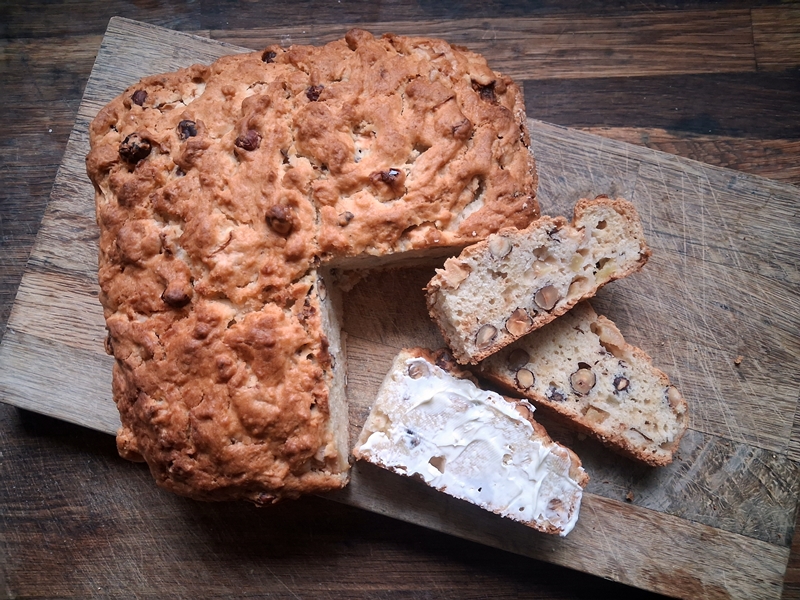
Apple and Hazelnut Soda Cake

Apples and nuts were central to the feasting at Halloween and this sweet soda cake is rich with both kinds of autumnal bounty. Enjoy warm from the oven or toasted, with a generous spreading of good butter. I’ve chosen to use Bramley cooking apples, as they break down into fluff when cooked.

100g whole unblanched hazelnuts
450g plain flour
1tsp bicarbonate of soda
1 tsp salt
50g sugar – caster, granulated, Demerera, light/dark brown – your choice
2 Bramley Apples – or 500-600g of similar cooking/sharp apples
200ml plain yogurt
200ml whole milk

  • Prepare your baking tin. My tin of preference is a 24cm shallow square tin. Line with baking parchment.
  • Heat the oven to 200°C, 180°C Fan.
  • Put the hazelnuts onto a baking tin and bake for 10 minutes until lightly browned and toasty. You can remove the skins by rubbing the nuts in a clean cloth, but I prefer to leave them as is.
  • Put the flour, salt, sugar and soda into a bowl and whisk together.
  • Peel and core your apples, and chop into 2cm pieces. Add the chopped apple and nuts to your dry ingredients and mix.
  • Whisk together the yogurt and milk, then gradually add to the rest of the ingredients. I find it best to stir the liquid through with a round-ended knife, which is less rough than a larger utensil. You might not need all of the liquid as the apples will contribute to the moisture of the mix.
  • Tip out your dough and shape lightly into a round. Transfer the dough to your baking tin, and cut a deep cross in the top to facilitate even baking.
  • Bake for 50-60 minutes until risen and browned, turning the tin around after 30 minutes.
  • Cool briefly on a wire rack and enjoy warm or toasted with lots of good butter.

1 The Schools’ Collection, Volume 0096, Page 84
2The Schools’ Collection, Volume 0982, Page 233
3 The Schools’ Collection, Volume 0234, Page 307
4 The Schools’ Collection, Volume 0359, Page 144.
5 The Schools’ Collection, Volume 0626, Page 350.
6 The Schools’ Collection, Volume 0654, Page 447.
7The Schools’ Collection, Volume 0498, Page 131
8 The Schools’ Collection, Volume 0598, Page 249

Griddle Scones

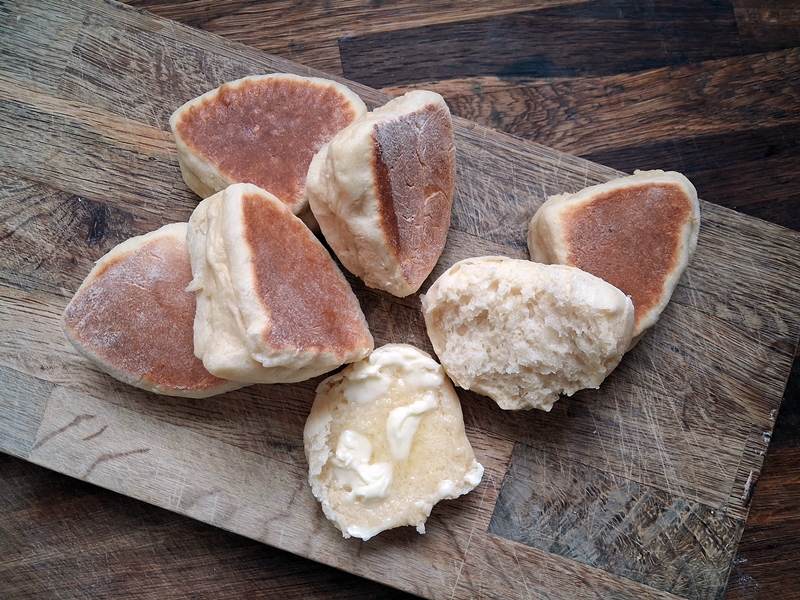
Following on from the Slapan last time, I have another bakestone recipe for you – Griddle Scones!

I love a scone. I willfully and shamelessly pronounce it ‘skon’ too – even though I know the etymology dictates that it should rightfully be pronounced ‘sk-ohhh-n’, because that brings images to mind of little finger outstretched and pretensions of grandeur, so I just prefer the short, humble sound of ‘skon’. Fight me.

Traditional scones are absolutely the easiest and best thing to whip up when presented with an Entertaining Emergency™. You can be serving up a batch of fragrant and hot scones in about 30 minutes – and that includes 15 minutes of baking!

Griddle scones are not that kind of scone – the time required is closer to 3.5 hours, start to finish. “Why would I bother waiting around for all that time when I can have some oven scones in just 30 minutes?” I hear you ask. I’m afraid I have no quick response, but for the fact that if you were to make these, you would then have your answer.

So do you like eating soft, billowy clouds? Because making griddle scones is how you get to eat sweet, billowy, buttery clouds. The yeast dough is enriched with double-strength milk, butter, eggs and sugar, and therefore it requires much longer to prove – 2 hours in the first instance. So while it’s a relatively long time, it’s not a hands-on commitment. The second rise can be up to an hour, but I recommend starting cooking half the dough after about 40 minutes – mainly because if, like me, you don’t actually possess a griddle, but do possess a rather nice non-stick pan, you can cook the first half of the dough easily, with plenty of room for manoeuvering the scones when turning them over. I have tried cooking the whole dough all at once, and it was very tricksy – plus the scones expand upwards quite considerably during baking, which was also not helpful in a confined pan space.

If you’re a fan of muffins then, aside from the extended rising time, this method is pretty much the same, but with one subtle difference. The enrichments of butter, sugar and egg mean that the cooked dough remains incredibly soft. Even when browned, the outsides of these scones never approaches anything remotely close to crusty. The sides of the scones are particularly delicate, and as supple as skin. In enjoying them, we must be mindful of Hannah Glasse’s advice when referring to muffins, in that they must be split/pulled apart, for to use a knife on them when hot, is to squish down the cloud of dough to something claggy and leaden. The best approach I have found is to use a serrated knife to just break the skin of the scone on the sides, then use the tines of two forks to pull the scones apart. You don’t have to use forks, of course, you can just pull them apart – but I must be lacking a bit of skill there, because I always seem to end up with one pillowy side and one thin and somewhat meagre side, and thus reduce the overall eating experience by half.

Griddle scones go back to the 19th century, but this recipe is scaled down and adapted from an absolute classic of griddle/bakestone cookery, “Morning and Hot Plate Goods” by John Boyd (undated, but thought to be 1946-ish) – a veritable cornucopia of commercial recipes from the offices of The British Baker. He calls them fermented scones, but I’ve opted for the more easily understood Griddle Scones.

Griddle Scones

This recipe has the unusual ingredient of ‘double strength’ milk, which is water mixed with twice the usual quantity of milk powder. I use whole milk powder, because that’s what I have in the cupboard, but skimmed milk powder, which might be easier to find, would be fine as well.

145ml water
30g whole milk powder
scant ½ tsp salt
45g unsalted butter
45g caster sugar
1 large egg – beaten
260g plain flour
1 sachet fast action yeast

  • Put the water, milk powder, salt, butter and sugar in a small saucepan and stir over low heat until the butter melts and the sugar is dissolved. Cool to blood temperature, whisk in the egg, then pour into a bowl. Add the remaining ingredients to the bowl and stir until combined. The dough will be very soft and moist.
  • Cover the bowl with plastic, or a cloth, and set aside to rise for 2 hours.
  • Gently tip out the dough onto a floured surface and divide it into two (roughly 270g each). Shape each half into a circle, and pat down gently until it is 2-3cm thick.
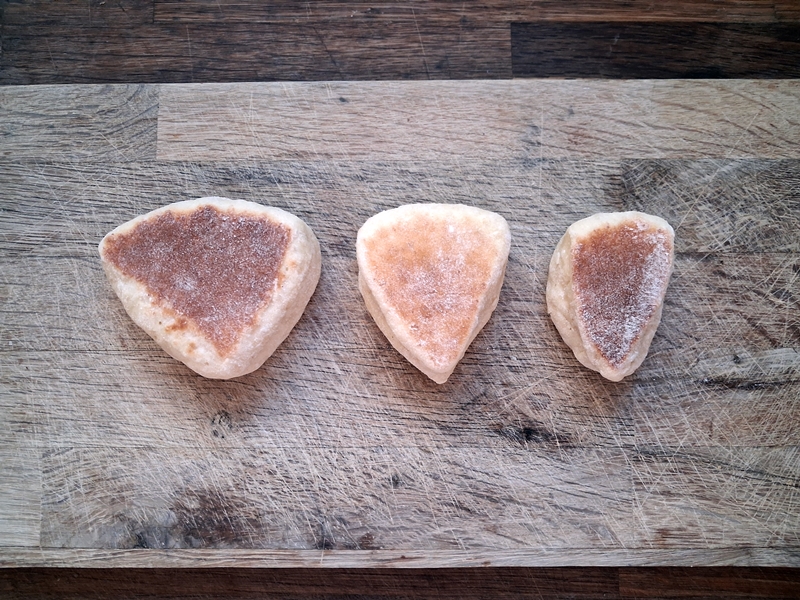
  • Using a dough scraper or similar, cut each round into triangular farls. These can be as few as four or as many as eight.
    The sizes of scone you get whether cutting your round into (L->R) four, six or eight.

    I think six farls is probably the happy medium, unless you’re serving teeny scones for afternoon tea, in which case go with the eight.

  • Slide the farls apart from one another, so that they have room to rise, and cover lightly with a cloth.
  • Leave to rise for 30-40 minutes.
  • Put a non-stick pan on medium-low heat (4 on my hob) and allow it to heat through. This will take about 5 minutes. You want the pan to be evenly hot throughout, otherwise your scones will cook unevenly. No need to grease the pan.
  • Cook your first batch of scones. NB: As you move each scone into the pan TURN IT OVER and cook the top first. By cooking the rounded, risen ‘top’ first, and the already-flat bottom second, your scones will have a much neater shape. Not turning them over will make your finished scones rather misshapen. Still delicious, but not at their best to look at. Spread them out, avoiding the centre of the pan as it will be the hottest. Cook for 4-5 minutes until browned on the bottom, then carefully turn them over and cook until both sides are evenly coloured. Don’t worry if you turned them too early, you can flip them again once the second side is done.They will continue to rise with the heat of the pan, and will become almost wobbly, so try and turn them over in one fluid motion and then don’t touch them until they have cooked for a further four minutes. To check for done-ness, lightly rest a finger on the top of a scone and try to move it gently from side to side: if there’s no longer any wobble, the scone is cooked.  
  • Cool on a wire rack.
  • To serve: If not eating immediately, when time to serve, warm the scones in the oven. Use a serrated knife to break the ‘skin’ on the sides of each scone, then pull apart either by hand or by using the tines of two forks. Butter generously and enjoy.

Fried Bread and Marmalade

In the old days, when religious observance was a greater part of daily lives, as Lent approached, efforts were made to use up larder items in preparation for the coming period of abstemiousness. Bacon and eggs were eaten on Collop Monday, Pancakes (using the resulting bacon grease) were enjoyed on Shrove Tuesday, and Lent itself began on Ash Wednesday.

In the past few weeks I have been looking through various manuscript sources in order to find a shiny, new old pancake recipe for you to try, but, alas, my efforts have been thwarted at every turn due to the adorable (!) British quirk of different regions giving a specific dish their own local name.

I scrolled through the thousands of recipes in my spreadsheets and compiled the following list to look at in more detail:

  • Court pancakes
  • Million pancakes
  • Pancake pudding
  • Pancake wafers
  • Paper pancakes
  • Temple pancakes
  • Creeping pancakes

In Every. Single. Case. they turned out to be variations of the recipe most popularly known as A Quire of Pancakes: lots of small, thin, rich, cream-based pancakes stacked in a pile, with sugar strewn between each layer, and served like a cake slice (see image below).

Quire of Pancakes, 1714

So I’ve decided to go in a completely different direction and bringing you a recipe for Collop Monday, or alternately Shrove Tuesday breakfast, and in doing so, recording for posterity a dish I know my mother ate in her childhood: Fried bread and Marmalade.

When I first heard of this as a child myself, I thought it sounded awful, but as an adult, I have come to appreciate the delicious interplay of salty, sweet, bitter and smoke.

Slices of bread were added to the pan after bacon was fried and mopped up the remaining fat and in the process become toasted from the heat of the pan. They were fishes out and spread with marmalade and handed to my mother and her siblings.

Many modern packs of bacon, especially at the lower prices, are injected with water to artificially plump up the weight. When fried, it splutters and spits and seeps a milky liquid that is visually very unappealing. Back in the day – we ‘re talking 1930s here – the bacon would have been purchased from the butcher by the slice, possibly even home-cured by the butcher himself, and the dry-brining method employed drew out moisture from, rather than injecting it into, the slabs of belly pork used for bacon. In the pan the fat would render down into a clear liquid, filled with the smoky, salty flavour of the bacon. When cold, the fat would solidify and could be kept for use, but if this were impractical (it not yet being the age of ubiquitous refrigeration in the home) to use it up at once, it was easy to mop up the fat with slices of bread, which then became imbued with this flavour bomb as an alternative to the (more expensive) butter. It is easy to overdo the bacon fat, and it doesn’t take much for the bread to become overly greasy, so marmalade was a perfect foil to combat this: the bitterness of the Seville oranges and the sweetness of the jelly providing delicious contrasts to the hot, crunchy, salty, smoky bacon fat.

Back then, this snack was born from frugal-by-necessity living. My mother grew up in a one-income household. Nothing was left to waste. But that’s not a reason not to enjoy it today. And additionally, the level at which you enjoy it is completely adaptable – from simple to complex, the components are almost infinitely customisable according to what you have in the cupboard/fridge.

  • The Bread: Whatever you have to hand, or prefer: brown, white, pre-sliced, hand-sliced, doorstep, gluten-free, rye, sourdough… you get the idea.
  • The Bacon Fat: Kinda non-negotiable. I learned recently that Bacon grease is available to buy by the tub in the USA, and in checking online for this post I am slightly horrified to find a 9lb bucket now available to buy in the UK. If you’re a fan, then go for it, but my approach here is to be much smaller in scale – get your bacon fat from cooking bacon. Dry-cure bacon will render pure bacon fat without any white residue.
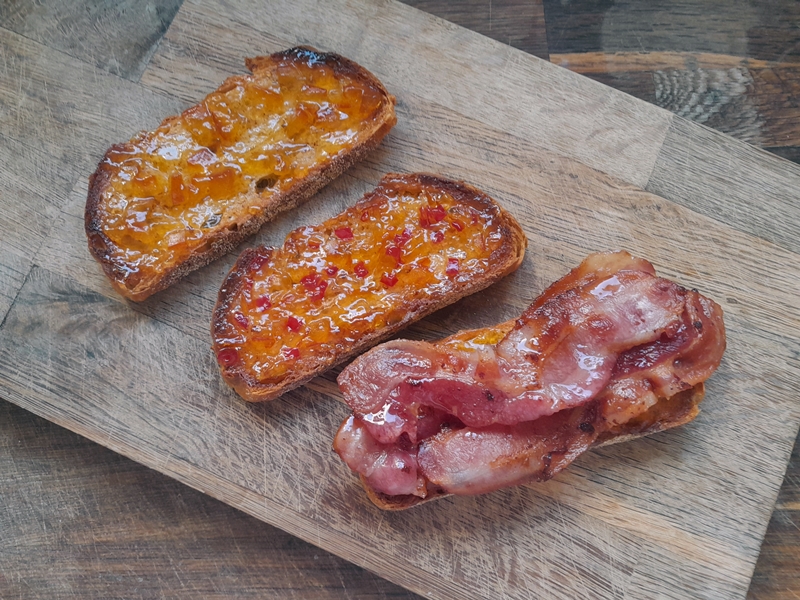
  • The Marmalade: Regular listeners will be aware of my keenness at the moment to find ways to use the various marmalades I have on hand after entering The Marmalade Awards this year. I have an embarrassment of riches on that score, but any marmalade will suffice. Use whatever you have and like. In the photographs I’ve gone with the Chilli Marmalade I made this year – classic Seville marmalade with fresh red chillies – it looks so pretty with the red flecks of chilli pepper, and the spiciness pairs well with the bacon.
  • The Bacon: Optional. If you want a more substantial snack, tuck in a few slices of your favourite. Smoke, unsmoked, back bacon, streaky bacon, gammon, ham… it’s all delicious.

Fried Bread and Marmalade

Slices of bread
Bacon fat (from dry-cure bacon/gammon)
Marmalade of choice
Bacon (optional)

  • I’m going to stray a little from the traditional preparation method. As mentioned above, the traditional method is to turn the slices of bread over in the fat in the pan, until they have both absorbed the fat and become toasted. Which is fine. Except it’s difficult to get an even colour on the bread – at least so I find. Also, I dislike having greasy fingers from the bread being fried on both sides, so I’m going to suggest the following:
    • Toast the bread in a toaster/under a grill, then spread the solidified bacon fat onto the hot toast with a knife, like butter. This way the toasting of the bread is even, it stays dry on the outside for cleaner eating, and you can easily control the amount of bacon fat used. If your bacon fat is still hot in the pan, use a pastry brush to dip in and then brush over the surface of your toast.
  • Spread your choice of marmalade onto the non-dry sides of the toast.
  • Add your bacon – or not – and enjoy.

Carrot Bread

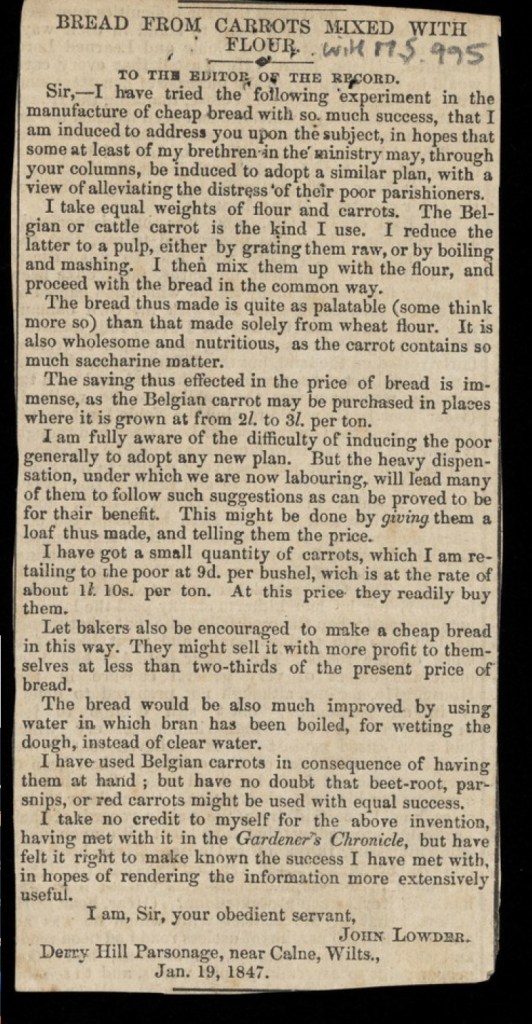
Personal recipe books can be quite eclectic in the mix of recipes the owner chooses to include. Quite apart from the recipes they (or if you’re a wealthy noblewoman, your scribe) include, there can also be hurried notes scribbled down on scraps of paper or the backs of envelopes, letters and cards answering requests for recipes, as well as clippings from newspapers and magazines.

This recipe was found between the pages of Catherine Ashley’s household book, dated circa 1830 (MS.995, held by The Wellcome Collection). It had been clipped from The Record, a twice-weekly religious newspaper, in January, 1847. The author, The Rev. John Lowder, had experimented with using carrots to make bread after reading an article in The Gardeners’ Chronicle in December 1846. He wrote to the editor of The Record in the hope that by sharing his findings, his clergy brethren might find the results useful for their own poor and needy.

The article in The Gardeners’ Chronicle had detailed an open correspondence between The Right Hon. T.F.Kennedy, Paymaster General for the Irish Civil Service and Henry Labouchere, the then Secretary of State for Ireland in the government of Lord John Russell (1846-1852). In it, Kennedy suggested that experiments done in Austria on the supplementing of flour with beetroot to make bread might help with the (then early stages) of the potato disaster in Ireland. Growing beetroot on just one acre, he maintained, would produce a crop of £30 value, with a clear profit of £15 to the grower, and provide valuable supplementary nutrition  to the Irish poor, being of a much higher value than potatoes. Although noble, this idea falls at the first hurdle because the poor in Ireland were eating potatoes precisely because they did not have access to the flour needed for this scheme to work.

Parsnips were also used in experiments and were deemed excellent, but carrots were not, with the reason being given as carrots were “much less palatable.”

Enter the Rev. Lowder with his own efforts, whereby he succeeded in producing delicious carrot bread by cooking and pureeing the carrots first, whereas the original experiments had been done by grating the raw vegetables.

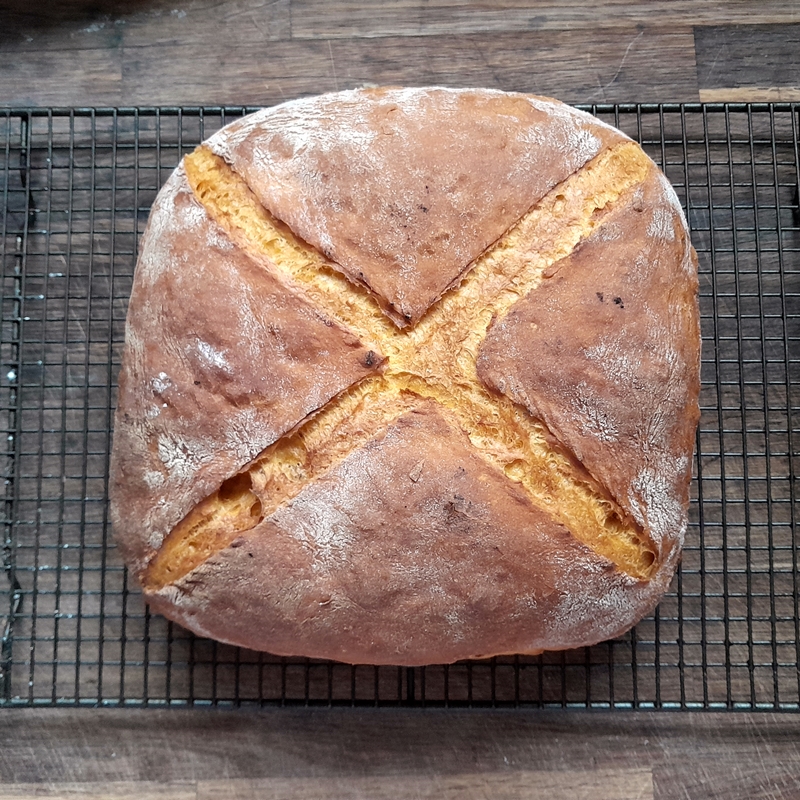
The recipe is simple: equal weights of (pureed, cooked) carrot and flour mixed together, and then continued with the usual bread-making method. I thought this almost too good to be true and put it to the test by adding only salt and yeast. The result is the loaf picture above. I added no water, bar the 2-3 tablespoons of carrot water needed to get the carrots pureed. In all honesty, it looked too moist in the initial mixing, but I had faith and decided to wait and see what the first rise made of it. The resulting dough after an hour was gloriously light and very lithe and needed only the briefest of shaping before putting it into a 20cm/8″ square tin. Another rise of 30 minutes was followed with a 40 minute bake. The loaf was cooled on a rack overnight before being sliced.

I appreciate that the use of white bread flour is probably of a finer quality than that employed by the good Reverend Lowder in his experimentation, but I made that call in order to give the recipe its best chance of success.

Shortly after this recipe was published (1848) Reverend Lowder moved half a world away, with his wife and five children, to China, after being appointed Chaplain of Shanghai. Heartrendingly, he would perish in a swimming tragedy shortly thereafter (September, 1849) at the age of just thirty-nine.

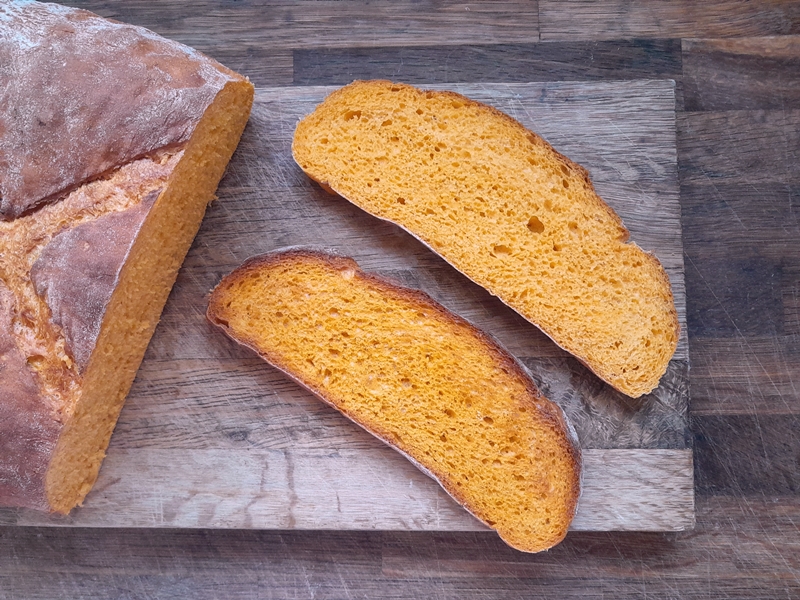
Carrot Bread sliced – plain (top) and toasted (bottom)

As can be seen in the photo above, the colour of the crumb is glorious. Given the vibrancy, it’s surprising that there isn’t more carrot flavour. The texture is soft, with a slight chew, similar to potato bread. When toasted, the colour changes very little – the darkening of the crust around the edges being the main indicator. There is a suspicion of roasted carrot in the flavour, and if you’re eating it with anything other than butter, you might miss it altogether. Overall, I’m really liking this new (to me) recipe – it will definitely be making a regular appearance in this household.

Carrot Bread

Since proportions of flour and carrot are the only specifications, although I’ve not tried it yet, I see no reason why carrots left over from a previous meal might not be successfully used in this recipe, adding plain water if necessary for a smooth puree. If the total of puree + flour is less than 700g, then only one sachet of yeast would be needed, and half the salt. Some accent spices could also be added, such as caraway or cumin seeds.

500g carrots, peeled and sliced
500g strong white flour
10g salt
2 sachets fast action yeast

  • Put the carrots into a saucepan, cover with water and bring to a simmer.
  • Cook until tender all the way through – between 20-30 minutes, depending on the size of the carrot pieces.
  • When cooked, strain (reserving the liquid) and puree in a liquidiser or using a stick blender. Add a little of the cooking water if the carrots aren’t blending easily.
  • When pureed and smooth, set aside for 10 minutes to cool slightly, in order to not adversely affect the yeast.
  • When just warm, put the carrots and the rest of the ingredients into a bowl and bring together as a dough. Knead either by hand or using a dough hook for 10 minutes.
  • Cover and allow to rise for 1 hour.
  • Tip out the risen dough onto a lightly floured surface and gently deflate.
  • Shape and add to your tin of choice. I used a 20cm/8 inch square tin lined with baking parchment. If you use a different shaped tin, you might have to adjust the cooking time accordingly.
  • Allow to rise for a further 30 minutes.
  • Heat the oven to 220°C/200°C Fan.
  • Just before putting your loaf in the oven, cut some slashes in the top crust to prevent it rising  unevenly during the initial ‘oven spring’. Bake for 35-40 minutes until well risen and with the crust firm. You might want to remove your loaf from the tin and return it to the oven to bake for another 5-10 minutes in order to really crisp up the crust.
  • Cool on a wire rack.
  • Slice when cold.

Cream Toasts

This is going to be the newest recipe on here, because I just made it up!

Well, not to claim all the credit – it is a Lego™ recipe in that I’ve cherry-picked a bit from here and a bit from there and brought it together into something absolutely delicious. As a bonus, it can be made with just a few storecupboard ingredients.

It struck me recently that there are no 21st century recipes here – indeed, there wasn’t even a 21st century category until I added one just now. I don’t want this blog to become a museum to British food, rather for it to be an ongoing celebration of British food that ranges across centuries, including this one.

This recipe pays homage to recipes that date back to Days of Yore (a very technical term in food history circles, which means quite a number of years ago!). Poor Knights of Windsor, Fried Cream, Fried Toasts and Pain Perdu are all similar dishes and all have long pedigrees in British food. Eggs, bread, sugar and cream, together with some spices and flavourings, sometimes even a splash of alcohol, have been tweaked and teased into subtly different, but equally enjoyable, dishes for centuries.

This recipe is also similar to several dishes ‘out there’ because, as we know, there’s nothing new under the sun. I’ve done some fairly rigorous searching and there isn’t anything out there exactly like this, but if I have missed something, be sure to let me know.

It was inspired by a dish I saw recently on television, specifically a caramelised French Toast, served in a restaurant in the Basque region in Spain: the smooth shiny, crisp outside a stark contrast with the soft, creamy insides. The local name for these fried milk toasts is Torrijas. Rather that slices, I decided to make toast fingers and roll them in panko breadcrumbs for contrasting crunch, because everything tastes better with crunch!

You can make simplified versions of this, according to your cupboard contents, but I’m just going to run through the method I used and the reasons behind it, so you can make your own decisions.

The Bread: Unsliced white bread. For a start, in these modern, health-conscious times, white bread is so NORTY, which makes it taste doubly delicious when used for a treat such as this. You can make your own, which has its advantages in that it holds up better during the soaking in the milk. However, a BOUGHTEN white loaf from the bakery retains its feather lightness incredibly, if you’re willing to be patient in the handling/preparation. It helps if you stale the bread a little before the soaking, as that will help keep it from falling apart. More on this below.

The Milk: A mixture of condensed milk and fresh milk gives both sweetness and richness. Also, keeping a tin on hand in the cupboard makes these an anytime snack. You could also mix your own combination of sugars and fresh cream/milk. Just ensure your mixture is fluid enough to soak into the bread.

The Flavourings. Whatever takes your fancy, really. I infused the milk with some citrus zest and then added a generous splash of vanilla and orange-flower water. It makes for a very creamy aroma, if that makes any sense.

The Coating: Breadcrumbs, Japanese Panko-style for preference. It forms a crisp, golden shell around the soft pillowy bread and looks very appetising when cooked and golden brown. My local supermarket (the orange one) has recently started selling large bags of panko breadcrumbs in the Japanese Foods section of the International Foods aisle. Great value for money and perfect for this recipe. Also, I prefer to use eggwhites for coating, as I believe it helps give crispness.

The Frying: Again, whatever takes your fancy. I used Indian ghee (clarified butter), as I didn’t want the milk solids from regular butter to catch in the pan and spoil the breadcrumb coating with dark flecks. You could also use oil, or even deep-fry them if you have a fryer. Alas, mine is currently filled with beef dripping, which is flavoursome for savoury dishes, but not so suitable for this sweet treat.

Cream Toasts

These quantities will make several servings, so if you’re not going to use it up all at once, keep the extra milk in the fridge for later use.

white loaf of bread

280ml milk – whole, skimmed, whatever you have
zest of 1 lemon
1tsp orange flower water (optional)
1tsp vanilla flavouring (optional)
1 tin sweetened condensed milk (397ml)

eggwhites for coating
panko breadcrumbs for coating
ghee, butter or oil for frying

sharp, seedless jam (raspberry/redcurrant/cranberry) or coulis to serve

  • Remove the crusts from the loaf and set aside for crust sandwiches.
  • Cut the bread ino 3cm slices, then cut each slice into 3 x 3cm fingers. Arrange the bread fingers on a wire cooling rack to stale for about an hour. This can be done beforehand.
  • Put the milk into a small pan and add the lemon zest.
  • Bring to a gentle boil and turn off the heat.
  • Cover and allow to infuse for 30 minutes.
  • Strain out the lemon zest (if you prefer, I didn’t) and mix in the condensed milk and other flavourings until well combined. Set aside.
  • Pour a little of the milk mixture into a plastic box.
  • Arrange the slightly stale bread fingers in the box, then pour over the rest of the milk mixture. Leave to soak for 5 minutes.
  • Carefully turn the bread fingers over and allow to soak for another 5 minutes.
  • Drain off the excess milk and put the plastic box into the fridge – uncovered – for an hour or two. This will allow the outside of the bread fingers to dry a little. If you’re wanting to make these for breakfast you can do everything up to this point the night before, and then continue in the morning. If leaving overnight, cover the box lightly in cling film so that it doesn’t dry out too much.
  • When ready to cook, pour some eggwhite into a plastic box and the panko breadcrumbs onto a shallow tray.
  • Whisk the eggwhites briefly until frothy.
  • Carefully take each soaked bread finger and coat with eggwhite. Since they will be rather delicate, I usually drop them into the eggwhite one by one and then shake the box from side to side and get the eggwhite to wash over them that way.
  • Lift out and let the excess eggwhite drain off, then lay them in the panko breadcrumbs.
  • Pat the panko onto the bread fingers until thoroughly coated.
  • Set aside onto a plate until ready to be cooked.
  • Heat the fat you are using in a small pan on medium heat. I use 6 on a scale of 1-9. If you use a small pan and can make your fat/oil 2cm deep, you’ll only need to turn your cream toasts once. If it’s shallower, you may need to fry each side individually.
  • Fry 3 or 4 fingers in the pan at a time. Cook until the panko coating is crisp and golden.
  • While they are cooking, set out a wire cooling rack, with a sheet of kitchen roll underneath it.
  • When cooked, transfer the now golden brown toasts to the wire rack and allow to drain.
  • Serve warm with a pot of jam/coulis for dipping.

Bonus recipe – Crispy Eggy Bread

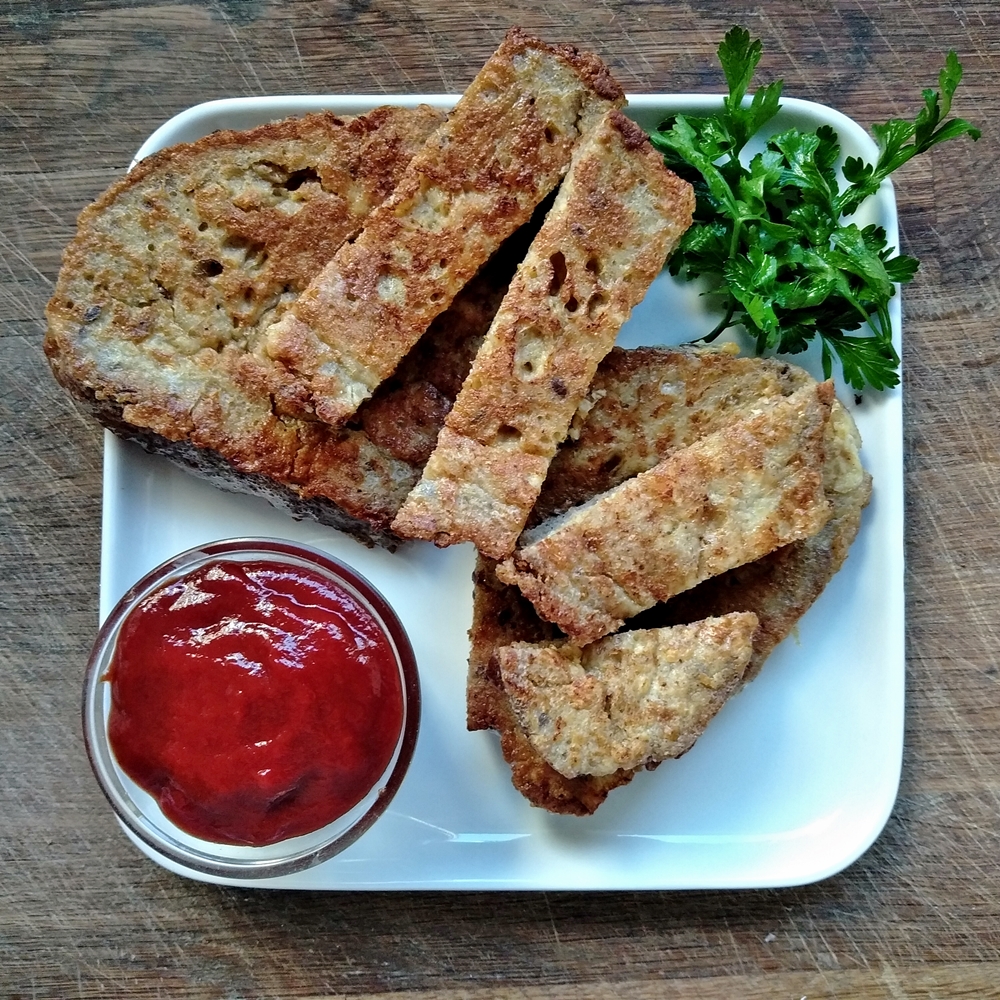
Four fingers of Crunchy Eggy Bread with tomato ketchup for dipping

This same method can be used to jazz-up a personal favourite of mine – Eggy Bread. This is a savoury version of egg-soaked bread, and one which I enjoyed for breakfast as a child and still do to this day.

This recipe is more easily scaled than the one above, as it can be made in a per-person quantity.

The home-made loaf I made suited this recipe better than store bought.

Crispy Eggy Bread for One

1 x 3cm thick slice of white bread
1 large egg
salt and pepper to taste

eggwhites for coating
panko breadcrumbs for coating
ghee, butter or oil for frying

tomato ketchup to serve

  • Remove the crusts from the loaf and cut into 3 x 3cm fingers. Arrange the bread fingers on a wire cooling rack to stale for about an hour. This can be done beforehand.
  • Whisk the egg vigorously, then pass through a sieve to make sure the white and the yolk are fully mixed.
  • Season egg with salt and pepper to taste.
  • Pour a little of the egg mixture into a plastic box.
  • Arrange the slightly stale bread fingers in the box, then pour over the rest of the egg mixture. Leave to soak for 5 minutes.
  • Carefully turn the bread fingers over and allow to soak for another 5 minutes.
  • Put the plastic box into the fridge – uncovered – for an hour or two.. This will allow the outside of the bread fingers to dry a little. If you’re wanting to make these for breakfast you can do everything up to this point the night before, and then continue in the morning. If leaving overnight, cover the box lightly in cling film so that it doesn’t dry out too much.
  • When ready to cook, pour some eggwhite into a plastic box and the panko breadcrumbs onto a shallow tray.
  • Whisk the eggwhites briefly until frothy.
  • Carefully take each soaked bread finger and coat with eggwhite. Since they will be rather delicate, I usually drop them into the eggwhite one by one and then shake the box from side to side and get the eggwhite to wash over them that way.
  • Lift out and let the excess eggwhite drain off, then lay them in the panko breadcrumbs.
  • Set aside onto a plate until ready to be cooked.
  • Heat the fat you are using in a small pan on medium heat. I use 6 on a scale of 1-9. If you use a small pan and can make your fat/oil 2cm deep, you’ll only need to turn your eggy bread fingers once. If it’s shallower, you may need to fry each side individually.
  • Fry the fingers in the pan until the panko coating is crisp and golden.
  • While they are cooking, set out a wire cooling rack, with a sheet of kitchen roll underneath it.
  • When cooked, transfer the now golden brown toasts to the wire rack and allow to drain.
  • Serve warm with a pot of tomato ketchup for dipping.

Soda Bread

I was surprised to read recently that Soda Bread is considered to have migrated from the US, based on a notion that the early settlers used potash to improve their baking. Amelia Simmons (1796) uses potash in some of her gingerbread recipes and Mary Randolph includes a recipe for Soda Cake in her 1824 book The Virginia Housewife.

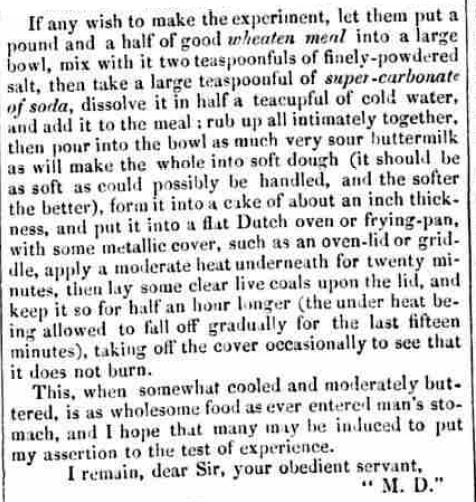
These notwithstanding, the earliest Soda Bread recipe that I have been able to find in print is a letter published in the Newry Telegraph, dated September 2nd 1836. The correspondant, who signs him/herself “M.D.” gives the following recipe:

Soda Bread recipe

Having tried a fair few soda bread recipes over the years, I was struck by how minimalistic this recipe is – literally four ingredients: flour, salt, baking soda, buttermilk. Over the years, modern recipes have managed to sneak in  a myriad of embellishments – white flour, sugar, honey, egg, butter, cream of tartar…. but this, this appears to be soda bread in its earliest and purest form. I had to try it. And I was not disappointed.

I followed MD’s recipe as written as closely as possible, and the first batch was fine, but not, in my opinion, the best it could be. The mixing of the soda in water was, for the time, an acceptable way to remove lumps, but it meant for an uneven distribution of soda throughout the flour, which resulted in blotches of yellow crumb amongst the wholemeal. Sieving the soda into the flour with the salt was a much better approach. In addition, buttermilk is not as freely available nowadays as it once was, so my solution was to mix equal quantities of whole milk and low-fat, plain yogurt. Lastly, as the recipe stated that the buttermilk should be very sour (which is what reacts with the soda to give the rise), I stirred in two teaspoons of vinegar.

Halving the batch made two mini loaves of dimensions 14cm x 8cm, which took, rather surprisingly, almost an hour to bake. If you wish to make the full batch, or bake in larger tins, you will need to increase the baking time accordingly.

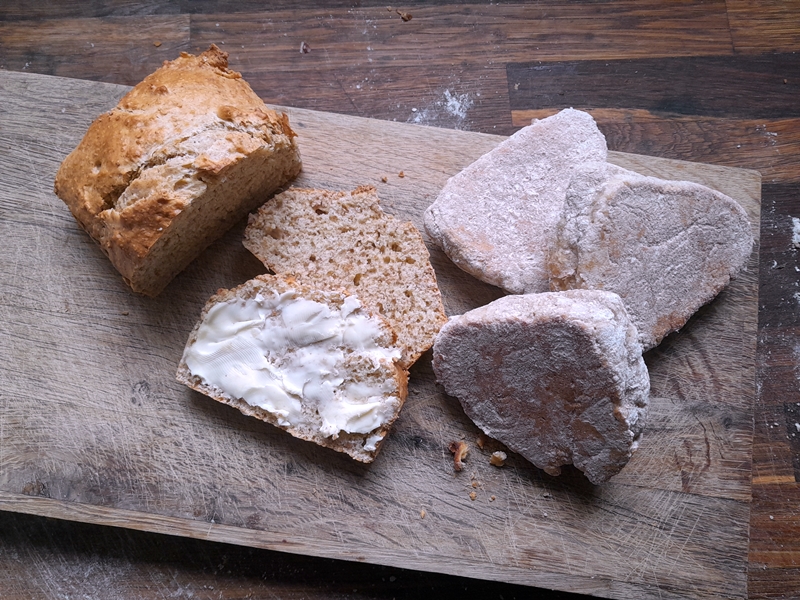
The result is delicious. The crust bakes to a browned, knobbly crispness and the crumb inside is close-textured, but not claggy. Just warm from the oven and lightly spread with, as MD suggests, some fresh, salted butter, it is delicious with no further adornment. If, like me, you have occasionally read accounts of 19th century afternoon teas where guests are served ‘brown bread and butter’ and been rather puzzled at the plainness of the fare, having tasted this bread with butter, it all makes sense now.

If you’re a fan of modern soda bread recipes, this might not be to your tastes, but I would urge you to try it just once to enjoy the simple pleasure of this diamond in the rough, craggy crust.

Soda Bread

These litte loaves will almost double their size during baking, but only if you get them into the oven promptly. The soda will start reacting as soon as the liquids are added, so be sure the oven is at temperature before mixing wet and dry together.

340g stoneground wholemeal flour
1 level teaspoon of salt
1 level teaspoon of bicarbonate of soda
150ml whole milk
150ml low-fat, plain yogurt
2tsp white wine vinegar

a little milk (maybe)

  • Preheat the oven to 200°C, 180°C Fan.
  • Grease and line two mini loaf tins (14cm x 8cm) with baking parchment. Grease the parchment.
  • Sieve the flour, salt and soda together twice (to spread the soda evenly).
  • Mix the milk, yogurt and vinegar until smooth.
  • When the oven is hot, add the liquids to the flour mixture and mix into a soft dough. You may need a little extra milk.
  • Put half of the dough into each prepared loaf tin and smooth over.
  • Using a sharp knife, cut a deep slit down the centre of each loaf.
  • Place in the oven and bake for 30 minutes.
  • Turn the tins around and bake for another 15 minutes.
  • Remove the loaves from the tins and place them back in the oven on a rack to crisp up the crust – a final 5-10 minutes.
  • Set to cool on a wire rack.
  • Enjoy just warm on the day of baking, or toast the following day for breakfast.

Eggs and Bread

It’s very easy to make a meal out of just eggs and bread, as has been demonstrated over centuries. I grew up enjoying the culinary delight known in our house as Eggy Bread – bread soaked in egg and then fried in a little butter until the eggs were cooked and the slices a dappled yellow and brown. A delicious, savoury breakfast, brunch or supper.

So imagine my horror when I went out into the wide world and learned that some people sprinkle ICING SUGAR or – heaven forfend – POUR SYRUP on their eggy bread and call it French Toast or Lost Bread (pain perdu). It’s something I still can’t get my head around: imagine if I suggested you drizzled syrup over quiche. Yes, THAT level of horror. To me, Eggy Bread is, and will always be, a savoury dish.

Which leads me to this week’s recipes, neither of which are particularly old, but which are firm favourites in this house. Although I love discovering and resurrecting old recipes, I don’t live on them, and it struck me recently that it is as important to record here the ordinary, everyday recipes meals on my table, as it is to bring back the glorious fare of ages past. So here we are.

If the notion of a savoury egg and bread combo is new to you, let me lead you through, in the first instance, Eggy Bread.

Eggy Bread

Eggy Bread

As with many classic recipes, Eggy Bread is deceptively simple. It looks pretty straightforward, with just three ingredients – five if you count salt and pepper separately – but looks can be deceiving. Indulge me as I share my decades of experience in considering each element.

  • Eggs – size doesn’t matter. What matters is having enough egg to soak the bread thoroughly. A slice of Eggy Bread with too little egg is tragic. So always err on the side of caution and if in doubt, whisk in an extra egg, just to be on the safe side. A good benchmark is a 1:1 ratio of egg and bread slices. Of course, if your slices are doorsteps and your eggs quail, then some adjustments are going to be needed.
  • Bread – you can really go as wild here as you like, but with one proviso – no ready-sliced bread. Having made such a sweeping directive, I’m immediately going to contradict it – you CAN have ready-sliced bread, as long as it is done by the bakery department wherever you shop. Nice crusty cob or farmhouse or split tin – just take them to the bakery counter and ask them to slice it for you. THAT kind of sliced is fine. It’s the plastic-wrapped, ready-sliced, soft and squishy bread that is a disaster when it comes to Eggy Bread. The crumb is not open and the surface is impervious to egg: the slices slide around on top of the beaten egg and persistently fail to absorb it. Bread with airy holes in is perfect for filling with egg, so why not try a sourdough or similar?
  • Butter – for cooking the eggy bread. I recommend unsalted butter, as it makes balancing the seasoning easier.
  • Salt and Pepper. A must. Use table salt in the egg mixture, where it dissolves easily, and save your sea salt flakes for sprinkling over the finished product if liked. Pepper can be a minefield. I like coarse-ground black pepper, but the larger pieces run the risk of burning if the pan is too hot, so you have to be careful. Ground white pepper mixes in easily, but can quickly be overpowering if your hand slips when sprinkling. Dried red pepper flakes and a few dashes of hot sauce are also options.
  • Tomato ketchup – technically not an ingredient, but in my opinion a must-have to serve. I’m going to surprise you now by recommending a non-brand tomato ketchup. Not any particular brand, just not the 57 varieties one (which is too sweet, in my opinion). Cheaper, non-brand ketchups tend to be on the tart side, with the use of vinegar being a little heavy handed. Although it might sound like I’m not really selling this, the sharpness is a perfect foil against the richness of the Eggy Bread.

slices of bread
1 egg per slice of bread, + 1 extra
salt and pepper
butter

tomato ketchup

  • Break the eggs into a flat dish. A baking sheet with edges is ideal. It needs to be something large enough for the slices of bread to lie flat.
  • Whisk the eggs and season well with salt and pepper.
  • Lay the bread in the seasoned egg and allow it to soak (5 minutes).
  • Turn the bread over and soak the second side.
  • Melt a little butter in a pan. Have it set to medium heat. My hob goes from 1-9, and I cook Eggy Bread on 5.
  • Lay your slices of egg-soaked bread into the pan. Don’t crowd the pan – make batches if cooking for more than one person. If you have any egg left over, after a couple of minutes (when the surface of the egged bread has cooked) you can drizzle the remaining egg over the bread slices, filling up the holes in the bread.
  • Allow the slices to cook gently until the underside is cooked (3-4 minutes).
  • Carefully turn the slices over and cook to your desired level of done-ness. Lovers of a soft-boiled egg, or a classic French omelet, who enjoy a certain fluidity to their eggs, might want to leave it only a few moments. Personally, I can’t bear underdone eggs, so I like my Eggy Bread ‘well done’: for the egg to be fully cooked. The effect on the bread is to make it expand until they appear to be little butter-covered mattresses – very bouncy and springy.
  • Remove the cooked slices from the pan. I prefer to lay them on kitchen paper, to absorb excess butter, but if your tastes are otherwise, feel free to omit this stage.
  • Cut your Eggy Bread into soldiers and transfer to a serving plate.
  • Squeeze a generous blob of ketchup into a ramekin or similar, and serve.
  • Dip soldiers into ketchup and enjoy.

Once you have mastered Eggy Bread, or if you feel the need for more complex flavours, leap straight into Eggity Bread!

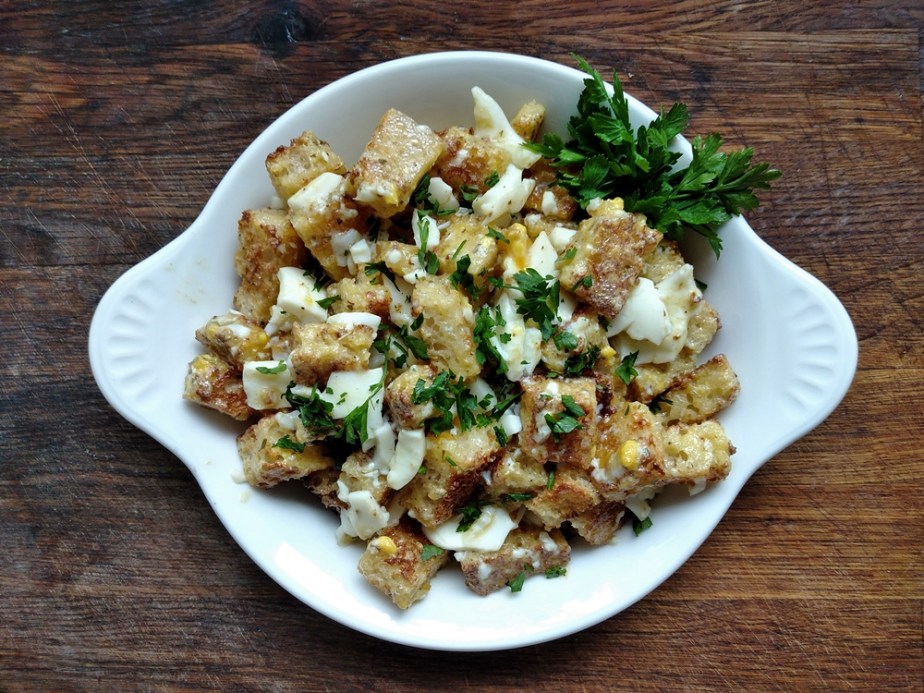
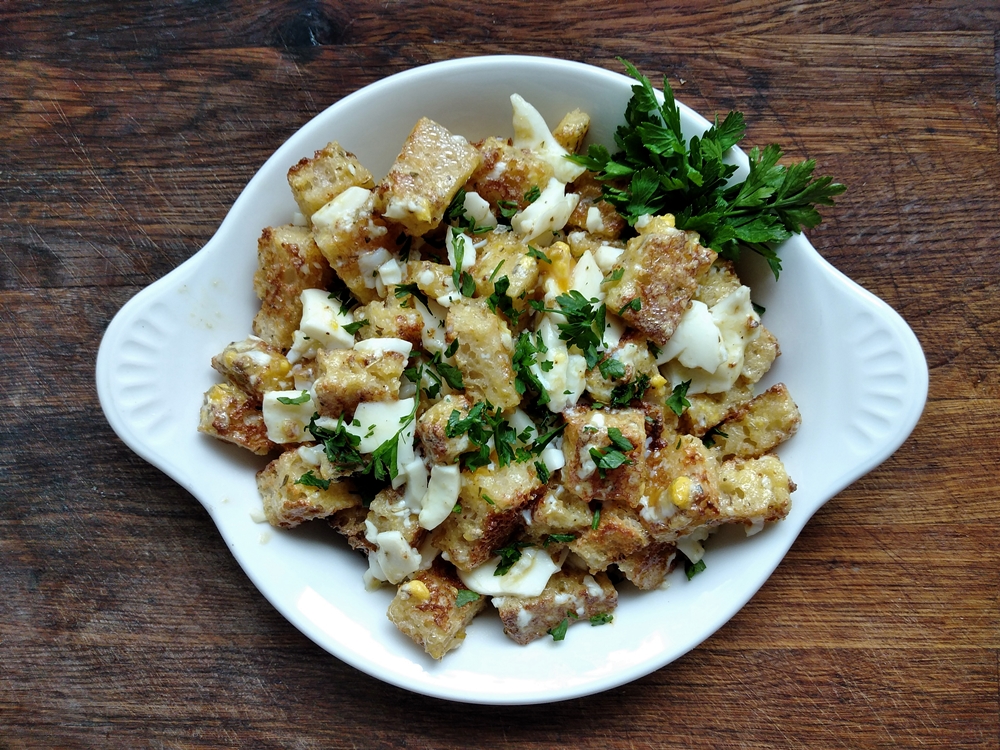
Eggity Bread

Eggity Bread

This has all the components of Eggy Bread, but rearranged and dressed up with a few exciting flourishes.

I have found several variations of this recipe on the internet, some of which might appeal more to your tastes. This version, with its jumble of textures and flavours with a pop of herbs, is the one that my daughter enjoys.

A few comments on ingredients

  • Eggs – softboiled. Cooked for between 3 and 4 minutes, just enough for the whites to be mostly cooked and the yolk runny.
  • Bread – as above, whatever you prefer or have to hand. Toasted, buttered, diced.
  • Seasoning – in addition to salt and pepper, these eggs also have a dusting of herbs. I’ve tried with both fresh herbs and dried, and my recommendation is that dried works best. It is easier to get a light dusting with dried herbs. In my experiments with fresh herbs, they quickly overpowered the eggs with the slightest slip of the hand. A light sprinkling of chopped, fresh parsley to serve is acceptable. The mixture of herbs can be anything you like – I like the combination of oregano, marjoram, thyme, and rosemary.

slices of bread
eggs – one per slice
butter
salt and pepper
dried herbs
fresh parsley to serve (optional)

  • Bring a pan of water to the boil.
  • Lower the eggs into the boiling water in a spoon and cook for 3 minutes if medium, no more than 4 minutes if large.
  • While the eggs are cooking, toast the bread and butter whilst hot.
  • Preheat the grill.
  • Cut the toast into cubes/dice. This small act makes for a fantastic mixture of flavours and textures in the finished dish – buttery, dry, soft, crunchy…
  • Remove the eggs from the pan and immediately crack them into a bowl. Don’t worry if they break – eggs boiled for this short a time are impossible to get out of the shells whole. Use a teaspoon to scoop out the shells, and chop the eggs roughly. If you find that your yolks have cooked solid, crack a raw egg into the mixture – this dish just doesn’t work without some liquid to bind everything together.
  • Season the eggs with salt, pepper and a dusting of each of the herbs. Use a light hand – literally two or three shakes of the herb jar, about 1/8th teaspoon of each.
  • Add the cubed toast to the seasoned eggs and toss together. The toast will become coated and lightly bound together with runny yolk and any liquid white.
  • Spoon the mixture into an oven-proof dish (a gratin dish as above is ideal) and place under a hot grill for about 90 seconds to heat everything through, crisp the edges of the toast and finish cooking any liquid egg.
  • Sprinkle with chopped fresh parsley and serve (be careful with the hot dish!).


Barm Bread

Here is a basic barm bread recipe for you to use with your home-made potato barm.

I am still experimenting with recipes other than loaves of bread, and will hopefully be able to post some other uses in due course, but in the meantime, I present to you a basic recipe, and some suggestions of how you can use it to adapt to what you have to hand. If you have multiple loaf tins, feel free to double or even triple this recipe.

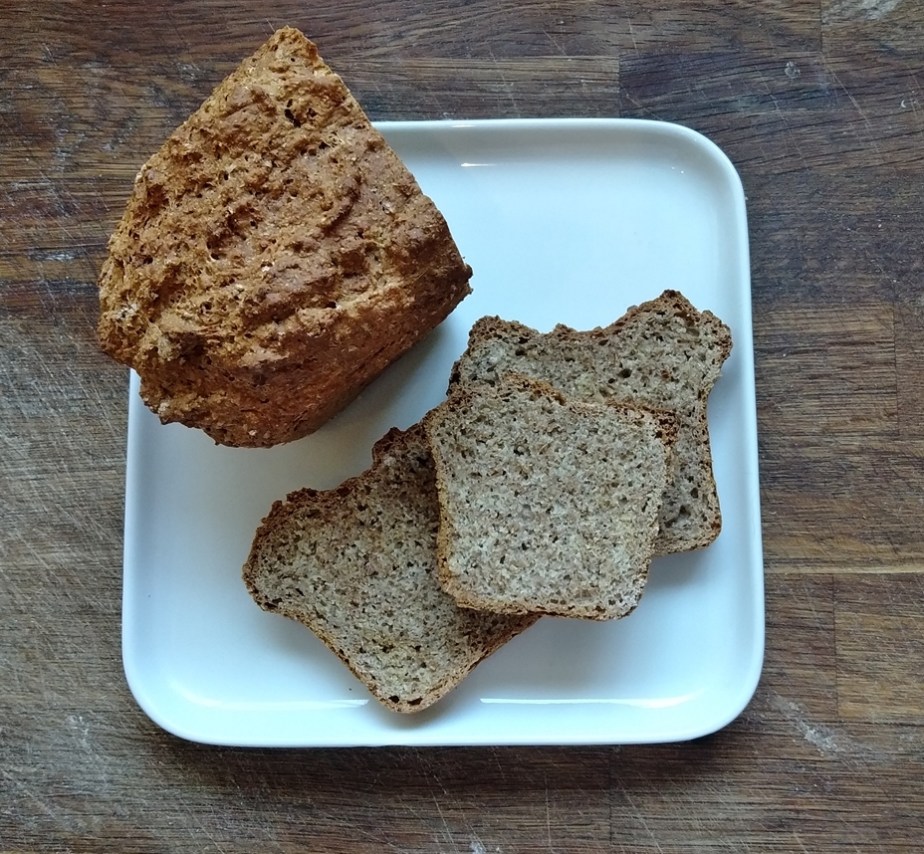
Both breads on this page, and the two white loaves on the previous page, were made according to this recipe. The above image is a cross-section of a loaf made with Stoneground Wholemeal Flour. The image below is from a loaf made with Stoneground Wholemeal Flour and Buckwheat Flour in a 50:50 ratio.

Buckwheat Wholemeal Barm Bread


Simple Barm Bread

350g bread flour(s)
150ml room-temperature barm¹
150ml warm water
1tsp salt

  • Mix 50g of the flour with the barm and the warm water. Set aside to work for 30 minutes. This is not strictly necessary with fresh barm, as it is full of life, but it is good to get into the habit for the future, be it weeks or months later, in order to check whether your barm is still lively. If there are no bubbles visible after 30 minutes, you can try and jump-start it by stirring in 1tsp brown sugar and waiting another 15 minutes.
  • When bubbles are visible, add the rest of the flour and the salt and mix thoroughly. Knead by hand for 10 minutes. If you’re using a mixer and a dough hook, set it to the lowest possible speed for 10 minutes, then the highest speed for two minutes. You want the dough to be elastic, but probably a little more moist than regular dough – the long rise time is very drying and if the dough is too stiff to begin with, it will restrict the rise.
  • Grease a large loaf tin well.
  • Tip out the dough and knead it into a loaf shape. I usually pat it flat(ish), then fold the ends in, then the sides in, then turn it over so the seal is on the bottom.
  • Lay the dough in your loaf tin. Brush the top of the dough lightly with a little oil or spray with water and/or scatter flour over the surface. This will help keep the dough from drying out.
  • If you have a plastic bag large enough, you could put your tin inside and ‘inflate’ it around the loaf to keep off any drafts. I usually just put it in the oven.
  • Set aside to rise. The rising time will depend on the age of the barm, the type of flour used and the temperature of the room.
    • I recently made white bread with a fresh batch of barm, and it took 5½ hours to rise during the day (warmer).
    • Stoneground wholemeal flour bread with some month-old barm took 10 hours overnight (cooler).
    • Enriched (with sugar and butter) dough with fresh barm (for hot cross buns) 9 hours overnight.
  • When the dough has risen sufficiently,² bake in a hot oven, 200°C, 180°C Fan for 50 minutes, turning the loaf around half way through the baking time to even the colouring.
  • For an extra crispy crust, remove the loaf from the tin and return to the oven for 5-10 minutes before cooling on a wire rack.


¹ Be sure to shake/whisk your barm up well before taking your measure out.

² This should be when it has doubled in size. For this amount of flour, in a large loaf tin, it will be when the dough almost ¾ fills the tin. The last bit of rise should be in reaction to the heat of the oven (oven spring). Don’t worry if you mis-judge it and let it go a little too long, bake the loaf anyway – it will be delicious, just with a rather flattened top.

Barm

Barm is what we used to use to make bread before the advent of solid, compressed yeast. It was skimmed off the top of fermenting beer and occasionally wine, and, back in the day when everyone was drinking small beer and ale because water couldn’t be relied on, was in ready supply.

Nowadays, it is a little tricky to obtain, unless you live near a brewery, but easy to rustle up your own due to the numerous recipes available in old books.

In general, a small quantity of hops is simmered in water for flavour, then flour and sugar and boiled, mashed potatoes are added to create the right consistency (a little like double cream). Frustratingly, when I was first looking into this, most of the recipes I found included an instruction something along the lines of: “then add a pint of good barm.” So yes, you end up with a large quantity of barm for all your baking needs, but only if you have barm to begin with. What about if you have no barm or, as I recently found, no yeast in the shops due to the random panic buying intially happening at the start of the COVID-19 lockdown?

To the rescue came a recipe in a Welsh-language cookery book “Llyfr Coginio a Chadw Ty”, (Wrexham, circa 1880), in which you can indeed start with no barm and end up with about a gallon.

I’ve made this a few times. The batch I made last year was in October, and after something of a baking frenzy spread over a couple of weeks, I left the remainder outside the back door in a closed, tupperare box. With the recent demise of yeast in the shops, I thought I’d try and resurrect it, and by jove it worked! The bread had a pronounced beery/yeasty flavour, which was due to the age, I think. Still, good to know it can keep for over 5 months in a cool environment.

Unlike a sourdough starter, it doesn’t need cosseting and feeding. Once mixed, and it has ‘risen and fallen’, it can be transferred to your container of choice and left alone. Before you use it, you stir it up (because it will settle over time), take what you need, then put the rest back.

Baking with barm is a little different from regular yeast. For starters, it takes a long time to rise, but on the plus side, it only needs to rise once. For wholemeal flour, it’s usually about 10 hours at room temperature for a loaf, and for white flour, around eight. This can be to your advantage, in that you can set a batch to rise at night, and it’ll be ready to bake by the morning. Also morning/afternoon rise, bake at night. If these times don’t suit, you could always go for an extra long, slow rise by putting the dough in a cool place, or even in the fridge (not tried this myself yet).

I have three hop bines planted in my garden, and if, like me, your garden is tiny, I can thoroughly recommend them as they are excellent producers of foliage for a tiny footprint of earth. I freeze some of the cones for barm making, others can be used in pillows to aid sleep. They also look fabulous hanging up and absorbing smells from the kitchen (although once dry, the droppage from the cones when you brush past is a housekeeping nightmare).

I realise not everyone will be in a similar position, so I have spent some time exploring other options, and

  • you can buy hops on the internet from brewing supply stores. You only need 60g for one batch of barm – which makes a LOT – so don’t go mad with the quantities.
  • I have also been investigating whether hops are actually needed at all, and the good news is, they aren’t! I have successfully made a batch of barm using only sugar, flour, potatoes, salt and water. If I’m honest, the hop-less bread does initially seem to lack a little something flavourwise, so my workaround for this is a suggestion to use beer as some (up to 50%) of the initial liquid, in order to get the hint of brewery aromas. You can choose dark, strong beers if you like it really pronounced, or something from the ales aisle for a lighter flavour. Or, you could just wait a while – the lower bread in the picture was baked with 2 week old hopless barm, and it had already started to have its own yeasty flavour.

Home-made Barm

Day One
4.5 litres water or beer & water mixed
60g dried hops (optional)
225g brown sugar
4tbs salt
450g flour – a mixture of different flours if liked.

Day Three
1.5kg floury potatoes (Maris Piper, Wilja, etc)

Day Four
Put into container(s)

  • Day One. The aim on Day One is to get a mixture that will attract the natural airborne yeast that surrounds us. One method uses hops, another uses no hops, but beer and water, a third uses neither beer or hops.
    • With Hops: Add your hops to litres of water, bring the water to a gentle simmer and simmer for 30 minutes. If you want just a mild hoppiness, strain now, otherwise allow to cool to blood temperature and strain.
    • With Beer: Make up 4.5 litres of liquid using beer/ale and water. Bring the mixture to blood temperature.
    • No hops or beer: Bring 4.5 litres of water to blood temperature.
  • Weigh out 450g flour. It can be one type of flour or a mixture of flours. Generally speaking, bleached white bread flour isn’t the best, better to have a mixture of brown/wholewheat with a little rye or buckwheat for flavour.
  • Weigh out 225g brown sugar. Again, the type doesn’t matter, it’s more for colour and flavour. I prefer dark muscovado.
  • Mix the flour, salt and sugar to a smooth paste with a little of your warm liquid, then add the whole to the rest of the liquid and whisk together thoroughly.
  • Set aside and leave uncovered (so it can catch all the lovely natural yeast) for 48 hours. I use my preserving pan and leave it on one of the back rings of the hob.
  • The flour will eventually sink, so keep a whisk handy and give it a good stir every now and then.
  • Day Three
  • Peel and boil 1.5kg mealy potatoes.
  • Put the cooked potatoes through a ricer, or mash thoroughly.
  • Add the mashed potatoes to the flour mixture and mix thoroughly. If you’re concerned about there being lumps of potato, I’ve found a stick blender is very efficient at smoothing out the mix.
  • Leave for at least 24 hours. NB essentially what you are doing here is feeding the yeast your delicious flour/sugar mixture caught in the previous two days with a carb-fest of potatoes. The yeast will enjoy this so much, it will start working overtime, but will eventually fall into a carb coma. This is my very unscientific explanation of the ‘rise and fall’ that needs to happen before you confine your barm in a container. Failure to let this initial activity work through completely will result in exploded containers (see Exhibit A: my bathroom walls/ceiling/shower screen a few weeks ago….).
  • You can pre-empt any overflows by continuing to whisk vigorously during this 24 hour period, to knock out the air in the mixture. If you’re concerned that your pan might overflow overnight, put it in the (empty) kitchen sink before you go to bed. I’ve done this every time, and it’s never overflowed, but I’ll bet the one time I don’t do it, I’ll regret it.
  • Day Four: You will see a distinct ‘tide mark’ around your pan indicating both the high point your mixture got to, and confirmation that it has indeed ‘dropped’.
  • Stir your mixture one last time, and put into your container(s). I use a large, 5 litre tupperwear box for a whole batch, but large (1.5 litre) plastic fruit juice bottles make for a handy size, with the added ease of a screwtop. VERY IMPORTANT do not screw the lids tight initially, just rest them on the top and only tighten them gradually, otherwise explosions, mess, wailing and gnashing of teeth, yaddah, yaddah…

Here endeth the lesson on the making of barm. Next up, what to do with your gallon of barm !