Irish Halloween Treats

There are several Halloween traditions around these isles, but arguably the strongest traditions abide in Ireland.

Several years ago, I discovered online a trove of fascinating Irish social history at the National Folklore Collection. This project is the digitisation of thousands of essays written by Irish schoolchildren and teachers from over 5000 primary schools in the Irish Free State, between the years 1937-1939. These social history essays contain information gleaned from parents and grandparents, and give a fascinating insight into hearth and home stretching back to famine times in the nineteenth century. This amazing resource is searchable on an abundance subjects, but of course the food essays are going to be my main interest.

If you’d like a deep-dive into just how much information is available to explore, my paper “The Boxty Paradox: Everything, Everywhere, All At Once” can be downloaded from the Books and Writing page. One thing that became aparrent during the research of that paper was just how bleak the food choices of so many families were. Consequently, the celebratory foods might seem to us rather plain. However, they can also demonstrate an appreciation for, if not the finer things in life, then life’s simple pleasures.

“Hallowe’en was a great night among the Irish people long ago and they looked forward to it for many weeks. All the boys and girls would gather together in one house and they would have great feasting & merrymaking.”

Collected by Annie Fallon from Mr John Harley, Farmhill, Co. Mayo1

The Halloween/November’s Night/Oidhche Shamhna foods most mentioned are barn brack/bairín breac – a ‘speckled loaf’ originally of caraway seeds, but more recently dried fruit – boxty, apples and nuts.

“In this locality the popular food at Halloween are apples, nuts, and boxty, also dumplings of many kinds.”

Collected by Mrs A. Montgomery from Mrs Kelly, Corr, Co. Cavan2

According to many accounts, the Halloween barn brack was saved up for and bought from a bakery. These cakes were baked containing a ring, and whoever got the piece of cake with the ring was supposed to get married within a year.

“Halloweve night falls on the last night of October. On that day my mother goes to town and she buys apples, nuts and a barn-brack. “

Collected by Jerard Jordan from Mrs Gara, Tivannagh, Co. Roscommon.3

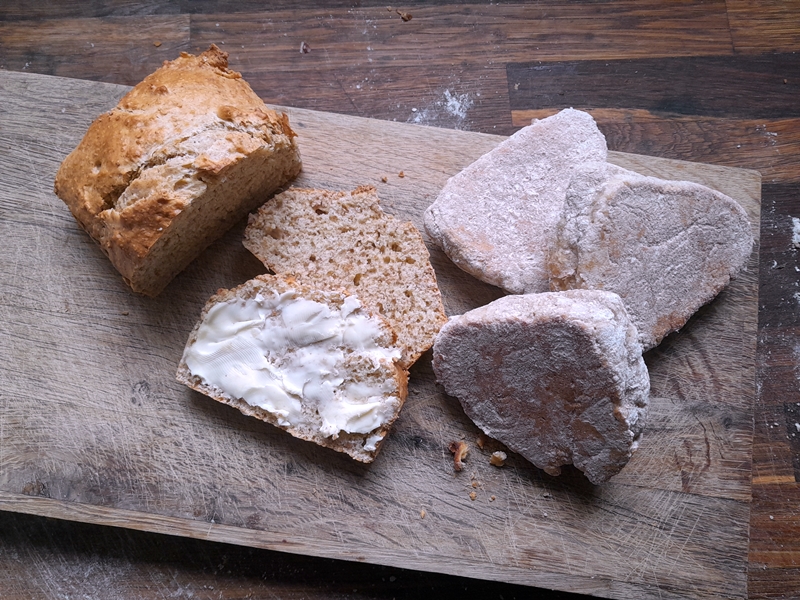
Alternately, during hard times, a soda cake would be baked at home either on the griddle or inside a bastible (lidded pot). The most coveted cake was baked with sour cream, but apples and hazelnuts could also be added.

“apples are put in cakes for November night.”

Collected by Tommy Kelleher from Mrs Margaret Kelleher, Mullaghroe South, Co. Cork4

The cream cake was a soda cake with plenty of cream in it and baked in the griddle.”

Collected by Beití Ní Dhomhnaill from Mrs Ashe, teacher, Dún Beag5

“On special occasions … a cream cake was made. Cream was mixed through the milk when mixing the dough. Currants, sugar and raisins were also put in the cream cake to make it rich and sweet.”

Collected by Seamus Daly, Kilclooney, Co. Waterford6

“On festive occasions a special cake was baked of such ingredients as flour, eggs, sour cream and a little sugar.”

Collected by Mary Jones from Mr M. Jones, Bruree, Co. Limerick7

“… cream cakes were made. These were made thin, but otherwise were made in the same way as ordinary soda cake.”

Collected by Michael Collins, Woodcock Hill, Co. Clare8

The recipes this week are two versions of soda cake mentioned in accounts in The Schools Collection: the cream cake and a fruit cake. According to the written accounts, the cream cake was considered the pinnacle of social delicacies, in numerous accounts warranting special mention. The fruit soda cake has more oblique mentions, but is absolutely symbolic of the foods enjoyed at Halloween. You can, of course, choose to add apples and nuts to the cream cake, if liked.

 Cream Cake

In the 19th century in Ireland, white flour was expensive, so if wheat flour was used at all, in most households it was wholemeal. I’ve opted for a less dense mixture of white and brown. Choose your own variation.

If you’d like to add apples and nuts to your cream cake, use the proportions in the recipe below, and reduce the sugar to 50g.

450g plain flour/wholemeal/brown/mixture
1tsp bicarbonate of soda
1 tsp salt
2 large eggs
85g sugar – caster, light/dark brown – your choice
300ml sour cream
100ml milk

  • Prepare your baking tin(s). You can, of course, bake your soda cake freeform, but a tin is also fine. My tin of preference is a 24cm shallow square tin, but you can also choose smaller tins or indeed choose to bake them in a pan on the ob over medium-low heat. If using a tin, line with baking parchment.
  • Heat the oven to 200°C, 180°C Fan. If using the hob, put a non-stick pan over medium-low heat (4 on a 1-9 scale) and allow to heat thoroughly.
  • Put the flour(s), soda, salt, sugar and eggs into a food processor and blitz briefly until well combined.
  • Tip the mixture into a large bowl.
  • Mix the milk and cream together until smooth, then add to the dry ingredients bit by bit. NB You might not need all of the milk mixture, as it will depend on the amount of moisture already in the flour and eggs. You want a soft dough, so a little extra is fine, but not enough moisture will lead to a dense loaf too stiff to rise.
  • When your dough is fully combined, tip out onto a floured surface.
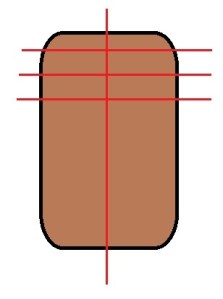
    • For soda farls to cook on the hob, divide the dough into two, and lightly shape each half into rounds. Gently pat down until 4cm in height. Using a dough scraper or similar, cut each round into six or eight triangles.
    • For a large loaf, shape into a round and transfer to your prepared tin. Cut a deep cross in the top to assist in even cooking. If you have any of the cream mixture left, you can brush it over the top of your loaf as a glaze.
  • To cook your cream cake(s)
    • For a large loaf, bake for 45-50 minutes, turning the oven half-way through to ensure even baking.
    • For cream farls, bake gently in your pan for around 10 minutes each side, turning carefully when the first side is toasted and lightly browned.
  • Cool briefy on a wire rack and serve warm with plenty of good butter.

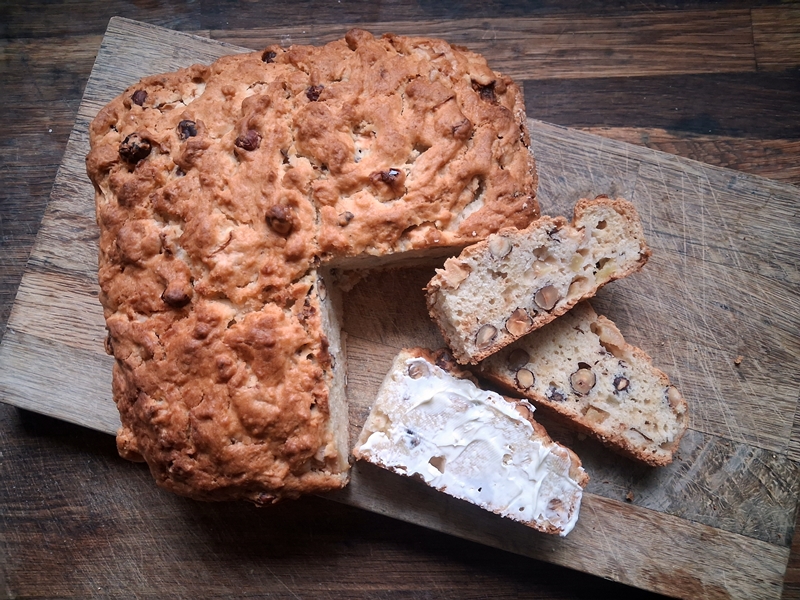
Apple and Hazelnut Soda Cake

Apples and nuts were central to the feasting at Halloween and this sweet soda cake is rich with both kinds of autumnal bounty. Enjoy warm from the oven or toasted, with a generous spreading of good butter. I’ve chosen to use Bramley cooking apples, as they break down into fluff when cooked.

100g whole unblanched hazelnuts
450g plain flour
1tsp bicarbonate of soda
1 tsp salt
50g sugar – caster, granulated, Demerera, light/dark brown – your choice
2 Bramley Apples – or 500-600g of similar cooking/sharp apples
200ml plain yogurt
200ml whole milk

  • Prepare your baking tin. My tin of preference is a 24cm shallow square tin. Line with baking parchment.
  • Heat the oven to 200°C, 180°C Fan.
  • Put the hazelnuts onto a baking tin and bake for 10 minutes until lightly browned and toasty. You can remove the skins by rubbing the nuts in a clean cloth, but I prefer to leave them as is.
  • Put the flour, salt, sugar and soda into a bowl and whisk together.
  • Peel and core your apples, and chop into 2cm pieces. Add the chopped apple and nuts to your dry ingredients and mix.
  • Whisk together the yogurt and milk, then gradually add to the rest of the ingredients. I find it best to stir the liquid through with a round-ended knife, which is less rough than a larger utensil. You might not need all of the liquid as the apples will contribute to the moisture of the mix.
  • Tip out your dough and shape lightly into a round. Transfer the dough to your baking tin, and cut a deep cross in the top to facilitate even baking.
  • Bake for 50-60 minutes until risen and browned, turning the tin around after 30 minutes.
  • Cool briefly on a wire rack and enjoy warm or toasted with lots of good butter.

1 The Schools’ Collection, Volume 0096, Page 84
2The Schools’ Collection, Volume 0982, Page 233
3 The Schools’ Collection, Volume 0234, Page 307
4 The Schools’ Collection, Volume 0359, Page 144.
5 The Schools’ Collection, Volume 0626, Page 350.
6 The Schools’ Collection, Volume 0654, Page 447.
7The Schools’ Collection, Volume 0498, Page 131
8 The Schools’ Collection, Volume 0598, Page 249

Marmalade Cake

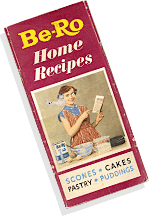
The recipe I have for you today comes from the classic and ever-reliable Be-Ro baking booklet.


My copy dates from somewhere between 1930 and 1950 (going on the fashions worn in the illustrations), and contains tried and tested recipes both for the everyday and special occasions.

I chose this recipe for a number of reasons:

  • It tastes absolutely delicious.
  • It’s a genuine store-cupboard cake, requiring everyday ingredients.
  • It is an excellent way to use up last year’s marmalade to make way for this year’s batch(es).
  • It is an excellent way to start making use of this year’s batch of marmalade, bursting with freshness.
  • It can be varied with whatever preserves you have on hand (within reason).

It being marmalade season, I have recently been preserving up a storm and entering some marmalades in the annual Marmalade Awards competition.

The method I used was extremely small-batch, but still provided me with more than the single jar required for each entry. Now, this year I entered six categories. I have six lots of extra marmalade. So I was KEENLY in the market for some way to increase marmalade consumption.

Enter the Be-Ro booklet and its recipe for Marmalade Cake with its short list of simple ingredients: flour, fat, sugar, marmalade, eggs, milk.

I’ve increased the amounts of each ingredient to 1.5 times the original quantities, because I had almost exactly that amount of Stork baking margarine in the fridge, and the first cake was so successful I made a second with a different marmalade and used butter, which was just as nice.

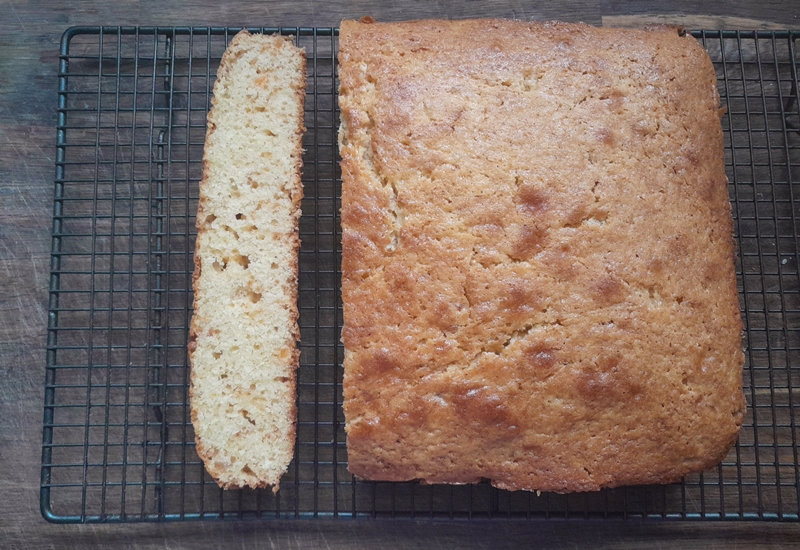
A square lime marmalade cake with two pieces cut off and displayed, on a wooden cutting board.

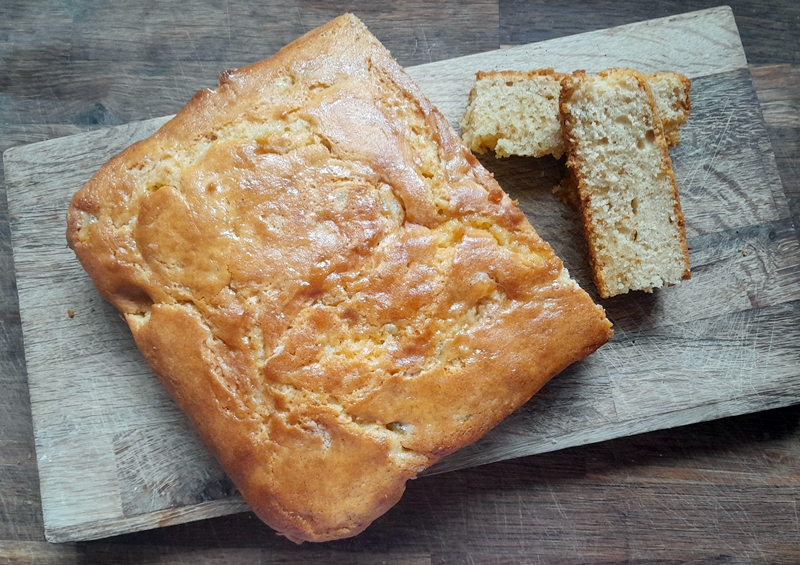
The first cake was made with lime marmalade (see above pic) and was very delicate in flavour and the cake was soft of crumb. The second cake was made with Seville Orange marmalade (see recipe for Dundee Marmalade here), and was just as delicious, possibly even more so. The striking difference was the aroma when the cake was cut – it was like a cloud of intense orange that wafted up. Amazing. I would venture that you could also substitute the marmalade for other jams or preserves, with the caveat that it should be one of the stronger and preferably tart-flavoured fruit: apricot, plum, damson, etc. because the sharpness of the fruit is a delicious contrast to the sweetness of the crumb.

This isn’t the flashiest, most exotic bake you’ll make, but it is easy and very fine-tasting and can be whipped up in about an hour start to finish from the contents of your cupboard/fridge.

Marmalade Cake

This is for the enlarged mix, and requires a 20cm square tin.

170g butter/Stork
170g sugar
170g marmalade
340g plain flour + 1tbs baking powder OR 340g self-raising flour
3 large eggs
80ml milk

  • Heat the oven to 170°C, 150°C Fan.
  • Grease and line a 20cm square tin with baking parchment.
  • Cream the fat and sugar together until light and fluffy.
  • Add the marmalade and mix thoroughly.
  • Sift together the baking powder and flour if using. Otherwise, sift the self-raising flour.
  • Whisk together the eggs and milk.
  • Alternately add these two ingredient mixtures to the mixture in the bowl, stirring, until everything is fully combined.
  • Pour the cake mixture into the prepared tin and smooth evenly.
  • Bake for a total of 45 minutes, turning the tin around after 25 minutes to ensure even baking.
  • Allow to cool for 10 minutes in the tin, then carefully transfer to a wire rack to cool completely.
  • Store in an airtight container.

Gossiping Cakes

I have a confession to make. I chose these recipes because I loved the idea of women baking cakes specifically for having a get-together and swapping gossip. Alas, that’s not where these cakes originate, but the truth just as interesting.

As I’ve mentioned before, I have spent quite a considerable amount of time cataloguing household manuscripts that have been digitised by various libraries around the world. Obviously, there is going to be a certain degree of repetition of the most popular recipes, but there are also those that stand out as original either by name or by ingredient, etc. Whenever I come across such a recipe, I mark it in the spreadsheet with an asterisk, so when I’m looking back over the thousands of recipes, those asterisked ones are easily highlighted as worthy of a second look. And for the other type of recipes, such as the 200+ recipes simply entitled “A cake”, I’ll get to looking at you in all your (presumed) variety  soon, but to be blunt, you’re pretty low on the ToDo list.

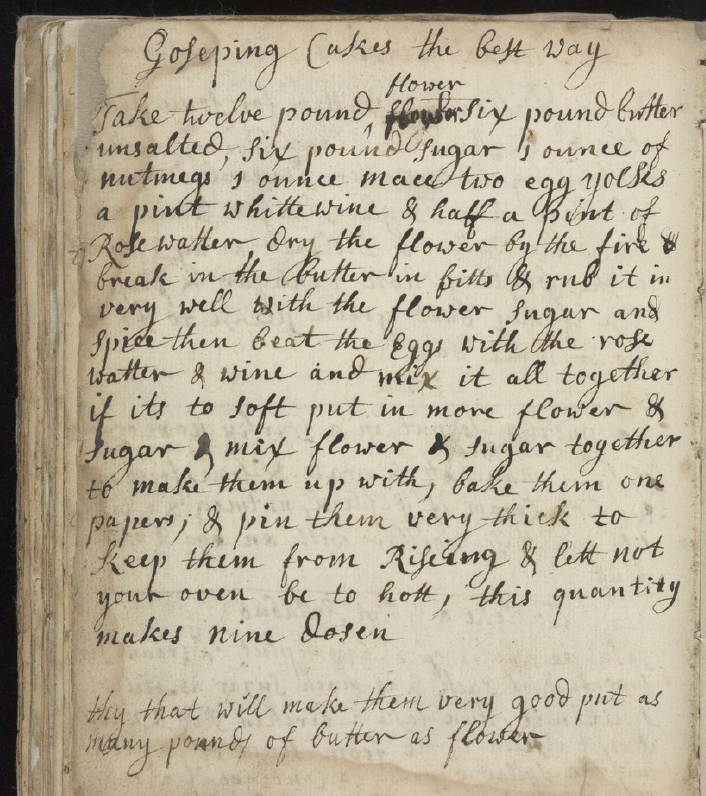
The first recipe I found was this one, dated early 18th century (1738), at the Wellcome Collection.

Recipe for Goseping Cakes The Best Way, from the manuscript of Rebecca Tallamy, (1738), MS4759, Wellcome Collection

It appears to be a spiced variation of shortbread, and obviously one to make in quantity, because the yield of the recipe is over 100 biscuits. It’s demonstrating one of the many interpretations of the word ‘cake’, in this case meaning small, circular biscuits. The last line also caught my eye, because it recommends using equal quantities of butter and flour to make them “very good”.

Regular listeners will have read about my shortbread variation testing a few months ago, where the ratio of butter to flour can range from 1:3 to 1:2, so the assertion that 1:1 is the best, had me intrigued.

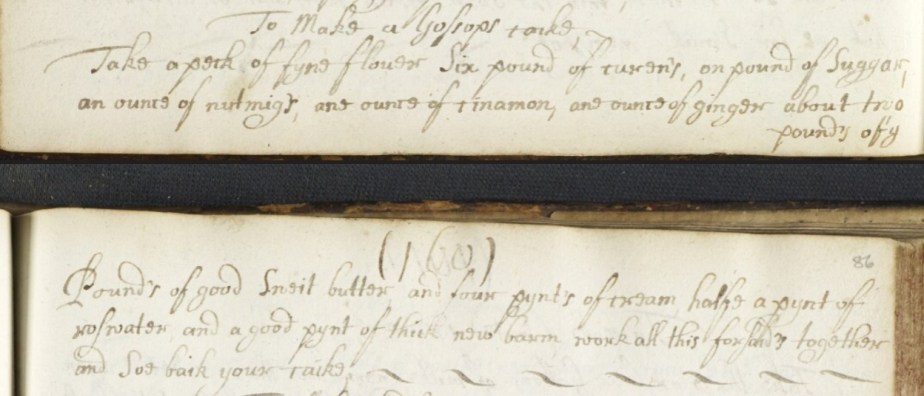
This recipe was very much on the back burner until I came across another recipe, similarly named, while indexing the digitised manuscripts at the National Library of Scotland.

Recipe for a Gossops Cake, from MS103093966.23, (1660-1699), National Library of Scotland

This recipe is in a manuscript older by almost a century (1660-1699), and differs in that it contains fruit, and is a large yeasted cake – exceedingly large, going by the peck/14lb/9kg of flour required – the term cake being used in this instance more akin to our modern usage.

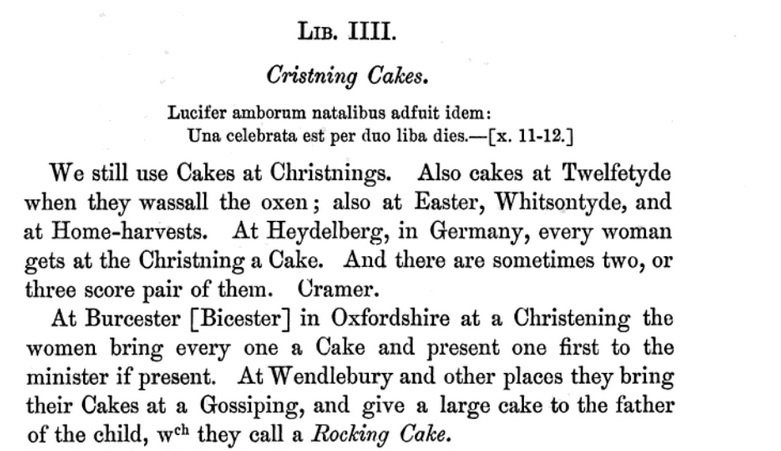
To delve deeper into this mystery, I turned to the internet, and found the following passage:

Christening cake traditions, from “Remains of Gentilisme and Judaisme 1686-87”, John Aubrey, James Britten, 1881, p65

This threw up the question: What is a Gossiping? And so I went hunting in the Oxford English Dictionary which I learned that a Gossiping is  a christening, or christening feast, derived and corrupted from “Godsibb”, which is an old English word for Godparent.

Not entirely relevant, but interesting nontheless, the oldest usage of Godshib I found was over a thousand years ago in Sermo Lupi ad Anglos, or the Sermon of the Wolf to the English, a sermon given by Wulfstan II, Bishop of Worcester and Archbishop of York (d. 1023) in 1014:

“And godsibbas and godbearn to fela man forspilde wide gynd þas þeode toeacan oðran ealles to manegan þe man unscyldgige forfor ealles to wide.”

Trans: And too many godparents and godchildren have been killed widely through-out this nation, in addition to entirely too many other innocent people who have been destroy­ed entirely too widely.”

Later usages of the word referred to a gathering of women/midwives when a woman was in labour, and hence to the modern usage.

So with a history stretching back many centuries, the account of christening traditions at Wendlebury would appear to neatly explain the differences between our two recipes: a large cake was presented to the father – presumably for all his hard work in the proceedings *eyeroll* – and the smaller cakes were shared with the guests.

So let’s get on with some gosseping!

A Gossop’s Cake

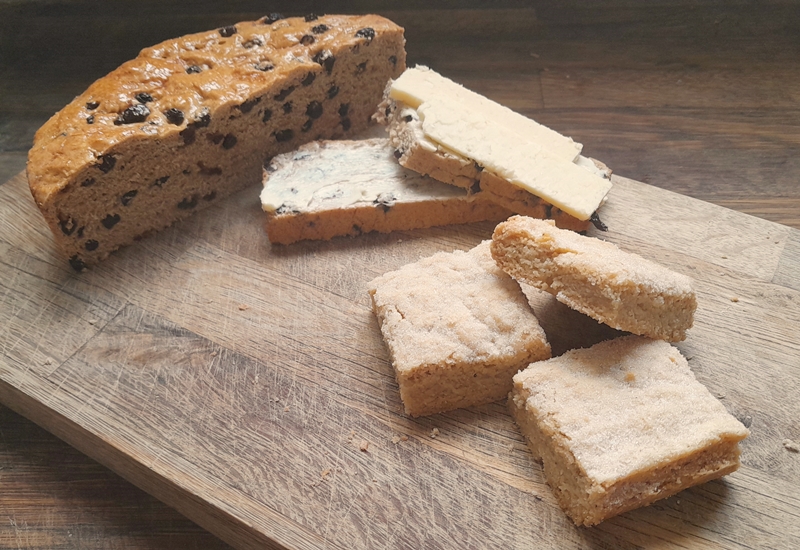
This is a fruited, lightly spiced and yeast-raised cake. If you’re British, it’s like an enriched teacake: delicious fresh, delicious toasted, and delicious either way with butter and a slab of cheese (but better with toasted). I’ve scaled the recipe down to make for a modest sized cake, but you can always double the recipe if it turns out to be a favourite.

315g plain flour
135g raisins
25g caster sugar
1tsp ground nutmeg
1tsp ground cinnamon
1tsp ground ginger
50g unsalted butter
150ml single cream
100ml water
1½tsp rosewater
1 sachet fast-acting yeast

single cream to glaze

  • Plump the raisins: put the raisins in a saucepan and cover with water. Warm gently on a low heat for 10 minutes while the dough mixes. Strain and pat dry.
  • Sift together the flour, yeast, sugar and spices.
  • Put the butter, cream, water and rosewater into a small pan and warm gently over low heat just until the butter has melted.
  • Put all ingredients except the raisins into the bowl of a stand mixer fitted with the dough hook and mix on slow until the dough comes together, then continue to knead for 10 minutes until smooth.
  • Add in the plumped raisins and mix on slow to combine.
  • Grease and line a tall, 20cm cake tin, preferably loose bottomed, with parchment.
  • Form the dough into a smooth cake and place in the prepared tin.
  • Set aside to rise until doubled in size. The enrichments to the dough (cream/sugar/fruit) will impact the rise, which is why there is only a single rise for this cake, thus taking advantage of the initial vigorousness of the yeast.
  • Heat the oven to 190°C, 170°C Fan.
  • When the cake has risen, gently brush the surface with single cream, and bake for 30-40 minutes until well risen and golden brown.
  • Cool the cake for 10 minutes in the tin, then remove and set on a wire rack to cool completely.
  • Store in an airtight container.

Goseping Cakes The Best Way

I’ve opted for the proportions where butter = flour because, contrary to my expectations, it really did taste much better that with just half the amount of butter.

250g plain flour
250g unsalted butter
125g caster sugar
1tsp ground nutmeg
1tsp ground mace
1.5tsp rosewater
1 large egg yolk
30ml white wine

1tbs caster sugar for sprinkling

  • Put the dry ingredients into the bowl of a food processor.
  • Cube the butter and add to the dry ingredients.
  • Blitz the mixture a few times until it resembles breadcrumbs.
  • Whisk together the yolk, wine and rosewater.
  • Add the wet ingredients to the dry and blitz until the mixture comes together in a soft dough.
  • Line a 20cm square tin with parchment paper.
  • Turn the dough out onto parchment paper.
  • Press the dough out evenly and smooth over.
  • Chill in the freezer for 20 minutes.
  • Heat the oven to 160°C, 140°C Fan.
  • Poke holes all over the surface with a fork or using a cocktail stick, in the manner of shortbread.
  • Bake for 30 minutes, turning the tin around after 15 minutes to ensure even baking.
  • Remove from the oven and turn off the heat. Sprinkle the caster sugar over the hot shortbread.
  • Cut the shortbread into pieces using a thin bladed knife or metal dough scraper.
  • Return the tin to the cooling oven until cold, to ‘dry out’.
  • When cold, store in an airtight container.

Marble Cake

Marble Cake can be considered a classic British cake, still enjoyed by many all over the country. To my mind, however, it has always seemed less marble-y and more blobby, in that the big dollops of (usually) vanilla and chocolate cake batters are frequently only half-heartedly stirred together.

Well, as we all know, there’s nothing new under the sun and just over 100 years ago, Frederick T. Vine was thinking just the same thing. In his 1908 commercial baking book “Cakes and How To Make Them”, he has entries for several different marble cakes, whether by design or whether he forgot he’d already included some in the front of the book and just bunged a couple more in later on, we don’t know. His suggestions are obviously geared towards commercial bakeries turning out dozens of different cakes, as he initially suggests taking quantities of mixtures that are probably prepared on a daily basis and combining them into marble cakes a lot more colourfully than we do today.

  • Marble Cake No.1: 1 batch of Silver Cake, divided, half coloured pink, half left white, 1 batch Spice Cake, 2 batches Gold Cake.
  • Marble Cake No 2: 1 batch Silver Cake, divided: ¼ coloured pink, ¼ coloured brown with cocoa, ½ left white.
  • Marble Cake No 3: ‘White Part’ made with egg-whites, ‘Dark Part’ made with yolks, treacle, cinnamon and dark brown sugar.
  • Marble Cake No. 4: Silver Cake, with coloured and flavoured milk.

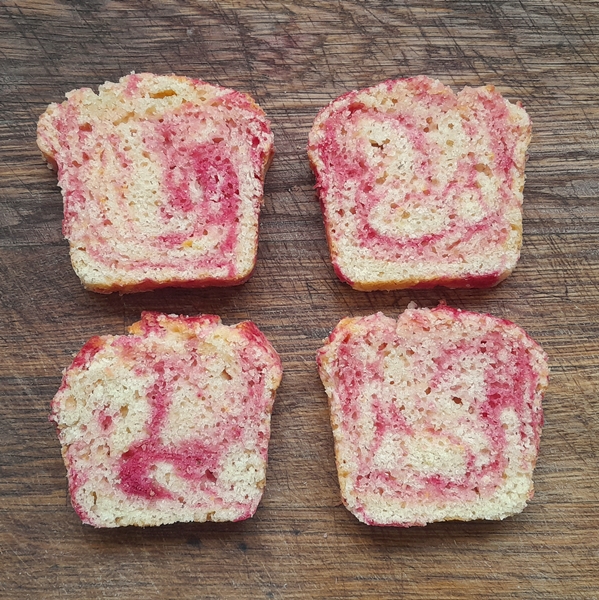
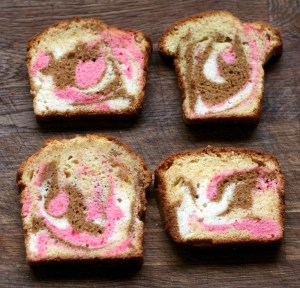
I tried a version of Marble Cake No. 1 some time ago, in a variety of loaf tins (see image below), and it certainly made a very jolly and colourful cake. However, if I’m being honest, it was still rather on the blobby side. So trying the ‘coloured milk’ method has been on the ToDo List ever since, and here we are.

4 slices of Fred Vine's four-colour marble cake

The original recipe did not call for any flavouring, aside from some brandy, so after a couple of trials I decided that a better approach was to flavour both the cake and the milk. I chose to flavour the cake with lemon and the milk with raspberry, to both preserve the paleness of the Silver Cake, and to make the milk complementary in flavour and contrasting in colour. You can, of course, choose any combination that appeals.

Using coloured/flavoured milk for the contrast allows for a much more delicate pattern to be achieved, and although a little fiddly in the construction, the results are very pleasing. The fine lines of red are a much more accurate depicion of the patterns in marble, and these are interspersed with the strong patches of colour/flavour where the milk has pooled between the spoonfuls of cake batter, almost a raspberry ‘ripple’ effect.

Marble Cake

I baked this Silver Cake mixture in mini loaf tins, but you could also use larger or smaller loaf tins and adjust the baking time accordingly.

115g unsalted butter, softened
140g caster sugar
140 egg whites
30ml brandy
zest of 1 large lemon
190g plain flour
60g cornflour
1tsp cream of tartar
½tsp bicarbonate of soda
milk (maybe)

60ml whole milk
raspberry flavouring
claret/raspberry colouring

  • Grease and line 3 mini loaf tins (16cm x 9 cm x 5cm) with baking parchment.
  • Heat the oven to 180°C, 160°C Fan.
  • Mix the colour and flavouring into the milk. You want both to be strong, in order to be able to see and taste them in the baked cake.
  • Whisk the softened butter until light and creamy.
  • Add the sugar and whisk until pale and fluffy
  • Add the eggwhites and mix thoroughly.
  • Mix in the brandy and the lemon zest.
  • Sift the remaining dry ingredients together, and gradually mix into the wet ingredients.
  • If the mixture seems a little tight, mix through some milk until you achieve a dropping consistency.
  • Spoon the mixture into the bottom of each tin in shallow blobs. Brush over the flavoured milk. There should be no uncoloured cake mixture. The excess milk will pool between the spoonfuls of batter and that’s fine. Each ‘layer’ should be a series of uneven portions of cake mix, rather than a smooth layer. Having the cake mix too smooth will make the flavoured marbling appear too formal. I found the best method was to scoop half a spoonful of cake mixture and lay it into the tin by ‘unscooping’ using the opposite wrist action, to lay it in a partial layer rather than a blob.
  • Repeat the spooning and painting until all the cake mixture has been used up.
  • Bake for about 25 minutes, turning the tins around after 15 minutes to ensure even baking. NB Be careful not to overbake – as an egg-white-only cake it will never be golden brown, and overbaking will make your cakes dry.
  • When baked, remove from the oven and allow to cool for 10 minutes, before removing the cakes from the tins, peeling off the parchment and setting to cool on a wire rack.
  • Store in an airtight container.

Twelfth Night Cakes

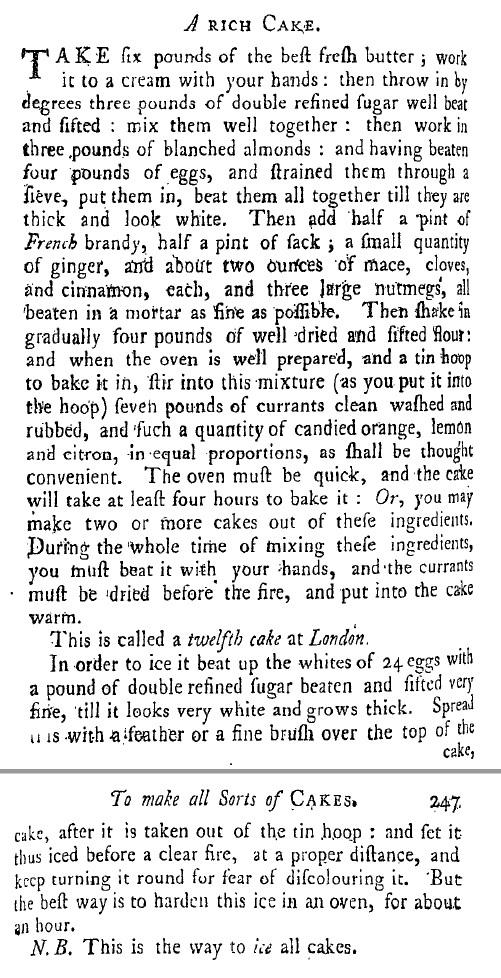
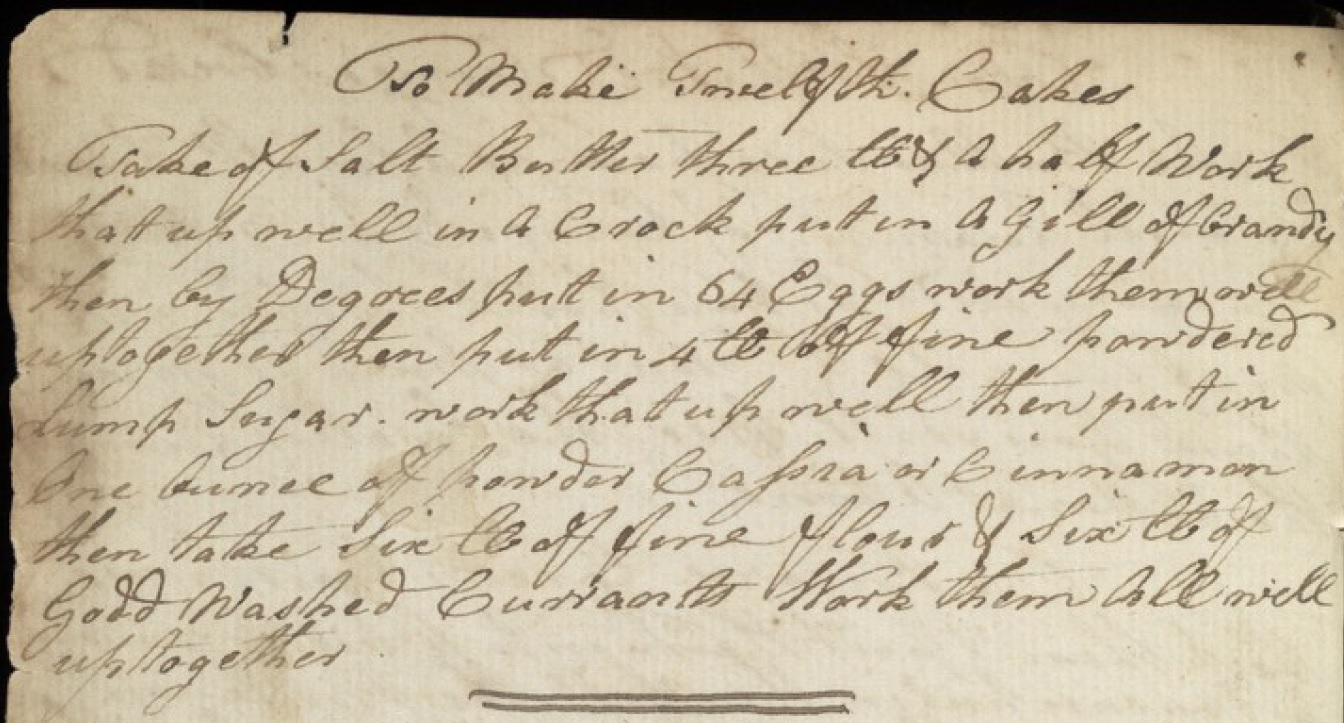
Twelfth Cakes, circa 1800 (left) from a manuscript recipe book, and James Jenks' 1768 recipe (right).
Twelfth Cakes, circa 1800 (left) from a manuscript recipe book, and James Jenks’ 1768 recipe (right).

The biggest party of the festive season used to be the evening of January 5th, the last of the Twelve Days of Christmas (Christmas Day being the first day), at which the Twelfth Night Cake made its appearance. Baked into the cake were a dried bean and dried pea, and when the cake was sliced and distributed amongst guests whoever discovered these in their slices were declared the King (bean) and Queen (pea) of the festivities. Quite how they managed to contrive that the correct gender found the appropriate bean/pea is not clear – unless two cakes were always served.

In times past, my home county of Herefordshire, being a very agricultural region, also has several rural traditions.

  • The Lighting the Twelfth Night Bonfires (twelve small fires in a circle and one larger one in the middle) in a wheat field and toasting the coming season with cider.
  • Wassailing the apple trees: Forming a procession to the apple orchard and arranging pieces of toast from the wassail bowl  (or cake, if one had been baked) in the branches and pouring the contents of the wassail bowl onto the roots of the tree, to encourage a good apple harvest.
  • Baking a cake with a hole in the middle and on Twelfth Night, placing it on the horns of a cow in the byre. The cow was then tickled until he tossed his head. If the cake was thrown backwards, it belonged to the mistress/dairymaid, and if forwards, to the bailiff/cowherd.

The Twelfth Night Cake was an extremely popular celebratory treat for centuries, but its popularity declined from the middle of the nineteenth century. A lot of people on the internet point the finger of blame at Queen Victoria, even going so far as to accuse her of banning the festivities circa 1860-1870. No evidence is offered to support this argument, and indeed I have been unable to find any myself, but if I missed something, do please get in touch and let me know.

Despite its popularity, recipes for Twelfth Cake are relatively few. Indeed, it has long been claimed that John Mollard’s 1801 recipe is the earliest one in print. Well, I do love a challenge, and the two recipes I have for you here do indeed date from the eighteenth century, albeit by a rather oblique route.

The first can be found in James Jenks’ The Complete Cook (1768).

As can be seen above, the recipe is actually called A Rich Cake, but has the helpful note “This is called a twelfth cake at London” underneath.

The second recipe I found in a handwritten manuscript at the Welcome Collection.

Twelfth Cake recipe from MS1074, Wellcome Collection, circa 1800

I appreciate that with an estimated date of 1800, this recipe is only just squeaking in to the 18th century, but I would argue, that it was unlikely to have been invented at the time of it’s entry into the manuscript, and thus has origins firmly in the preceding decades.

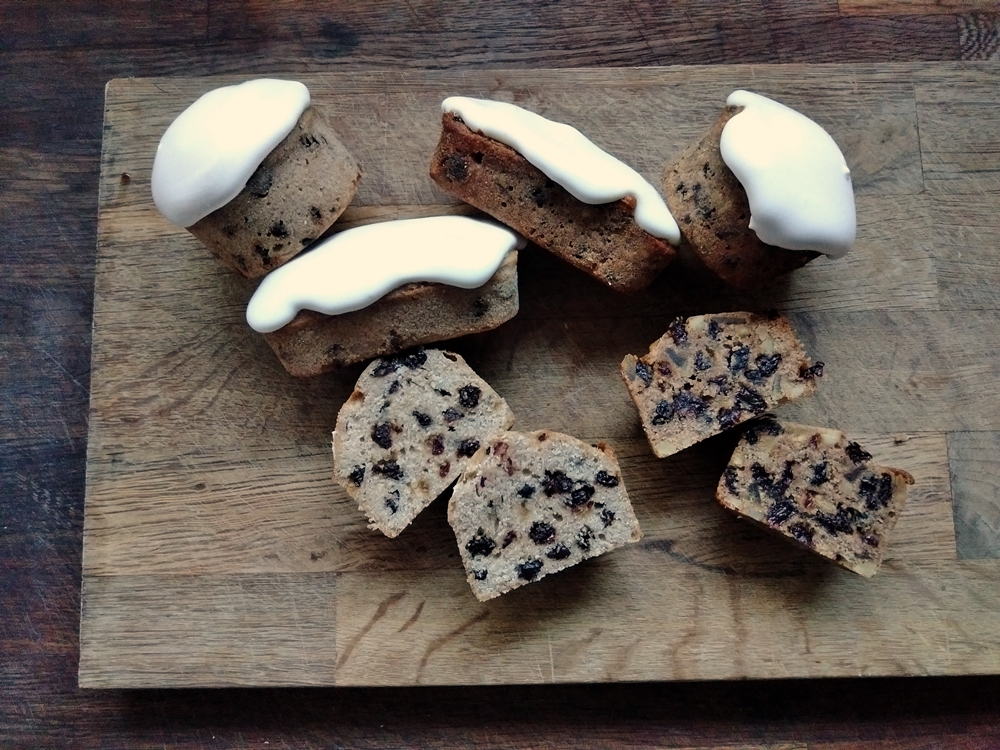
At the risk of stating the obvious, Twelfth Cakes are party cakes. They are made for celebrations, to be shared with numerous people, and consequently the quantities of both of these recipes are huge. I managed to scale them down considerably and chose to bake them in mini loaf/cake tins for the photo at the top of this page. This way, everyone can have their own miniature Twelfth Cake, and should you wish to annoint a King and Queen of the Revels, you can solve the tricky problem of ensuring the recipients are of the correct gender by adding the bean and the pea to cakes of different shapes.

James Jenks’ recipe is very heavily fruited and spiced and, whilst being a stickler for accurate scaling of recipes, I have had to reduce the proportion of both mace and clove in the recipe, as the original quantities of these spices tended to clonk you around the head flavourwise, and overpower the rest of the ingredients. The candied peel, nuts and alcohol all provide lots of interest and topped with a billowy royal icing, although both recipes are delicious, they are my personal favourite of the two. If this sparks your interest, Jenks’ book includes a further three rich cakes which could also be served as Twelfth Cakes.

The manuscript recipe is a paler and much milder affair. If lots of dried fruit and spice is not your idea of an enjoyable mouthful, then this might be the Twelfth Cake for you. Think of this as a sedate morning-coffee type of cake, as opposed to the full-on party-in-the-mouth that is James Jenks’ offering.

I chose to bake these in silicone moulds, as this protects the sides of the cake and prevents burning of the fruit. Metal tins might need a little less baking.

James Jenks Twelfth Cakes, 1768

Makes 8 small cakes

100g unsalted butter
50g caster sugar
2 large eggs – separated
2 tsp brandy
2 tsp cream sherry
1½ tsp ground ginger
1 tsp ground cinnamon
¼ tsp ground mace
¼ tsp ground cloves
1 tsp ground nutmeg
70g plain flour
50g chopped almonds
115g currants
20g candied orange peel, sliced very thin
20g candied lemon peel, sliced very thin
20g candied citron peel, sliced very thin

  • Heat the oven to 180°C, 160°C Fan.
  • Grease and line your chosen baking tins with parchment.
  • Cream the butter and sugar together until light and fluffy.
  • Whisk in the egg yolks, brandy and sherry.
  • Sift together the flour and spices and fold into the mixture.
  • Whisk the egg whites to stiff peaks and fold into the batter, 1/3 at a time.
  • Fold through the fruit and nuts.
  • Spoon into the moulds. A standard ice-cream scoop is helpful here.
  • Bake for 15 minutes, then turn the tins/moulds around and bake for a further 10 minutes for a total of 25 minutes.
  • Allow to cool in the tins for 10 minutes, then remove to a rack to cool completely.

Icing
100g icing sugar
25g egg-white

  • Heat the oven to 170°C, 150°C Fan.
  • Whisk the sugar and egg-white together for 5-10 minutes, until the mixture is thickened.
  • Spread as liked on your Twelfth Cakes.
  • Set the cakes into the oven and turn off the heat.
  • Remove after 15 minutes, when the icing has set.
  • Set aside to cool.

Twelfth Cakes circa 1800

Makes 8-10 small cakes

100g salt butter
115g  powdered sugar
2 tsp brandy
3 large eggs
1 tsp ground cinnamon
170g plain flour
170g currants

  • Heat the oven to 180°C, 160°C Fan.
  • Grease and line your chosen baking tins with parchment.
  • Cream the butter and sugar together until light and fluffy.
  • Whisk in the eggs, one by one.
  • Add the brandy.
  • Sift together the flour and cinnamon and fold into the mixture.
  • Fold through the fruit and nuts.
  • Spoon into the moulds. A standard ice-cream scoop is helpful here.
  • Bake for 15 minutes, then turn the tins around and bake for a further 10 minutes for a total of 25 minutes.
  • Allow to cool in the tins for 10 minutes, then remove to a rack to cool completely.

Icing
100g icing sugar
25g egg-white

  • Heat the oven to 170°C, 150°C Fan.
  • Whisk the sugar and egg-white together for 5-10 minutes, until the mixture is thickened.
  • Spread as liked on your Twelfth Cakes.
  • Set the cakes into the oven and turn off the heat.
  • Remove after 15 minutes, when the icing has set.
  • Set aside to cool.

Chocolate Cakes

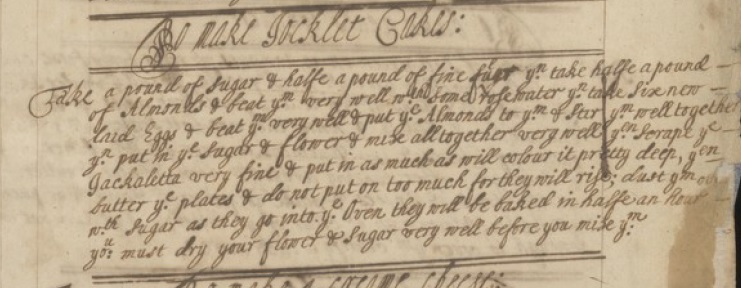
Whilst poring over old manuscripts, I love finding really early examples of recipes we would recognise today. And so I was delighted to come across this recipe for chocolate cakes. It appears near the front of a manuscript (MS1799, dated 1700-1775) digitised by the Wellcome Collection, and so, in my opinion, is closer in date to 1700 than the latter half of the century. The reason it caught my eye was because it reads as a ‘normal’ cake recipe, very unusual for the time.

18thC Chocolate Cakes
Chocolate Cakes, MS1799, (1700-1775), Wellcome Collection

Experience has led me to be cautious when it comes to the word ‘cake’ appearing in old recipes. In times past, this word was used for a broad range of ‘items that were circular’, rather than the baked confections of flour and eggs we associate with the word today. In the past I have been thrilled to find early recipes for lemon cakes and gooseberry cakes, only to find that they are for fruit paste and jellies, musk cakes that turn out to be incence, puff cakes that are meringues, rout cakes that are biscuits and spice cakes that are buns.

Even ‘chocolate cakes’ can catch the unwary, as many old recipes sporting such a title are actually instructions for making solid blocks of ‘chocolate’ ready to use in recipes. Unlike the cocoa powder we buy today, these ‘cakes’ were similar to the modern blocks of Mexican chocolate: solid, hard and requiring grating before use. The old recipes for ‘chocolate’ begin with the roasting of the cocoa beans, which are then pounded and ground extremely fine and mixed with sugar, vanilla and spices before drying in cakes which are then stored for use, which makes me incredibly grateful that we don’t have to go through such Faff today.

Happily, this recipe omits the time-consuming ‘make your chocolate’ part, but in adapting this recipe for modern use, if an authentic 18thC flavour is required, the spices that would be part of the original cakes of ‘chocolate’ need to be added in. The quantities below might seem a lot, but there’s also a lot of cocoa, so to make sure they can all sing, the quantities need to be generous. You can play around with the spices to your taste – other chocolate recipes I’ve read include one or more of the following: allspice, cloves, aniseed, cardamom, musk, ambergris, and either achiote or cochineal for a reddish colour.

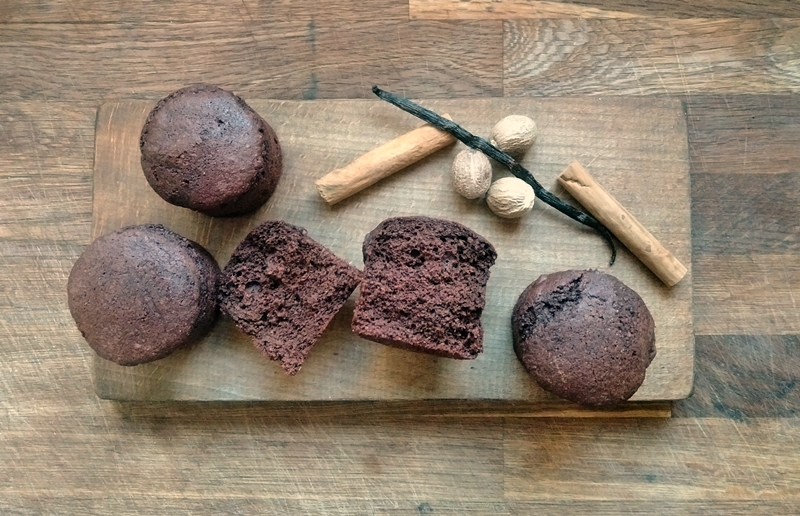
So what are they like? Well, to be honest, it took several batches of tweaking before I was happy with the result. The taste is intensely chocolate-y, and the addition of the spices makes for an unusual and rich flavour. In the interests of full disclosure, as can be seen from the photo, these are dense cakes, and are most definitely not of a lightness of a Victoria sponge, or even a sturdy Madeira cake. But to be frank, that is part of their charm. Since they are made without butter, I would recommend serving/eating them with some lightly whipped cream, or ice-cream, for the mosture as well as the contrast in texture and temperature: the rich warmth and spiciness of the cake against the cold cream is deliciously satisfying.

These cakes include ground almonds, which help to enrich the texture, but also require a little time to work their magic. Consequently, if you’re not eating them straight from the oven, these cakes benefit from being kept 1-2 days in order for them to soften. Freshly-baked, but cooled, they are rather – ahem – ‘firm’, but stick them in a ziplock bag for a day or two and they soften and become glossy and a little sticky (in a good way).

If you’d like to make a less sturdy, more modern sponge version, all it takes is the addition of 1.5tsp baking powder, sifted with the flour.

I used a silicon cupcake mould with straight sides, which look great, but, even thoroughly buttered, proved challenging when it came to getting the cakes out in one piece. Other options might be ‘regular’ bun/cupcake moulds, or use paper liners.

Chocolate Cakes

Circa 1700. Makes 8-12, depending on your small cake tin size.

30g melted butter
150g sugar
3 large eggs
1tbs vanilla extract/paste/seeds of 1 vanilla pod
40g cocoa powder*
2tsp ground cinnamon
1tsp ground nutmeg
75g plain flour
1.5tsp baking powder (optional)
pinch salt
75g ground almonds

  • Heat the oven to 180°C, 160°C Fan.
  • Grease your moulds with the melted butter.
  • Whisk the eggs and sugar together until light and foamy (5 minutes or so).
  • Sift together the flour, cocoa, spices, salt and baking powder if using.
  • When the eggs are foamy, use the whisk attachment (or a balloon whisk) to gently fold in the flour mixture.
  • Stir in the almonds.
  • Portion the batter out into the greased moulds.
  • Bake for 18-20 minutes, turning the moulds around after 10 minutes to even the baking.
  • Remove from the oven and allow to stand for 10 minutes to firm up.
  • Run a thin blade around the edges of the cakes (if not using cupcake papers) and gently ease the cakes from the moulds and cool on a wire rack.
  • Enjoy warm with cream, or place in an airtight container for 1-2 days to mellow.

* Modern cocoa is very drying, so if you’d like to use more than this amount, reduce the quantity of flour by that same amount. i.e for 50g cocoa, use just 65g flour.

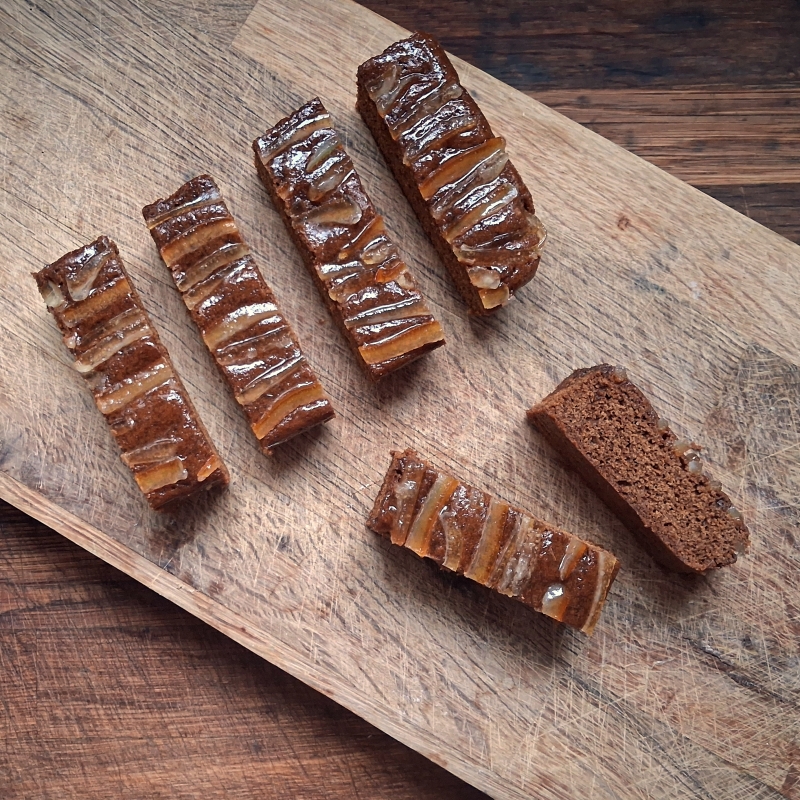
Rhubarb Gingerbread

This is a recipe from that classic of home cooking, Farmhouse Fare. I have copies ranging in date from the 1930s to the 1960s, and I always find it interesting to see which recipes come and go through the decades as they are replaced with more fashionable dishes, or as tastes change, as well as recipes which persist over time. This recipe comes from the second impression of the third edition, published in 1947.

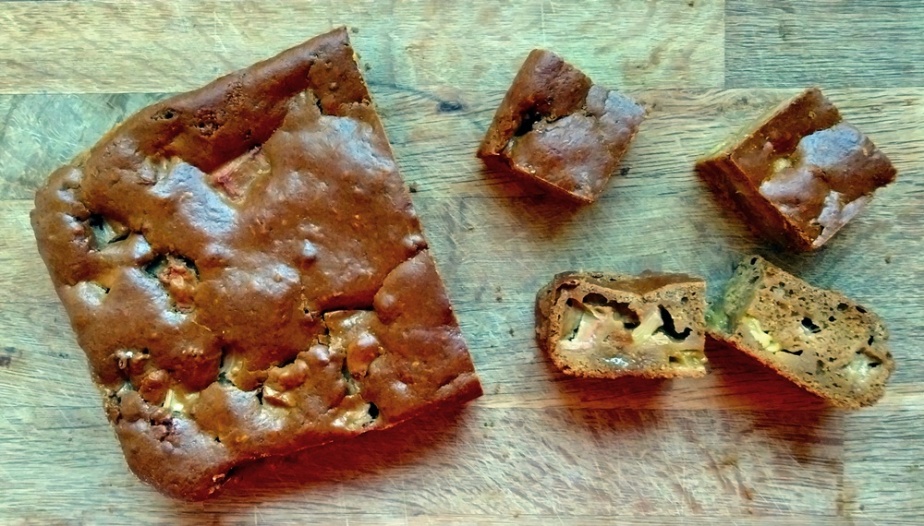
It recipe is in the style of the delightfully named pudding cakes, which are so deliciously comforting hot from the oven with custard or cream, that can also be enjoyed cold as a cake. I must confess, though, this really does taste better warm, so have been briefly zapping leftover slices in the microwave to bring it back to a cosy and comforting temperature.

Pairing sharp, zingy  rhubarb with the warmth of treacle and ginger is just the tonic for this time of year, when there has possibly been a little over-indulgence, and a jaded palate needs reviving with something bright and fresh.

The rhubarb in the shops is currently of the beautiful, coral-pink forced variety and sandwiching it within gently-spiced sponge provides richness and freshness with every bite.

Rhubarb Gingerbread

150-250ml milk
60g butter
85g treacle
1 heaped teaspoon ground ginger
1 level teaspoon ground cinnamon
1 large egg – whisked
225g self-raising flour, or plain flour + 2tsp baking powder
200g rhubarb, chopped into 2cm slices
50g soft brown sugar

  • Grease and line a dish with parchment paper. Grease the parchment paper. I used a rectangular tin of dimensions 15cm by 25cm. You could also use a 20cm square tin, or indeed a round cake tin.
  • Heat the oven to 180°C, 160°C Fan.
  • Put 150ml milk, butter, treacle and spices into a pan and warm through until the butter has melted.
  • Remove from the heat and sift in the flour, then whisk in the beaten egg.
  • Add more milk, if required, until the mixture reaches a dropping consistency – that is, it will drop freely from a spoon (as opposed to thud in a lump).
  • Spread half of the mixture into your prepared tin and then lay over the rhubarb. I like to gently poke the slices into the mixture standing on end, but you could also just scatter them freestyle.
  • Sprinkle over the sugar, then top with the remaining mixture.
  • Smooth over and bake for 45-50 minutes, until the middle is springy to the touch. If you like to test for doneness with a toothpick, be sure you don’t mistake cooked rhubarb for uncooked cake mixture and overbake.
  • Allow to cool in the tin for 10 minutes, then serve for pudding either as is, which is delicious, or with custard, cream or ice-cream.


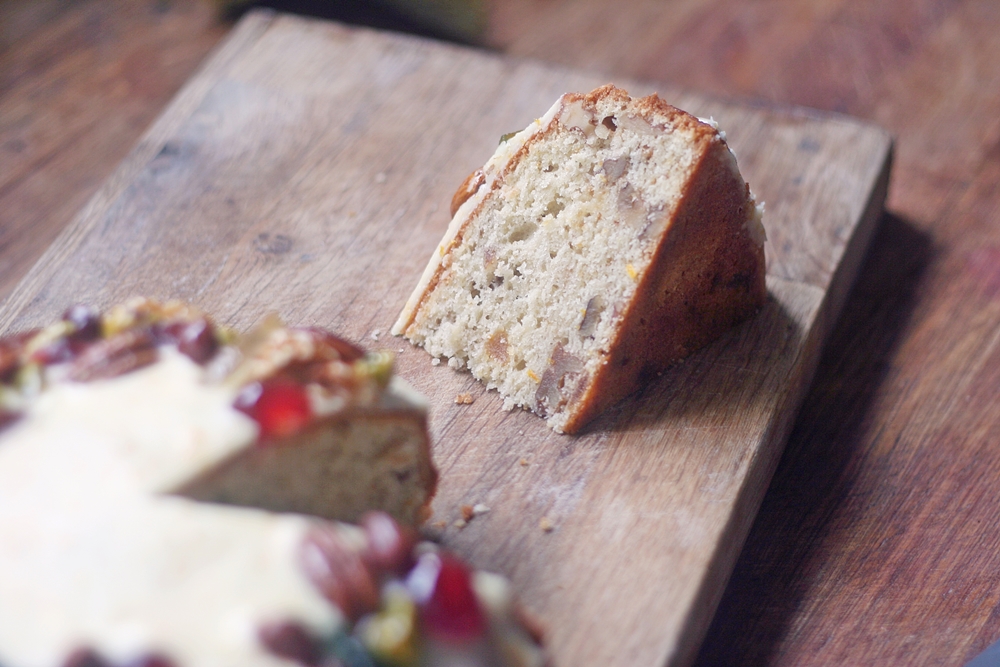
Orange and Walnut Garland Cake

In my head, the book from which this recipe is adapted is practically modern, as I clearly remember the year it was published, but then my brain gently reminds me that 1978 is now 40 years ago and I am PLUNGED into a slough of despond at how OLD that makes me feel. But enough of the over-dramatics…

I found this recipe in Bread, Cakes and Biscuits, by Mary Norwak, one of the 500 Recipes series published by Hamlyn. It is a fantastic collection of almost every kind of tea-time bake you could wish for, reassuringly written by someone in whose recipes I have absolute confidence. If you’re in need of well-written, dependable recipes, then Mary Norwak is a name you can trust.

The 500 Recipes series is an immense collection of themed recipe books by a variety of authors and, when published, was very competitively priced at just 99p. I regularly find copies in charity shops and car-boot sales and have amassed quite a number of the range. Their only downside is, aside from the cover, a complete lack of illustrations, being printed as they are, on rather low-grade, coarse paper. So it takes a little imagination to be able to pluck out the real gems from a flat page of text.

I chose this recipe for a number of reasons: the unusual flavours, the simplicity of the recipe and the ease with which it can quickly be turned into a very eye-catching, celebration cake.

Nowadays, the more standard cake flavour combination is for coffee to be paired with walnut, but the brightness of citrus really lifts this cake into something altogether more delightful.

I have made a few, small, changes to the original recipe and am also introducing a new element, that of the glaze for the decoration.

Firstly, I have substituted Seville Orange zest and juice for the original sweet orange. The sharpness and bitter notes really pack a punch against the sweetness of the cake.  The simple glace icing is a revelation – I do so love it when an idea exceeds all expectation. This normally (for me) overly-sweet icing is really lifted by the tang of the bitter orange. And where do I have access to Seville oranges out of season, you ask? In my freezer, I reply.  Every Seville orange season, I buy, zest and juice at least one net of Seville oranges. After mixing the juice and zest together, I freeze it in ice-cube trays (one large ‘cube’ contains the juice and zest of 1 orange) and, once frozen, pack into a ziplock bag for later use, just as in this case. It’s fantastic for Seville orange curd, custard, even savoury dishes like roast duck or game casserole. I highly recommend the practice. If you have no Seville oranges, the recipe contains a suggestion for substitution.

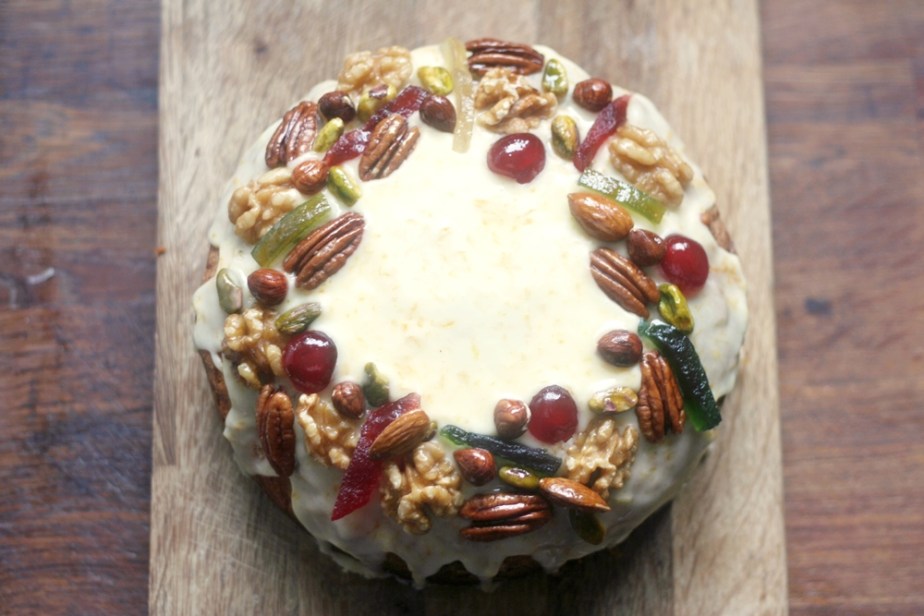
You can leave the cake adorned with just the icing topping and it is delicious, but for a bit of wow-factor, you can add a garland of candied fruit and whole nuts. This is my favourite kind of decoration (requires practically zero skill and almost no effort from me), where the beauty of the ingredients IS the decoration and they can really shine. And on that note, I shall segue seamlessly into the new element of this recipe – the glaze.

You will have noticed that the fruit and especially the nuts in the picture above, have a glorious shine to them, and this is achieved through the use of a glaze. For fresh fruit tarts and the like, the traditional glaze is a syrup, but this has the downside of being exceedingly sticky, and in this case might interfere with the glace icing. Also, fresh fruit tarts tend to be eaten immediately, whereas this is a cake that will last several days in an airtight container. The glaze I have used for the decoration is a mixture of simple sugar syrup and gelatine. This adds the shine without the stickiness. The excess glaze will set like a jelly, and later can be gently warmed and re-used to decorate sweet buns, tea-breads, even sweet pies for an extra shiny appearance without stickiness.

Orange & Walnut Garland Cake

Do customise the flavorings to your own personal taste. Dislike walnuts? Use hazelnuts instead, or pistachios or macadamia nuts. Dislike candied peel? Make your own for a fantastic flavour punch, leave it out altogether or add in some more fresh zest.

225g self-raising flour (or plain flour + 1 tsp baking powder)
½ tsp salt
175g unsalted butter, softened
175g caster sugar
zest & juice of 1 Seville orange [1]
3 large eggs
30g candied peel – chopped
60g walnuts – quartered
a little milk (maybe)

Icing
zest & juice of 1 Seville orange [1]
120g icing sugar

Decoration
100g mixed whole nuts
50g candied peel, cherries, etc.

Glaze
50ml water
50g caster sugar
½ sheet gelatine – or enough vegegel to set 100ml of liquid.

  • Preheat the oven to 180°C, 160°C Fan.
  • Grease and line an 18-20cm cake tin with parchment.
  • Sift flour and salt.
  • Cream butter, sugar and orange zest together until light and fluffy.
  • Add eggs one at a time, beating thoroughly between additions.
  • Fold in the flour.
  • Stir in the peel, nuts and juice. If the mixture seems a little heavy, loosen it to a dropping consistency with a little milk.
  • Spoon the mixture into the prepared tin and bake for 50-55 minutes, or until the cake is cooked through[2].
  • Allow the cake to cool in the tin for ten minutes (to firm up), then cool completely on a wire rack.
  • After decoration, store in an airtight container.

Decoration
As mentioned above, there’s two tiers of decoration you can use for this cake, either with just a simple glace icing, or with the addition of a garland of candied fruit and nuts.  Read through both sets of instructions, because if you want to do the glazed fruit and nuts on top, you need to start before mixing the icing.

  • Glace icing:
    • Mix the zest/juice into the icing sugar until smooth. It should be thin enough be able to pour, but not so runny that it just falls off the side of the cake.
    • Pour over cake and allow to drip down the sides a little.
    • Leave to set.
  • Glazed fruit and nuts:
    • Soak the gelatine in a little cold water.
    • Cut the cherries in half and trim the rest of the fruit to suitable sizes/shapes.
    • Dissolve the sugar in the water (zapping it in the microwave for a few seconds to warm it helps) then add the softened gelatine and stir until it is melted.
    • Now, there are two ways to arrange and glaze the fruit and nuts, either glaze first, then arrange, or arrange, then glaze.  Choose whichever approach you prefer.
      • Arrange then glaze: As soon as you have poured over the icing, press the fruit and nuts into the icing while it is still moist. As the icing dries, it will hold them securely in place. Using a clean paintbrush, paint the glaze over the fruit and nuts, being careful not to allow it to drip onto the icing too much.
      • Glaze then arrange: Put the fruit and nuts into a bowl and pour the glaze over. Toss gently to ensure and even coating. Drain in a sieve, then arrange as above.

[1] If you have no Seville oranges, use the zest of 2 sweet oranges and the juice of 1 in the cake, and for the icing, the zest of 1 orange and the juice of a lemon.
[2] Quick reminder on how to tell when a cake is cooked:

  • Ears: the cake is not making any bubbling/hissing noises.
  • Touch: the cake feels springy when lightly pressed with the fingertips.
  • Eyes: The cake has shrunk away from the sides of the tin a little.
  • Eyes: A cocktail stick inserted into the middle of the cake has no wet mixture on it when removed. NB when making moist, fruited cakes (apple, banana, etc) any fruit moisture is ok, it’s the cake mixture that’s important.

Welsh Cakes

I’ve always had a fondness for Wales. The first family holidays were amongst its lush and rolling hills and I became an avid fan of rugby through watching Wales during the glorious days of the mid-1970s.

In terms of its food, I’m constantly frustrated by the existence of so few old books from which to draw recipes. I have on my bookshelves just three in the Welsh language, all dating from the 19th century, and, disappointingly, not one of them contains recipes for either Bara Brith or Welsh Cakes. I have a feeling that there must be a very rich hoard of manuscript recipes lurking somewhere in storage, perhaps in a record office or some archive, just waiting to be discovered.

I have already brought you a couple of Bara Brith recipes, being unable to choose between the rich fruitiness of one and the delicate texture of the other. For years I have been in search of an authentic and worthy Welsh Cake recipe, with no joy. With the best will in the world, the modern Welsh Cake can be a little on the heavy side. The more tactful descriptions suggest ‘close-textured’, other spade-a-spade critiques might go with ‘stodgy’. And the stodginess would seem to be almost necessary, as too long on the griddle and the pastry-like dough of the modern Welsh cake recipe is prone to drying out and becoming tough.

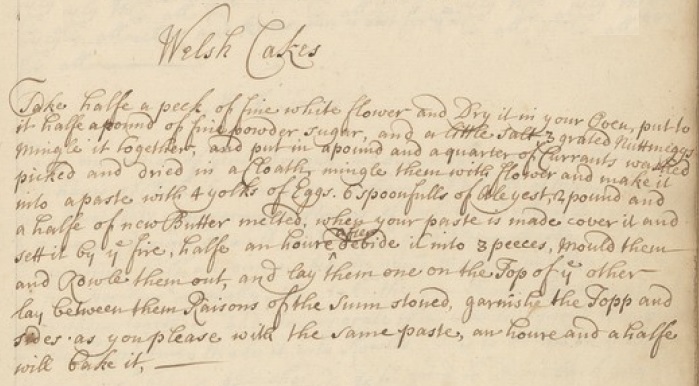
I have therefore been more than a little mollified by this week’s recipe, which I found in the digitised manuscript collection of the Welcome Library. It comes from the recipe book of Dorothea Repps (nee Fountaine) and dated 1703, when she was just 21 and already married to John Repps. I am extremely fond of this manuscript book, for Dorothea’s handwriting is bold, confident and easy to read, and adorned with swooping flourishes. This recipe for Welsh Cakes appears very early on in the book and consequently I feel confident that she must have recorded it  no later than 1710.

What I find curious, quite apart from it pre-dating most other Welsh Cake recipes by at least 150 years, is the fact that Dorothea spent her life in Norfolk, just about as far east and distant from Wales as you can get without falling in the sea. There’s nothing else in her book that is particularly Welsh, so its presence is something of an enigma. Also curious is the form that Dorothea’s Welsh Cakes take: a single, large, layered yeast cake sprinkled with currants and sandwiched with raisins.

Welsh Cakes Recipe
From MS 7788, Wellcome Library Collection

As with many recipes of this age, the quantities of ingredients are huge, and reflect the catering-size amounts required in a large house. I scaled them down to something more manageable and baked it as described and I have to be honest, it was a bit heavy. Nice, but decidedly door-stop. So I had another go, making even smaller, single-serving versions, with just two layers of the currant dough sandwiching the plump raisins. They were very neat, and baked to a lovely golden brown, but…..ordinary. Despite the richness of the mix, the oven heat, even without fan convection,  made the outsides of a crustiness that all the post-baking basting with milk failed to soften.

Having concentrated so much on the presentation, after carefully cutting and shaping these little filled cakes, I found myself left with quite a lot of trimmings. I can’t abide waste, so I decided to gather them together, re-roll and cut them like modern Welsh Cakes. Since the oven was in use baking the sandwich version, I thought I might cook these in a dry pan on the stove top. And this spur of the moment decision provided the secret to revealing the deliciousness of this recipe. For cooked in the traditional bakestone manner, they are extraordinary.

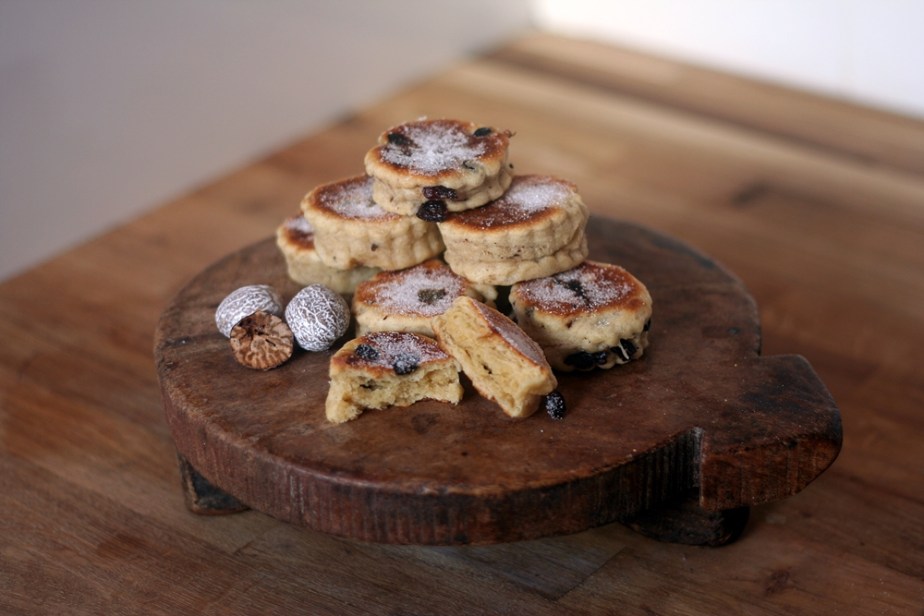
The thin crust that forms from contact with the warm pan (for a gentle heat is all they require) surrounds a yeast-raised interior so delicate and feather-light they almost disappear. They are at their best hot from the pan, sprinkled with a little caster sugar.

This combination of a centuries-old recipe, with a relatively modern form and method of cooking produces a real tea-time delicacy.  Wherever she gathered this delightful recipe from, I’m grateful to Dorothea Repps for recording it in her book so that we can enjoy them today. If you’re in Norfolk, you can stop by and thank her yourself: she is buried in the place where she lived until the ripe old age of 78 and lies surrounded by her family, in a vault in the magnificent church  of St Peter and St Paul, in Salle.

Dorothea Repps’ Welsh Cakes

You can, of course, use your own favourite spicing/flavourings for these Welsh cakes, instead of Dorothea’s suggestion of nutmeg. I suggest no more than a total of 1 teaspoon of whatever spices you choose.

Makes 16-20

225g plain flour
pinch of salt
½-1tsp freshly grated nutmeg
15g icing sugar
80g unsalted butter
1 large egg yolk
50-100ml milk
10g fresh yeast
40-60g currants

caster sugar for sprinkling

  • Mix the flour, icing sugar, salt and spices in a bowl.
  • Whisk 50ml of milk and the yeast together, then add the yolk and stir thoroughly.
  • Melt the butter and allow to cool a little before whisking in the milk/yeast mixture.
  • Add these wet ingredients to the dry and knead until the mixture comes together in a soft dough. Add more milk if necessary.
  • Knead for 10 minutes until smooth.
  • Knead in 40g of the currants. If it looks a little sparse to your tastes, add more until the desired level of fruitiness is achieved. Oooh, Matron!
  • Cover and set aside to rise until the dough has doubled in size. Due to the richness of the mixture, this may take between 1.5-2 hours.
  • When risen, tip the dough out and pat gently to deflate. Use a rolling-pin to roll the dough out to a thickness of 1.5cm.
  • Use a fluted, 5cm cutter to cut out little cakes, making sure each one contains a sprinkling of fruit. Re-roll trimmings until all dough has been used.
  • Cover lightly with plastic wrap and set aside to rise for 30-45 minutes.
  • When ready to cook, gently heat a thick-bottomed, heavy pan on your stove. My induction hob goes from 0-9, and I cook these on 5. I also place the cakes around the edge of the pan, avoiding the concentrated heat of the middle. The dough is rich with butter, so no further oil is required.
  • Bake the cakes until lightly browned on each side and the centre is cooked through: around 7 minutes for the first side, and 6 minutes on the second. Turn them gently, as the uncooked tops will have risen due to the heat and will be extremely light and easily deflated.
  • Remove the cooked cakes from the pan and sprinkle the tops lightly with caster sugar.
  • Serve warm, or allow to cool on a wire rack and store in an airtight box. Warm gently before serving

Soda Cake

This was a spur-of-the-moment bake this week, and in just over 1 hour after reading the recipe, I was taking this picture. Not as fast as scones, admittedly, but made from store-cupboard ingredients and comes together in mere minutes.

I found the recipe in a manuscript recipe book from The Wellcome Library, an impressively long-lived book containing over 100 years of family entries, starting around 1750.

The use of bicarbonate of soda became popular in the 19th century for its speed and ease of use, especially in areas where fresh yeast was difficult to come by.  This is a very early recipe – not the earliest I’ve found – that award goes to the recipe in “The Virginia Housewife” by Mary Randolph, published in the US in 1824, but this recipe has the added deliciousness of currants and candied peel.

Notes in the book suggest a larger proportion of peel and fruit can be used if liked, but I think it’s perfect as is. Best enjoyed fresh from the oven, it is delicious plain and also spread with an indulgent layer of butter.

You can add a little lemon juice to sour the milk if liked – the bicarbonate reacts best with acidity – or you could use buttermilk, a mixture of milk and plain yogurt or whey.

Soda Cake (1835) MS4645, Wellcome Library

Soda Cake

450g plain flour
115g currants
115g caster sugar
115g unsalted butter
60g candied orange peel – diced small
1tsp bicarbonate of soda
240ml milk/buttermilk/yogurt+milk/whey

  • Preheat the oven to 180°C, 160°C Fan.
  • Butter a square, 20cm tin or cover a baking sheet with parchment if you want to bake it freeform.
  • When the oven is heated, mix the flour, currants, sugar, peel and soda in a bowl.
  • Melt the butter in the microwave or in a pan on a low heat.
  • Add the milk (or whatever liquid you are using) to the melted butter and pour into the dry ingredients.
  • Mix thoroughly and either shape into a round on the baking sheet or in the tin, if using. Try and mound the mixture up into a dome shape, if possible, but don’t faff about too much The quicker you get the cake into the oven after adding the liquid, the more lift you’ll get from the reaction of the soda.
  • Bake for 50-55 minutes, until a skewer inserted into the middle comes out clean. Turn the sheet/tin around after 30 minutes to help with even colouring.
  • Cool the cake on a wire rack.
  • Enjoy warm.