One of the main attractions of old recipes is the lack of messing about that goes on. For the most part, what you see is what you get. The ingredients are largely wholesome and unadulterated. Flavours are clear and crisp and very reminiscent of a much simpler time.
However some recipes that sound simple in my indexed spreadsheet, turn out to be surprisingly complicated when I come to look them up.
Take this recipe for pottage, for example. Back in the early part of the year, I thought a recipe for the humble dish of pottage might be just the thing for the blog during Lent – tasty, but abstemious and possibly even pious. I was going to look so good adapting this recipe. Many, many Lenten brownie points were going to be headed my way. I selected one of many recipes entitled just ‘pottage’ that appears in an anonymous manuscript from the late 17th century, and bustled off, as much as one can when reading a PDF document, to see what it was all about.
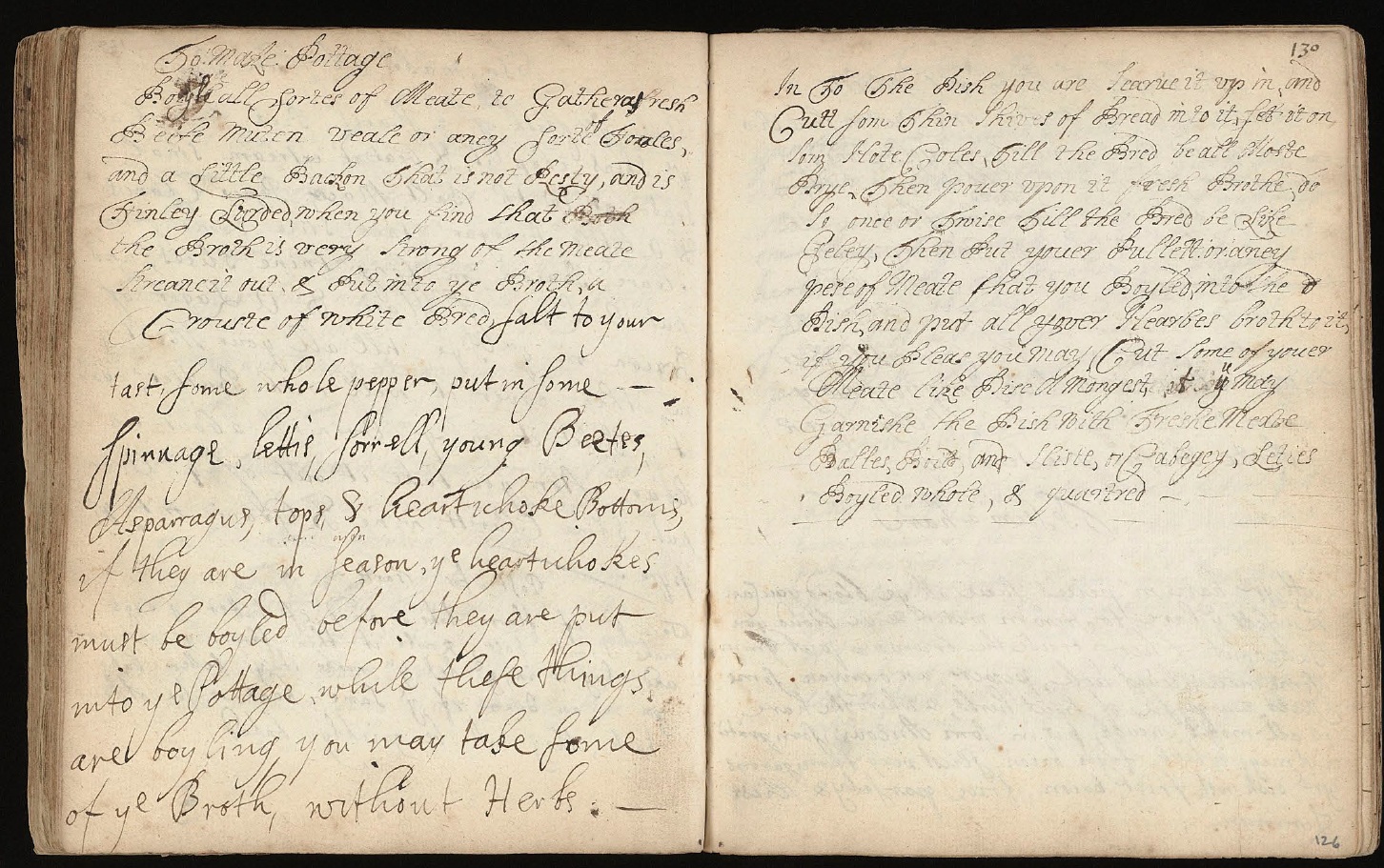
Turns out, it is quite the Palaver, possibly even bordering Malarkey! We have beef, we have mutton, we have veal, we have a range of unspecified poultry and we also have bacon. And this is just to make the broth! Then we need to add seasoning and greens, specifically spinach, lettuce, sorrel, young beets, asparagus tops and artichoke bottoms. And while all that is going on, we have a quick side-quest to prepare the serving dish and rustle up garnishes by dicing up the meat that was boiled, making and slicing fresh meatballs. and boiling and slicing cabbage lettuces. *mops brow* I’m exhausted just from typing that all out!
I’m also quite amused by the apparent ‘three stages of pottage’ handwriting styles. It’s almost as if we too have been on something of a journey with the recipe writer, who starts out using a calm and flourishing hand in the beginning, with just a couple of smudges, where it’s all ‘throw it in a pot’ – simple, straightforward. When I first re-read the recipe, I actually thought it ended after the first paragraph, and was rather puzzled that my notes said it was a very detailed recipe. Because then we enter what is obviously a manic phase, where greenery is having to be prepped and shredded and simmered. The handwriting style is all over the place. Perhaps it all got too much for the cook and she delegated to an underling when the frenzy of pottage-making took a bit of a turn. The final section, on the second page, is much more sedate and calm: the neat handwriting has returned and you just know that, even though there is quite a bit of detail in finishing off the dish, this part of the account has been written in a much less frenzied atmosphere, after the author has almost certainly had a bit of a lie-down in a dark room and possibly a stiff drink to calm the frazzled nerves. All in all a veritable pottage saga! Who knew cooking soup could be such a rollercoaster!
All of which is in complete contrast to the recipe we’re actually doing today, namely Carrot Soup.
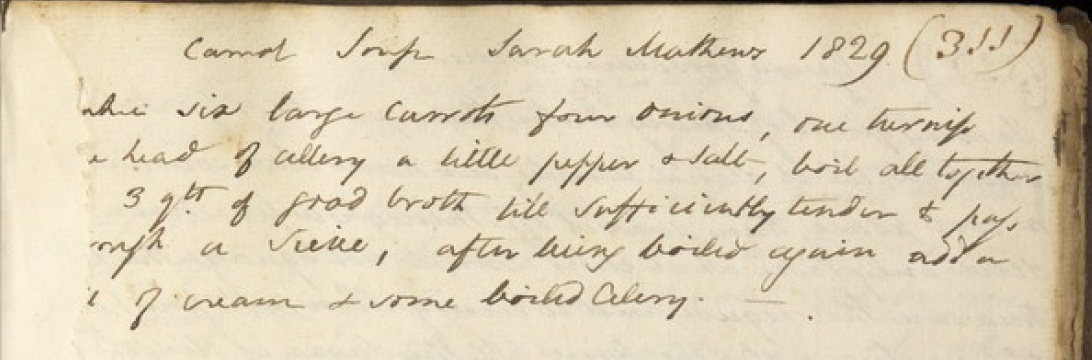
Helpfully including details such as provenance (Sarah Mathews) and a date of 1829, this late-Georgian recipe is the epitome of simplicity: vegetables in a pan, add stock, cook, puree, garnish, serve. Bish, bash, bosh. Done.
It is also, however, slightly sneaky in that it includes lots of vegetables that give body to the soup and round out the flavour but are undetectable in the final serving. There’s no need for flour thickening – great for anyone with a sensitivity to gluten – and just some slight adjustment with the finishing can easily make this vegetarian soup vegan by swapping out the butter for a suitable alternative
Carrot Soup
This is a scaled-down version of the above recipe, which makes four generous meal-sized servings. You can add more vegetables if you like – another similar recipe I found suggested adding 2 leeks, which I didn’t have, but I did have a bunch of spring onions that needed using up, so in they went. The garnish is a mixture of a swirl of cream and diced celery tossed in sage butter.
500-600g carrots
2 onions
1 turnip (and/or small swede)
1 small celeriac
(optional) 2 leeks/bunch of spring onions
60g butter
1 litre vegetable stock (1 litre of water + 2 stock cubes)
To finish
150ml cream
3 sticks celery
60g butter
10-12 sage leaves (optional)
coarse-ground black pepper
- Peel and chop all the vegetables to roughly the same size – I used my trusty mandolin slicer fitted with the wide/large blade.
- Put the vegetables in a pot with the butter and cook gently until softened.
- Add the vegetable stock and cover.
- Simmer until all the vegetables are tender. (about 30 minutes, depending on how large the pieces are).
- Use a stick blender or liquidiser to puree the soup smooth. For extra smoothness, pass the soup through a sieve.
- Rinse the pan, pour the pureed soup back in and heat gently.
- To Garnish
- While the vegetables are cooking, cut each of the celery sticks into 3 pieces and add to a pan with enough water to cover.
- Simmer for 20-25 minutes until tender. Drain.
- Using a sharp knife, cut the cooked celery lengthwise into strips about 1cm wide, then across making 1cm cubes.
- Melt the butter in a pan and toss in the sage leaves. Fry until just crisped.
- Add the cubed celery and heat through.
- Serve the heated soup with a swirl of cream and a spoonful of the celery/sage butter. Finish with a sprinkling of black pepper.