Ormskirk Gingerbread

If you’d asked me only a few years ago, of my opinion of gingerbread, I would have given an indifferent shrug in response: I didn’t dislike it, but I wasn’t a fervent fan either. Ginger biscuits and the gingerbread used for gingerbread men I thought dull. Ginger cake was fine, but it would never be a first choice. Since then, I have discovered so many old recipes that have range and depth and nuance that it’s turned my head completely. And here we have another to add to the collection.

Ormskirk Gingerbread has a lot going for it, and I’d even go so far as to say it is probably one of the best-tasting gingerbreads you’ve never heard of.

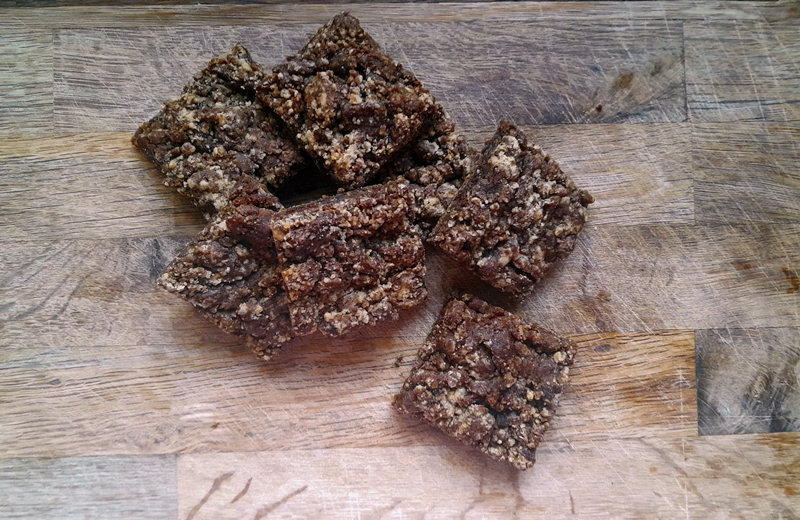
It has a speckled appearance, from mixing the dry ingredients with melted butter and treacle, which is enough to bind, but not drown. There is candied peel, traditionally lemon but sometimes others, and spices, usually ginger, but frequently, additional spices as well. A major attraction, for me at least, is the texture, falling between the softness of parkin and the crispness of a biscuit. As you, quite literally, sink your teeth into a piece, you experience a dense chewiness which, with the variety of flavourings, is immensely satisfying.

Ormskirk Gingerbread (1830s) is  one of the earliest geographically-linked gingerbreads I’ve found – predated only by Wrexham Gingerbread (1828). In the 1850s, a group of five local women paid £20 per year to the East Lancashire Railway company for the privilege to sell their gingerbread to travellers passing through Ormskirk station, which must have contributed to the spread of its popularity.

I have a selection of recipes for you to try, because in all honesty, I like them all. The method is the same for all of them, so I shall be listing the scaled-down ingredients alongside each recipe, then you can scroll down to the method and cooking instructions. All quantities are for a 20cm square tin.
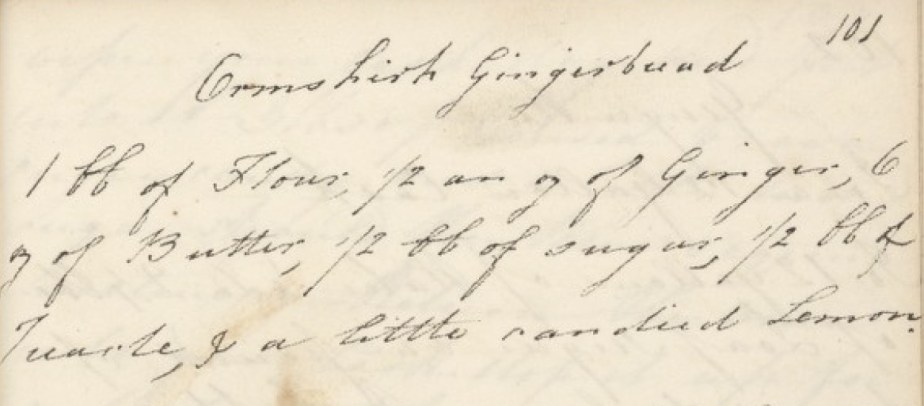
Ormskirk Gingerbread recipe, (1822-1841), MS4998, Wellcome Collection

This recipe is from a handwritten manuscript held at the Wellcome Collection. It might actually be older than the recipe below, but there’s no way of telling for sure. Rather unhelpfully, there are no instructions for either making or baking, but it clearly contains all the classic ingredients and is a great introduction to this type of gingerbread:

225g plain flour
115g soft, light brown sugar
7g/1tbsp ground ginger
85g butter
115g treacle
20g candied lemon peel
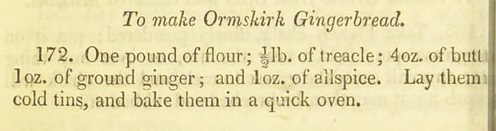
From: The domestic receipt-book by Joseph Worrrall, 1832, p38.

This is the earliest printed recipe I found. Unfortunately, it contains an error – the sugar is missing. Aside from this, what I found interesting was the complete omission of what appears to be a major component of other recipes, the candied lemon peel.  In  addition, there is, proportionally, a lot of spice in relation to the quantity of flour, but it is an interesting variation. In the past, I have bought dried, chipped ginger, and ground it as needed, and the flavour is bright and vibrant and, curiously, with a touch of lemon. Similarly with allspice, whose flavour really evokes a blend of spices.

225g plain flour
60g butter
115g treacle
115g soft, light brown sugar
14g ground ginger
14g allspice
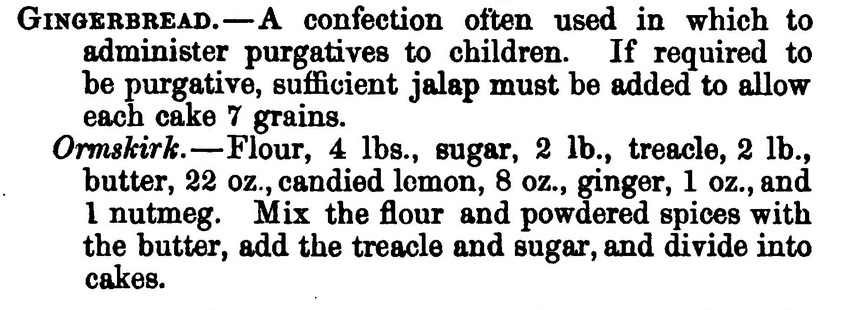
From The druggist’s hand-book of practical receipts, Thomas F. Branston, 1853, p80

This recipe echoes the medicinal uses many believed gingerbread possessed in the middle ages. I find it odd that it is Ormskirk Gingerbread that is specified in particular, instead of a generic gingerbread recipe. Jalap is the ground root of a Mexican plant of the Morning Glory family, and it was used in times past for its laxative effect.

225g plain flour
115g soft, light brown sugar
115g treacle
80g butter
30g candied lemon peel
2 tsp ground ginger
1½ tsp ground nutmeg
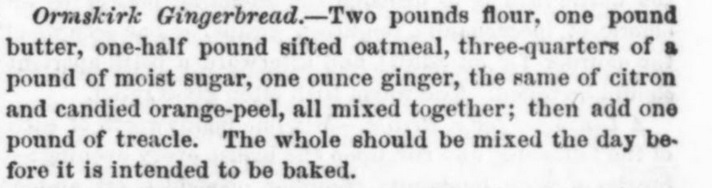
Peterson Magazine 1861-01: Vol 39 Iss 1, p93

This last recipe is a full-on, all the bells and whistles version. There’s no candied lemon peel – instead there’s candied orange and candied citron and, aside from the ginger, no other spices. There’s a higher than usual farinaceous component, with the addition of some oatmeal flour (which you can make yourself by putting rolled oats into a blender/spice mill). Finally, there’s the instruction to mix it a full day before you want to bake it. Many old gingerbread recipes have this added time requirement, because they’d also use alum and potash as raising agents, and these worked slowly, so a mix for gingerbread could be sitting in a tub for days if not weeks. There’s no raising agent included in this recipe, so I was curious whether there would be any difference to the other batches. Verdict: There was, and the resulting gingerbread was definitely veering towards cakey, although this might have been due to the added oatmeal – if that’s your preferred texture, have at it. The next time I make this I probably wouldn’t wait the 24 hours, but that’s just me being impatient.

225g plain flour
115g butter
60g sifted oatmeal flour
80g soft, light brown sugar
115g treacle
15g candied orange peel
15g candied citron peel
7g ground ginger

As I said at the top, all these recipes are delicious.

Ormskirk Gingerbread

Another reason to choose to make this gingerbread is that it can be made gluten-free, using gluten-free flour (I used Doves Farm) and gluten-free oats (Morrisons have the nicest looking GF oats – they’re like steel-rolled ones!).

It can also be made vegan, if you swap out the butter for either coconut oil or some other fat that is solid at room temperature.

Finally, there’s two slight variations in method, and it relates to how you handle the butter. The traditional method for gingerbread is to melt it in the treacle and then pour the mixture into the dry ingredients to mix. The other method is to blitz it with the dry ingredients in a food processor (or rub it in by hand). It doesn’t matter which method you choose, as the result is the same.

  • Choose your ingredients from one of the four recipes above.
  • Line a 20cm square tin with baking parchment.
  • Heat the oven to 160°C, 140°C Fan.
  • Mix your spices, sugar and flour(s).
  • If you’re blitzing the butter with the dried ingredients, add it now.
  • Blitz the mixture to resemble breadcrumbs.
  • Slice the candied peel thinly and then cut into 1cm pieces. Mix the peel into the dry ingredients, making sure the pieces don’t stick together.
  • Pour your treacle into a pan to warm. I use a large frying pan, as I prefer to add everything to the treacle, as opposed to pouring the treacle into the dry ingredients. Add the butter if you’ve not added it to the flour. You’re not trying to boil it, just warm it up enough that it moves freely and the butter (if using) is melted.
  • When the butter has melted and the treacle warmed, pour  the warm liquid into the dry ingredients and mix in. It doesn’t have to be evenly coloured.
  • Tip the mixture into your prepared pan and level out. I like to leave it rather roughly textured. Don’t press the mixture down hard, just even it out.
  • Bake for 40 minutes, turning the tin around after 20 minutes to ensure even baking.
  • Remove from the oven and , leaving the gingerbread in the tin, divide it into pieces. You can cut it into any shape you please – easiest with a square tin is 16 pieces (4 x 4 grid).
  • Set the pan aside to cool completely.
  • When the gingerbread is cold, store in an airtight container.
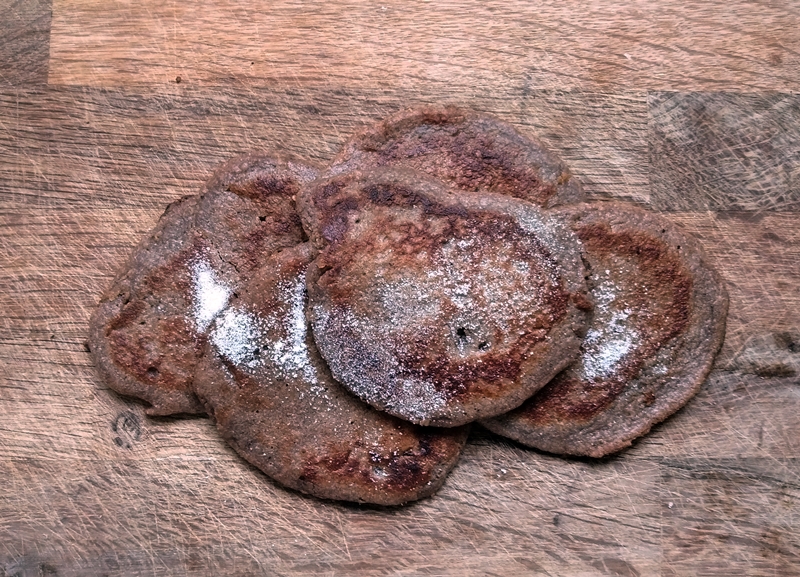
Oatmeal Pancakes


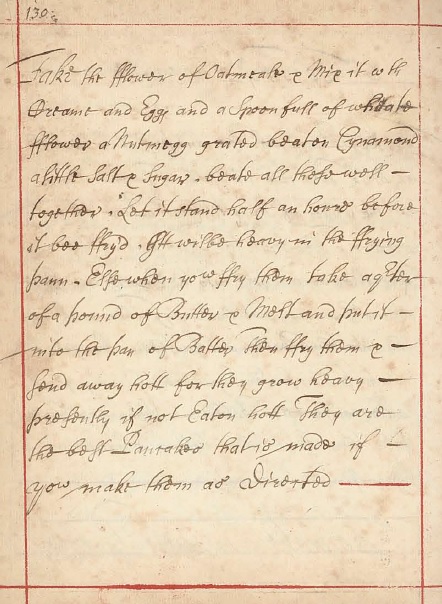
This recipe comes from the manuscript of Jane Newton dated circa 1675-1700. I like Jane’s manuscript a lot – she has ruled out the pages with red margins, still bright after more than 300 years, and stamps her character on them with occasional personal comments that are a pleasure to find. The one that always sticks in my mind is her snappily titled “To Make the Puffs I was Speaking of Before in my Pottage”.

Oatmeal Pancake Recipe
Oatmeal Pancake Recipe from Jane Newton’s manuscript, 1675-c1700, MS1325, Wellcome Collection

I chose this recipe this week because tomorrow is Shrove Tuesday and someone out there might fancy something different to the regular lemon & sugar pancakes. (Ratafia Pancakes are another option). Also, Jane’s comment at the bottom of this recipe: “They are the best pancakes that is made if you make them as directed” – quite the gauntlet you’re throwing down there, Jane! I’d have initially made it as written anyways, but now I’m feeling Jane’s beady eye on me. No pressure.

Long story short – she’s right. They might look fairly ordinary, but they are the first pancakes that I’ve tasted that I could eat with no further adornment. Yes, I know the picture shows them dusted with sugar – I added it for photographic purposes only. The batter is sweetened and spiced, and, as all good recipes using oatmeal, lightly salted which kicks in at the end of each mouthful as a delightful contrast.

Oatmeal Pancakes

60g medium oatmeal flour
150ml single cream
1 large egg
1 large yolk
1tbs plain flour
1tsp ground nutmeg
1tsp ground cinnamon
½ tsp salt
2tbs caster sugar
30g unsalted butter – melted

  • Mix all the ingredients, except the butter, thoroughly and allow to stand for 30 minutes.
  • Stir through the melted butter until combined.
  • Melt some butter in a non-stick pan on medium heat. Add spoonfulls of the batter into the pan, you can cook 3 at a time.
  • Turn the pancakes when the undersides have browned.
  • Remove cooked pancakes to a sheet of kitchen roll.
  • Enjoy warm as is (it really is the best way) or with your favourite toppings.


Chocolate Cakes

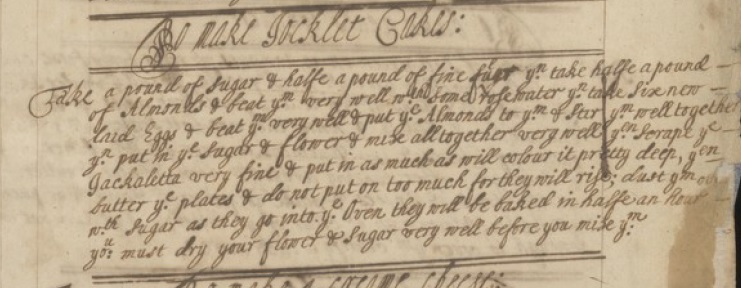
Whilst poring over old manuscripts, I love finding really early examples of recipes we would recognise today. And so I was delighted to come across this recipe for chocolate cakes. It appears near the front of a manuscript (MS1799, dated 1700-1775) digitised by the Wellcome Collection, and so, in my opinion, is closer in date to 1700 than the latter half of the century. The reason it caught my eye was because it reads as a ‘normal’ cake recipe, very unusual for the time.

18thC Chocolate Cakes
Chocolate Cakes, MS1799, (1700-1775), Wellcome Collection

Experience has led me to be cautious when it comes to the word ‘cake’ appearing in old recipes. In times past, this word was used for a broad range of ‘items that were circular’, rather than the baked confections of flour and eggs we associate with the word today. In the past I have been thrilled to find early recipes for lemon cakes and gooseberry cakes, only to find that they are for fruit paste and jellies, musk cakes that turn out to be incence, puff cakes that are meringues, rout cakes that are biscuits and spice cakes that are buns.

Even ‘chocolate cakes’ can catch the unwary, as many old recipes sporting such a title are actually instructions for making solid blocks of ‘chocolate’ ready to use in recipes. Unlike the cocoa powder we buy today, these ‘cakes’ were similar to the modern blocks of Mexican chocolate: solid, hard and requiring grating before use. The old recipes for ‘chocolate’ begin with the roasting of the cocoa beans, which are then pounded and ground extremely fine and mixed with sugar, vanilla and spices before drying in cakes which are then stored for use, which makes me incredibly grateful that we don’t have to go through such Faff today.

Happily, this recipe omits the time-consuming ‘make your chocolate’ part, but in adapting this recipe for modern use, if an authentic 18thC flavour is required, the spices that would be part of the original cakes of ‘chocolate’ need to be added in. The quantities below might seem a lot, but there’s also a lot of cocoa, so to make sure they can all sing, the quantities need to be generous. You can play around with the spices to your taste – other chocolate recipes I’ve read include one or more of the following: allspice, cloves, aniseed, cardamom, musk, ambergris, and either achiote or cochineal for a reddish colour.

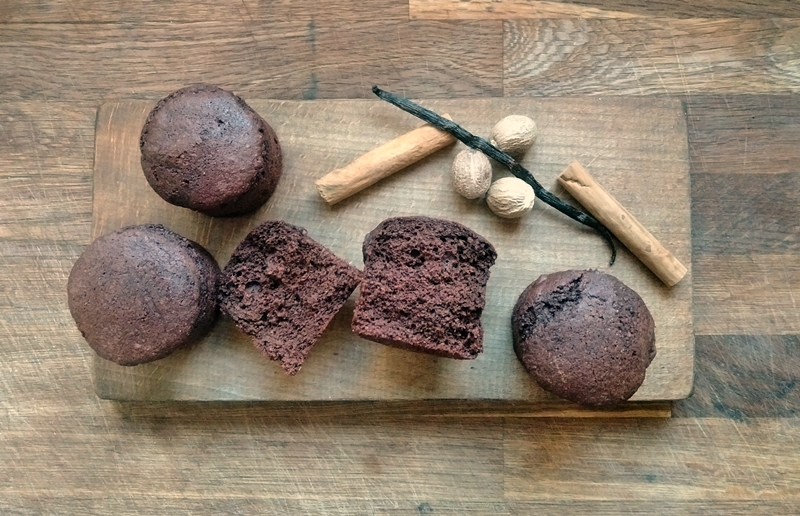
So what are they like? Well, to be honest, it took several batches of tweaking before I was happy with the result. The taste is intensely chocolate-y, and the addition of the spices makes for an unusual and rich flavour. In the interests of full disclosure, as can be seen from the photo, these are dense cakes, and are most definitely not of a lightness of a Victoria sponge, or even a sturdy Madeira cake. But to be frank, that is part of their charm. Since they are made without butter, I would recommend serving/eating them with some lightly whipped cream, or ice-cream, for the mosture as well as the contrast in texture and temperature: the rich warmth and spiciness of the cake against the cold cream is deliciously satisfying.

These cakes include ground almonds, which help to enrich the texture, but also require a little time to work their magic. Consequently, if you’re not eating them straight from the oven, these cakes benefit from being kept 1-2 days in order for them to soften. Freshly-baked, but cooled, they are rather – ahem – ‘firm’, but stick them in a ziplock bag for a day or two and they soften and become glossy and a little sticky (in a good way).

If you’d like to make a less sturdy, more modern sponge version, all it takes is the addition of 1.5tsp baking powder, sifted with the flour.

I used a silicon cupcake mould with straight sides, which look great, but, even thoroughly buttered, proved challenging when it came to getting the cakes out in one piece. Other options might be ‘regular’ bun/cupcake moulds, or use paper liners.

Chocolate Cakes

Circa 1700. Makes 8-12, depending on your small cake tin size.

30g melted butter
150g sugar
3 large eggs
1tbs vanilla extract/paste/seeds of 1 vanilla pod
40g cocoa powder*
2tsp ground cinnamon
1tsp ground nutmeg
75g plain flour
1.5tsp baking powder (optional)
pinch salt
75g ground almonds

  • Heat the oven to 180°C, 160°C Fan.
  • Grease your moulds with the melted butter.
  • Whisk the eggs and sugar together until light and foamy (5 minutes or so).
  • Sift together the flour, cocoa, spices, salt and baking powder if using.
  • When the eggs are foamy, use the whisk attachment (or a balloon whisk) to gently fold in the flour mixture.
  • Stir in the almonds.
  • Portion the batter out into the greased moulds.
  • Bake for 18-20 minutes, turning the moulds around after 10 minutes to even the baking.
  • Remove from the oven and allow to stand for 10 minutes to firm up.
  • Run a thin blade around the edges of the cakes (if not using cupcake papers) and gently ease the cakes from the moulds and cool on a wire rack.
  • Enjoy warm with cream, or place in an airtight container for 1-2 days to mellow.

* Modern cocoa is very drying, so if you’d like to use more than this amount, reduce the quantity of flour by that same amount. i.e for 50g cocoa, use just 65g flour.

Chelsea Buns

Back in  2013 I wrote an article on the history of Chelsea Buns, ultimately included in my book Great British Bakes which culminated in a recipe suggestion for the original Chelsea Buns.

I based the recipe on anecdotes that appeared in various publications on the borough of Chelsea and its surroundings, mostly written in the mid-to-late nineteenth century.

Before me appeared the shops so famed for Chelsea buns, which, for above thirty years, I have never passed without filling my pockets…. …….These buns have afforded a competency, and even wealth; to four generations of the same family; and it is singular, that their delicate flavour, lightness and richness, have never been successfully imitated.”i

To be good, it should be made with a good deal of butter, be very light and eat hotii

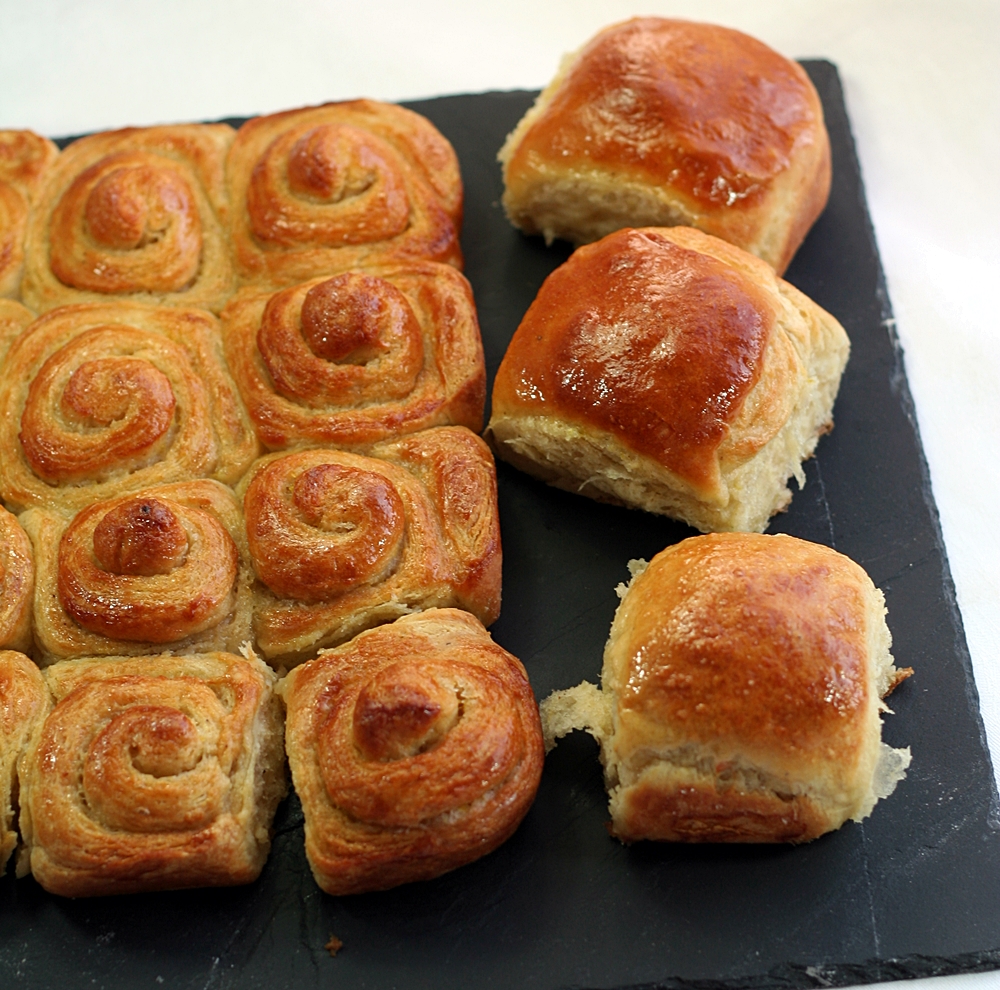
“The old Chelsea Buns were greatly in demand and were a superior kind to our common buns, more like Bath Buns. Old people say they were very rich and seemed full of butter. They were square in form and were made with eggs, with the kind of sugar, lemon and spice but without fruit.”iii

“Note that the true Chelsea Bun of the Hands family was by no means the darksome and dismal lump which is now sold us as a hot cross bun. On the contrary, it was specially famous for its flaky lightness and delicate flavour.”iv

“It was not round, but square in shape, and it came into the world in batches, the several individuals crammed as close together as the cells of a honeycomb…..Excellent they were—light, sweet, glistening as to their crowns in a sort of sugary varnish, and easy of digestion.”v

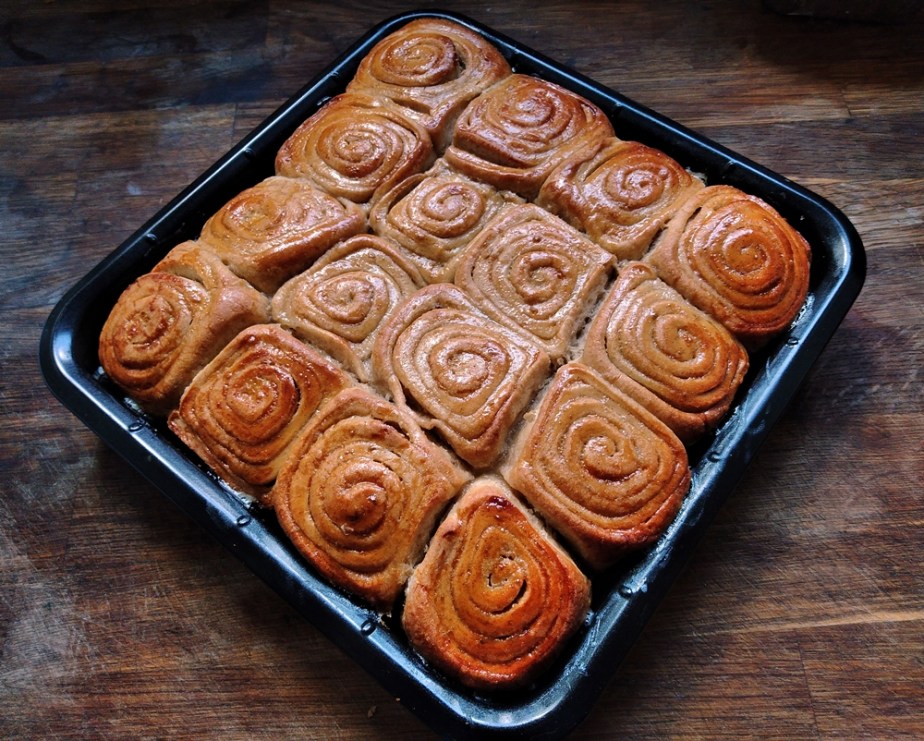
There was no mention of the fruit which adorns the modern version of the bun, neither was there mention of the spiral. The recipe I came up with was therefore fruitless and a regular bun shape. I couldn’t quite let go of the iconic spiral shape, though, so baked a version in this shape, too. Below is one of the original photographs taken for the book.

Chelsea Buns

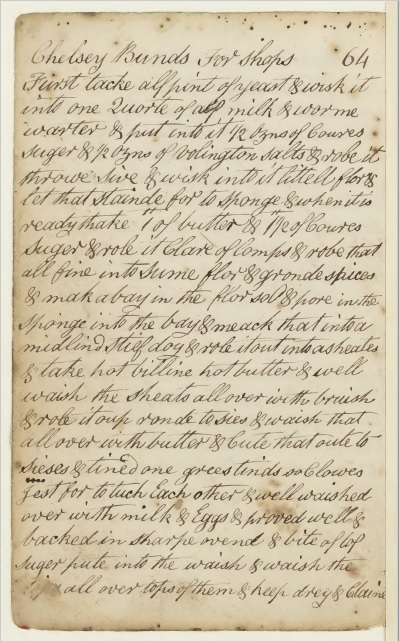
Fast forward to 2020 and last week I discovered a recipe for Chelsea Buns in a manuscript (MS10979) held by the National Library of Scotland. This was very exciting, because the manuscript was dated circa 1827, which is a time when the original Chelsea Bun House was still in business. (It was eventually torn down in 1839). Prior to this, the earliest recipe available had been the one published in 1854 in George Read’s The Complete Biscuit and Gingerbread Baker’s Assistant (p103).

Recipe for Chelsea Buns from a c1827 anonymous manuscript (MS10979) at the National Library of Scotland.

The recipe itself is rather challenging to read, but there are a couple of details that I think deserve pointing out. The recipe title “Chelsea Bunds for shops” suggests that the recipe was for an independant baker, who sold his/her wares wholesale. Perhaps s/he only had a baking premises and not a shopfront. The other detail is the tiny diagram  on the bottom left of the page, showing how the buns are to be laid out: laying the buns like this will ensure the characteristic square shape once the dough has risen.

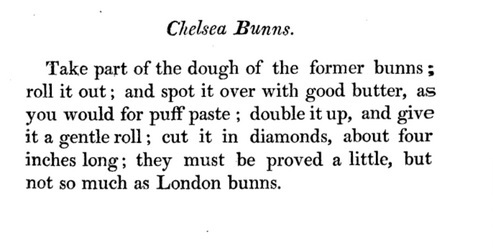
As luck would have it, and paraphrasing the well-known bus analogy, you wait seven years for a recipe, and then two come along at once. Also last week I spotted another early Chelsea Bun recipe, which had heretofore hidden from my internet searching by the cunning ruse of calling itself Chelsea Bunns. It appears in A Treatise on Confectionary, in all its branches, with practical notes, etc (1817) by Joseph BELL (p36, see below).

Chelsea Bunns

The previous recipe referred to is one for London Buns – flour, sugar, butter, yeast, and no spice. The shaping of the buns in this recipe is also unusual: I’ve never heard of Chelsea Buns being diamond-shaped, and it makes me wonder whether the author was confusing them with another bun, and if so, which?

I used to be rather evangelical about recipes for things being the PROPER recipe. Seven years ago, I was very firm in my conviction that a fruitless Chelsea Bun was the PROPER recipe and the fruit-filled, overblown, too-heavily-glazed monstrosities on sale in bakeries were borderline abominations. Now I’m much more laid back, having come to understand that, just like us, recipes have a lifespan, some longer than others, over the course of which changes happen. In the 18th and early 19th centuries, the light and gently-spiced Chelsea Buns were extremely popular. Over time, personal taste, or possibly economics (costs of dried fruit & sugar) saw a change to fruit-filled buns being favourite. It is absolutely possible to like one style of Chelsea Bun over another, and liking one style doesn’t invalidate the other in the slightest.

So enjoy whatever floats your boat – or in this instance, fills your bun.

Chelsea Buns

This recipe doesn’t contain any lemon, as mentioned in one of the anecdotes. Since it was the only reference I found that did mention lemon, I’m reserving judgement on whether it was a regular ingredient in the original. However, if you’d like to include some, I suggest the zest of one lemon, and just one teaspoon of spice.

1 sachet fast-action yeast
150ml hot water
150ml milk
500g strong bread flour
75g unsalted butter
110g soft brown sugar
2tsp mixed spice

150g melted butter for glazing

1 large egg
50ml milk

3-4tbs icing sugar

  • Mix the milk and water together, then add the yeast, 1tsp of sugar (from the listed amount) and 3-4tbs of flour (again from the given amount).
  • Whisk all together thoroughly, and stand aside for 15 minutes until the mixture starts to froth.
  • Put the rest of the flour, sugar, butter and spice in a food processor and blitz until thoroughly mixed.
  • Combine the wet and dry ingredients and knead for 10 minutes. Add more flour if the mixture seems a little too soft. If using a machine with a dough hook, make the last 2 minutes maximum speed, to pull the dough together.
  • Tip out the dough and roll into a thin (5-10mm) sheet on a floured surface.
  • Cover the whole surface with melted butter, using a pastry brush.
  • Roll up the dough from the long side, keeping it tight. This will be a little tricky to start, on account of the butter making it slippery.
  • Brush the outside of the roll with more melted butter.
  • Grease a 24cm square tin.
  • Starting from the centre of the roll, slice off 4cm rounds and place them cut-side upwards in the tin. You should get 16 well-shaped slices. The smaller end pieces can be placed in cupcake tins to bake.
  • Whisk the egg and the milk together to make a glaze and paint the cut surfaces of the buns.
  • Cover the glazed buns lightly with greased clingfilm and allow to prove for 45minutes or until doubled in size.
  • Heat the oven to 180°C, 160°C Fan.
  • Glaze the buns again just before going into the oven, and bake for 25-30 minutes until risen and golden. The smaller bun offcuts will only need 20 minutes
  • As the buns are baking, mix the sugar into the remainder of the glaze, and brush over the cooked buns as they come out of the oven. The heat of the buns will set the glaze and the sugar will make them extra shiny.
  • Cool in the tin to keep the sides soft. Cover with a clean cloth to cool if you like the tops soft as well.
  • Enjoy warm.

_ _ _ _ _ _ _ _ _ _

i“A Morning’s Walk from London to Kew”, p22, Sir Richard Phillips, J Adlard, London 1817

iiGentleman’s Magazine and Historical Chronicle, Volume 11, 1839, p466.

iiiThe Village of Palaces (1880) Vol II, p191

iv“By Chelsea Reach: some riverside records” Blunt, R. 1921. London. p55

v“Some Savoury Reminiscences”, The People’s magazine, May 4th, 1867, p331


Spiced Strawberry Tart

Jane Parker, 1651 adapted from The Good Huswife’s Jewell, 1587

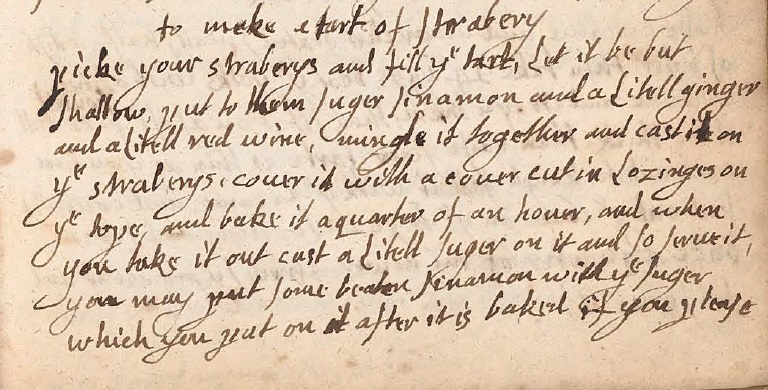
I was drawn to this recipe because it involved spicing strawberries and baking them in pastry, both details being so different from how we tend to use strawberries today. Originally, I was delighted to find the recipe in Jane Parker’s manuscript recipe book¹ but some months later, when I found an earlier version in a cookery book from the previous century, it became at once both more interesting and more delightful. Thomas Dawson’s recipe for strawberry tart², was published in the middle of the reign of Elizabeth I, and is, in all honesty, a little sparse on the level of detail to which our 21st century eyes are accustomed when it comes to recipes. Indeed, it is so brief I can quote it in full below:

To make a tart of strawberries

Wash your strawberries and put them into your Tarte and season them with sugar, cinnamon, and ginger and put in a little red wine into them.

No quantities, cooking times, or even mention of a pastry recipe. It would appear Jane Parker also thought a little extra detail was required, and her recipe is as follows:

Jane Parker's Recipe
Source: MS3769, Wellcome Library Collection

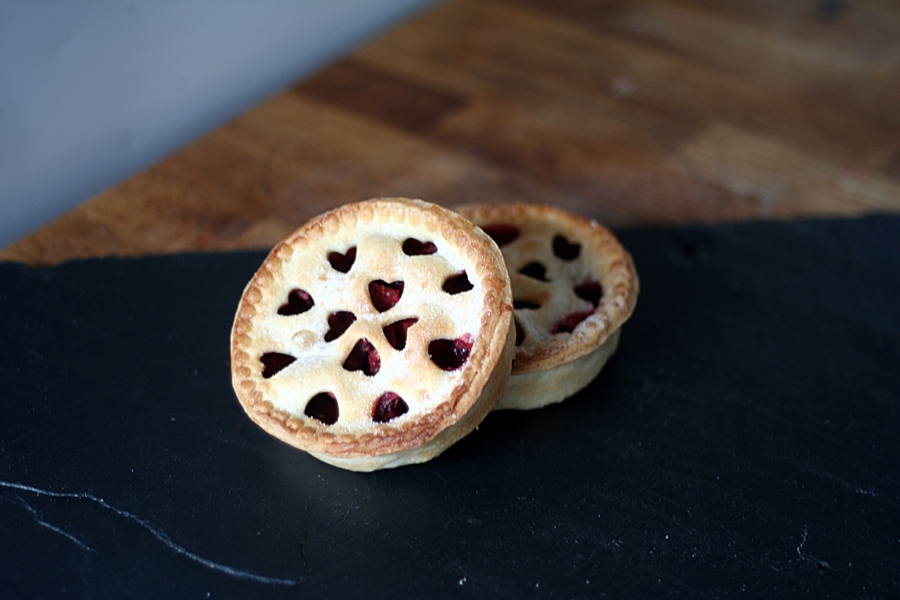
Whilst there’s still no pastry recipe, we do have more detail in terms of presentation: the tart should be shallow, the pastry lid should have diamond cutouts, baking time of 15 minutes and a sprinkling of spiced sugar over the baked tart. These additional details, to my mind, highlight the fact that, even if she didn’t actually make the tart herself, Jane Parker definitely got the recipe from someone who had, as these details are precisely the kind of personal touches an experienced cook would note down for future reference.

After centuries of refinement, the strawberries we now use are impressively large but much milder in flavour than those that would have been used for this originally Elizabethan tart. If you can find sufficient wild strawberries either to mix with your ordinary strawberries or, decadently, to use on their own, their deep aromatic flavour, together with the wine and spices, will make for a much more robust flavour to this unusual Tudor tart.

Spiced Strawberry Tart

1 batch of Sweet Shortcrust Pastry

600g fresh strawberries
3 tbs caster sugar
1tbs cornflour
1tsp ground cinnamon
1 tsp ground ginger
½ tsp coarse ground black pepper
60ml red wine or port
Milk for glazing
1tbs caster sugar
1tsb ground cinnamon

  • Preheat the oven to 200°C/180°C fan/gas 6.
  • Roll out the shortcrust pastry thinly. The thinner the pastry, the less time it will need in the oven and the freshness of the strawberries will be all the better for it.
  • Cut out four lids for your tarts. Cut them generously so that there is sufficient pastry to form a seal with the pastry lining the tins. Use a small diamond cutter or any small shape, to cut a lattice into the lids. Be careful not to cut too close to the edge, otherwise they will be tricky to attach to the rest of the pastry.
  • Gather the trimmings and re-roll the pastry.
  • Grease and line four individual pie tins with the pastry. Let any excess pastry hang over the sides for now.
  • Prepare the strawberries: Remove the stalks and cut into small pieces, either 4 or 8, depending on the size of the strawberries.
  • Put the cut strawberries into a bowl and sprinkle over the red wine. Toss gently to coat.
  • Mix the sugar, cornflour and spices together. Sprinkle over the strawberries and toss gently to mix.
  • Divide the strawberry filling amongst the tins and smooth over.
  • Moisten the edges of the pastry and place the lids over each tart. Press firmly to seal, then trim and crimp the edges
  • Brush the tops with milk and bake for 12-15 minutes until the pastry is cooked and lightly golden.
  • Mix the remaining caster sugar and cinnamon together and sprinkle over the hot pies.
  • Cool on a wire rack.

¹ MS3769, Wellcome Library.
² The Good Huswife’s Jewell, 1587

Bara Brith

This week it’s the classic Welsh speckled bread Bara Brith. Nowadays, this is usually made using baking powder as the leavener, but personally I prefer the more traditional yeast.

And bonus! There’s two recipes for you to choose from!

When looking at an old recipe, I usually study the range of recipes available and select the one that, to my imagination, sounds the nicest. If there is a tie, then I will make both and decide which makes the cut by taste. This time, however, it was too difficult to decide, so I chose not to choose and leave that decision to you.

Both recipes have their strongpoints, not least from their provenance and pedigree.

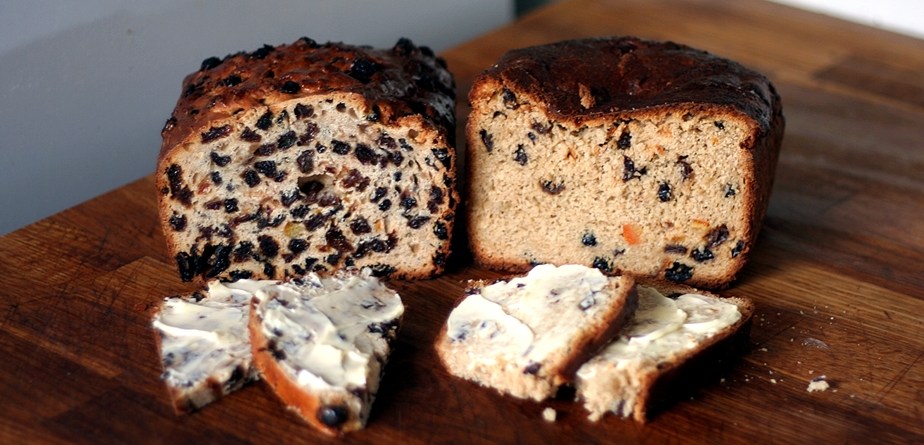
On the left of the photo above, we have the recipe from Walter Banfield’s classic book “Manna”: A Comprehensive Treatise on Bread Manufacture (1937), a book admired by Elizabeth David and breathtaking in its breadth and scope. It is based on additions made to ordinary white bread dough after its first proving. The large quantity of fruit and peel contrast brightly against the white of the dough and make for a very sturdy slice that will keep moist for a long time.

On the right of the photo, a possibly more authentic Bara Breith from Mrs E.B.Jones, who, for many years, ran the Powys Temperance Hotel on Market Square, Llanrhaeadr-Ym-Mochnant in the first half of the 20th century. The recipe was collected by Dorothy Hartley and included in her iconic book Food in England, first published in 1954. As can be seen from the picture, this recipe isn’t as heavily fruited as the first one, but it has the added interest of being made from half wheat flour and half oat flour (finely ground oatmeal). Against expectation, the crumb is very light, making it a much more delicate slice.

I love the richness of the fruit in the bread dough version, but also really enjoy the delicate flavours of Mrs Jones’ version. I suggest you make both and decide for yourself.

Both loaves will keep well wrapped in parchment and foil, in a cake tin. Both are best enjoyed sliced and buttered, with a hot cup of something in front of a roaring fire.

Mrs Jones’ Bara Brieth

Don’t feel the need to order oat flour especially for this recipe, you can make your own by blitzing rolled oats in a spice grinder, or just use medium oatmeal for a more robust texture.

60g candied orange peel – diced
100g currants
70g sultanas
225g strong white flour
225g oat flour or medium oatmeal
115g lard
115g Demerara sugar
¼ tsp salt
1 large egg
1 tsp mixed spice
1tsp soft brown sugar
30g fresh yeast

  • Put the peel and the fruit into a bowl and pour over boiling water. Set aside to plump for about 30 minutes.
  • After 15 minutes, cream the yeast and the soft brown sugar together.
  • Put the flours and the lard into the bowl of a food processor and blitz until the mixture resembles breadcrumbs.
  • Tip into the bowl you will be using for mixing and add the Demerara sugar, spice and salt
  • Drain the fruit, retaining the water, and use it to mix the dough. Keep the fruit warm in a low oven while the dough is kneaded.
  • Add the yeast to the flour mixture with the egg, lightly whisked. Use the (by now just) warm fruit-soaking water to mix everything to a soft dough.
  • Knead for 10 minutes.
  • Mix in the warm fruit, cover with plastic and allow to rise until doubled in size. Due to the richness of the ingredients, this may take anything between 1 and 2 hours.
  • Grease a large loaf tin.
  • When the dough has risen, tip it out and pat down to deflate. Form into a loaf shape and lay into the prepared tin.
  • Cover lightly and allow to rise for about 45 minutes.
  • Preheat the oven to 170°C, 150°C Fan.
  • Bake for 30 minutes.
  • Turn the tin around 180 degrees and lay a sheet of foil lightly over the top, to prevent the loaf browning too much.
  • Bake for a further 25-30 minutes.
  • Remove from the tin and if the bottom doesn’t sound hollow, return to the oven for 5-10 minutes to crisp up. You can place the loaf directly onto the oven bars.
  • Cool on a wire rack.

Walter Banfield’s Bara Brith

450g strong white flour
½ tsp salt
1tsp soft brown sugar
30g fresh yeast
warm water to mix

115g lard in small cubes
5g mixed spice
65g Demerara sugar
1 large egg
300g currants
90g sultanas
90g raisins
60g candied orange peel – diced
50g plain flour

  • Cream the sugar and yeast together with a tablespoon of the flour and a little warm water and set aside to work
  • Mix with the rest of the ingredients into a soft dough.
  • Cover with plastic and set aside to rise for 1 hour.
  • After 30 minutes, spread the fruit (not the peel) out on a baking sheet lined with parchment and put into the oven on its lowest setting, just to warm through.
  • Grease a large loaf tin.
  • When the dough has risen to twice its original size, add in the finely cubed lard, spice, egg and sugar and knead smooth.
  • Add the warmed fruit and peel and mix thoroughly.
  • Sprinkle over the flour and mix thoroughly.
  • Shape into a large loaf and place into the prepared tin.
  • Allow a long second rise, of 1-2 hours.
  • Preheat the oven to 170°C, 150°C Fan.
  • Bake for 30 minutes.
  • Turn the tin around 180 degrees and lay a sheet of foil lightly over the top, to prevent the loaf browning too much.
  • Bake for a further 25-30 minutes.
  • Remove from the tin and if the bottom doesn’t sound hollow, return to the oven for 5-10 minutes to crisp up. You can place the loaf directly onto the oven bars.
  • Cool on a wire rack.