Stuffing Loaf

This recipe might be my finest creation since The Ploughman’s Loaf!

If the name of the blog weren’t already a huge clue, I am a big fan of leftovers, and the bigger the occasion, the greater my happiness.

Because however wonderful the celebratory meal, opening the fridge the next day to an array of already-cooked food requiring only a little reheating – or in the best cases, none at all – is a thing of beauty.

Boxing Day is arguably the Christmas Day of deja food, with the greatest selection of food possibilities. The simplest way to sample these delights is the humble sandwich: a little turkey or chicken, a little ham, a little cranberry, some stuffing…

But the problem with all these little bits here and there is that before long, you’re quickly headed towards a sandwich of Dagwood proportions.

In addition, I love some texture to my sandwiches – the popularity of adding crisps to sandwiches in the UK is well acknowledged. In traditional roast dinners, the stuffing is frequently the star on the plate: crunchy on top, soft underneath, and packed with savoury flavour. However, as a deja food, it loses much of its appeal, being rather bulky and in texture, veering towards the claggy.

The recipe I have here is the solution, and is so simple, I’m surprised it hasn’t occurred to me before: instead of breadcrumbs in the stuffing, put the stuffing flavourings into the bread. The bread can then be toasted for a sandwich and provide crunch and taste without the resulting sandwich requiring the unhinging of one’s jaw.

This recipe is based on my Traditional Stuffing recipe, although you can also use it as a basis for making a loaf from your own family stuffing recipes. To my lovely American readers, I hope you’ll enjoy saving money by making sandwiches at home with this bread on the day after Thanksgiving, instead of joining the wrestling matches at the Black Friday sales.
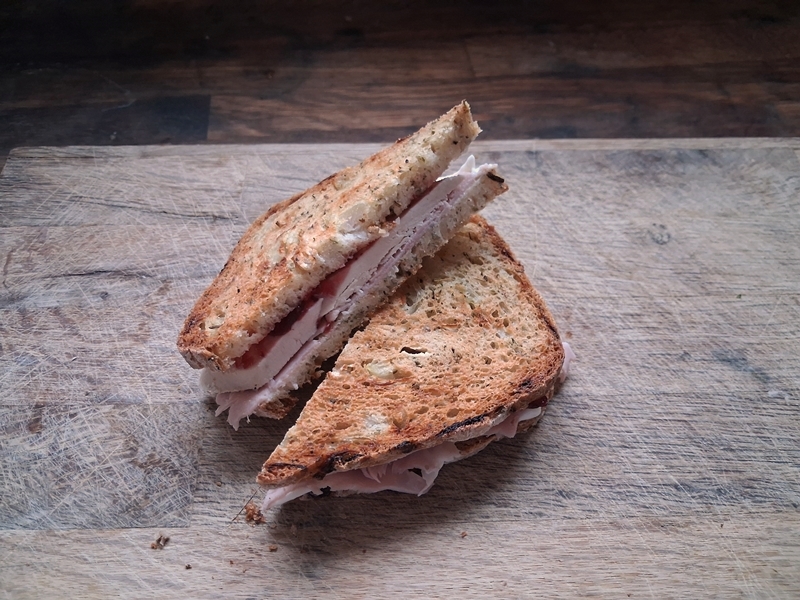
A toasted Stuffing Loaf sandwich with cold chicken, ham and cranberry sauce

Stuffing Loaf

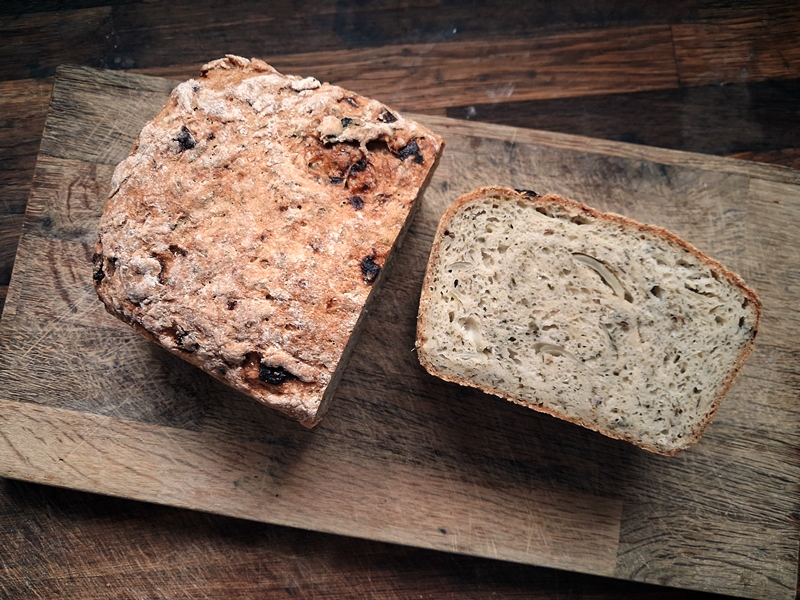
When cooked, this loaf will be a lot heavier than your regular white loaf – after all, it will have an additional half a kilo of onions in it – but provided you let it have sufficient rising times, the crumb will be open and moist (see top photo).

500g onions
60ml vegetable oil
salt and pepper
1 tbs  each dried “Scarborough Fair” herbs, i.e. parsley, sage, rosemary, thyme
1 tbs chicken bouillon powder (optional)
2 sachets fast action yeast
600g strong white bread flour
500ml warm water

  • Peel and chop the onions into 2cm squares.
  • Add the oil to a pan and set over medium-low heat (4 on a 1-9 scale).
  • Add the onions and toss in the oil to coat.
  • Sprinkle with 1tsp of salt to help draw out the moisture.
  • Cook gently until the onions are softened but not coloured, stirring occasionally  – about 15-20 minutes.
  • Season with pepper and sprinkle in the dried herbs and stir to mix in. Cook for another 2 minutes, then remove from the heat and set aside.
  • Mix the bouillon (if using), yeast and flour together.
  • In a large bowl – stand mixer or other – pour in the warm water and add the onion mixture.
  • Add the flour mixture and knead into a dough – around 10 minutes.
  • Cover the bowl with plastic and set in a warm place to rise for at least 1 hour, probably a little longer, until doubled in size.
  • Tip the risen dough out onto a floured work surface and form into a loaf shape.
  • Drop the dough into a large (1kg/2lb) greased loaf tin. Dust the top with flour and lightly cover with plastic. The dough will fill the tin to about 3/4 of its height.
  • Set the loaf aside to rise for at least 30 minutes.
  • Heat the oven to 220°C, 200°C Fan.
  • Arrange the oven shelves so that there is a solid shelf below the rack shelf.
  • Fill a cup with water.
  • When the loaf has risen (and nicely rounded above the edge of the tin), move it into the oven and onto the rack shelf.
  • Pour the cup of water onto the solid shelf and close the oven. The steam will help the formation of the crust.
  • Bake for 30 minutes.
  • Turn the loaf tin around and bake for another 20 minutes.
  • Remove the loaf from the tin and return it to the oven on the rack shelf and bake without the tin for 10 minutes to crisp the crust.
  • Remove the loaf from the oven and cool on a wire rack.
A hot toasted Stuffing Loaf sandwich with chicken and gravy

The Day After Sandwich

Whether it’s Thanksgiving, Christmas, Easter or just your regular Sunday roast, The Day After Sandwich made with Stuffing Loaf is a delicious treat. Obviously, you can make a sandwich any way you like, but I thought I’d offer a couple of suggestions with special reference to using your stuffing loaf.

  • Toast the bread: You’ll get the best stuffing flavour from the bread if its toasted, but here’s my recommendation – ONLY TOAST ONE SIDE OF EACH SLICE. This will give a nice crunch to the outsides and a good contrast with the softness of the filling. Toast both sides by all means, but I found that a bit too crunchy (tho’ that’s probably because I cut the slices thin – approx 1cm).
    Now my kitchen has a minuscule amount of counter space, so I don’t have room for a toaster. Consequently, when I want to make toast, I use the oven grill, so it’s easy for me to only toast one side (move rack to highest level, put in cold, turn on grill setting, 8 minutes). If you have a toaster with a nice wide opening, you can put two slices in together, and then only the outer sides will get toasted.
  • Preparing the inside of the bread/toast. Another of the great choices you can make is to have either a hot or cold filling. I recommend spreading the insides of your bread/toast slices with mayonnaise if planning a cold sandwich, and butter if going for a hot sandwich.
  • For a hot sandwich, warm some slices of chicken/turkey in  gravy and spoon generously into your sandwich.
  • For a cold sandwich, arrange slices of turkey/chicken/ham or a combination, and add a teaspoon of cranberry sauce.
Griddle Scones

Following on from the Slapan last time, I have another bakestone recipe for you – Griddle Scones!

I love a scone. I willfully and shamelessly pronounce it ‘skon’ too – even though I know the etymology dictates that it should rightfully be pronounced ‘sk-ohhh-n’, because that brings images to mind of little finger outstretched and pretensions of grandeur, so I just prefer the short, humble sound of ‘skon’. Fight me.

Traditional scones are absolutely the easiest and best thing to whip up when presented with an Entertaining Emergency™. You can be serving up a batch of fragrant and hot scones in about 30 minutes – and that includes 15 minutes of baking!

Griddle scones are not that kind of scone – the time required is closer to 3.5 hours, start to finish. “Why would I bother waiting around for all that time when I can have some oven scones in just 30 minutes?” I hear you ask. I’m afraid I have no quick response, but for the fact that if you were to make these, you would then have your answer.

So do you like eating soft, billowy clouds? Because making griddle scones is how you get to eat sweet, billowy, buttery clouds. The yeast dough is enriched with double-strength milk, butter, eggs and sugar, and therefore it requires much longer to prove – 2 hours in the first instance. So while it’s a relatively long time, it’s not a hands-on commitment. The second rise can be up to an hour, but I recommend starting cooking half the dough after about 40 minutes – mainly because if, like me, you don’t actually possess a griddle, but do possess a rather nice non-stick pan, you can cook the first half of the dough easily, with plenty of room for manoeuvering the scones when turning them over. I have tried cooking the whole dough all at once, and it was very tricksy – plus the scones expand upwards quite considerably during baking, which was also not helpful in a confined pan space.

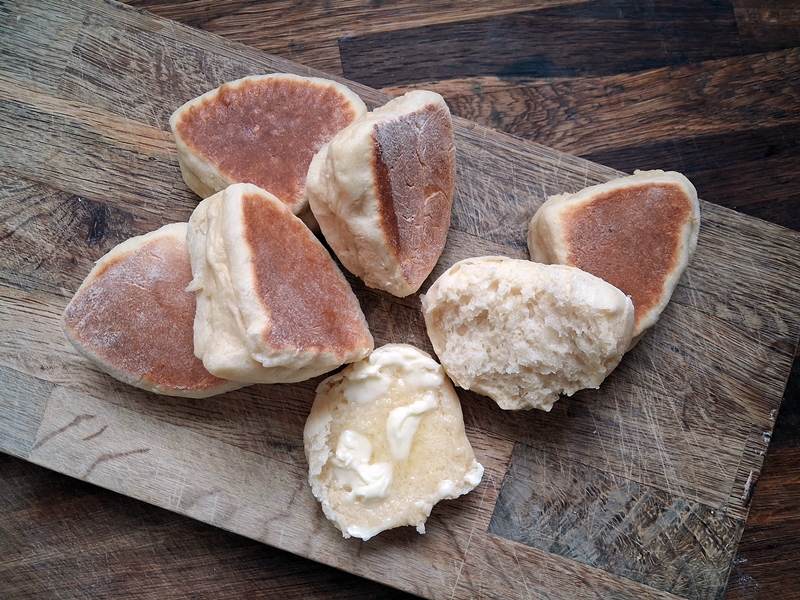
If you’re a fan of muffins then, aside from the extended rising time, this method is pretty much the same, but with one subtle difference. The enrichments of butter, sugar and egg mean that the cooked dough remains incredibly soft. Even when browned, the outsides of these scones never approaches anything remotely close to crusty. The sides of the scones are particularly delicate, and as supple as skin. In enjoying them, we must be mindful of Hannah Glasse’s advice when referring to muffins, in that they must be split/pulled apart, for to use a knife on them when hot, is to squish down the cloud of dough to something claggy and leaden. The best approach I have found is to use a serrated knife to just break the skin of the scone on the sides, then use the tines of two forks to pull the scones apart. You don’t have to use forks, of course, you can just pull them apart – but I must be lacking a bit of skill there, because I always seem to end up with one pillowy side and one thin and somewhat meagre side, and thus reduce the overall eating experience by half.

Griddle scones go back to the 19th century, but this recipe is scaled down and adapted from an absolute classic of griddle/bakestone cookery, “Morning and Hot Plate Goods” by John Boyd (undated, but thought to be 1946-ish) – a veritable cornucopia of commercial recipes from the offices of The British Baker. He calls them fermented scones, but I’ve opted for the more easily understood Griddle Scones.

Griddle Scones

This recipe has the unusual ingredient of ‘double strength’ milk, which is water mixed with twice the usual quantity of milk powder. I use whole milk powder, because that’s what I have in the cupboard, but skimmed milk powder, which might be easier to find, would be fine as well.

145ml water
30g whole milk powder
scant ½ tsp salt
45g unsalted butter
45g caster sugar
1 large egg – beaten
260g plain flour
1 sachet fast action yeast

  • Put the water, milk powder, salt, butter and sugar in a small saucepan and stir over low heat until the butter melts and the sugar is dissolved. Cool to blood temperature, whisk in the egg, then pour into a bowl. Add the remaining ingredients to the bowl and stir until combined. The dough will be very soft and moist.
  • Cover the bowl with plastic, or a cloth, and set aside to rise for 2 hours.
  • Gently tip out the dough onto a floured surface and divide it into two (roughly 270g each). Shape each half into a circle, and pat down gently until it is 2-3cm thick.
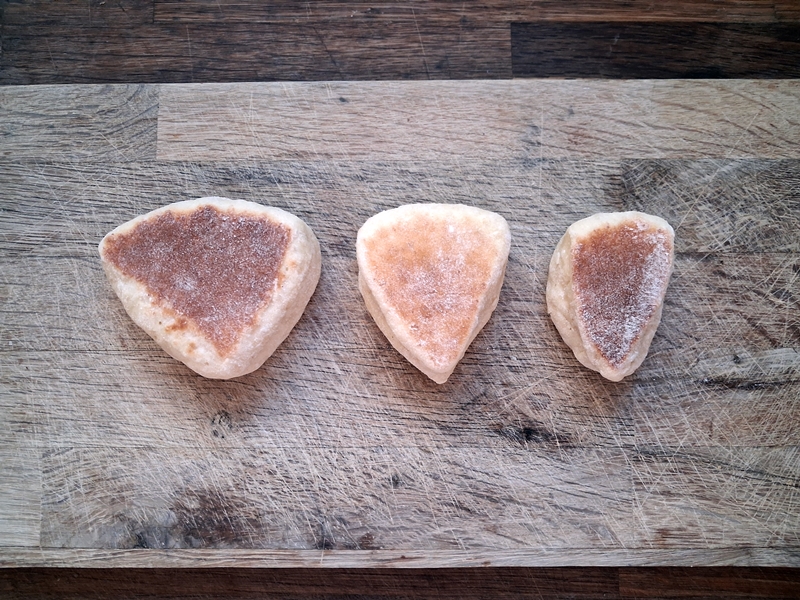
  • Using a dough scraper or similar, cut each round into triangular farls. These can be as few as four or as many as eight.
    The sizes of scone you get whether cutting your round into (L->R) four, six or eight.

    I think six farls is probably the happy medium, unless you’re serving teeny scones for afternoon tea, in which case go with the eight.

  • Slide the farls apart from one another, so that they have room to rise, and cover lightly with a cloth.
  • Leave to rise for 30-40 minutes.
  • Put a non-stick pan on medium-low heat (4 on my hob) and allow it to heat through. This will take about 5 minutes. You want the pan to be evenly hot throughout, otherwise your scones will cook unevenly. No need to grease the pan.
  • Cook your first batch of scones. NB: As you move each scone into the pan TURN IT OVER and cook the top first. By cooking the rounded, risen ‘top’ first, and the already-flat bottom second, your scones will have a much neater shape. Not turning them over will make your finished scones rather misshapen. Still delicious, but not at their best to look at. Spread them out, avoiding the centre of the pan as it will be the hottest. Cook for 4-5 minutes until browned on the bottom, then carefully turn them over and cook until both sides are evenly coloured. Don’t worry if you turned them too early, you can flip them again once the second side is done.They will continue to rise with the heat of the pan, and will become almost wobbly, so try and turn them over in one fluid motion and then don’t touch them until they have cooked for a further four minutes. To check for done-ness, lightly rest a finger on the top of a scone and try to move it gently from side to side: if there’s no longer any wobble, the scone is cooked.  
  • Cool on a wire rack.
  • To serve: If not eating immediately, when time to serve, warm the scones in the oven. Use a serrated knife to break the ‘skin’ on the sides of each scone, then pull apart either by hand or by using the tines of two forks. Butter generously and enjoy.

Cookeels

I have a ‘lost’ recipe for you today – a spiced bun that has been known about, recorded and discussed for over 200 years, but for which there has been no recipe. Until now.

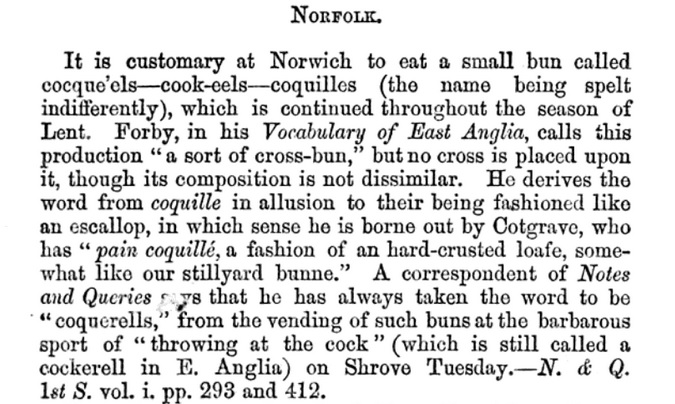
British Popular Customs, Present and Past; Illustrating the Social and Domestic Manners of the People: Arranged According to the Calendar of the Year
By Thomas Firminger Thiselton Dyer · 1876 p81

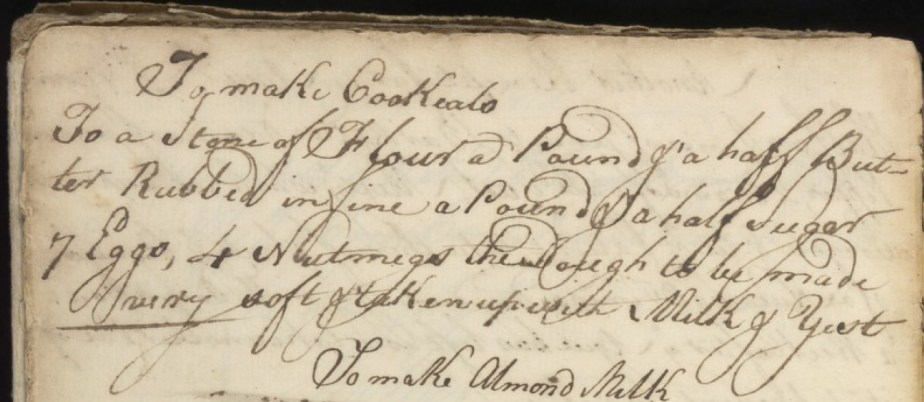
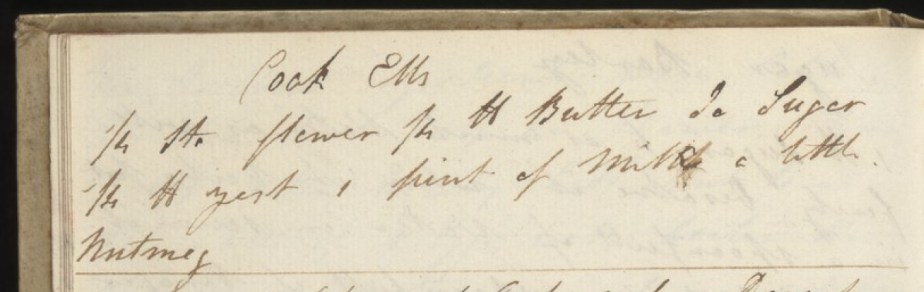
As luck would have it, I found not one but two recipes buried in the handwritten manuscripts held by The Wellcome Collection.

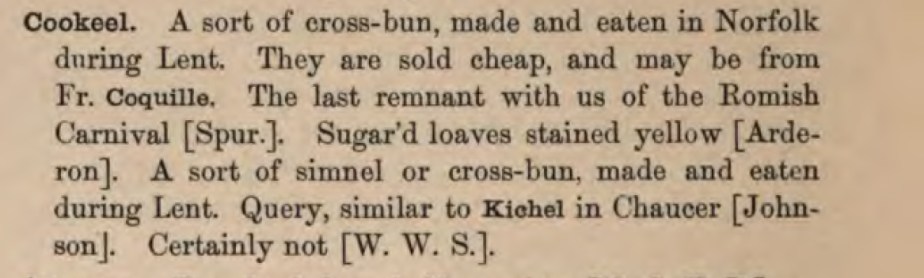
The earliest mention of Cookeels is found in Robert Forby’s The Vocabulary of East Anglia.

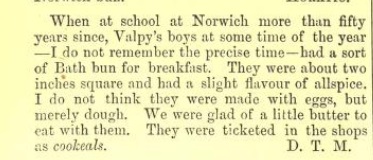
Cookeel: A sort of cross-bun, made and eaten in Norfolk during Lent. They are sold cheap and may be from Fr. Coquille.
The Vocabulary of East Anglia, Robert Forby, 1830, p76.

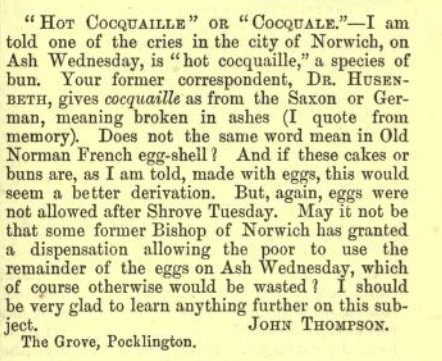
This definition is expanded upon throughout the nineteenth century as more and more academics weigh in with their opinion.

From “A glossary of words used in East Anglia, founded on that of Forby”, p46, Walter Rye, 1895, London
Notes and queries, Fifth Series, Volume Ninth, 1878, Jan-June, London. p87
Notes and queries, Fifth Series, Volume Ninth, 1878 Jan-June, London. p152

Something that became more and more apparent, is the somewhat lackadaisical approach to the spelling of these baked items. This is also true of the names of the two manuscript recipes, to whit Cookeals and Cock Ells:

MS7850, Anonymous manuscript circa 1745, Wellcome Collection

MS7834, Anonymous 19thC manuscript, Wellcome Collection

Confession time, I do like to get the the truth of the matter when it comes to recipe names and history. Love a great backstory, cannot be doing with made-up rubbish. So with all these different names, I decided to drill down and see if I couldn’t get to the bottom of it all (this phrase will come back to haunt me shortly).

I don’t think there’s much merit in the name deriving from the French ‘coquille’ (shell): there’s no hard crust, due to the butter, milk and eggs, and no mention of them being shell-shaped. Similarly, I think naming them after the cockfighting pits is also a bit of a stretch. The various accounts seeme to waver between Cockeel and Cookeel, and neither of the handwritten recipes offer any definitive help.

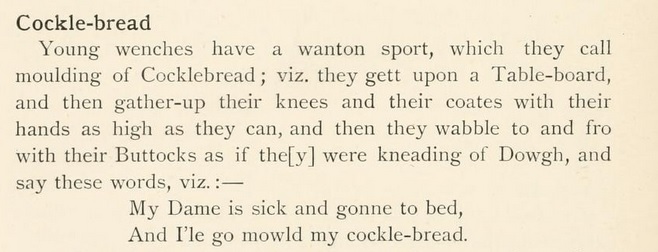
Playing around with the spelling, it turns out that Cockle bread is a thing:

“So far back as the time of Henry III., we find mention made of wassel bread, cockle bread and bread of treet corresponding with the three sorts of bread now in use, viz. white, wheaten and household bread.”

The Englishwoman’s Domestic Magazine, Vol. 1, No. 1, p157, 1852.

Cocklety bread has also been recorded in playground chants:

“The term ” Cockelty ” is still heard among our children at play. One of them squats on its haunches with the hands joined beneath the thighs, and being lifted by a couple of others who have hold by the bowed arms, it is swung backwards and forwards and bumped on the ground or against the wall, while continuing the words, “This is the way we make cockelty bread.”- -Robinson’s Whitby Glossary, p. 40.”

“The traditional games of England, Scotland, and Ireland” 1894-1898, Alice Bertha Gomme, p75

Delighted with this quaint image, I pursued Cockle Bread further – and immediately regretted that decision.

“The traditional games of England, Scotland, and Ireland” 1894-1898, Alice Bertha Gomme, p74

And before I knew it, I was learning that as an extension of this ribaldry, sometimes dough was actually kneaded this way, and then baked and fed to the person whom the girl wished to enamour.

ANYHOO……..Spice buns!

Cookeels

Makes 16

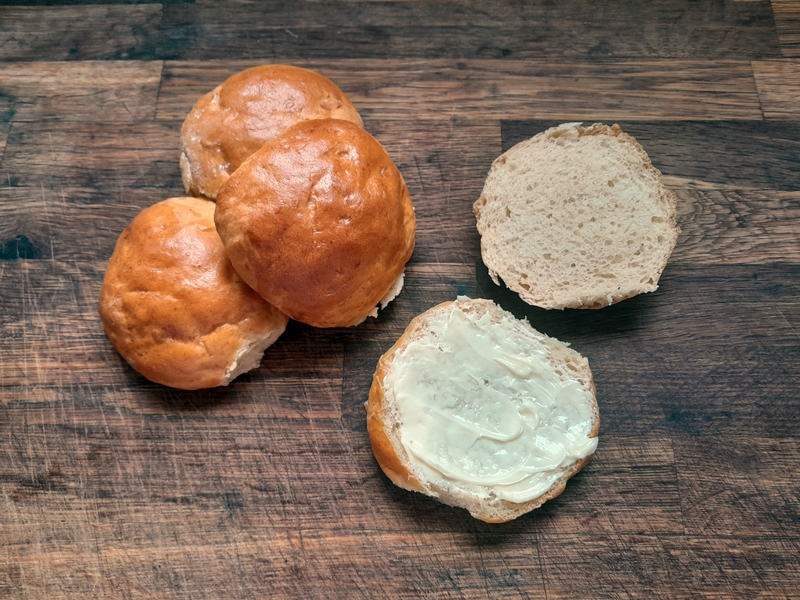
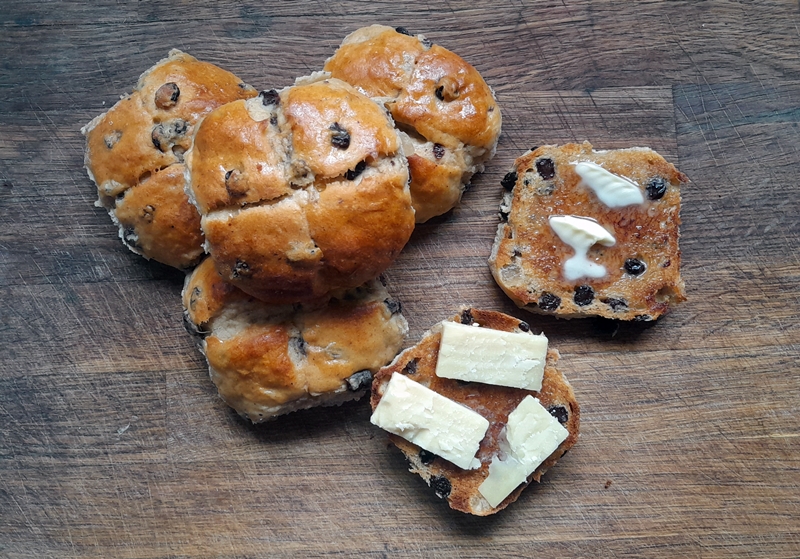
These soft, pillowy buns were enjoyed throughout the season of Lent. Unlike the more famous Good Friday buns, they contained no fruit and neither were they marked with a cross. One of the above anecdotes mentioned allspice as a seasoning, but neither of the recipes do, so we’re going to stick to nutmeg. Usually mixed with several other spices, the fact that these buns have just a single spice adds to their appeal. The enrichment of the egg, milk and butter makes the dough exceedingly soft and the baked bun incredibly tender of crumb. Delicious warm from the oven and freshly buttered, you can also enjoy them toasted with butter and cheese.

150ml water
150ml milk
1 large egg
100g butter
100g caster sugar
pinch of salt
450g strong white flour
2tsp ground nutmeg
1 sachet fast-action yeast

1 large egg yolk
2-3tbs milk

  • Put the dry ingredients into a food processor and blitz until the mixture resembles breadcrumbs.
  • Tip the mixture into a mixing bowl.
  • Zap the water in the microwave for 1 minute. This should heat it but without boiling.
  • Pour the milk into the hot water and stir. It should now be warm. Add the egg to the warm milk mixture and whisk thoroughly.
  • Pour the milk mixture into the other ingredients and mix until the dough comes together. It will be very soft – too soft to knead – but it will become manageable once risen.
  • Cover the mixing bowl with plastic wrap and set aside in a warm place to rise for 1 hour.
  • Cover a large baking tray, or shallow oven shelf for preference, in baking parchment.
  • Once the dough has risen, dust your work surface well with flour.
  • Tip the dough out onto the flour and pat gently to deflate. Dust the surface with flour, then, with the help of a dough scraper, lift and fold the sides inwards and pat down. Continue the dusting and folding until the dough is firm enough to handle. The first time I made this, I put too much liquid in, but it only took three lots of folding to make it manageable.
  • Pat the dough into a square. it will be roughly 20cm, but if it’s larger, that’s fine.
  • Cut the dough into 16 pieces. The easiest way is to cut your square of dough into quarters, then cut each quarter into four.
  • For each piece, fold in the edges of the dough, flip it over and roll into a ball under your hand.
  • Set the shaped dough onto your prepared baking sheet. The dough will spread during rising/baking to the size of a teacake, so space them well apart (7-8cm).
  • When all the dough has been shaped, cover lightly and set aside to rise for 30 minutes.
  • Heat the oven to 180°C/160°C Fan.
  • Whisk together the egg yolk and the milk and brush this glaze over your risen buns. You can use just milk if you prefer.
  • Bake your buns for 20 minutes, turning the baking tray/shelf around after 10 minutes to help with even colouring.
  • Remove from the oven and immediately cover with a clean cloth. This will trap the steam and ensure your buns are soft and pillowy when cooled.
  • Store in an airtight container when cold.

Carrot Bread

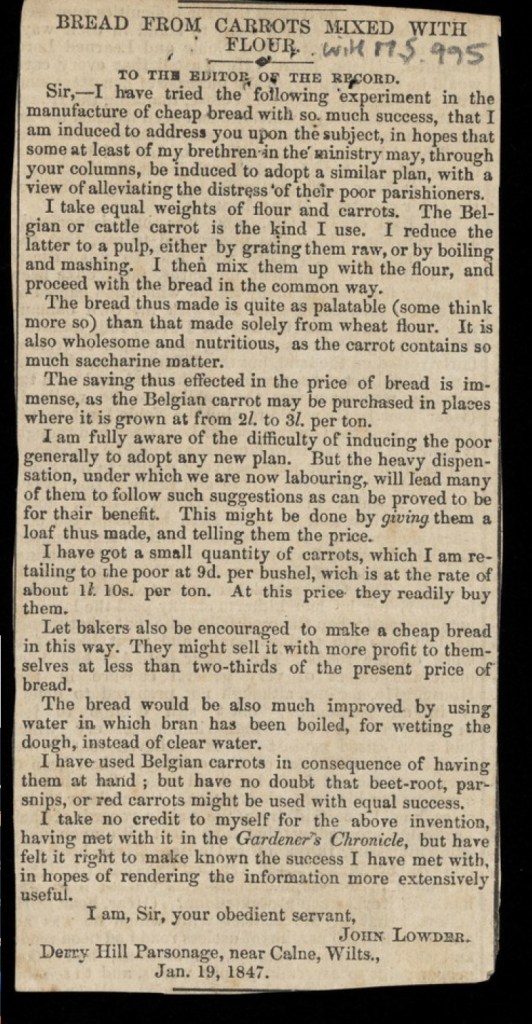
Personal recipe books can be quite eclectic in the mix of recipes the owner chooses to include. Quite apart from the recipes they (or if you’re a wealthy noblewoman, your scribe) include, there can also be hurried notes scribbled down on scraps of paper or the backs of envelopes, letters and cards answering requests for recipes, as well as clippings from newspapers and magazines.

This recipe was found between the pages of Catherine Ashley’s household book, dated circa 1830 (MS.995, held by The Wellcome Collection). It had been clipped from The Record, a twice-weekly religious newspaper, in January, 1847. The author, The Rev. John Lowder, had experimented with using carrots to make bread after reading an article in The Gardeners’ Chronicle in December 1846. He wrote to the editor of The Record in the hope that by sharing his findings, his clergy brethren might find the results useful for their own poor and needy.

The article in The Gardeners’ Chronicle had detailed an open correspondence between The Right Hon. T.F.Kennedy, Paymaster General for the Irish Civil Service and Henry Labouchere, the then Secretary of State for Ireland in the government of Lord John Russell (1846-1852). In it, Kennedy suggested that experiments done in Austria on the supplementing of flour with beetroot to make bread might help with the (then early stages) of the potato disaster in Ireland. Growing beetroot on just one acre, he maintained, would produce a crop of £30 value, with a clear profit of £15 to the grower, and provide valuable supplementary nutrition  to the Irish poor, being of a much higher value than potatoes. Although noble, this idea falls at the first hurdle because the poor in Ireland were eating potatoes precisely because they did not have access to the flour needed for this scheme to work.

Parsnips were also used in experiments and were deemed excellent, but carrots were not, with the reason being given as carrots were “much less palatable.”

Enter the Rev. Lowder with his own efforts, whereby he succeeded in producing delicious carrot bread by cooking and pureeing the carrots first, whereas the original experiments had been done by grating the raw vegetables.

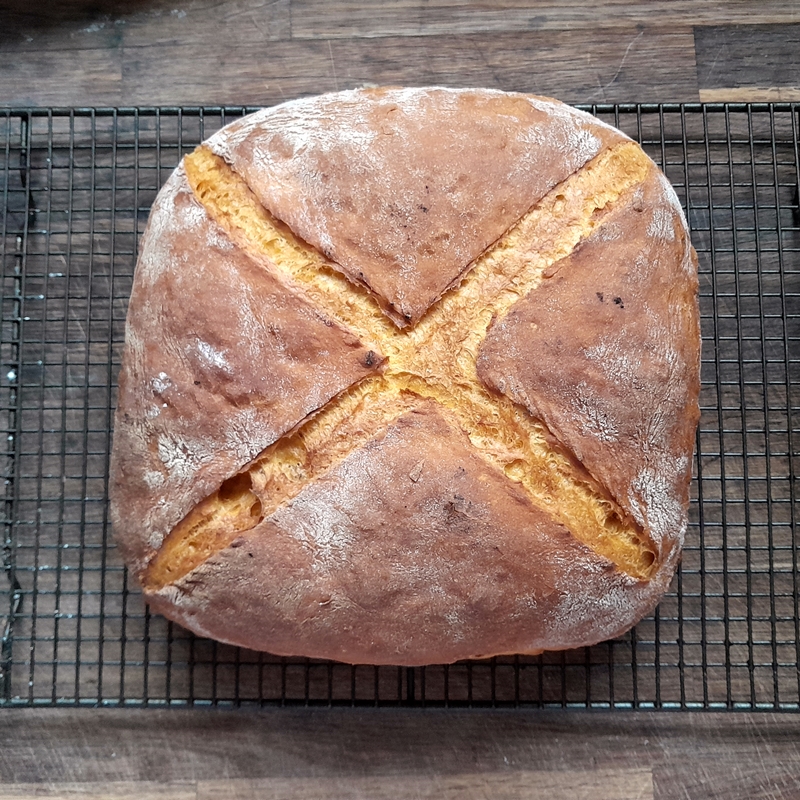
The recipe is simple: equal weights of (pureed, cooked) carrot and flour mixed together, and then continued with the usual bread-making method. I thought this almost too good to be true and put it to the test by adding only salt and yeast. The result is the loaf picture above. I added no water, bar the 2-3 tablespoons of carrot water needed to get the carrots pureed. In all honesty, it looked too moist in the initial mixing, but I had faith and decided to wait and see what the first rise made of it. The resulting dough after an hour was gloriously light and very lithe and needed only the briefest of shaping before putting it into a 20cm/8″ square tin. Another rise of 30 minutes was followed with a 40 minute bake. The loaf was cooled on a rack overnight before being sliced.

I appreciate that the use of white bread flour is probably of a finer quality than that employed by the good Reverend Lowder in his experimentation, but I made that call in order to give the recipe its best chance of success.

Shortly after this recipe was published (1848) Reverend Lowder moved half a world away, with his wife and five children, to China, after being appointed Chaplain of Shanghai. Heartrendingly, he would perish in a swimming tragedy shortly thereafter (September, 1849) at the age of just thirty-nine.

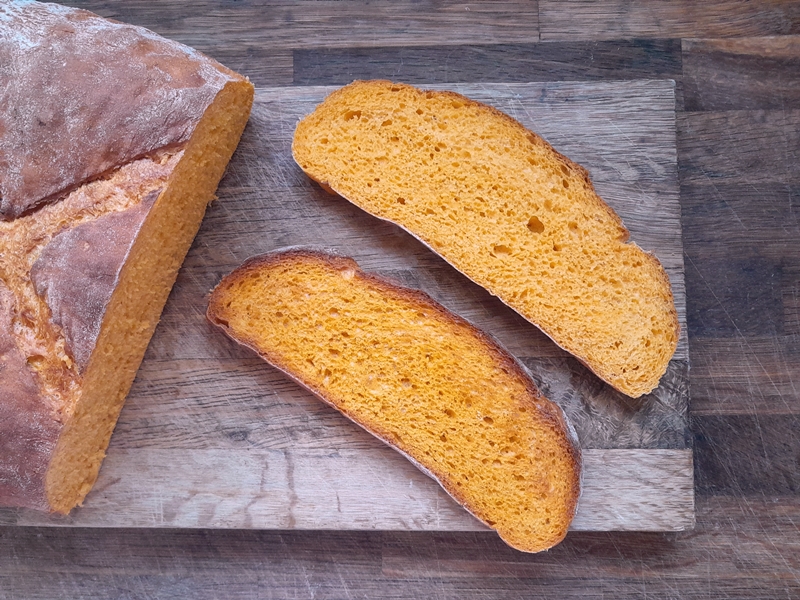
Carrot Bread sliced – plain (top) and toasted (bottom)

As can be seen in the photo above, the colour of the crumb is glorious. Given the vibrancy, it’s surprising that there isn’t more carrot flavour. The texture is soft, with a slight chew, similar to potato bread. When toasted, the colour changes very little – the darkening of the crust around the edges being the main indicator. There is a suspicion of roasted carrot in the flavour, and if you’re eating it with anything other than butter, you might miss it altogether. Overall, I’m really liking this new (to me) recipe – it will definitely be making a regular appearance in this household.

Carrot Bread

Since proportions of flour and carrot are the only specifications, although I’ve not tried it yet, I see no reason why carrots left over from a previous meal might not be successfully used in this recipe, adding plain water if necessary for a smooth puree. If the total of puree + flour is less than 700g, then only one sachet of yeast would be needed, and half the salt. Some accent spices could also be added, such as caraway or cumin seeds.

500g carrots, peeled and sliced
500g strong white flour
10g salt
2 sachets fast action yeast

  • Put the carrots into a saucepan, cover with water and bring to a simmer.
  • Cook until tender all the way through – between 20-30 minutes, depending on the size of the carrot pieces.
  • When cooked, strain (reserving the liquid) and puree in a liquidiser or using a stick blender. Add a little of the cooking water if the carrots aren’t blending easily.
  • When pureed and smooth, set aside for 10 minutes to cool slightly, in order to not adversely affect the yeast.
  • When just warm, put the carrots and the rest of the ingredients into a bowl and bring together as a dough. Knead either by hand or using a dough hook for 10 minutes.
  • Cover and allow to rise for 1 hour.
  • Tip out the risen dough onto a lightly floured surface and gently deflate.
  • Shape and add to your tin of choice. I used a 20cm/8 inch square tin lined with baking parchment. If you use a different shaped tin, you might have to adjust the cooking time accordingly.
  • Allow to rise for a further 30 minutes.
  • Heat the oven to 220°C/200°C Fan.
  • Just before putting your loaf in the oven, cut some slashes in the top crust to prevent it rising  unevenly during the initial ‘oven spring’. Bake for 35-40 minutes until well risen and with the crust firm. You might want to remove your loaf from the tin and return it to the oven to bake for another 5-10 minutes in order to really crisp up the crust.
  • Cool on a wire rack.
  • Slice when cold.

Gossiping Cakes

I have a confession to make. I chose these recipes because I loved the idea of women baking cakes specifically for having a get-together and swapping gossip. Alas, that’s not where these cakes originate, but the truth just as interesting.

As I’ve mentioned before, I have spent quite a considerable amount of time cataloguing household manuscripts that have been digitised by various libraries around the world. Obviously, there is going to be a certain degree of repetition of the most popular recipes, but there are also those that stand out as original either by name or by ingredient, etc. Whenever I come across such a recipe, I mark it in the spreadsheet with an asterisk, so when I’m looking back over the thousands of recipes, those asterisked ones are easily highlighted as worthy of a second look. And for the other type of recipes, such as the 200+ recipes simply entitled “A cake”, I’ll get to looking at you in all your (presumed) variety  soon, but to be blunt, you’re pretty low on the ToDo list.

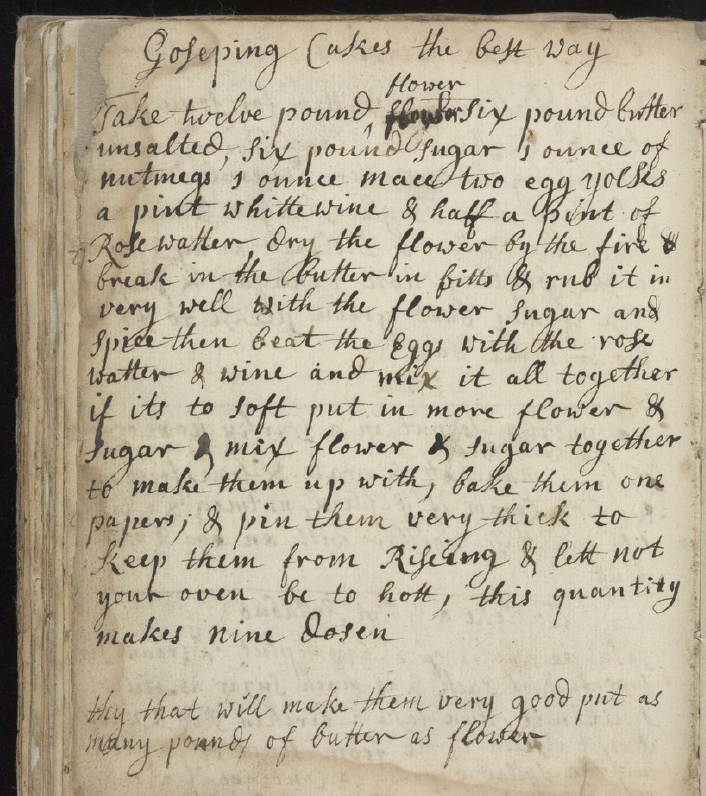
The first recipe I found was this one, dated early 18th century (1738), at the Wellcome Collection.

Recipe for Goseping Cakes The Best Way, from the manuscript of Rebecca Tallamy, (1738), MS4759, Wellcome Collection

It appears to be a spiced variation of shortbread, and obviously one to make in quantity, because the yield of the recipe is over 100 biscuits. It’s demonstrating one of the many interpretations of the word ‘cake’, in this case meaning small, circular biscuits. The last line also caught my eye, because it recommends using equal quantities of butter and flour to make them “very good”.

Regular listeners will have read about my shortbread variation testing a few months ago, where the ratio of butter to flour can range from 1:3 to 1:2, so the assertion that 1:1 is the best, had me intrigued.

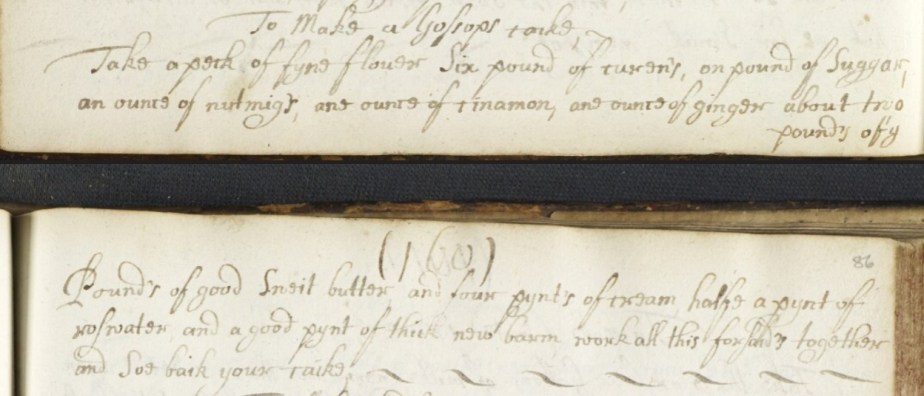
This recipe was very much on the back burner until I came across another recipe, similarly named, while indexing the digitised manuscripts at the National Library of Scotland.

Recipe for a Gossops Cake, from MS103093966.23, (1660-1699), National Library of Scotland

This recipe is in a manuscript older by almost a century (1660-1699), and differs in that it contains fruit, and is a large yeasted cake – exceedingly large, going by the peck/14lb/9kg of flour required – the term cake being used in this instance more akin to our modern usage.

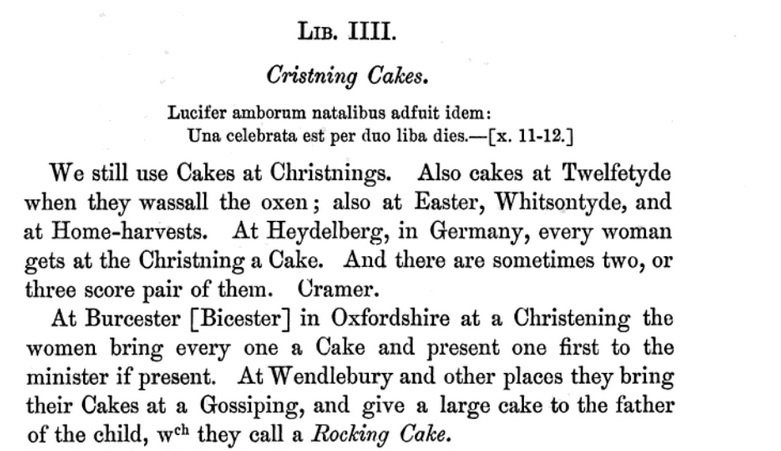
To delve deeper into this mystery, I turned to the internet, and found the following passage:

Christening cake traditions, from “Remains of Gentilisme and Judaisme 1686-87”, John Aubrey, James Britten, 1881, p65

This threw up the question: What is a Gossiping? And so I went hunting in the Oxford English Dictionary which I learned that a Gossiping is  a christening, or christening feast, derived and corrupted from “Godsibb”, which is an old English word for Godparent.

Not entirely relevant, but interesting nontheless, the oldest usage of Godshib I found was over a thousand years ago in Sermo Lupi ad Anglos, or the Sermon of the Wolf to the English, a sermon given by Wulfstan II, Bishop of Worcester and Archbishop of York (d. 1023) in 1014:

“And godsibbas and godbearn to fela man forspilde wide gynd þas þeode toeacan oðran ealles to manegan þe man unscyldgige forfor ealles to wide.”

Trans: And too many godparents and godchildren have been killed widely through-out this nation, in addition to entirely too many other innocent people who have been destroy­ed entirely too widely.”

Later usages of the word referred to a gathering of women/midwives when a woman was in labour, and hence to the modern usage.

So with a history stretching back many centuries, the account of christening traditions at Wendlebury would appear to neatly explain the differences between our two recipes: a large cake was presented to the father – presumably for all his hard work in the proceedings *eyeroll* – and the smaller cakes were shared with the guests.

So let’s get on with some gosseping!

A Gossop’s Cake

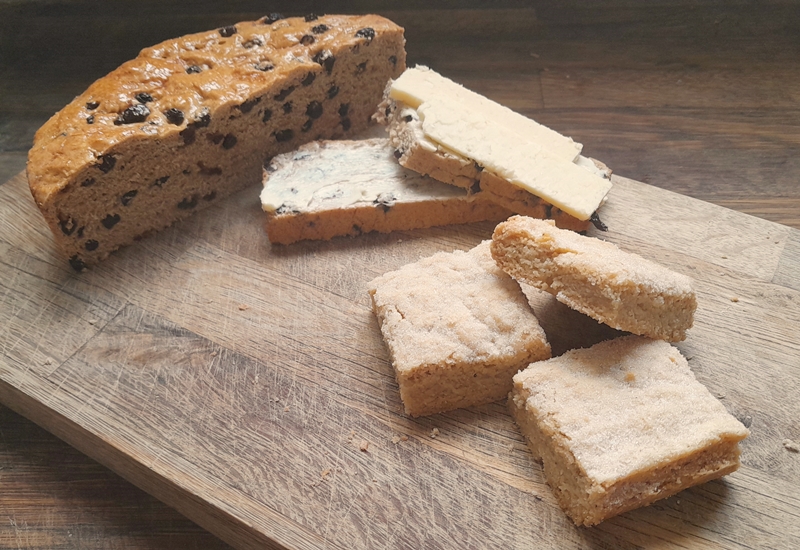
This is a fruited, lightly spiced and yeast-raised cake. If you’re British, it’s like an enriched teacake: delicious fresh, delicious toasted, and delicious either way with butter and a slab of cheese (but better with toasted). I’ve scaled the recipe down to make for a modest sized cake, but you can always double the recipe if it turns out to be a favourite.

315g plain flour
135g raisins
25g caster sugar
1tsp ground nutmeg
1tsp ground cinnamon
1tsp ground ginger
50g unsalted butter
150ml single cream
100ml water
1½tsp rosewater
1 sachet fast-acting yeast

single cream to glaze

  • Plump the raisins: put the raisins in a saucepan and cover with water. Warm gently on a low heat for 10 minutes while the dough mixes. Strain and pat dry.
  • Sift together the flour, yeast, sugar and spices.
  • Put the butter, cream, water and rosewater into a small pan and warm gently over low heat just until the butter has melted.
  • Put all ingredients except the raisins into the bowl of a stand mixer fitted with the dough hook and mix on slow until the dough comes together, then continue to knead for 10 minutes until smooth.
  • Add in the plumped raisins and mix on slow to combine.
  • Grease and line a tall, 20cm cake tin, preferably loose bottomed, with parchment.
  • Form the dough into a smooth cake and place in the prepared tin.
  • Set aside to rise until doubled in size. The enrichments to the dough (cream/sugar/fruit) will impact the rise, which is why there is only a single rise for this cake, thus taking advantage of the initial vigorousness of the yeast.
  • Heat the oven to 190°C, 170°C Fan.
  • When the cake has risen, gently brush the surface with single cream, and bake for 30-40 minutes until well risen and golden brown.
  • Cool the cake for 10 minutes in the tin, then remove and set on a wire rack to cool completely.
  • Store in an airtight container.

Goseping Cakes The Best Way

I’ve opted for the proportions where butter = flour because, contrary to my expectations, it really did taste much better that with just half the amount of butter.

250g plain flour
250g unsalted butter
125g caster sugar
1tsp ground nutmeg
1tsp ground mace
1.5tsp rosewater
1 large egg yolk
30ml white wine

1tbs caster sugar for sprinkling

  • Put the dry ingredients into the bowl of a food processor.
  • Cube the butter and add to the dry ingredients.
  • Blitz the mixture a few times until it resembles breadcrumbs.
  • Whisk together the yolk, wine and rosewater.
  • Add the wet ingredients to the dry and blitz until the mixture comes together in a soft dough.
  • Line a 20cm square tin with parchment paper.
  • Turn the dough out onto parchment paper.
  • Press the dough out evenly and smooth over.
  • Chill in the freezer for 20 minutes.
  • Heat the oven to 160°C, 140°C Fan.
  • Poke holes all over the surface with a fork or using a cocktail stick, in the manner of shortbread.
  • Bake for 30 minutes, turning the tin around after 15 minutes to ensure even baking.
  • Remove from the oven and turn off the heat. Sprinkle the caster sugar over the hot shortbread.
  • Cut the shortbread into pieces using a thin bladed knife or metal dough scraper.
  • Return the tin to the cooling oven until cold, to ‘dry out’.
  • When cold, store in an airtight container.

Georgian Cross Buns

Reading a handwritten manuscript is very exciting: you never know what is just over the next page.

Lately I have been reading through the manuscripts held by the National Library of Scotland and alighted upon something rather unusual. It is a manuscript from a bakery, with appropriately large batch quantities. It is a fascinating peek into the variety of bakes and extras that formed the day to day offerings of a Georgian bakery.

The manuscript has been dated to 1827, which puts it slap-bang in the middle of the reign of George IV, but other than that, there appears to be no other identifying information. Now this might be looked upon as more than a little frustrating, however, being much more of a glass-half-full person, I usually see it as an opportunity for sleuthing, and seeing whether or not I can glean any more information from the pages within.

Firstly, I think the date is very well chosen, and I’m sure the Library of Scotland is nothing short of THRILLED at my approbation. This I deduced from the raising agents used in the recipes, which call either for yeast or volatile salts. Volatile salts are the precursor to baking powder, which was only a mere fifteen years away from being invented.

Another piece of information I noted gave me reason to believe that there may well be a Scottish link, aside from where the manuscript is currently held, is the use of the word ‘carvey’ for caraway seeds. In the 18th century, the word was in much greater use throughout the British Isles, but in the 19th century, it was retained mostly in Scotland. The one thing holding me back from declaring this a definite is the Englishness of the other recipes: Abernathy biscuits, Bath cakes and buns, Weymouth biscuits, Stratford cakes, Norwich biscuits, Isle of Wight cracknels…

The recipes themselves cover a wide range of items: biscuits, cakes, buns, jams and jellies, sweeties, custards, bread, muffins and cakes. I love this manuscript for its sheer uniqueness. I have a small but favourite collection of commercial baking books dating from around the turn of the 20th century, but I’ve not come across any other handwritten recipes of catering size quantities of this early age. Browsing for something for Easter, I came across this recipe for Buns for Shops or Cross Buns. Perfect!

But it came at a price. And the price was the spelling.

Oh my dears, the spelling.

I fully appreciate that spelling from 200 years ago is going to be a little quirky, but this… This is on a whole new level.

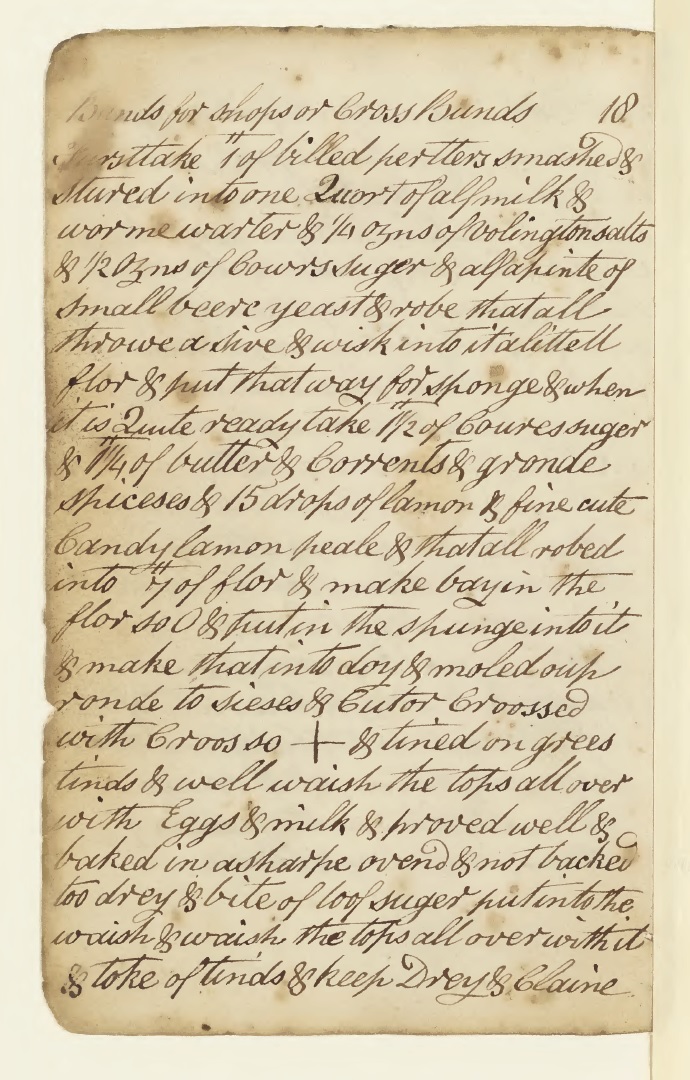
Cross Buns Manuscript Recipe, National Library Scotland

In case your cursive reading skills are a little rusty, allow me to transcribe the recipe for you, with the original spelling, in all it’s glory.

Bunds for shops or Cross Bunds
Fursttake 1″ of billed pertters smashed & stured into one Quort of alfmilk & worme warter & 1/4 ozns of volington salts & 1/2 ozns of Cours suger & alfa pinte of small beere yeast & robe that all throwe a sive & wisk into it a littell flor & put that way for sponge & when it is Quite ready take 1 1/2″ of coures suger & 1 1/4″ of butter & Corrents & gronde spiceses & 15 drops of lamon & fine cute Candy lamon pale & that all robed into 7″ of flor & make bayin the flor so O & pit in the spunge into it & make that into doy & moled oup ronde to sieses & Cut or Croossed with Croos so + & tined on grees tinds & well waish the tops all over with Eggs & milk & proved well & baked in a sharpe ovend & not backed too drey & bite of loaf suger put into the waish & waish the tops all over with it & toke of tinds & keep Drey & Claine.

The modern translation is as follows:

Buns for shops or Cross Buns
First take 1lb of boiled potatoes mashed & stirred into one Quart of half milk & warm water & ¼ oz of volatile salts & ½ oz of Coarse sugar & half a pint of small beer yeast & rub that all through a sieve & whisk into it a little flour & put that away for sponge & when it is Quite ready take 1½lb of coarse sugar & 1¼lb of butter & Currants & ground spices & 15 drops of lemon & fine cut Candied lemon peel & that all rubbed into 7lb of flour & make a bay in the flour so – O – & put the sponge into it & make that into dough & mould it up round to size & Cut or Cross with a Cross so + & put them on greased tins & well wash the tops all over with Eggs & milk & prove well & bake in a sharp oven & don’t bake too dry & add a bit of loaf sugar into the wash & wash the tops all over with it & take them off the tins & keep them Dry & Clean.

Yes, that first ingredient is boiled potatoes, and I will freely admit it took me a good half hour of pondering and saying the phrase out loud to myself in a frankly embarrassing number of accents in order to try and work out what it might be. Adding mashed, boiled potatoes to a bread recipe helps keep the resulting buns from drying out too quickly and keeps them pleasantly chewy. ‘Volington Salts’ makes me chuckle, because it sounds like the name of a Georgian Dandy.

The travails of translating the handwriting aside, there are two aspects of this recipe that I love. Firstly, it is the unusual (to modern palates) combination of spicings and flavourings. The recipe calls for both lemon essence and candied lemon peel as well as ‘mixed spices’. I’ve also made some biscuits from this book which called for cinnamon and lemon, and maybe its because this combination seemed so unusual to my 21st century palate, but to me they tasted Georgian. The ‘mixed spices’ gives you carte blanch to use whatever combination you like, but I’m going to recommend cinnamon and nutmeg, which were a popular combination for decades in the 17th and 18th centuries. The lemon flavouring, for some reason, I found problematic: liquid flavouring seemed to fade when baked, so I tried using finely grated fresh lemon zest, which also didn’t have quite the punch I was looking for. Perhaps a combination of the two will give the lemon burst I think these might need – but if we hang around for me to trial that, we’d miss Easter, so onwards!

Georgian Cross Buns

This is a 1/7th scale of the original recipe, and will make 18 x 60g buns. If this is a bit much, halve the recipe and divide the dough into 8 buns. Make a sponge if you feel inclined, but I went for mixing all together at once.

70g cooked mashed potatoes
100ml milk
100ml water
450g strong white flour, or plain
7g sachet of fast action yeast
100g caster sugar
80g butter
1tsp ground cinnamon
1tsp ground nutmeg
1 tsp lemon flavouring and/or zest of 1 lemon
60g fine sliced candied lemon peel
125g currants

For the glaze


1 large egg
1/2 an eggshell of milk
2tbs caster sugar

  • Heat the milk and water to blood temperature.
  • Add the cooked potato and whisk together – a stick whisk works well to make the mixture smooth.
  • Put the flour, yeast, sugar, butter, spices and lemon flavouring(s) into a food processor and blitz until the mixture resembles breadcrumbs.
  • Put the liquid mixture into a mixing bowl and add the dry mixture on top.
  • Knead for 10 minutes. Don’t be tempted to add more liquid – there’s moisture in the butter and the working of the dough will bring that out and make a dough that ‘cleans the bowl’.
  • When the dough has come together and is smooth and elastic, mix in the currants and lemon peel.
  • Cover the bowl with plastic and set aside in a warm place to double in size.  If your kitchen is on the cool side, use your oven: Turn the heat to 170°C/150°C Fan for TWO MINUTES ONLY, switch off, and place your bowl inside. Due to the enrichments of butter and sugar, this may take longer than normal, probably closer to 90 minutes.
  • Tip out the risen dough and gently deflate by pressing with the hands.
  • Divide your dough by weight: 60g makes a decent-sized bun, but go larger if you prefer a more substantial bun.
  • Roll the dough into a smooth ball, press flat with the palm of your hand, then arrange on a parchment-lined baking sheet at least 3cm apart.
  • Cover lightly with plastic and allow to rise a second time (30-45 minutes).
  • Heat the oven to 180°C, 160°C Fan.
  • When the buns are sufficiently risen, cut a cross into them. I find pressing (not rolling) a pizza wheel down into the buns is an ideal tool for this: it marks a deep cross, but doesn’t cut through the edges of the bun and cause them to split during baking. Alternatively, use the flat end of a spatula.
  • Whisk the egg and milk together, and glaze the buns by brushing the mixture over them using a pastry brush.
  • Bake for 15-20 minutes, depending on size. For the smaller 60g buns 15 minutes is fine. If your buns are larger, then leave them for 20 minutes. Turn the baking sheet around halfway though.
  • While the buns are baking, add 2tbs caster sugar to the remaining bun wash and stir to dissolve.
  • When the buns are baked and golden brown, remove from the oven and place the baking sheet on a rack. Brush the hot buns over with the sweetened bun wash. The heat of the buns will set the sweetened glaze, and your cross buns will cool with a lovely shine.
  • Remove the buns from the baking sheet when cool and store in an airtight container.
  • Serving suggestion: Delicious when freshly baked. When cooled, cut in half and toast both sides. Serve warm with butter and a sharp cheddar cheese.

Ouse Bridge Cakes

I love coming across a geographically-named recipe. It gives a place and time in which to ground the dish: Grasmere Gingerbread, Cornish Pasties, Chelsea Buns.

Almost better yet, is discovering a recipe that is also unknown today, having gone out of fashion or due to some other circumstance. Such is Ouse Bridge Cakes.

There’s practically no information available about these bakes. In “The Gentlewoman’s Kitchen” (1984), Peter Brears suggests Ouse Bridge Cakes are a yeast dough flavoured with mace, cloves and nutmeg and mixed with sugar and milk. In his book “Secret York” (2014), author Paul Chrystal writes:

“Ouse Bridge Cakes, known in the eighteenth century, a type of Yorkshire tea cake.”

And that’s pretty much it. Not much to go on at all.

Luckily, in my scouring of old manuscripts, I have turned up five, different, eighteenth-century Ouse Bridge Cake recipes. I reasoned that, within their pages lay an understanding of what constituted the original Ouse Bridge Cakes.

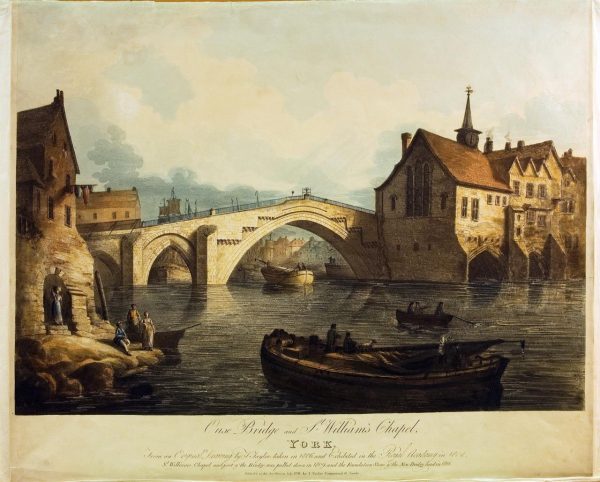
But first, a little history. The bridge over the River Ouse that this recipe refers refers to is in the city of York. Although there have been many bridges over the centuries, it is the fourth Ouse Bridge (1565–1810) which has been commemorated in these buns.

Old Ouse Bridge from the South. T.Taylor, 1806.

Just as with many city bridges of the time, the Ouse bridge was heavily built-up, its five arches supporting substantial buildings on both sides of it’s towering centre arch.

Old Ouse Bridge from the North. Attrib. Henry Cave (British 1779-1836)

With all this busyness on the bridge, it is likely that there were businesses too, and if not a baker’s shop, then almost certainly a stall or street hawkers. Just as Wood Street Cake (see Great British Bakes) took its name from the London street where it was made, Ouse Bridge Cakes take theirs from the place where they could be bought, if not actually baked.

As already mentioned, Ouse Bridge cakes were a spiced bun. But seeing as Yorkshire has quite a reputation for similar items – the most well-known being the Yorkshire Teacake (as with all tea cakes, best eaten toasted and buttered) – it occurred to me that there must be something to distinguish the Ouse Bridge cake from a host of other buns, and that something was probably its shape. A bun of a particular shape is instantly recognisabe – just look at modern Chelsea Buns and their square, spiralled form (which isn’t the original shape – but don’t get me started, see Great British Bakes (again)).

Luckily, there were two of the five recipes (yes, remember them? Back before the detour?) that held clues. The first was in a manuscrpt dating from the mid-eighteenth century, which suggested the dough be weighed out into 8oz (225g) pieces before being shaped.

Ouse Bridge Cakes recipe, MS3498, (1750-1900) Wellcome Collection.

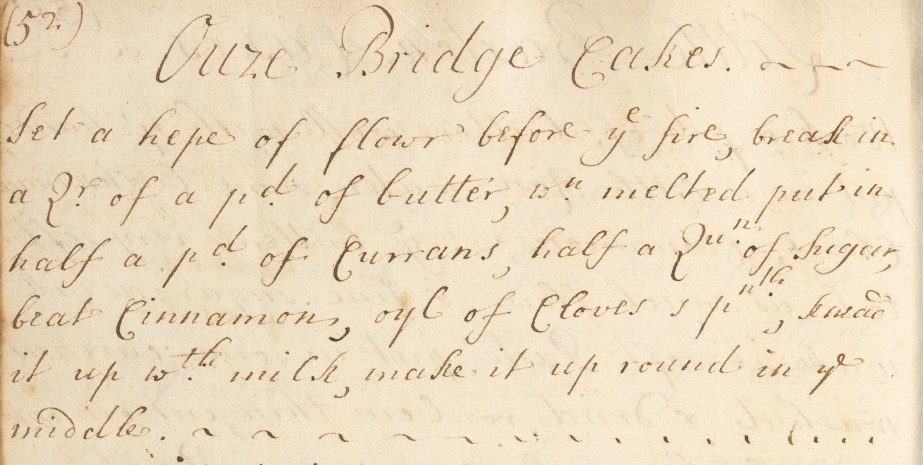
The second piece of information was from a manuscript dated 1750, the last line of which reads “make it up round in ye middle”.

Ouse Bridge Cakes recipe from MS4645, (1750-1853), Wellcome Collection.

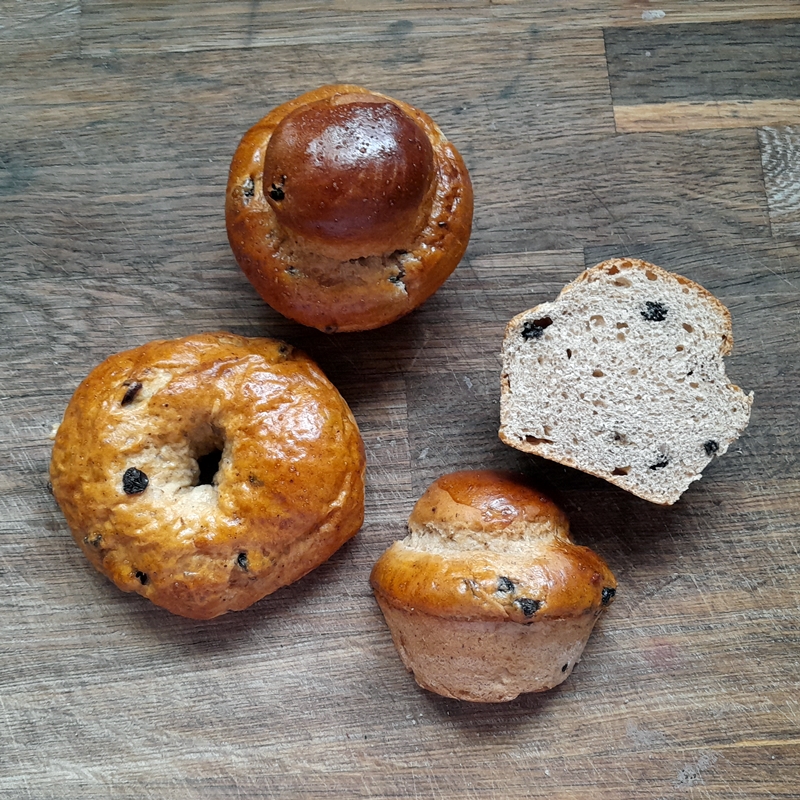
I spent a lot of time thinking about this, and decided it meant to shape it like a bagel/ring donut. I also asked online, and the feedback was that it might mean something cottage-loaf-esque, so I experimented with both shapes. I still think the ‘hole in the middle’ is a better fit for the description, but until more recipes are rediscovered, the jury will have to remain resolutely out.

Of course, it might well be that none of these five recipes are the definitive, perfect Ouse Bridge Cakes. Back in the day, even the moderately wealthy (such as the authors of these manuscripts) didn’t necessarily bake for themselves: practically everyone bought their bread from a baker. The recipes that we find in manuscripts are attempts to copy, on a smaller scale, something enjoyed elsewhere, so that they can be enjoyed in their own homes. The five recipes in the manuscripts were all different, yet there were some uniting features, as each author tried to recreate something they had only tasted. Firstly, all of them had currants, ranging from a spartan few ounces to almost half the total weight of the ingredients. All of them were flavoured with spices (nutmeg, cinnamon, cloves, ginger, mace),  but nutmeg was a common denominator amongst all five. All of them were enriched with milk and either butter or cream, and most had added sugar.

The recipe below is very much a Goldilocks version of them all. Neither too much nor too little of everything, because recipe testing revealed certain flaws in the versions that veered towards the extreme. The overly-fruited buns were heavy and close textured, and those buns with generous/excessive additions of butter and cream were reluctant to rise, with a rather greasy taste.

This version is moderately fruited, moderatly enriched and moderately spiced. Delicious warm from the oven, and even more so toasted, with slabs of cold, mature Cheddar cheese (it’s a taste sensation!).

Ouse Bridge Cakes

Each bun is formed from a generous 75g of dough, and I have scaled the quantities down to make a very modest seven buns per batch. Feel free to double the recipe as you see fit. The spicing is just a suggestion: change things up if you have a favourite mix.

225g flour
1 sachet fast-action yeast.
180ml milk
15g sugar
30g unsalted butter
60g currants
1 tsp ground ginger
1 tsp ground nutmeg
½ tsp ground cloves
½ tsp ground mace
1 large egg for glazing

  • Put the milk, sugar and butter in a pan and scald. IMPORTANT Scalding is when the milk almost boils, but not quite. Heat it until it bubbles around the edges (or in the middle if you have an induction hob), then remove from the heat and allow to cool down. Scalding milk breaks down the proteins, which will allow your buns to remain soft and yielding, even when cold. Using 100% unscalded milk in a dough recipe can lead to heaviness.
  • When the milk mixture has cooled to blood temperature, pour it into your mixing bowl.
  • Sift the flour, yeast and spices together and add to the milk mixture.
  • Knead the mixture by hand or on the lowest possible speed on your stand mixer for 10 minutes. increase speed to high for up to 2 minutes, or until the mixture comes together in a clean ball.
  • Add the currants and fold them in.
  • Cover the bowl with cling film. The milk, butter and sugar will make the dough slower to rise that a regular dough, so allow at least 90 minutes or until the dough has doubled in size.
  • Tip out the dough and divide into seven pieces, each of roughly 75 grams. There’s no need to get all aggressive and start punching it: it will naturally deflate with the turning out.
  • Shape the dough as you see fit. In addition to the two shapes mentioned above, you can also shape them into a regular teacake shape. NB: If you’re going for the cottage loaf shape, I recommend baking the shaped dough in cupcake tins, which really lets the dough ‘sit up’ and hold it’s shape. I used silicone baking trays rather than metal, to keep the dough from forming too crusty an outside.
  • Set aside to rise for 40 minutes.
  • When the dough has risen, whisk the egg and brush over the buns with a pastry brush.
  • Heat the oven to 180°C, 160°C Fan.
  • Bake the buns for 20 minutes, turning the baking trays/sheets after 10 minutes to ensure even baking.
  • When cooked and golden brown, transfer to a wire rack to cool.
  • Store in an airtight container at room temperature.

Hot Cross Buns

More interesting than toast, not as rich as cake, what’s not to love about a bun?  The buns traditionally served towards then end of Lent are… well now, here’s the thing. They go by many names. Most people might think, as the title above implies, that they’re Hot Cross Buns, but that’s not strictly accurate. “Hot Cross Buns!” was originally the cry of the street vendors who sold Cross Buns – hot. Recipes also appear under the name “Good Friday Buns” and “Easter Buns”.

Interestingly, Cross Buns weren’t originally fruited, only spiced – and thanks to an edict from Queen Elizabeth I, could only be sold on Good Friday, Christmas and for funerals.

“That no baker or other person or persons shall at any time or times hereafter, make,
utter or sell by retail within or without their houses, unto any the queen’s subjects,
any spice cakes, buns, bisket or other spice bread (being bread out of size, and not by
law allowed), except it be at burials, or upon the Friday before Easter, or at Christmas;
upon pain of forfeiture of all such spice bread to the poor.”

John Powell, The Assyse of Breade, 1595

Fruit gradually crept into recipes from about the middle of the 19th century, presumably as industrialization and improved transport links brought foodstuffs from far flung places to the UK cheaper and quicker, all to make for a really indulgent treat after the privations of Lent.

This recipe comes from a very favourite author of mine: Frederick T. Vine. Doyen of numerous professional books for the baker and confectioner. This is his own personal recipe, scaled down from a recipe in which quantities such as pounds and quarts were bandied about, and a full batch of which would produce almost 650 penny buns. The quantities below will make about 12 x 100g buns, more if you drop the weight down to 85 grams. This might seem a large amount, but they can be gifted to friends and family, or easily frozen to enjoy at a later date.

crossbunsrecipe

The buns are enriched with milk, butter and egg and are packed with bags of fruit and spice. The original recipe also includes malt extract, which gives a wonderfully rich flavour, but isn’t usually something you find in the supermarket, so you can improvise by adding some powdered Ovaltine to the mixing liquid if you have difficulty sourcing it. You can omit it altogether if liked.

The original recipe suggested using flavouring essences of lemon and ‘spice’. I happened to have some lemon flavouring, but no ‘spice’, so I used regular ground spices. Reading an inordinately large number of baking books as I do, I’ve noticed that the use of essences is very prevalent in commercial baking mixtures. The reason seems to be that regular ground spices darken the dough, which is assumed to be unappealing to the customer. This opinion contrasts greatly with the fact that, for example, in modern times the appearance of the seeds in vanilla-flavoured items today are celebrated – how things change! Personally, I like the authentic appearance of the dark flecks of spice, not to mention the flavour. Feel free to go with your own blend of spices, but I really like the punchiness of the quantities below. After all, no-one likes a bland spice bun – if you’re promised spice, you want to be able to taste it.

These buns have a sweetened, tinted glaze to be painted on after they are baked. It uses gelatine to give shine without the stickiness. If you’re not keen on using gelatine and don’t mind a little stickiness with your shine, then omit the gelatine, swap the water for milk and warm to dissolve the sugar.

Hot Cross Buns

I’ve gone for a mixture of spices, but it is traditional to only use allspice. If you’d prefer this flavouring, I suggest just 1½tsp ground allspice, as it is quite potent.

I’ve switched around the method a little to make for a more straightforward approach.

180ml water
90g unsalted butter, cubed
15g malt extract OR 2tbs Ovaltine
180ml milk
30ml of beaten egg, from1 large egg
135g soft brown sugar
½tsp salt
1 sachet fast-acting yeast
30g mixed orange/lemon peel, finely sliced/chopped
180g currants
1/2tsp lemon flavouring OR zest of 1 lemon
1tsp ground nutmeg
½ tsp ground mace
½tsp ground allspice
½tsp ground mixed spice
500g strong white flour

Pre-bake Glaze
30ml beaten egg(from above)
30ml milk

Post-Bake Glaze
1 sheet gelatine (or vegetarian equivalent)
100ml cold water
2tbs caster sugar
1tsp treacle

  • Heat the water, butter and malt/Ovaltine until steaming and the butter melted, then add the (cold) milk. This should bring the temperature down to just warm.
  • Whisk in the egg, sugar, salt, lemon flavouring if using, and yeast.
  • Pour the warm mixture into a bowl.
  • Sift together the flour and spices and add to the bowl.
  • Knead into a soft and supple dough, about 10 mins.
  • Knead in the currants, zest if using, and peel, cover with plastic, and set to rise. Because of the enriched nature of this dough, this will take slightly longer than usual, about 1½ hours.
  • When the dough is risen, turn out onto a floured work surface and pat to deflate.
  • Weigh off the dough into 100g pieces, and then roll and shape each into a smooth ball.
  • Line a deep-sided baking tin with parchment.
  • Place the balls of dough into the pan, pressing with the flat of the had as you do so, to flatten them into discs about 2cm thick. Place these ‘cakes’ about 1cm apart from one another. This will mean they touch as they prove, giving a soft ‘kissing crust’ on each side and a rounded sqare shape.
  • Cut a cross into each bun using a dough cutter or similar. NB Take care not to cut all the way through, just deep enough so that the dough will stay apart during baking, preserving the cross.
  • Cover lightly with a cloth to rise for 30 minutes.
  • Heat the oven to 200°C, 180°C Fan. This is a slightly hotter temperature than usual for buns (180°C, 160°C Fan), because the sides of the tin will block direct heat, and the buns will therefore need cooking a little longer.
  • Pre-bake Glaze: Whisk the remaining egg with the milk and brush over the tops of the buns.
  • Bake for 20 minutes until risen and browned. Turn the tin around after 10 minutes to ensure even baking.
  • While the buns are baking, prepare the gelatine glaze. Soak the gelatine sheet in the water until softened. Heat gently to dissolve the gelatine, then stir in the treacle and sugar. Continue stirring until the sugar is dissolved.
  • When the buns are baked, remove from the oven and brush over with the glaze.
  • Cover lightly with a cloth and allow to cool in the tin for 15 minutes. The cloth will keep the steam close, making for a soft crust.
  • After 15 minutes uncover the buns and transfer to a wire rack to cool completely. If you leave them to cool completely in the tin, they’re prone to sogginess.
  • To serve: Cut in half and toast both sides. When toasted, spread with salted butter. For added decadence, add some slices of vintage cheddar cheese. The contrasts between the hot spicy bread, the fruit, the richness of the butter and the sharp, cool and creamy tang of the cheese is sublime.

Chelsea Buns

Back in  2013 I wrote an article on the history of Chelsea Buns, ultimately included in my book Great British Bakes which culminated in a recipe suggestion for the original Chelsea Buns.

I based the recipe on anecdotes that appeared in various publications on the borough of Chelsea and its surroundings, mostly written in the mid-to-late nineteenth century.

Before me appeared the shops so famed for Chelsea buns, which, for above thirty years, I have never passed without filling my pockets…. …….These buns have afforded a competency, and even wealth; to four generations of the same family; and it is singular, that their delicate flavour, lightness and richness, have never been successfully imitated.”i

To be good, it should be made with a good deal of butter, be very light and eat hotii

“The old Chelsea Buns were greatly in demand and were a superior kind to our common buns, more like Bath Buns. Old people say they were very rich and seemed full of butter. They were square in form and were made with eggs, with the kind of sugar, lemon and spice but without fruit.”iii

“Note that the true Chelsea Bun of the Hands family was by no means the darksome and dismal lump which is now sold us as a hot cross bun. On the contrary, it was specially famous for its flaky lightness and delicate flavour.”iv

“It was not round, but square in shape, and it came into the world in batches, the several individuals crammed as close together as the cells of a honeycomb…..Excellent they were—light, sweet, glistening as to their crowns in a sort of sugary varnish, and easy of digestion.”v

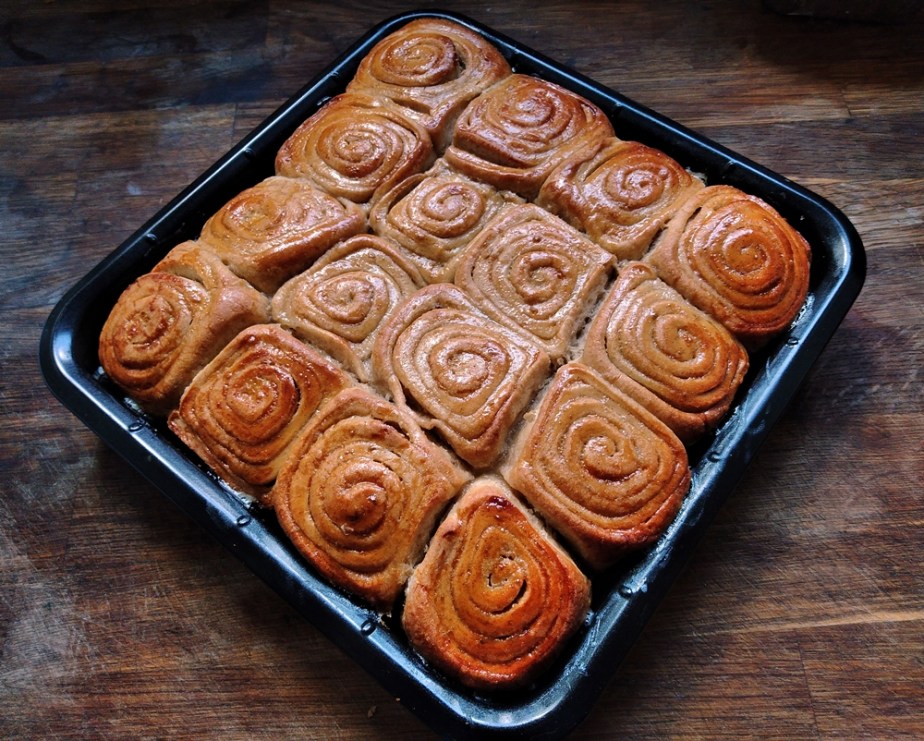
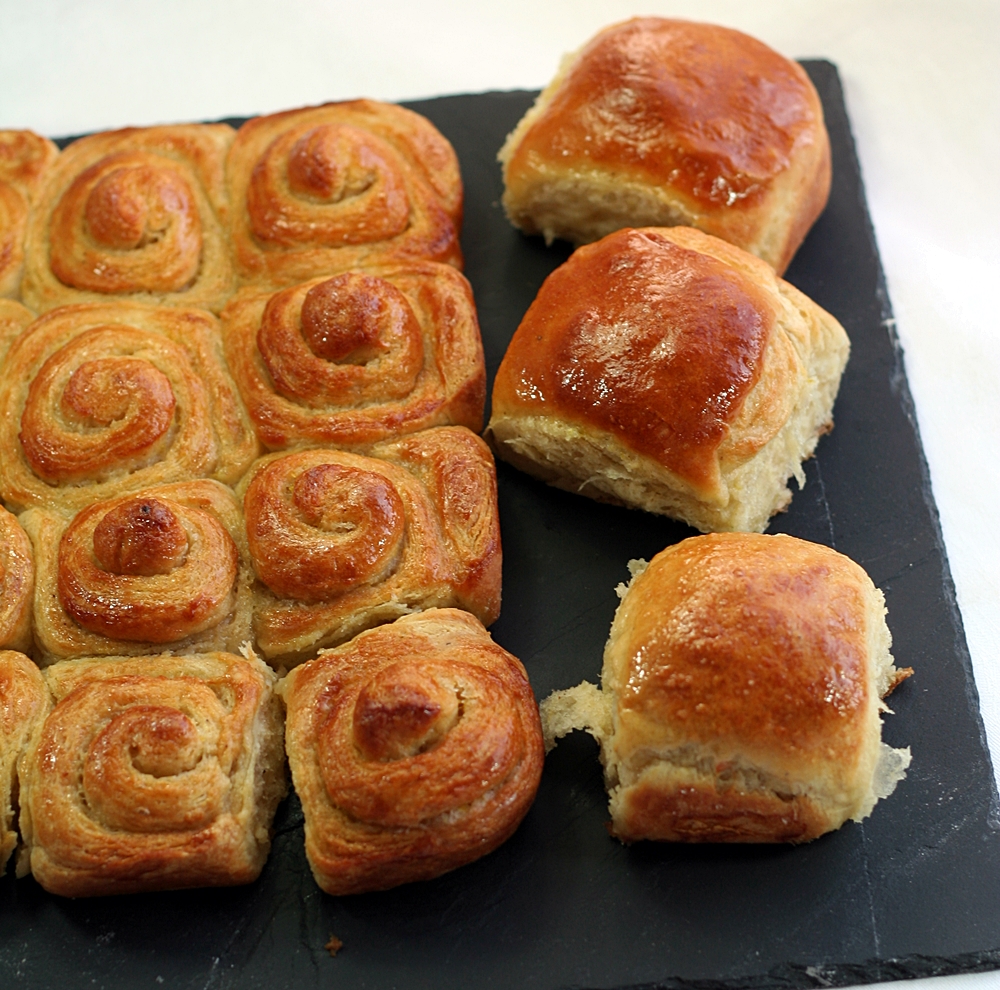
There was no mention of the fruit which adorns the modern version of the bun, neither was there mention of the spiral. The recipe I came up with was therefore fruitless and a regular bun shape. I couldn’t quite let go of the iconic spiral shape, though, so baked a version in this shape, too. Below is one of the original photographs taken for the book.

Chelsea Buns

Fast forward to 2020 and last week I discovered a recipe for Chelsea Buns in a manuscript (MS10979) held by the National Library of Scotland. This was very exciting, because the manuscript was dated circa 1827, which is a time when the original Chelsea Bun House was still in business. (It was eventually torn down in 1839). Prior to this, the earliest recipe available had been the one published in 1854 in George Read’s The Complete Biscuit and Gingerbread Baker’s Assistant (p103).

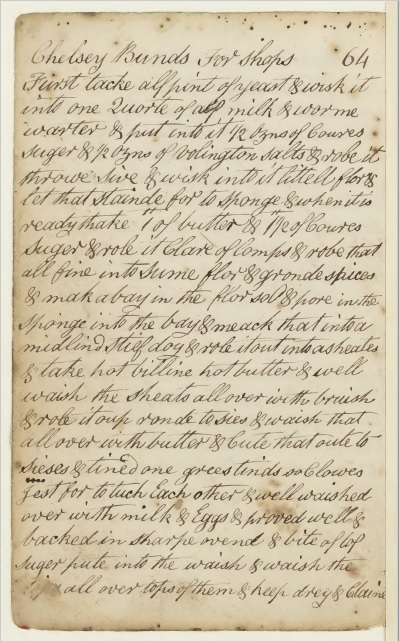
Recipe for Chelsea Buns from a c1827 anonymous manuscript (MS10979) at the National Library of Scotland.

The recipe itself is rather challenging to read, but there are a couple of details that I think deserve pointing out. The recipe title “Chelsea Bunds for shops” suggests that the recipe was for an independant baker, who sold his/her wares wholesale. Perhaps s/he only had a baking premises and not a shopfront. The other detail is the tiny diagram  on the bottom left of the page, showing how the buns are to be laid out: laying the buns like this will ensure the characteristic square shape once the dough has risen.

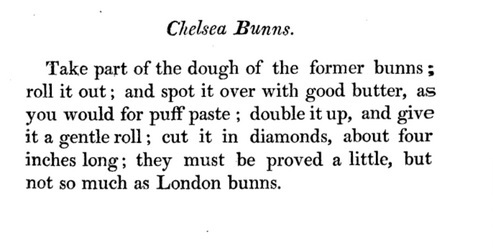
As luck would have it, and paraphrasing the well-known bus analogy, you wait seven years for a recipe, and then two come along at once. Also last week I spotted another early Chelsea Bun recipe, which had heretofore hidden from my internet searching by the cunning ruse of calling itself Chelsea Bunns. It appears in A Treatise on Confectionary, in all its branches, with practical notes, etc (1817) by Joseph BELL (p36, see below).

Chelsea Bunns

The previous recipe referred to is one for London Buns – flour, sugar, butter, yeast, and no spice. The shaping of the buns in this recipe is also unusual: I’ve never heard of Chelsea Buns being diamond-shaped, and it makes me wonder whether the author was confusing them with another bun, and if so, which?

I used to be rather evangelical about recipes for things being the PROPER recipe. Seven years ago, I was very firm in my conviction that a fruitless Chelsea Bun was the PROPER recipe and the fruit-filled, overblown, too-heavily-glazed monstrosities on sale in bakeries were borderline abominations. Now I’m much more laid back, having come to understand that, just like us, recipes have a lifespan, some longer than others, over the course of which changes happen. In the 18th and early 19th centuries, the light and gently-spiced Chelsea Buns were extremely popular. Over time, personal taste, or possibly economics (costs of dried fruit & sugar) saw a change to fruit-filled buns being favourite. It is absolutely possible to like one style of Chelsea Bun over another, and liking one style doesn’t invalidate the other in the slightest.

So enjoy whatever floats your boat – or in this instance, fills your bun.

Chelsea Buns

This recipe doesn’t contain any lemon, as mentioned in one of the anecdotes. Since it was the only reference I found that did mention lemon, I’m reserving judgement on whether it was a regular ingredient in the original. However, if you’d like to include some, I suggest the zest of one lemon, and just one teaspoon of spice.

1 sachet fast-action yeast
150ml hot water
150ml milk
500g strong bread flour
75g unsalted butter
110g soft brown sugar
2tsp mixed spice

150g melted butter for glazing

1 large egg
50ml milk

3-4tbs icing sugar

  • Mix the milk and water together, then add the yeast, 1tsp of sugar (from the listed amount) and 3-4tbs of flour (again from the given amount).
  • Whisk all together thoroughly, and stand aside for 15 minutes until the mixture starts to froth.
  • Put the rest of the flour, sugar, butter and spice in a food processor and blitz until thoroughly mixed.
  • Combine the wet and dry ingredients and knead for 10 minutes. Add more flour if the mixture seems a little too soft. If using a machine with a dough hook, make the last 2 minutes maximum speed, to pull the dough together.
  • Tip out the dough and roll into a thin (5-10mm) sheet on a floured surface.
  • Cover the whole surface with melted butter, using a pastry brush.
  • Roll up the dough from the long side, keeping it tight. This will be a little tricky to start, on account of the butter making it slippery.
  • Brush the outside of the roll with more melted butter.
  • Grease a 24cm square tin.
  • Starting from the centre of the roll, slice off 4cm rounds and place them cut-side upwards in the tin. You should get 16 well-shaped slices. The smaller end pieces can be placed in cupcake tins to bake.
  • Whisk the egg and the milk together to make a glaze and paint the cut surfaces of the buns.
  • Cover the glazed buns lightly with greased clingfilm and allow to prove for 45minutes or until doubled in size.
  • Heat the oven to 180°C, 160°C Fan.
  • Glaze the buns again just before going into the oven, and bake for 25-30 minutes until risen and golden. The smaller bun offcuts will only need 20 minutes
  • As the buns are baking, mix the sugar into the remainder of the glaze, and brush over the cooked buns as they come out of the oven. The heat of the buns will set the glaze and the sugar will make them extra shiny.
  • Cool in the tin to keep the sides soft. Cover with a clean cloth to cool if you like the tops soft as well.
  • Enjoy warm.

_ _ _ _ _ _ _ _ _ _

i“A Morning’s Walk from London to Kew”, p22, Sir Richard Phillips, J Adlard, London 1817

iiGentleman’s Magazine and Historical Chronicle, Volume 11, 1839, p466.

iiiThe Village of Palaces (1880) Vol II, p191

iv“By Chelsea Reach: some riverside records” Blunt, R. 1921. London. p55

v“Some Savoury Reminiscences”, The People’s magazine, May 4th, 1867, p331


Barm Bread

Here is a basic barm bread recipe for you to use with your home-made potato barm.

I am still experimenting with recipes other than loaves of bread, and will hopefully be able to post some other uses in due course, but in the meantime, I present to you a basic recipe, and some suggestions of how you can use it to adapt to what you have to hand. If you have multiple loaf tins, feel free to double or even triple this recipe.

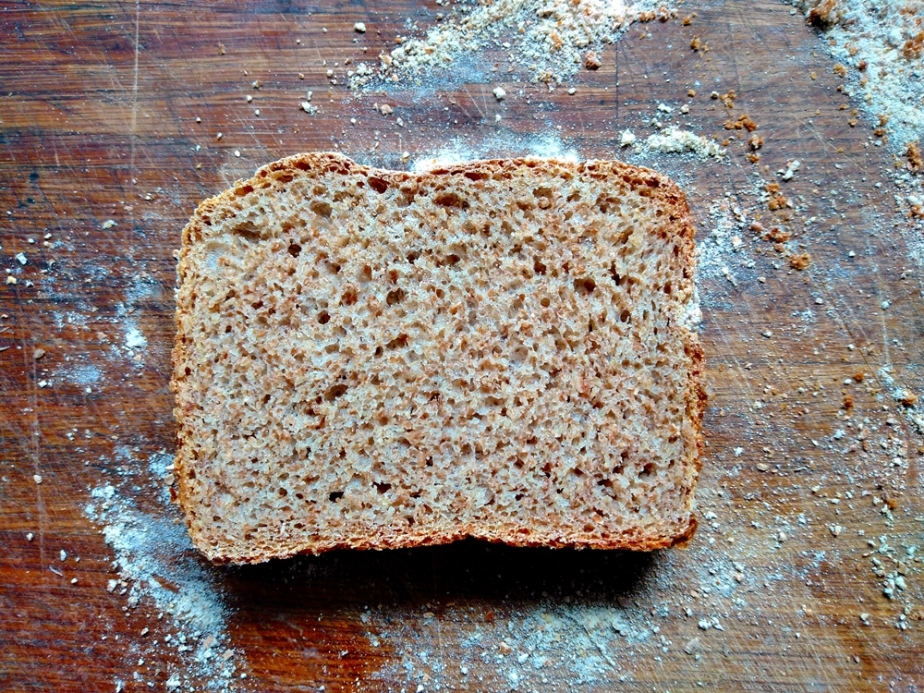
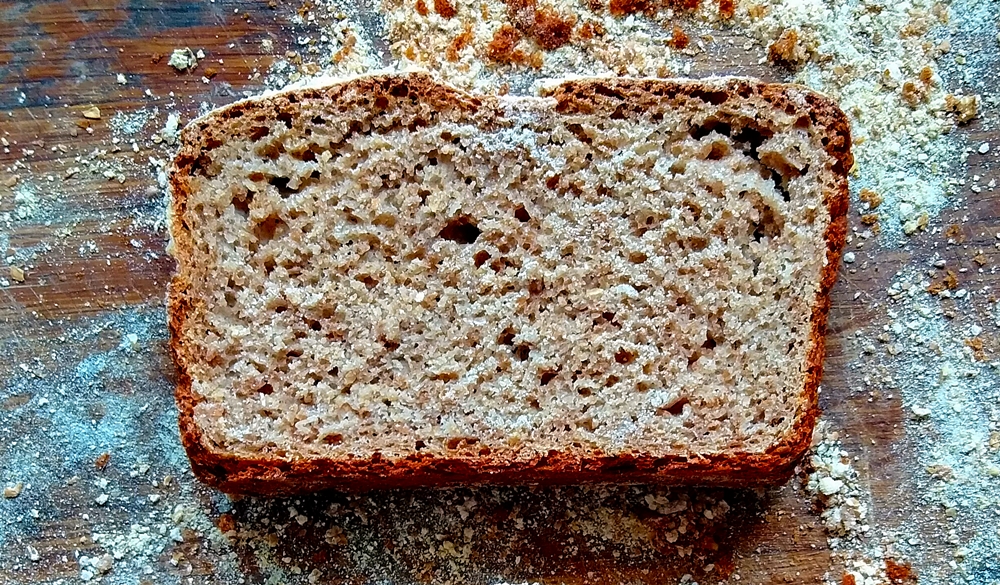
Both breads on this page, and the two white loaves on the previous page, were made according to this recipe. The above image is a cross-section of a loaf made with Stoneground Wholemeal Flour. The image below is from a loaf made with Stoneground Wholemeal Flour and Buckwheat Flour in a 50:50 ratio.

Buckwheat Wholemeal Barm Bread


Simple Barm Bread

350g bread flour(s)
150ml room-temperature barm¹
150ml warm water
1tsp salt

  • Mix 50g of the flour with the barm and the warm water. Set aside to work for 30 minutes. This is not strictly necessary with fresh barm, as it is full of life, but it is good to get into the habit for the future, be it weeks or months later, in order to check whether your barm is still lively. If there are no bubbles visible after 30 minutes, you can try and jump-start it by stirring in 1tsp brown sugar and waiting another 15 minutes.
  • When bubbles are visible, add the rest of the flour and the salt and mix thoroughly. Knead by hand for 10 minutes. If you’re using a mixer and a dough hook, set it to the lowest possible speed for 10 minutes, then the highest speed for two minutes. You want the dough to be elastic, but probably a little more moist than regular dough – the long rise time is very drying and if the dough is too stiff to begin with, it will restrict the rise.
  • Grease a large loaf tin well.
  • Tip out the dough and knead it into a loaf shape. I usually pat it flat(ish), then fold the ends in, then the sides in, then turn it over so the seal is on the bottom.
  • Lay the dough in your loaf tin. Brush the top of the dough lightly with a little oil or spray with water and/or scatter flour over the surface. This will help keep the dough from drying out.
  • If you have a plastic bag large enough, you could put your tin inside and ‘inflate’ it around the loaf to keep off any drafts. I usually just put it in the oven.
  • Set aside to rise. The rising time will depend on the age of the barm, the type of flour used and the temperature of the room.
    • I recently made white bread with a fresh batch of barm, and it took 5½ hours to rise during the day (warmer).
    • Stoneground wholemeal flour bread with some month-old barm took 10 hours overnight (cooler).
    • Enriched (with sugar and butter) dough with fresh barm (for hot cross buns) 9 hours overnight.
  • When the dough has risen sufficiently,² bake in a hot oven, 200°C, 180°C Fan for 50 minutes, turning the loaf around half way through the baking time to even the colouring.
  • For an extra crispy crust, remove the loaf from the tin and return to the oven for 5-10 minutes before cooling on a wire rack.


¹ Be sure to shake/whisk your barm up well before taking your measure out.

² This should be when it has doubled in size. For this amount of flour, in a large loaf tin, it will be when the dough almost ¾ fills the tin. The last bit of rise should be in reaction to the heat of the oven (oven spring). Don’t worry if you mis-judge it and let it go a little too long, bake the loaf anyway – it will be delicious, just with a rather flattened top.