Irish Halloween Treats

There are several Halloween traditions around these isles, but arguably the strongest traditions abide in Ireland.

Several years ago, I discovered online a trove of fascinating Irish social history at the National Folklore Collection. This project is the digitisation of thousands of essays written by Irish schoolchildren and teachers from over 5000 primary schools in the Irish Free State, between the years 1937-1939. These social history essays contain information gleaned from parents and grandparents, and give a fascinating insight into hearth and home stretching back to famine times in the nineteenth century. This amazing resource is searchable on an abundance subjects, but of course the food essays are going to be my main interest.

If you’d like a deep-dive into just how much information is available to explore, my paper “The Boxty Paradox: Everything, Everywhere, All At Once” can be downloaded from the Books and Writing page. One thing that became aparrent during the research of that paper was just how bleak the food choices of so many families were. Consequently, the celebratory foods might seem to us rather plain. However, they can also demonstrate an appreciation for, if not the finer things in life, then life’s simple pleasures.

“Hallowe’en was a great night among the Irish people long ago and they looked forward to it for many weeks. All the boys and girls would gather together in one house and they would have great feasting & merrymaking.”

Collected by Annie Fallon from Mr John Harley, Farmhill, Co. Mayo1

The Halloween/November’s Night/Oidhche Shamhna foods most mentioned are barn brack/bairín breac – a ‘speckled loaf’ originally of caraway seeds, but more recently dried fruit – boxty, apples and nuts.

“In this locality the popular food at Halloween are apples, nuts, and boxty, also dumplings of many kinds.”

Collected by Mrs A. Montgomery from Mrs Kelly, Corr, Co. Cavan2

According to many accounts, the Halloween barn brack was saved up for and bought from a bakery. These cakes were baked containing a ring, and whoever got the piece of cake with the ring was supposed to get married within a year.

“Halloweve night falls on the last night of October. On that day my mother goes to town and she buys apples, nuts and a barn-brack. “

Collected by Jerard Jordan from Mrs Gara, Tivannagh, Co. Roscommon.3

Alternately, during hard times, a soda cake would be baked at home either on the griddle or inside a bastible (lidded pot). The most coveted cake was baked with sour cream, but apples and hazelnuts could also be added.

“apples are put in cakes for November night.”

Collected by Tommy Kelleher from Mrs Margaret Kelleher, Mullaghroe South, Co. Cork4

The cream cake was a soda cake with plenty of cream in it and baked in the griddle.”

Collected by Beití Ní Dhomhnaill from Mrs Ashe, teacher, Dún Beag5

“On special occasions … a cream cake was made. Cream was mixed through the milk when mixing the dough. Currants, sugar and raisins were also put in the cream cake to make it rich and sweet.”

Collected by Seamus Daly, Kilclooney, Co. Waterford6

“On festive occasions a special cake was baked of such ingredients as flour, eggs, sour cream and a little sugar.”

Collected by Mary Jones from Mr M. Jones, Bruree, Co. Limerick7

“… cream cakes were made. These were made thin, but otherwise were made in the same way as ordinary soda cake.”

Collected by Michael Collins, Woodcock Hill, Co. Clare8

The recipes this week are two versions of soda cake mentioned in accounts in The Schools Collection: the cream cake and a fruit cake. According to the written accounts, the cream cake was considered the pinnacle of social delicacies, in numerous accounts warranting special mention. The fruit soda cake has more oblique mentions, but is absolutely symbolic of the foods enjoyed at Halloween. You can, of course, choose to add apples and nuts to the cream cake, if liked.

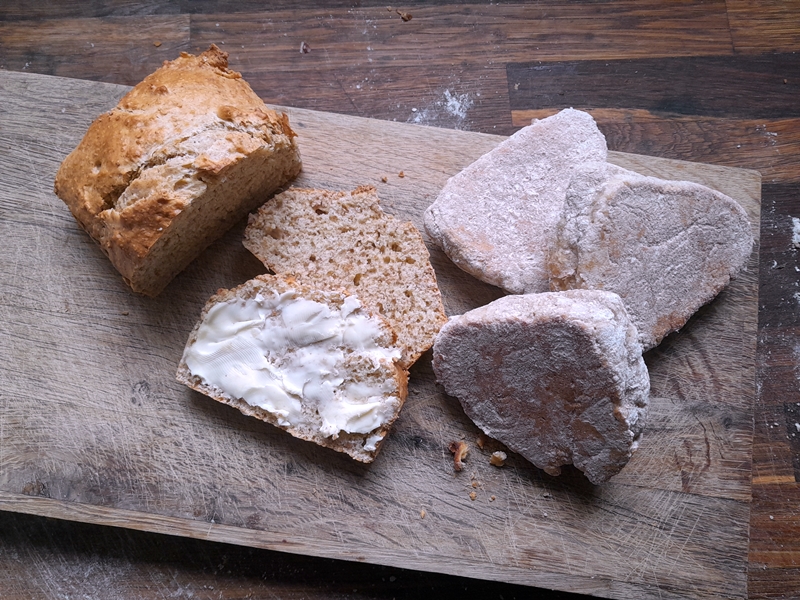
 Cream Cake

In the 19th century in Ireland, white flour was expensive, so if wheat flour was used at all, in most households it was wholemeal. I’ve opted for a less dense mixture of white and brown. Choose your own variation.

If you’d like to add apples and nuts to your cream cake, use the proportions in the recipe below, and reduce the sugar to 50g.

450g plain flour/wholemeal/brown/mixture
1tsp bicarbonate of soda
1 tsp salt
2 large eggs
85g sugar – caster, light/dark brown – your choice
300ml sour cream
100ml milk

  • Prepare your baking tin(s). You can, of course, bake your soda cake freeform, but a tin is also fine. My tin of preference is a 24cm shallow square tin, but you can also choose smaller tins or indeed choose to bake them in a pan on the ob over medium-low heat. If using a tin, line with baking parchment.
  • Heat the oven to 200°C, 180°C Fan. If using the hob, put a non-stick pan over medium-low heat (4 on a 1-9 scale) and allow to heat thoroughly.
  • Put the flour(s), soda, salt, sugar and eggs into a food processor and blitz briefly until well combined.
  • Tip the mixture into a large bowl.
  • Mix the milk and cream together until smooth, then add to the dry ingredients bit by bit. NB You might not need all of the milk mixture, as it will depend on the amount of moisture already in the flour and eggs. You want a soft dough, so a little extra is fine, but not enough moisture will lead to a dense loaf too stiff to rise.
  • When your dough is fully combined, tip out onto a floured surface.
    • For soda farls to cook on the hob, divide the dough into two, and lightly shape each half into rounds. Gently pat down until 4cm in height. Using a dough scraper or similar, cut each round into six or eight triangles.
    • For a large loaf, shape into a round and transfer to your prepared tin. Cut a deep cross in the top to assist in even cooking. If you have any of the cream mixture left, you can brush it over the top of your loaf as a glaze.
  • To cook your cream cake(s)
    • For a large loaf, bake for 45-50 minutes, turning the oven half-way through to ensure even baking.
    • For cream farls, bake gently in your pan for around 10 minutes each side, turning carefully when the first side is toasted and lightly browned.
  • Cool briefy on a wire rack and serve warm with plenty of good butter.

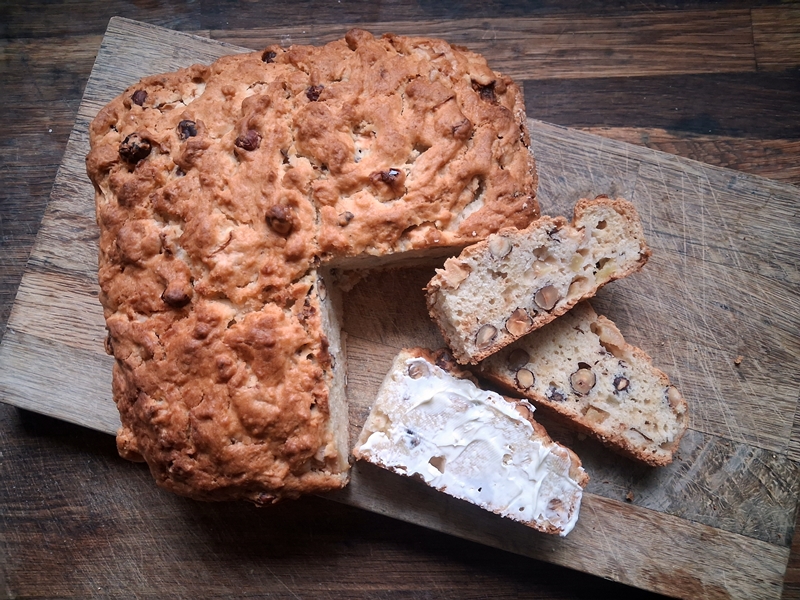
Apple and Hazelnut Soda Cake

Apples and nuts were central to the feasting at Halloween and this sweet soda cake is rich with both kinds of autumnal bounty. Enjoy warm from the oven or toasted, with a generous spreading of good butter. I’ve chosen to use Bramley cooking apples, as they break down into fluff when cooked.

100g whole unblanched hazelnuts
450g plain flour
1tsp bicarbonate of soda
1 tsp salt
50g sugar – caster, granulated, Demerera, light/dark brown – your choice
2 Bramley Apples – or 500-600g of similar cooking/sharp apples
200ml plain yogurt
200ml whole milk

  • Prepare your baking tin. My tin of preference is a 24cm shallow square tin. Line with baking parchment.
  • Heat the oven to 200°C, 180°C Fan.
  • Put the hazelnuts onto a baking tin and bake for 10 minutes until lightly browned and toasty. You can remove the skins by rubbing the nuts in a clean cloth, but I prefer to leave them as is.
  • Put the flour, salt, sugar and soda into a bowl and whisk together.
  • Peel and core your apples, and chop into 2cm pieces. Add the chopped apple and nuts to your dry ingredients and mix.
  • Whisk together the yogurt and milk, then gradually add to the rest of the ingredients. I find it best to stir the liquid through with a round-ended knife, which is less rough than a larger utensil. You might not need all of the liquid as the apples will contribute to the moisture of the mix.
  • Tip out your dough and shape lightly into a round. Transfer the dough to your baking tin, and cut a deep cross in the top to facilitate even baking.
  • Bake for 50-60 minutes until risen and browned, turning the tin around after 30 minutes.
  • Cool briefly on a wire rack and enjoy warm or toasted with lots of good butter.

1 The Schools’ Collection, Volume 0096, Page 84
2The Schools’ Collection, Volume 0982, Page 233
3 The Schools’ Collection, Volume 0234, Page 307
4 The Schools’ Collection, Volume 0359, Page 144.
5 The Schools’ Collection, Volume 0626, Page 350.
6 The Schools’ Collection, Volume 0654, Page 447.
7The Schools’ Collection, Volume 0498, Page 131
8 The Schools’ Collection, Volume 0598, Page 249

Chipstead Churdles

I’ll be the first to admit that I love a good story behind a recipe. However, what winds me up no end are stories that have been made up to make a recipe appear more ‘authentic’ than it actually needs to be.

And so we have Chipstead Churdles. Chipstead is a small village in Surrey, southeast of Croyden. Churdle Pies are also claimed by Sussex, though I have yet to find any recipe predating this one.

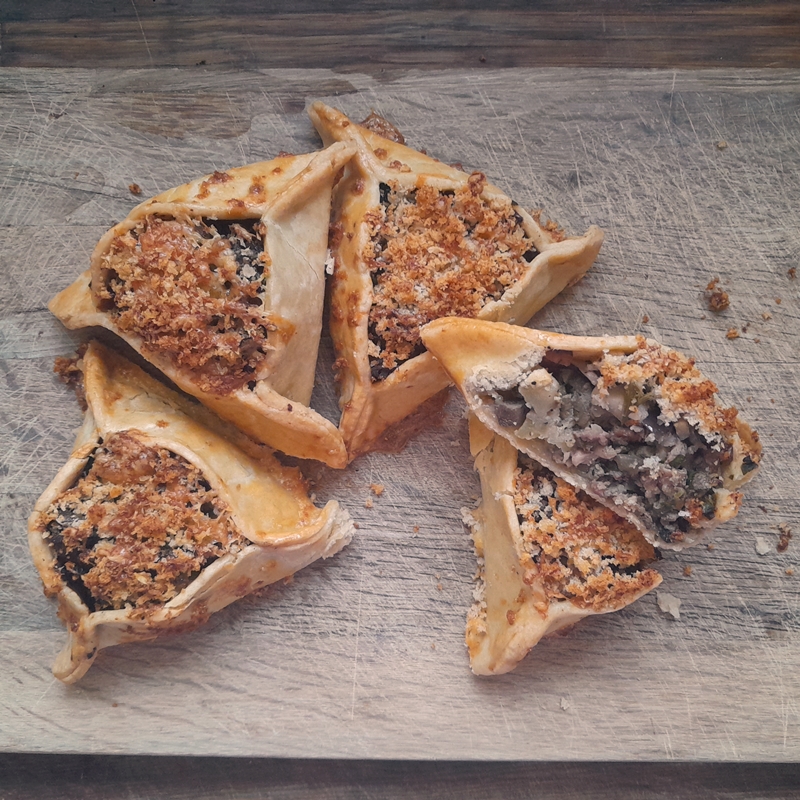
These little triangular pasties are a pleasant way to enjoy the classic and flavoursome combination of liver and bacon, aside from the traditional grilling. As you’ve probably already surmised, they have also managed to develop quite a colourful, and largely fictitious, provenance. Touted online as ‘an ancient recipe’, ideal for the farm worker to stuff into his pocket as he headed out to the fields, no-one seems to know specifically where and when they date from, although I’ve read many a vague “…Seventeenth century…” claim.

Even without any provenance, neither the shape nor the style of the pies would appear to support this. These are tricorn-shaped pies – although easy to form, hardly the most robust nor the most practical of shapes – with the top being left open to be filled with a cheese and breadcrumb mixture (this crunchy topping being much more of a 20thC style). Any farm worker worth his salt would end up with a pocketful of crumbs within an hour.

No, in actual fact, the recipe actually originates in Doreen Fulleylove’s “Simple Country Fare” (1970). Now to me, that’s not that long ago – good gravy, I remember 1970 – but then I have to stop and remind myself that that is now over fifty years ago.

The Churdles name, however, can be traced back much further, all the way to the 1920s. In his fabulously-titled “Away Dull Cookery!” (1932), Earle Welby recorded an entertaining nonsense menu devised by the dramatist Henry Arthur Jones for his grandchildren. It is, perhaps, the greatest menu I have ever read, and I reproduce it below:

  • Pickled Trunnions
  • Filets of Poucher Bonne Femme
  • Baked Banbury Mush
  • Squibbles on Toast
  • Truffled Guffins
  • Boogoose Bordelause
  • Varicose Beans
  • Danderchits in Aspic
  • Wombles
  • Stuffed Spanish Crippets
  • Churdle Pie
  • Mulligatawny Fritters
  • Nostrum Roes à la Diable
  • Piblets
  • Trundleberry Gin

It’s on my ever-lengthening list of Things To Do to devise and make dishes for this menu.

But back to the Chipstead Churdles. It seems to me that a far more likely scenario would be for the name Churdle to have been borrowed to grace a heretofore unnamed but very toothsome pie. And there’s nothing wrong with that at all.

Chipstead Churdles

The savoury flavours of liver and bacon are here paired with mushroom, onion and sharp apple to make for a lighter and fresher mouthful.

shortcrust pastry

1 onion
30g unsalted butter
200g smoked back bacon, rind removed
200g lamb’s liver
60g mushrooms, chopped
1 small Bramley apple, peeled and finely chopped
2-3tbs chopped parsley
½tsp ground black pepper
½tsp salt

4tbs fresh breadcrumbs
4tbs finely grated strong cheddar cheese

1 large egg for glazing

  • Peel and chop the onion finely.
  • Melt the butter in a frying pan and add the onion. Fry gently for 8-10 minutes until softened and translucent.
  • Add the bacon and fry for a 1-2 minutes and then turn the slices over.
  • Add the liver and fry for 2 minutes, turning the slices over after 1 minute. This should cook the liver enough to remain pink in the centre. As it will be cooked again during the baking of the pies, you don’t want to overdo it at this stage.
  • Lift the meat from the pan and chop finely.
  • Scrape the cooked onion and butter into a bowl and add the chopped meat.
  • Stir in the mushrooms, apple, parsley and seasoning. Set aside.
  • Preheat the oven to 180°C/160°C Fan.
  • Roll out the pastry to a thickness of about 5mm.
  • Cut 8 circles of pastry 10-12cm in diameter. You can make 4 large pies, but the larger the pie, the more difficult the pastry is to handle.
  • Divide the filling into 8 and add one portion to the middle of each circle of pastry.
  • Damp the edges of the pastry with water.
  • Pinch the edges together to make a triangle base, folding the sides of the pastry inwards and pressing the edges together to make a three-cornered hat shape. Leave the middle of the pie open.
  • Mix the cheese and breadcrumbs and sprinkle one spoonful over the opening at the top of the pies, and transfer the pies to a baking sheet lined with baking parchment.
  • Whisk the egg with a tablespoon of water and use it to glaze the sides of the pies with a pastry brush.
  • Bake for 25-30 minutes until crisp and golden. Turn the baking sheet around after 15 minutes to help even the browning.
  • Cool on a wire rack.
  • Serve warm.

Chestnut Apple Pie

Lady Grisel Baillie was a Scottish noblewoman who lived in the 17th/18th century. She was married to a Scottish MP, and became known to social historians for the meticulously detailed account books she kept, which  offer a glimpse into the cost of living during that time, including food and drink, servants wages, travel costs and entertainment. Lady Grisel was also something of a foodie, as she noted down many a menu from various dinners she and her husband attended.

Extracts of Lady Grisel’s household books were published by the Scottish Historical Society in 1911 and over the years I have dipped into this book many times, and have been somewhat frustrated that menus are recorded, but not recipes. She definitely had a recipe book, because the Scottish Historical Society lists it amongst her papers:

“Lady Grisell left three ‘Day Books’ folio size, the first running from 1692 to 1718 inclusive, and containing 442 pages ; the second from 1719 to 1742 inclusive, and containing 354 pages, and the third from 1742 to the date of her death (6th December 1746), continued by her daughter, Lady Murray. She also left books containing the accounts of expenses in connection with their journeys to Bath and to the Continent ; Books containing Inventories of Bottles, etc. ; a Book of Receipts ; a Book of Bills of Fare ; Books relating to estate management during the years 1742, 1743 and 1744, and many other Account and Memoranda Books.”

A few years ago, I revisited a manuscript at the Folger Library to study a recipe for Stilton Cheese that had caught my eye, (the results of which can be found in Petits Propos Culinaires 114, June 2019), and in the course of my research, discovered that the manuscript in which it appeared was the long-lost recipe book of Lady Grisel Baillie! The manuscript had been purchased by the Folger Library in June, 1959 from the London bookseller Francis Edwards, Ltd. for the princely sum of £35.00. More intriguing is what happened to it during the preceding 48 years, from 1911, when its existence was noted by the Scottish Historical Society, and its purchase and trans-Atlantic voyage in 1959, and why the current Mellerstain estate owners didn’t know where it was. Very mysterious!

The point of this extended preamble is that this recipe comes from that self-same, long-lost recipe book. It has been on my radar for a while, because it is a sweet pie with chestnuts, and when I spotted nets of fresh chestnuts in the shops this week, I was enthused to have a stab at it.

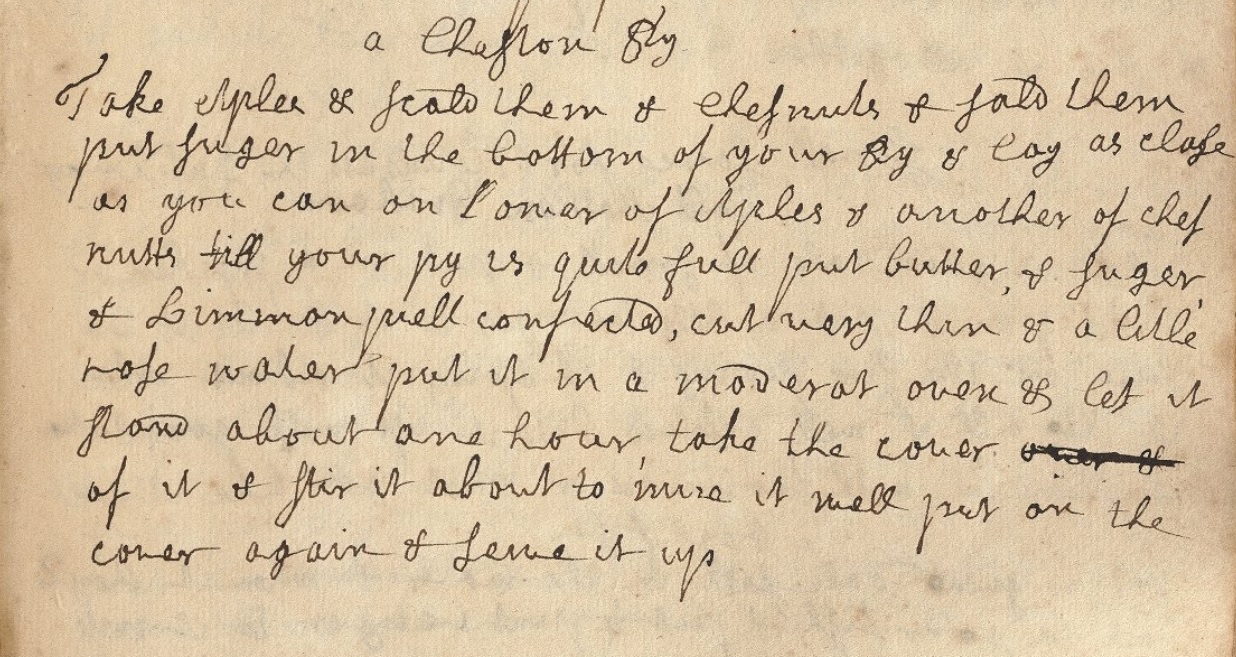
A Cheston Pye, from the cookbook of Lady Grisel Baillie, Folger Digital Image Collection, Ms W.a.111, p289, circa 1706.

Which also brings me to the word of the day: scald. Both apples and chestnuts are scalded in this recipe, and after much hunting about reading other usages, the best definition I can come up with is: cooked gently in their skins. When scalded, the apple skin will peel off by itself freely, leaving the partially cooked flesh intact. I suspect this was done to prevent wastage, preserve flavour and minimise juice. Similarly, the chestnuts are scalded in order to soften them and to loosen both the skin and the pith surrounding the nut. This all sounds simple, but, from experience, left unsupervised, things can get a little tricky. It doesn’t take much for the water in which the apples are scalding to become too hot, thereby causing the apples to burst, and then you have to retrieve your apple pulp from the ‘soup’ in the saucepan. Scald the chestnuts for too long, and then you will have difficulty extracting them whole. This isn’t too much of a disaster, as the crumbled pieces are perfect for this dish, but if you were wanting them for another use – candying, for example – the wastage in broken nuts can get quite high.

Why you should make this pie

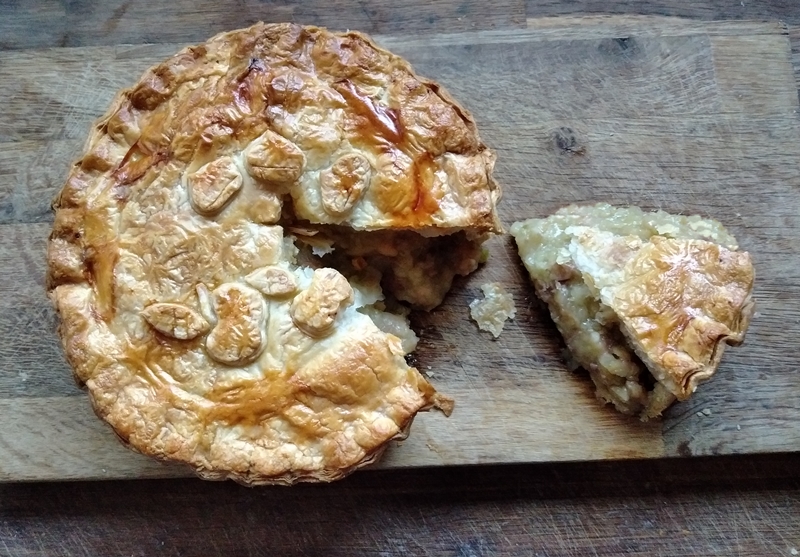
Well, it’s absolutely delicious, that’s why! It’s unusual, in that it is a sweet pie with chestnuts, and thus something of a novelty in modern recipes. During the long, slow baking, the pastry crisps up beautifully, and the chestnuts and candied lemon soak up some of the apple juice and become soft. The texture of the apples and the chestnuts is much more interesting that a regular apple pie and the contrast between the filling and the two different types of pastry is a delight. This pie embodies autumn in a deliciously comforting way, you’ll be elbowing your way back to the nets of chestnuts to make it again. Perfect for the upcoming holiday season!

Sliced of Chestnut Apple Pie
Slices of Chestnut Apple Pie: The pie slices very neatly when cold, and the chestnuts and candied lemon peel are shown.

Chestnut and Apple Pie

These quantities are for a 20cm diameter pie. You can obviously use as many or as few chestnuts as you like. You can, of course, shorten the prep time by using stewed apple and ready-cooked chestnuts. The only caveat to this I would add is that the ready-cooked chestnuts you can buy tend to be a little dark, whereas if you scald them yourself, they come out very similar in colour to the apple pulp.

If you’re making this from scratch, prepare the apples and chestnuts a day or so ahead, and then assemble the pie when required. The cooked apples and chestnuts will keep in the fridge several days.

Filling
4 Bramley Apples (or 600g unsweetened stewed apple)
1 x 400g net of raw chestnuts (or 300g cooked chestnuts)
30g candied lemon peel
30g unsalted butter
3-4tbs caster sugar
3tbs cornflour
zest of 1/2 a lemon (optional)

1 x box of ready rolled puff pastry
egg-white for glazing

Base Pastry
225g plain flour
60g cornflour
140g unsalted butter
ice cold water

  • Put the flours and butter into the bowl of a food processor and blitz until the mixture resembles breadcrumbs.
  • With the machine running, gradually add the cold water a tablespoon at a time until the mixture comes together in a ball.
  • Tip the mixture onto a floured surface, knead smooth.
  • Roll out the pastry to the desired thickness (5mm) and line a greased, 20cm pie tin. Ease the pastry into the corners of the tin, rather than stretch it, and allow the excess to hang over the edges of the tin.
  • Place in the fridge to chill until required.

To scald the apples

  • Put the apples, whole, into a saucepan and add just enough water to cover.
  • Lay a saucer upside-down on top of the apples, to keep them submerged.
  • Put the saucepan on a gentle heat (I use 5 on a 1-9 scale) and allow the apples to barely simmer for 30 minutes. Keep an eye on them, and if the skin starts to split, remove from the heat and the water immediately.
  • Lift the scalded apples out of the pan and set aside to cool.
  • When cool enough to handle, peel away the skin and then scoop all the flesh from the core.
  • Mash the apple pulp with a fork. You don’t need to make it puree-smooth, just get rid of the larger lumps.
  • Mix the sugar and cornflour together and then add to the apple pulp and mix thoroughly.
  • Taste the apple pulp and add more sugar to taste.
  • Set the apple pulp aside until required.

To scald the chestnuts

  • Using a sharp knife, cut a slit ito each nut, being sure to pierce bith the hard outer shell and the soft skin underneath.
  • Put the nuts into a saucepan and cover with cold water.
  • Set pan on a gentle heat, and simmer the chestnuts for 30 minutes.
  • Remove from the heat and allow to cool in the water.
  • Remove the chestnuts one at a time and peel away the softened shell and skin. Don’t worry if the nut doesn’t come out whole, as pieces are perfect for this recipe. Don’t drain the chestnuts, because the shells will harden quickly once out of the water, and make peeling them difficult.
  • Crumble the chestnuts into pieces – not too small – and store in a covered container in the fridge until required.

To assemble the pie.

  • Heat the oven to 180°C, 160°C Fan.
  • Slice the candied lemon peel into thin slivers. If you don’t have whole pieces, diced is fine, just make sure they’re not too big.
  • Divide the butter into three. Keep chilled until required.
  • Remove the pie tin from the fridge and trim the excess pastry. Leave about a 2cm overhang from the edge of the tin.
  • Fill the pie
    • Add a layer of apple pulp.
    • Add half the chestnuts in a layer
    • Add half the lemon peel
    • Dot over 1 portion of the butter in thin slices.
    • Add a layer of apple pulp.
    • Add half the chestnuts in a layer
    • Add half the lemon peel
    • Dot over 1 portion of the butter in thin slices.
    • Add a layer of apple pulp.
    • Dot over the last portion of the butter in thin slices.
    • Grate over the zest of half a lemon (optional). I like the lemony zing, but it can be omitted if you prefer.
  • Unroll the puff pastry and smooth out with a few strokes of the rolling pin.
  • Wet the edges of the shortcrust pastry with water.
  • Lay the puff pastry over the top of the pie and press the edges together gently.
  • Trim the puff pastry to the size of the shortcrust pastry.
  • Crimp the pastry edges as shown in the top photograph.
  • Cut out decorations for the top of the pie from the puff pastry offcuts and lay them on the pastry lid. I did a few apples and chestnuts.
  • Brush the top of the pie with eggwhite.
  • Bake the pie for 60 minutes. Turn the pie around after 30 minutes to ensure even colouring.
  • After a further 20 minutes, if your puff pastry isn’t quite cooked through, turn the heat up to 220°C, 200°C Fan for the last 10 minutes.
  • Remove the pie from the oven and cool on a wire rack for 10 minutes.
  • Remove the pie from the tin and allow to cool until just warm.
  • Serve with double cream.

Almacks

Almacks (also Almack’s and Almack) is one of many recipes that have originated from people copying dishes they have enjoyed whilst eating out. Almack’s was a Georgian/Regency London club where the great and the good could socialise during ‘the season’, Pontacks is another such establishment, now equally long gone, whose reputation remains only in the names of recipes they have inspired.

By the end of the 18th century, being presented at the Royal court was deemed old fashioned for the up and coming ladies in society, so Almacks provided a setting whereby  socialising and marriage alliances could be conducted amongst the ‘Ton’. As an example of the importance of Almack’s in the social life of the capital, when Lady Caroline Lamb published ‘Glenarvon’, with a thinly-fictionalised Lord Byron as the main character, Sarah Villiers, Lady Jersey, was so incensed at the way she had been satirised, she barred Lady Caroline from Almacks in 1816, thereby making her a social outcast *gasps and clutches pearls*. Although Lady Caroline eventually managed to regain membership three years later, thanks mainly to the assistance of her cousin, Emily Lamb (Countess Cowper), her reputation never recovered.

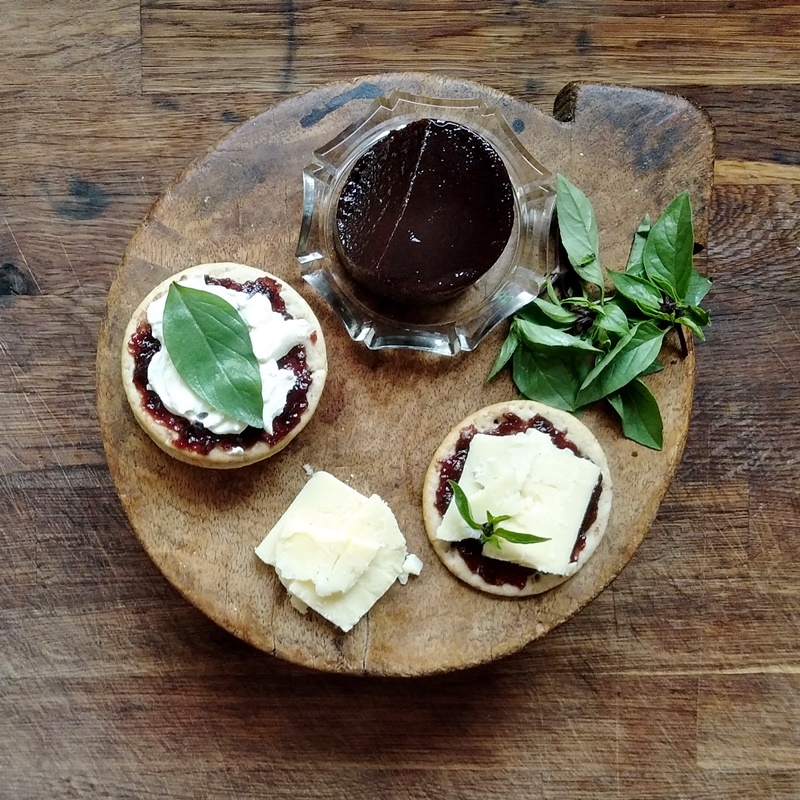
Almacks provided refreshments to its member and this thick fruit ‘cheese’ would have been ideal as it has great keeping qualities and is easy to serve at short notice. It can be eaten a number of ways: as a sweet, with cream or as a savoury, with biscuits and cheese. It is also versatile in its preparation as it can be varied by type of apple, pear and plum, thus giving it subtle changes in flavour with each batch. It is an ideal way to use up gluts of fruit, or to waste-not-want-not with windfalls.

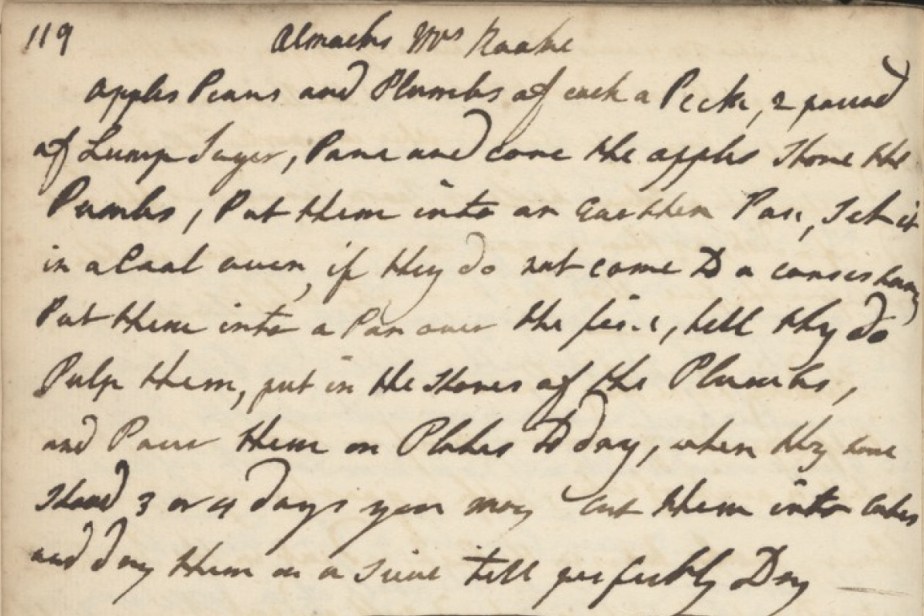
Almack recipe (1785-1825) from MS1827, Wellcome Collection.

This is the earliest recipe I have found, coming from a household manuscript dated 1785-1825. The quantities are huge, even allowing for a loss of volume during the cooking. A peck of apples is roughly 6 kg, so it calls for a total of 18kg of prepared fruit, although it’s probably going to be closer to 20 kg by the time you factor in weight loss due to peeling/coring/chopping.

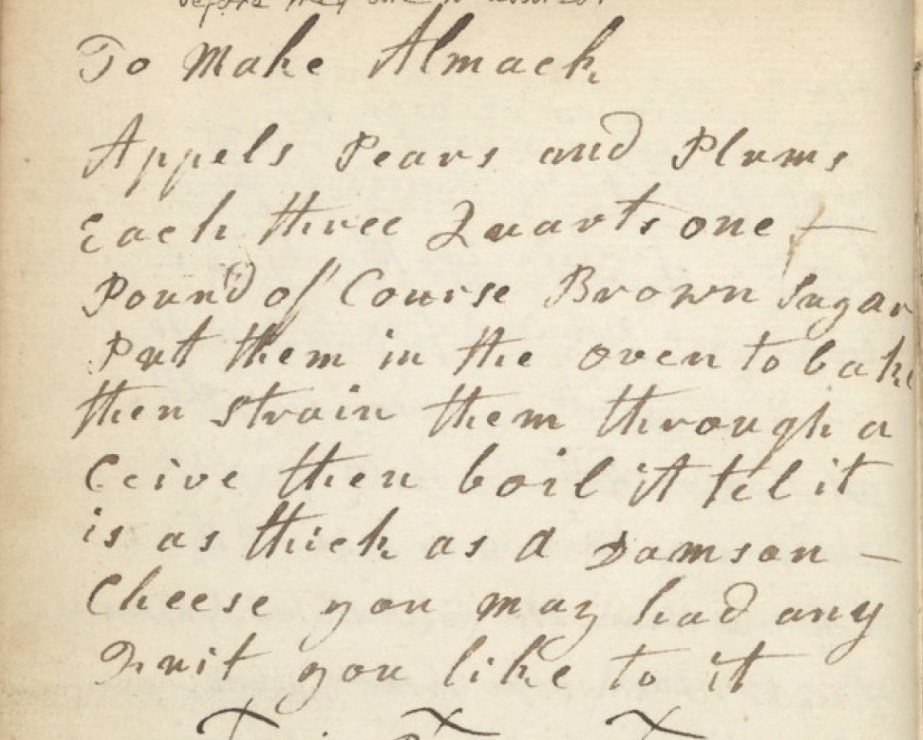
Almack recipe, (1800-1822) from MS1830, Wellcome Collection

This is a recipe with slightly more reasonable quantities – 3 quarts of each fruit = 7.5kg, but in the end I thought the recipe from Elizabeth Pease (below) was both the simplest and most reasonable in terms of batch size.

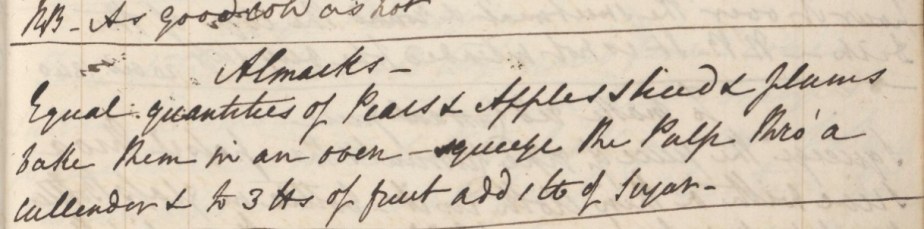
Elizabeth Pease’s recipe for Almacks (1802-1871) in MS3824, Wellcome Collection.

Admittedly, it does take a few things for granted such as expecting readers to know the method and how to prepare the fruit, but I’ll be filling you in on those in the recipe below.

So how much Almacks you make is really up to you and what you have to hand. As a guide, I used 750g of prepared apples and pears and 800g damsons (to allow for the stones) and it made 8 generous portions as seen in the photo above, and about 400g in a box for more casual use. The damsons add a real tang to the paste, and the low quantity of sugar means it sits right on the edge between sweet and savoury. Serve (small) portions with a drizzle of cream and a biscuit (ratafias, macaroons, etc) for crunch as a dessert, or with your favourite cheese and crackers.

Almacks

I’ve reduced the quantities, so you can make a small batch to try, but you can scale it up quite easily if you have it in mind to pot and gift it for Christmas.

500g peeled, cored and chopped apples
500g peeled, cored and chopped pears
500g plums/damsons, stones removed if possible
500g demerera sugar.

  • Cook the fruit. You want it soft enough so that it can be sieved easily. This can be done a couple of ways:
    • layer the fruit and sugar into a large casserole  (preferably ceramic or enamelled) and put it in the oven, uncovered, at 150°C, 130°C Fan for 45 minutes to an hour, stirring every 15 minutes to make sure the fruit floating on top of the juice doesn’t dry out.
    • Put the fruit and sugar into a slow cooker and cook on high for 4 hours. This method generates more juice, as it won’t evaporate as much as it does in the oven, but it has the advantage of being able to be left unattended for an extended period of time.
  • Sieve the cooked fruit until nothing is left but skin and (possibly) damson pits.
  • Simmer the puree in a preserving pan until no excess liquid is visible when you draw a spoon across the pan, and it’s just fruit puree. This will take rather a long time, if you used the slow-cooker method, due to the extra juice.
  • You MUST stir the pan, otherwise the puree will burn. Towards the end, it will turn into fruit LAVA< so have a towel cover your arm handy, to avoid the hot splashes.
  • When your puree is ready, spoon it into moulds or hot, sterilised jars as you would for jam. Silicone moulds are great, especially if you’re making Almacks to serve at a special meal – although you don’t need a special occasion to serve some delicious fruit cheese in a pretty shape. The flexibility of the silicone makes it very simple to turn out the paste, once cold.

Incomprehensible Pudding

When browsing handwritten manuscripts, my eye is always drawn to recipes with unusual titles. Whether it’s someone’s name, or a location, or as in this case, an odd title.

Incomprehensible Recipe
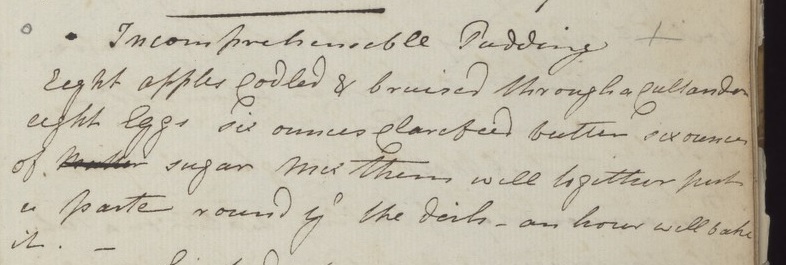
Incomprehensible Pudding Recipe, circa 1785, MS2242, Wellcome Collection.

To be honest, after reading it, I wasn’t sure why this pudding is incomprehensible. There are only a few ingredients – none of them unusual, and a straightforward method.

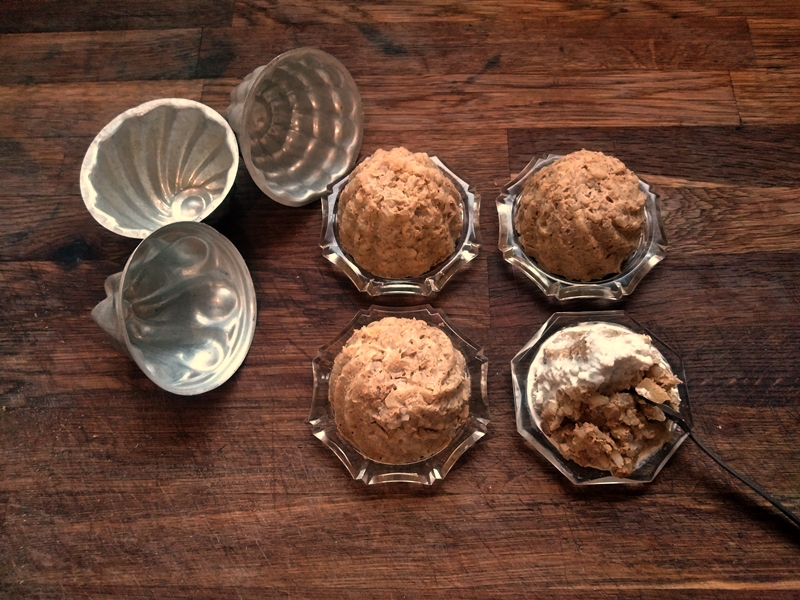
Then I made it and it turned out so light and delicate, it was a real surprise. At first glance, it seems like a custard, but the addition of the apple pulp, especially if you can get Bramley cooking apples, makes it almost frothy. With the use of clarified butter (where only the fat is used, and not the dairy solids), you could arguably denote this dairy-free.

It makes the perfect dessert in that it appears decadent, but can be enjoyed without the heaviness associated with a lot of puddings.

The original recipe called for puff pastry round the edge of the dish, which is something that has puzzled me for years, as it appears in many pudding recipes of this time. I can’t work out if it is for decoration only, or for consumption. I decided not to include pastry, because the high temperature required to cook it properly is at odds with the gentle heat needed to just set the custard.

I also opted for individual servings, so aimed for a shorter cooking time, because in typical 18th century style, the original cooking instructions are short and vague: “an hour will bake it”. Sometimes custard-style puddings are baked in a water bath, and in testing I did try baking it both ways, and for this serving size the difference was so slight I’m going to suggest no water bath. If you wanted to make a large serving, then yes, use a water bath to ensure the mixture cooks without curdling.

I’ve scaled the recipe down to a single serving size. You can scale it up as required.

The puddings in the photo are served plain, but you could also opt to sprinkle them with sugar and blowtorch/grill them to caramelise the top.

Incomprehensible Pudding for One

120g unsweetened apple pulp

1 large egg

20g liquid clarified butter

20g caster sugar

extra caster sugar or brulée sugar

  • Heat the oven to 150°C, 130°C Fan.
  • Whisk the egg and sugar until pale and frothy.
  • Add the apple and butter and mix until smooth.
  • Pour mixture into a shallow dish and bake for 20 minutes until almost set (slightly wobbly in the centre).
  • Remove from the oven and allow to cool to room temperature.
  •  (Optional) Sprinkle with caster sugar (or brulée sugar) and brulee with either blowtorch or grill.

Spiced Apple Rice Pudding

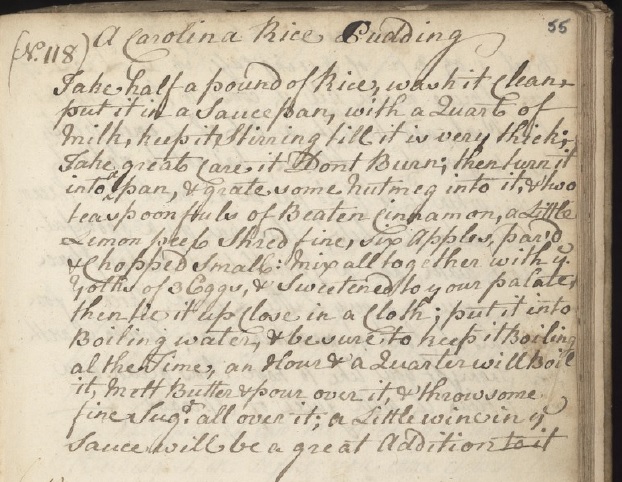
A new variety of rice arrived in Carolina in the 17th century that was to become incredibly popular for almost 200 years. However, it’s popularity dwindled in the 19th century, first with the abolition of slavery and secondly when the waterlogged lands of the Carolinas proved unsuitable for the heavy harvesting machines developed as part of the mechanisation of farming. The grain all but disappeared, but Carolina Gold has now seen a resurgence thanks mainly to the work of one man, Glenn Roberts, founder of Anson Mills. You can read about him here.

This recipe caught my eye as I was transcribing some newly (to me) digitised manuscripts at the Wellcome Library. Although MS1810 is inscribed and dated on the inside cover with “J. Hodgkin. Oct. 2. 1913”, the recipes within have been dated to the middle of the eighteenth century.

Carolina Rice Pudding, MS1810, Wellcome Collection.

As a child, I was a huge fan of the classic rice pudding, with my favourite bit being the darkly caramelised skin that would form on the top. The cottage that we lived in for a while had a Rayburn – a smaller, low-budget version of an Aga. Since it was on all the time, it was no bother to throw some rice, sugar, milk and butter in a dish and pop it in the low-heat oven and let it do it’s own thing. Nowadays, preheating and using the oven for over an hour for a pudding is a little more effort and also more expensive. Consequently, alternative methods have been developed in order for us to continue to enjoy this classic and simple dish. Slow cookers are very useful, as are the various stove-top methods. For this recipe, I opted to steam the rice in individual-sized pudding dishes. I’ve managed to acquire some fancy-shaped ones, thanks to ebay, but you can also use classic, smooth-sided pudding bowls.

As much as I love traditional rice pudding, it is very carbohydrate-heavy, and it’s a short hop and a skip from that warm, fuzzy, comfort feeling to carb-coma. This recipe unwittingly addresses that – deliciously. The inclusion of apple and spices makes for a creamy cross between apple pie and rice pudding. By using Bramley apples, the pudding becomes positively light, as the cooked apples disappear into a froth of freshness. Dessert/eating apples can also be used, but the relatively short cooking time means they don’t break down as completely as the Bramleys do. But that might be just the bite you’re looking for, so have at it. Alternately, make a large pudding and steam/boil for an hour.

When eaten hot, they need no further adornment, but that doesn’t mean you can’t ‘gild the lily’ as it were. Fresh double cream, as in the photo, is simple, delicious, and being cold, is a fabulous contrast against the heat of the rice and apples. Caramel sauce, home-made or spooned out of a tin of caramel condensed milk, steers them towards toffee apple territory. A drizzle of more evaporated milk can add creaminess without the calories of cream.

Spiced Apple Rice Pudding

The recipe predates pasturisation, so would originally have been made with raw milk, much richer than our modern-day whole milk. I’ve tweaked the original and replaced (approximately) half the milk with evaporated milk.  Next variation I plan on trying is all condensed milk and dark brown sugar, for a real caramel-y treat.

If you have a sweet tooth, you might want to add more sugar. Taste the rice mixture before filling your moulds and decide.

Makes 4 individual puddings.

60g short-grain, pudding rice
1 x 170ml tin evaporated milk
130ml whole milk
½ tsp ground nutmeg
½ tsp ground cinnamon
50g soft, light-brown sugar
1 x 250g Bramley apple
zest of ½ a lemon
2 large yolks

4 individual pudding moulds
butter for greasing
foil to cover
steamer saucepan

  • Put the milks and the rice into a saucepan and stir over medium-low heat until the rice is mostly cooked and the mixture has thickened (15 minutes or so).
  • Remove from the heat and stir through the spices and the sugar.
  • Peel, core and chop the apple finely. I find a food processor is best for this, as a couple of pulses can reduce it to fine pieces without pureeing them.
  • Add the chopped apple, and lemon zest to the rice mixture and stir well. This will have cooled the rice a little, so you can now also beat in the yolks.
  • Butter your pudding moulds well. Be thorough, as this is key in getting your puddings to turn out once cooked.
  • Fill your pudding moulds with the rice and apple mixture.
  • Tear off some foil and divide it into four. Make a fold in piece of foil and then cover your puddings, scrunching the foil round the sides to form a seal. The fold will allow for the rice expanding, whilst preventing any water getting in.
  • Arrange the covered puddings in your steamer pan and cover with the saucepan lid.
  • Bring some water to a boil and put your steamer pan on for 30 minutes. Make sure your water doesn’t boil away. A brisk simmer is all that is needed, not a raging, rolling boil.
  • When your puddings are cooked, remove from the pan and peel off the foil. Gently ease the edges of your puddings away from the sides of the mould, then turn them out onto your serving dish.
  • Enjoy warm or cold, with sauce if liked.

Fruit Puffs

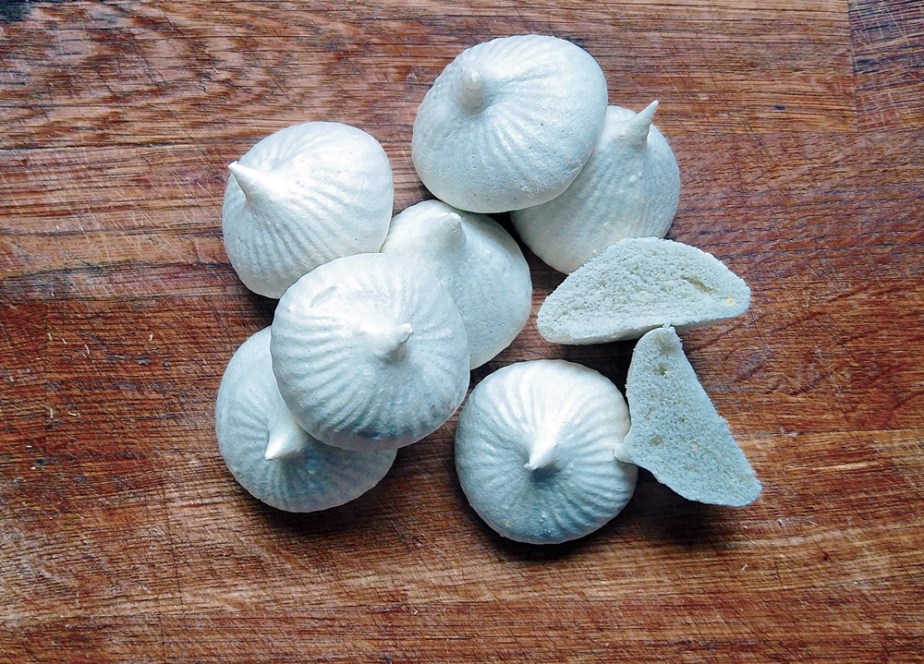
This recipe appears in the 17th century manuscript book of Lady Anne Fanshawe (MS.7113 at the Wellcome Collection), and is attributed to Lady Scarborough. What might appear, from the name, at first to be something pastry-based, is in fact a form of meringue.

Unsweetened fruit (I used apples) pulp is mixed with sugar and eggwhites and whisked until stiff and white. The recipe calls for this to be dropped in spoonfuls onto glass and dried in the oven, although I made adaptations for the modern kitchen. After a couple of practice runs, the result is, to all intents and purposes, an apple-flavoured meringue. Not as sweet as regular meringues, with the pleasantly tart flavour of sharp apples.

It is from the same recipe family as Apple Snow, with a slight alteration in porportions and a spell in the oven, and to my mind would be delightful served alongside that ethereal confection.

The main challenge with this recipe was the missing details. Apple and sugar quantities are given, but the instruction to beat them ‘with white of egg’ is open to interpretation. Additionally, “dry it in a stove” is hardly suffering from an over-abundance of detail. Hence the trial runs.

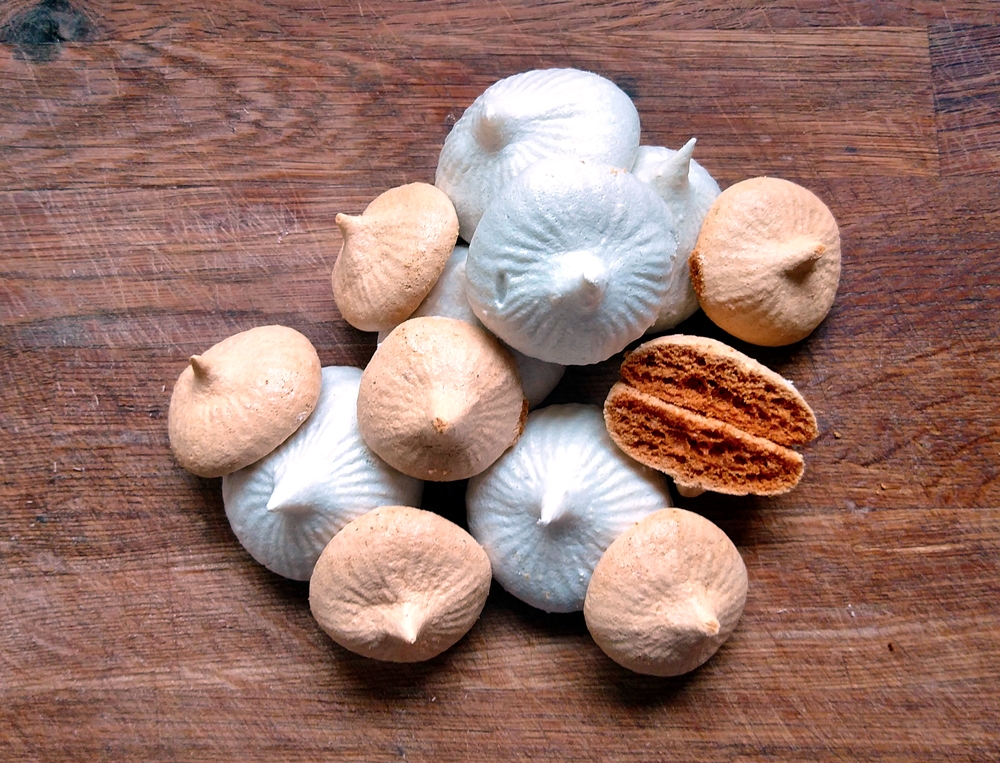
One of the batches I made whilst juggling baking times and temperatures turned a light caramel colour, which I suspect is not how the finished puffs should look, but proved to be absolutely delicious – crisp, delicate with a whisper of toffee apple. I’m counting that particular error as a win!

Apple and Caramel Apple Puffs

Fruit Puffs

Although I have only used apple here, the recipe does state that any fruit pulp can be used. My advice would be to choose pulp that has some bulk to it. Berries might prove too moist. Stone fruit, rhubarb and gooseberries would all be suitable, especially if tart, as the sugar content is quite high, and it would ‘cut through’ it nicely.

340g cooked cooking apples
225g caster sugar
2 large egg-whites (about 80g)

  • Puree the apple smooth with a stick blender. Sieve the puree if liked (I didn’t, but I was very thorough with the blender).
  • Add the remaining ingredients and whisk until light, white and stiff. I used a stand mixer on High and this took 10 minutes.
  • Heat the oven to 100°C, 80°C Fan. This temperature will be for the white puffs, for caramel puffs, increase the temperature to 140°C, 120°C Fan after 2 hours.
  • Add a decorative nozzle to a piping bag and spoon in some of the mixture. Pipe the mixture onto a baking sheet lined with parchment. There will be some shrinkage as the puffs dry out, so pipe them on the large side. For example, the white puffs in the top photo were 5cm tall when first piped. When dried, they are about 3cm tall.
  • Dry in the oven for 5-6 hours, depending on the size and how moist they are. Prop the oven door ajar by inserting the handle of a wooden spoon, for the first hour or so, to help dispel the moisture, (otherwise it stays trapped in the oven and slows down drying time).
  • After about 4 hours, remove the baking sheet from the oven and allow to cool for 5 minutes. The puffs should be firm enough by this stage to gently peel off from the parchment. Turn the puffs upside down and lay them back on the parchment, so that the bases can dry (about an hour). If you don’t let the puffs cool down first, you will squish them as you try to remove them from the paper. If the puffs aren’t firm even when cooled down, put them back in the oven for another 30 minutes and try again.
  • For Caramel Puffs, bake as above for 2 hours, then increase the heat to 140°C, 120°C Fan and bake for 1 hour. Check the colour/dryness and bake a little longer if still sticky.
  • Once the puffs are dried to your liking, store them in an airtight container. They will absorb moisture and become sticky if left in the open air for any length of time.

Apple Snow

This recipe is more usually served in the late summer and autumn months, but I’ve chosen it now because the weather outside today has carpeted the garden with a thick layer of snow.

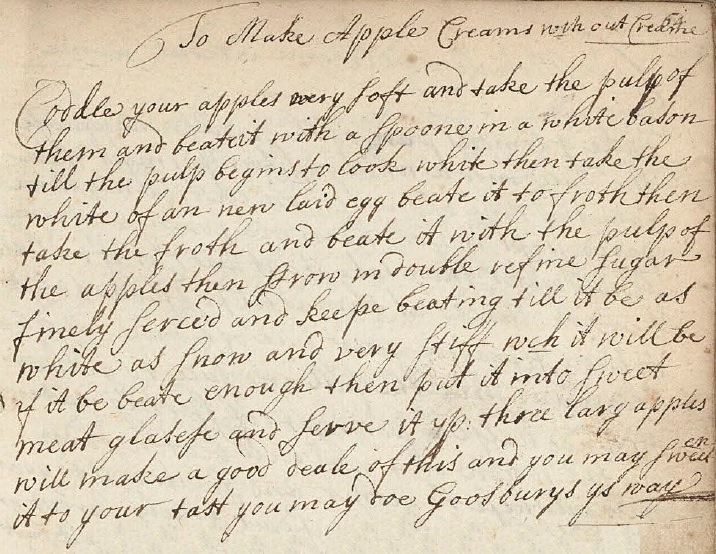
This is a classic dessert whose provenance stretches back centuries. Although the name ‘Apple Snow’ is the one more usually found in modern recipe books, it can also be found under the name Apple Fluff, Apple Souffle, Apple Puff and this version, Apple Cream Without Cream.

This last was found in a manuscript from the 17th century, held by The Wellcome Library. The manuscript has been attributed to the splendidly named Mrs Deborah Haddock, who sounds as if she should be the twinkly-eyed star of stories set in a small, quaint fishing village.

It is elegant in its simplicity, requiring only apple pulp, an egg-white and a little sugar. It is also, thanks to modern kitchen gadgetry, prepared incredibly swiftly, requiring less than ten minutes to come together before serving, once the initial preparation has been completed.

Apple Cream Without Cream, aka apple Snow, c1675, MS7892, Wellcome Library Collection

Choice of Fruit

This recipe can be made with any apple you have to hand, either keeping a purity of flavour with a single variety, or mixing and matching in a clearing-out-the-fruit-bowl, waste-not-want-not kind of way.

One of the manuscript recipes I read recommended green apples as being the best, but failed to elaborate any identifying characteristics beyond colour. I prefer to use Bramley apples, for the pale insides and sharpness of taste. Other varieties you might like to try include Worcester Pearmains, which have dazzlingly white flesh that tastes faintly of lemon and rough-skinned Russets that have an almost nutty flavour.

Alternatively, you could follow the recommendation in the recipe above and try this with gooseberries.

Apple Snow

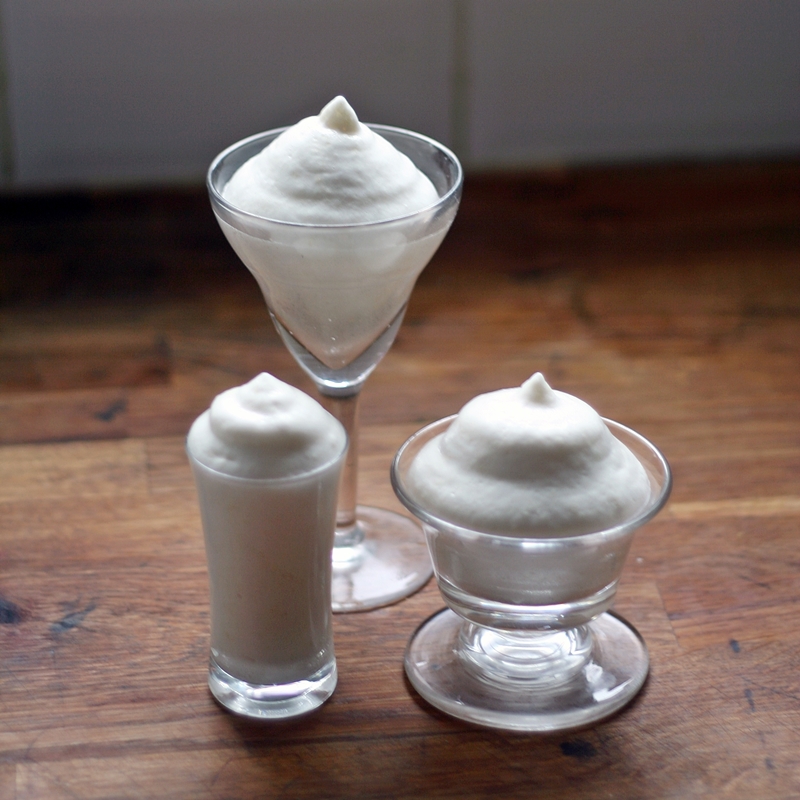
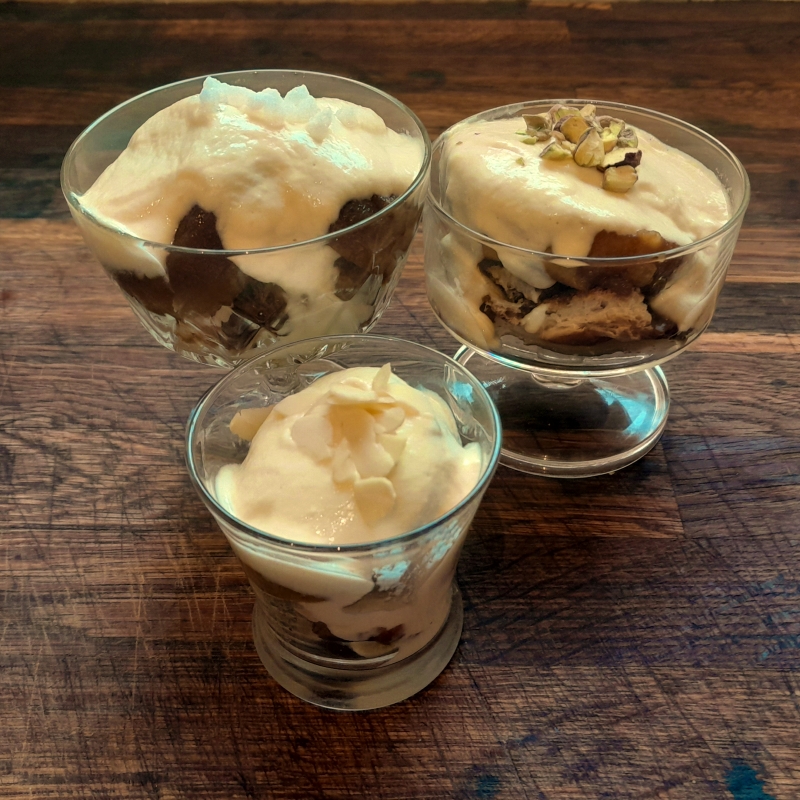
This recipe tweaks the original slightly with additions found in other versions. In terms of quantity, it will make a visually impressive amount, but is so light and delicate, a full glass is still only a relatively small amount. It will hold its shape for two hours or so, but can be mounded in more impressive heights if served immediately after preparation.

Serves 4 – 8

5 Bramley apples, or apple of your choice.
juice of 1 lemon
2tbs cream sherry (optional)
4tbs caster sugar
1 large egg-white

  • Peel, core and chop the apples finely. Toss them in the lemon juice as you go, to prevent them from discolouring.
  • Add the apple and lemon juice to a saucepan with the sherry, if using.
  • Cover and cook over medium-low heat until the apples soften and turn to froth.
  • Mash the apples to a pulp, then sieve to remove all lumps. Chill until required.
  • Whisk the egg-white until it will stand in soft peaks. Set aside.
  • Put 250ml chilled apple pulp into a bowl and whisk on High for 2-3 minutes until pale and fluffy.
  • Add the whisked egg-white and continue whisking, adding in the sugar one spoonful at a time.
  • After 2-3 minutes the mixture will have both increased in volume and become dazzlingly white.
  • Taste and whisk in more sugar if needed.
  • Spoon or pipe into glasses and serve with some crisp biscuits on the side.
  • If you have apple pulp spare, you could spoon a little of it into the glasses before adding the apple snow.

Fruit Charlotte

This is a deliciously simple, autumnal dessert that, although it can be assembled from very few, ordinary ingredients, ends up tasting so much better than the sum of its parts – the crisp, golden outside, hot and sharp insides and cool cream or hot, rich custard make this a dish of delicious contrasts. It is one of the many British desserts that evolved to use up stale bread and cooked fruit. Whilst the filling can be almost any fruit purée you have to hand, the construction needs to observe a few rules if it is going to look as impressive when served as it tastes.

Firstly, the fruit purée needs to be relatively firm and ‘dry’, with little or no visible liquid. If your cooked fruit is especially moist, then just set it in a sieve to drain – the resultant liquid can be sweetened and served as a pouring syrup or saved for use in/on other desserts. Alternatively, set it over a low heat in a wide pan, to help evaporate the excess liquid. If you think your fruit is still too soft, you could consider whisking in an egg yolk or two to help thicken it during cooking, making it more of a fruit custard.

The bread should not be plastic-wrapped and pre-sliced. The best charlottes are made when the bread can absorb some moisture from the filling in much the same way as it does in Summer Pudding, and sliced bread just doesn’t have a suitable surface for this. Not that having your bread sliced by a machine is bad – it can make it wonderfully thin and regular – just buy a whole loaf and get the bakery to cut it for you on their machine. If it’s not stale, just leave the slices you intend to use out on the counter for an hour, they’ll dry just enough. During baking, the dry outside will, thanks to the coating of butter, crisp up and turn wonderfully golden, and the inside will draw moisture from the filling and pull everything together, so that you have a firm pudding to turn out.

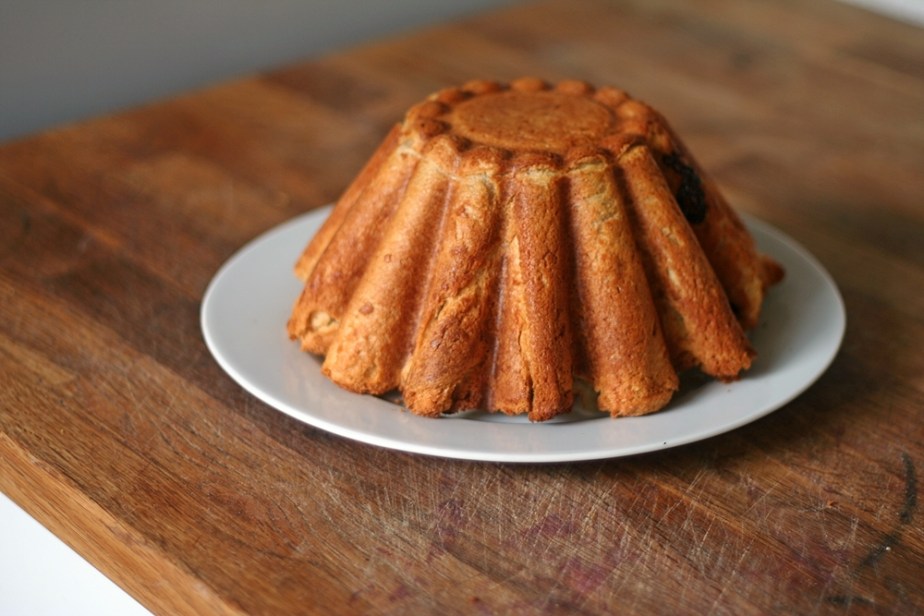
The final important consideration is the shape of the bowl in which you construct your charlotte. It needs to be both oven-proof and domed/tapering. Straight-sided charlottes are usually cold desserts such as the Charlotte Russe, which uses sponge fingers and a firmly set cream and is also thoroughly chilled before being served, which helps greatly with presentation. A traditional, domed pudding bowl, or individual pudding bowls, are ideal. Their tapering form is most conducive to maintaining an impressive shape of your hot charlotte. The fluted tins commonly marketed as brioche tins are also the ideal shape, with the added detail of fluting giving the turned-out dish a very elegant appearance.

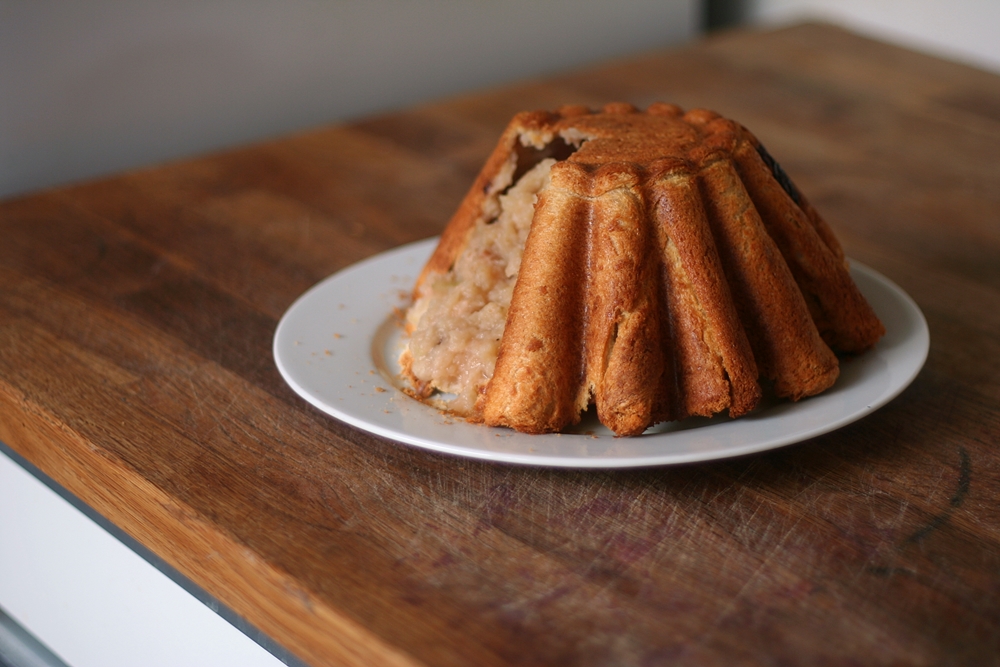
This is an adaptation of Mrs Rundell’s recipe from 1808. Her version calls for raw apples, sugar and butter and is baked slowly for 3 hours with a weight on top to help compress the apples as they shrink during cooking. This recipe is much shorter, just over one hour, but this length of time is necessary for the bread to crisp, turn golden and be sturdy enough to support the fruit filling until serving time. Higher heat and baking for a shorter time means that, when turned out, the pudding slowly sags and collapses, like a Victorian matron with her corset removed. The use of an already-cooked puree makes preparation that much quicker and the cooked pudding less prone to loss of volume.

Fruit Charlotte cut

Fruit Charlotte

I used some apples from a friend’s garden for this recipe, and added no sugar – the sharpness was a great contrast against the rich, buttery crust. I highly recommend this approach. If your fruit is especially sharp, consider using a sweet custard as an accompaniment.

750g fruit pulp
stale white bread slices
softened butter

pouring cream or custard to serve

  • Preheat the oven to 200°C/180°C fan.
  • Butter the inside of your bowl(s) generously with softened butter.
  • Cut the crusts from the bread. Cut a circle or flower shape for the bottom of your bowl and put it in first. It will make for a neat top once you turn out the pudding, and also hide the ends of all the side pieces of bread.
  • Line your bowl(s) with the crustless bread. How you choose to do this is up to you. Personally, I keep the pieced of bread whole and patch where necessary. If your bread is fresh and springy, you can make things easier for yourself by using a rolling pin to flatten them slightly. If you are using individual pudding bowls, you might want to reduce this to a width of 1.5cm, as the smaller form will need thinner slices if it is still to look dainty when turned out.  Place the slices inside the pudding at a slight angle and press into the butter. Leave the excess sticking out of the top of the bowl for now. Make sure  there are no spaces or holes for fruit to leak through. You can see on the above photo that a little apple juice has squeezed out and been caramelised by the heat of the oven. Delicious, but a flaw if you’re after an unblemished exterior to your charlotte.
  • Fill the lined mould with the fruit puree.
  • Butter slices of crustless bread for the top of the mould. Fold the ends of the bread at the sides inward and place the final pieces of bread butter-side upward over the top.
  • Spread a little butter onto a sheet of parchment and place this butter-side down over your filled bowl.
  • Add a cake tin on top together with an oven-safe weight, such as a foil-wrapped metal weight or quarry tile.
  • Bake for about an hour until the outside of the buttered bread is crisp and golden brown and the filling piping hot. For individual puddings, bake for 30-40minutes.
  • Remove the weight/tin/parchment and bake for a further 10 minutes, to allow the lid to crisp up.
  • Remove from the oven and turn out onto your serving dish.

Posset Pie

Joseph Cooper, 1654

The surfeted Groomes doe mock their charge With Snores.
I have drugg’d their Possets.

Macbeth, Act II, scene II

The broadest description of a posset that I can think of is that of a hot syllabub: a thickened drink of either milk or cream, sweetened and flavoured with any of a number of alcoholic drinks and/or fruit, served warm.

In the Middle Ages it was seen as a winter warmer and it’s ability to make one feel good meant that over the years it segued into becoming borderline medicinal. It was recommended for insomnia, indigestion, as a purgative and of benefit when fasting.

Recipes abound, and the styles are as numerous as their intended uses: custard posset, cold posset, apple posset, whipped posset, froth posset, sack posset, soap sud posset, posset without milk, posset without wine, posset without milk wine or beer.

Thus far, Joseph Cooper is the only person I have found that turns posset into a dessert. Twenty years later Hannah Woolley would include this same recipe in her own book, adding a few of her own details to the method.

Apples are the recommended fruit, but this would work well with almost any fleshy fruit pulp; apricots in summer, for example, and dark, sharp damsons in autumn.

Posset Pie

Sweet shortcrust pastry
Eggwhite for glazing

500g fruit puree
2 large yolks
200ml double cream
50ml cream sherry
1tsp ginger
1/2tsp cinnamon
1-2tbs icing sugar
4 heaped tablespoons dried white breadcrumbs

To decorate
2cm matchsticks of candied orange, lemon and citron peel
sugar nibs

  • Preheat the oven to 200°C/180°C fan/gas 6.
  • Roll out the pastry and line a greased shallow tart tin. My favourite shape is long and rectangular (36 x 12 x 3cm).
  • Prick the bottom with the tines of a fork to prevent blistering and line with parchment paper and baking beads.
  • Bake for 10 minutes, then remove the parchment and baking beads and bake for a further five minutes.
  • Brush the insides of the tart with beaten egg white and bake for a further 3 minutes.
  • Turn the oven heat to 160°C/140°C fan/gas 3.
  • Mix the filling ingredients until smooth. Taste and add more sugar if liked.
  • Pour into the pastry case and smooth over.
  • Bake for 20-25 minutes until the filling is almost set. It will firm up while it cools.
  • Arrange your candied peel and sugar nibs on the pie as decoratively as you like.
  • Serve cold.

Apple Posset Pie
Apple Posset Pie Joseph Cooper, 1654