Cheese biscuits

Three recipes for you this week, all originating from a single idea. I thought I’d take the opportunity to show how it is possible to play with recipes you already know and love, and adapt a favourite one to different flavourings and pairings.

I was catching up on the latest season of the Great British Bake Off the other day, and for Biscuit Week the bakers were asked to make Viennese Whirls for their signature bake. I made a similar biscuit in Season Two – except I called them Melting Moments – so I was interested to see what variations this season’s bakers would bring to the table.

The range was wide and the flavour combinations a mix of both unusual and familiar (you can read more details on the specific flavourings/pairings here), and I got to pondering what I would have made. I think I would probably have gone savoury, and what better place to start than with my original recipe, and seeing if it could be tweaked to a more salty flavouring.

Obviously, the main stumbling block is the Melting Moments I made were sweet. Messing about with other recipes I’ve found that substituting cheese for the sugar on a 1:1 basis can get you a long way down the savoury route. I didn’t want the biscuits to spread much, and I also didn’t want the cheese to clump together and produce blobs, so rather than grating fresh from a block, I chose to use already-finely-grated Parmesan cheese (still fresh, just not grated by me). Test Batch 1 (a half batch of the original quantities – another Top Tip when you’re experimenting – no need for a full batch of anything until you get it right) was a straight substitution of cheese for sugar. To compliment the cheese, I also added dry mustard and ground nutmeg, as well as salt.

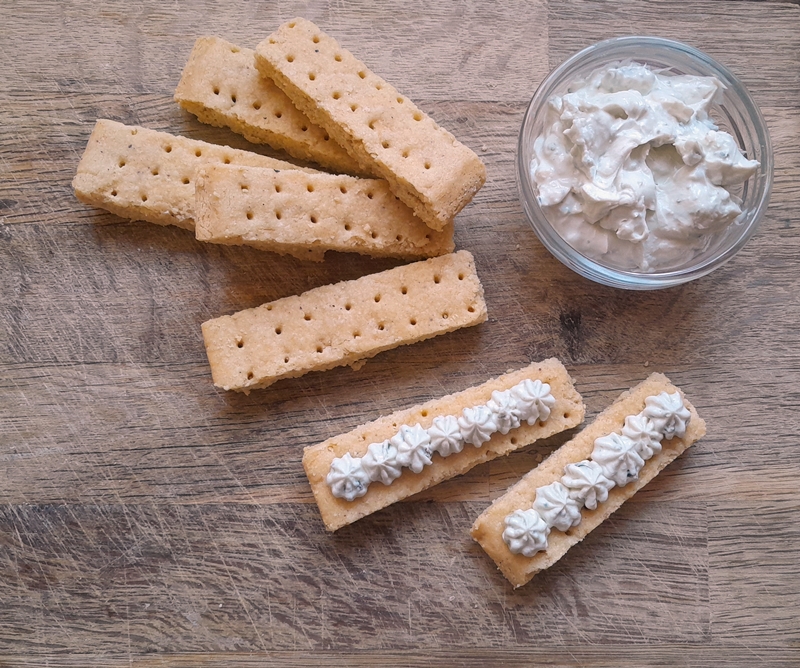
The results were cheesy-ish but also a little greasy, so Test Batch 2 involved more cheese (for taste) and more cornflour (to help with the greasiness). Batch 1 also didn’t hold their shape very well, but when I was looking at the tweaked ingredient proportions, I saw they were veering close to those of the best kind of shortbread (I made so many batches the proportions are burned into my brain), and so I opted to bake the dough in a shallow-sided pan, just like the shortbread. I didn’t want to dough to blister or rise up, so I poked holes in the dough, also like shortbread. The baking was also done long and low, and the result was absolutely delicious: strong cheese flavour, with the subtle hints of the mustard and the nutmeg rounding it out. The long, slow baking had toasted the cheese particles, which now had the bonus of adding little nuggets of crunchiness to the texture. Finally, cutting the cooked dough into pieces hot from the oven, then putting the tin back in as the oven cooled, made for a gloriously toasted flavour and appearance. It was an amazingly savoury, cheesy, shortbread, but a bit far from a Viennese Whirl.

In addition, the original prompt required a filling of some sort, so I went back to the drawing board and recalled a recipe for a favourite pull-apart bread flavoured with walnuts and blue cheese. After toying with the idea of adding the nuts to the biscuit filling, I opted for adding them to the biscuit dough, and making the filling with blue cheese.

Test Batch 2 was much better in terms of crumbly texture, but the flavour of the walnuts wasn’t really there. So for what would be the final Test Batch, I reduced the Parmesan cheese to keep it savoury but not intrusive, and toasted the walnuts. I kept the amount of cornflour the same, since walnuts have their own oil and this would also need to be absorbed in order to keep the biscuit texture. The result was just what I was going for: crumbly melt in the mouth biscuit texture, robust walnut taste with just a hint of Parmesan.

The last step was to sort out the filling. I opted for Saint Agur, which is a soft and creamy, relatively mild blue cheese, and mixed it with some cream cheese to make it pipe-able. These biscuits lack the piped form of traditional Melting Moments, so adding the swirl in the filling is a neat compromise. If you’re a blue cheese fiend, then use stronger-flavoured cheeses by all means – you might have to work a little harder to get them blended with the cream cheese. I don’t usually recommend brands, but Philadelphia cream cheese has the firmness and creaminess that is just perfect here. If you use a different cream cheese and the result seems a little watery or not as dense as you would like, you can firm it up by placing it directly onto 4-6 folded layers of kitchen roll (in a sealable plastic box or similar) and chilling in the fridge overnight. The excess moisture will be drawn out into the paper towel, firming the cheese mixture up and making the mix easier to pipe. If you don’t have the time to do this, just use your cream/blue cheese mixture as a dip. There is also a Saint Agur Blue Crème product with the cream cheese already mixed in. It is very smooth indeed, but too soft to pipe. Perfect to use as a dip, though.

So there we are. Arguably three different recipes (yes, yes – I know the dip is a bit of a stretch, recipe-wise) from a single inspiration. I do hope you try them, and then have fun experimenting with tweaking your own recipe favourites.

Cheese Shortbread with blue cheese topping and dip

Cheese Shortbread

125g plain flour
50g cornflour
125g unsalted butter – chilled
½tsp salt
½tsp ground nutmeg
½tsp yellow mustard powder
50g ground Parmesan cheese

  • Heat the oven to 160°C, 140°C Fan.
  • Line a shallow baking tin with parchment. I used one of dimensions 26cm x 18cm, but a 20cm square would also work.
  • Put all of the ingredients into a food processor and blitz in brief bursts until the mixture comes together in a soft paste.
  • Press the paste into the prepared tin and smooth over. Using a skewer or a cocktail stick, poke holes evenly over the whole surface area.
  • Bake for 30 minutes, turning the tin around halfway through to ensure even baking.
  • When baked, turn off the oven, remove the shortbread and cut into pieces. I prefer to use my metal dough scraper, which is super thin, to get nice, clean, sharp cuts.
  • Put the shortbread back into the cooling oven, to finish off.
  • When cold, store in an airtight container.

Walnut & Blue Cheese Melting Moments

30g walnuts
125g plain flour
50g cornflour
125g unsalted butter – chilled
½tsp salt
30g ground Parmesan cheese

  • Toast the walnuts:
    • Heat the oven to 200°C, 180°C Fan.
    • Lay the nuts on a baking tray lined with parchment paper.
    • Bake for 8 minutes, turning the tray around halfway through to ensure even browning.
    • Set aside until cool, then chop with a knife into small pieces.
  • Put the remaining ingredients into a food processor and blitz in brief bursts until the mixture comes together in a soft paste.
  • Tip the mixture out onto a piece of parchment and knead in the chopped walnuts.
  • Lay clingfilm over the dough and roll it out thinly (5mm).
  • Slide the sheet of covered dough onto a chopping board and freeze for 20 minutes. The dough is very soft and chilling it hard will make cutting the biscuits out and transferring them to the baking sheet much easier and with no loss of shape.
  • Turn the oven to 160°C, 140°C Fan.
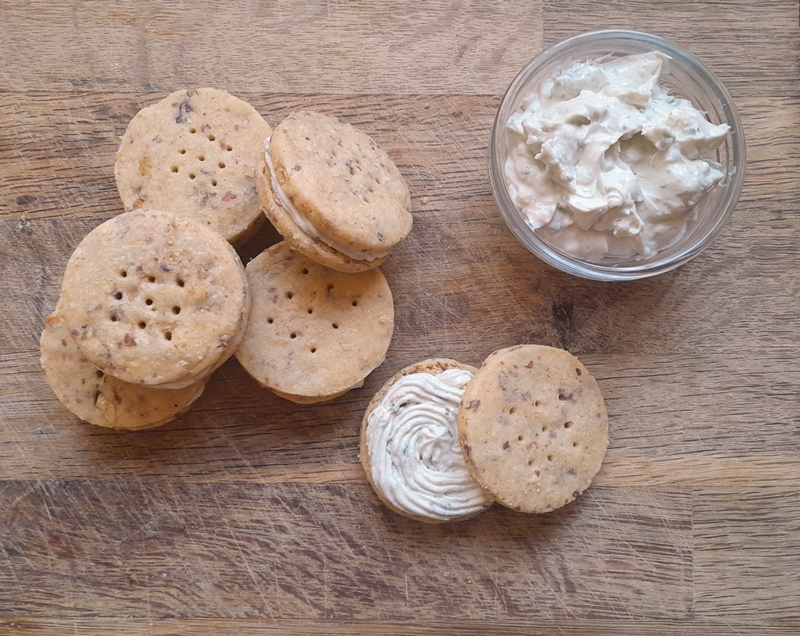
  • Cut the dough into biscuits using a plain 5cm round cutter. Lay the biscuits on a baking sheet covered with baking parchment. There’s little to no spreading during baking, so you can lay them as close as 1cm from each other.
  • Poke holes in the centre of your biscuits using a cocktails stick. Or not. I tried both ways, and to be honest, there wasn’t really a difference. Arguably the biscuits with the perforations, as in the photo at the top, maybe look a little more aesthetically pleasing, but not by much. You choose.
  • Bake for 30 minutes, turning the baking sheet around halfway through to ensure even baking.
  • Remove from the oven and allow to cool on the tins. The biscuits are rather friable when warm, so don’t be too eager to move them.
  • Store in an airtight container when cold.

Blue Cheese Filling/Dip

150g (1 pack) Saint Agur blue cheese
280g (1 large box) Philadelphia cream cheese

  • Remove both ingredients from the fridge and allow to come to room temperature.
  • Crumble the blue cheese into a bowl and mash with a fork or the back of a spoon until smooth.
  • Add half the cream cheese and mix thoroughly, making sure there are no lumps.
  • Add the rest of the cream cheese and mix until smooth and fully incorporated.
  • Fill a piping bag fitted with a 5mm star nozzle, and pipe onto half your biscuits.
  • Top with the remaining biscuits and arrange on a serving plate.
  • Use any remaining filling as a dip by adding a little cream/creme fraiche, yogurt until the desired consistency is reached.

Ormskirk Gingerbread

If you’d asked me only a few years ago, of my opinion of gingerbread, I would have given an indifferent shrug in response: I didn’t dislike it, but I wasn’t a fervent fan either. Ginger biscuits and the gingerbread used for gingerbread men I thought dull. Ginger cake was fine, but it would never be a first choice. Since then, I have discovered so many old recipes that have range and depth and nuance that it’s turned my head completely. And here we have another to add to the collection.

Ormskirk Gingerbread has a lot going for it, and I’d even go so far as to say it is probably one of the best-tasting gingerbreads you’ve never heard of.

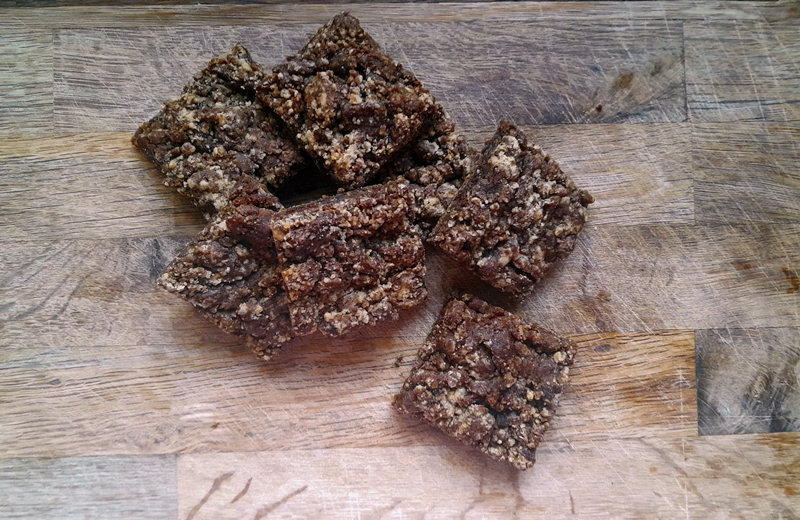
It has a speckled appearance, from mixing the dry ingredients with melted butter and treacle, which is enough to bind, but not drown. There is candied peel, traditionally lemon but sometimes others, and spices, usually ginger, but frequently, additional spices as well. A major attraction, for me at least, is the texture, falling between the softness of parkin and the crispness of a biscuit. As you, quite literally, sink your teeth into a piece, you experience a dense chewiness which, with the variety of flavourings, is immensely satisfying.

Ormskirk Gingerbread (1830s) is  one of the earliest geographically-linked gingerbreads I’ve found – predated only by Wrexham Gingerbread (1828). In the 1850s, a group of five local women paid £20 per year to the East Lancashire Railway company for the privilege to sell their gingerbread to travellers passing through Ormskirk station, which must have contributed to the spread of its popularity.

I have a selection of recipes for you to try, because in all honesty, I like them all. The method is the same for all of them, so I shall be listing the scaled-down ingredients alongside each recipe, then you can scroll down to the method and cooking instructions. All quantities are for a 20cm square tin.

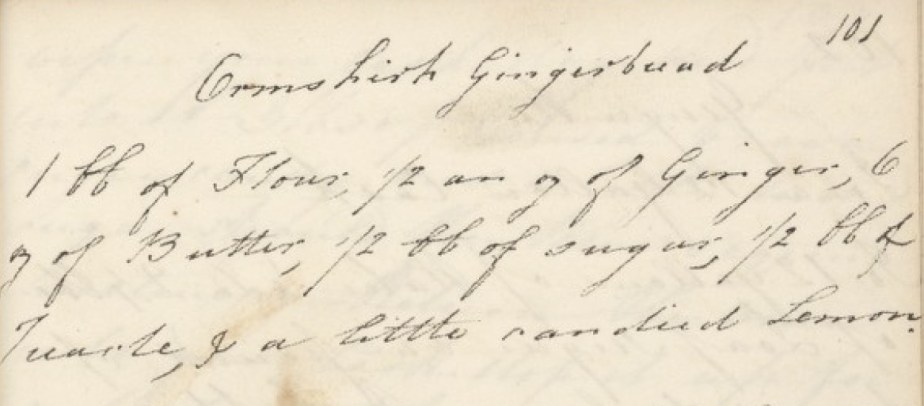
Ormskirk Gingerbread recipe, (1822-1841), MS4998, Wellcome Collection

This recipe is from a handwritten manuscript held at the Wellcome Collection. It might actually be older than the recipe below, but there’s no way of telling for sure. Rather unhelpfully, there are no instructions for either making or baking, but it clearly contains all the classic ingredients and is a great introduction to this type of gingerbread:

225g plain flour
115g soft, light brown sugar
7g/1tbsp ground ginger
85g butter
115g treacle
20g candied lemon peel

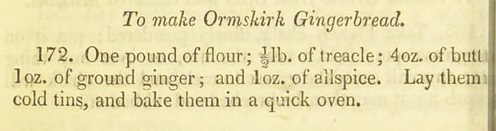
From: The domestic receipt-book by Joseph Worrrall, 1832, p38.

This is the earliest printed recipe I found. Unfortunately, it contains an error – the sugar is missing. Aside from this, what I found interesting was the complete omission of what appears to be a major component of other recipes, the candied lemon peel.  In  addition, there is, proportionally, a lot of spice in relation to the quantity of flour, but it is an interesting variation. In the past, I have bought dried, chipped ginger, and ground it as needed, and the flavour is bright and vibrant and, curiously, with a touch of lemon. Similarly with allspice, whose flavour really evokes a blend of spices.

225g plain flour
60g butter
115g treacle
115g soft, light brown sugar
14g ground ginger
14g allspice

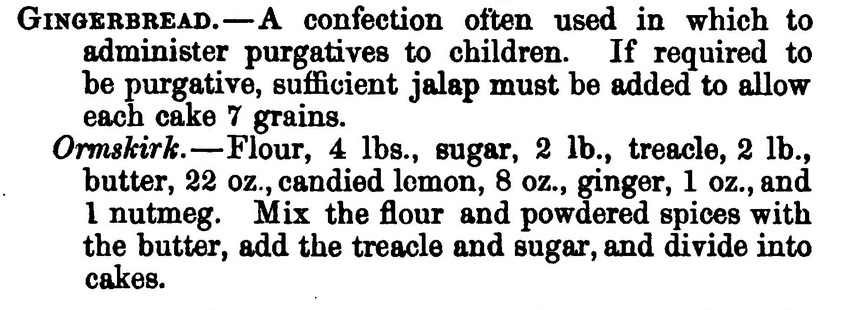
From The druggist’s hand-book of practical receipts, Thomas F. Branston, 1853, p80

This recipe echoes the medicinal uses many believed gingerbread possessed in the middle ages. I find it odd that it is Ormskirk Gingerbread that is specified in particular, instead of a generic gingerbread recipe. Jalap is the ground root of a Mexican plant of the Morning Glory family, and it was used in times past for its laxative effect.

225g plain flour
115g soft, light brown sugar
115g treacle
80g butter
30g candied lemon peel
2 tsp ground ginger
1½ tsp ground nutmeg

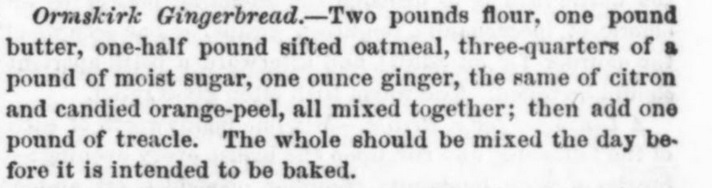
Peterson Magazine 1861-01: Vol 39 Iss 1, p93

This last recipe is a full-on, all the bells and whistles version. There’s no candied lemon peel – instead there’s candied orange and candied citron and, aside from the ginger, no other spices. There’s a higher than usual farinaceous component, with the addition of some oatmeal flour (which you can make yourself by putting rolled oats into a blender/spice mill). Finally, there’s the instruction to mix it a full day before you want to bake it. Many old gingerbread recipes have this added time requirement, because they’d also use alum and potash as raising agents, and these worked slowly, so a mix for gingerbread could be sitting in a tub for days if not weeks. There’s no raising agent included in this recipe, so I was curious whether there would be any difference to the other batches. Verdict: There was, and the resulting gingerbread was definitely veering towards cakey, although this might have been due to the added oatmeal – if that’s your preferred texture, have at it. The next time I make this I probably wouldn’t wait the 24 hours, but that’s just me being impatient.

225g plain flour
115g butter
60g sifted oatmeal flour
80g soft, light brown sugar
115g treacle
15g candied orange peel
15g candied citron peel
7g ground ginger

As I said at the top, all these recipes are delicious.

Ormskirk Gingerbread

Another reason to choose to make this gingerbread is that it can be made gluten-free, using gluten-free flour (I used Doves Farm) and gluten-free oats (Morrisons have the nicest looking GF oats – they’re like steel-rolled ones!).

It can also be made vegan, if you swap out the butter for either coconut oil or some other fat that is solid at room temperature.

Finally, there’s two slight variations in method, and it relates to how you handle the butter. The traditional method for gingerbread is to melt it in the treacle and then pour the mixture into the dry ingredients to mix. The other method is to blitz it with the dry ingredients in a food processor (or rub it in by hand). It doesn’t matter which method you choose, as the result is the same.

  • Choose your ingredients from one of the four recipes above.
  • Line a 20cm square tin with baking parchment.
  • Heat the oven to 160°C, 140°C Fan.
  • Mix your spices, sugar and flour(s).
  • If you’re blitzing the butter with the dried ingredients, add it now.
  • Blitz the mixture to resemble breadcrumbs.
  • Slice the candied peel thinly and then cut into 1cm pieces. Mix the peel into the dry ingredients, making sure the pieces don’t stick together.
  • Pour your treacle into a pan to warm. I use a large frying pan, as I prefer to add everything to the treacle, as opposed to pouring the treacle into the dry ingredients. Add the butter if you’ve not added it to the flour. You’re not trying to boil it, just warm it up enough that it moves freely and the butter (if using) is melted.
  • When the butter has melted and the treacle warmed, pour  the warm liquid into the dry ingredients and mix in. It doesn’t have to be evenly coloured.
  • Tip the mixture into your prepared pan and level out. I like to leave it rather roughly textured. Don’t press the mixture down hard, just even it out.
  • Bake for 40 minutes, turning the tin around after 20 minutes to ensure even baking.
  • Remove from the oven and , leaving the gingerbread in the tin, divide it into pieces. You can cut it into any shape you please – easiest with a square tin is 16 pieces (4 x 4 grid).
  • Set the pan aside to cool completely.
  • When the gingerbread is cold, store in an airtight container.

18th Century Bath Buns

We don’t eat buns as frequently as we used to, and I think it is a great shame, because buns are synonymous with fun!

I spend a lot of time pondering different recipes, and one thing that causes much musing is the way recipes evolve in the UK, compared to, say, France.

French recipes tend to be rather rigid and proscribed. Definitions of what constitutes those two most recognisable of French baked goods – the croissant and the baguette – have been firmly established, almost set in stone. A croissant is a croissant, a baguette de tradition is a baguette de tradition, – there are rules, there is order, and there is never, ever, deviation. You want to tweak a recipe a little? Then you have to give it a new name. The French have no truck with ‘croissant-ish’ or ‘baguette de tradition adjacent.’ No messing about with rules that have been decided decades, even centuries, ago. Absolument pas!

In contrast, British recipes are a lot more open to interpretation. On the Books and Writing page of this website you will find, amongst other things, a paper I wrote on Pikelets, and how, over the centuries, the word has been used to describe different recipes for arguably quite different items. Also a paper on Summer Pudding, which has undergone its own transformation during its long and illustrious history.

Having given the matter a great deal of thought, I’m pretty comfortable with viewing recipes, especially British ones, as having a timeline. Some are long, some short, but throughout which adapts and changes with tastes and fashions. To illustrate this, in Great British Bakes, I included multiple recipes for Shrewsbury Cakes, an all but forgotten English shortbread that has a history spanning centuries. Others, such as the less-successful Crimson Biscuits (be honest – have YOU ever heard of them?) in Ann Peckham’s 1767 book, have timelines of alarming brevity. An added feature (frustration) with British recipes is that they might go by a number of different names, according to region, or indeed the one name may refer to numerous different dishes.

And so, after WAY too much preamble, we come to Bath Buns, whose history stretches back into the 1600s, and might be a genuine contender for Britain’s Oldest Bun, much to the probable dismay of fans of Sally Luns and Chelsea Buns, very much the Johnny-Come-Latelies of the eighteenth century pastry scene. The glitterati of Bath were happily taking the waters and chomping on this style of bun for the best part of a century before Dr Oliver invented his biscuit in an effort to improve the health of The Ton.

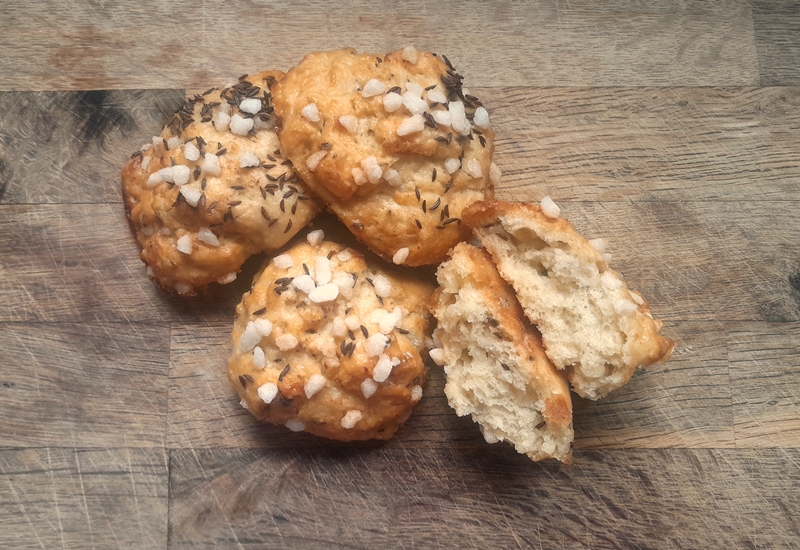
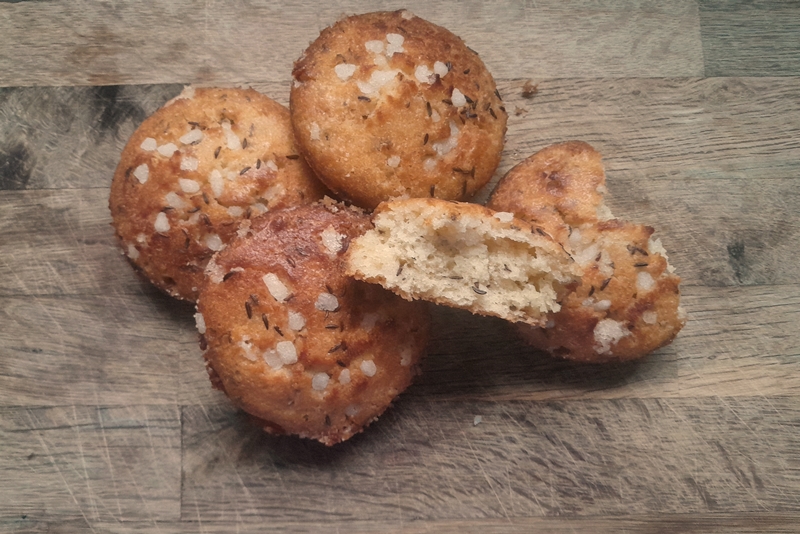
The Bath Bun of the late 17th century is rather different to the buns we might find in bakeries and tea shops today. The early Bath Buns were sweetened and flavoured with caraway comfits: seeds enclosed in numerous layers of sugar and enjoyed as sweetmeats and digestives. Today, a classic Bath Bun should retain the image of these candied seeds by being topped with pearled or candied sugar, which retains its colour and shape during baking, giving them a very distinct appearance. The time and effort required to create seeded comfits is considerable, and it is unsurprising to learn that they are no longer made. In imitation, I have found that using pearled/candied sugar and a sprinkling of unadorned seeds provides the sweetness, flavour and crunch of these forgotten sweetmeats.

The original Bath Buns were also incredibly rich with butter. Looking at recipes throughout the century, the most popular ratios ranged from an almost paltry one third of the weight of flour in butter, up to croissant-exceeding levels of 1.5 times the weight of flour in butter. Add in, as in the recipe below, a couple of pounds of caraway comfits, and these buns are probably a major cause of the gentry having to ‘take the waters’.

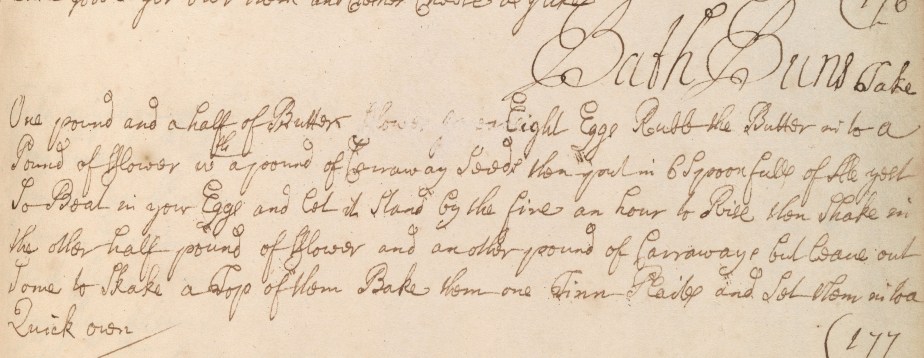
The first recipe below, the earliest I could find, is from an old manuscript dated to ‘late 17th century’ and has an equal weight of flour and butter. I scaled the recipe down, but there was still an alarming quantity of butter in not much dough. I broke my own rule too, in the baking, and did not bake it as written. Partly because I suspect that there is an error in the transcribing the original ingredients, and partly because I just couldn’t bring myself to put the full complement of sugar into the dough. I settled for half, and even that was a challenge – the buns were practically crystallized!

Earliest Bath Bun recipe I’ve found, from manuscript dated 1675-1725, MS1792, Wellcome Collection

With all the eggs and butter and sugar the dough is incredibly soft – too soft to knead – and is practically spooned onto baking trays – something which later recipes mention frequently. The modern Bath Bun traditionally should have a rather rough appearance, and shuns the round perfection of Sally Luns or the even sugared, square edges of the Chelsea Buns. Due to all this richness, the dough can take a long time to rise and the finished texture is cake-like rather than bready, crunchy with the sugar crystals and with the unusual (to our modern palates) and distinct flavour and aroma of caraway.

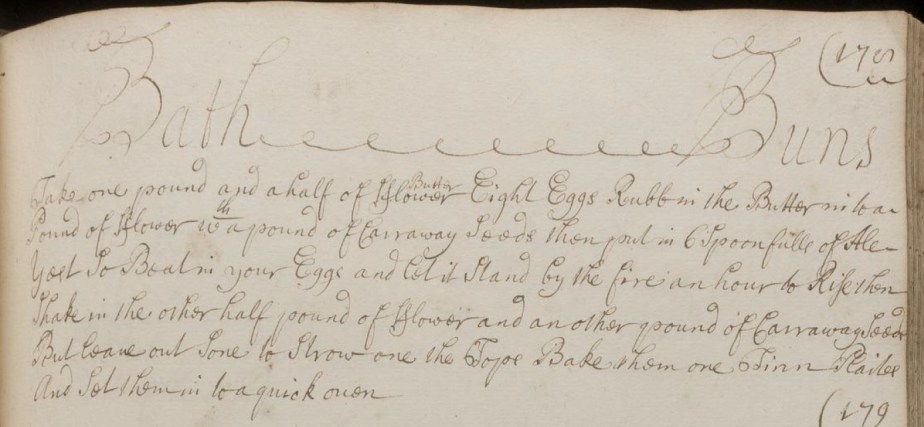
Bath Buns recipe from manuscript dated 1675-1725, MS1792, Wellcome Collection

This recipe is particularly interesting because it has a twin, in another manuscript, on the other side of the Atlantic Ocean. This manuscript is one of the holdings at Yale University Library, and are both written in the same handwriting, possibly that of a scribe. They are mostly similar, but not exact copies. My guess is that one was copied from the other, with edits being made to exclude recipes not liked and including new recipes in the copy. With this in mind, I’m of the opinion that the Wellcome Collection manuscript is the copy. Below is the potential ‘original’.

Bath Bun recipe from MS Osborn fc181, Yale University Library.

All of which is an interesting detour, but doesn’t really get us an enjoyable Bath Bun that respects the traditions of the original, but is also acceptable to our 21st century tastes. Fear not, for galloping to our rescue comes a heroine for the ages: Mrs Bridget Ilbert (1712-1790), daughter of the 6th Earl of Devon and the wife of William Ilbert of Bowringsleigh, Devon.

Recipe for Bath Buns in Bridget Ilbert’s manuscript MS1821, Wellcome Collection

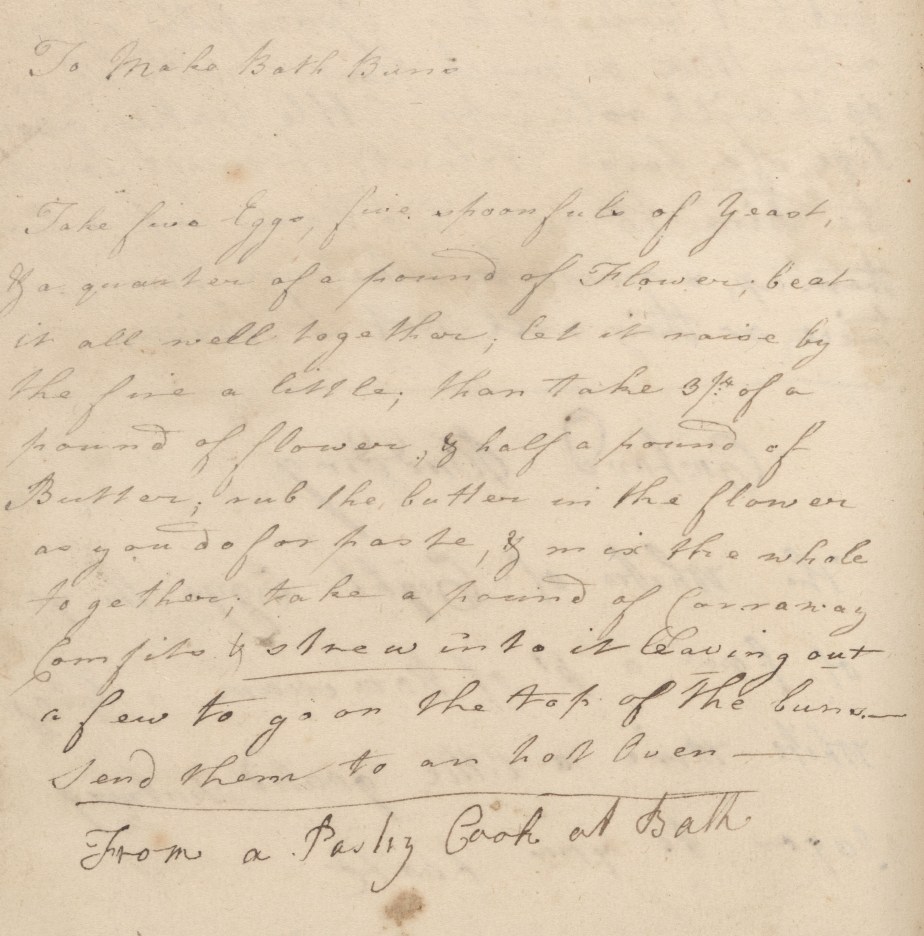
Bridget’s manuscript is held at The Wellcome Collection, and one of the recipes within is for Bath Buns. I particularly like this recipe because it comes with the added credentials of being “From a Pastry Cook at Bath” – and you can’t get much better than that. The recipe is undated, unfortunately, but it is not too big a stretch to allocate a date in the general area of early-to-mid 18th century.

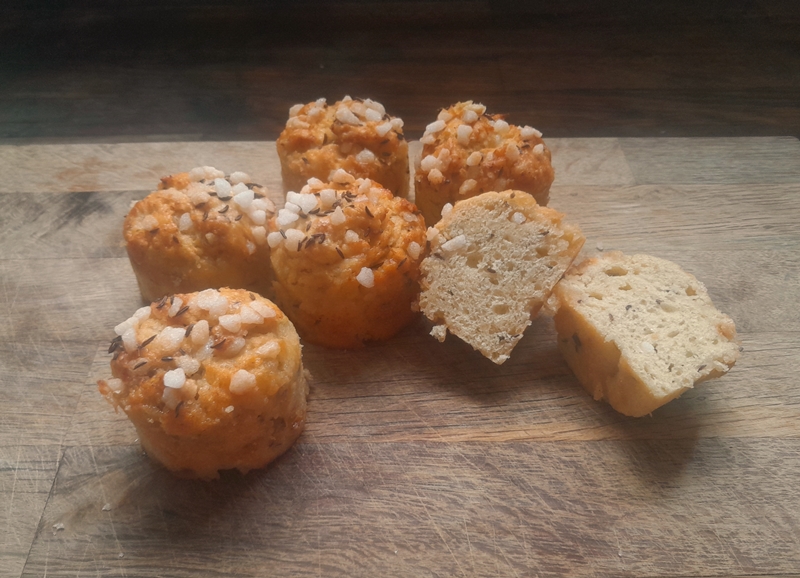
Miniature bath buns adapted from a recipe MS1821, Wellcome Collection

Original 18thC Bath Buns

You can bake these on baking sheets or in silicone moulds. I used a mould like this, and had dough enough left over to make 4 free-form buns in the photo at the top of the page.

Makes 10-12 buns.

225g plain flour – divided
115g unsalted butter
1 sachet fast action yeast
2 large eggs
2tbs warm water
1tbs caraway seeds
100g crystallised sugar

1 large egg for glazing
milk
more crystallised sugar for  finishing
a few caraway seeds to sprinkle

  • Crack the eggs into the bowl of a stand mixer and add the yeast, water and 50g of flour.
  • Whisk together thoroughly, then set aside to rise for 20 minutes.
  • Prepare your baking items – parchment paper on baking sheets if baking ‘free-form’, butter your silicone moulds if using.
  • Put the remaining flour and the butter into a food processor and blitz until the mixture resembles breadcrumbs.
  • Add the butter mixture to the yeast mixture, together with the caraway seeds and mix thoroughly to a smooth paste.
  • Mix in 100g crystallised sugar.
  • Spoon onto/into your prepared baking items. 50g of dough makes an elegant size. Try and make your dough sit up high in as round a shape as you can make. N/A if baking in moulds.
  • Whisk the egg with half an egg-shell of milk.
  • Brush the egg glaze over the buns.
  • Add a scattering of crystallised sugar onto the top of each bun, followed by a pinch of caraway seeds.
  • Allow to rise for 30-45 minutes, depending on how warm your kitchen is. There won’t be a huge rise, because of all the sugar and butter.
  • Heat the oven to 180°C, 160°C Fan.
  • Bake for 15-20 minutes until golden brown. The bottoms of the buns will be slightly brown when baked.
  • Allow to cool for 10 minutes to firm up before transferring to a wire rack to cool completely.
  • Best served fresh.
  • Store in an airtight container.
  • To reheat before serving, microwave briefly, 10 seconds per bun, i.e. for 4 buns, zap them for 40 seconds.

Summer Ice-creams

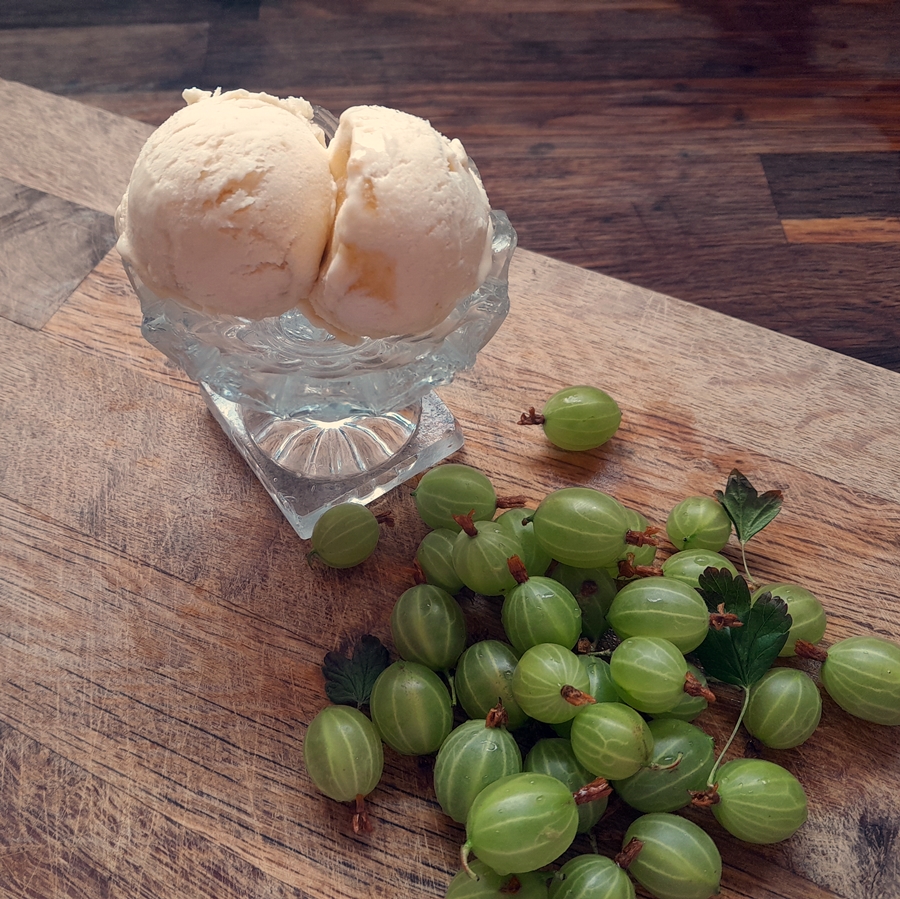
The brief green gooseberry season is upon us and their delicate but sharp taste is a wonderfully aromatic taste of summer. Reddish dessert gooseberries ripen later in the season, but the sharpness of the green is my preference. They’re a thorny bush, so be prepared for having multiple jabs in your hands. I picked some at a local Pick Your Own fruit farm. Top Tip: most berries conceal themselves on the undersides of branches, so always lift them up for maximum harvesting efficiency. If your local fruit farm doesn’t have PYO gooseberries (and many don’t, sadly) they can also sometimes be found in the freezer of your local Farm Shop.

After laying down a batch of my bi-annual batch of gooseberry vinegar (a doddle to make, but a year in the fermenting/clearing), I decided to make a batch of gooseberry ice-cream. As the owner of a tiny kitchen (2m x 3m), I have neither the counter/cupboard space for an ice-cream maker, nor the patience to keep stirring a semi-frozen mixture in order to break up the ice-crystals, so the ‘set it and forget it’ no-churn recipe employing sweetened condensed milk is pretty much a no-brainer in this household.

The method is practically the same as that given for Damson Ice-Cream from a couple of years ago: Mix most of a fruit puree into the cream/milk mixture, then ripple through a ribbon of the remaining puree and set in the freezer.

The means of obtaining your gooseberry puree is a little different than usual, mainly due to their water content, which will wreak icy-crystal havoc with your ice-cream if it is too high. Rather than simmer with water until they break down, the gooseberries are coddled in a closed vessel over simmering water. The result will be a clear-ish liquid (which can be poured off) and the fruit pulp, which is then used for the ice-cream. This approach preserves not only the colour, but also the flavour, as prolonged cooking and/or high heat impairs both.

The second recipe is my re-creation of an ice-cream I had several years ago in Yorkshire. It’s actually not really a summer ice-cream, because citrus isn’t really in season in July, but oranges are in the shops and marmalade is on the shelves, and I am in love with it, so here we are.

The bitterness of Seville oranges, just as the tartness of gooseberries, is the perfect pairing with this ice-cream method, because the condensed milk is SO sweet, it needs something sharp to cut through all that sugar. Interestingly, in developing this version, I did learn that there is such a thing as too much bitterness. An early version contained both the zest and juice of Seville oranges (which I keep in my freezer as frozen cubes for year-round zestiness), and while I liked the end result, it really leaned heavily into bitterness, so I had to dial it back somewhat. This version uses the zest of regular oranges and no juice, with the slivers of peel from the marmalade providing delicious pops of intense Seville bitterness, tempered with sugar.

Both of these ice-creams will need to be removed from the freezer for 20-30 minutes before serving, in order to soften.

Gooseberry Ice-Cream

I have left the gooseberries without sugar, as there is more than enough sweetness with the condensed milk. Feel free to add some sugar if you feel they need it.

500g green gooseberries

1 x 397g tin of sweetened condensed milk
600ml double cream

  • Put the gooseberries in a lidded pan without any additional water and set it inside a larger pan. Add water until the larger pan is half filled. Heat over medium high heat until the water is simmering and coddle the gooseberries until soft. if you don’t have suitable pans to do this, you can put them into a casserole with a close-fitting lid and bake in the oven at 170°C, 150°C Fan. for 20-30 minutes.
  • Tip the coddled gooseberries into a sieve over a bowl and allow the clear liquid to drain through. Set the liquid aside.
  • Rub the gooseberry pulp through the sieve until all that remains are the seeds. Discard the seeds and set the pulp aside to cool.
  • Put the condensed milk and double cream into a bowl and whisk together until light and billowly.
  • Fold through 3/4 of the gooseberry pulp until well combined.
  • Spoon the ice-cream mixture into containers and then stir through the remaining puree in a ripple.
  • Cover and freeze at least overnight before serving.
  • Waste not, want not: You can add sugar to the clear gooseberry liquid and simmer it down to a syrup to pour over your ice-cream.
  • Bonus: Add a splash of elderflower cordial to taste to the puree, but beware of adding too much liquid.

Marmalade Cheesecake Ice-Cream

There is a slight difference in the method of this ice-cream, in order to get the cream cheese fully incorporated with the other ingredients. There’s no added sugar, as the condensed milk add more than enough. The amount of marmalade you’ll need will depend very much on the whatever marmalade you are using. I used a jar of my Dundee Marmalade, which is quite peel-heavy, so I only needed one jar.  Top Tip: An efficient way to get your marmalade shreds separated from your marmalade jelly, tip your jar(s) of marmalade into a pan and warm it gently until the jelly liquefies, then pour it through a sieve over a bowl. The jelly can then be poured back into the jar(s) for use later. Cut your shreds into smaller pieces if liked.

100g of orange shreds from your favourite marmalade – about half a cup.

zest of 3 oranges
330g cream cheese, Philadelphia for preference – at room temperature
1 x 397g tin of sweetened condensed milk
600ml double cream

  • Put the orange zest and cream cheese into a bowl and whisk until smooth.
  • Pour in the condensed milk and whisk again until smooth.
  • Add the double cream and whisk until light and billowy.
  • Stir through the marmalade shreds.
  • Spoon the ice-cream mixture into containers.
  • Cover and freeze at least overnight before serving.

Serving suggestion

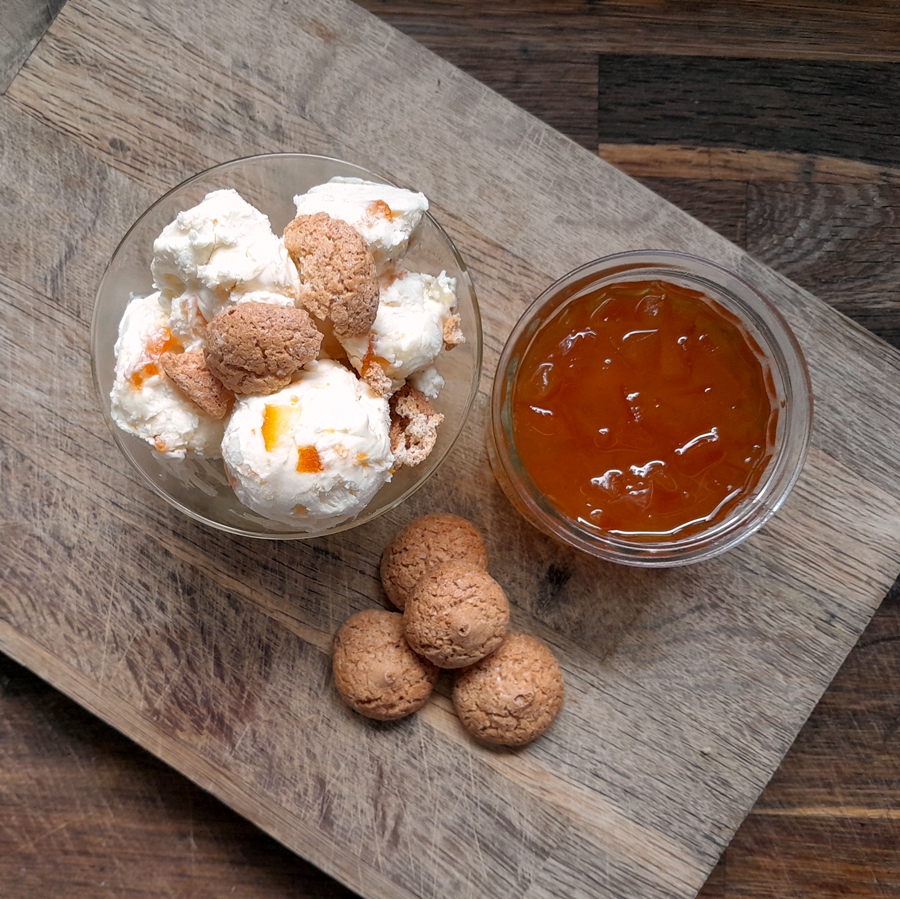
To emulate a regular cheesecake, serve with some crisp/crunchy biscuits – Digestive biscuits/Graham crackers are a favourite. I used amaretti in the picture because that’s what I had, and regular readers will know we don’t make special trips to the supermarket for just one ingredient.

Nankaties

Something a little different for you this week, dear Reader, and something of a surprise, perhaps.

These are Nantakies: Indian shortbread biscuits that are still enjoyed today, mainly at Christmastime.

This particular recipe comes from a book printed in 1887 in Bombay (Mumbai) at the height of the British rule in India. It is one of many Indian cookery books in English that I have collected over the years and is freely available to download at The Internet Archive.

What first drew me to this shortbread recipe was the small number of ingredients when compared to modern recipes. Also, following on from my earlier shortbread investigations, I was curious to know how using 100% ‘rolong’ (semolina) as the flour ingredient would affect the taste and texture.

Initially, testing this recipe went poorly, because I used coarse semolina. Switching to finely ground semolina (found in my local orange supermarket under the brand name Natco) was a great improvement. It was still too sweet for my tastes, so I tinkered a little with the ratios and switched out regular butter for more appropriate clarified ghee.

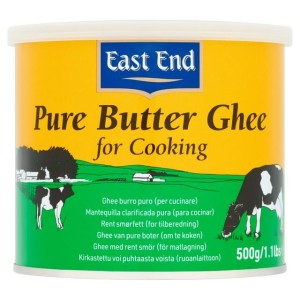
In the UK, ghee can be found in supermarkets and smaller shops in distinctive green and gold tins. Once opened, they don’t require refrigeration and can be stored in a drawer/cupboard. However, I must impress upon you that not all tins of ghee are the same. The very best brand, in my humble opinion, is East End.

Opening this brand especially, releases an almost perfumed aroma that immediately sends you to a more exotic and fragrant place. I have not had the same experience with other tins of ghee – purchase them at your peril!

The result of the tweaks and changes made for  a wonderfully aromatic and decadent shortbread bite, needing no further flavouring. However, if you’d like to add a hint of cardamom or rosewater, I think it would be a delicious variation. The golden colour from the ghee remained during baking in the cool oven and I have added a gold dragee to the top of each one as an exotic but restrained decoration.

You will have noticed that there are two shades of biscuit in the above photograph. Spurred on by my success with the tweaked original, I also made a gluten-free version using ground rice instead of semolina, and accented the biscuits with a silver dragee. I used up most of my ground rice in doing so and when I went to buy more I was disappointed to find that my local shops no-longer stock ground rice as a matter of course: perhaps it’s viewed as old-fashioned. I would have thought it would be readily available, given its usefulness in gluten-free baking, but there are numerous shops online that stock it, so all it requires is a little forward planning.

I wanted small, neat biscuits and having persevered with hand rolling various sizes, I eventually found the perfect ‘mould’ in my tablespoon measuring spoon. It was a little fiddly to form the biscuits one by one, but well worth it in the end result.

Nankaties – 1887, Mumbai

Makes 12-20 biscuits, depending on size.

150g finely-ground semolina or ground rice if gluten-free
75g ghee
35g icing sugar

gold/silver dragees for decoration

  • Heat the oven to 150°C, 130°C Fan if baking the biscuits immediately. Otherwise, heat the oven just before removing the chilled biscuits from the fridge.
  • Put the ingredients into a food processor and blitz until the mixture resembles breadcrumbs. It will have a texture of damp sand, and will hold together when pressed.
  • Tip out the mixture and shape your biscuits – either by hand rolling or by pressing it into a mould. If you choose the measuring tablespoon method mentioned above, I found it useful to use some plastic wrap/cling film to line the spoon, which made it very easy to remove the moulded biscuits without damaging them. Be sure to pack the mixture firmly in order for it to keep its shape during baking.
  • Arrange your biscuits on a baking sheet lined with parchment or a silpat mat.
  • Add the dragee decoration if using.
  • You can chill the biscuits in the fridge for 30 minutes before baking, if liked. It can help retain a neat shape, although I should point out that the biscuits in the photo above were not chilled before baking. If you want especially crisp edges to your biscuits, you can always neaten them once cold with a microblade grater.
  • Bake for 30-40 minutes until crisp. The colour won’t really change, due to the low temperature.
  • WARNING: the biscuits will be extremely delicate when hot. Leave them to cool on the baking sheet/tin until completely cold before moving them.
  • Store in an airtight tin.

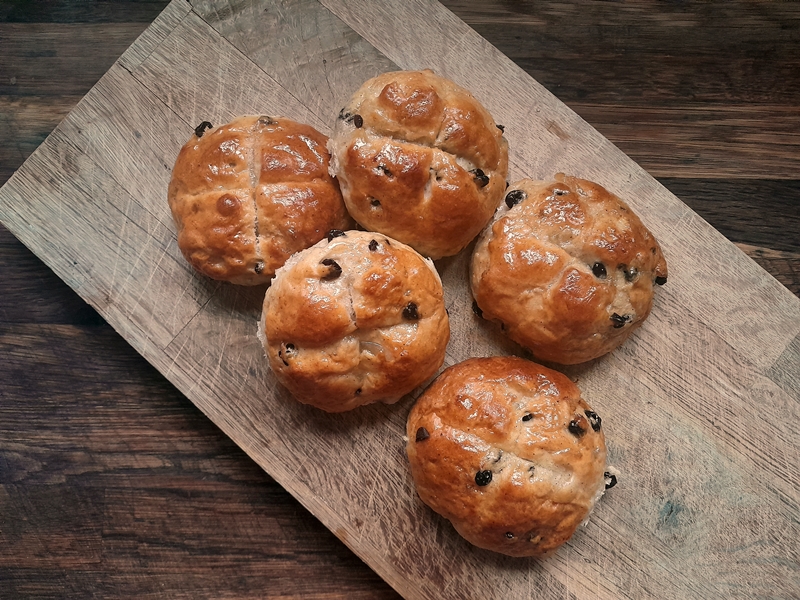
Georgian Cross Buns

Reading a handwritten manuscript is very exciting: you never know what is just over the next page.

Lately I have been reading through the manuscripts held by the National Library of Scotland and alighted upon something rather unusual. It is a manuscript from a bakery, with appropriately large batch quantities. It is a fascinating peek into the variety of bakes and extras that formed the day to day offerings of a Georgian bakery.

The manuscript has been dated to 1827, which puts it slap-bang in the middle of the reign of George IV, but other than that, there appears to be no other identifying information. Now this might be looked upon as more than a little frustrating, however, being much more of a glass-half-full person, I usually see it as an opportunity for sleuthing, and seeing whether or not I can glean any more information from the pages within.

Firstly, I think the date is very well chosen, and I’m sure the Library of Scotland is nothing short of THRILLED at my approbation. This I deduced from the raising agents used in the recipes, which call either for yeast or volatile salts. Volatile salts are the precursor to baking powder, which was only a mere fifteen years away from being invented.

Another piece of information I noted gave me reason to believe that there may well be a Scottish link, aside from where the manuscript is currently held, is the use of the word ‘carvey’ for caraway seeds. In the 18th century, the word was in much greater use throughout the British Isles, but in the 19th century, it was retained mostly in Scotland. The one thing holding me back from declaring this a definite is the Englishness of the other recipes: Abernathy biscuits, Bath cakes and buns, Weymouth biscuits, Stratford cakes, Norwich biscuits, Isle of Wight cracknels…

The recipes themselves cover a wide range of items: biscuits, cakes, buns, jams and jellies, sweeties, custards, bread, muffins and cakes. I love this manuscript for its sheer uniqueness. I have a small but favourite collection of commercial baking books dating from around the turn of the 20th century, but I’ve not come across any other handwritten recipes of catering size quantities of this early age. Browsing for something for Easter, I came across this recipe for Buns for Shops or Cross Buns. Perfect!

But it came at a price. And the price was the spelling.

Oh my dears, the spelling.

I fully appreciate that spelling from 200 years ago is going to be a little quirky, but this… This is on a whole new level.

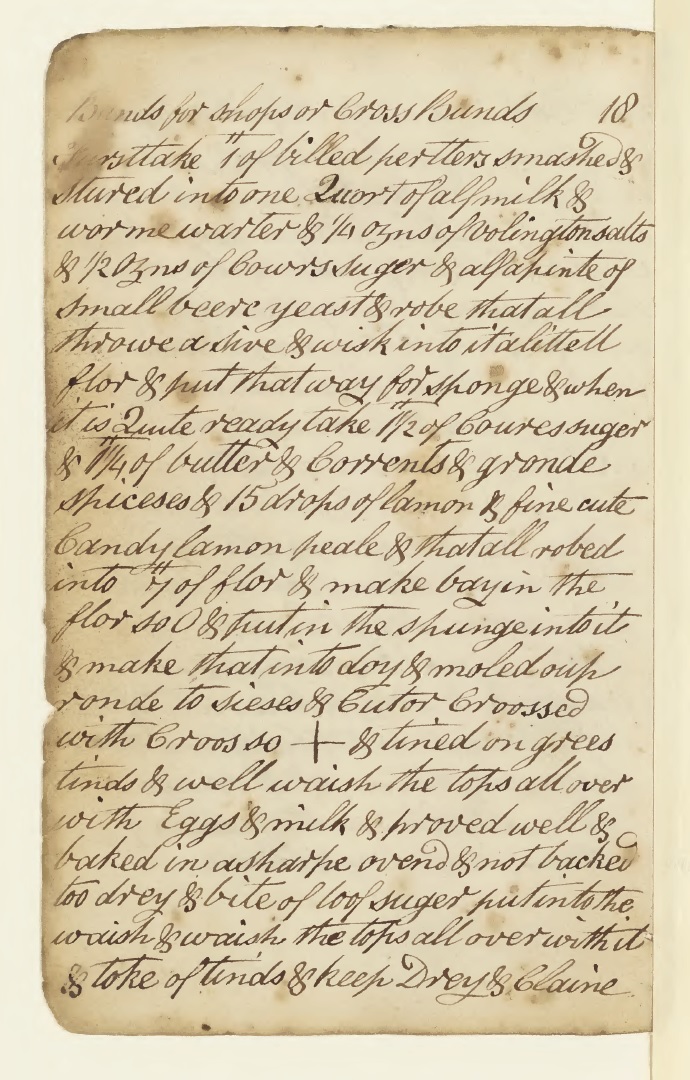
Cross Buns Manuscript Recipe, National Library Scotland

In case your cursive reading skills are a little rusty, allow me to transcribe the recipe for you, with the original spelling, in all it’s glory.

Bunds for shops or Cross Bunds
Fursttake 1″ of billed pertters smashed & stured into one Quort of alfmilk & worme warter & 1/4 ozns of volington salts & 1/2 ozns of Cours suger & alfa pinte of small beere yeast & robe that all throwe a sive & wisk into it a littell flor & put that way for sponge & when it is Quite ready take 1 1/2″ of coures suger & 1 1/4″ of butter & Corrents & gronde spiceses & 15 drops of lamon & fine cute Candy lamon pale & that all robed into 7″ of flor & make bayin the flor so O & pit in the spunge into it & make that into doy & moled oup ronde to sieses & Cut or Croossed with Croos so + & tined on grees tinds & well waish the tops all over with Eggs & milk & proved well & baked in a sharpe ovend & not backed too drey & bite of loaf suger put into the waish & waish the tops all over with it & toke of tinds & keep Drey & Claine.

The modern translation is as follows:

Buns for shops or Cross Buns
First take 1lb of boiled potatoes mashed & stirred into one Quart of half milk & warm water & ¼ oz of volatile salts & ½ oz of Coarse sugar & half a pint of small beer yeast & rub that all through a sieve & whisk into it a little flour & put that away for sponge & when it is Quite ready take 1½lb of coarse sugar & 1¼lb of butter & Currants & ground spices & 15 drops of lemon & fine cut Candied lemon peel & that all rubbed into 7lb of flour & make a bay in the flour so – O – & put the sponge into it & make that into dough & mould it up round to size & Cut or Cross with a Cross so + & put them on greased tins & well wash the tops all over with Eggs & milk & prove well & bake in a sharp oven & don’t bake too dry & add a bit of loaf sugar into the wash & wash the tops all over with it & take them off the tins & keep them Dry & Clean.

Yes, that first ingredient is boiled potatoes, and I will freely admit it took me a good half hour of pondering and saying the phrase out loud to myself in a frankly embarrassing number of accents in order to try and work out what it might be. Adding mashed, boiled potatoes to a bread recipe helps keep the resulting buns from drying out too quickly and keeps them pleasantly chewy. ‘Volington Salts’ makes me chuckle, because it sounds like the name of a Georgian Dandy.

The travails of translating the handwriting aside, there are two aspects of this recipe that I love. Firstly, it is the unusual (to modern palates) combination of spicings and flavourings. The recipe calls for both lemon essence and candied lemon peel as well as ‘mixed spices’. I’ve also made some biscuits from this book which called for cinnamon and lemon, and maybe its because this combination seemed so unusual to my 21st century palate, but to me they tasted Georgian. The ‘mixed spices’ gives you carte blanch to use whatever combination you like, but I’m going to recommend cinnamon and nutmeg, which were a popular combination for decades in the 17th and 18th centuries. The lemon flavouring, for some reason, I found problematic: liquid flavouring seemed to fade when baked, so I tried using finely grated fresh lemon zest, which also didn’t have quite the punch I was looking for. Perhaps a combination of the two will give the lemon burst I think these might need – but if we hang around for me to trial that, we’d miss Easter, so onwards!

Georgian Cross Buns

This is a 1/7th scale of the original recipe, and will make 18 x 60g buns. If this is a bit much, halve the recipe and divide the dough into 8 buns. Make a sponge if you feel inclined, but I went for mixing all together at once.

70g cooked mashed potatoes
100ml milk
100ml water
450g strong white flour, or plain
7g sachet of fast action yeast
100g caster sugar
80g butter
1tsp ground cinnamon
1tsp ground nutmeg
1 tsp lemon flavouring and/or zest of 1 lemon
60g fine sliced candied lemon peel
125g currants

For the glaze


1 large egg
1/2 an eggshell of milk
2tbs caster sugar

  • Heat the milk and water to blood temperature.
  • Add the cooked potato and whisk together – a stick whisk works well to make the mixture smooth.
  • Put the flour, yeast, sugar, butter, spices and lemon flavouring(s) into a food processor and blitz until the mixture resembles breadcrumbs.
  • Put the liquid mixture into a mixing bowl and add the dry mixture on top.
  • Knead for 10 minutes. Don’t be tempted to add more liquid – there’s moisture in the butter and the working of the dough will bring that out and make a dough that ‘cleans the bowl’.
  • When the dough has come together and is smooth and elastic, mix in the currants and lemon peel.
  • Cover the bowl with plastic and set aside in a warm place to double in size.  If your kitchen is on the cool side, use your oven: Turn the heat to 170°C/150°C Fan for TWO MINUTES ONLY, switch off, and place your bowl inside. Due to the enrichments of butter and sugar, this may take longer than normal, probably closer to 90 minutes.
  • Tip out the risen dough and gently deflate by pressing with the hands.
  • Divide your dough by weight: 60g makes a decent-sized bun, but go larger if you prefer a more substantial bun.
  • Roll the dough into a smooth ball, press flat with the palm of your hand, then arrange on a parchment-lined baking sheet at least 3cm apart.
  • Cover lightly with plastic and allow to rise a second time (30-45 minutes).
  • Heat the oven to 180°C, 160°C Fan.
  • When the buns are sufficiently risen, cut a cross into them. I find pressing (not rolling) a pizza wheel down into the buns is an ideal tool for this: it marks a deep cross, but doesn’t cut through the edges of the bun and cause them to split during baking. Alternatively, use the flat end of a spatula.
  • Whisk the egg and milk together, and glaze the buns by brushing the mixture over them using a pastry brush.
  • Bake for 15-20 minutes, depending on size. For the smaller 60g buns 15 minutes is fine. If your buns are larger, then leave them for 20 minutes. Turn the baking sheet around halfway though.
  • While the buns are baking, add 2tbs caster sugar to the remaining bun wash and stir to dissolve.
  • When the buns are baked and golden brown, remove from the oven and place the baking sheet on a rack. Brush the hot buns over with the sweetened bun wash. The heat of the buns will set the sweetened glaze, and your cross buns will cool with a lovely shine.
  • Remove the buns from the baking sheet when cool and store in an airtight container.
  • Serving suggestion: Delicious when freshly baked. When cooled, cut in half and toast both sides. Serve warm with butter and a sharp cheddar cheese.

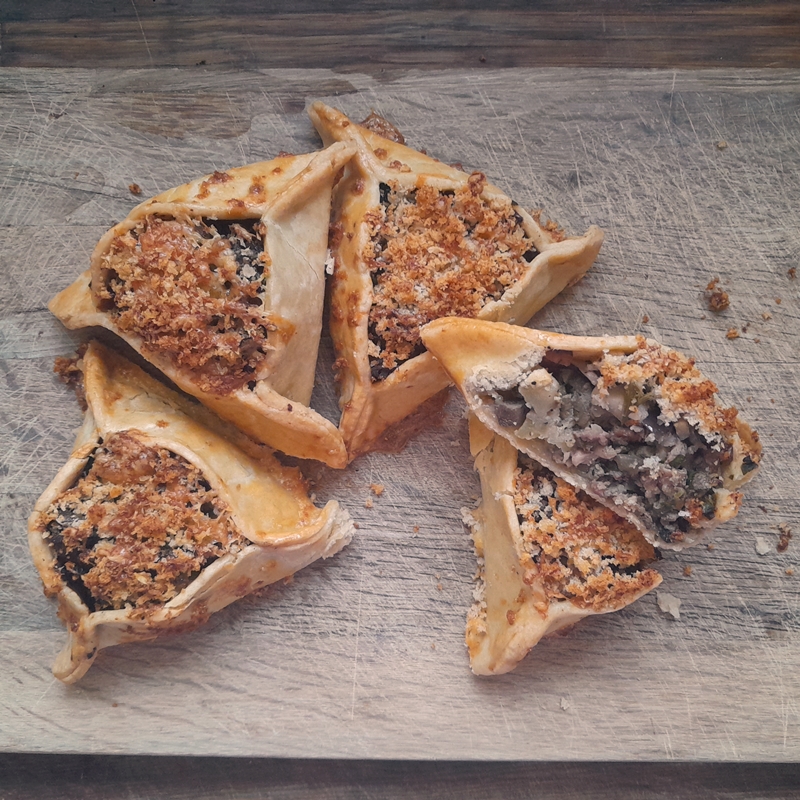
Chipstead Churdles

I’ll be the first to admit that I love a good story behind a recipe. However, what winds me up no end are stories that have been made up to make a recipe appear more ‘authentic’ than it actually needs to be.

And so we have Chipstead Churdles. Chipstead is a small village in Surrey, southeast of Croyden. Churdle Pies are also claimed by Sussex, though I have yet to find any recipe predating this one.

These little triangular pasties are a pleasant way to enjoy the classic and flavoursome combination of liver and bacon, aside from the traditional grilling. As you’ve probably already surmised, they have also managed to develop quite a colourful, and largely fictitious, provenance. Touted online as ‘an ancient recipe’, ideal for the farm worker to stuff into his pocket as he headed out to the fields, no-one seems to know specifically where and when they date from, although I’ve read many a vague “…Seventeenth century…” claim.

Even without any provenance, neither the shape nor the style of the pies would appear to support this. These are tricorn-shaped pies – although easy to form, hardly the most robust nor the most practical of shapes – with the top being left open to be filled with a cheese and breadcrumb mixture (this crunchy topping being much more of a 20thC style). Any farm worker worth his salt would end up with a pocketful of crumbs within an hour.

No, in actual fact, the recipe actually originates in Doreen Fulleylove’s “Simple Country Fare” (1970). Now to me, that’s not that long ago – good gravy, I remember 1970 – but then I have to stop and remind myself that that is now over fifty years ago.

The Churdles name, however, can be traced back much further, all the way to the 1920s. In his fabulously-titled “Away Dull Cookery!” (1932), Earle Welby recorded an entertaining nonsense menu devised by the dramatist Henry Arthur Jones for his grandchildren. It is, perhaps, the greatest menu I have ever read, and I reproduce it below:

  • Pickled Trunnions
  • Filets of Poucher Bonne Femme
  • Baked Banbury Mush
  • Squibbles on Toast
  • Truffled Guffins
  • Boogoose Bordelause
  • Varicose Beans
  • Danderchits in Aspic
  • Wombles
  • Stuffed Spanish Crippets
  • Churdle Pie
  • Mulligatawny Fritters
  • Nostrum Roes à la Diable
  • Piblets
  • Trundleberry Gin

It’s on my ever-lengthening list of Things To Do to devise and make dishes for this menu.

But back to the Chipstead Churdles. It seems to me that a far more likely scenario would be for the name Churdle to have been borrowed to grace a heretofore unnamed but very toothsome pie. And there’s nothing wrong with that at all.

Chipstead Churdles

The savoury flavours of liver and bacon are here paired with mushroom, onion and sharp apple to make for a lighter and fresher mouthful.

shortcrust pastry

1 onion
30g unsalted butter
200g smoked back bacon, rind removed
200g lamb’s liver
60g mushrooms, chopped
1 small Bramley apple, peeled and finely chopped
2-3tbs chopped parsley
½tsp ground black pepper
½tsp salt

4tbs fresh breadcrumbs
4tbs finely grated strong cheddar cheese

1 large egg for glazing

  • Peel and chop the onion finely.
  • Melt the butter in a frying pan and add the onion. Fry gently for 8-10 minutes until softened and translucent.
  • Add the bacon and fry for a 1-2 minutes and then turn the slices over.
  • Add the liver and fry for 2 minutes, turning the slices over after 1 minute. This should cook the liver enough to remain pink in the centre. As it will be cooked again during the baking of the pies, you don’t want to overdo it at this stage.
  • Lift the meat from the pan and chop finely.
  • Scrape the cooked onion and butter into a bowl and add the chopped meat.
  • Stir in the mushrooms, apple, parsley and seasoning. Set aside.
  • Preheat the oven to 180°C/160°C Fan.
  • Roll out the pastry to a thickness of about 5mm.
  • Cut 8 circles of pastry 10-12cm in diameter. You can make 4 large pies, but the larger the pie, the more difficult the pastry is to handle.
  • Divide the filling into 8 and add one portion to the middle of each circle of pastry.
  • Damp the edges of the pastry with water.
  • Pinch the edges together to make a triangle base, folding the sides of the pastry inwards and pressing the edges together to make a three-cornered hat shape. Leave the middle of the pie open.
  • Mix the cheese and breadcrumbs and sprinkle one spoonful over the opening at the top of the pies, and transfer the pies to a baking sheet lined with baking parchment.
  • Whisk the egg with a tablespoon of water and use it to glaze the sides of the pies with a pastry brush.
  • Bake for 25-30 minutes until crisp and golden. Turn the baking sheet around after 15 minutes to help even the browning.
  • Cool on a wire rack.
  • Serve warm.

Carnival Fruit

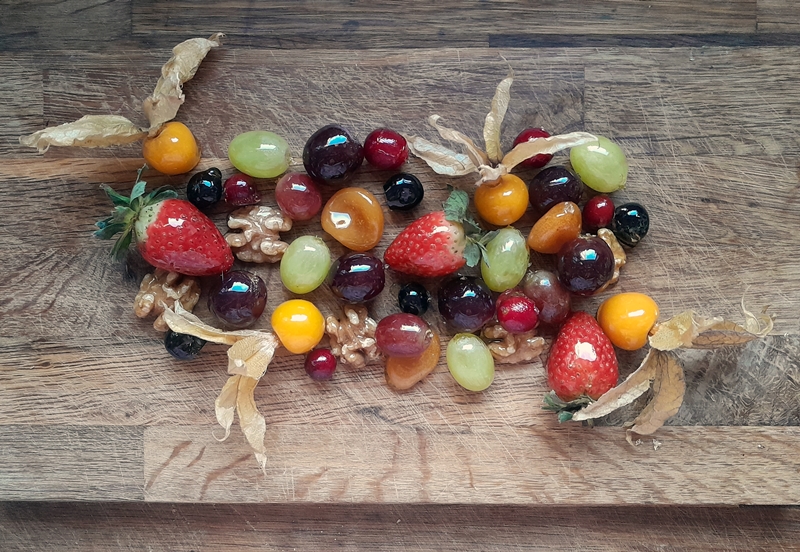
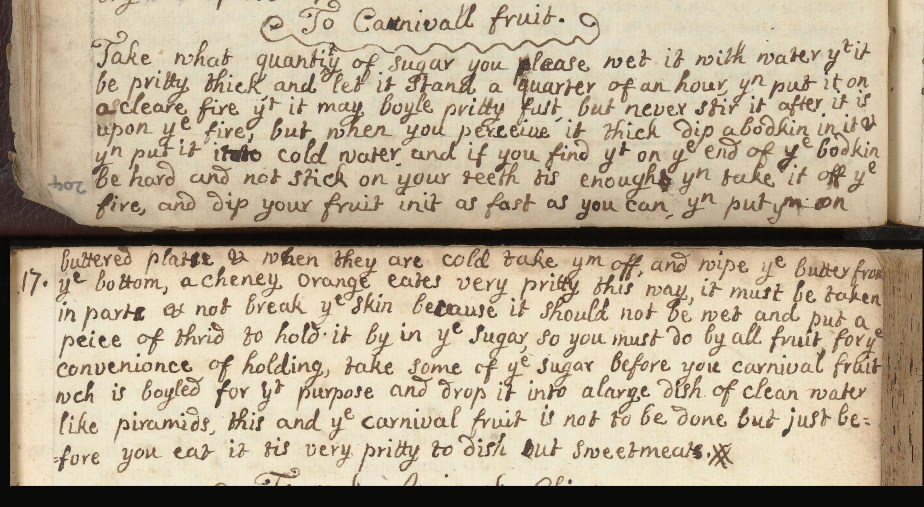
This recipe is such a delight. So simple, so eye-catching, and almost 400 years old.

It comes from one of my favourite manuscripts at The Wellcome Collection. Now I’ll freely admit I am very fickle with my favouritism, and I have been reminded this week of just how special this manuscript is, mainly due to a completely different manuscript I’ve been working on. I’m not going to name and shame it, but my dears… The handwriting. The spelling. Lets just say, I was sorely tested.

THIS manuscript, however, is an absolute delight. Straddling the 17th and 18th centuries, the handwriting is surprisingly modern: neat, well punctuated, with a pleasing layout, it is a joy to read, and I regularly have to remind myself just how old it actually is.

Carnival Fruit 1650-1750, MS8097, Wellcome Collection

The method used to ‘carnival’ fruit is to dip it into a clear caramel. Although I have used several different fruits in the top image, the fruit recommended in the recipe is ‘a Cheney Orange’ (China Orange), aka an eating orange (as opposed to a Seville bitter orange). Since oranges are in season during the winter months, I believe this is perfect dish to serve up during the festive season. Nowadays we have the luxury of fruit out of season, which can make for a very colourful display, however, some fruit are more suited than others. Very moist, juicy fruit such as strawberries and cherries (not pictured) will only last 2 hours before the shiny caramel coating starts to break down. Other fresh fruits such as grapes, physalis, blueberries, nuts and even dried fruit such as apricots will last 3 hours before starting to become sticky. Whilst you can do orange segments, I feel that against the scale of the other fruit, they’re a bit big, and that small orange segments (satsuma, mandarin, clementine and the like) would be more suitable.

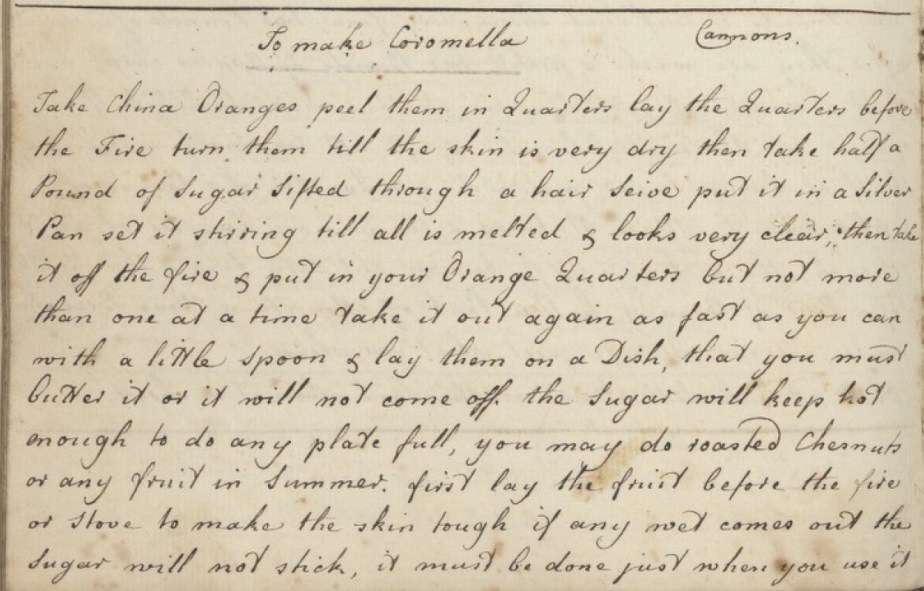
A similar recipe in a slightly later manuscript, ‘Coromella’ 1805-1860, MS2203, Wellcome Collection

I have changed very little in this recipe: I’ve added some weights and measures, to help with getting the sugar to the correct stage and added a little liquid glucose to keep the caramel from crystallizing. I tried several times to go ‘old school’ with just sugar and water, but the caramel always crystallized too quickly to get more than just a few pieces dipped. Perhaps they used honey to help them out back then?

When choosing your fruits and nuts, it is important to consider how they are going to taste with the caramel. If you have a sweet tooth, then it gives you free rein to pick and choose almost anything. Personally, I would recommend choosing fruit that is slightly sharp, just to prevent an overload of sugar. The fruit also needs to be dry, so this rules out any fruit so large it needs to be sliced.

Choose your favourites from: green/red/black grapes, cherries, strawberries, raspberries, strings of redcurrants, blueberries, blackberries, physalis, dried apricots, walnuts, hazelnuts, pecans, almonds. If you have the patience to put individual pomegranate seeds on cocktail sticks and dip them, I think they would be delightful in both appearance and flavour.

The greatest amount of time for this recipe will involve preparing the fruits and nuts.

  • You can utilise the stalks on cherries and redcurrants, the papery coverings on physalis and the green stalks on strawberries to hold as you dip them in the caramel.
  • Most other fruits and nuts can be pierced with a wooden cocktail stick to prevent getting boiling caramel on your fingertips.
  • The recipe recommends using a thread to dip orange segments, and I must confess to not having tried this method. I opted instead to use the cocktail stick. If you can pierce the skin and avoid bursting any of the juice sacs inside, you’re onto a real winner.

To Carnival Fruit

For the caramel

400g granulated sugar
125ml water
60ml/4tbs/¼ cup glucose.

a selection of fresh fruits, berries and nuts

wooden cocktail sticks for dipping

a silicone mat or baking parchment

a sugar thermometer

  • Put the sugars and water into a small saucepan and set aside to begin dissolving while you prepare the fruit for dipping.
  • Use the wooden cocktail sticks to skewer the fruit and lay them neatly on a board or plate. If you’re using small orange segments, remove all the white pith. If you accidentally tear the skin of a segment, eat it – the juice will compromise the caramel.
  • Line a baking sheet with the silicone mat or baking parchment. This is for laying the dipped fruits on to cool. Although the dipping is straightforward, you will need to work fairly briskly in order to get all the fruit dipped before the caramel cools. If you can keep the pan on a very low heat while you dip your fruit, then this won’t be much of a problem. However, the heat will continue to cook the caramel, and it will become darker the longer it remains on the heat.
  • Arrange the prepared fruit and baking sheet so that they are easily to hand when the caramel is ready.
  • Heat the pan with the sugars in over a low heat until the granulated sugar has dissolved.
  • Increase the heat and cook until the syrup registers 150°C on a sugar thermometer. The syrup will be bubbling vigorously over the whole surface of the liquid.
  • Remove from the heat (or turn the heat down to the minimum, your choice), and begin dipping your fruits and nuts.
  • Tilt the pan so that the syrup is deep, and then one at a time, dip your fruit fully into the caramel and set on the silicone mat/parchment to cool. For fruit not on wooden sticks, be sure to keep your fingers well away from the caramel when dipping, as the caramel will burn, and stick to your skin and continue to burn, if it comes into contact.
  • The caramel needs only a minute or two to set, and then all that remains is to arrange it on your serving dish and serve. I went for a wooden board, as it’s plainness and natural material made for a great contrast against all the brightly coloured, shiny carnival fruit. To remove the wooden sticks, roll them between your thumb and forefinger – this will provide enough pressure to break the caramel surrounding them, thus making it easy to remove them.

Mince Pie Shortbread

I seem to be on a bit of a shortbread obsession lately, but this is the last post on it for now, promise.

Today I have for you a combination of two festive treats: Mince Pies & Shortbread.

Back in the far off days of the 1980s, I had the distinct pleasure of discovering Jocelyn Dimbleby’s “Cooking for Christmas” – a slim paperback book of recipes, produced in association with Sainsbury’s. Amongst its pages I found Deluxe Mince Pies, a version of which I have had posted over on my other blog for over 12 years now. With their orange pastry and decadent cream cheese and mincemeat filling, if you’re only going to eat one mince pie during the season, it really should be those.

However, even I will admit that they are a bit of a faff and since they are best served warm, it does limit their accessibility. So recently, whilst experimenting with the butterscotch shortbread, I got to thinking whether I could make a mincemeat version, and from there it was just a hop and a skip to re-imagining Jocelyn’s recipe.

This recipe is also an adaptation of recipes I’ve already posted on here, which I love as an example of some real Lego™ thinking, taking two different recipes and smushing them together to create something new.

The shortbread here is standing in for the mince pie pastry, so the only thing I changed was to add some orange zest. The mincemeat is an adaptation of the guilt-free mincemeat, based on Hannah Glasse’s 1747 Lenten mince pie recipe. The potential problem here was whether it would hold together on top of the shortbread, so the slight tweak I made was to increase the quantity of dates, which break down into a sweet and sticky paste during the simmering of the fruit, and firm up when cooled. I increased the spices a little, to compensate for the mincemeat being eaten cold, which tends to dull their potency. I also used an egg-white wash over the top of the shortbread, which when briefly baked forms something of a barrier to keep the moisture from the mincemeat compromising the crispness of the shortbread. Finally, I decided to top things off with white chocolate flavoured with lemon zest, to mimic the cream cheese element of the original mince pies.

Baking a slab of shortbread is a lot more straightforward than battling with pastry and filling and fretting whether the lids are sealed properly and whether the bottoms are properly cooked, etc. Bonus: you can cut your shortbread into as many pieces of whatever size you like.

Mince Pie Shortbread

The Mincemeat

You can make this several days beforehand and store in the fridge, if liked. When required, to make it easier to then spread over the shortbread, put it into a pan, cover and heat on the lowest setting. You might want to add a little more liquid (apple juice/orange juice/brandy/sherry) to help it loosen up. The additional dates add to the sweetness, so if you don’t have a sweet tooth, you might want to substitute the apple juice for the juice of an extra orange or even lemon

50g currants
50g raisins – crimson raisins look pretty
50g sultanas
200g dates – finely chopped
25g candied orange peel
25g candied lemon peel
25g candied grapefruit or citron peel
35g dried cranberries
25g slivered almonds or flaked almonds – chopped
2tbs sherry
1tbs brandy
juice & grated rind of 1 orange
¼ tsp of ground ginger
¼ tsp of nutmeg,
¼ tsp of ground cinnamon
¼ tsp of mixed spice
¼ tsp of ground cloves

60-100ml apple juice or juice of 1 orange/lemon

  • Put the dried fruits into a small saucepan.
  • Cut the candied peel into small pieces with scissors and add to the pan with the spices. NB If you’re using your home-made candied peel that has been stored in syrup, then there’s no need to soften it in the saucepan – just stir it in with the nuts once the fruit has plumped.
  • Add the orange juice and zest, brandy, sherry and 60ml of apple juice (or the extra orange/lemon juice).
  • Stir gently to combine and set pan over the lowest possible heat.
  • Cover and let the mixture stew gently until all the liquid has been absorbed.
  • If the fruit isn’t as plumped and juicy as you would like, add a little more liquid.
  • The mixture should be moist, but with no liquid visible in the bottom.
  • When you’re happy with the consistency, stir through the almonds.


The Shortbread

Make whichever shortbread variation you prefer, regular or gluten-free.

60g soft brown sugar
120g unsalted butter, chilled
180g plain flour – or gluten-free flour
60g your choice of additional flour (rice flour, cornflour, cornmeal, semolina, etc)
¼ tsp salt
zest of 1-2 oranges, depending on size

1 egg-white for glazing

  • Line a small baking tin (18cm x 25cm) with baking parchment. Leave extra parchment overlapping the sides, to assist in moving the baked shortbread.
  • Heat the oven to 160°C, 140°C Fan.
  • Cut the butter into cubes and add to the bowl of a food processor fitted with a blade.
  • Add the remaining dry ingredients and zest to the butter and pulse briefly until the mixture resembles breadcrumbs.
  • Tip the mixture onto the parchment, and press into an even layer.
  • Use a round skewer or cocktail stick to poke holes all over the surface of the slab of shortbread.
  • Bake the shortbread for 30 minutes, turning the tin around after 15 minutes to ensure even baking.
  • Once the shortbread is baked,
    • Remove the shortbread from the oven. Keep the oven on.
    • Whisk the egg white until frothy, then paint a layer onto the hot shortbread and return it to the oven for 3 minutes to set.
    • Remove the tin from the oven, switch off the heat and using a very thin bladed knife or (ideally, in my opinion) a metal dough scraper, cut the shortbread into pieces. I cut mine lengthwise in half, then across into fingers 2-3cm wide.
    • Return the tin to the cooling oven to cool.

The Topping

250g white chocolate
zest from 1 lemon

  • Break the chocolate into pieces and melt in a bowl either over simmering water, or by zapping in the microwave in short bursts.
  • Stir through the lemon zest.

To Assemble

  • Spread a layer of mincemeat over the cooled shortbread. I didn’t use all of the batch, only about 2/3, but if you’d prefer a thicker layer, have at it by all means.
  • Smooth over the top with a palette knife or similar.
  • Pour over the lemon-flavoured white chocolate and smooth over.
  • Put it in the fridge to set (optional – you can leave it on the worktop if you have the room).

To Divide

In a repeat of the instructions from Butterscotch Shortbread, here is how to ensure your slab of mince pie shortbread emerges in sharp and clean slices.

  • When you’re ready to portion it out, remove your slab of mince pie shortbread from the fridge and set it on the countertop. Leave it to come to room temperature. Trying to cut through the chocolate layer whilst chilled will just shatter it. If your shortbread cooled on the worktop, you can, if course, skip this step.
  • Take a clean cloth or a double layer of kitchen roll and lay it on top of the set chocolate.
  • Lay a cutting board on top of that, and carefully turn the whole slab over, so that once the tin and the baking parchment are removed, the shortbread is uppermost.
  • The lines from cutting the shortbread earlier should be clearly visible.
  • Slide your dough blade into the cuts in the shortbread, then press down sharply to cut through both the mincemeat and the chocolate layers in one clean movement.
  • Make sure you have cut – or rather re-cut – through all of the pieces before trying to move your mince pie shortbread.
  • Store your shortbread in an airtight container. Use a piece of parchment between layers to keep crumbs off your pristine chocolate finish.

Butterscotch Shortbread

The deliciousness I have for you this week is something of a Lego™ recipe in that it started with A New Thing, which was exciting and delicious, but for which I had no use for at the time. However, if you then clip it together with two other things, Voila! A NEW New thing that VERY usable anytime, but especially as a delicious-mouth-filler-round-about-mid-morning-with-some-hot-strong-coffee-thankyousoverymuch.

OK, enough code-talking. The New Thing to which I refer is something that I found on the internet which is Whipped Caramel. A simple and straightforward combination of sugar, cream and butter which is whipped as it cools to incorporate air into the mixture, thus making it light and creamy. It holds it’s shape very well, making it an indulgent means of filling and topping cakes, large and small.

However, I must confess to taking issue with the name, because it’s not so much caramel as butterscotch. Because, and I don’t feel this is too much of an exaggeration, it has butter in it. I also think it has something to do with the incorporation of the air. It’s almost as if it tastes lighter. Anyway, I only mention this because if you’re expecting a caramel from a recipe and you end up with a butterscotch, it might throw a spanner in your recipe works. A delicious spanner, but a spanner nonetheless.

So there I was, with some delicious whipped butterscotch, and nothing to use it on, so I popped it in the fridge, reasoning that, if nothing else, I could determine how long it would last.

Well, as luck would have it, my daughter came home from school the very next day with news that the school’s Macmillan Coffee Morning was scheduled for the end of the week and she needed ALL the bakes. Also lucky was the fact that I’d just finished my mammoth shortbread testing session, so it was just a matter of thinking what to top it off with, found I had some white chocolate in the cupboard, and the Coffee Morning was saved!

I was pleased with the way that the white chocolate finished it all off, and the overall result is very similar to Millionaire’s Shortbread (Sidebar: the difference between Millionaire’s and Billionaire’s Shortbread is, apparently, Billionaire’s Shortbread has a little salt in the caramel – who knew!?) to look at. The butterscotch and white chocolate gives it a flavour combination which is both decidedly different, and rather moreish. Teamed with your favourite 1:2:4 shortbread, and you have a customised treat fit for bake sales, gifting or even just hiding away for your own special treat.

The only changes I’ve made to the Whipped Caramel are a couple of suggestions for the method, which, due to the somewhat Faffy™ approach, will markedly reduce your chances of failure.

I am suggesting making a large batch here, mainly due to the Faff™ Factor, because you don’t want to end up having to go through it all again because it has been inhaled by your nearest and dearest. That said, you could make a batch of the caramel and just a regular batch of shortbread, and keep the extra in the fridge for later (it will keep a week at least).

Butterscotch Shortbread

There are three elements to this recipe: the shortbread, the whipped butterscotch and the white chocolate topping. I recommend that they are made in that order, or if you want to spread out the tasks, make the whipped butterscotch the day before.

The Shortbread

  • Make a batch of 1:2:4 shortbread.
    • For a small batch, that uses only half the quantity of whipped caramel, use a tin of size 18cm x 25cm.
    • For the large amount of butterscotch shortbread, I used a double batch of shortbread and a tin of dimensions 30cm x 22cm and bake for a total of 40 minutes, turning the tin around halfway through.
  • Take the cooked shortbread out of the oven and cut it to the size pieces you wish to serve your butterscotch shortbread. I cut fingers of dimensions approximately 3cm by 10cm. NB The finished shortbread is very rich, so smaller is better – with hindsight, a more reasonable size would have been 5cm x 3cm. Remember, you can always go back for another piece, but a too-large piece… well, let’s just say it IS possible to have too much of a good thing.
  •   Set the shortbread aside to cool, either in the cooling oven or on the worktop.

The Whipped Butterscotch

375g caster sugar
100ml water
100g unsalted butter cut into cubes
300ml double cream[1]

  • Add the sugar and water to a pan. A broad (frying) pan will help with moisture evaporation more than a saucepan. A non-stick pan for preference.
  • Stir the sugar and water together over low heat until dissolved. It is possible to skip using the water and just melt the sugar, but you then run the risk of burning the sugar, and once burnt, there’s no disguising the bitterness. And I know this because I did it myself. I was melting the sugar without water, and I thought I’d smelled a touch of burn, but ploughed on regardless. After going through all the whipping and cooling and more whipping, it was very disappointing to be able to taste the burn in the finished butterscotch. So making a syrup and evaporating the water is worth it for peace of mind and guaranteed success, and doesn’t lengthen the process by much.
  • Simmer the syrup to evaporate the water, and allow it to bubble until it has reached a golden caramel colour. Once all the water has evaporated, it will caramelise quickly, so keep a beady eye on it.
  • When the caramel has darkened to your liking, add in the butter and whisk it as it melts.
  • Add the cream and continue whisking over heat until combined – about 2 minutes.
  • Pour the butterscotch into a bowl and cool in the fridge for 20 minutes. It won’t be cold, but it will be much cooler than it was, and quicker than waiting for it to cool on the side.
  • Using a hand whisk, or a stand mixer, whisk the butterscotch for 1-2 minutes. The aim is to incorporate as much air into the butterscotch as it cools. It will thicken as it cools and the colour will become lighter.
  • Put the butterscotch bowl into the freezer and chill for 10 minutes, then whisk again. Each time you whisk, the butterscotch will thicken and get lighter again.
  • You can now use your whipped butterscotch, or keep it in the fridge until required.

To Assemble

400g white chocolate

  • If you’ve stored your whipped butterscotch in the fridge, you might want to give it an extra whisk, to make it easier to spread.
  • Spread the butterscotch over your shortbread in as thick a layer as you wish. I recommend erring on the side of caution, as it is very rich. Smooth over the surface and chill in the fridge while the chocolate is prepared. If you don’t use all your whipped butterscotch, you can store it in the fridge in a covered container. When needed, just whisk it briefly to get it to a suitable softness.
  • Break the chocolate into squares and melt – either over hot water or in 30 second intervals in the microwave. Stir the chocolate until fully melted, and then for 1-2 more minutes in order to cool it down: too hot, and it will start to melt the butterscotch and you won’t get a clean finish. Then again, a few swirls of butterscotch in the chocolate isn’t the end of the world by any means.
  • Take the shortbread and butterscotch slab out of the fridge and pour over the melted chocolate. Smooth it to an even layer using an offset spatula.
  • Return the tin to the fridge to set completely.

To Divide

Regular listeners will be aware of how much I love a clean, sharp slice. Even the humblest of recipes can become eye-catching with the cunning wielding of a sharp blade.

That said, I’ve found one of the best blades is one of these dough scrapers. The blade itself isn’t sharp, but it is super thin and can make an excellent and clean cut.

Here is how to ensure your slab of butterscotch shortbread emerges in sharp and clean slices.

  • Remove your slab of butterscotch shortbread from the fridge and set it on the countertop.
  • Take a clean cloth or a double layer of kitchen roll and lay it on top of the set chocolate.
  • Lay a cutting board on top of that, and carefully turn the whole slab over, so that once the baking parchment is removed, the shortbread is uppermost.
  • The lines from cutting the shortbread earlier after it was baked should be visible.
  • Slide your dough blade into the cuts in the shortbread, then press down sharply to cut through both the butterscotch and the chocolate in one clean movement.
  • Make sure you have cut – or rather re-cut – through all of the pieces before transferring your butterscotch shortbread to an airtight container. Use a piece of parchment between layers to keep crumbs off your pristine chocolate finish.
  • NB I recommend storing your butterscotch shortbread in an airtight container in the fridge, or failing that, somewhere cool, in order to preserve the clean, sharp edges of the butterscotch. Allow it to come to room temperature before serving.

[1] You can also use whipping cream, which will give a softer textured butterscotch, that might be more suitable for frosting/filling cakes/cupcakes.