Cookeels

I have a ‘lost’ recipe for you today – a spiced bun that has been known about, recorded and discussed for over 200 years, but for which there has been no recipe. Until now.

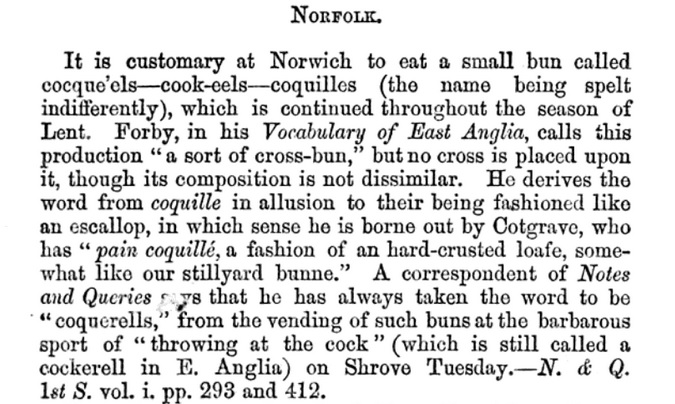
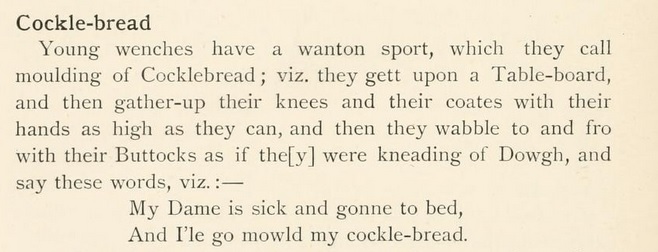
British Popular Customs, Present and Past; Illustrating the Social and Domestic Manners of the People: Arranged According to the Calendar of the Year
By Thomas Firminger Thiselton Dyer · 1876 p81

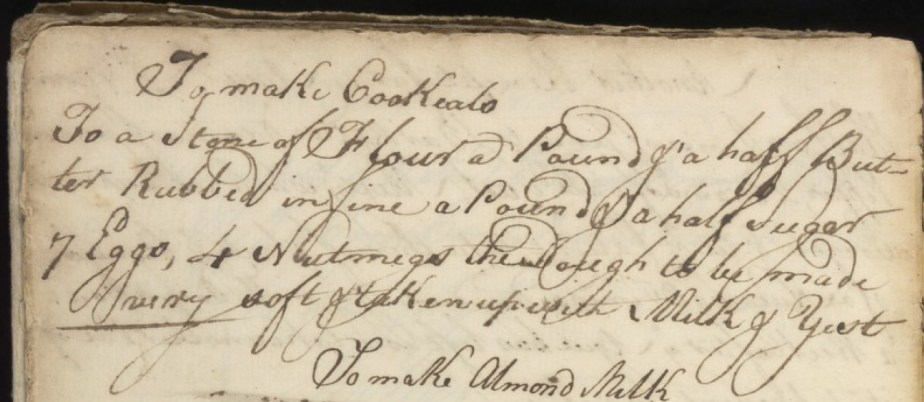
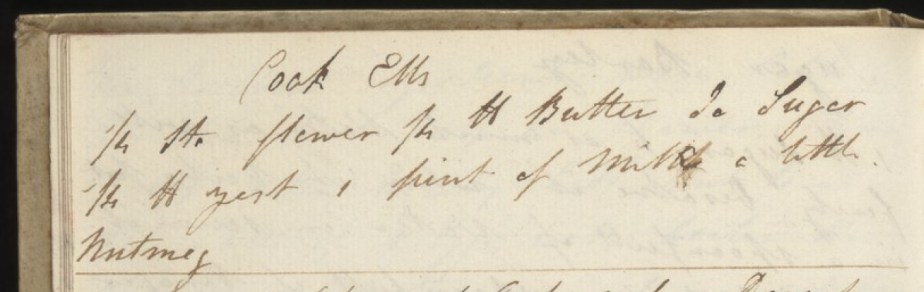
As luck would have it, I found not one but two recipes buried in the handwritten manuscripts held by The Wellcome Collection.

The earliest mention of Cookeels is found in Robert Forby’s The Vocabulary of East Anglia.

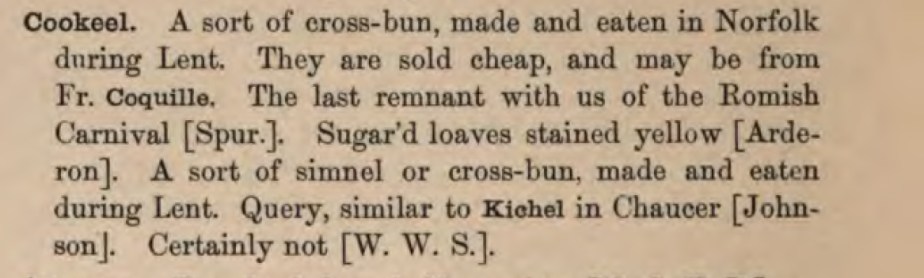
Cookeel: A sort of cross-bun, made and eaten in Norfolk during Lent. They are sold cheap and may be from Fr. Coquille.
The Vocabulary of East Anglia, Robert Forby, 1830, p76.

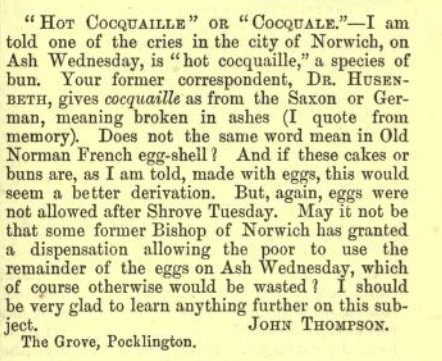
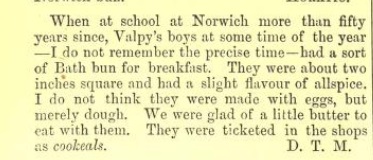
This definition is expanded upon throughout the nineteenth century as more and more academics weigh in with their opinion.

From “A glossary of words used in East Anglia, founded on that of Forby”, p46, Walter Rye, 1895, London
Notes and queries, Fifth Series, Volume Ninth, 1878, Jan-June, London. p87
Notes and queries, Fifth Series, Volume Ninth, 1878 Jan-June, London. p152

Something that became more and more apparent, is the somewhat lackadaisical approach to the spelling of these baked items. This is also true of the names of the two manuscript recipes, to whit Cookeals and Cock Ells:

MS7850, Anonymous manuscript circa 1745, Wellcome Collection

MS7834, Anonymous 19thC manuscript, Wellcome Collection

Confession time, I do like to get the the truth of the matter when it comes to recipe names and history. Love a great backstory, cannot be doing with made-up rubbish. So with all these different names, I decided to drill down and see if I couldn’t get to the bottom of it all (this phrase will come back to haunt me shortly).

I don’t think there’s much merit in the name deriving from the French ‘coquille’ (shell): there’s no hard crust, due to the butter, milk and eggs, and no mention of them being shell-shaped. Similarly, I think naming them after the cockfighting pits is also a bit of a stretch. The various accounts seeme to waver between Cockeel and Cookeel, and neither of the handwritten recipes offer any definitive help.

Playing around with the spelling, it turns out that Cockle bread is a thing:

“So far back as the time of Henry III., we find mention made of wassel bread, cockle bread and bread of treet corresponding with the three sorts of bread now in use, viz. white, wheaten and household bread.”

The Englishwoman’s Domestic Magazine, Vol. 1, No. 1, p157, 1852.

Cocklety bread has also been recorded in playground chants:

“The term ” Cockelty ” is still heard among our children at play. One of them squats on its haunches with the hands joined beneath the thighs, and being lifted by a couple of others who have hold by the bowed arms, it is swung backwards and forwards and bumped on the ground or against the wall, while continuing the words, “This is the way we make cockelty bread.”- -Robinson’s Whitby Glossary, p. 40.”

“The traditional games of England, Scotland, and Ireland” 1894-1898, Alice Bertha Gomme, p75

Delighted with this quaint image, I pursued Cockle Bread further – and immediately regretted that decision.

“The traditional games of England, Scotland, and Ireland” 1894-1898, Alice Bertha Gomme, p74

And before I knew it, I was learning that as an extension of this ribaldry, sometimes dough was actually kneaded this way, and then baked and fed to the person whom the girl wished to enamour.

ANYHOO……..Spice buns!

Cookeels

Makes 16

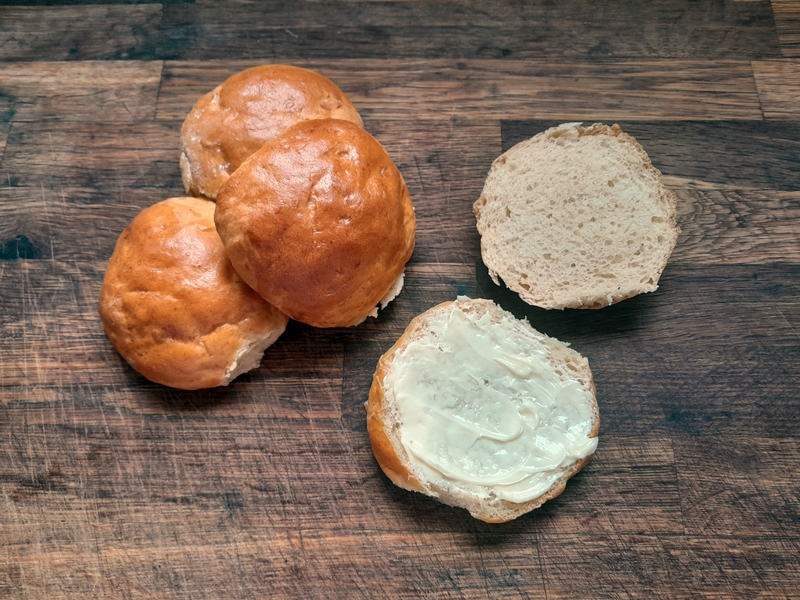
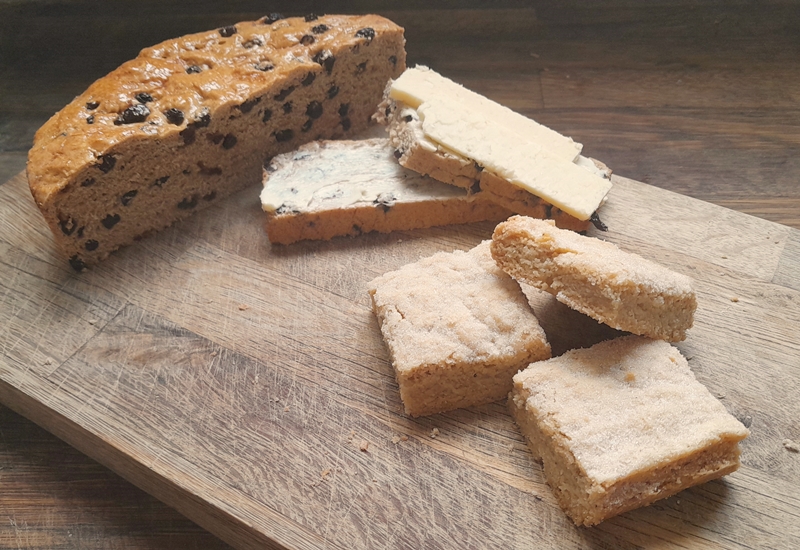
These soft, pillowy buns were enjoyed throughout the season of Lent. Unlike the more famous Good Friday buns, they contained no fruit and neither were they marked with a cross. One of the above anecdotes mentioned allspice as a seasoning, but neither of the recipes do, so we’re going to stick to nutmeg. Usually mixed with several other spices, the fact that these buns have just a single spice adds to their appeal. The enrichment of the egg, milk and butter makes the dough exceedingly soft and the baked bun incredibly tender of crumb. Delicious warm from the oven and freshly buttered, you can also enjoy them toasted with butter and cheese.

150ml water
150ml milk
1 large egg
100g butter
100g caster sugar
pinch of salt
450g strong white flour
2tsp ground nutmeg
1 sachet fast-action yeast

1 large egg yolk
2-3tbs milk

  • Put the dry ingredients into a food processor and blitz until the mixture resembles breadcrumbs.
  • Tip the mixture into a mixing bowl.
  • Zap the water in the microwave for 1 minute. This should heat it but without boiling.
  • Pour the milk into the hot water and stir. It should now be warm. Add the egg to the warm milk mixture and whisk thoroughly.
  • Pour the milk mixture into the other ingredients and mix until the dough comes together. It will be very soft – too soft to knead – but it will become manageable once risen.
  • Cover the mixing bowl with plastic wrap and set aside in a warm place to rise for 1 hour.
  • Cover a large baking tray, or shallow oven shelf for preference, in baking parchment.
  • Once the dough has risen, dust your work surface well with flour.
  • Tip the dough out onto the flour and pat gently to deflate. Dust the surface with flour, then, with the help of a dough scraper, lift and fold the sides inwards and pat down. Continue the dusting and folding until the dough is firm enough to handle. The first time I made this, I put too much liquid in, but it only took three lots of folding to make it manageable.
  • Pat the dough into a square. it will be roughly 20cm, but if it’s larger, that’s fine.
  • Cut the dough into 16 pieces. The easiest way is to cut your square of dough into quarters, then cut each quarter into four.
  • For each piece, fold in the edges of the dough, flip it over and roll into a ball under your hand.
  • Set the shaped dough onto your prepared baking sheet. The dough will spread during rising/baking to the size of a teacake, so space them well apart (7-8cm).
  • When all the dough has been shaped, cover lightly and set aside to rise for 30 minutes.
  • Heat the oven to 180°C/160°C Fan.
  • Whisk together the egg yolk and the milk and brush this glaze over your risen buns. You can use just milk if you prefer.
  • Bake your buns for 20 minutes, turning the baking tray/shelf around after 10 minutes to help with even colouring.
  • Remove from the oven and immediately cover with a clean cloth. This will trap the steam and ensure your buns are soft and pillowy when cooled.
  • Store in an airtight container when cold.

Gossiping Cakes

I have a confession to make. I chose these recipes because I loved the idea of women baking cakes specifically for having a get-together and swapping gossip. Alas, that’s not where these cakes originate, but the truth just as interesting.

As I’ve mentioned before, I have spent quite a considerable amount of time cataloguing household manuscripts that have been digitised by various libraries around the world. Obviously, there is going to be a certain degree of repetition of the most popular recipes, but there are also those that stand out as original either by name or by ingredient, etc. Whenever I come across such a recipe, I mark it in the spreadsheet with an asterisk, so when I’m looking back over the thousands of recipes, those asterisked ones are easily highlighted as worthy of a second look. And for the other type of recipes, such as the 200+ recipes simply entitled “A cake”, I’ll get to looking at you in all your (presumed) variety  soon, but to be blunt, you’re pretty low on the ToDo list.

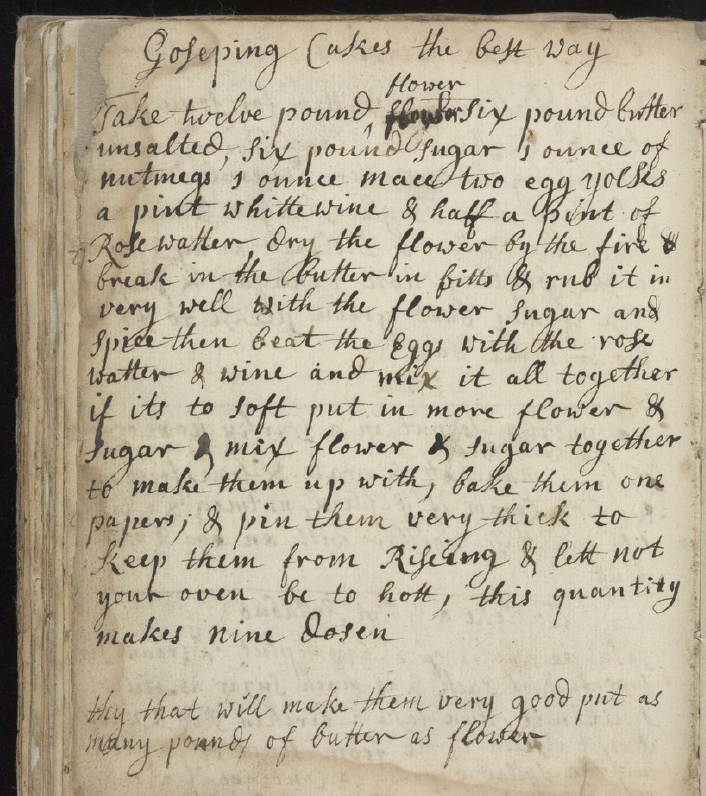
The first recipe I found was this one, dated early 18th century (1738), at the Wellcome Collection.

Recipe for Goseping Cakes The Best Way, from the manuscript of Rebecca Tallamy, (1738), MS4759, Wellcome Collection

It appears to be a spiced variation of shortbread, and obviously one to make in quantity, because the yield of the recipe is over 100 biscuits. It’s demonstrating one of the many interpretations of the word ‘cake’, in this case meaning small, circular biscuits. The last line also caught my eye, because it recommends using equal quantities of butter and flour to make them “very good”.

Regular listeners will have read about my shortbread variation testing a few months ago, where the ratio of butter to flour can range from 1:3 to 1:2, so the assertion that 1:1 is the best, had me intrigued.

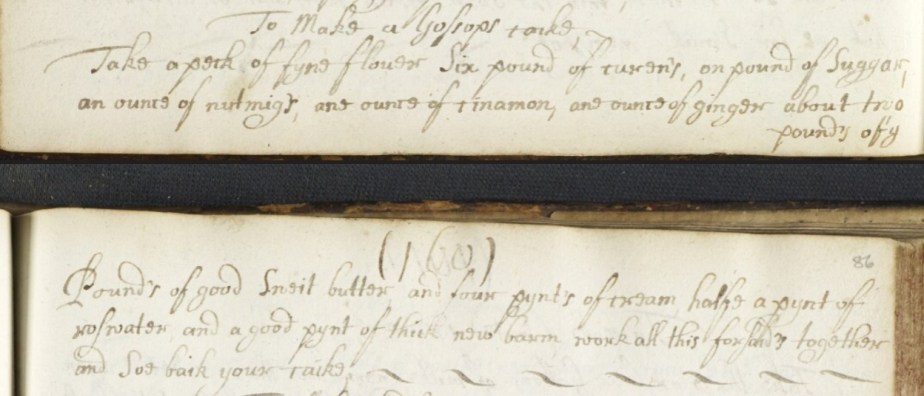
This recipe was very much on the back burner until I came across another recipe, similarly named, while indexing the digitised manuscripts at the National Library of Scotland.

Recipe for a Gossops Cake, from MS103093966.23, (1660-1699), National Library of Scotland

This recipe is in a manuscript older by almost a century (1660-1699), and differs in that it contains fruit, and is a large yeasted cake – exceedingly large, going by the peck/14lb/9kg of flour required – the term cake being used in this instance more akin to our modern usage.

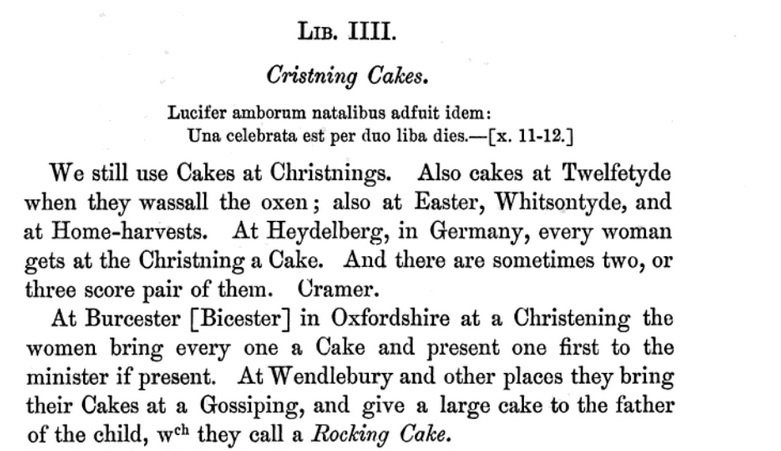
To delve deeper into this mystery, I turned to the internet, and found the following passage:

Christening cake traditions, from “Remains of Gentilisme and Judaisme 1686-87”, John Aubrey, James Britten, 1881, p65

This threw up the question: What is a Gossiping? And so I went hunting in the Oxford English Dictionary which I learned that a Gossiping is  a christening, or christening feast, derived and corrupted from “Godsibb”, which is an old English word for Godparent.

Not entirely relevant, but interesting nontheless, the oldest usage of Godshib I found was over a thousand years ago in Sermo Lupi ad Anglos, or the Sermon of the Wolf to the English, a sermon given by Wulfstan II, Bishop of Worcester and Archbishop of York (d. 1023) in 1014:

“And godsibbas and godbearn to fela man forspilde wide gynd þas þeode toeacan oðran ealles to manegan þe man unscyldgige forfor ealles to wide.”

Trans: And too many godparents and godchildren have been killed widely through-out this nation, in addition to entirely too many other innocent people who have been destroy­ed entirely too widely.”

Later usages of the word referred to a gathering of women/midwives when a woman was in labour, and hence to the modern usage.

So with a history stretching back many centuries, the account of christening traditions at Wendlebury would appear to neatly explain the differences between our two recipes: a large cake was presented to the father – presumably for all his hard work in the proceedings *eyeroll* – and the smaller cakes were shared with the guests.

So let’s get on with some gosseping!

A Gossop’s Cake

This is a fruited, lightly spiced and yeast-raised cake. If you’re British, it’s like an enriched teacake: delicious fresh, delicious toasted, and delicious either way with butter and a slab of cheese (but better with toasted). I’ve scaled the recipe down to make for a modest sized cake, but you can always double the recipe if it turns out to be a favourite.

315g plain flour
135g raisins
25g caster sugar
1tsp ground nutmeg
1tsp ground cinnamon
1tsp ground ginger
50g unsalted butter
150ml single cream
100ml water
1½tsp rosewater
1 sachet fast-acting yeast

single cream to glaze

  • Plump the raisins: put the raisins in a saucepan and cover with water. Warm gently on a low heat for 10 minutes while the dough mixes. Strain and pat dry.
  • Sift together the flour, yeast, sugar and spices.
  • Put the butter, cream, water and rosewater into a small pan and warm gently over low heat just until the butter has melted.
  • Put all ingredients except the raisins into the bowl of a stand mixer fitted with the dough hook and mix on slow until the dough comes together, then continue to knead for 10 minutes until smooth.
  • Add in the plumped raisins and mix on slow to combine.
  • Grease and line a tall, 20cm cake tin, preferably loose bottomed, with parchment.
  • Form the dough into a smooth cake and place in the prepared tin.
  • Set aside to rise until doubled in size. The enrichments to the dough (cream/sugar/fruit) will impact the rise, which is why there is only a single rise for this cake, thus taking advantage of the initial vigorousness of the yeast.
  • Heat the oven to 190°C, 170°C Fan.
  • When the cake has risen, gently brush the surface with single cream, and bake for 30-40 minutes until well risen and golden brown.
  • Cool the cake for 10 minutes in the tin, then remove and set on a wire rack to cool completely.
  • Store in an airtight container.

Goseping Cakes The Best Way

I’ve opted for the proportions where butter = flour because, contrary to my expectations, it really did taste much better that with just half the amount of butter.

250g plain flour
250g unsalted butter
125g caster sugar
1tsp ground nutmeg
1tsp ground mace
1.5tsp rosewater
1 large egg yolk
30ml white wine

1tbs caster sugar for sprinkling

  • Put the dry ingredients into the bowl of a food processor.
  • Cube the butter and add to the dry ingredients.
  • Blitz the mixture a few times until it resembles breadcrumbs.
  • Whisk together the yolk, wine and rosewater.
  • Add the wet ingredients to the dry and blitz until the mixture comes together in a soft dough.
  • Line a 20cm square tin with parchment paper.
  • Turn the dough out onto parchment paper.
  • Press the dough out evenly and smooth over.
  • Chill in the freezer for 20 minutes.
  • Heat the oven to 160°C, 140°C Fan.
  • Poke holes all over the surface with a fork or using a cocktail stick, in the manner of shortbread.
  • Bake for 30 minutes, turning the tin around after 15 minutes to ensure even baking.
  • Remove from the oven and turn off the heat. Sprinkle the caster sugar over the hot shortbread.
  • Cut the shortbread into pieces using a thin bladed knife or metal dough scraper.
  • Return the tin to the cooling oven until cold, to ‘dry out’.
  • When cold, store in an airtight container.

18th Century Bath Buns

We don’t eat buns as frequently as we used to, and I think it is a great shame, because buns are synonymous with fun!

I spend a lot of time pondering different recipes, and one thing that causes much musing is the way recipes evolve in the UK, compared to, say, France.

French recipes tend to be rather rigid and proscribed. Definitions of what constitutes those two most recognisable of French baked goods – the croissant and the baguette – have been firmly established, almost set in stone. A croissant is a croissant, a baguette de tradition is a baguette de tradition, – there are rules, there is order, and there is never, ever, deviation. You want to tweak a recipe a little? Then you have to give it a new name. The French have no truck with ‘croissant-ish’ or ‘baguette de tradition adjacent.’ No messing about with rules that have been decided decades, even centuries, ago. Absolument pas!

In contrast, British recipes are a lot more open to interpretation. On the Books and Writing page of this website you will find, amongst other things, a paper I wrote on Pikelets, and how, over the centuries, the word has been used to describe different recipes for arguably quite different items. Also a paper on Summer Pudding, which has undergone its own transformation during its long and illustrious history.

Having given the matter a great deal of thought, I’m pretty comfortable with viewing recipes, especially British ones, as having a timeline. Some are long, some short, but throughout which adapts and changes with tastes and fashions. To illustrate this, in Great British Bakes, I included multiple recipes for Shrewsbury Cakes, an all but forgotten English shortbread that has a history spanning centuries. Others, such as the less-successful Crimson Biscuits (be honest – have YOU ever heard of them?) in Ann Peckham’s 1767 book, have timelines of alarming brevity. An added feature (frustration) with British recipes is that they might go by a number of different names, according to region, or indeed the one name may refer to numerous different dishes.

And so, after WAY too much preamble, we come to Bath Buns, whose history stretches back into the 1600s, and might be a genuine contender for Britain’s Oldest Bun, much to the probable dismay of fans of Sally Luns and Chelsea Buns, very much the Johnny-Come-Latelies of the eighteenth century pastry scene. The glitterati of Bath were happily taking the waters and chomping on this style of bun for the best part of a century before Dr Oliver invented his biscuit in an effort to improve the health of The Ton.

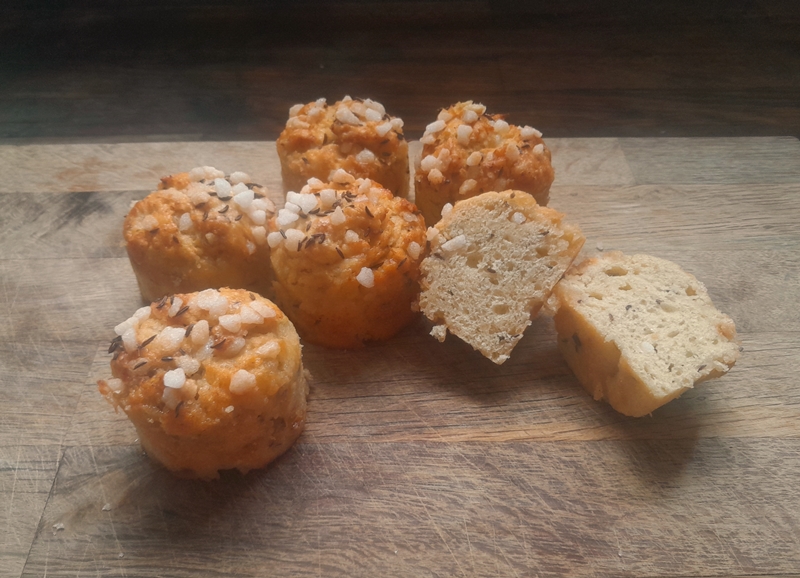
The Bath Bun of the late 17th century is rather different to the buns we might find in bakeries and tea shops today. The early Bath Buns were sweetened and flavoured with caraway comfits: seeds enclosed in numerous layers of sugar and enjoyed as sweetmeats and digestives. Today, a classic Bath Bun should retain the image of these candied seeds by being topped with pearled or candied sugar, which retains its colour and shape during baking, giving them a very distinct appearance. The time and effort required to create seeded comfits is considerable, and it is unsurprising to learn that they are no longer made. In imitation, I have found that using pearled/candied sugar and a sprinkling of unadorned seeds provides the sweetness, flavour and crunch of these forgotten sweetmeats.

The original Bath Buns were also incredibly rich with butter. Looking at recipes throughout the century, the most popular ratios ranged from an almost paltry one third of the weight of flour in butter, up to croissant-exceeding levels of 1.5 times the weight of flour in butter. Add in, as in the recipe below, a couple of pounds of caraway comfits, and these buns are probably a major cause of the gentry having to ‘take the waters’.

The first recipe below, the earliest I could find, is from an old manuscript dated to ‘late 17th century’ and has an equal weight of flour and butter. I scaled the recipe down, but there was still an alarming quantity of butter in not much dough. I broke my own rule too, in the baking, and did not bake it as written. Partly because I suspect that there is an error in the transcribing the original ingredients, and partly because I just couldn’t bring myself to put the full complement of sugar into the dough. I settled for half, and even that was a challenge – the buns were practically crystallized!

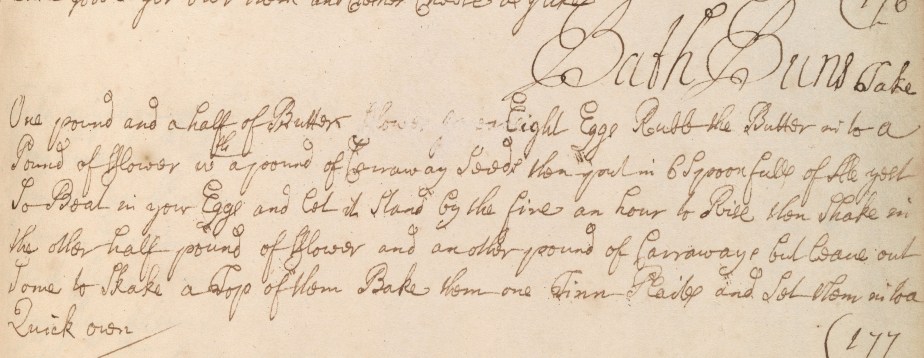
Earliest Bath Bun recipe I’ve found, from manuscript dated 1675-1725, MS1792, Wellcome Collection

With all the eggs and butter and sugar the dough is incredibly soft – too soft to knead – and is practically spooned onto baking trays – something which later recipes mention frequently. The modern Bath Bun traditionally should have a rather rough appearance, and shuns the round perfection of Sally Luns or the even sugared, square edges of the Chelsea Buns. Due to all this richness, the dough can take a long time to rise and the finished texture is cake-like rather than bready, crunchy with the sugar crystals and with the unusual (to our modern palates) and distinct flavour and aroma of caraway.

Bath Buns recipe from manuscript dated 1675-1725, MS1792, Wellcome Collection

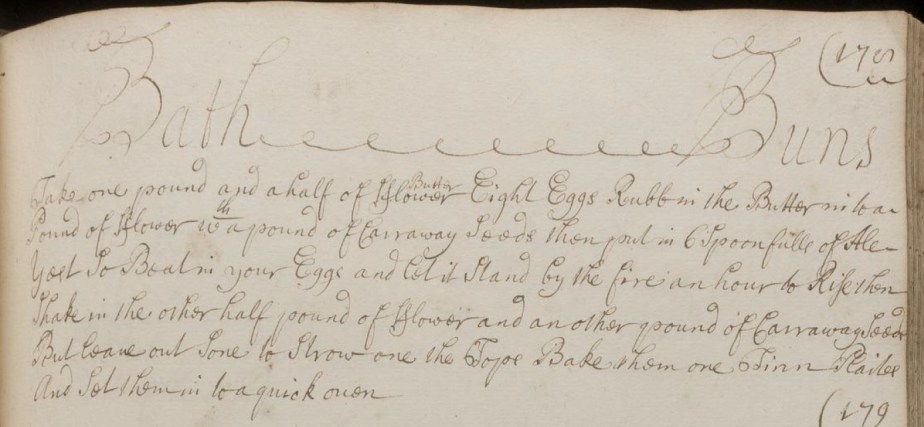
This recipe is particularly interesting because it has a twin, in another manuscript, on the other side of the Atlantic Ocean. This manuscript is one of the holdings at Yale University Library, and are both written in the same handwriting, possibly that of a scribe. They are mostly similar, but not exact copies. My guess is that one was copied from the other, with edits being made to exclude recipes not liked and including new recipes in the copy. With this in mind, I’m of the opinion that the Wellcome Collection manuscript is the copy. Below is the potential ‘original’.

Bath Bun recipe from MS Osborn fc181, Yale University Library.

All of which is an interesting detour, but doesn’t really get us an enjoyable Bath Bun that respects the traditions of the original, but is also acceptable to our 21st century tastes. Fear not, for galloping to our rescue comes a heroine for the ages: Mrs Bridget Ilbert (1712-1790), daughter of the 6th Earl of Devon and the wife of William Ilbert of Bowringsleigh, Devon.

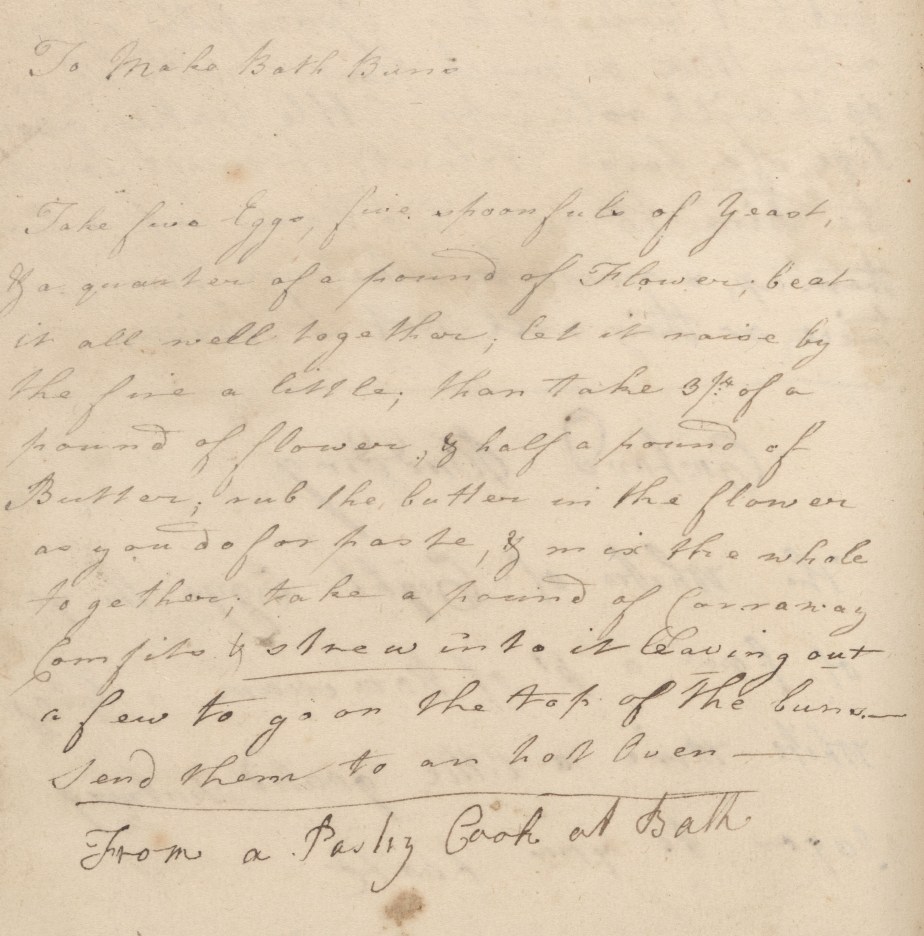
Recipe for Bath Buns in Bridget Ilbert’s manuscript MS1821, Wellcome Collection

Bridget’s manuscript is held at The Wellcome Collection, and one of the recipes within is for Bath Buns. I particularly like this recipe because it comes with the added credentials of being “From a Pastry Cook at Bath” – and you can’t get much better than that. The recipe is undated, unfortunately, but it is not too big a stretch to allocate a date in the general area of early-to-mid 18th century.

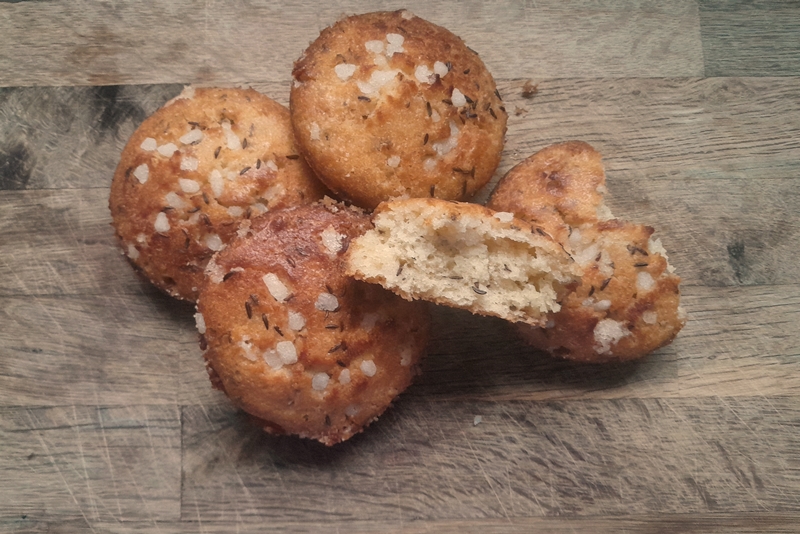
Miniature bath buns adapted from a recipe MS1821, Wellcome Collection

Original 18thC Bath Buns

You can bake these on baking sheets or in silicone moulds. I used a mould like this, and had dough enough left over to make 4 free-form buns in the photo at the top of the page.

Makes 10-12 buns.

225g plain flour – divided
115g unsalted butter
1 sachet fast action yeast
2 large eggs
2tbs warm water
1tbs caraway seeds
100g crystallised sugar

1 large egg for glazing
milk
more crystallised sugar for  finishing
a few caraway seeds to sprinkle

  • Crack the eggs into the bowl of a stand mixer and add the yeast, water and 50g of flour.
  • Whisk together thoroughly, then set aside to rise for 20 minutes.
  • Prepare your baking items – parchment paper on baking sheets if baking ‘free-form’, butter your silicone moulds if using.
  • Put the remaining flour and the butter into a food processor and blitz until the mixture resembles breadcrumbs.
  • Add the butter mixture to the yeast mixture, together with the caraway seeds and mix thoroughly to a smooth paste.
  • Mix in 100g crystallised sugar.
  • Spoon onto/into your prepared baking items. 50g of dough makes an elegant size. Try and make your dough sit up high in as round a shape as you can make. N/A if baking in moulds.
  • Whisk the egg with half an egg-shell of milk.
  • Brush the egg glaze over the buns.
  • Add a scattering of crystallised sugar onto the top of each bun, followed by a pinch of caraway seeds.
  • Allow to rise for 30-45 minutes, depending on how warm your kitchen is. There won’t be a huge rise, because of all the sugar and butter.
  • Heat the oven to 180°C, 160°C Fan.
  • Bake for 15-20 minutes until golden brown. The bottoms of the buns will be slightly brown when baked.
  • Allow to cool for 10 minutes to firm up before transferring to a wire rack to cool completely.
  • Best served fresh.
  • Store in an airtight container.
  • To reheat before serving, microwave briefly, 10 seconds per bun, i.e. for 4 buns, zap them for 40 seconds.

Carnival Fruit

This recipe is such a delight. So simple, so eye-catching, and almost 400 years old.

It comes from one of my favourite manuscripts at The Wellcome Collection. Now I’ll freely admit I am very fickle with my favouritism, and I have been reminded this week of just how special this manuscript is, mainly due to a completely different manuscript I’ve been working on. I’m not going to name and shame it, but my dears… The handwriting. The spelling. Lets just say, I was sorely tested.

THIS manuscript, however, is an absolute delight. Straddling the 17th and 18th centuries, the handwriting is surprisingly modern: neat, well punctuated, with a pleasing layout, it is a joy to read, and I regularly have to remind myself just how old it actually is.

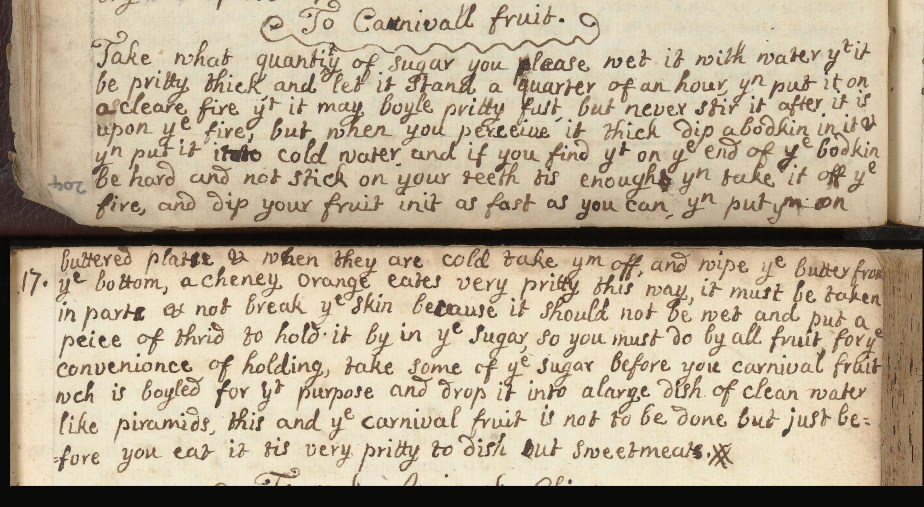
Carnival Fruit 1650-1750, MS8097, Wellcome Collection

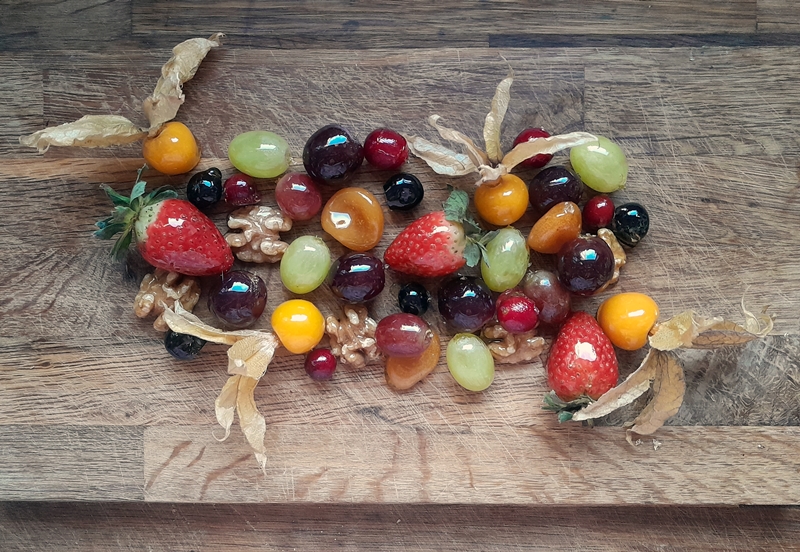
The method used to ‘carnival’ fruit is to dip it into a clear caramel. Although I have used several different fruits in the top image, the fruit recommended in the recipe is ‘a Cheney Orange’ (China Orange), aka an eating orange (as opposed to a Seville bitter orange). Since oranges are in season during the winter months, I believe this is perfect dish to serve up during the festive season. Nowadays we have the luxury of fruit out of season, which can make for a very colourful display, however, some fruit are more suited than others. Very moist, juicy fruit such as strawberries and cherries (not pictured) will only last 2 hours before the shiny caramel coating starts to break down. Other fresh fruits such as grapes, physalis, blueberries, nuts and even dried fruit such as apricots will last 3 hours before starting to become sticky. Whilst you can do orange segments, I feel that against the scale of the other fruit, they’re a bit big, and that small orange segments (satsuma, mandarin, clementine and the like) would be more suitable.
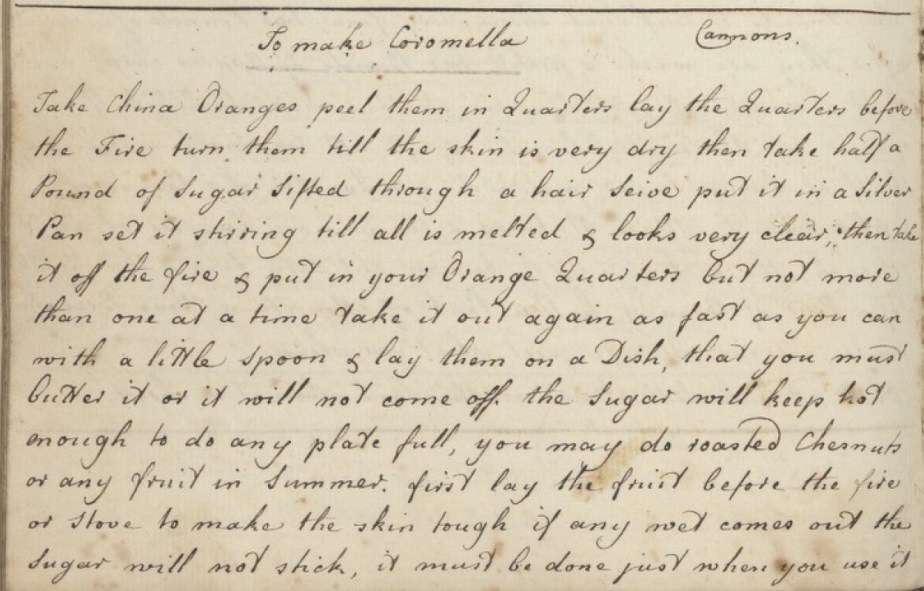
A similar recipe in a slightly later manuscript, ‘Coromella’ 1805-1860, MS2203, Wellcome Collection

I have changed very little in this recipe: I’ve added some weights and measures, to help with getting the sugar to the correct stage and added a little liquid glucose to keep the caramel from crystallizing. I tried several times to go ‘old school’ with just sugar and water, but the caramel always crystallized too quickly to get more than just a few pieces dipped. Perhaps they used honey to help them out back then?

When choosing your fruits and nuts, it is important to consider how they are going to taste with the caramel. If you have a sweet tooth, then it gives you free rein to pick and choose almost anything. Personally, I would recommend choosing fruit that is slightly sharp, just to prevent an overload of sugar. The fruit also needs to be dry, so this rules out any fruit so large it needs to be sliced.
Choose your favourites from: green/red/black grapes, cherries, strawberries, raspberries, strings of redcurrants, blueberries, blackberries, physalis, dried apricots, walnuts, hazelnuts, pecans, almonds. If you have the patience to put individual pomegranate seeds on cocktail sticks and dip them, I think they would be delightful in both appearance and flavour.

The greatest amount of time for this recipe will involve preparing the fruits and nuts.

  • You can utilise the stalks on cherries and redcurrants, the papery coverings on physalis and the green stalks on strawberries to hold as you dip them in the caramel.
  • Most other fruits and nuts can be pierced with a wooden cocktail stick to prevent getting boiling caramel on your fingertips.
  • The recipe recommends using a thread to dip orange segments, and I must confess to not having tried this method. I opted instead to use the cocktail stick. If you can pierce the skin and avoid bursting any of the juice sacs inside, you’re onto a real winner.

To Carnival Fruit

For the caramel

400g granulated sugar
125ml water
60ml/4tbs/¼ cup glucose.

a selection of fresh fruits, berries and nuts

wooden cocktail sticks for dipping

a silicone mat or baking parchment

a sugar thermometer

  • Put the sugars and water into a small saucepan and set aside to begin dissolving while you prepare the fruit for dipping.
  • Use the wooden cocktail sticks to skewer the fruit and lay them neatly on a board or plate. If you’re using small orange segments, remove all the white pith. If you accidentally tear the skin of a segment, eat it – the juice will compromise the caramel.
  • Line a baking sheet with the silicone mat or baking parchment. This is for laying the dipped fruits on to cool. Although the dipping is straightforward, you will need to work fairly briskly in order to get all the fruit dipped before the caramel cools. If you can keep the pan on a very low heat while you dip your fruit, then this won’t be much of a problem. However, the heat will continue to cook the caramel, and it will become darker the longer it remains on the heat.
  • Arrange the prepared fruit and baking sheet so that they are easily to hand when the caramel is ready.
  • Heat the pan with the sugars in over a low heat until the granulated sugar has dissolved.
  • Increase the heat and cook until the syrup registers 150°C on a sugar thermometer. The syrup will be bubbling vigorously over the whole surface of the liquid.
  • Remove from the heat (or turn the heat down to the minimum, your choice), and begin dipping your fruits and nuts.
  • Tilt the pan so that the syrup is deep, and then one at a time, dip your fruit fully into the caramel and set on the silicone mat/parchment to cool. For fruit not on wooden sticks, be sure to keep your fingers well away from the caramel when dipping, as the caramel will burn, and stick to your skin and continue to burn, if it comes into contact.
  • The caramel needs only a minute or two to set, and then all that remains is to arrange it on your serving dish and serve. I went for a wooden board, as it’s plainness and natural material made for a great contrast against all the brightly coloured, shiny carnival fruit. To remove the wooden sticks, roll them between your thumb and forefinger – this will provide enough pressure to break the caramel surrounding them, thus making it easy to remove them.

Colcannon

There are many traditional foods associated with All Hallow’s Eve/Hallowe’en, November Night, but one which might be new (and deliciously simple to prepare), is the Irish potato dish of Colcannon.

Back in the beforetimes, when cakes of bairín breac were considered a luxury, people used to celebrate All Hallow’s Eve with a big pot of Colcannon. A ring was hidden in the depths of the creamy, mashed potatoes, and whoever ended up with it on their spoon, was said to be going to be the first to marry, within the next 12 months.

There aren’t many Irish cookery books of this time, so my favourite place to find accounts of the Irish food actually eaten by the population (as opposed to some publisher’s imagined scenario), is The School’s Collection at the National Folklore Collection, held at University College, Dublin. The Schools Project was an ambitious and wide-ranging collection of everything to do with Irish Folklore and Culture, gathered and recorded by school pupils between 1937 and 1939. More information about the project can be found here.

With information gathered from all across the country, it is fascinating to see both the common threads that bind the Irish people together, as well as discover the little differences that make each community unique. For instance, you might be aware of the popular Irish potato dish of Boxty, you might also be aware that it can be served in three different ways (loaf, dumplings, pan), but you might be surprised to learn that The Schools Collection contains over 150 different ways of making Boxty. I recently wrote a paper about this, the appendices of which, including the list of 150+ different ways of making Boxty, you can access here.

So it is, to a certain extent, with Colcannon. It also appears under the names Brúitín, Brúchin, Champ and Poundies, to name but a few. “No, no no!” I hear you exclaim, “Champ is its own thing! It’s made with spring onions!”

Well yes, but actually no.

It might actually be a Stampy/Boxty situation, where the same dish has different names, depending on the part of the country you come from. I shall be looking into this more soon.

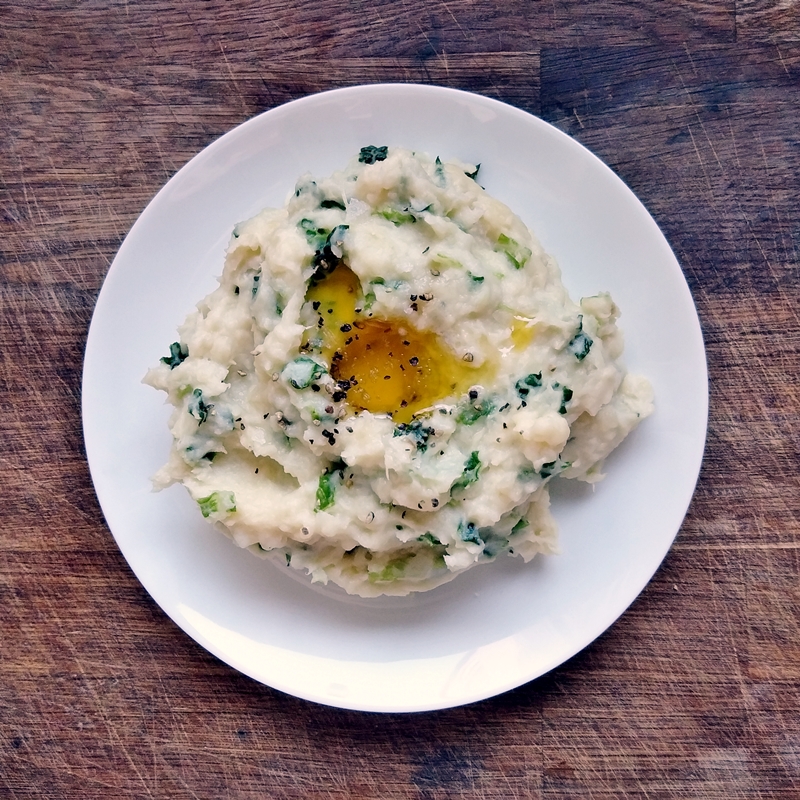
Similarly, there can be interpretation as to what exactly the dish comprises. At it’s simplest, it is cooked potatoes, mashed with a little milk, pepper and salt, and served in a mound with a lump of butter in the middle. It is eaten by scooping some potato from around the edge and then dipping it in the growing pool of melted butter in the middle before consuming.

Many accounts of Colcannon have additional items of flavouring added. “A bit of greenery” is probably the easiest way to describe a large proportion of them, which include young (spring) onion, chives, nettles, leeks, shredded cooked cabbage or kale, parsley, regular onions.

The accompaniments can be anything you enjoy, but traditionally they include: sweet milk, buttermilk or sowans to drink, and crisp, crunchy oat bread (oatcakes) to use as a scoop.

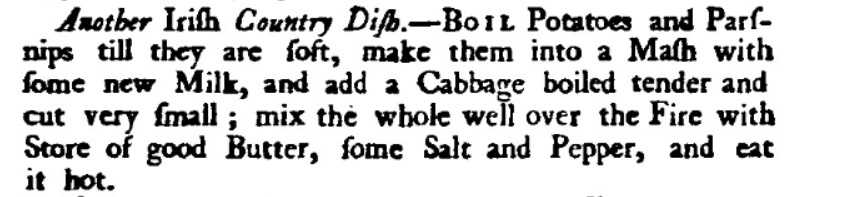
I was delighted to find just how old the dish of Colcannon is: there’s mention of it back in the eighteenth century. William Ellis (1750) includes a recipe for an “Irish Country Dish” in his The Country Housewife’s Family Companion, p366.

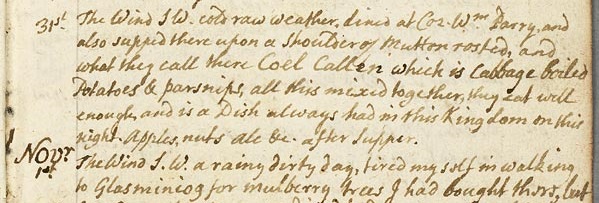
And Welsh diarist William Bulkeley (1691-1751), whose diaries are kept at Bangor University, mentions dining on “Coel Callen” at Halloween in 1735, whilst on a trip to Ireland.

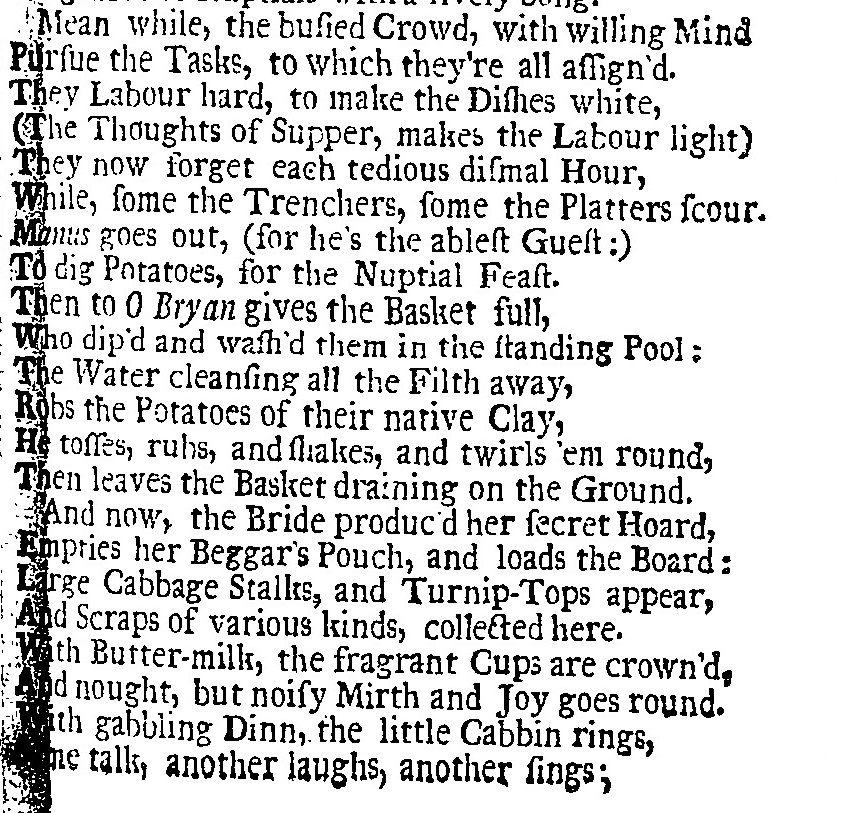
Even earlier, a poem published in Dublin in 1723, speaks of what certainly seems to be a dish of Colcannon being prepared for a wedding feast.

From “Mendico-hymen seu, tuphlo-pero-gamia. The beggar’s match. Translated from the Latin.”, W. Thompson, printed by Tho. Hume, for Jer. and Sil. Pepyat, Dublin, 1723.

Colcannon

This is more of a guideline than hard-and-fast recipe. Use quantities to your own personal needs and taste.

potatoes
greenery 
milk
salt & pepper
butter

ring (optional)

  • Cook your potatoes. The method doesn’t really matter: boil or bake. The important detail is to mash them smooth whilst hot. I use a ricer to make sure all lumps have been dealt with, but you can also press them through a coarse sieve or use some elbow grease and a masher utensil.
  • Smooth out the mixture by adding milk. NB Use hot milk, otherwise you run the risk of cooling down your potatoes too much. If you’re using any kind of onion, you might like to simmer them in milk for 10 minutes to both flavour the milk and reduce the harshness of the onions themselves. Strain out the onions, keeping the warm milk for mixing, and chop the onions finely – or to your taste. Cover and keep hot while the greens are prepared.
  • Add your greens – this may be in the form of herbs (chives/parsley) green onions/spring onions/cibol/leeks, Savoy cabbage, spring greens, kale, sweetheart cabbage, white cabbage, Brussels sprouts, spinach, nettles, etc. The cabbage and/or leeks should be shredded to your liking (fine/coarse) and blanched/steamed for five minutes. Add sufficient to your own personal taste.
  • When everything is piping hot, serve your Colcannon in a large communal dish, with a generous amount of butter in a hollow in the centre, and hand round spoons for all. Don’t forget to pop a ring  into the mix before serving, if matrimony is in your plans.

Petticoat Tails and Pitcaithly Bannock

This might seem like a double recipe post, but it is more of a ‘two for one’ in that the same ingredients can be presented in different ways, depending on your inclination and the effort you wish to put in.

So… Petticoat Tails.

Much has already been made of the contortion of ‘petites gatelles’ into ‘petticoat tails’, as well as other origins,  so I’m going to dwell no more upon it.

No, what I’ve been looking at/obsessing over of late is the early recipes. Late eighteenth/early nineteenth century recipes.

Mrs Frazer’s 1806 recipe for “Petticoat Tails For Tea” caught my eye, as it seems to be the earliest recipe in print.

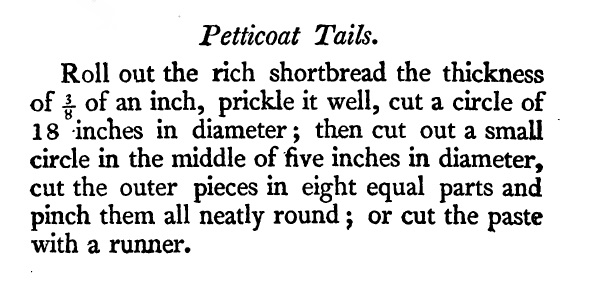
Two interesting details about this recipe are the inclusion of caraway seeds and the first (to date) description of the now iconic Petticoat Tails shape. There’s also oblique reference to the Scottish weights and measures system, which is significantly different to the English one at the time. This factor was the source of much head-scratching until I eventually managed to get the ingredients scaled accurately. It is a much less rich version than that which is popular today, and while I will concede that caraways aren’t a regular sweet spice these days, they are strangely compelling and I can heartily recommend them if you’ve not tried them before in a sweet context.

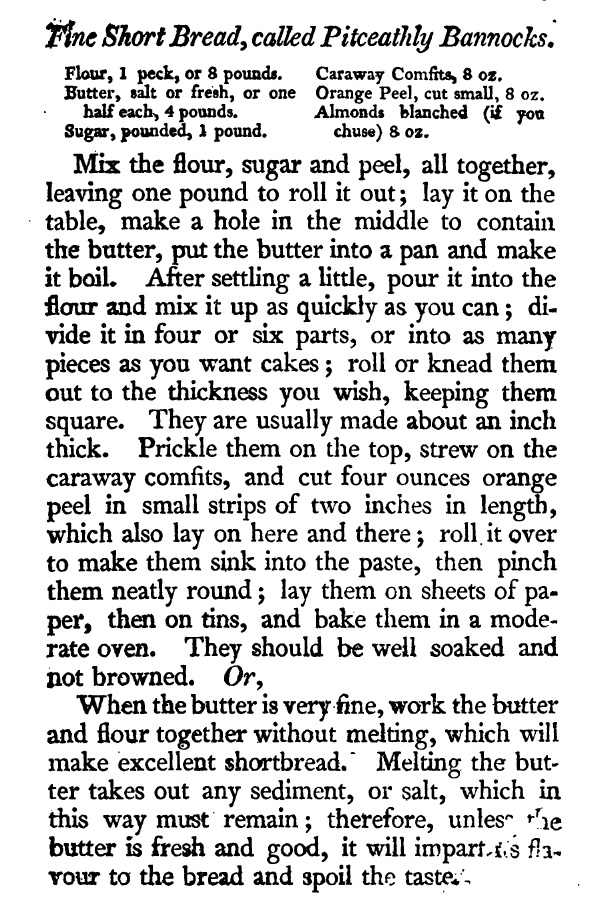
The next recipe I spotted comes from John Caird (1809) as something of a post-script to his recipe for “Fine Short Bread, called Pitcaithly Bannocks”.

From “The Complete Confectioner and Family Cook” by John Caird, 1809

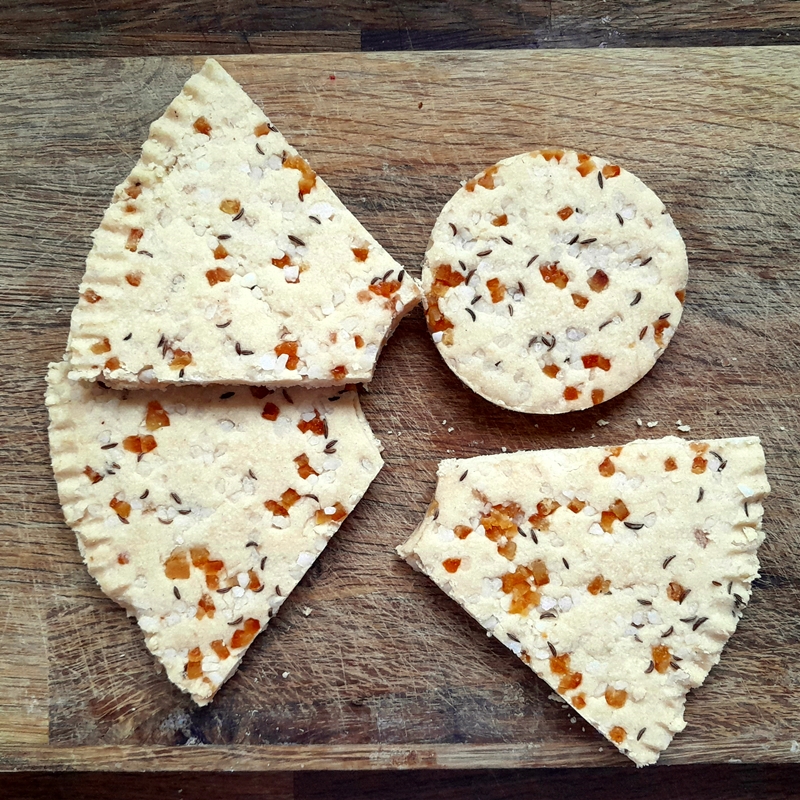
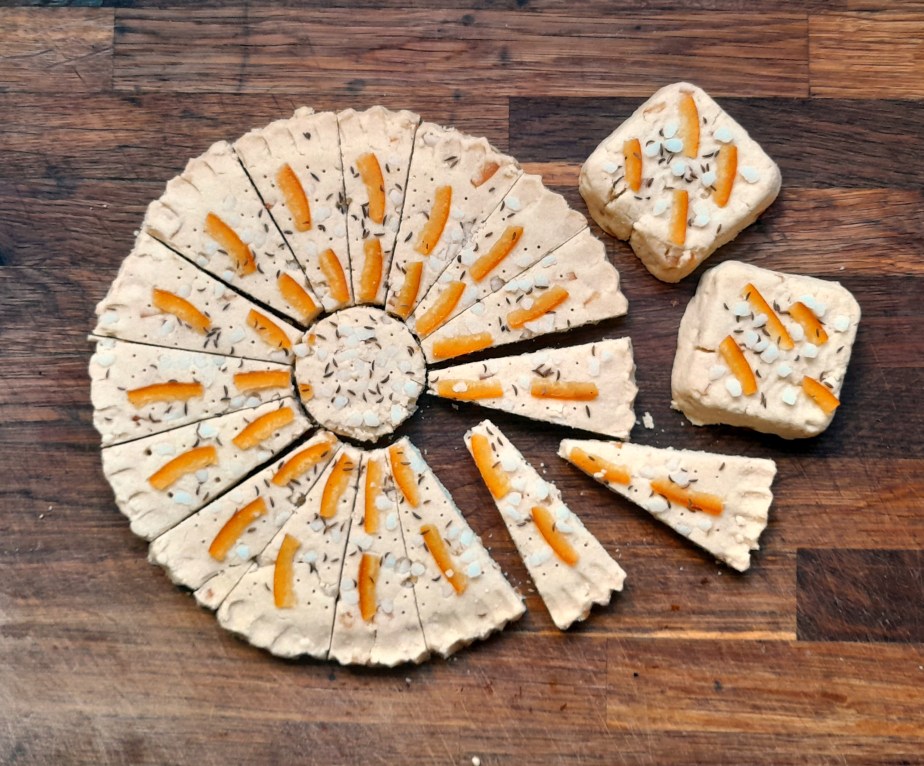
So it would seem that Petticoat Tails are just a thin version of rich shortbread or Pitcaithly Bannocks. It certainly makes Petticoat Tails a lot more interesting than the pale and unadorned recipes we have today. I must take issue, however, with the size of Mr Caird’s Petticoat Tails – they’re enormous! Eighteen inches in diameter? What on earth is he cutting round – a cartwheel? I used a dinner plate and a pastry ring to cut the two circle in the photo at the top of the page, and doubled the number of slices to sixteen to make the portions reasonable and not too slab-like, because in the first test batch of eight portions (using a dinner plate –  see below) they were so massive I could only fit four pieces on my cutting board. Mr Caird only suggests cutting his cartwheel of shortbread into eight pieces, so I am puzzled as to how it was then served: broken into smaller pieces by hand, perhaps? Seems odd to go to the trouble of observing the format outlined by Mrs Frazer, but insisting on them being of giant size.

The other challenge was the sticky issue of caraway comfits. These were popular confections of caraway seeds coated in several layers of sugar and often enjoyed at the end of a meal, or in sweetened, baked goods, as an aid to digestion. No-one makes caraway comfits these days, that I have been able to find, at least – and the process of making them is very time-consuming, even with the correct equipment (which I don’t have). Thus I have come up with an adaptation which mimics bith the flavour and texture, but without all the Faff™ of having to make them yourself. Adding caraway seeds to the dough, then scattering sugar nibs ensures both the added sweetness and the caraway flavouring can be enjoyed together, as well as the textural crunch. Just scattering seeds over the surface of the shortbread doesn’t work, as they tend to fall off, even when they have been vigorously rolled in.

So here we have a recipe that can be shaped in two separate ways – thick and chunky or thin and ladylike. Whichever way you decide to make it, with the candied peel and the caraway seeds and the rich buttery taste, it is going to pack a real punch in terms of flavour. Enjoy!

Petticoat Tails and Pitcaithly Bannock, 1809

After persevering for several batches, I made the decision to change the method slightly, as the recipe as written just wasn’t working out very well, being very dry and crumbly. I suspect that the butter of times past might have had a higher water content than modern butters. It is still prone to crumbling, and so if it’s not coming together for you, try adding a little cream to help things along.

225g room temperature best butter*
60g caster sugar
390g plain flour
2 tsp caraway seeds
60g sliced, blanched almonds
60g orange peel, cut small
a little double cream (optional)

To decorate
30g sugar nibs
sliced candied orange peel to taste

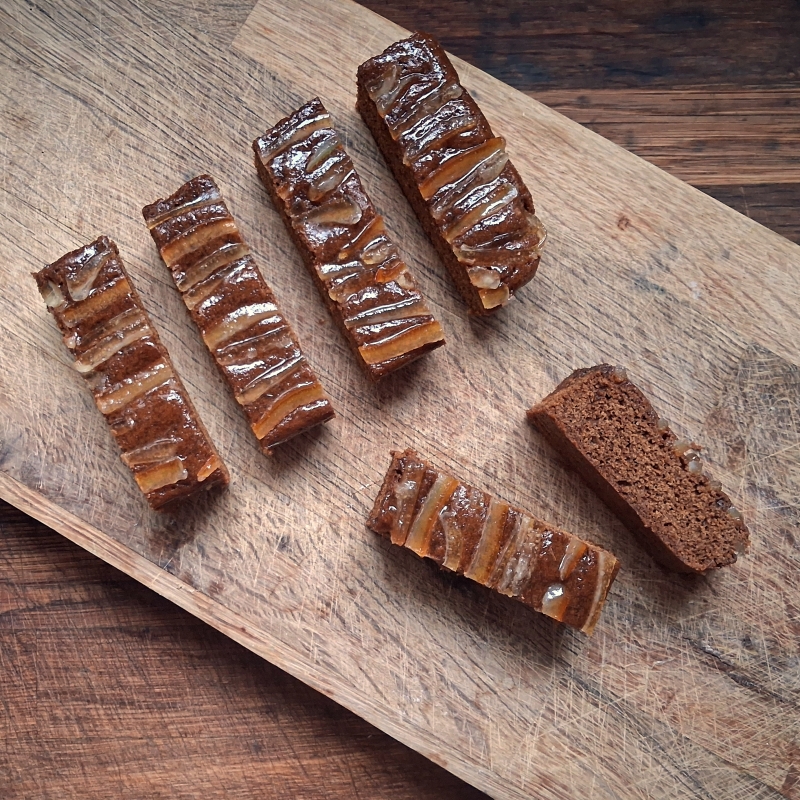
  • Decide how you want to bake your shortbread. If its the traditional shape, line a baking sheet with parchment. If you prefer to bake a slab, line a suitably sized baking tin with parchment. I suggest 20cm x 30cm or similar. A third alternative is to bake individual portions. In the top photograph, I have included a couple of thick, square servings. I made them with the offcuts of the circle of shortbread, and shaped them in a brownie pan with square holes, before baking them ‘free-standing’.
  • Cream the butter and sugar together until light and fluffy.
  • Add the caraway seeds.
  • Gradually add in the flour, almonds and peel and mix until incorporated. Add a little cream if necessary.
  • Tip out the dough onto whatever you are baking it on/in.
  • If making thin Petticoat Tails,
    • Roll out to 1cm thick.
    • Scatter over sugar nibs and orange peel to taste. Use the rolling pin to roll over and press them into the dough.
    • Use a skewer to poke holes all over the surface of the dough.
    • Use a dining plate to cut out a circle, and a large, plain pastry cutter to cut the centre circle.
    • Pinch the edges of the outer circle between finger and thumb to decorate.
    • With a thin, bladed knife or pastry scraper, cut the outer circle into 16 wedges.
  • If making thick Pitcaithly Bannock,
    • Press the dough evenly into your baking tin.
    • Scatter over sugar nibs and orange peel to taste. Use the rolling pin to roll over and press them into the dough.
    • Use a skewer to poke holes all over the surface of the dough.
    • Use the tines of a fork to mark a border around the edges.
    • With a thin, bladed knife or pastry scraper, cut your dough into serving size pieces – squares or fingers.
  • Chill the dough for an hour or until ready to bake.
  • Heat the oven to 150°C, 130°C Fan.
  • Bake for 45-50 minutes, until pale but still cooked through. Turn the baking tin/sheet around half-way through, to ensure even baking. Yes, it is the same baking time whether it be thick chunks or broad but thin Petticoat Tails. The colour will darken only very slightly.
  • When baked, remove from the oven. Using the same thin-bladed knife/dough scraper to refresh the cuts in the dough, but do not lift out.
  • Allow to cool in/on the tin.
  • Store in an airtight container.

* Salted or unsalted, as you like. I used Isigny Sainte-Mère Unpasteurised Salted Butter, because it has a wonderful flavour and might actually be close in flavour to the best butter of old.

Ouse Bridge Cakes

I love coming across a geographically-named recipe. It gives a place and time in which to ground the dish: Grasmere Gingerbread, Cornish Pasties, Chelsea Buns.

Almost better yet, is discovering a recipe that is also unknown today, having gone out of fashion or due to some other circumstance. Such is Ouse Bridge Cakes.

There’s practically no information available about these bakes. In “The Gentlewoman’s Kitchen” (1984), Peter Brears suggests Ouse Bridge Cakes are a yeast dough flavoured with mace, cloves and nutmeg and mixed with sugar and milk. In his book “Secret York” (2014), author Paul Chrystal writes:

“Ouse Bridge Cakes, known in the eighteenth century, a type of Yorkshire tea cake.”

And that’s pretty much it. Not much to go on at all.

Luckily, in my scouring of old manuscripts, I have turned up five, different, eighteenth-century Ouse Bridge Cake recipes. I reasoned that, within their pages lay an understanding of what constituted the original Ouse Bridge Cakes.

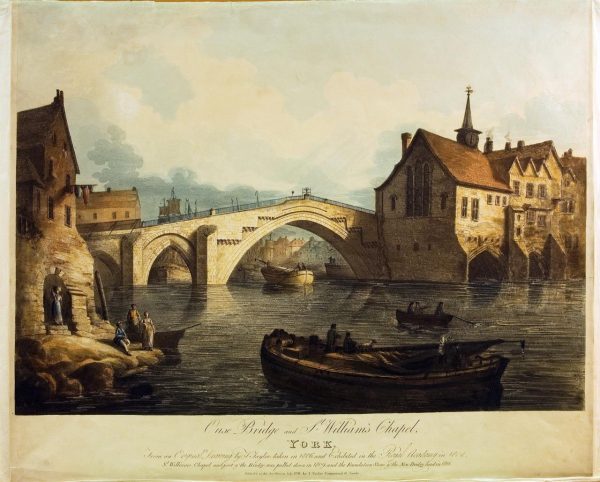
But first, a little history. The bridge over the River Ouse that this recipe refers refers to is in the city of York. Although there have been many bridges over the centuries, it is the fourth Ouse Bridge (1565–1810) which has been commemorated in these buns.

Old Ouse Bridge from the South. T.Taylor, 1806.

Just as with many city bridges of the time, the Ouse bridge was heavily built-up, its five arches supporting substantial buildings on both sides of it’s towering centre arch.

Old Ouse Bridge from the North. Attrib. Henry Cave (British 1779-1836)

With all this busyness on the bridge, it is likely that there were businesses too, and if not a baker’s shop, then almost certainly a stall or street hawkers. Just as Wood Street Cake (see Great British Bakes) took its name from the London street where it was made, Ouse Bridge Cakes take theirs from the place where they could be bought, if not actually baked.

As already mentioned, Ouse Bridge cakes were a spiced bun. But seeing as Yorkshire has quite a reputation for similar items – the most well-known being the Yorkshire Teacake (as with all tea cakes, best eaten toasted and buttered) – it occurred to me that there must be something to distinguish the Ouse Bridge cake from a host of other buns, and that something was probably its shape. A bun of a particular shape is instantly recognisabe – just look at modern Chelsea Buns and their square, spiralled form (which isn’t the original shape – but don’t get me started, see Great British Bakes (again)).

Luckily, there were two of the five recipes (yes, remember them? Back before the detour?) that held clues. The first was in a manuscrpt dating from the mid-eighteenth century, which suggested the dough be weighed out into 8oz (225g) pieces before being shaped.

Ouse Bridge Cakes recipe, MS3498, (1750-1900) Wellcome Collection.

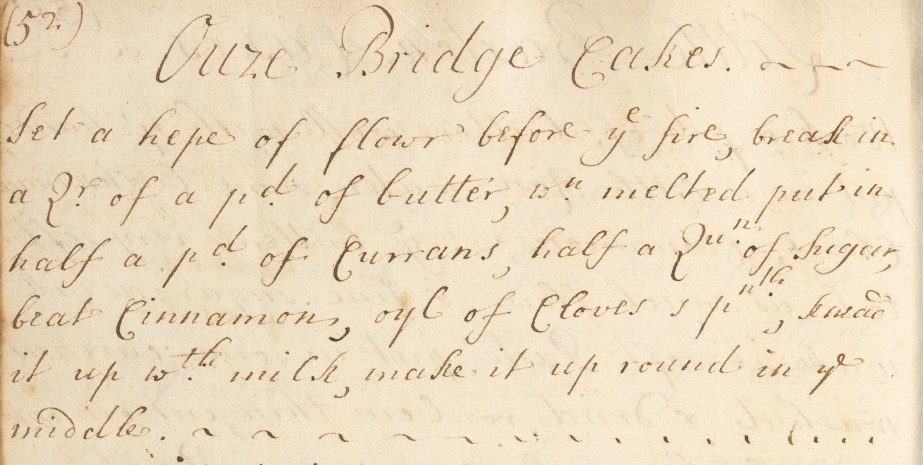
The second piece of information was from a manuscript dated 1750, the last line of which reads “make it up round in ye middle”.

Ouse Bridge Cakes recipe from MS4645, (1750-1853), Wellcome Collection.

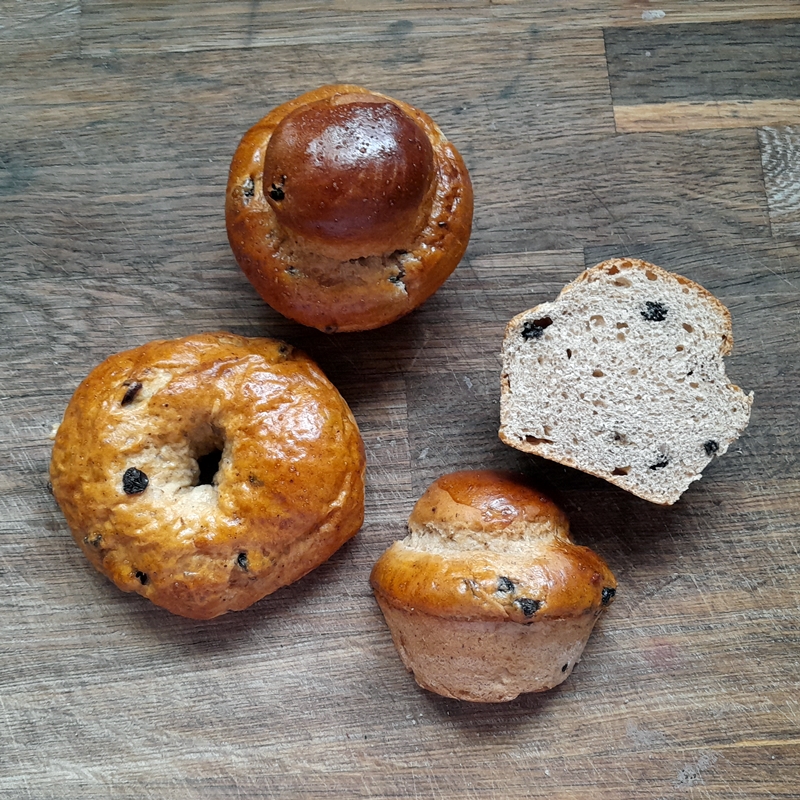
I spent a lot of time thinking about this, and decided it meant to shape it like a bagel/ring donut. I also asked online, and the feedback was that it might mean something cottage-loaf-esque, so I experimented with both shapes. I still think the ‘hole in the middle’ is a better fit for the description, but until more recipes are rediscovered, the jury will have to remain resolutely out.

Of course, it might well be that none of these five recipes are the definitive, perfect Ouse Bridge Cakes. Back in the day, even the moderately wealthy (such as the authors of these manuscripts) didn’t necessarily bake for themselves: practically everyone bought their bread from a baker. The recipes that we find in manuscripts are attempts to copy, on a smaller scale, something enjoyed elsewhere, so that they can be enjoyed in their own homes. The five recipes in the manuscripts were all different, yet there were some uniting features, as each author tried to recreate something they had only tasted. Firstly, all of them had currants, ranging from a spartan few ounces to almost half the total weight of the ingredients. All of them were flavoured with spices (nutmeg, cinnamon, cloves, ginger, mace),  but nutmeg was a common denominator amongst all five. All of them were enriched with milk and either butter or cream, and most had added sugar.

The recipe below is very much a Goldilocks version of them all. Neither too much nor too little of everything, because recipe testing revealed certain flaws in the versions that veered towards the extreme. The overly-fruited buns were heavy and close textured, and those buns with generous/excessive additions of butter and cream were reluctant to rise, with a rather greasy taste.

This version is moderately fruited, moderatly enriched and moderately spiced. Delicious warm from the oven, and even more so toasted, with slabs of cold, mature Cheddar cheese (it’s a taste sensation!).

Ouse Bridge Cakes

Each bun is formed from a generous 75g of dough, and I have scaled the quantities down to make a very modest seven buns per batch. Feel free to double the recipe as you see fit. The spicing is just a suggestion: change things up if you have a favourite mix.

225g flour
1 sachet fast-action yeast.
180ml milk
15g sugar
30g unsalted butter
60g currants
1 tsp ground ginger
1 tsp ground nutmeg
½ tsp ground cloves
½ tsp ground mace
1 large egg for glazing

  • Put the milk, sugar and butter in a pan and scald. IMPORTANT Scalding is when the milk almost boils, but not quite. Heat it until it bubbles around the edges (or in the middle if you have an induction hob), then remove from the heat and allow to cool down. Scalding milk breaks down the proteins, which will allow your buns to remain soft and yielding, even when cold. Using 100% unscalded milk in a dough recipe can lead to heaviness.
  • When the milk mixture has cooled to blood temperature, pour it into your mixing bowl.
  • Sift the flour, yeast and spices together and add to the milk mixture.
  • Knead the mixture by hand or on the lowest possible speed on your stand mixer for 10 minutes. increase speed to high for up to 2 minutes, or until the mixture comes together in a clean ball.
  • Add the currants and fold them in.
  • Cover the bowl with cling film. The milk, butter and sugar will make the dough slower to rise that a regular dough, so allow at least 90 minutes or until the dough has doubled in size.
  • Tip out the dough and divide into seven pieces, each of roughly 75 grams. There’s no need to get all aggressive and start punching it: it will naturally deflate with the turning out.
  • Shape the dough as you see fit. In addition to the two shapes mentioned above, you can also shape them into a regular teacake shape. NB: If you’re going for the cottage loaf shape, I recommend baking the shaped dough in cupcake tins, which really lets the dough ‘sit up’ and hold it’s shape. I used silicone baking trays rather than metal, to keep the dough from forming too crusty an outside.
  • Set aside to rise for 40 minutes.
  • When the dough has risen, whisk the egg and brush over the buns with a pastry brush.
  • Heat the oven to 180°C, 160°C Fan.
  • Bake the buns for 20 minutes, turning the baking trays/sheets after 10 minutes to ensure even baking.
  • When cooked and golden brown, transfer to a wire rack to cool.
  • Store in an airtight container at room temperature.

Dairy-Free Cream

Here is very useful recipe for those looking to avoid dairy products or even to just reduce the amount of fat in their diet. By whisking together some smooth jam and a couple of egg-whites, a deliciously light and frothy ‘cream’ can be created, for use as a finishing touch to trifles, puddings and pastries, or to enjoy by itself. The cream will be influenced by whatever flavour of jam you choose to use, but it doesn’t dominate at all. The above was made using seedless raspberry jam, and the subtlty of colour reflects the subtlty of flavour – a mere whisper on the palate. For an almost white ‘cream’ with a very faint flavour (if that suits your needs best), I can recommend making and using Christine Ferber’s Green Apple Jelly.

It is a surprisingly elegant solution for anyone with dietary restrictions, and dates from the cusp of the 17th and 18th centuries (circa 1700).

This particular recipe I found in a manuscript held by the Wellcome Collection in London, but I have also read variations in other manuscripts and locations. I am surprised tht it has fallen out of favour, for it is one of the simplest and easiest recipes I have adapted.

Well, I say adapted. In fact I have changed very little from the original instructions.

To Make Cream Without Milk, MS1804, dated circa 1700, Wellcome Collection.

The one detail I did change was to reduce the number of egg-whites from three to two, reasoning that the eggs we have nowadays are much larger than those of three hundred years ago.

Thanks to modern technology, we are also spared the two hours of hand whisking (with a spoon of all things!) required in order to achieve the light and fluffy outcome pictured above, and can achieve the same result with about 10 minutes of whisking with your kitchen gadget of choice.

The potential worry regarding the consumption of raw egg whites is eliminated by the convenience of being able to purchase pasteurised egg whites in a carton.

The finished whip will hold its shape for several hours, should the need arise, allowing you to prepare this well in advance of your entertaining needs. I decided to leave the whipped ‘cream’ out, to test it’s durability, and can confirm that after 5 hours, it was still (mostly) holding its shape, as can be seen below.

Dairy Free Cream after five hours

Furthermore, this recipe is customisable in that you can vary the flavour of the whip by using different jams/jellies. For the smoothest result, they should be clear and set. Alternately, you could make your own by gently warming and sieving the jam to remove the fruit pieces in the conserve or jam flavour that you require. Apple, apricot, redcurrant, cranberry, blueberry, blackcurrant, plum, damson, marmalade…the possibilities are endless!

Dairy-Free Cream

You can easily halve the recipe at first, to make a trial batch to see if you like it. However, this might be too small an amount for a stand mixer to get to grips with, so use a hand-held whisk instead.

2 large egg whites (80ml)
225g seedless raspberry jam (or smooth jam/jelly of choice)

  • Put both ingredients into a bowl and whisk using a mixer, for about 10 minutes, until the mixture is thick and glossy and holds its shape.

Toad In The Hole

Toad In The Hole was a favourite dish of my childhood, and also one of the first dishes I made when I began cookery lessons at school, aged 11. Toad in the Hole is a traditional lunch or supper dish combining sausages and a standard Yorkshire Pudding batter.

The earliest mention attributed by the Oxford English Dictionary is 1787¹, but as the digitisation of old books increases, earlier mentions will no-doubt come to light. I’ve managed to find a few.

From 1762 we have a mention in the publication The Beauties of all the magazines selected, a kind of Readers Digest of its day, in an article describing an engraving by William Hogarth. The Hogarth print, published in 1761,  is entitled The Five Orders of Perriwigs, and the magazine’s description of the first image (below) is as follows:

The first Capital discovers only a forehead, nose, lips, and one eye, the rest of the face is eclipsed by the Wig’s protuberance, and appears like a small piece of beef baked in a large pudding, vulgarly called, a Toad in a hole.

The other mention is from several years earlier, 1749 to be exact, and is in the form of a footnote to some verse in a play².

In the eighteenth century, ‘Cant’ was secret language or jargon used by certain groups of people, such as gypseys, thieves and professional beggars, for the purposes of secrecy. In this context, it more likely to have been (slightly derogatory) slang. Together with the wig reference, the overall image is of a rather mean piece of meat being padded out to the point of almost being swallowed by a large, voluminous  and above all, filling pudding.³

Nearly three hundred years later it is still a very budget friendly dish, as it can make a meal for 4 out of a pack of sausages and a few cupboard staples.

There are a couple of tips when making a Toad which can add both flavour and interest. I was taught to put the sausages in your baking/serving dish and put the dish into the heated oven for 10-15 minutes before adding in the batter. This allows the sausages to start cooking and (hopefully) develop a little bit of colour. Most importantly, however, it will allow the fat in the sausages to start to render, thereby greasing your dish, and thus you don’t need to add any additional fat.

The second is flavouring. Many people like to serve Toad In The Hole with gravy – onion gravy is popular. But not all people are gravy enthusiasts, and so another approach is to flavour the batter. Obviously salt and pepper are a given, but the addition of some fresh herbs can add some big punch flavours, especially if the sausages are also herbed. I think you can’t go wrong with the old “Scarborough Fair” mix of parsley, sage, rosemary and thyme. As far as quantity, go by your own personal taste: a nice rounded teaspoon of fresh chopped, or half that if using dried is a reasonable amount to start with. Onion in some form is also another option. Pick your preferred strength from what I like to think of as an allium continuum: chives, spring onions, white/French, pink, shallots, red, brown, – and whether to add them raw, softened, browned or caramelised.

This version is time as well as budget friendly, as it cooks in the slow cooker. With only about five minutes work, you can then forget about it and be tucking into a crispy Toad in just two hours.

There are couple of important tips to using a slow cooker for your Toad In The Hole

  1. To avoid a soggy Toad, you need to prevent the condensation that will form on your slow cooker lid from dripping back onto your Toad, so you need to trap – for want of a better word – some kitchen paper or a clean teatowel under the lid to absorb the moisture.
  2. No peeking! Lifting the lid to check on progress will cause the heat to escape, which will adversely affect the cooking of your batter. I peeked several times when first trying this method, and the resulting Toad was decidedly ‘firm’. By not peeking throughout the whole two hours, the Toad had a much lighter crust. Admittedly not quite as puffed as an oven-baked Toad, but perfectly acceptable for such a hands-off approach. As a bonus, the bottom and sides get deliciously crisp and brown.
  3. (Optional) Pre-cooking the sausages. You don’t have to do this, you can just plonk everything in at once, but I find a little colour on the sausages does wonders for the visual appeal of the finished dish. The cooking doesn’t have to be that long either. In a pan on a fairly high heat, they will take a little colour in about a minute (you only need to have colour on one side). Then you can arrange them coloured-side up in your slow cooker before pouring over the batter.

Toad In The Hole – Slow-cooker method

Caveat: I have a large slow cooker, for easy batch cooking, and I appreciate not everyone will have a slow cooker of a similar size. Smaller cookers will require some adjustment in either the quantity made and/or the length of cooking time. Do let me know how you go if you are making this in a small slow cooker.

Batter (based on a 17thC recipe)
2 large eggs
120g plain flour
220ml milk
salt and pepper
herbs (optional)
onions (optional)

12 chipolata sausages.

kitchen paper or clean teatowel

  • Turn on your slow cooker to High to heat up.
  • Colour one side of your sausages in a pan. Set aside.
  • Put the eggs, flour and milk into an appropriate container and whisk into a batter (I use a stick blender).
  • Season with salt and pepper.
  • Stir in your herbs and/or onion if using.
  • Brush the inside of your slow cooker with some of the sausage fat. Remember to include the sides for when the batter puffs up.
  • Arrange your sausages coloured side upwards. I like to use chipolata sausages because they cover the bottom of the slow cooker more densely than regular-sized sausages.
  • Gently pour the batter between the sausages, trying to keep them from rolling over, although it’s easy to turn them back if this does happen.
  • Lay a double-thickness of kitchen roll over the top of your slow cooker and clamp it in place with the lid.
  • Set a timer for 2 hours and NO PEEKING!
  • When the time is up, remove the Toad from the slow cooker to a dish or board, and cut into serving pieces.
  • Serve with salad and/or vegetables and/or gravy.
  • DejaFood: If you have any leftover Toad, it reheats well. Wrap in foil and put into a 200°C, 180°C Fan oven for 10 minutes.

¹ “Pudding-Pye-Doll, the dish called toad-in-a-hole, meat boiled in a crust. Norf.” Francis Grose · A provincial glossary, with a collection of local proverbs, and popular superstitions · 1st edition, 1787.

² A general history of the stage; (more particularly the Irish theatre) from its origin in Greece down to the present time. (1749), by William Rufus Chetwood, printed by E. Rider, for the author, and sold by Messrs. Ewing, Wilson, Esdall, and James, in Dublin, and Mr. Sullivan in Cork, Dublin, p183.

³  Sidebar: Hannah Glasse’s 1747 book The Art of Cookery contains a recipe for Pigeons In A Hole³, which is definitely a related dish:

The art of cookery, made plain and easy; which far exceeds any thing of the kind ever yet published. (1747), Hannah Glasse, printed for the author; and sold at Mrs. Ashburn’s, a China-Shop, London, p46.

Twelfth Night Cakes

Twelfth Cakes, circa 1800 (left) from a manuscript recipe book, and James Jenks' 1768 recipe (right).
Twelfth Cakes, circa 1800 (left) from a manuscript recipe book, and James Jenks’ 1768 recipe (right).

The biggest party of the festive season used to be the evening of January 5th, the last of the Twelve Days of Christmas (Christmas Day being the first day), at which the Twelfth Night Cake made its appearance. Baked into the cake were a dried bean and dried pea, and when the cake was sliced and distributed amongst guests whoever discovered these in their slices were declared the King (bean) and Queen (pea) of the festivities. Quite how they managed to contrive that the correct gender found the appropriate bean/pea is not clear – unless two cakes were always served.

In times past, my home county of Herefordshire, being a very agricultural region, also has several rural traditions.

  • The Lighting the Twelfth Night Bonfires (twelve small fires in a circle and one larger one in the middle) in a wheat field and toasting the coming season with cider.
  • Wassailing the apple trees: Forming a procession to the apple orchard and arranging pieces of toast from the wassail bowl  (or cake, if one had been baked) in the branches and pouring the contents of the wassail bowl onto the roots of the tree, to encourage a good apple harvest.
  • Baking a cake with a hole in the middle and on Twelfth Night, placing it on the horns of a cow in the byre. The cow was then tickled until he tossed his head. If the cake was thrown backwards, it belonged to the mistress/dairymaid, and if forwards, to the bailiff/cowherd.

The Twelfth Night Cake was an extremely popular celebratory treat for centuries, but its popularity declined from the middle of the nineteenth century. A lot of people on the internet point the finger of blame at Queen Victoria, even going so far as to accuse her of banning the festivities circa 1860-1870. No evidence is offered to support this argument, and indeed I have been unable to find any myself, but if I missed something, do please get in touch and let me know.

Despite its popularity, recipes for Twelfth Cake are relatively few. Indeed, it has long been claimed that John Mollard’s 1801 recipe is the earliest one in print. Well, I do love a challenge, and the two recipes I have for you here do indeed date from the eighteenth century, albeit by a rather oblique route.

The first can be found in James Jenks’ The Complete Cook (1768).

As can be seen above, the recipe is actually called A Rich Cake, but has the helpful note “This is called a twelfth cake at London” underneath.

The second recipe I found in a handwritten manuscript at the Welcome Collection.

Twelfth Cake recipe from MS1074, Wellcome Collection, circa 1800

I appreciate that with an estimated date of 1800, this recipe is only just squeaking in to the 18th century, but I would argue, that it was unlikely to have been invented at the time of it’s entry into the manuscript, and thus has origins firmly in the preceding decades.

At the risk of stating the obvious, Twelfth Cakes are party cakes. They are made for celebrations, to be shared with numerous people, and consequently the quantities of both of these recipes are huge. I managed to scale them down considerably and chose to bake them in mini loaf/cake tins for the photo at the top of this page. This way, everyone can have their own miniature Twelfth Cake, and should you wish to annoint a King and Queen of the Revels, you can solve the tricky problem of ensuring the recipients are of the correct gender by adding the bean and the pea to cakes of different shapes.

James Jenks’ recipe is very heavily fruited and spiced and, whilst being a stickler for accurate scaling of recipes, I have had to reduce the proportion of both mace and clove in the recipe, as the original quantities of these spices tended to clonk you around the head flavourwise, and overpower the rest of the ingredients. The candied peel, nuts and alcohol all provide lots of interest and topped with a billowy royal icing, although both recipes are delicious, they are my personal favourite of the two. If this sparks your interest, Jenks’ book includes a further three rich cakes which could also be served as Twelfth Cakes.

The manuscript recipe is a paler and much milder affair. If lots of dried fruit and spice is not your idea of an enjoyable mouthful, then this might be the Twelfth Cake for you. Think of this as a sedate morning-coffee type of cake, as opposed to the full-on party-in-the-mouth that is James Jenks’ offering.

I chose to bake these in silicone moulds, as this protects the sides of the cake and prevents burning of the fruit. Metal tins might need a little less baking.

James Jenks Twelfth Cakes, 1768

Makes 8 small cakes

100g unsalted butter
50g caster sugar
2 large eggs – separated
2 tsp brandy
2 tsp cream sherry
1½ tsp ground ginger
1 tsp ground cinnamon
¼ tsp ground mace
¼ tsp ground cloves
1 tsp ground nutmeg
70g plain flour
50g chopped almonds
115g currants
20g candied orange peel, sliced very thin
20g candied lemon peel, sliced very thin
20g candied citron peel, sliced very thin

  • Heat the oven to 180°C, 160°C Fan.
  • Grease and line your chosen baking tins with parchment.
  • Cream the butter and sugar together until light and fluffy.
  • Whisk in the egg yolks, brandy and sherry.
  • Sift together the flour and spices and fold into the mixture.
  • Whisk the egg whites to stiff peaks and fold into the batter, 1/3 at a time.
  • Fold through the fruit and nuts.
  • Spoon into the moulds. A standard ice-cream scoop is helpful here.
  • Bake for 15 minutes, then turn the tins/moulds around and bake for a further 10 minutes for a total of 25 minutes.
  • Allow to cool in the tins for 10 minutes, then remove to a rack to cool completely.

Icing
100g icing sugar
25g egg-white

  • Heat the oven to 170°C, 150°C Fan.
  • Whisk the sugar and egg-white together for 5-10 minutes, until the mixture is thickened.
  • Spread as liked on your Twelfth Cakes.
  • Set the cakes into the oven and turn off the heat.
  • Remove after 15 minutes, when the icing has set.
  • Set aside to cool.

Twelfth Cakes circa 1800

Makes 8-10 small cakes

100g salt butter
115g  powdered sugar
2 tsp brandy
3 large eggs
1 tsp ground cinnamon
170g plain flour
170g currants

  • Heat the oven to 180°C, 160°C Fan.
  • Grease and line your chosen baking tins with parchment.
  • Cream the butter and sugar together until light and fluffy.
  • Whisk in the eggs, one by one.
  • Add the brandy.
  • Sift together the flour and cinnamon and fold into the mixture.
  • Fold through the fruit and nuts.
  • Spoon into the moulds. A standard ice-cream scoop is helpful here.
  • Bake for 15 minutes, then turn the tins around and bake for a further 10 minutes for a total of 25 minutes.
  • Allow to cool in the tins for 10 minutes, then remove to a rack to cool completely.

Icing
100g icing sugar
25g egg-white

  • Heat the oven to 170°C, 150°C Fan.
  • Whisk the sugar and egg-white together for 5-10 minutes, until the mixture is thickened.
  • Spread as liked on your Twelfth Cakes.
  • Set the cakes into the oven and turn off the heat.
  • Remove after 15 minutes, when the icing has set.
  • Set aside to cool.