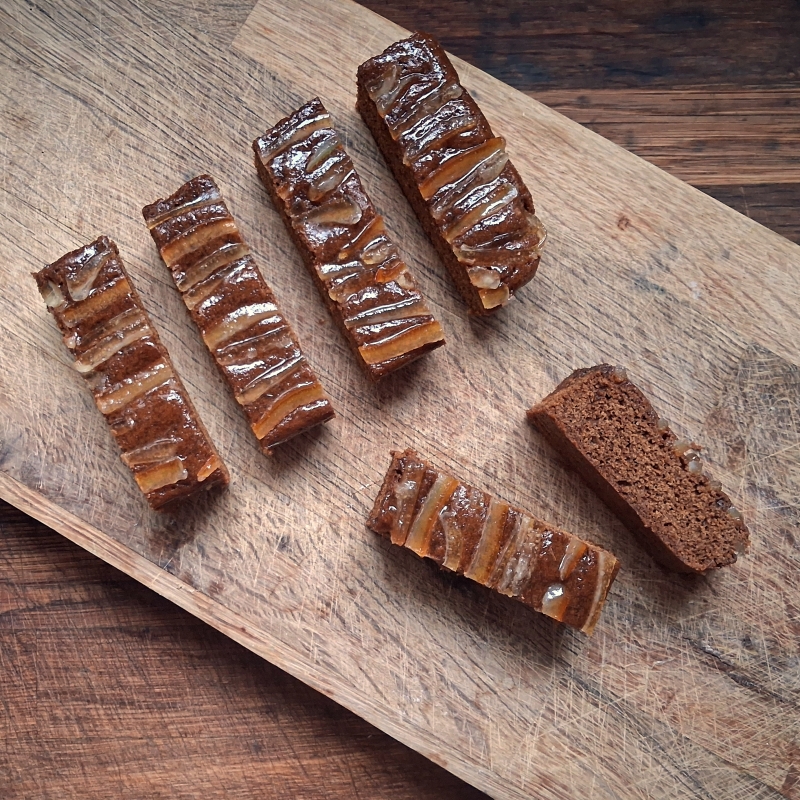
Irish Halloween Treats

There are several Halloween traditions around these isles, but arguably the strongest traditions abide in Ireland.

Several years ago, I discovered online a trove of fascinating Irish social history at the National Folklore Collection. This project is the digitisation of thousands of essays written by Irish schoolchildren and teachers from over 5000 primary schools in the Irish Free State, between the years 1937-1939. These social history essays contain information gleaned from parents and grandparents, and give a fascinating insight into hearth and home stretching back to famine times in the nineteenth century. This amazing resource is searchable on an abundance subjects, but of course the food essays are going to be my main interest.

If you’d like a deep-dive into just how much information is available to explore, my paper “The Boxty Paradox: Everything, Everywhere, All At Once” can be downloaded from the Books and Writing page. One thing that became aparrent during the research of that paper was just how bleak the food choices of so many families were. Consequently, the celebratory foods might seem to us rather plain. However, they can also demonstrate an appreciation for, if not the finer things in life, then life’s simple pleasures.

“Hallowe’en was a great night among the Irish people long ago and they looked forward to it for many weeks. All the boys and girls would gather together in one house and they would have great feasting & merrymaking.”

Collected by Annie Fallon from Mr John Harley, Farmhill, Co. Mayo1

The Halloween/November’s Night/Oidhche Shamhna foods most mentioned are barn brack/bairín breac – a ‘speckled loaf’ originally of caraway seeds, but more recently dried fruit – boxty, apples and nuts.

“In this locality the popular food at Halloween are apples, nuts, and boxty, also dumplings of many kinds.”

Collected by Mrs A. Montgomery from Mrs Kelly, Corr, Co. Cavan2

According to many accounts, the Halloween barn brack was saved up for and bought from a bakery. These cakes were baked containing a ring, and whoever got the piece of cake with the ring was supposed to get married within a year.

“Halloweve night falls on the last night of October. On that day my mother goes to town and she buys apples, nuts and a barn-brack. “

Collected by Jerard Jordan from Mrs Gara, Tivannagh, Co. Roscommon.3

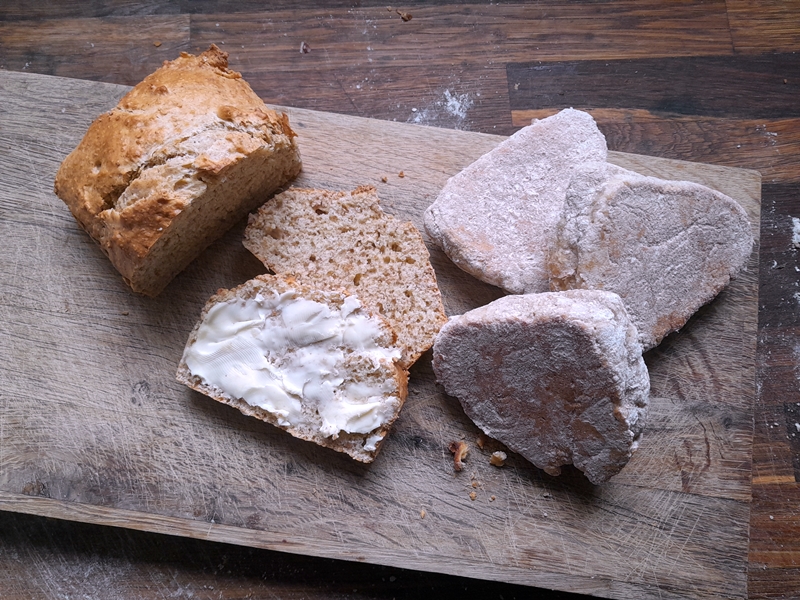
Alternately, during hard times, a soda cake would be baked at home either on the griddle or inside a bastible (lidded pot). The most coveted cake was baked with sour cream, but apples and hazelnuts could also be added.

“apples are put in cakes for November night.”

Collected by Tommy Kelleher from Mrs Margaret Kelleher, Mullaghroe South, Co. Cork4

The cream cake was a soda cake with plenty of cream in it and baked in the griddle.”

Collected by Beití Ní Dhomhnaill from Mrs Ashe, teacher, Dún Beag5

“On special occasions … a cream cake was made. Cream was mixed through the milk when mixing the dough. Currants, sugar and raisins were also put in the cream cake to make it rich and sweet.”

Collected by Seamus Daly, Kilclooney, Co. Waterford6

“On festive occasions a special cake was baked of such ingredients as flour, eggs, sour cream and a little sugar.”

Collected by Mary Jones from Mr M. Jones, Bruree, Co. Limerick7

“… cream cakes were made. These were made thin, but otherwise were made in the same way as ordinary soda cake.”

Collected by Michael Collins, Woodcock Hill, Co. Clare8

The recipes this week are two versions of soda cake mentioned in accounts in The Schools Collection: the cream cake and a fruit cake. According to the written accounts, the cream cake was considered the pinnacle of social delicacies, in numerous accounts warranting special mention. The fruit soda cake has more oblique mentions, but is absolutely symbolic of the foods enjoyed at Halloween. You can, of course, choose to add apples and nuts to the cream cake, if liked.

 Cream Cake

In the 19th century in Ireland, white flour was expensive, so if wheat flour was used at all, in most households it was wholemeal. I’ve opted for a less dense mixture of white and brown. Choose your own variation.

If you’d like to add apples and nuts to your cream cake, use the proportions in the recipe below, and reduce the sugar to 50g.

450g plain flour/wholemeal/brown/mixture
1tsp bicarbonate of soda
1 tsp salt
2 large eggs
85g sugar – caster, light/dark brown – your choice
300ml sour cream
100ml milk

  • Prepare your baking tin(s). You can, of course, bake your soda cake freeform, but a tin is also fine. My tin of preference is a 24cm shallow square tin, but you can also choose smaller tins or indeed choose to bake them in a pan on the ob over medium-low heat. If using a tin, line with baking parchment.
  • Heat the oven to 200°C, 180°C Fan. If using the hob, put a non-stick pan over medium-low heat (4 on a 1-9 scale) and allow to heat thoroughly.
  • Put the flour(s), soda, salt, sugar and eggs into a food processor and blitz briefly until well combined.
  • Tip the mixture into a large bowl.
  • Mix the milk and cream together until smooth, then add to the dry ingredients bit by bit. NB You might not need all of the milk mixture, as it will depend on the amount of moisture already in the flour and eggs. You want a soft dough, so a little extra is fine, but not enough moisture will lead to a dense loaf too stiff to rise.
  • When your dough is fully combined, tip out onto a floured surface.
    • For soda farls to cook on the hob, divide the dough into two, and lightly shape each half into rounds. Gently pat down until 4cm in height. Using a dough scraper or similar, cut each round into six or eight triangles.
    • For a large loaf, shape into a round and transfer to your prepared tin. Cut a deep cross in the top to assist in even cooking. If you have any of the cream mixture left, you can brush it over the top of your loaf as a glaze.
  • To cook your cream cake(s)
    • For a large loaf, bake for 45-50 minutes, turning the oven half-way through to ensure even baking.
    • For cream farls, bake gently in your pan for around 10 minutes each side, turning carefully when the first side is toasted and lightly browned.
  • Cool briefy on a wire rack and serve warm with plenty of good butter.

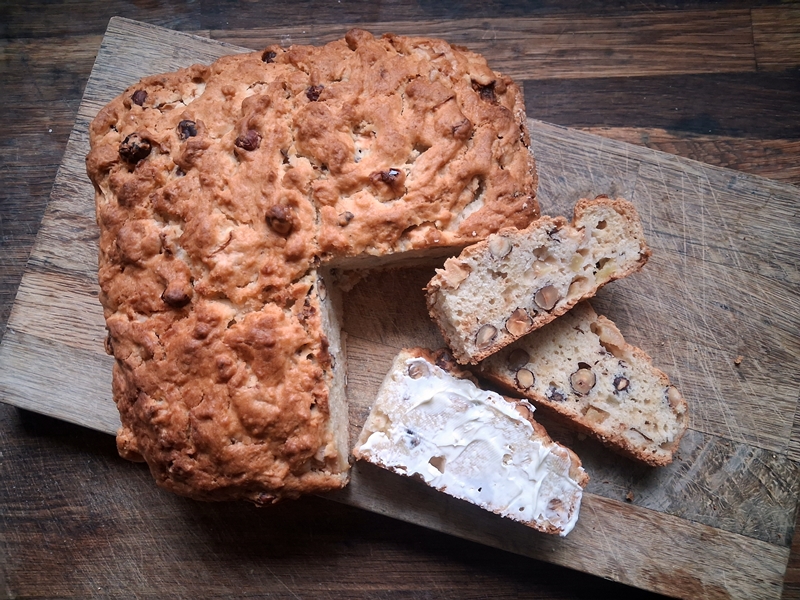
Apple and Hazelnut Soda Cake

Apples and nuts were central to the feasting at Halloween and this sweet soda cake is rich with both kinds of autumnal bounty. Enjoy warm from the oven or toasted, with a generous spreading of good butter. I’ve chosen to use Bramley cooking apples, as they break down into fluff when cooked.

100g whole unblanched hazelnuts
450g plain flour
1tsp bicarbonate of soda
1 tsp salt
50g sugar – caster, granulated, Demerera, light/dark brown – your choice
2 Bramley Apples – or 500-600g of similar cooking/sharp apples
200ml plain yogurt
200ml whole milk

  • Prepare your baking tin. My tin of preference is a 24cm shallow square tin. Line with baking parchment.
  • Heat the oven to 200°C, 180°C Fan.
  • Put the hazelnuts onto a baking tin and bake for 10 minutes until lightly browned and toasty. You can remove the skins by rubbing the nuts in a clean cloth, but I prefer to leave them as is.
  • Put the flour, salt, sugar and soda into a bowl and whisk together.
  • Peel and core your apples, and chop into 2cm pieces. Add the chopped apple and nuts to your dry ingredients and mix.
  • Whisk together the yogurt and milk, then gradually add to the rest of the ingredients. I find it best to stir the liquid through with a round-ended knife, which is less rough than a larger utensil. You might not need all of the liquid as the apples will contribute to the moisture of the mix.
  • Tip out your dough and shape lightly into a round. Transfer the dough to your baking tin, and cut a deep cross in the top to facilitate even baking.
  • Bake for 50-60 minutes until risen and browned, turning the tin around after 30 minutes.
  • Cool briefly on a wire rack and enjoy warm or toasted with lots of good butter.

1 The Schools’ Collection, Volume 0096, Page 84
2The Schools’ Collection, Volume 0982, Page 233
3 The Schools’ Collection, Volume 0234, Page 307
4 The Schools’ Collection, Volume 0359, Page 144.
5 The Schools’ Collection, Volume 0626, Page 350.
6 The Schools’ Collection, Volume 0654, Page 447.
7The Schools’ Collection, Volume 0498, Page 131
8 The Schools’ Collection, Volume 0598, Page 249

Griddle Scones

Following on from the Slapan last time, I have another bakestone recipe for you – Griddle Scones!

I love a scone. I willfully and shamelessly pronounce it ‘skon’ too – even though I know the etymology dictates that it should rightfully be pronounced ‘sk-ohhh-n’, because that brings images to mind of little finger outstretched and pretensions of grandeur, so I just prefer the short, humble sound of ‘skon’. Fight me.

Traditional scones are absolutely the easiest and best thing to whip up when presented with an Entertaining Emergency™. You can be serving up a batch of fragrant and hot scones in about 30 minutes – and that includes 15 minutes of baking!

Griddle scones are not that kind of scone – the time required is closer to 3.5 hours, start to finish. “Why would I bother waiting around for all that time when I can have some oven scones in just 30 minutes?” I hear you ask. I’m afraid I have no quick response, but for the fact that if you were to make these, you would then have your answer.

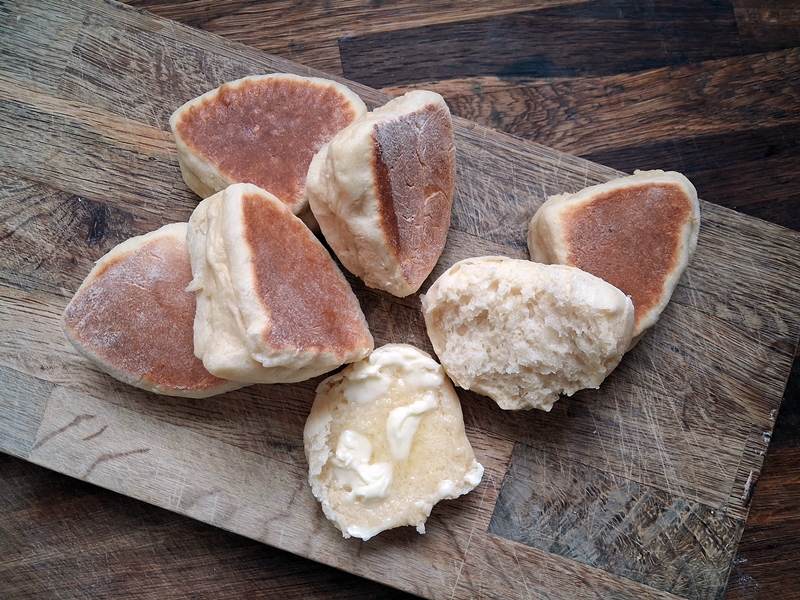
So do you like eating soft, billowy clouds? Because making griddle scones is how you get to eat sweet, billowy, buttery clouds. The yeast dough is enriched with double-strength milk, butter, eggs and sugar, and therefore it requires much longer to prove – 2 hours in the first instance. So while it’s a relatively long time, it’s not a hands-on commitment. The second rise can be up to an hour, but I recommend starting cooking half the dough after about 40 minutes – mainly because if, like me, you don’t actually possess a griddle, but do possess a rather nice non-stick pan, you can cook the first half of the dough easily, with plenty of room for manoeuvering the scones when turning them over. I have tried cooking the whole dough all at once, and it was very tricksy – plus the scones expand upwards quite considerably during baking, which was also not helpful in a confined pan space.

If you’re a fan of muffins then, aside from the extended rising time, this method is pretty much the same, but with one subtle difference. The enrichments of butter, sugar and egg mean that the cooked dough remains incredibly soft. Even when browned, the outsides of these scones never approaches anything remotely close to crusty. The sides of the scones are particularly delicate, and as supple as skin. In enjoying them, we must be mindful of Hannah Glasse’s advice when referring to muffins, in that they must be split/pulled apart, for to use a knife on them when hot, is to squish down the cloud of dough to something claggy and leaden. The best approach I have found is to use a serrated knife to just break the skin of the scone on the sides, then use the tines of two forks to pull the scones apart. You don’t have to use forks, of course, you can just pull them apart – but I must be lacking a bit of skill there, because I always seem to end up with one pillowy side and one thin and somewhat meagre side, and thus reduce the overall eating experience by half.

Griddle scones go back to the 19th century, but this recipe is scaled down and adapted from an absolute classic of griddle/bakestone cookery, “Morning and Hot Plate Goods” by John Boyd (undated, but thought to be 1946-ish) – a veritable cornucopia of commercial recipes from the offices of The British Baker. He calls them fermented scones, but I’ve opted for the more easily understood Griddle Scones.

Griddle Scones

This recipe has the unusual ingredient of ‘double strength’ milk, which is water mixed with twice the usual quantity of milk powder. I use whole milk powder, because that’s what I have in the cupboard, but skimmed milk powder, which might be easier to find, would be fine as well.

145ml water
30g whole milk powder
scant ½ tsp salt
45g unsalted butter
45g caster sugar
1 large egg – beaten
260g plain flour
1 sachet fast action yeast

  • Put the water, milk powder, salt, butter and sugar in a small saucepan and stir over low heat until the butter melts and the sugar is dissolved. Cool to blood temperature, whisk in the egg, then pour into a bowl. Add the remaining ingredients to the bowl and stir until combined. The dough will be very soft and moist.
  • Cover the bowl with plastic, or a cloth, and set aside to rise for 2 hours.
  • Gently tip out the dough onto a floured surface and divide it into two (roughly 270g each). Shape each half into a circle, and pat down gently until it is 2-3cm thick.
  • Using a dough scraper or similar, cut each round into triangular farls. These can be as few as four or as many as eight.
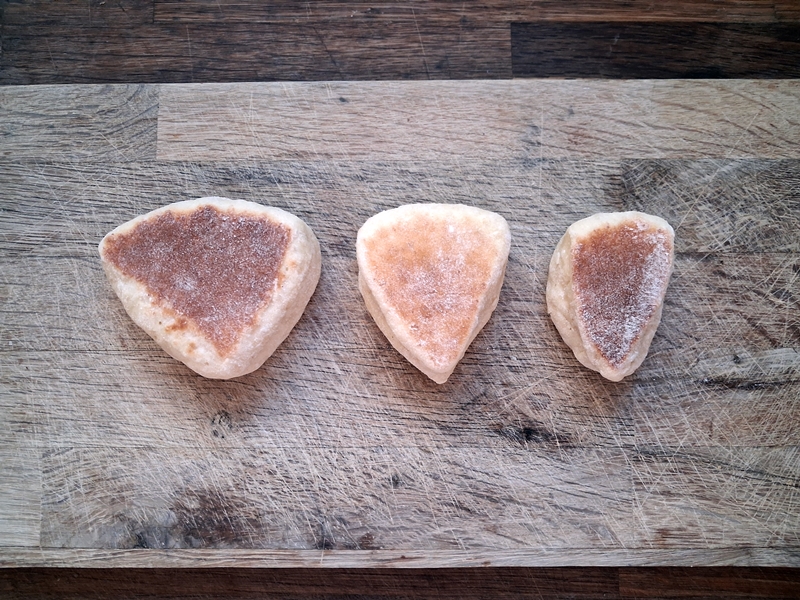
    The sizes of scone you get whether cutting your round into (L->R) four, six or eight.

    I think six farls is probably the happy medium, unless you’re serving teeny scones for afternoon tea, in which case go with the eight.

  • Slide the farls apart from one another, so that they have room to rise, and cover lightly with a cloth.
  • Leave to rise for 30-40 minutes.
  • Put a non-stick pan on medium-low heat (4 on my hob) and allow it to heat through. This will take about 5 minutes. You want the pan to be evenly hot throughout, otherwise your scones will cook unevenly. No need to grease the pan.
  • Cook your first batch of scones. NB: As you move each scone into the pan TURN IT OVER and cook the top first. By cooking the rounded, risen ‘top’ first, and the already-flat bottom second, your scones will have a much neater shape. Not turning them over will make your finished scones rather misshapen. Still delicious, but not at their best to look at. Spread them out, avoiding the centre of the pan as it will be the hottest. Cook for 4-5 minutes until browned on the bottom, then carefully turn them over and cook until both sides are evenly coloured. Don’t worry if you turned them too early, you can flip them again once the second side is done.They will continue to rise with the heat of the pan, and will become almost wobbly, so try and turn them over in one fluid motion and then don’t touch them until they have cooked for a further four minutes. To check for done-ness, lightly rest a finger on the top of a scone and try to move it gently from side to side: if there’s no longer any wobble, the scone is cooked.  
  • Cool on a wire rack.
  • To serve: If not eating immediately, when time to serve, warm the scones in the oven. Use a serrated knife to break the ‘skin’ on the sides of each scone, then pull apart either by hand or by using the tines of two forks. Butter generously and enjoy.

Slapan

I’ve been reading a lot of bakestone recipes lately, and, spoiler alert, if you like Welsh Cakes, then this recipe is about to become your new favourite.

This recipe comes from a small but delightful mid-20th century recipe book. “Croeso Cymreig: A Welsh Welcome”, originally published by the Wales Gas Board in the 1950s (mine is from 1957). I’ve seen a couple of editions on the second hand market (AbeBooks) for about £20, but more modern editions seem available for as little as £3. These newer editions are published by Gwasg Dinefwr Press or John Jones Press under the title “Recipes from Wales – 113 Traditional Welsh Recipes”. Alternatively, you can view a copy online for free at Archive.com

One of the reasons why I like this book is that it includes several variations of the same recipe. Some of them have different cooking methods too, for example, there are three Teisen Lap (‘moist cake’) recipes that can be cooked in an oven, in a Dutch oven in front of the fire, or on a griddle.

Slapan originates in North Wales. The book contains two Slapan recipes – ordinary Slapan, and Slapan Sir Fon (Anglesey Slapan). The difference between the two seems to be that Slapan is made with mixed fruit, and Slapan Sir Fon is made with currants only. Doing some more reading, I found a third version – Slapan Dafydd (Saint David’s Slapan) – which is made with sultanas only.

There are subtle variations in both the liquid used (milk/buttermilk) and leavening agents (baking powder, bicarbonate of soda, and also a little of both), but essentially it is the same method for all: rub the butter into the flour, add the rest of the ingredients and bring together into a soft dough with the eggs and liquid. Spoonfuls of the dough are then cooked on a bakestone, turning halfway through. An important aspect of the appeal of these teatime dainties is the speed with which they can be brought to the table – not much more than 30 minutes from start to finish. Perfect for when company drops by unexpectedly.

Taste

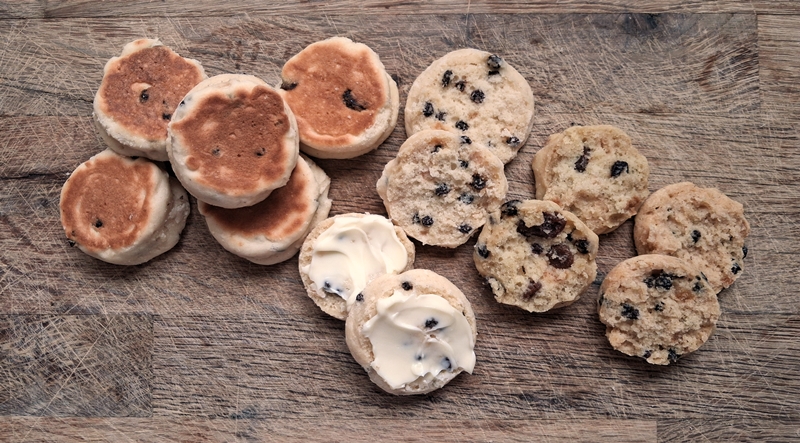
So what are they like to eat? Really delicious, actually. I mentioned above that Slapan are similar to Welsh Cakes, and they are, but without any of the spicing of the latter. Also in contrast, they are very light. With all the love in the world, even Welsh Cake devotees must admit they’re decidedly firm in texture. The texture of Slapan is much closer to a scone, or a muffin, but decadently rich with butter. They are not overly sweet, the dried fruit contributing a lot, so there is relatively little sugar added. Slapan are best served warm from the pan, split and generously buttered. Crisp outsides give way to a soft, cake-like centre, and with lashings of delicious butter melting inside, it’s a surprisingly rich treat.

Equipment

You don’t need a bakestone to cook your Slapan, a non-stick pan and a heat source with serve just fine. Slapan are baked, not fried, so there is no need to grease the pan. The traditional method is to spoon the mixture onto the bakestone using two spoons, but I found my small ice-cream scoop² much easier to use, in addition to making small, delightful 2-bite Slapan.

Slapan

Each batch makes approximately 12 Slapan. If you’re using gluten-free flour, then you may need to add extra flour (see note below).

120g plain flour/gluten-free flour³
60g chilled butter – cubed
20g sugar (caster or soft brown)
¼ tsp salt
scant ½ tsp baking powder
30-50g mixed dried fruit/currants/sultanas
1 large egg
2-ish tbs milk

  • Put a non-stick pan onto a medium (number 5 on my 1-9 electric hob) heat and let it come to temperature while you mix up the dough. if you’re using gluten-free  flour, you should delay this until the mixture half-rested.
  • Put the flour, butter, sugar, salt and baking powder into the bowl of a food processor and blitz until the mixture resembles breadcrumbs.
  • Crack the egg into a mixing bowl and add milk for a total of 90ml of liquid. Whisk together well (I use a stick blender), then add the flour mixture and dried fruit.
  • Fold together until the mixture forms a smooth-ish dough. The consistency should be like that of a fruit cake, or mashed potatoes. Definitely too soft to roll out.
  • Using a small ice-cream scoop, or two spoons, drop the dough into the now hot pan. Drop them around the edge, rather than the middle, so that they don’t scorch. Cooking them all at once will make it tricky to turn over, so do two batches of six or seven.
  • Bake for 5 minutes. A light crust will form on the bottom of each heap.
  • Using two cocktail sticks, carefully turn each Slapan over.
  • Bake for a further 3-4 minutes until the underside is as browned as the top.
  • Cool on a wire rack.
  • Split, butter and serve warm.

Bonus Recipe: Christmas Slapan

Here’s my own take on a Slapan variation, seen top right in the photo – with the addition of candied peel, mixed spice and a splash of booze. Much quicker to rustle up than mince pies.

120g plain flour/gluten-free flour³
60g chilled butter – cubed
20g soft brown sugar
¼ tsp salt
scant ½ tsp baking powder
½ tsp mixed spice
15g candied lemon and orange peel, finely chopped
15g dried cranberries or barberries
20g dried currants
1 large egg
1 tbs brandy
1 tbs cream sherry/madeira

  • Method as above.

¹ You need to sign up to be able to borrow books, but it is free, no strings attached.

² A small ice-cream scoop of 4cm diameter, roughly 30ml volume.

³ I’ve made this recipe with two different gluten-free flours. Schar’s Baking/Patisserie flour (red bag) contains a thickener (guar gum), and so the recipe took the same quantity of flour as regular flour. Dove’s Farm Freee gluten-free flour contains no thickener, and they recommend adding xantham gum when using. I didn’t have any, so I ended up adding more flour (60g in 2 batches of 30g) and allowed it to sit a while (20 minutes) to allow the excess liquid to be absorbed.

Improving Strawberries

On a recent holiday in France I had some wonderful strawberries: heady, aromatic and bursting with flavour.¹

Still a bit mesmerised, two punnets of strawberries were one of the first things I bought when we got back. Alas, compared to the French ones, they were decidedly underwhelming. I know it’s late in the season for strawberries, but even so, a great disappointment.

Since we now have the luxury of strawberries year-round, I thought I’d bring you this method of not only rescuing below-par strawberries, but also demonstrating how you can use them in a couple of recipes, as well as enjoying them in their new and improved, glow-up form.

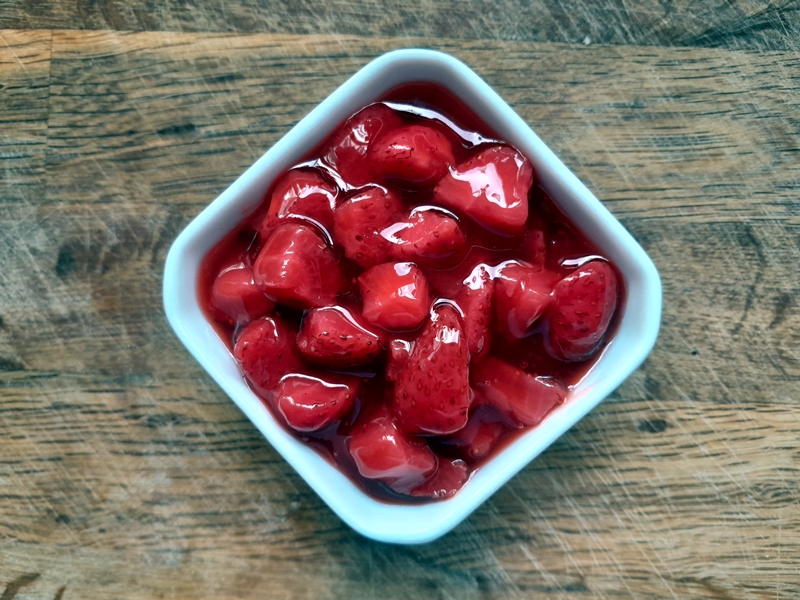
The method is very simple, too. Cut up your strawberries and sprinkle them with a little sugar – NOT icing sugar, because it contains an anti-caking agent. Use white caster or granulated. The sugar will gradually draw out the juices from the strawberries, which will in turn absorb some of the sugar.

You can enjoy them as is, and luxuriate in their much improved flavour, or you can use them in other things. Below I have two suggestions – a strawberry scone and in a mille feuille made from stale croissants.

To Confit strawberries

I’ve gone back and forth quite a bit to come up with a term for this method and, to be honest, I’m not entirely happy with ‘confit’, because to confit something generally involves the use of heat to cook the items, which this patently doesn’t. However ‘macerating’ wasn’y really suitable either, because that involves adding liquid, and here the liquid comes from the fruit itself. If someone can find a word that fits better, do please leave a comment.

strawberries
caster or granulated sugar – 1tbs per 100g strawberries

  • Remove the green stalks and leaves from the strawberries and cut each one into 6-8 pieces, depending on size.
  • Put the cut strawberries into a bowl and sprinkle over the sugar.
  • Turn the berries over gently so that the sugar is distributed evenly.
  • Cover with plastic and set somewhere cool. I prefer to keep them at room temperature rather than chilled, at least in the initial stages as I believe it produces a better overall flavour, but keep in the fridge if you prefer.
  • Gently stir occasionally.
  • Allow your strawberries to macerate for up to 24 hours. The longer you leave them, the more juice will be drawn out. After about 24 hours, the  strawberries will be practically floating in a light syrup and their flavour will be deliciously intense.
  • You can choose when to eat/use your strawberries. For the two recipes below I used berries that had been macerating for 24 hours.

Strawberry Scones

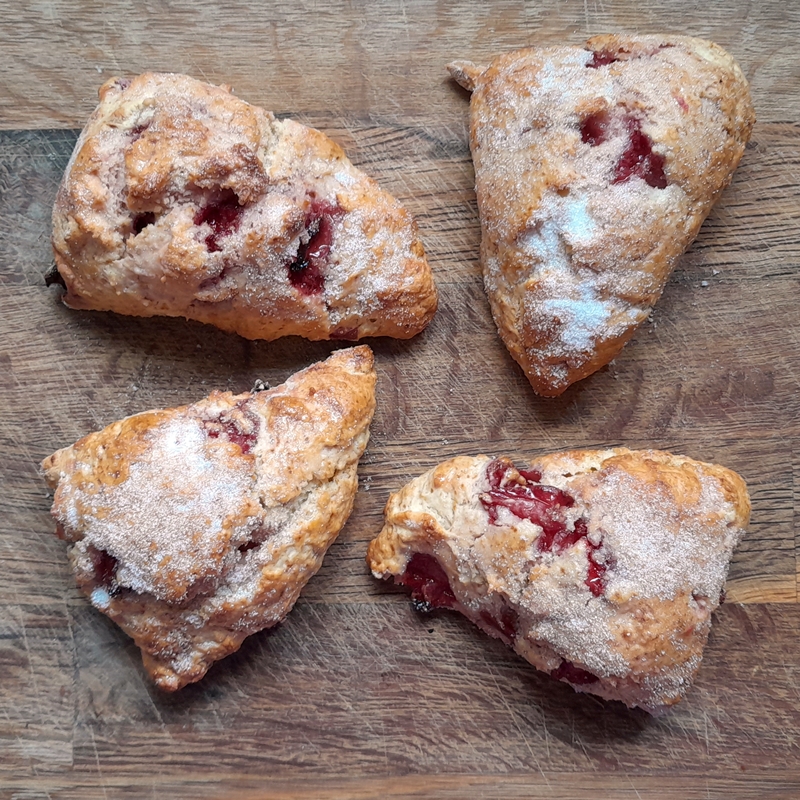
Fresh strawberries release too much juice to be included in regular scones, but by using confit strawberries, you can get all the concentrated flavour and still maintain the integrity of your scones. This recipe is based on that of Mrs McNab (19thC farmer’s wife from Ballater, Scotland – see Great British Bakes). It makes 8 scones. It is deliberately unsweetened, as I believe the plainness of the scone dough highlights the flavour of the strawberry pieces much better than a sweet dough. You might disagree, and that’s fine. You can add 30g of sugar to the mixture before baking if you like, or sprinkle some sugar over the hot scones after baking (as in the picture).

225g plain flour
2tsp baking powder, or 1 tsp cream of tartar, ½ tsp bicarbonate of soda.
½ tsp salt
30g unsalted butter
1 large egg
60ml plain yogurt
60ml milk

100g drained, confit strawberries.

Milk for glazing
sugar to sprinkle (optional)

  • Heat the oven to 220°C, 200°C Fan.
  • Put the flour, powder(s), salt, butter, sugar if using, and egg into the bowl of a food processor fitted with a blade and blitz until the mixture resembles breadcrumbs.
  • Tip the mixture into a bowl.
  • Add the drained strawberries and fold in.
  • Mix the yogurt and milk together until smooth.
  • Fold in the yogurt mixture little by little, ideally with a round-ended knife. NB Do NOT slosh it in all at once. You may not need all of the liquid, especially if the strawberries are juicy. You want just enough liquid to bring the dough together.
  • NB The faster you do the shaping/cutting/getting the scones in the oven, the more they will rise.
  • Turn the dough out onto a floured surface and pat into a circle about 4cm thick. NB Don’t roll it with a rolling pin, you’ll just squash out all the lift from the raising agents.
  • Using a dough scraper or thin-bladed knife, cut the disk of dough into eight triangles. They will look small, but they will rise splendidly in the oven.
  • Transfer the triangles to a parchment covered baking sheet and brush over with milk to glaze.
  • Bake for 15 minutes, turning the baking sheet around after 10 minutes to ensure even colouring.
  • Remove from the oven and sprinkle caster sugar over the hot scones if liked.
  • Transfer to a wire rack to cool.
  • Enjoy warm as is, or with butter or cream.

Strawberry Croissant Mille Feuille

You know when you have stale croissants lying around?

*crickets*

Of course not. No-one does.

HOWEVER!

The thought “What if…” did cross my mind over the aforementioned holidays, and that led me to thinking about how they might be used in a new and exciting way. The idea is related to the puff pastry more traditionally used insofar as I brought back some delicious French butter with the intention of making a batch, and now I’m procrastinating like mad because, although delicious, it’s SUCH A FAFF™! Bonus: You can use gluten-free croissants (Schar is one brand I have tried – find them in the freezer section of your local supermarket).

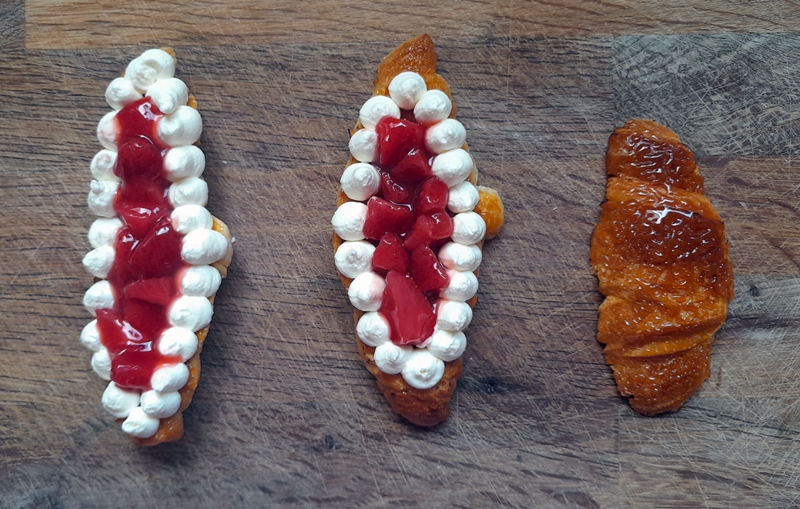
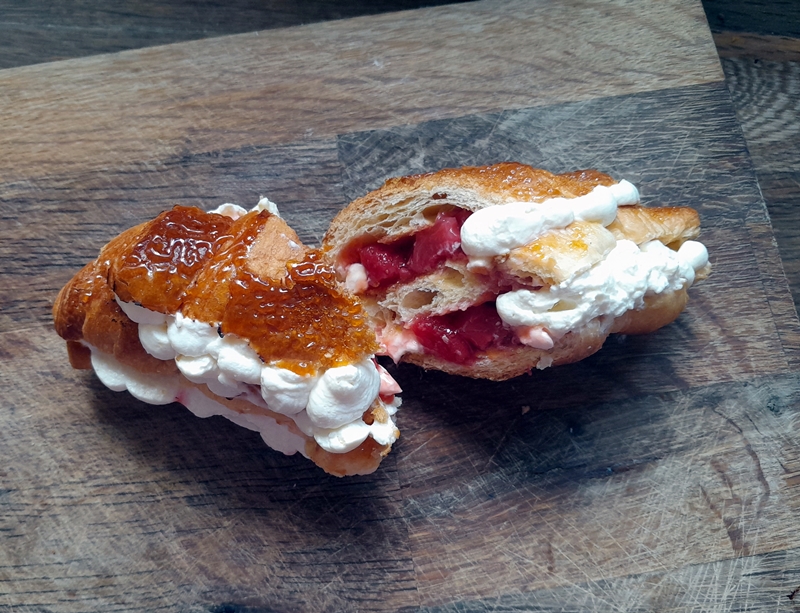
Using a croissant reduces the Faff to almost non-existant levels and provides another opportunity to use the strawberries prepares above – this time using the juice as well. Slicing, toasting and then bruléeing the croissants will give both crunch and shine. The last two things needed for our croissant mille feuille are Brulée Sugar and some whipped cream.

To thicken liquid with Arrowroot

Why arrowroot, you may be asking? Well, it thickens and turns clear when heated, but unlike cornflour, when cooled it does not go ‘gloopy’ as such, rather it forms a loose jelly-like texture that clings wonderfully to the fruit (see top photo) making it bright and glossy, and doesn’t form a skin.

For each 80ml of liquid/syrup, use 1tsp arrowroot, or 1 tablespoon per 250ml.

  • Mix your arrowroot with an equal quantity of cold water until smooth.
  • Add the arrowroot slurry to your syrup and heat gently, stirring all the while.
  • NB Do not boil the mixture. High heat will break down the thickening properties. Remove from the heat when thickened and clear.
  • Stir in your strawberries and chill until required.

To Assemble

  • Slice your croissant(s) into three, horizontally.
  • Toast the slices lightly on both sides. Be careful, they will take less time to toast than regular bread, due to the higher fat content.
  • Dust the slices thickly with brulée sugar, then either grill them or use a blow torch to melt the sugar. The sugar will melt quickly, so keep an eye. Allow to cool, so that the sugar hardens.

  • To serve: pipe a rim of cream around the edge of the bottom two layers, and fill the middle with your strawberries in thickened juice.

  • Stack the layers together and serve.

¹ From the Calais Cité Europe Carrefour near the Tunnel, which I can highly recommend for all those last minute foodie purchases on your way home. If you’re interested in growing your own, the variety I recommend is Charlotte.

Ouse Bridge Cakes

I love coming across a geographically-named recipe. It gives a place and time in which to ground the dish: Grasmere Gingerbread, Cornish Pasties, Chelsea Buns.

Almost better yet, is discovering a recipe that is also unknown today, having gone out of fashion or due to some other circumstance. Such is Ouse Bridge Cakes.

There’s practically no information available about these bakes. In “The Gentlewoman’s Kitchen” (1984), Peter Brears suggests Ouse Bridge Cakes are a yeast dough flavoured with mace, cloves and nutmeg and mixed with sugar and milk. In his book “Secret York” (2014), author Paul Chrystal writes:

“Ouse Bridge Cakes, known in the eighteenth century, a type of Yorkshire tea cake.”

And that’s pretty much it. Not much to go on at all.

Luckily, in my scouring of old manuscripts, I have turned up five, different, eighteenth-century Ouse Bridge Cake recipes. I reasoned that, within their pages lay an understanding of what constituted the original Ouse Bridge Cakes.

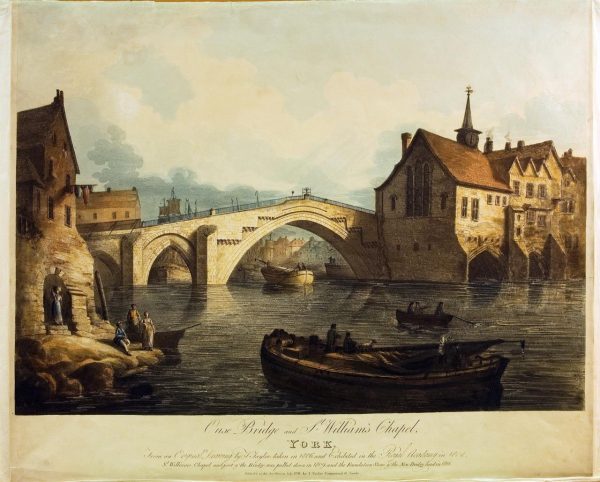
But first, a little history. The bridge over the River Ouse that this recipe refers refers to is in the city of York. Although there have been many bridges over the centuries, it is the fourth Ouse Bridge (1565–1810) which has been commemorated in these buns.

Old Ouse Bridge from the South. T.Taylor, 1806.

Just as with many city bridges of the time, the Ouse bridge was heavily built-up, its five arches supporting substantial buildings on both sides of it’s towering centre arch.

Old Ouse Bridge from the North. Attrib. Henry Cave (British 1779-1836)

With all this busyness on the bridge, it is likely that there were businesses too, and if not a baker’s shop, then almost certainly a stall or street hawkers. Just as Wood Street Cake (see Great British Bakes) took its name from the London street where it was made, Ouse Bridge Cakes take theirs from the place where they could be bought, if not actually baked.

As already mentioned, Ouse Bridge cakes were a spiced bun. But seeing as Yorkshire has quite a reputation for similar items – the most well-known being the Yorkshire Teacake (as with all tea cakes, best eaten toasted and buttered) – it occurred to me that there must be something to distinguish the Ouse Bridge cake from a host of other buns, and that something was probably its shape. A bun of a particular shape is instantly recognisabe – just look at modern Chelsea Buns and their square, spiralled form (which isn’t the original shape – but don’t get me started, see Great British Bakes (again)).

Luckily, there were two of the five recipes (yes, remember them? Back before the detour?) that held clues. The first was in a manuscrpt dating from the mid-eighteenth century, which suggested the dough be weighed out into 8oz (225g) pieces before being shaped.

Ouse Bridge Cakes recipe, MS3498, (1750-1900) Wellcome Collection.

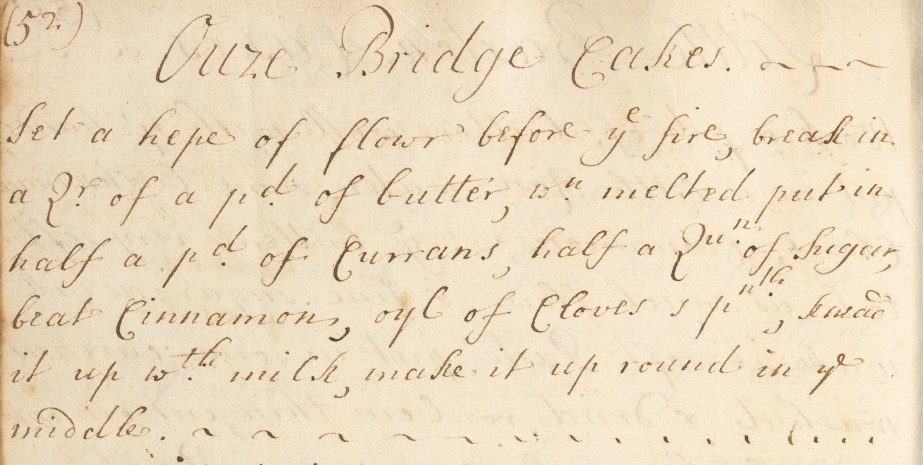
The second piece of information was from a manuscript dated 1750, the last line of which reads “make it up round in ye middle”.

Ouse Bridge Cakes recipe from MS4645, (1750-1853), Wellcome Collection.

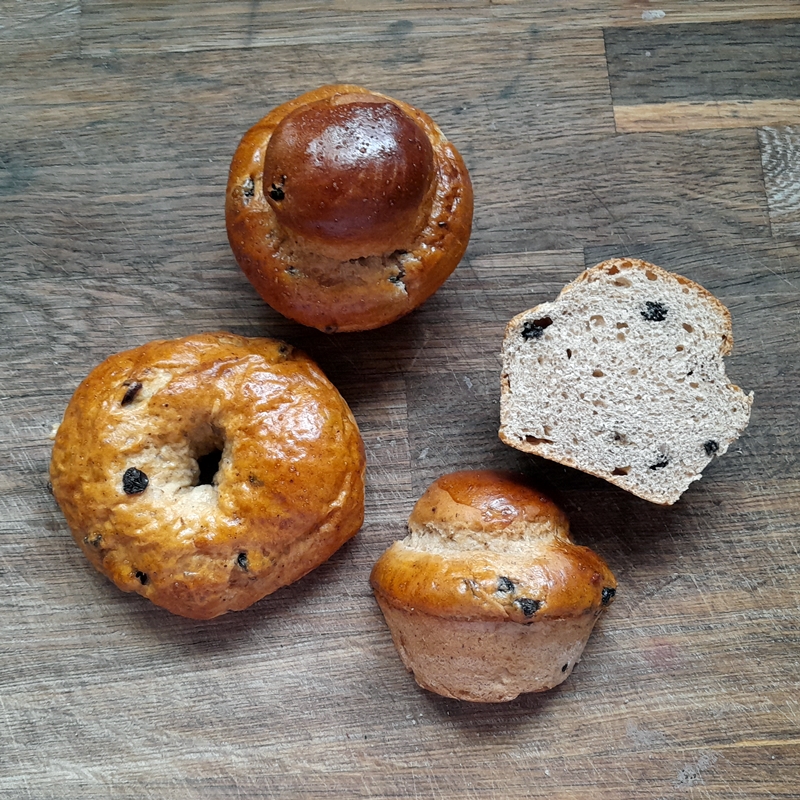
I spent a lot of time thinking about this, and decided it meant to shape it like a bagel/ring donut. I also asked online, and the feedback was that it might mean something cottage-loaf-esque, so I experimented with both shapes. I still think the ‘hole in the middle’ is a better fit for the description, but until more recipes are rediscovered, the jury will have to remain resolutely out.

Of course, it might well be that none of these five recipes are the definitive, perfect Ouse Bridge Cakes. Back in the day, even the moderately wealthy (such as the authors of these manuscripts) didn’t necessarily bake for themselves: practically everyone bought their bread from a baker. The recipes that we find in manuscripts are attempts to copy, on a smaller scale, something enjoyed elsewhere, so that they can be enjoyed in their own homes. The five recipes in the manuscripts were all different, yet there were some uniting features, as each author tried to recreate something they had only tasted. Firstly, all of them had currants, ranging from a spartan few ounces to almost half the total weight of the ingredients. All of them were flavoured with spices (nutmeg, cinnamon, cloves, ginger, mace),  but nutmeg was a common denominator amongst all five. All of them were enriched with milk and either butter or cream, and most had added sugar.

The recipe below is very much a Goldilocks version of them all. Neither too much nor too little of everything, because recipe testing revealed certain flaws in the versions that veered towards the extreme. The overly-fruited buns were heavy and close textured, and those buns with generous/excessive additions of butter and cream were reluctant to rise, with a rather greasy taste.

This version is moderately fruited, moderatly enriched and moderately spiced. Delicious warm from the oven, and even more so toasted, with slabs of cold, mature Cheddar cheese (it’s a taste sensation!).

Ouse Bridge Cakes

Each bun is formed from a generous 75g of dough, and I have scaled the quantities down to make a very modest seven buns per batch. Feel free to double the recipe as you see fit. The spicing is just a suggestion: change things up if you have a favourite mix.

225g flour
1 sachet fast-action yeast.
180ml milk
15g sugar
30g unsalted butter
60g currants
1 tsp ground ginger
1 tsp ground nutmeg
½ tsp ground cloves
½ tsp ground mace
1 large egg for glazing

  • Put the milk, sugar and butter in a pan and scald. IMPORTANT Scalding is when the milk almost boils, but not quite. Heat it until it bubbles around the edges (or in the middle if you have an induction hob), then remove from the heat and allow to cool down. Scalding milk breaks down the proteins, which will allow your buns to remain soft and yielding, even when cold. Using 100% unscalded milk in a dough recipe can lead to heaviness.
  • When the milk mixture has cooled to blood temperature, pour it into your mixing bowl.
  • Sift the flour, yeast and spices together and add to the milk mixture.
  • Knead the mixture by hand or on the lowest possible speed on your stand mixer for 10 minutes. increase speed to high for up to 2 minutes, or until the mixture comes together in a clean ball.
  • Add the currants and fold them in.
  • Cover the bowl with cling film. The milk, butter and sugar will make the dough slower to rise that a regular dough, so allow at least 90 minutes or until the dough has doubled in size.
  • Tip out the dough and divide into seven pieces, each of roughly 75 grams. There’s no need to get all aggressive and start punching it: it will naturally deflate with the turning out.
  • Shape the dough as you see fit. In addition to the two shapes mentioned above, you can also shape them into a regular teacake shape. NB: If you’re going for the cottage loaf shape, I recommend baking the shaped dough in cupcake tins, which really lets the dough ‘sit up’ and hold it’s shape. I used silicone baking trays rather than metal, to keep the dough from forming too crusty an outside.
  • Set aside to rise for 40 minutes.
  • When the dough has risen, whisk the egg and brush over the buns with a pastry brush.
  • Heat the oven to 180°C, 160°C Fan.
  • Bake the buns for 20 minutes, turning the baking trays/sheets after 10 minutes to ensure even baking.
  • When cooked and golden brown, transfer to a wire rack to cool.
  • Store in an airtight container at room temperature.

Marble Cake

Marble Cake can be considered a classic British cake, still enjoyed by many all over the country. To my mind, however, it has always seemed less marble-y and more blobby, in that the big dollops of (usually) vanilla and chocolate cake batters are frequently only half-heartedly stirred together.

Well, as we all know, there’s nothing new under the sun and just over 100 years ago, Frederick T. Vine was thinking just the same thing. In his 1908 commercial baking book “Cakes and How To Make Them”, he has entries for several different marble cakes, whether by design or whether he forgot he’d already included some in the front of the book and just bunged a couple more in later on, we don’t know. His suggestions are obviously geared towards commercial bakeries turning out dozens of different cakes, as he initially suggests taking quantities of mixtures that are probably prepared on a daily basis and combining them into marble cakes a lot more colourfully than we do today.

  • Marble Cake No.1: 1 batch of Silver Cake, divided, half coloured pink, half left white, 1 batch Spice Cake, 2 batches Gold Cake.
  • Marble Cake No 2: 1 batch Silver Cake, divided: ¼ coloured pink, ¼ coloured brown with cocoa, ½ left white.
  • Marble Cake No 3: ‘White Part’ made with egg-whites, ‘Dark Part’ made with yolks, treacle, cinnamon and dark brown sugar.
  • Marble Cake No. 4: Silver Cake, with coloured and flavoured milk.

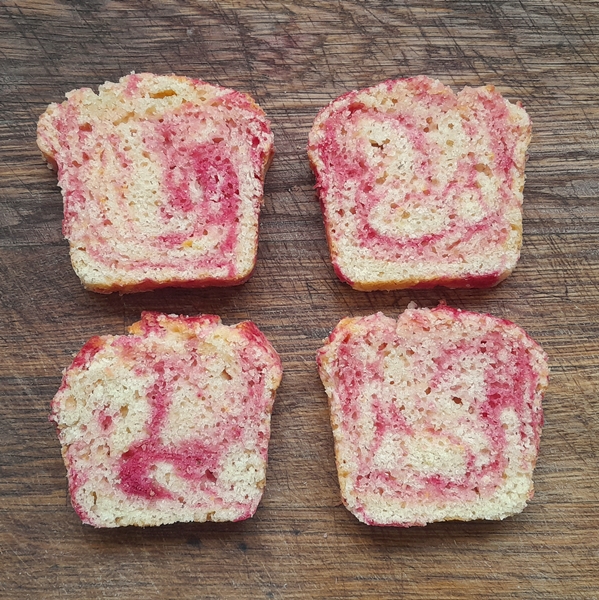
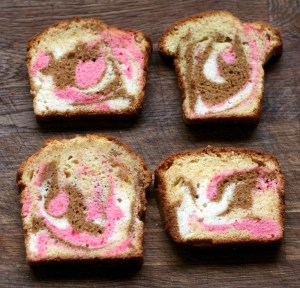
I tried a version of Marble Cake No. 1 some time ago, in a variety of loaf tins (see image below), and it certainly made a very jolly and colourful cake. However, if I’m being honest, it was still rather on the blobby side. So trying the ‘coloured milk’ method has been on the ToDo List ever since, and here we are.

4 slices of Fred Vine's four-colour marble cake

The original recipe did not call for any flavouring, aside from some brandy, so after a couple of trials I decided that a better approach was to flavour both the cake and the milk. I chose to flavour the cake with lemon and the milk with raspberry, to both preserve the paleness of the Silver Cake, and to make the milk complementary in flavour and contrasting in colour. You can, of course, choose any combination that appeals.

Using coloured/flavoured milk for the contrast allows for a much more delicate pattern to be achieved, and although a little fiddly in the construction, the results are very pleasing. The fine lines of red are a much more accurate depicion of the patterns in marble, and these are interspersed with the strong patches of colour/flavour where the milk has pooled between the spoonfuls of cake batter, almost a raspberry ‘ripple’ effect.

Marble Cake

I baked this Silver Cake mixture in mini loaf tins, but you could also use larger or smaller loaf tins and adjust the baking time accordingly.

115g unsalted butter, softened
140g caster sugar
140 egg whites
30ml brandy
zest of 1 large lemon
190g plain flour
60g cornflour
1tsp cream of tartar
½tsp bicarbonate of soda
milk (maybe)

60ml whole milk
raspberry flavouring
claret/raspberry colouring

  • Grease and line 3 mini loaf tins (16cm x 9 cm x 5cm) with baking parchment.
  • Heat the oven to 180°C, 160°C Fan.
  • Mix the colour and flavouring into the milk. You want both to be strong, in order to be able to see and taste them in the baked cake.
  • Whisk the softened butter until light and creamy.
  • Add the sugar and whisk until pale and fluffy
  • Add the eggwhites and mix thoroughly.
  • Mix in the brandy and the lemon zest.
  • Sift the remaining dry ingredients together, and gradually mix into the wet ingredients.
  • If the mixture seems a little tight, mix through some milk until you achieve a dropping consistency.
  • Spoon the mixture into the bottom of each tin in shallow blobs. Brush over the flavoured milk. There should be no uncoloured cake mixture. The excess milk will pool between the spoonfuls of batter and that’s fine. Each ‘layer’ should be a series of uneven portions of cake mix, rather than a smooth layer. Having the cake mix too smooth will make the flavoured marbling appear too formal. I found the best method was to scoop half a spoonful of cake mixture and lay it into the tin by ‘unscooping’ using the opposite wrist action, to lay it in a partial layer rather than a blob.
  • Repeat the spooning and painting until all the cake mixture has been used up.
  • Bake for about 25 minutes, turning the tins around after 15 minutes to ensure even baking. NB Be careful not to overbake – as an egg-white-only cake it will never be golden brown, and overbaking will make your cakes dry.
  • When baked, remove from the oven and allow to cool for 10 minutes, before removing the cakes from the tins, peeling off the parchment and setting to cool on a wire rack.
  • Store in an airtight container.

Twelfth Night Cakes

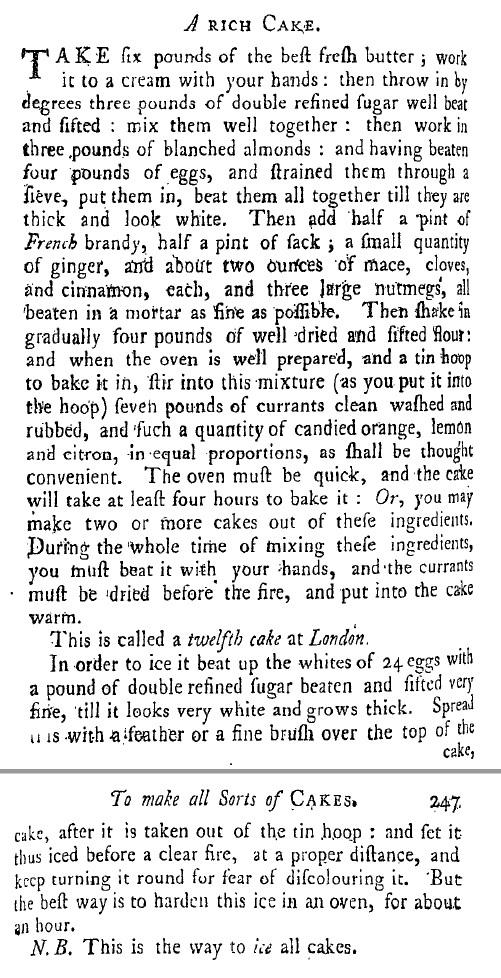
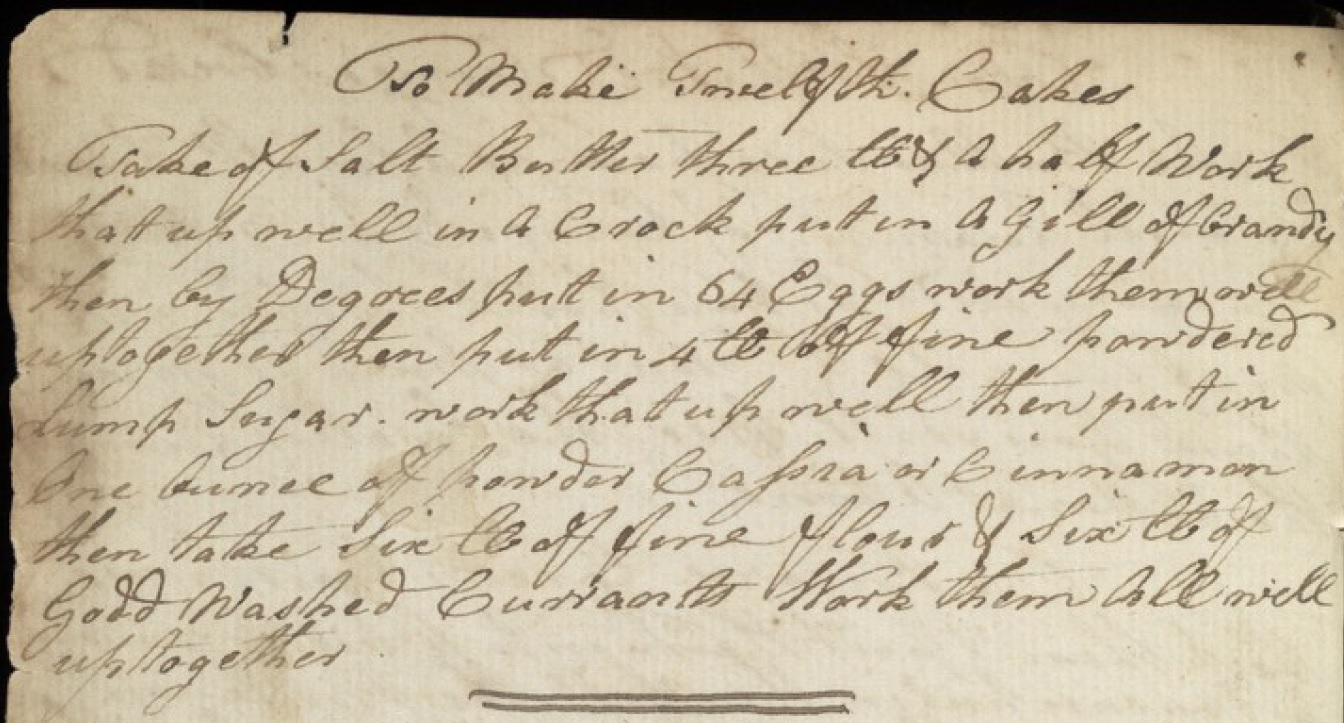
Twelfth Cakes, circa 1800 (left) from a manuscript recipe book, and James Jenks' 1768 recipe (right).
Twelfth Cakes, circa 1800 (left) from a manuscript recipe book, and James Jenks’ 1768 recipe (right).

The biggest party of the festive season used to be the evening of January 5th, the last of the Twelve Days of Christmas (Christmas Day being the first day), at which the Twelfth Night Cake made its appearance. Baked into the cake were a dried bean and dried pea, and when the cake was sliced and distributed amongst guests whoever discovered these in their slices were declared the King (bean) and Queen (pea) of the festivities. Quite how they managed to contrive that the correct gender found the appropriate bean/pea is not clear – unless two cakes were always served.

In times past, my home county of Herefordshire, being a very agricultural region, also has several rural traditions.

  • The Lighting the Twelfth Night Bonfires (twelve small fires in a circle and one larger one in the middle) in a wheat field and toasting the coming season with cider.
  • Wassailing the apple trees: Forming a procession to the apple orchard and arranging pieces of toast from the wassail bowl  (or cake, if one had been baked) in the branches and pouring the contents of the wassail bowl onto the roots of the tree, to encourage a good apple harvest.
  • Baking a cake with a hole in the middle and on Twelfth Night, placing it on the horns of a cow in the byre. The cow was then tickled until he tossed his head. If the cake was thrown backwards, it belonged to the mistress/dairymaid, and if forwards, to the bailiff/cowherd.

The Twelfth Night Cake was an extremely popular celebratory treat for centuries, but its popularity declined from the middle of the nineteenth century. A lot of people on the internet point the finger of blame at Queen Victoria, even going so far as to accuse her of banning the festivities circa 1860-1870. No evidence is offered to support this argument, and indeed I have been unable to find any myself, but if I missed something, do please get in touch and let me know.

Despite its popularity, recipes for Twelfth Cake are relatively few. Indeed, it has long been claimed that John Mollard’s 1801 recipe is the earliest one in print. Well, I do love a challenge, and the two recipes I have for you here do indeed date from the eighteenth century, albeit by a rather oblique route.

The first can be found in James Jenks’ The Complete Cook (1768).

As can be seen above, the recipe is actually called A Rich Cake, but has the helpful note “This is called a twelfth cake at London” underneath.

The second recipe I found in a handwritten manuscript at the Welcome Collection.

Twelfth Cake recipe from MS1074, Wellcome Collection, circa 1800

I appreciate that with an estimated date of 1800, this recipe is only just squeaking in to the 18th century, but I would argue, that it was unlikely to have been invented at the time of it’s entry into the manuscript, and thus has origins firmly in the preceding decades.

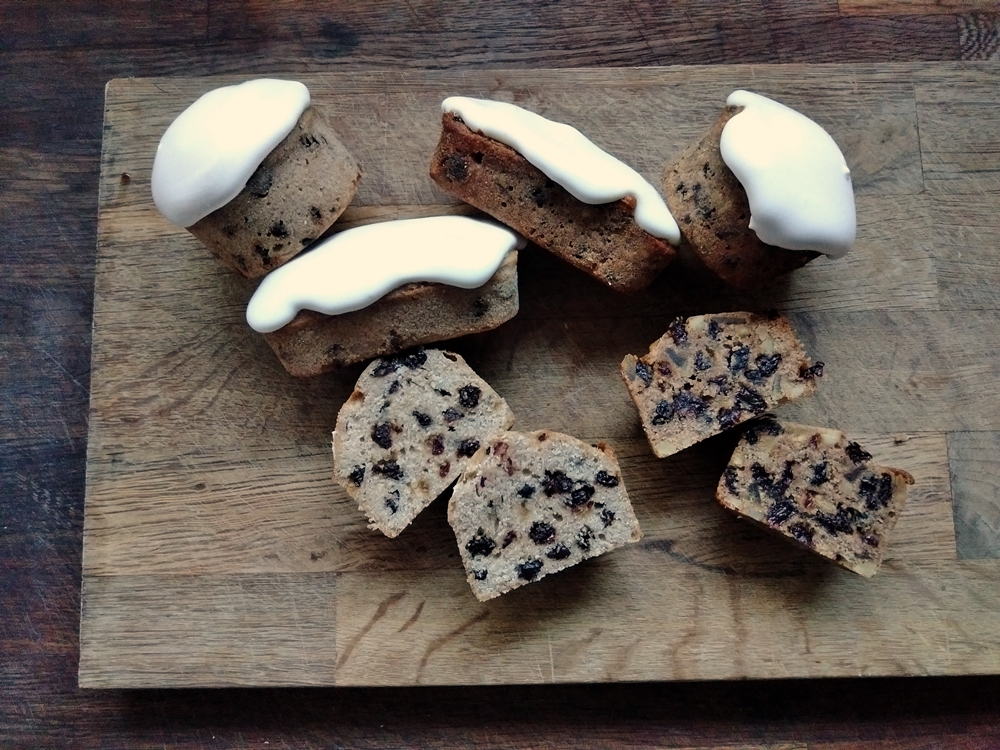
At the risk of stating the obvious, Twelfth Cakes are party cakes. They are made for celebrations, to be shared with numerous people, and consequently the quantities of both of these recipes are huge. I managed to scale them down considerably and chose to bake them in mini loaf/cake tins for the photo at the top of this page. This way, everyone can have their own miniature Twelfth Cake, and should you wish to annoint a King and Queen of the Revels, you can solve the tricky problem of ensuring the recipients are of the correct gender by adding the bean and the pea to cakes of different shapes.

James Jenks’ recipe is very heavily fruited and spiced and, whilst being a stickler for accurate scaling of recipes, I have had to reduce the proportion of both mace and clove in the recipe, as the original quantities of these spices tended to clonk you around the head flavourwise, and overpower the rest of the ingredients. The candied peel, nuts and alcohol all provide lots of interest and topped with a billowy royal icing, although both recipes are delicious, they are my personal favourite of the two. If this sparks your interest, Jenks’ book includes a further three rich cakes which could also be served as Twelfth Cakes.

The manuscript recipe is a paler and much milder affair. If lots of dried fruit and spice is not your idea of an enjoyable mouthful, then this might be the Twelfth Cake for you. Think of this as a sedate morning-coffee type of cake, as opposed to the full-on party-in-the-mouth that is James Jenks’ offering.

I chose to bake these in silicone moulds, as this protects the sides of the cake and prevents burning of the fruit. Metal tins might need a little less baking.

James Jenks Twelfth Cakes, 1768

Makes 8 small cakes

100g unsalted butter
50g caster sugar
2 large eggs – separated
2 tsp brandy
2 tsp cream sherry
1½ tsp ground ginger
1 tsp ground cinnamon
¼ tsp ground mace
¼ tsp ground cloves
1 tsp ground nutmeg
70g plain flour
50g chopped almonds
115g currants
20g candied orange peel, sliced very thin
20g candied lemon peel, sliced very thin
20g candied citron peel, sliced very thin

  • Heat the oven to 180°C, 160°C Fan.
  • Grease and line your chosen baking tins with parchment.
  • Cream the butter and sugar together until light and fluffy.
  • Whisk in the egg yolks, brandy and sherry.
  • Sift together the flour and spices and fold into the mixture.
  • Whisk the egg whites to stiff peaks and fold into the batter, 1/3 at a time.
  • Fold through the fruit and nuts.
  • Spoon into the moulds. A standard ice-cream scoop is helpful here.
  • Bake for 15 minutes, then turn the tins/moulds around and bake for a further 10 minutes for a total of 25 minutes.
  • Allow to cool in the tins for 10 minutes, then remove to a rack to cool completely.

Icing
100g icing sugar
25g egg-white

  • Heat the oven to 170°C, 150°C Fan.
  • Whisk the sugar and egg-white together for 5-10 minutes, until the mixture is thickened.
  • Spread as liked on your Twelfth Cakes.
  • Set the cakes into the oven and turn off the heat.
  • Remove after 15 minutes, when the icing has set.
  • Set aside to cool.

Twelfth Cakes circa 1800

Makes 8-10 small cakes

100g salt butter
115g  powdered sugar
2 tsp brandy
3 large eggs
1 tsp ground cinnamon
170g plain flour
170g currants

  • Heat the oven to 180°C, 160°C Fan.
  • Grease and line your chosen baking tins with parchment.
  • Cream the butter and sugar together until light and fluffy.
  • Whisk in the eggs, one by one.
  • Add the brandy.
  • Sift together the flour and cinnamon and fold into the mixture.
  • Fold through the fruit and nuts.
  • Spoon into the moulds. A standard ice-cream scoop is helpful here.
  • Bake for 15 minutes, then turn the tins around and bake for a further 10 minutes for a total of 25 minutes.
  • Allow to cool in the tins for 10 minutes, then remove to a rack to cool completely.

Icing
100g icing sugar
25g egg-white

  • Heat the oven to 170°C, 150°C Fan.
  • Whisk the sugar and egg-white together for 5-10 minutes, until the mixture is thickened.
  • Spread as liked on your Twelfth Cakes.
  • Set the cakes into the oven and turn off the heat.
  • Remove after 15 minutes, when the icing has set.
  • Set aside to cool.

Chocolate Cakes

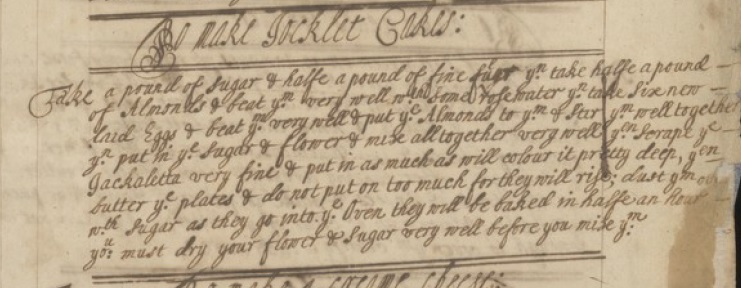
Whilst poring over old manuscripts, I love finding really early examples of recipes we would recognise today. And so I was delighted to come across this recipe for chocolate cakes. It appears near the front of a manuscript (MS1799, dated 1700-1775) digitised by the Wellcome Collection, and so, in my opinion, is closer in date to 1700 than the latter half of the century. The reason it caught my eye was because it reads as a ‘normal’ cake recipe, very unusual for the time.

18thC Chocolate Cakes
Chocolate Cakes, MS1799, (1700-1775), Wellcome Collection

Experience has led me to be cautious when it comes to the word ‘cake’ appearing in old recipes. In times past, this word was used for a broad range of ‘items that were circular’, rather than the baked confections of flour and eggs we associate with the word today. In the past I have been thrilled to find early recipes for lemon cakes and gooseberry cakes, only to find that they are for fruit paste and jellies, musk cakes that turn out to be incence, puff cakes that are meringues, rout cakes that are biscuits and spice cakes that are buns.

Even ‘chocolate cakes’ can catch the unwary, as many old recipes sporting such a title are actually instructions for making solid blocks of ‘chocolate’ ready to use in recipes. Unlike the cocoa powder we buy today, these ‘cakes’ were similar to the modern blocks of Mexican chocolate: solid, hard and requiring grating before use. The old recipes for ‘chocolate’ begin with the roasting of the cocoa beans, which are then pounded and ground extremely fine and mixed with sugar, vanilla and spices before drying in cakes which are then stored for use, which makes me incredibly grateful that we don’t have to go through such Faff today.

Happily, this recipe omits the time-consuming ‘make your chocolate’ part, but in adapting this recipe for modern use, if an authentic 18thC flavour is required, the spices that would be part of the original cakes of ‘chocolate’ need to be added in. The quantities below might seem a lot, but there’s also a lot of cocoa, so to make sure they can all sing, the quantities need to be generous. You can play around with the spices to your taste – other chocolate recipes I’ve read include one or more of the following: allspice, cloves, aniseed, cardamom, musk, ambergris, and either achiote or cochineal for a reddish colour.

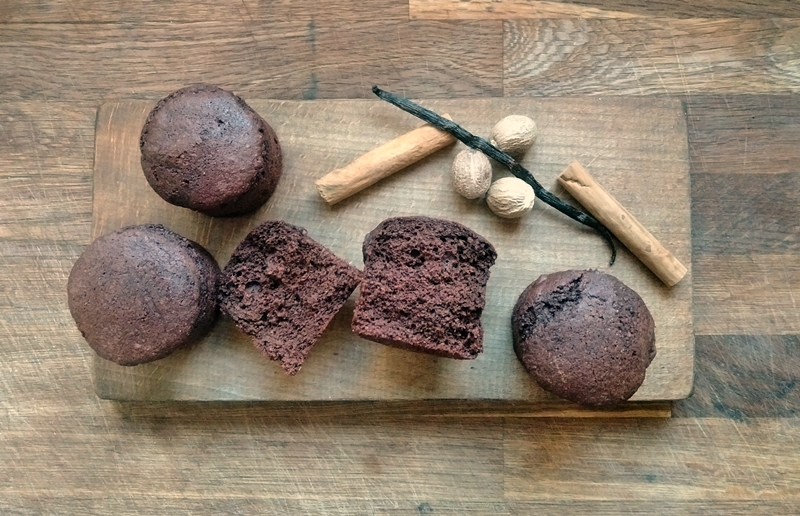
So what are they like? Well, to be honest, it took several batches of tweaking before I was happy with the result. The taste is intensely chocolate-y, and the addition of the spices makes for an unusual and rich flavour. In the interests of full disclosure, as can be seen from the photo, these are dense cakes, and are most definitely not of a lightness of a Victoria sponge, or even a sturdy Madeira cake. But to be frank, that is part of their charm. Since they are made without butter, I would recommend serving/eating them with some lightly whipped cream, or ice-cream, for the mosture as well as the contrast in texture and temperature: the rich warmth and spiciness of the cake against the cold cream is deliciously satisfying.

These cakes include ground almonds, which help to enrich the texture, but also require a little time to work their magic. Consequently, if you’re not eating them straight from the oven, these cakes benefit from being kept 1-2 days in order for them to soften. Freshly-baked, but cooled, they are rather – ahem – ‘firm’, but stick them in a ziplock bag for a day or two and they soften and become glossy and a little sticky (in a good way).

If you’d like to make a less sturdy, more modern sponge version, all it takes is the addition of 1.5tsp baking powder, sifted with the flour.

I used a silicon cupcake mould with straight sides, which look great, but, even thoroughly buttered, proved challenging when it came to getting the cakes out in one piece. Other options might be ‘regular’ bun/cupcake moulds, or use paper liners.

Chocolate Cakes

Circa 1700. Makes 8-12, depending on your small cake tin size.

30g melted butter
150g sugar
3 large eggs
1tbs vanilla extract/paste/seeds of 1 vanilla pod
40g cocoa powder*
2tsp ground cinnamon
1tsp ground nutmeg
75g plain flour
1.5tsp baking powder (optional)
pinch salt
75g ground almonds

  • Heat the oven to 180°C, 160°C Fan.
  • Grease your moulds with the melted butter.
  • Whisk the eggs and sugar together until light and foamy (5 minutes or so).
  • Sift together the flour, cocoa, spices, salt and baking powder if using.
  • When the eggs are foamy, use the whisk attachment (or a balloon whisk) to gently fold in the flour mixture.
  • Stir in the almonds.
  • Portion the batter out into the greased moulds.
  • Bake for 18-20 minutes, turning the moulds around after 10 minutes to even the baking.
  • Remove from the oven and allow to stand for 10 minutes to firm up.
  • Run a thin blade around the edges of the cakes (if not using cupcake papers) and gently ease the cakes from the moulds and cool on a wire rack.
  • Enjoy warm with cream, or place in an airtight container for 1-2 days to mellow.

* Modern cocoa is very drying, so if you’d like to use more than this amount, reduce the quantity of flour by that same amount. i.e for 50g cocoa, use just 65g flour.

Fruit Puffs

This recipe appears in the 17th century manuscript book of Lady Anne Fanshawe (MS.7113 at the Wellcome Collection), and is attributed to Lady Scarborough. What might appear, from the name, at first to be something pastry-based, is in fact a form of meringue.

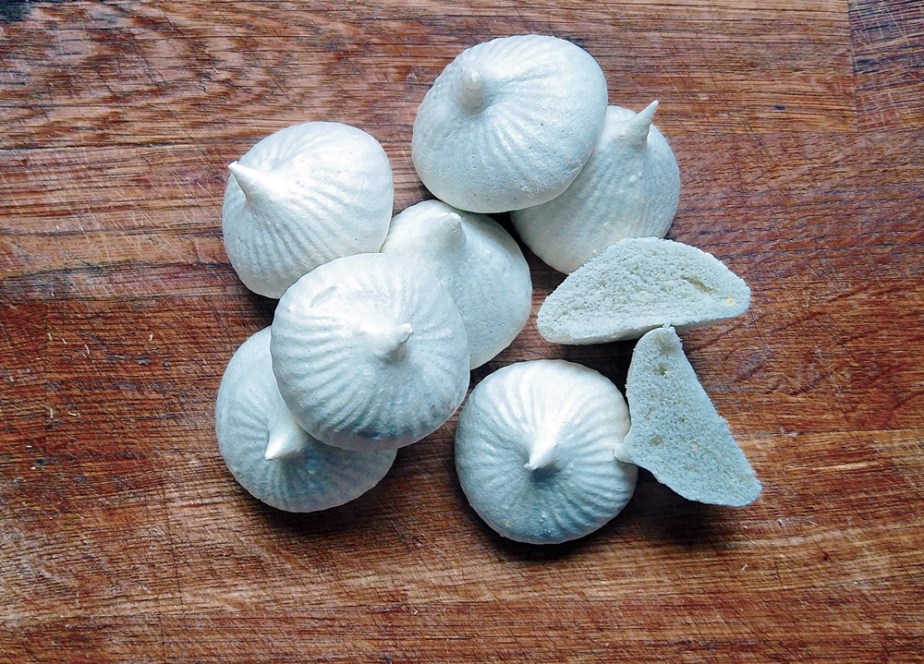
Unsweetened fruit (I used apples) pulp is mixed with sugar and eggwhites and whisked until stiff and white. The recipe calls for this to be dropped in spoonfuls onto glass and dried in the oven, although I made adaptations for the modern kitchen. After a couple of practice runs, the result is, to all intents and purposes, an apple-flavoured meringue. Not as sweet as regular meringues, with the pleasantly tart flavour of sharp apples.

It is from the same recipe family as Apple Snow, with a slight alteration in porportions and a spell in the oven, and to my mind would be delightful served alongside that ethereal confection.

The main challenge with this recipe was the missing details. Apple and sugar quantities are given, but the instruction to beat them ‘with white of egg’ is open to interpretation. Additionally, “dry it in a stove” is hardly suffering from an over-abundance of detail. Hence the trial runs.

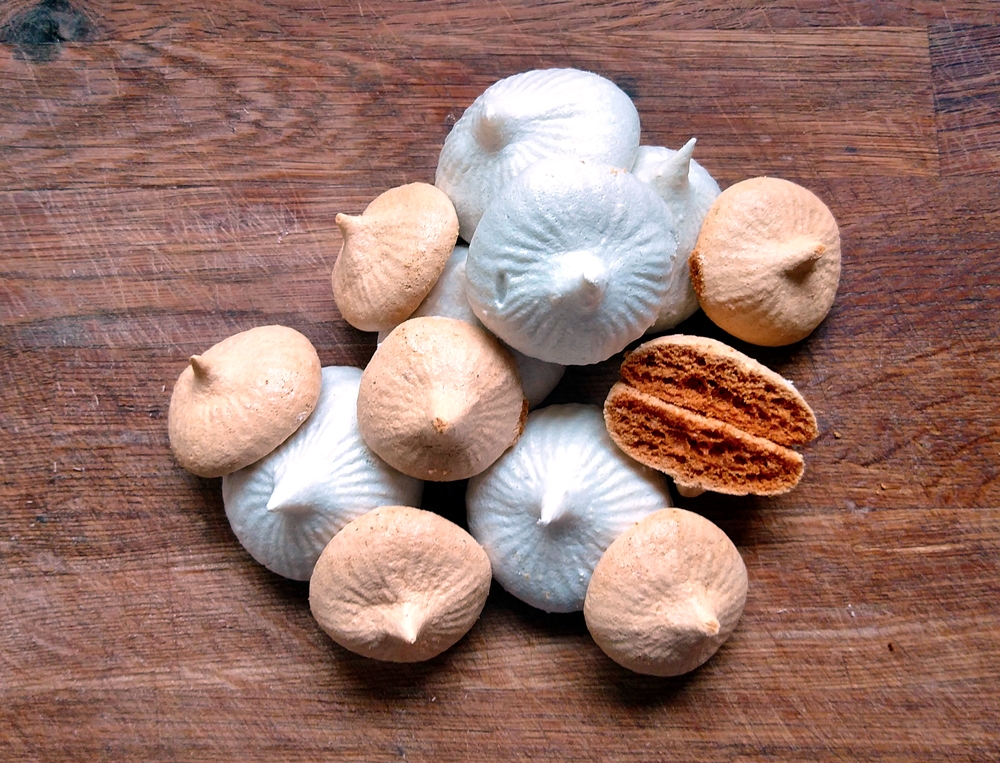
One of the batches I made whilst juggling baking times and temperatures turned a light caramel colour, which I suspect is not how the finished puffs should look, but proved to be absolutely delicious – crisp, delicate with a whisper of toffee apple. I’m counting that particular error as a win!

Apple and Caramel Apple Puffs

Fruit Puffs

Although I have only used apple here, the recipe does state that any fruit pulp can be used. My advice would be to choose pulp that has some bulk to it. Berries might prove too moist. Stone fruit, rhubarb and gooseberries would all be suitable, especially if tart, as the sugar content is quite high, and it would ‘cut through’ it nicely.

340g cooked cooking apples
225g caster sugar
2 large egg-whites (about 80g)

  • Puree the apple smooth with a stick blender. Sieve the puree if liked (I didn’t, but I was very thorough with the blender).
  • Add the remaining ingredients and whisk until light, white and stiff. I used a stand mixer on High and this took 10 minutes.
  • Heat the oven to 100°C, 80°C Fan. This temperature will be for the white puffs, for caramel puffs, increase the temperature to 140°C, 120°C Fan after 2 hours.
  • Add a decorative nozzle to a piping bag and spoon in some of the mixture. Pipe the mixture onto a baking sheet lined with parchment. There will be some shrinkage as the puffs dry out, so pipe them on the large side. For example, the white puffs in the top photo were 5cm tall when first piped. When dried, they are about 3cm tall.
  • Dry in the oven for 5-6 hours, depending on the size and how moist they are. Prop the oven door ajar by inserting the handle of a wooden spoon, for the first hour or so, to help dispel the moisture, (otherwise it stays trapped in the oven and slows down drying time).
  • After about 4 hours, remove the baking sheet from the oven and allow to cool for 5 minutes. The puffs should be firm enough by this stage to gently peel off from the parchment. Turn the puffs upside down and lay them back on the parchment, so that the bases can dry (about an hour). If you don’t let the puffs cool down first, you will squish them as you try to remove them from the paper. If the puffs aren’t firm even when cooled down, put them back in the oven for another 30 minutes and try again.
  • For Caramel Puffs, bake as above for 2 hours, then increase the heat to 140°C, 120°C Fan and bake for 1 hour. Check the colour/dryness and bake a little longer if still sticky.
  • Once the puffs are dried to your liking, store them in an airtight container. They will absorb moisture and become sticky if left in the open air for any length of time.

Coventrys, Godcakes and Congleton Cakes

It’s all about triangular pastries this week.

Let us start with Coventreys (middle pastry in the above photo). Essentially, these are jam turnovers, but there are a few key characteristics that set them apart from your average turnover. For a start they are triangular, formed by cutting circles of puff pastry, adding a teaspoon of raspberry jam and folding in the edges of the pastry to form an equilateral triangle. These are then turned over and laid on the baking sheet with the seal underneath. The edges of the pastry are notched using either a flat-ended spatula, or a knife. This has two purposes. Firstly, it allows the steam to scape during baking, and secondly, it permits the jam to peek through in an attractive manner.

Godcakes (on the left in the above photo) also hail from Coventry, but according to Harris & Borella (All About Pastries, c1900) are actually more well known in their home town than regular Coventrys. Godcakes too are triangular, formed in the same way as regular Coventreys, but are baked with the seals upwards and visible. Their filling is of a rich mincemeat, and derived their popularity from being given as blessings by godparents to their godchildren, the three sides being symbolic of the Holy Trinity.

There’s some differing opinions as to when this gifting of pastries might have taken place. Harris & Borella maintain it was at Easter, whereas other sources claim New Year’s Day or even the festive season itself. This might be down to the filling. Nowadays we tend to associate mincemeat very much with Christmas, but originally it was eaten pretty much all year round, and a number of eighteenth century cookery writers, including Hannah Glasse, have recipes specially tailored for consumption during Lent.

There’s certainly a long history of symbolic cakes tied to the church. A ‘God’s Kichel’ is mentioned in Chaucer’s Summoner’s Tale, and defined as

Kichel: A flat Christmas cake, of a triangular shape, with sugar and a few currants strow’d over the top – differing, only in shape, I believe, from a bun. Cocker says “Kichel is Saxon – a kind of cake of God’s Kichel, a cake given to God-children when they ask blessing of their God father.”¹

The third pastry is, I confess, something of a mystery in that I have not been able to find much detail about them at all. Congleton Cakes, aka Count Cakes, have long been celebrated. They are of triangular form, with a raisin inserted at each corner; and, from being eaten at the quarterly account meetings of the Corporation for more than a century, they are called ‘Court Cakes’. The three raisins are thought to represent the mayor and two justices, who were the governing body under the charter of James I. By others, they are supposed to symbolise the Trinity. ²

Aside from their shape, and the detail of the three raisins at the corners, there’s no further information that I have been able to find. The pastry, if indeed it is that, might be shortcrust, sweet shortcrust, puff or hot water crust. It might even be bread dough, either plain or enriched. The filling might be jam or mincemeat or apple or currants or something else entirely. I’ve gone with puff pastry and a mincemeat filling, as the names ‘court’ and ‘count’ have a whiff of expense. However, the high temperature needed to bake the puff pastry well and truly crisped the three raisins, which is what got me thinking the paste might be something plainer, shortcrust perhaps (like Chorley cakes), or even an enriched dough (like the original Banbury Cakes). They might not even be a filled pastry at all, but a fruited dough which has merely been cut into triangles, but it’s all guesswork unless someone can fill in the gaps.

If anyone has any information on these mysterious baked treats, please do get in touch.

Coventrys, Godcakes & Congleton Cakes

The instructions can easily be adapted to whichever of the three pastries you’d like to make, so it’s going to be a one-size-fits-all kinda recipe. To make about 8 cakes.

1 sheet of ready-rolled puff pastry
raspberry jam (Coventrys) OR mincemeat (Godcakes/Congleton cakes)
large raisins (Congleton cakes)
eggwhite (for glazing)
caster sugar (for glazing)

  • Heat the oven to 220°C, 200°C Fan.
  • Sprinkle the pastry with flour and roll out a little thinner (3-4mm).
  • Cut plain circles of pastry, about 10cmin diameter.
  • Dampen the edges with a little water to help with sealing the cakes/
  • For Coventrys, spread a teaspoon of raspberry jam in the centre, then fold the edges in over the jam to make a triangle. Press gently, then turn the pastry over and place seal-side down on a baking sheet lined with parchment.
  • For Godcakes, spoon a rounded teaspoon of mincemeat into the centre, then fold the edges in over the mincemeat to make a triangle. Press gently, then place seal-side uppermost on a baking sheet lined with parchment.
  • For Congleton Cakes, place three large raisins at equal distance around the edge of the pastry. Spoon a rounded teaspoon of mincemeat into the centre, then fold the edges in over the mincemeat to make a triangle, ensuring the raisins are closely folded in the pastry.
  • Whichever style you have made, brush over with lightly whisked egg-white and sprinkle with caster sugar.
  • Using a flat-ended spatula, or a knife, make notches in all three sides of each pastry. For Coventrys, don’t make the cuts too deep, as the jam might leak out during cooking.
  • Bake for 18-20 minutes, turning the baking sheet around after 10 minutes to ensure even colouring.
  • Cool on a wire rack.

¹ “Suffolk Words and Phrases: Or, An Attempt to Collect the Lingual Localisms of that County”, Edward Moore, 1823

² “The English dialect dictionary”, J. Wright, Volume 1 A – C, 1898