Gossiping Cakes

I have a confession to make. I chose these recipes because I loved the idea of women baking cakes specifically for having a get-together and swapping gossip. Alas, that’s not where these cakes originate, but the truth just as interesting.

As I’ve mentioned before, I have spent quite a considerable amount of time cataloguing household manuscripts that have been digitised by various libraries around the world. Obviously, there is going to be a certain degree of repetition of the most popular recipes, but there are also those that stand out as original either by name or by ingredient, etc. Whenever I come across such a recipe, I mark it in the spreadsheet with an asterisk, so when I’m looking back over the thousands of recipes, those asterisked ones are easily highlighted as worthy of a second look. And for the other type of recipes, such as the 200+ recipes simply entitled “A cake”, I’ll get to looking at you in all your (presumed) variety  soon, but to be blunt, you’re pretty low on the ToDo list.

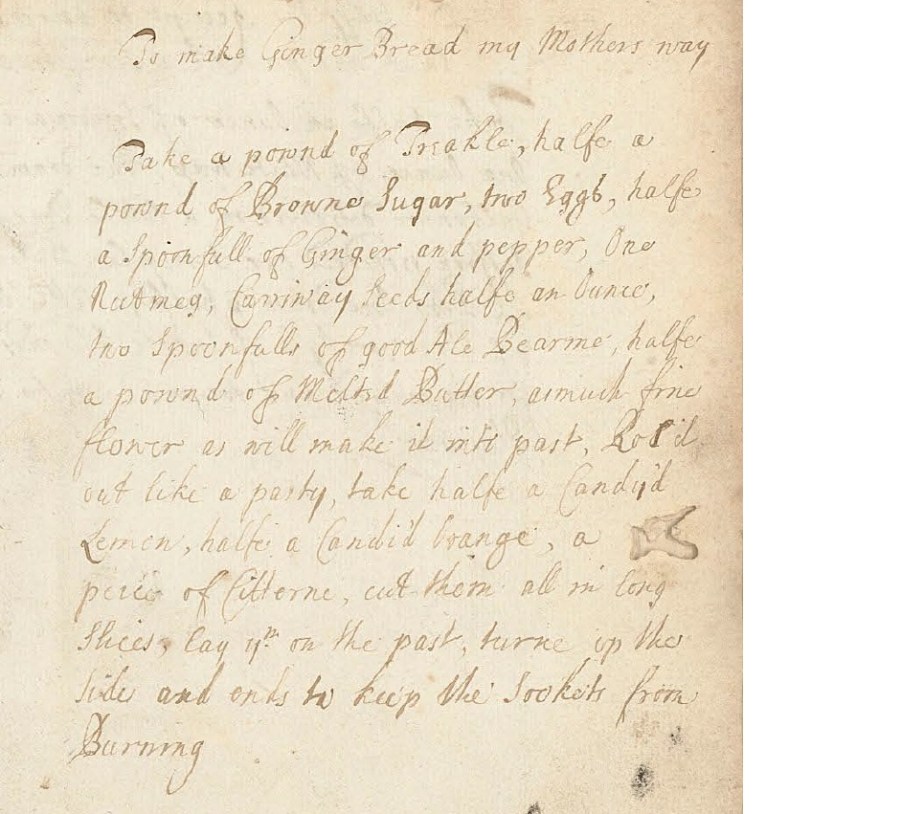
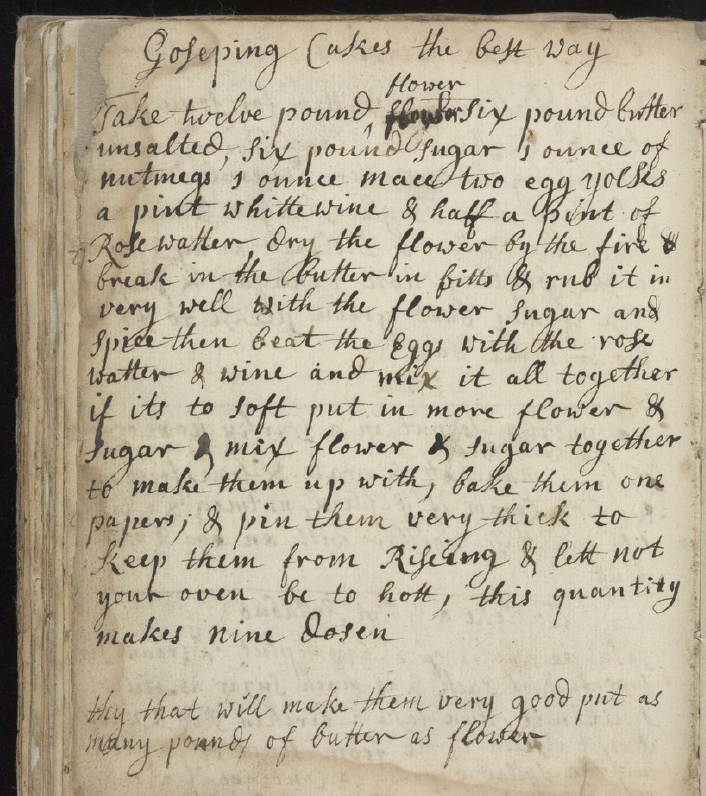
The first recipe I found was this one, dated early 18th century (1738), at the Wellcome Collection.

Recipe for Goseping Cakes The Best Way, from the manuscript of Rebecca Tallamy, (1738), MS4759, Wellcome Collection

It appears to be a spiced variation of shortbread, and obviously one to make in quantity, because the yield of the recipe is over 100 biscuits. It’s demonstrating one of the many interpretations of the word ‘cake’, in this case meaning small, circular biscuits. The last line also caught my eye, because it recommends using equal quantities of butter and flour to make them “very good”.

Regular listeners will have read about my shortbread variation testing a few months ago, where the ratio of butter to flour can range from 1:3 to 1:2, so the assertion that 1:1 is the best, had me intrigued.

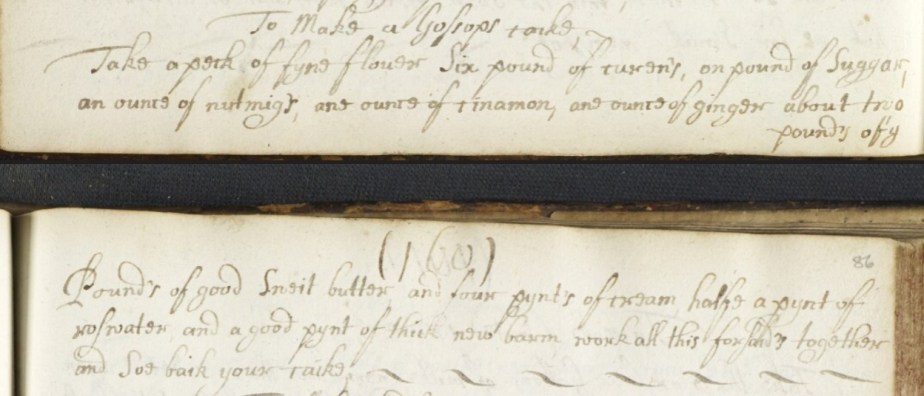
This recipe was very much on the back burner until I came across another recipe, similarly named, while indexing the digitised manuscripts at the National Library of Scotland.

Recipe for a Gossops Cake, from MS103093966.23, (1660-1699), National Library of Scotland

This recipe is in a manuscript older by almost a century (1660-1699), and differs in that it contains fruit, and is a large yeasted cake – exceedingly large, going by the peck/14lb/9kg of flour required – the term cake being used in this instance more akin to our modern usage.

To delve deeper into this mystery, I turned to the internet, and found the following passage:

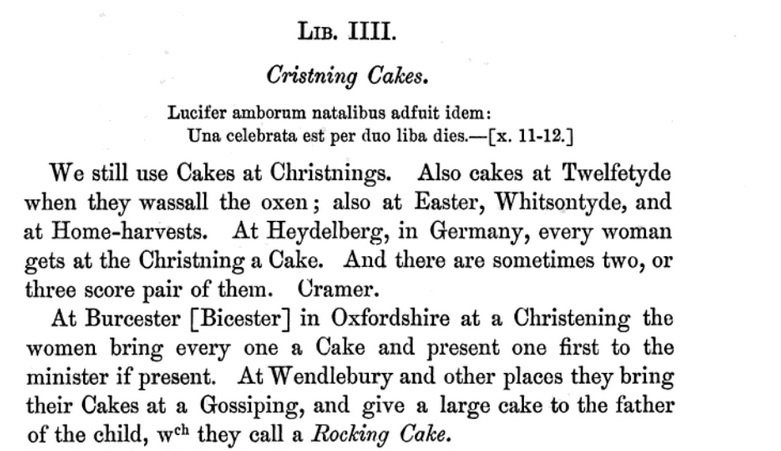
Christening cake traditions, from “Remains of Gentilisme and Judaisme 1686-87”, John Aubrey, James Britten, 1881, p65

This threw up the question: What is a Gossiping? And so I went hunting in the Oxford English Dictionary which I learned that a Gossiping is  a christening, or christening feast, derived and corrupted from “Godsibb”, which is an old English word for Godparent.

Not entirely relevant, but interesting nontheless, the oldest usage of Godshib I found was over a thousand years ago in Sermo Lupi ad Anglos, or the Sermon of the Wolf to the English, a sermon given by Wulfstan II, Bishop of Worcester and Archbishop of York (d. 1023) in 1014:

“And godsibbas and godbearn to fela man forspilde wide gynd þas þeode toeacan oðran ealles to manegan þe man unscyldgige forfor ealles to wide.”

Trans: And too many godparents and godchildren have been killed widely through-out this nation, in addition to entirely too many other innocent people who have been destroy­ed entirely too widely.”

Later usages of the word referred to a gathering of women/midwives when a woman was in labour, and hence to the modern usage.

So with a history stretching back many centuries, the account of christening traditions at Wendlebury would appear to neatly explain the differences between our two recipes: a large cake was presented to the father – presumably for all his hard work in the proceedings *eyeroll* – and the smaller cakes were shared with the guests.

So let’s get on with some gosseping!

A Gossop’s Cake

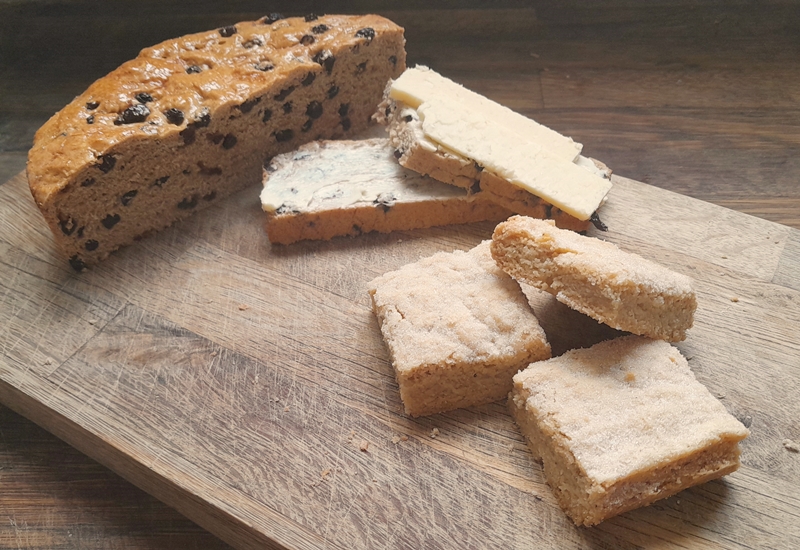
This is a fruited, lightly spiced and yeast-raised cake. If you’re British, it’s like an enriched teacake: delicious fresh, delicious toasted, and delicious either way with butter and a slab of cheese (but better with toasted). I’ve scaled the recipe down to make for a modest sized cake, but you can always double the recipe if it turns out to be a favourite.

315g plain flour
135g raisins
25g caster sugar
1tsp ground nutmeg
1tsp ground cinnamon
1tsp ground ginger
50g unsalted butter
150ml single cream
100ml water
1½tsp rosewater
1 sachet fast-acting yeast

single cream to glaze

  • Plump the raisins: put the raisins in a saucepan and cover with water. Warm gently on a low heat for 10 minutes while the dough mixes. Strain and pat dry.
  • Sift together the flour, yeast, sugar and spices.
  • Put the butter, cream, water and rosewater into a small pan and warm gently over low heat just until the butter has melted.
  • Put all ingredients except the raisins into the bowl of a stand mixer fitted with the dough hook and mix on slow until the dough comes together, then continue to knead for 10 minutes until smooth.
  • Add in the plumped raisins and mix on slow to combine.
  • Grease and line a tall, 20cm cake tin, preferably loose bottomed, with parchment.
  • Form the dough into a smooth cake and place in the prepared tin.
  • Set aside to rise until doubled in size. The enrichments to the dough (cream/sugar/fruit) will impact the rise, which is why there is only a single rise for this cake, thus taking advantage of the initial vigorousness of the yeast.
  • Heat the oven to 190°C, 170°C Fan.
  • When the cake has risen, gently brush the surface with single cream, and bake for 30-40 minutes until well risen and golden brown.
  • Cool the cake for 10 minutes in the tin, then remove and set on a wire rack to cool completely.
  • Store in an airtight container.

Goseping Cakes The Best Way

I’ve opted for the proportions where butter = flour because, contrary to my expectations, it really did taste much better that with just half the amount of butter.

250g plain flour
250g unsalted butter
125g caster sugar
1tsp ground nutmeg
1tsp ground mace
1.5tsp rosewater
1 large egg yolk
30ml white wine

1tbs caster sugar for sprinkling

  • Put the dry ingredients into the bowl of a food processor.
  • Cube the butter and add to the dry ingredients.
  • Blitz the mixture a few times until it resembles breadcrumbs.
  • Whisk together the yolk, wine and rosewater.
  • Add the wet ingredients to the dry and blitz until the mixture comes together in a soft dough.
  • Line a 20cm square tin with parchment paper.
  • Turn the dough out onto parchment paper.
  • Press the dough out evenly and smooth over.
  • Chill in the freezer for 20 minutes.
  • Heat the oven to 160°C, 140°C Fan.
  • Poke holes all over the surface with a fork or using a cocktail stick, in the manner of shortbread.
  • Bake for 30 minutes, turning the tin around after 15 minutes to ensure even baking.
  • Remove from the oven and turn off the heat. Sprinkle the caster sugar over the hot shortbread.
  • Cut the shortbread into pieces using a thin bladed knife or metal dough scraper.
  • Return the tin to the cooling oven until cold, to ‘dry out’.
  • When cold, store in an airtight container.

18th Century Bath Buns

We don’t eat buns as frequently as we used to, and I think it is a great shame, because buns are synonymous with fun!

I spend a lot of time pondering different recipes, and one thing that causes much musing is the way recipes evolve in the UK, compared to, say, France.

French recipes tend to be rather rigid and proscribed. Definitions of what constitutes those two most recognisable of French baked goods – the croissant and the baguette – have been firmly established, almost set in stone. A croissant is a croissant, a baguette de tradition is a baguette de tradition, – there are rules, there is order, and there is never, ever, deviation. You want to tweak a recipe a little? Then you have to give it a new name. The French have no truck with ‘croissant-ish’ or ‘baguette de tradition adjacent.’ No messing about with rules that have been decided decades, even centuries, ago. Absolument pas!

In contrast, British recipes are a lot more open to interpretation. On the Books and Writing page of this website you will find, amongst other things, a paper I wrote on Pikelets, and how, over the centuries, the word has been used to describe different recipes for arguably quite different items. Also a paper on Summer Pudding, which has undergone its own transformation during its long and illustrious history.

Having given the matter a great deal of thought, I’m pretty comfortable with viewing recipes, especially British ones, as having a timeline. Some are long, some short, but throughout which adapts and changes with tastes and fashions. To illustrate this, in Great British Bakes, I included multiple recipes for Shrewsbury Cakes, an all but forgotten English shortbread that has a history spanning centuries. Others, such as the less-successful Crimson Biscuits (be honest – have YOU ever heard of them?) in Ann Peckham’s 1767 book, have timelines of alarming brevity. An added feature (frustration) with British recipes is that they might go by a number of different names, according to region, or indeed the one name may refer to numerous different dishes.

And so, after WAY too much preamble, we come to Bath Buns, whose history stretches back into the 1600s, and might be a genuine contender for Britain’s Oldest Bun, much to the probable dismay of fans of Sally Luns and Chelsea Buns, very much the Johnny-Come-Latelies of the eighteenth century pastry scene. The glitterati of Bath were happily taking the waters and chomping on this style of bun for the best part of a century before Dr Oliver invented his biscuit in an effort to improve the health of The Ton.

The Bath Bun of the late 17th century is rather different to the buns we might find in bakeries and tea shops today. The early Bath Buns were sweetened and flavoured with caraway comfits: seeds enclosed in numerous layers of sugar and enjoyed as sweetmeats and digestives. Today, a classic Bath Bun should retain the image of these candied seeds by being topped with pearled or candied sugar, which retains its colour and shape during baking, giving them a very distinct appearance. The time and effort required to create seeded comfits is considerable, and it is unsurprising to learn that they are no longer made. In imitation, I have found that using pearled/candied sugar and a sprinkling of unadorned seeds provides the sweetness, flavour and crunch of these forgotten sweetmeats.

The original Bath Buns were also incredibly rich with butter. Looking at recipes throughout the century, the most popular ratios ranged from an almost paltry one third of the weight of flour in butter, up to croissant-exceeding levels of 1.5 times the weight of flour in butter. Add in, as in the recipe below, a couple of pounds of caraway comfits, and these buns are probably a major cause of the gentry having to ‘take the waters’.

The first recipe below, the earliest I could find, is from an old manuscript dated to ‘late 17th century’ and has an equal weight of flour and butter. I scaled the recipe down, but there was still an alarming quantity of butter in not much dough. I broke my own rule too, in the baking, and did not bake it as written. Partly because I suspect that there is an error in the transcribing the original ingredients, and partly because I just couldn’t bring myself to put the full complement of sugar into the dough. I settled for half, and even that was a challenge – the buns were practically crystallized!

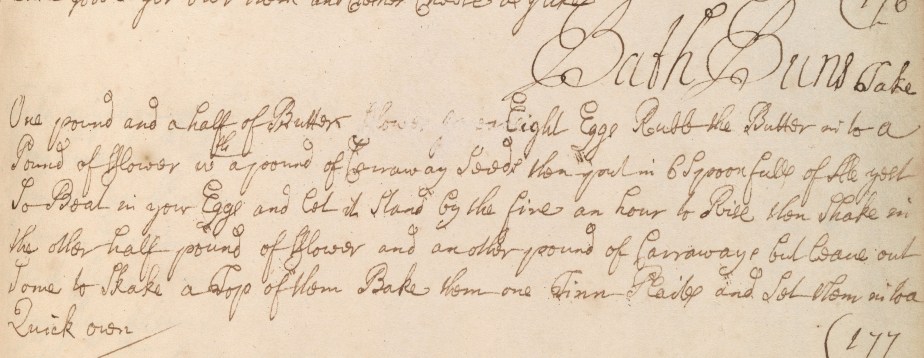
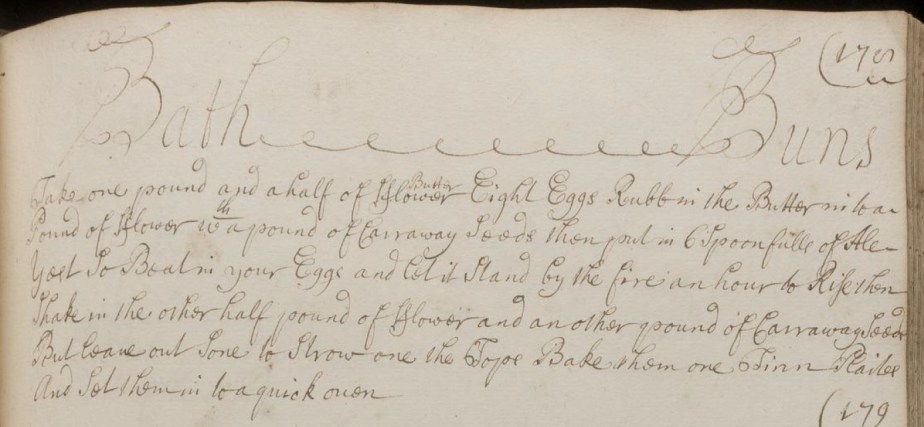
Earliest Bath Bun recipe I’ve found, from manuscript dated 1675-1725, MS1792, Wellcome Collection

With all the eggs and butter and sugar the dough is incredibly soft – too soft to knead – and is practically spooned onto baking trays – something which later recipes mention frequently. The modern Bath Bun traditionally should have a rather rough appearance, and shuns the round perfection of Sally Luns or the even sugared, square edges of the Chelsea Buns. Due to all this richness, the dough can take a long time to rise and the finished texture is cake-like rather than bready, crunchy with the sugar crystals and with the unusual (to our modern palates) and distinct flavour and aroma of caraway.

Bath Buns recipe from manuscript dated 1675-1725, MS1792, Wellcome Collection

This recipe is particularly interesting because it has a twin, in another manuscript, on the other side of the Atlantic Ocean. This manuscript is one of the holdings at Yale University Library, and are both written in the same handwriting, possibly that of a scribe. They are mostly similar, but not exact copies. My guess is that one was copied from the other, with edits being made to exclude recipes not liked and including new recipes in the copy. With this in mind, I’m of the opinion that the Wellcome Collection manuscript is the copy. Below is the potential ‘original’.

Bath Bun recipe from MS Osborn fc181, Yale University Library.

All of which is an interesting detour, but doesn’t really get us an enjoyable Bath Bun that respects the traditions of the original, but is also acceptable to our 21st century tastes. Fear not, for galloping to our rescue comes a heroine for the ages: Mrs Bridget Ilbert (1712-1790), daughter of the 6th Earl of Devon and the wife of William Ilbert of Bowringsleigh, Devon.

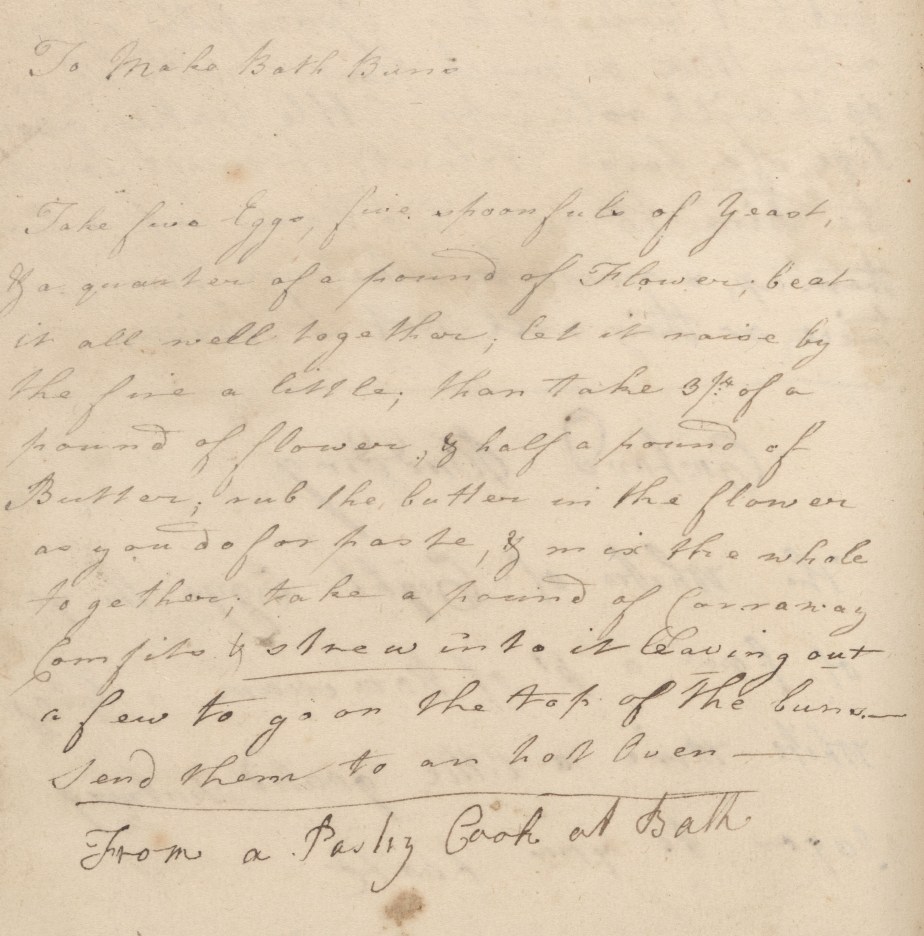
Recipe for Bath Buns in Bridget Ilbert’s manuscript MS1821, Wellcome Collection

Bridget’s manuscript is held at The Wellcome Collection, and one of the recipes within is for Bath Buns. I particularly like this recipe because it comes with the added credentials of being “From a Pastry Cook at Bath” – and you can’t get much better than that. The recipe is undated, unfortunately, but it is not too big a stretch to allocate a date in the general area of early-to-mid 18th century.

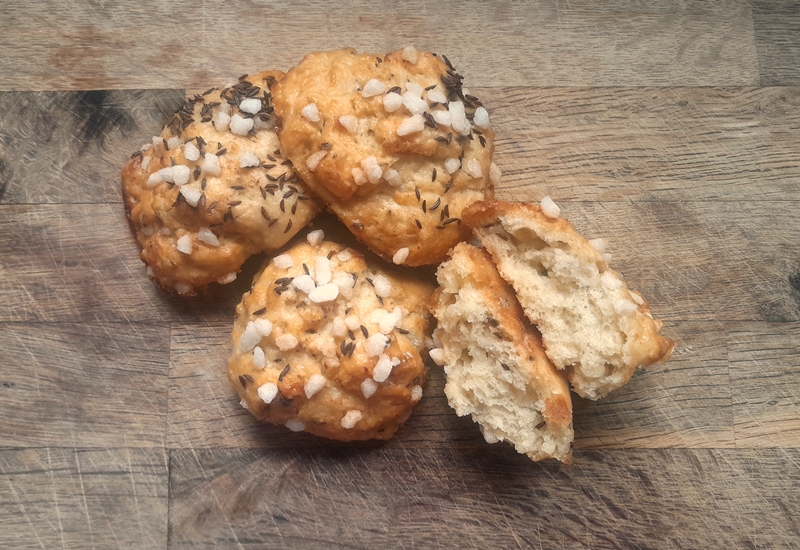
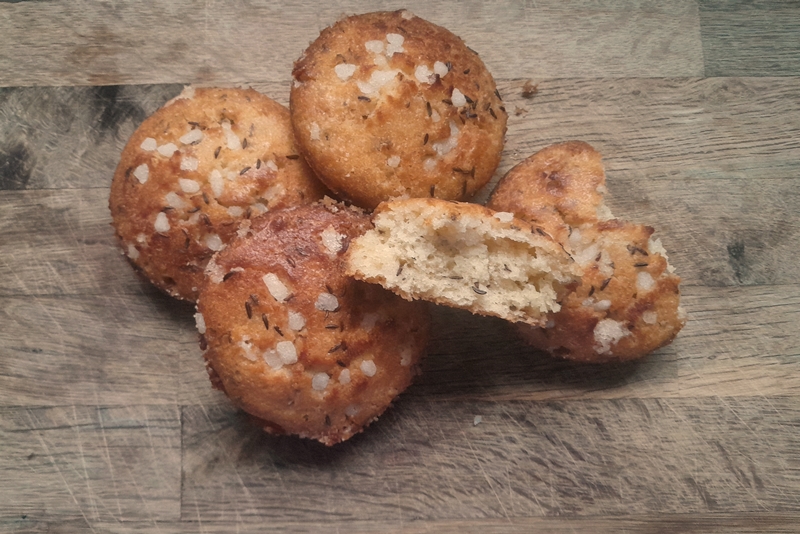
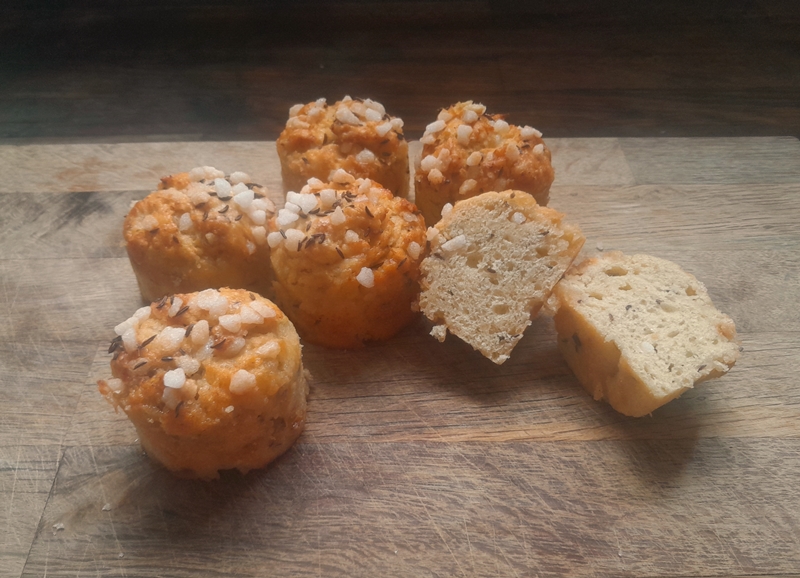
Miniature bath buns adapted from a recipe MS1821, Wellcome Collection

Original 18thC Bath Buns

You can bake these on baking sheets or in silicone moulds. I used a mould like this, and had dough enough left over to make 4 free-form buns in the photo at the top of the page.

Makes 10-12 buns.

225g plain flour – divided
115g unsalted butter
1 sachet fast action yeast
2 large eggs
2tbs warm water
1tbs caraway seeds
100g crystallised sugar

1 large egg for glazing
milk
more crystallised sugar for  finishing
a few caraway seeds to sprinkle

  • Crack the eggs into the bowl of a stand mixer and add the yeast, water and 50g of flour.
  • Whisk together thoroughly, then set aside to rise for 20 minutes.
  • Prepare your baking items – parchment paper on baking sheets if baking ‘free-form’, butter your silicone moulds if using.
  • Put the remaining flour and the butter into a food processor and blitz until the mixture resembles breadcrumbs.
  • Add the butter mixture to the yeast mixture, together with the caraway seeds and mix thoroughly to a smooth paste.
  • Mix in 100g crystallised sugar.
  • Spoon onto/into your prepared baking items. 50g of dough makes an elegant size. Try and make your dough sit up high in as round a shape as you can make. N/A if baking in moulds.
  • Whisk the egg with half an egg-shell of milk.
  • Brush the egg glaze over the buns.
  • Add a scattering of crystallised sugar onto the top of each bun, followed by a pinch of caraway seeds.
  • Allow to rise for 30-45 minutes, depending on how warm your kitchen is. There won’t be a huge rise, because of all the sugar and butter.
  • Heat the oven to 180°C, 160°C Fan.
  • Bake for 15-20 minutes until golden brown. The bottoms of the buns will be slightly brown when baked.
  • Allow to cool for 10 minutes to firm up before transferring to a wire rack to cool completely.
  • Best served fresh.
  • Store in an airtight container.
  • To reheat before serving, microwave briefly, 10 seconds per bun, i.e. for 4 buns, zap them for 40 seconds.

Carnival Fruit

This recipe is such a delight. So simple, so eye-catching, and almost 400 years old.

It comes from one of my favourite manuscripts at The Wellcome Collection. Now I’ll freely admit I am very fickle with my favouritism, and I have been reminded this week of just how special this manuscript is, mainly due to a completely different manuscript I’ve been working on. I’m not going to name and shame it, but my dears… The handwriting. The spelling. Lets just say, I was sorely tested.

THIS manuscript, however, is an absolute delight. Straddling the 17th and 18th centuries, the handwriting is surprisingly modern: neat, well punctuated, with a pleasing layout, it is a joy to read, and I regularly have to remind myself just how old it actually is.

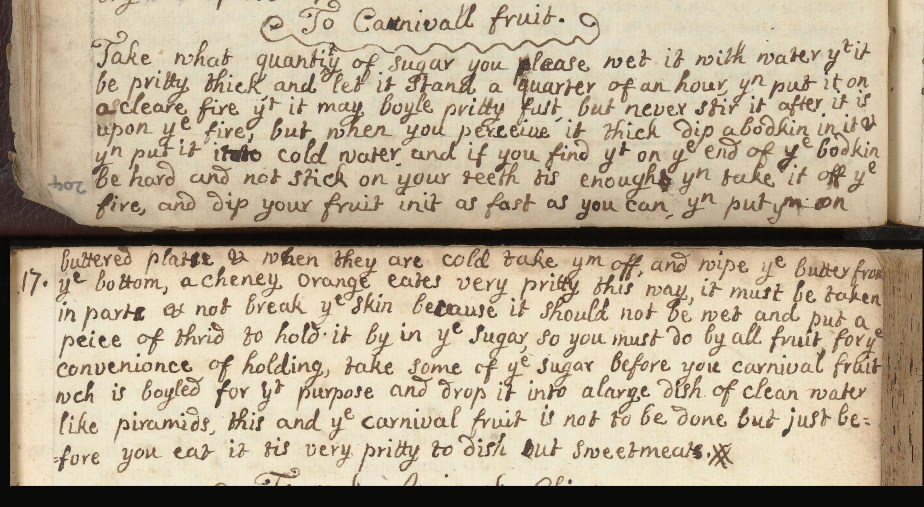
Carnival Fruit 1650-1750, MS8097, Wellcome Collection

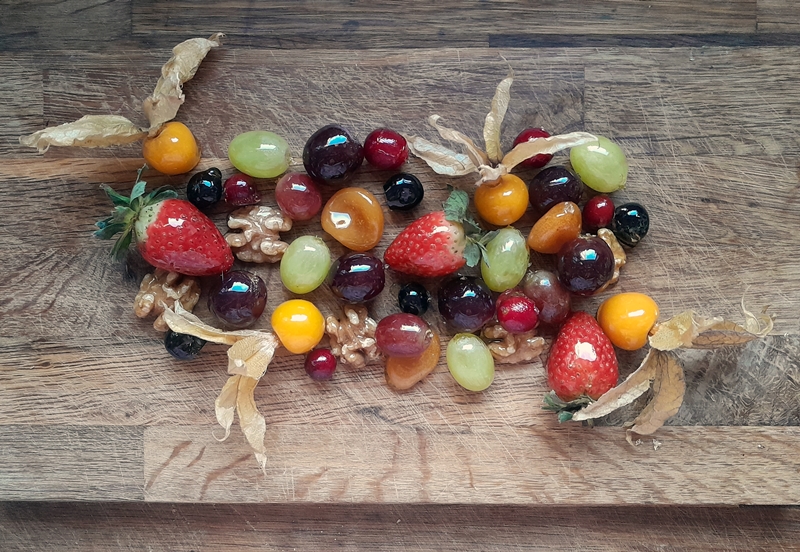
The method used to ‘carnival’ fruit is to dip it into a clear caramel. Although I have used several different fruits in the top image, the fruit recommended in the recipe is ‘a Cheney Orange’ (China Orange), aka an eating orange (as opposed to a Seville bitter orange). Since oranges are in season during the winter months, I believe this is perfect dish to serve up during the festive season. Nowadays we have the luxury of fruit out of season, which can make for a very colourful display, however, some fruit are more suited than others. Very moist, juicy fruit such as strawberries and cherries (not pictured) will only last 2 hours before the shiny caramel coating starts to break down. Other fresh fruits such as grapes, physalis, blueberries, nuts and even dried fruit such as apricots will last 3 hours before starting to become sticky. Whilst you can do orange segments, I feel that against the scale of the other fruit, they’re a bit big, and that small orange segments (satsuma, mandarin, clementine and the like) would be more suitable.

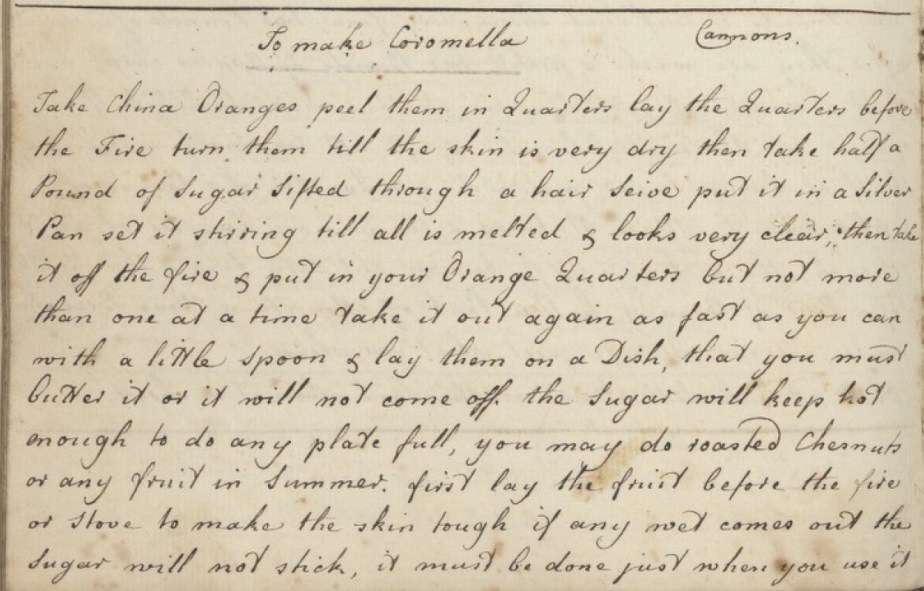
A similar recipe in a slightly later manuscript, ‘Coromella’ 1805-1860, MS2203, Wellcome Collection

I have changed very little in this recipe: I’ve added some weights and measures, to help with getting the sugar to the correct stage and added a little liquid glucose to keep the caramel from crystallizing. I tried several times to go ‘old school’ with just sugar and water, but the caramel always crystallized too quickly to get more than just a few pieces dipped. Perhaps they used honey to help them out back then?

When choosing your fruits and nuts, it is important to consider how they are going to taste with the caramel. If you have a sweet tooth, then it gives you free rein to pick and choose almost anything. Personally, I would recommend choosing fruit that is slightly sharp, just to prevent an overload of sugar. The fruit also needs to be dry, so this rules out any fruit so large it needs to be sliced.

Choose your favourites from: green/red/black grapes, cherries, strawberries, raspberries, strings of redcurrants, blueberries, blackberries, physalis, dried apricots, walnuts, hazelnuts, pecans, almonds. If you have the patience to put individual pomegranate seeds on cocktail sticks and dip them, I think they would be delightful in both appearance and flavour.

The greatest amount of time for this recipe will involve preparing the fruits and nuts.

  • You can utilise the stalks on cherries and redcurrants, the papery coverings on physalis and the green stalks on strawberries to hold as you dip them in the caramel.
  • Most other fruits and nuts can be pierced with a wooden cocktail stick to prevent getting boiling caramel on your fingertips.
  • The recipe recommends using a thread to dip orange segments, and I must confess to not having tried this method. I opted instead to use the cocktail stick. If you can pierce the skin and avoid bursting any of the juice sacs inside, you’re onto a real winner.

To Carnival Fruit

For the caramel

400g granulated sugar
125ml water
60ml/4tbs/¼ cup glucose.

a selection of fresh fruits, berries and nuts

wooden cocktail sticks for dipping

a silicone mat or baking parchment

a sugar thermometer

  • Put the sugars and water into a small saucepan and set aside to begin dissolving while you prepare the fruit for dipping.
  • Use the wooden cocktail sticks to skewer the fruit and lay them neatly on a board or plate. If you’re using small orange segments, remove all the white pith. If you accidentally tear the skin of a segment, eat it – the juice will compromise the caramel.
  • Line a baking sheet with the silicone mat or baking parchment. This is for laying the dipped fruits on to cool. Although the dipping is straightforward, you will need to work fairly briskly in order to get all the fruit dipped before the caramel cools. If you can keep the pan on a very low heat while you dip your fruit, then this won’t be much of a problem. However, the heat will continue to cook the caramel, and it will become darker the longer it remains on the heat.
  • Arrange the prepared fruit and baking sheet so that they are easily to hand when the caramel is ready.
  • Heat the pan with the sugars in over a low heat until the granulated sugar has dissolved.
  • Increase the heat and cook until the syrup registers 150°C on a sugar thermometer. The syrup will be bubbling vigorously over the whole surface of the liquid.
  • Remove from the heat (or turn the heat down to the minimum, your choice), and begin dipping your fruits and nuts.
  • Tilt the pan so that the syrup is deep, and then one at a time, dip your fruit fully into the caramel and set on the silicone mat/parchment to cool. For fruit not on wooden sticks, be sure to keep your fingers well away from the caramel when dipping, as the caramel will burn, and stick to your skin and continue to burn, if it comes into contact.
  • The caramel needs only a minute or two to set, and then all that remains is to arrange it on your serving dish and serve. I went for a wooden board, as it’s plainness and natural material made for a great contrast against all the brightly coloured, shiny carnival fruit. To remove the wooden sticks, roll them between your thumb and forefinger – this will provide enough pressure to break the caramel surrounding them, thus making it easy to remove them.

Dairy-Free Cream

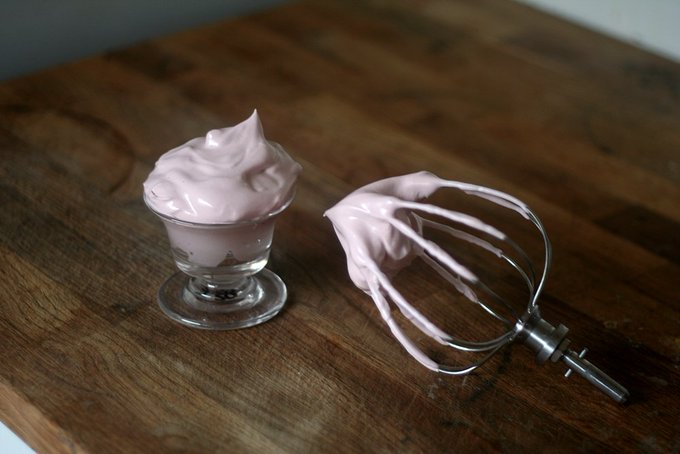
Here is very useful recipe for those looking to avoid dairy products or even to just reduce the amount of fat in their diet. By whisking together some smooth jam and a couple of egg-whites, a deliciously light and frothy ‘cream’ can be created, for use as a finishing touch to trifles, puddings and pastries, or to enjoy by itself. The cream will be influenced by whatever flavour of jam you choose to use, but it doesn’t dominate at all. The above was made using seedless raspberry jam, and the subtlty of colour reflects the subtlty of flavour – a mere whisper on the palate. For an almost white ‘cream’ with a very faint flavour (if that suits your needs best), I can recommend making and using Christine Ferber’s Green Apple Jelly.

It is a surprisingly elegant solution for anyone with dietary restrictions, and dates from the cusp of the 17th and 18th centuries (circa 1700).

This particular recipe I found in a manuscript held by the Wellcome Collection in London, but I have also read variations in other manuscripts and locations. I am surprised tht it has fallen out of favour, for it is one of the simplest and easiest recipes I have adapted.

Well, I say adapted. In fact I have changed very little from the original instructions.

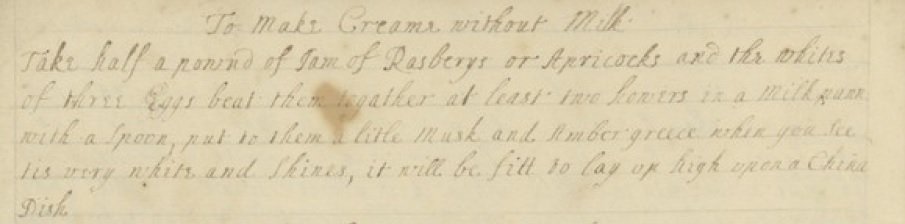
To Make Cream Without Milk, MS1804, dated circa 1700, Wellcome Collection.

The one detail I did change was to reduce the number of egg-whites from three to two, reasoning that the eggs we have nowadays are much larger than those of three hundred years ago.

Thanks to modern technology, we are also spared the two hours of hand whisking (with a spoon of all things!) required in order to achieve the light and fluffy outcome pictured above, and can achieve the same result with about 10 minutes of whisking with your kitchen gadget of choice.

The potential worry regarding the consumption of raw egg whites is eliminated by the convenience of being able to purchase pasteurised egg whites in a carton.

The finished whip will hold its shape for several hours, should the need arise, allowing you to prepare this well in advance of your entertaining needs. I decided to leave the whipped ‘cream’ out, to test it’s durability, and can confirm that after 5 hours, it was still (mostly) holding its shape, as can be seen below.

Dairy Free Cream after five hours

Furthermore, this recipe is customisable in that you can vary the flavour of the whip by using different jams/jellies. For the smoothest result, they should be clear and set. Alternately, you could make your own by gently warming and sieving the jam to remove the fruit pieces in the conserve or jam flavour that you require. Apple, apricot, redcurrant, cranberry, blueberry, blackcurrant, plum, damson, marmalade…the possibilities are endless!

Dairy-Free Cream

You can easily halve the recipe at first, to make a trial batch to see if you like it. However, this might be too small an amount for a stand mixer to get to grips with, so use a hand-held whisk instead.

2 large egg whites (80ml)
225g seedless raspberry jam (or smooth jam/jelly of choice)

  • Put both ingredients into a bowl and whisk using a mixer, for about 10 minutes, until the mixture is thick and glossy and holds its shape.

Chestnut Apple Pie

Lady Grisel Baillie was a Scottish noblewoman who lived in the 17th/18th century. She was married to a Scottish MP, and became known to social historians for the meticulously detailed account books she kept, which  offer a glimpse into the cost of living during that time, including food and drink, servants wages, travel costs and entertainment. Lady Grisel was also something of a foodie, as she noted down many a menu from various dinners she and her husband attended.

Extracts of Lady Grisel’s household books were published by the Scottish Historical Society in 1911 and over the years I have dipped into this book many times, and have been somewhat frustrated that menus are recorded, but not recipes. She definitely had a recipe book, because the Scottish Historical Society lists it amongst her papers:

“Lady Grisell left three ‘Day Books’ folio size, the first running from 1692 to 1718 inclusive, and containing 442 pages ; the second from 1719 to 1742 inclusive, and containing 354 pages, and the third from 1742 to the date of her death (6th December 1746), continued by her daughter, Lady Murray. She also left books containing the accounts of expenses in connection with their journeys to Bath and to the Continent ; Books containing Inventories of Bottles, etc. ; a Book of Receipts ; a Book of Bills of Fare ; Books relating to estate management during the years 1742, 1743 and 1744, and many other Account and Memoranda Books.”

A few years ago, I revisited a manuscript at the Folger Library to study a recipe for Stilton Cheese that had caught my eye, (the results of which can be found in Petits Propos Culinaires 114, June 2019), and in the course of my research, discovered that the manuscript in which it appeared was the long-lost recipe book of Lady Grisel Baillie! The manuscript had been purchased by the Folger Library in June, 1959 from the London bookseller Francis Edwards, Ltd. for the princely sum of £35.00. More intriguing is what happened to it during the preceding 48 years, from 1911, when its existence was noted by the Scottish Historical Society, and its purchase and trans-Atlantic voyage in 1959, and why the current Mellerstain estate owners didn’t know where it was. Very mysterious!

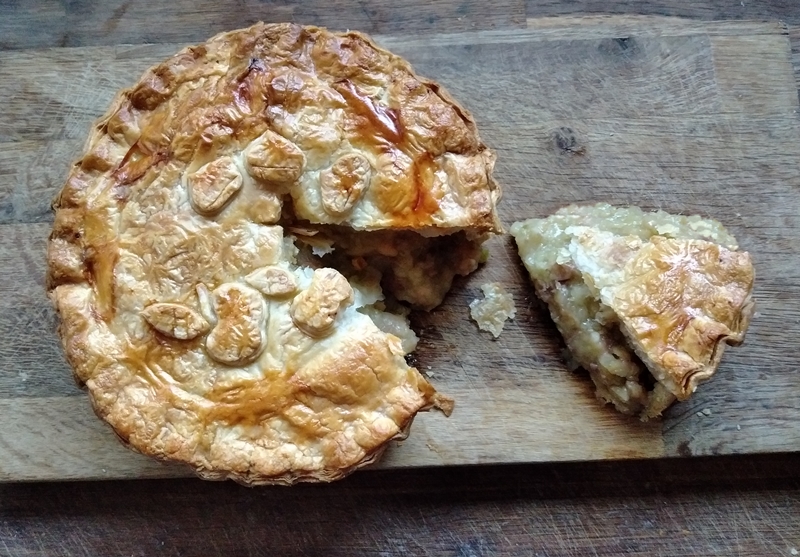
The point of this extended preamble is that this recipe comes from that self-same, long-lost recipe book. It has been on my radar for a while, because it is a sweet pie with chestnuts, and when I spotted nets of fresh chestnuts in the shops this week, I was enthused to have a stab at it.

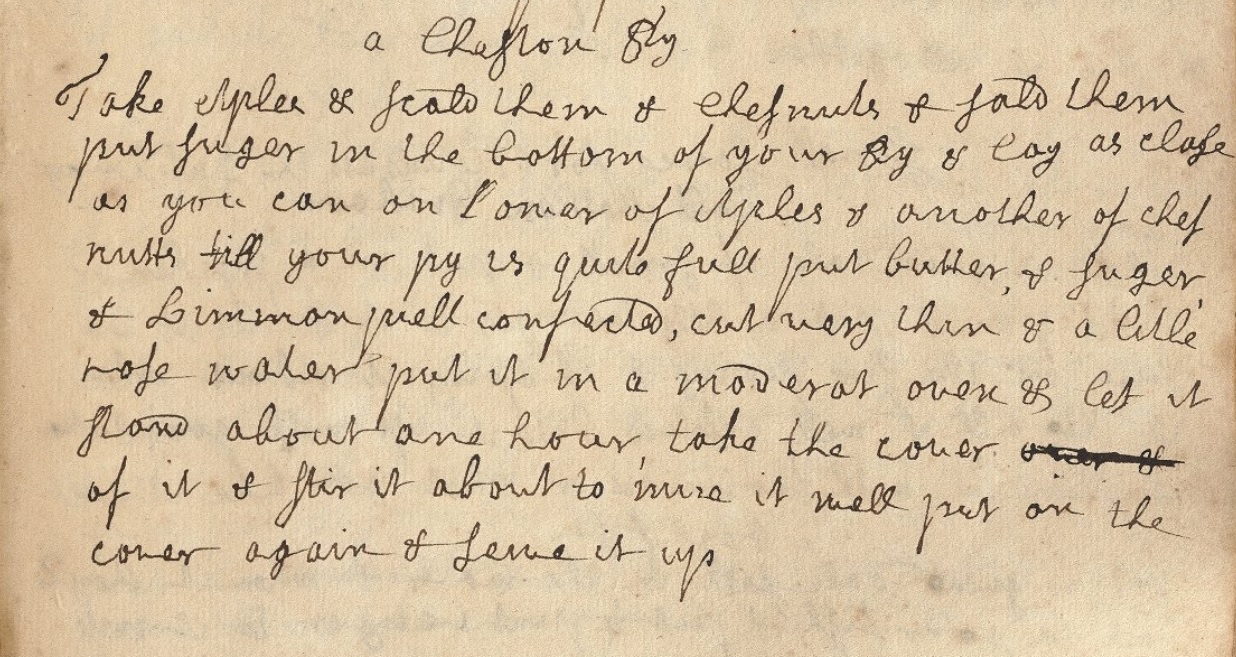
A Cheston Pye, from the cookbook of Lady Grisel Baillie, Folger Digital Image Collection, Ms W.a.111, p289, circa 1706.

Which also brings me to the word of the day: scald. Both apples and chestnuts are scalded in this recipe, and after much hunting about reading other usages, the best definition I can come up with is: cooked gently in their skins. When scalded, the apple skin will peel off by itself freely, leaving the partially cooked flesh intact. I suspect this was done to prevent wastage, preserve flavour and minimise juice. Similarly, the chestnuts are scalded in order to soften them and to loosen both the skin and the pith surrounding the nut. This all sounds simple, but, from experience, left unsupervised, things can get a little tricky. It doesn’t take much for the water in which the apples are scalding to become too hot, thereby causing the apples to burst, and then you have to retrieve your apple pulp from the ‘soup’ in the saucepan. Scald the chestnuts for too long, and then you will have difficulty extracting them whole. This isn’t too much of a disaster, as the crumbled pieces are perfect for this dish, but if you were wanting them for another use – candying, for example – the wastage in broken nuts can get quite high.

Why you should make this pie

Well, it’s absolutely delicious, that’s why! It’s unusual, in that it is a sweet pie with chestnuts, and thus something of a novelty in modern recipes. During the long, slow baking, the pastry crisps up beautifully, and the chestnuts and candied lemon soak up some of the apple juice and become soft. The texture of the apples and the chestnuts is much more interesting that a regular apple pie and the contrast between the filling and the two different types of pastry is a delight. This pie embodies autumn in a deliciously comforting way, you’ll be elbowing your way back to the nets of chestnuts to make it again. Perfect for the upcoming holiday season!

Sliced of Chestnut Apple Pie
Slices of Chestnut Apple Pie: The pie slices very neatly when cold, and the chestnuts and candied lemon peel are shown.

Chestnut and Apple Pie

These quantities are for a 20cm diameter pie. You can obviously use as many or as few chestnuts as you like. You can, of course, shorten the prep time by using stewed apple and ready-cooked chestnuts. The only caveat to this I would add is that the ready-cooked chestnuts you can buy tend to be a little dark, whereas if you scald them yourself, they come out very similar in colour to the apple pulp.

If you’re making this from scratch, prepare the apples and chestnuts a day or so ahead, and then assemble the pie when required. The cooked apples and chestnuts will keep in the fridge several days.

Filling
4 Bramley Apples (or 600g unsweetened stewed apple)
1 x 400g net of raw chestnuts (or 300g cooked chestnuts)
30g candied lemon peel
30g unsalted butter
3-4tbs caster sugar
3tbs cornflour
zest of 1/2 a lemon (optional)

1 x box of ready rolled puff pastry
egg-white for glazing

Base Pastry
225g plain flour
60g cornflour
140g unsalted butter
ice cold water

  • Put the flours and butter into the bowl of a food processor and blitz until the mixture resembles breadcrumbs.
  • With the machine running, gradually add the cold water a tablespoon at a time until the mixture comes together in a ball.
  • Tip the mixture onto a floured surface, knead smooth.
  • Roll out the pastry to the desired thickness (5mm) and line a greased, 20cm pie tin. Ease the pastry into the corners of the tin, rather than stretch it, and allow the excess to hang over the edges of the tin.
  • Place in the fridge to chill until required.

To scald the apples

  • Put the apples, whole, into a saucepan and add just enough water to cover.
  • Lay a saucer upside-down on top of the apples, to keep them submerged.
  • Put the saucepan on a gentle heat (I use 5 on a 1-9 scale) and allow the apples to barely simmer for 30 minutes. Keep an eye on them, and if the skin starts to split, remove from the heat and the water immediately.
  • Lift the scalded apples out of the pan and set aside to cool.
  • When cool enough to handle, peel away the skin and then scoop all the flesh from the core.
  • Mash the apple pulp with a fork. You don’t need to make it puree-smooth, just get rid of the larger lumps.
  • Mix the sugar and cornflour together and then add to the apple pulp and mix thoroughly.
  • Taste the apple pulp and add more sugar to taste.
  • Set the apple pulp aside until required.

To scald the chestnuts

  • Using a sharp knife, cut a slit ito each nut, being sure to pierce bith the hard outer shell and the soft skin underneath.
  • Put the nuts into a saucepan and cover with cold water.
  • Set pan on a gentle heat, and simmer the chestnuts for 30 minutes.
  • Remove from the heat and allow to cool in the water.
  • Remove the chestnuts one at a time and peel away the softened shell and skin. Don’t worry if the nut doesn’t come out whole, as pieces are perfect for this recipe. Don’t drain the chestnuts, because the shells will harden quickly once out of the water, and make peeling them difficult.
  • Crumble the chestnuts into pieces – not too small – and store in a covered container in the fridge until required.

To assemble the pie.

  • Heat the oven to 180°C, 160°C Fan.
  • Slice the candied lemon peel into thin slivers. If you don’t have whole pieces, diced is fine, just make sure they’re not too big.
  • Divide the butter into three. Keep chilled until required.
  • Remove the pie tin from the fridge and trim the excess pastry. Leave about a 2cm overhang from the edge of the tin.
  • Fill the pie
    • Add a layer of apple pulp.
    • Add half the chestnuts in a layer
    • Add half the lemon peel
    • Dot over 1 portion of the butter in thin slices.
    • Add a layer of apple pulp.
    • Add half the chestnuts in a layer
    • Add half the lemon peel
    • Dot over 1 portion of the butter in thin slices.
    • Add a layer of apple pulp.
    • Dot over the last portion of the butter in thin slices.
    • Grate over the zest of half a lemon (optional). I like the lemony zing, but it can be omitted if you prefer.
  • Unroll the puff pastry and smooth out with a few strokes of the rolling pin.
  • Wet the edges of the shortcrust pastry with water.
  • Lay the puff pastry over the top of the pie and press the edges together gently.
  • Trim the puff pastry to the size of the shortcrust pastry.
  • Crimp the pastry edges as shown in the top photograph.
  • Cut out decorations for the top of the pie from the puff pastry offcuts and lay them on the pastry lid. I did a few apples and chestnuts.
  • Brush the top of the pie with eggwhite.
  • Bake the pie for 60 minutes. Turn the pie around after 30 minutes to ensure even colouring.
  • After a further 20 minutes, if your puff pastry isn’t quite cooked through, turn the heat up to 220°C, 200°C Fan for the last 10 minutes.
  • Remove the pie from the oven and cool on a wire rack for 10 minutes.
  • Remove the pie from the tin and allow to cool until just warm.
  • Serve with double cream.

Buttered Oranges

For the past several years I have been making a searchable index of the digitised household books held at The Wellcome Library. In doing so, I’ve read over 300 manuscripts and logged more than 32,000 food and drink recipes and have a ‘To Do list of interesting recipes as long as my arm.

‘Buttering’ was exceedingly popular in times past, and was applied to numerous dishes: crab, chickens, rolls, loaves, turnips, rice, salmon… For the most part, this consists of a healthy slathering of butter over the dish in question. Buttered Oranges, however, stands apart, since it’s not a pairing that seems obvious. So it was that this year, in the midst of a Seville orange flurry of kitchen activity, I grabbed a net of sweet oranges and determined that Buttered Oranges would be promoted to the top of the To Do list with immediate effect.

Buttered Orange recipe
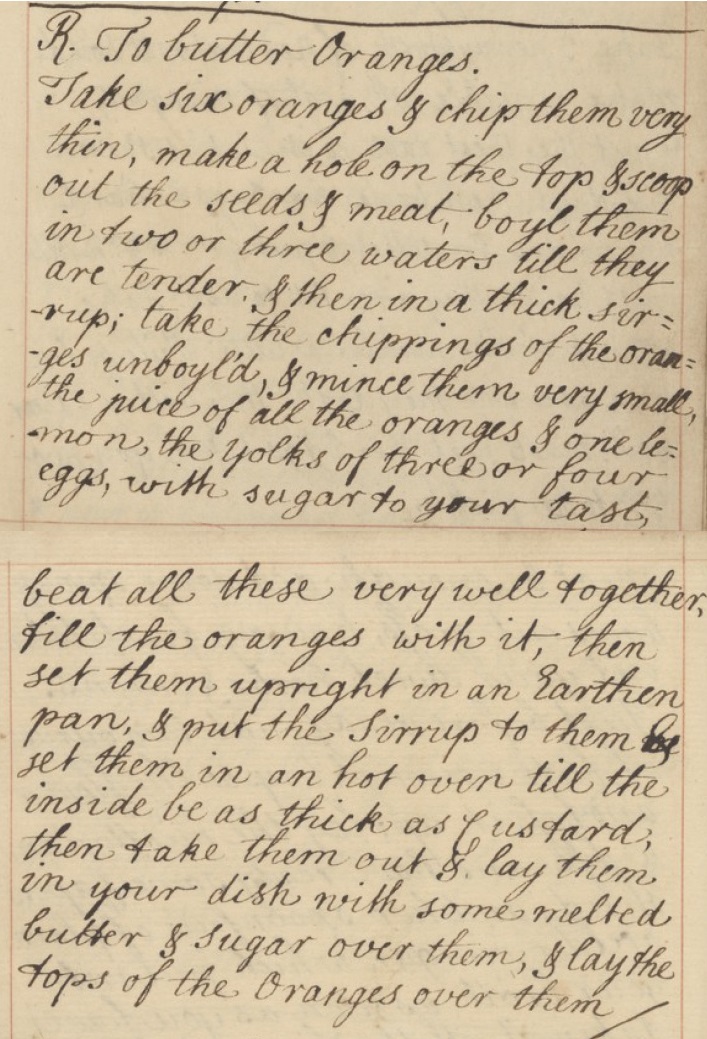
Buttered Orange recipe, circa 1750, MS1357, Wellcome Library Collection

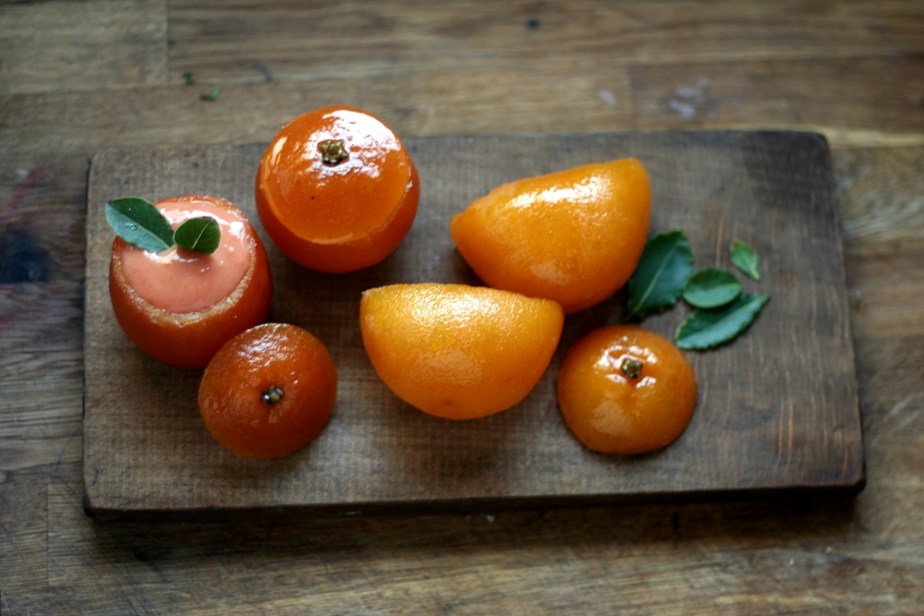
I re-read all of the recipes from the collection that I could find, and they were all pretty similar. I selected this one because of the novel presentation suggestion, which is to serve the buttered oranges in candied orange peels. Completely optional, of course, but it does make for an eye-catching dessert.

Which hopefully makes up for what might possibly be a bit of a let-down, because it turns out that Buttered Oranges is pretty much what we today would call a fruit curd: juice and zest, sweetened and thickened with eggs with a generous, but not excessive, quantity of butter melted in.

After experimentation, I found the best way to present this dessert was to make each element separately and then assemble before serving. I felt the original recipe’s instruction to bake the filled oranges until set was a little too risky and prone to mishap to risk all the preparation, but don’t let that deter you from trying it for yourself – I would just advise against a spur of the moment decision during an important social occasion.

Preparing the peels

I chose blood oranges to serve the curd in, as they were a beautiful colour and relatively small, thus being perfect for serving elegant portions of this rich dessert.

1 orange per person
1kg caster sugar
1 litre water

Before you start, you should make a decision on how you will be preparing the peels. The original recipe says to zest the oranges, slice off the top, hollow out the flesh, then simmer in water until tender, then finish in syrup. This gives the skins a pale, almost pastel colouring, which is delightful, and means the whole of the orange is put to good use but also makes them rather fragile during the cooking. One solution would be to tie them lightly in muslin or cheesecloth, to protect them, or alternately, use un-zested oranges, which will have a darker colour, but are also much more robust and less likely to split during the cooking. The results of both are illustrated in the photograph at the top, the zested peels on the right, the un-zested on the left. If you choose to use un-zested oranges, then you will need twice as many oranges overall.

  • If you’re zesting the oranges, do that now and reserve the zest for later.
  • Slice a lid off the top of each orange, and scoop out the insides using a combination of sharp knife and teaspoon. Reserve the flesh and juice for later.
  • Make sure there’s no orange flesh or fibres left inside.
  • Place the hollowed oranges and their lids into a saucepan of cold water, making sure the water fills the cavities.
  • Slowly bring the water to a boil, then turn the heat down and simmer until tender. This will take about 1.5-2 hours.
  • Change the water and scrub the pan every 30 minutes to remove the bitter oil.
  • When the peels are tender enough to be pierced by a toothpick, make a syrup by dissolving the sugar in the water over a low heat.
  • Add the peels and allow to simmer gently until the peel appears translucent.
  • Remove from the heat. The peels can remain in the syrup until required.

Buttered Oranges

As already mentioned, this is a variation of Orange Curd, so if you already have a favourite recipe, then by all means use that instead.

2 large eggs
the zest and juice from at least 4 oranges
the juice of 1 lemon
Sugar to taste
50g unsalted butter

  • Add the strained juices and zest to the eggs and whisk thoroughly.
  • Add the butter and whisk over a gentle heat until thickened.
  • Add sugar to taste.
  • To serve, you can either pour the curd into your oranges warm, or fill them and allow them to cool before serving.
  • I recommend serving some kind of biscuit or shortbread alongside to dip!

Oatmeal Pancakes


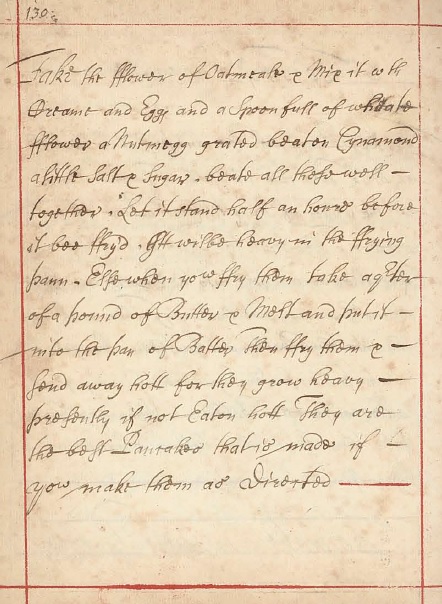
This recipe comes from the manuscript of Jane Newton dated circa 1675-1700. I like Jane’s manuscript a lot – she has ruled out the pages with red margins, still bright after more than 300 years, and stamps her character on them with occasional personal comments that are a pleasure to find. The one that always sticks in my mind is her snappily titled “To Make the Puffs I was Speaking of Before in my Pottage”.

Oatmeal Pancake Recipe
Oatmeal Pancake Recipe from Jane Newton’s manuscript, 1675-c1700, MS1325, Wellcome Collection

I chose this recipe this week because tomorrow is Shrove Tuesday and someone out there might fancy something different to the regular lemon & sugar pancakes. (Ratafia Pancakes are another option). Also, Jane’s comment at the bottom of this recipe: “They are the best pancakes that is made if you make them as directed” – quite the gauntlet you’re throwing down there, Jane! I’d have initially made it as written anyways, but now I’m feeling Jane’s beady eye on me. No pressure.

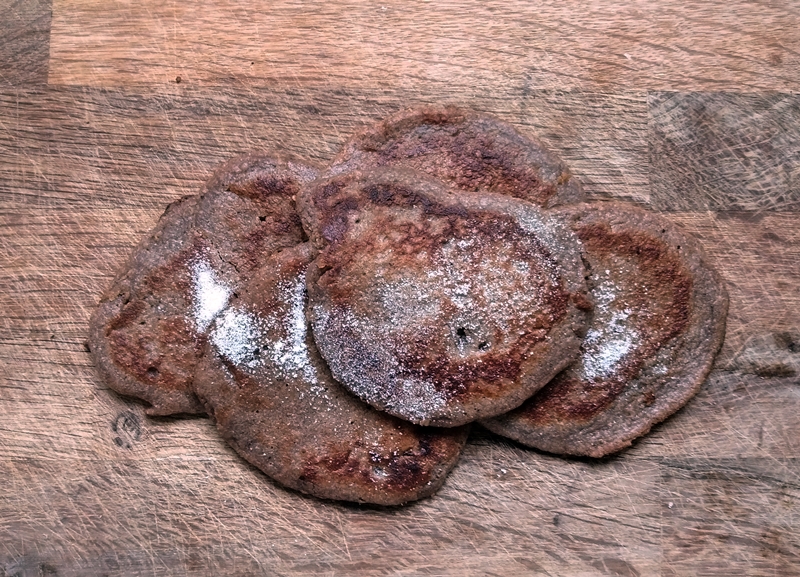
Long story short – she’s right. They might look fairly ordinary, but they are the first pancakes that I’ve tasted that I could eat with no further adornment. Yes, I know the picture shows them dusted with sugar – I added it for photographic purposes only. The batter is sweetened and spiced, and, as all good recipes using oatmeal, lightly salted which kicks in at the end of each mouthful as a delightful contrast.

Oatmeal Pancakes

60g medium oatmeal flour
150ml single cream
1 large egg
1 large yolk
1tbs plain flour
1tsp ground nutmeg
1tsp ground cinnamon
½ tsp salt
2tbs caster sugar
30g unsalted butter – melted

  • Mix all the ingredients, except the butter, thoroughly and allow to stand for 30 minutes.
  • Stir through the melted butter until combined.
  • Melt some butter in a non-stick pan on medium heat. Add spoonfulls of the batter into the pan, you can cook 3 at a time.
  • Turn the pancakes when the undersides have browned.
  • Remove cooked pancakes to a sheet of kitchen roll.
  • Enjoy warm as is (it really is the best way) or with your favourite toppings.


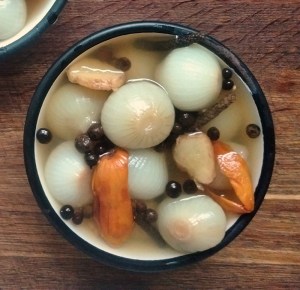
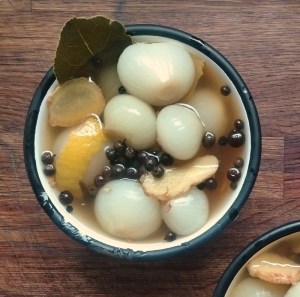
Pickled Onions

I do love a pickled onion, and not having had any for a while, decided to put to the test some of the old recipes from the Wellcome Insitute Library archives. The methods are a little different from modern recipes and I was curious to see the differences made to the final product, if any.

Some of the pickled onion recipes were too involved for my purposes (and lack of patience), with the brining going on for almost a week before any actual pickling was done. I chose these two recipes because they were both immediate and do-able in a morning, and I liked that they had slightly different aromatics as well as methods.

A lot of pickling recipes take weeks to mature, and originally I hadn’t planned to post these recipes for quite a while. However, after a taste test this morning, the results were so delicious after just 24 hours, here we are.

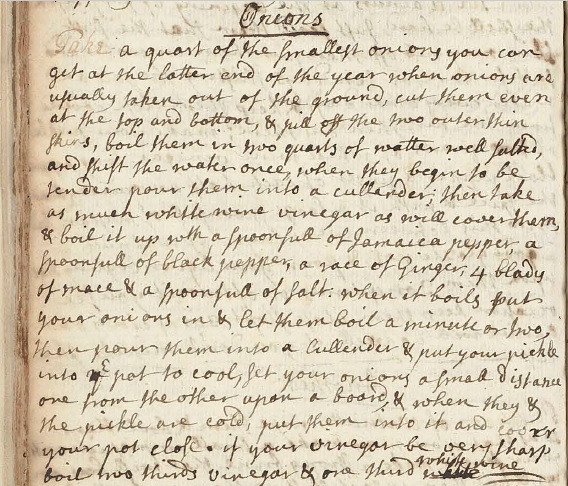
Pickled Onion manuscript recipe 1

This is the recipe from a manuscript (MS751) that belonged to one Elizabeth Sleigh, with later additions by a Mrs Felicia Whitfield. The manuscript has been dated to from the middle of the seventeenth century (1647) to the early 18th century (1722). The method involves blanching the peeled onions briefly in two changes of salted water, simmering the pickle with some aromatics and combining the two when both are cold.

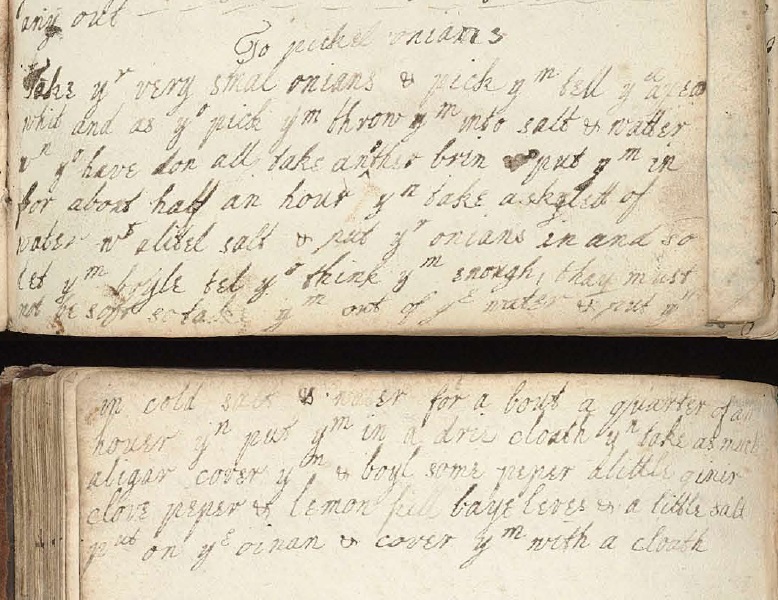
This recipe is from MS2323, originally owned by Amy Eyton and subsequenty by Mary Eyton and possibly even Mrs Sarah Justice. With a similar date (1691-1738), it is interesting how closely the recipes resemble one another in terms of method. This later recipe calls for initially soaking the peeled onions in two lots of brine, blanching in brine and then cooling in cold brine, and drying. The vinegar and aromatics are simmered for a while, then poured over the onions.

The results for both are deliciously similar: the onions have crunch and tang from the vinegar, but none of the harshness of raw onion nor eye-squinting ‘burn’ that accompanies the use of malt vinegar. The aromatics give subtle flavouring to the vinegar, which I suspect might intensify as time passes. As already mentioned, and by far the best part of this whole experiment, is they can be consumed almost immediately.

Elizabeth Sleigh’s Pickled Onions

1647-1722

I didn’t think I had any black peppercorns, so I used long peppercorns that were in the cupboard.

500-750g small/pickling/baby onions
9tbs table salt (divided)
800ml white wine vinegar
1tbs allspice berries
1tbs black peppercorns
1 thumb-sized piece of fresh ginger
4 blades of mace

clean jar(s)

  • Make a brine with 2 litres of cold water and 4tbs salt.
  • Cut the tops and bottoms off the onions and peel off the brown skin
  • Bring the brine to the boil and drop in the peeled onions and cook for two minutes. Drain.
  • Mix a fresh batch of brine (2 litres water, 4tbs salt).
  • Bring the fresh brine to the boil and drop in the onions and cook for another two minutes. Drain.
  • Cut the ginger into thin slices.
  • Add the aromatics and salt to the vinegar and bring to a boil. Turn the heat down to a simmer for 5 minutes.
  • Add the blanched onions and cook for 2 minutes
  • Turn off the heat and use a slotted spoon to remove the onions from the vinegar and set to cool on a baking tray or wire rack. Return any of the flavourings to the pickle.
  • Cover the vinegar pan and allow to cool.
  • When both onions and vinegar are cold, transfer them to your jar(s) and cover. If you’re using more than one jar, make sure the aromatics are divided equally amongst them.
  • Wait 24 hours, then enjoy.

Amy Eyton’s Pickled Onions

1691-1738

This recipe called for alegar – vinegar made from ale – of which I obviously have none, so I used half cider vinegar, half white wine vinegar. Use whatever light vinegar combination you like/have. Oh, and I found the black peppercorns.

500-750g small/pickling/baby onions
15tbs table salt (divided)
400ml white wine vinegar
400ml cider vinegar
1tbs allspice berries
1tsp whole cloves
1tbs black peppercorns
1 thumb-sized piece of fresh ginger
the zest of a lemon, cut in strips
4 bayleaves

clean jar(s)

  • Make a brine with 2 litres of cold water and 4tbs salt.
  • Cut the tops and bottoms off the onions and peel off the brown skin. Drop the peeled onions into the brine.
  • Mix a fresh batch of brine (2 litres water, 4tbs salt).
  • Drain the onions, then add them to the fresh brine for 30 minutes.
  • Make a third brine (2 litres water, 2tbs salt) and bring to the boil.
  • Drain the onions, then add them to the simmering brine for 3 minutes.
  • Mix 2 litres of cold water and 4tbs salt.
  • Drain the onions and drop them into the cold brine for 15  minutes
  • Add the aromatics and 1tbs salt to the vinegars and bring to a boil. Turn the heat down to a simmer for 5 minutes.
  • Drain the onions from the brine and dry with a clean cloth. Put the onions in your jar(s).
  • Turn off the heat under the pickle and allow to cool for five minutes,
  • Pour the pickle over your onions and seal. If you’re using more than one jar, make sure the aromatics are divided equally amongst them.
  • Wait 24 hours, then enjoy.

Fruit Puffs

This recipe appears in the 17th century manuscript book of Lady Anne Fanshawe (MS.7113 at the Wellcome Collection), and is attributed to Lady Scarborough. What might appear, from the name, at first to be something pastry-based, is in fact a form of meringue.

Unsweetened fruit (I used apples) pulp is mixed with sugar and eggwhites and whisked until stiff and white. The recipe calls for this to be dropped in spoonfuls onto glass and dried in the oven, although I made adaptations for the modern kitchen. After a couple of practice runs, the result is, to all intents and purposes, an apple-flavoured meringue. Not as sweet as regular meringues, with the pleasantly tart flavour of sharp apples.

It is from the same recipe family as Apple Snow, with a slight alteration in porportions and a spell in the oven, and to my mind would be delightful served alongside that ethereal confection.

The main challenge with this recipe was the missing details. Apple and sugar quantities are given, but the instruction to beat them ‘with white of egg’ is open to interpretation. Additionally, “dry it in a stove” is hardly suffering from an over-abundance of detail. Hence the trial runs.

One of the batches I made whilst juggling baking times and temperatures turned a light caramel colour, which I suspect is not how the finished puffs should look, but proved to be absolutely delicious – crisp, delicate with a whisper of toffee apple. I’m counting that particular error as a win!

Apple and Caramel Apple Puffs

Fruit Puffs

Although I have only used apple here, the recipe does state that any fruit pulp can be used. My advice would be to choose pulp that has some bulk to it. Berries might prove too moist. Stone fruit, rhubarb and gooseberries would all be suitable, especially if tart, as the sugar content is quite high, and it would ‘cut through’ it nicely.

340g cooked cooking apples
225g caster sugar
2 large egg-whites (about 80g)

  • Puree the apple smooth with a stick blender. Sieve the puree if liked (I didn’t, but I was very thorough with the blender).
  • Add the remaining ingredients and whisk until light, white and stiff. I used a stand mixer on High and this took 10 minutes.
  • Heat the oven to 100°C, 80°C Fan. This temperature will be for the white puffs, for caramel puffs, increase the temperature to 140°C, 120°C Fan after 2 hours.
  • Add a decorative nozzle to a piping bag and spoon in some of the mixture. Pipe the mixture onto a baking sheet lined with parchment. There will be some shrinkage as the puffs dry out, so pipe them on the large side. For example, the white puffs in the top photo were 5cm tall when first piped. When dried, they are about 3cm tall.
  • Dry in the oven for 5-6 hours, depending on the size and how moist they are. Prop the oven door ajar by inserting the handle of a wooden spoon, for the first hour or so, to help dispel the moisture, (otherwise it stays trapped in the oven and slows down drying time).
  • After about 4 hours, remove the baking sheet from the oven and allow to cool for 5 minutes. The puffs should be firm enough by this stage to gently peel off from the parchment. Turn the puffs upside down and lay them back on the parchment, so that the bases can dry (about an hour). If you don’t let the puffs cool down first, you will squish them as you try to remove them from the paper. If the puffs aren’t firm even when cooled down, put them back in the oven for another 30 minutes and try again.
  • For Caramel Puffs, bake as above for 2 hours, then increase the heat to 140°C, 120°C Fan and bake for 1 hour. Check the colour/dryness and bake a little longer if still sticky.
  • Once the puffs are dried to your liking, store them in an airtight container. They will absorb moisture and become sticky if left in the open air for any length of time.

Ratafia Pancakes

Pancakes have been the traditional pre-Lenten meal for centuries. Pancake Day is preceded by Collop Monday, when the last  of the bacon and ham was fried up for the evening meal, usually with some eggs. The fat in the pan was then retained for frying the pancakes on Shrove Tuesday.

There are almost as many pancake tradition as there are households. In my childhood, we had sugar and lemon juice on our rolled pancakes, which I just assumed was the one and only way to serve them. Only when I went away to college did I learn about jam, syrup, honey, treacle also being options, puffy American pancakes with syrup AND bacon, and in more recent years Scandinavian æbleskivers and Dutch poffertjes.

Ratafia Pancakes, MS.2767 c1750-1825, Wellcome Collection

This recipe comes from a Georgian manuscript recipe book, and is a charming twist on regular thin pancakes. Filled with a spiced custard and glazed with egg-white and sugar, they are then baked in the oven until crisp. There’s no ratafia flavouring in them, so I’m assuming that the name comes from the crunch of the caramelised sugar and the crisped pancake edges. The combination of warm, spiced custard, crisp pancake and crunchy sugar glaze is delicious. For an adult flavour, you can add a tablespoon of something alcoholic to the custard – cream sherry is probably the closest to the sack that was much in vogue at the time, Madeira, Marsala or Mead are also good choices.

You can use your favourite recipe, or the one below, and if short of time, use ready-made custard, or indeed ready-bought pancakes for that matter. The quantities given below are very modest, enough for four pancakes and filling. Increase the quantities to suit the number of diners you’re serving.

Ratafia Pancakes

For the pancakes
115ml milk
1 large egg
1 large yolk
60g plain flour

Butter for frying

For the custard
250ml milk
2 large yolks
30g cornflour
50g caster sugar
pinch of ground cloves
pinch of ground mace
1/4tsp ground cinnamon
fresh grated nutmeg to taste
1tbs cream sherry/Marsala/Madeira/Mead (optional)

For the glaze
1 large egg white
caster sugar for sprinkling

  • Whisk together the ingredients for the pancake batter.
  • Melt a little butter in a pan and fry ¼ of the batter at a time to make four, thin pancakes. Don’t worry if they’re uneven – the folding/rolling will neaten everything.
  • Set each cooked pancake aside to cool.
  • Whisk together the yolks, sugar, spices and cornflour.
  • Heat the milk in a pan and when almost boiling, pour over the egg mixture, whisking briskly.
  • Return the mixture to the pan and stir over medium heat until thickened.
  • Transfer the mixture to a bowl to cool. Stir in the alcohol, if using.
  • Cover the surface of the custard with plastic film and chill until cold.

To finish

  • Take ¼ of the custard and lay it in a log shape along the bottom edge of a pancake.
  • Fold the left and right sides of the pancake inwards (to contain the custard) and then roll up the pancake, keeping the custard filling well wrapped.
  •  Lay the rolled pancake on a parchment-lined baking sheet, with the free edge of the pancake underneath to keep it from unrolling.
  • Repeat with the remaining pancakes and filling.
  • Heat the oven to 200°C, 180°C Fan.
  • Whisk the egg-white until frothy and brush generously over the rolled pancakes.
  • Sprinkle the caster sugar over the rolled pancakes.
  • Bake the pancakes for 15 minutes to caramelise the sugar and crisp the pancakes. Add an extra 5 minutes more, depending on how brown/crispy your tastes are.
  • Allow to cool for 5 minutes before serving – the custard inside will be very hot.